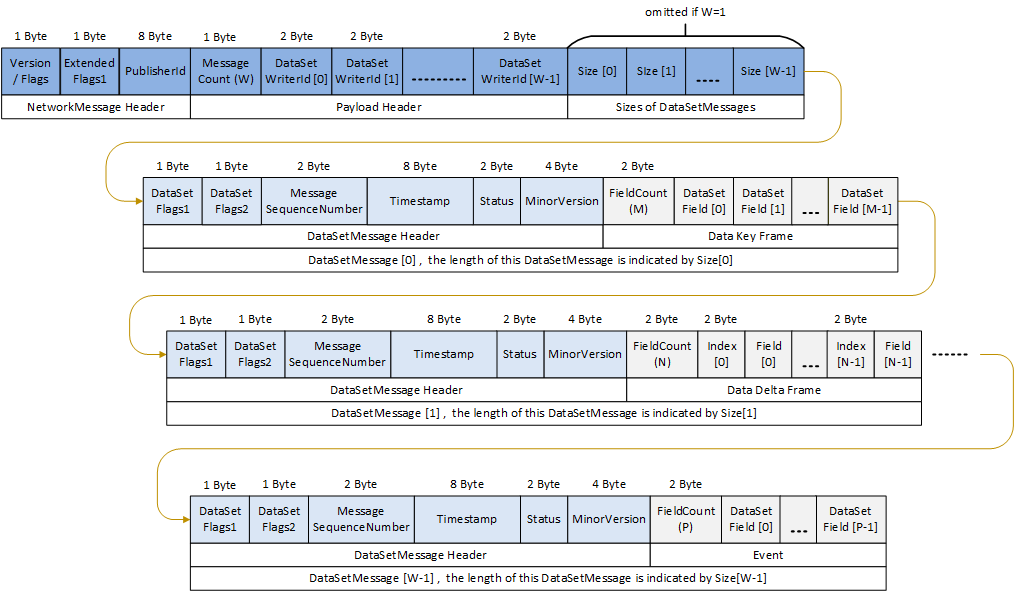
A.2.2 Message headers for Events and Data with dynamic layout
A.2.2.1 Motivation
In PubSub use cases with dynamically changing message layouts or Event based DataSetMessages, the number and ordering of DataSetMessages within different NetworkMessages can change arbitrarily. The header layouts described in this section are intended for use cases with dynamic DataSets and ad-hoc identification of DataSetMessages.
A.2.2.2 Overview
With the header layout described in this section, the NetworkMessage header only identifies the Publisher and the contained DataSetMessages. In contrast to the fixed layout, more header fields are enabled in the DataSetMessage header with this header layout but the GroupHeader is deactivated.
A.2.2.3 Header layout URI
The header layout URI for the dynamic layout as specified in A.2.2.4, A.2.2.5, A.2.2.6 and A.2.2.7 is
A.2.2.4 Header layout for NetworkMessages
A UADP NetworkMessage header shall consist of the following fields according to this header layout:
Version/Flags
ExtendedFlags1
PublisherId
PayloadHeader
Additional restrictions:
The datatype for the PublisherId shall be UInt64
The NetworkMessage header layout is shown in Figure A.7.

Table A.7 shows the configuration for the NetworkMessage header.
| Name | Type | Restrictions |
| UADPVersion | Bit[0-3] | The version shall be 1 |
| UADPFlags | Bit[4-7] | Bit 4: PublisherId enabled = 1 Bit 5: GroupHeader enabled = 0 Bit 6: PayloadHeader enabled = 1 Bit 7: ExtendedFlags1 enabled = 1 |
| ExtendedFlags1 | Byte | Bit range 0-2: PublisherId Type 011 The PublisherId is of DataType UInt64 Bit 3: DataSetClassId enabled = 0 Bit 4: SecurityHeader enabled = 0 Bit 5: Timestamp enabled = 0 Bit 6: PicoSeconds enabled = 0 Bit 7: ExtendedFlags2 enabled = 0 |
| PublisherId | UInt64 | Configured value for the PubSubConnection. The datatype shall be UInt64. |
| PayloadHeader | Byte[*] | Defined by Table 160. |
Table A.8 defines the values for the configuration parameters representing this layout.
| Parameter | Value |
| UadpNetworkMessageContentMask | 0x00000041 This value results of the following options: Bit 0: PublisherId enabled = 1 Bit 6: PayloadHeader enabled = 1 |
When a PubSubConnection is created by using the Method AddConnection() the element PublisherId contained in the argument PubSubConnectionDataType shall be of the DataType UInt64.
A.2.2.5 Header layout for NetworkMessages with integrity (signing)
UADP messages may be signed to ensure integrity. In this case a security header and a signature have to be added to the message. See clause 7.2.4.4.3 for a complete description of the signing mechanism.
This header layout is basically the same as the header layout defined in A.2.2.4 but with additional security level 'Signing but no encryption'. The NetworkMessage header layout with signing is shown in Figure A.8.

Table A.9 shows the configuration for the NetworkMessage header with signing. The table contains only the added or modified rows from Table A.7.
| Name | Type | Restrictions |
| ExtendedFlags1 | Byte | Bit 4: SecurityHeader enabled = 1 |
| SecurityHeader | ||
SecurityFlags | Byte | Bit 0: NetworkMessage Signed enabled = 1 Bit 1: NetworkMessage Encryption enabled = 0 Bit 2: SecurityFooter enabled = 0 Bit 3: Force key reset enabled = 0 Bit range 4-7: Reserved |
SecurityTokenId | IntegerId | The ID of the security token that identifies the security key in a SecurityGroup. |
NonceLength | Byte | The length of the Nonce used to initialize the encryption algorithm. |
MessageNonce | Byte[NonceLength] | A number used exactly once for a given security key. |
A.2.2.6 Header layout for NetworkMessages with integrity and confidentiality (signing and encryption)
UADP messages may be signed and encrypted. In this case the SecurityHeader and the Signature have to be added to the message. See clause 7.2.4.4.3 for a complete description of the security mechanisms.
This header layout is basically the same as the header layout defined in A.2.2.4 but with additional security level 'Signing and encryption'. The NetworkMessage header layout with signing and encryption is shown in Figure A.9.

Table A.10 shows the configuration for the NetworkMessage header with signing and encryption. The table contains only the added or modified rows from Table A.7.
| Name | Type | Restrictions |
| ExtendedFlags1 | Byte | Bit 4: SecurityHeader enabled = 1 |
| SecurityHeader | ||
SecurityFlags | Byte | Bit 0: NetworkMessage Signed enabled = 1 Bit 1: NetworkMessage Encryption enabled = 1 Bit 2: SecurityFooter enabled = 0 Bit 3: Force key reset enabled = 0 Bit range 4-7: Reserved |
SecurityTokenId | IntegerId | The ID of the security token that identifies the security key in a SecurityGroup. |
NonceLength | Byte | The length of the Nonce used to initialize the encryption algorithm. |
MessageNonce | Byte[NonceLength] | A number used exactly once for a given security key. |
A.2.2.7 Header layout for DataSetMessages
A UADP DataSetMessage header shall consist of the following fields according to this header layout:
DataSetFlags1
DataSetFlags2
DataSetMessageSequenceNumber
Timestamp
Status
MinorVersion
Additional remarks:
Fields can use any encoding
All types of DataSetMessages (Data Key Frame, Data Delta Frame, Event, etc.) are supported
The DataSetMessage header layout is shown in Figure A.10

Table A.11 shows the configuration for the DataSetMessage header.
| Name | Type | Description |
| DataSetFlags1 | Byte | Bit 0: Indicates whether this DataSetMessage is valid Bit range 1-2: Field Encoding <anything> Bit 4: Status enabled = 1 Bit 5: ConfigurationVersionMajorVersion enabled = 0 Bit 6: ConfigurationVersionMinorVersion enabled = 1 Bit 7: DataSetFlags2 enabled = 1 |
| DataSetFlags2 | Byte | Bit range 0-3: UADP DataSetMessage type <anything> Bit 4: Timestamp enabled = 1 Bit 5: PicoSeconds enabled = 0 (not included in the DataSetMessage header) |
| DataSetMessageSequenceNumber | UInt16 | Defined by Table 162. |
| Timestamp | UtcTime | Defined by Table 162. |
| StatusCode | UInt16 | Defined by Table 162. |
| MinorVersion | VersionTime | Defined by Table 162. |
Table A.12 defines the values for the configuration parameters representing this layout.
| Parameter | Value |
| UadpDataSetMessageContentMask | 0x00000035 This value results of the following options: Bit 0: Timestamp enabled = 1 Bit 2: Status enabled = 1 Bit 4: MinorVersion enabled = 1 Bit 5: SequenceNumber enabled = 1 |
| DataSetFieldContentMask | <anything> |
A.2.2.8 Example dynamic message layout with different DataSetMessage types
Figure A.11 shows an example for a UADP NetworkMessage with dynamic layout. As defined in A.2.2.3 and A.2.2.7 only the layout of the NetworkMessage header and the DataSetMessage header is fixed. The number, the type, the length, and the order of DataSetMessages can vary from one NetworkMessage to the next.