
6.2 Common configuration parameters
6.2.1 PubSubState state machine
The PubSubState is used to expose and control the operation of a PubSub component. It is an enumeration of the possible states. The enumeration values are described in Table 1.
| Name | Value | Description |
|---|---|---|
| Disabled | 0 | The PubSub component is configured but currently disabled. |
| Paused | 1 | The PubSub component is enabled but currently paused by a parent component. The parent component is either Disabled or Paused. |
| Operational | 2 | The PubSub component is operational. |
| Error | 3 | The PubSub component is in an error state. |
| PreOperational | 4 | The PubSub component is enabled but currently in the process to execute the steps necessary to enter the Operational state. |
Figure 22 depicts the PubSub components that have a PubSub state and their parent-child relationship. State changes of children are based on changes of the parent state. The root of the hierarchy is the PublishSubscribe component.
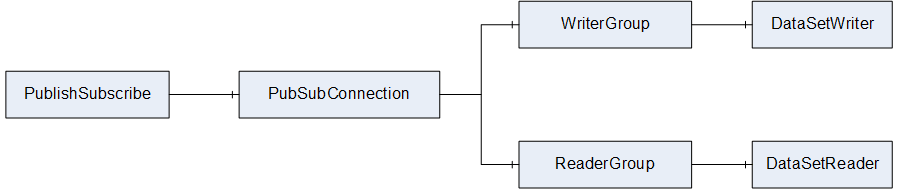
Table 2 formally defines the transitions of the state machine.
| Source State | Target State | Trigger Description |
| Disabled | Paused | The component was successfully enabled but the parent component is in the state Disabled or Paused. |
| Disabled | PreOperational | The component was successfully enabled. |
| Paused | Disabled | The component was successfully disabled. |
| Paused | PreOperational | The state of the parent component changed to Operational. |
| PreOperational | Operational | The component completed the steps necessary to enter the Operational state. These steps include setup of network communication and security keys. If the PubSub component is a DataSetReader, the state shall change to Operational after the first key frame or event DataSetMessage was received. |
| PreOperational | Disabled | The component was successfully disabled. |
| PreOperational | Paused | The state of the parent component changed to Disabled or Paused. |
| PreOperational | Error | There is a pending error situation for the related PubSub component. |
| Operational | Disabled | The component was successfully disabled. |
| Operational | Paused | The state of the parent component changed to Disabled or Paused. |
| Operational | Error | There is a pending error situation for the related PubSub component. |
| Error | Disabled | The component was successfully disabled. |
| Error | Paused | The state of the parent component changed to Disabled or Paused. |
| Error | Operational | The error situation was resolved for the related PubSub component. |
| Error | PreOperational | The error situation was resolved for the related PubSub component. |
The PubSubState representation in the AddressSpace is defined in Table 3.
| Attribute | Value | ||||
| BrowseName | PubSubState | ||||
| IsAbstract | False | ||||
| References | Node Class | BrowseName | DataType | TypeDefinition | Others |
|---|---|---|---|---|---|
| Subtype of Enumeration defined in OPC 10000-5 | |||||
| HasProperty | Variable | EnumStrings | LocalizedText [] | PropertyType | |
| Conformance Units | |||||
|---|---|---|---|---|---|
| PubSub Model Base |
6.2.2 PubSub configuration properties
The PubSub components have configuration property lists as KeyValuePair arrays. These optional configuration properties extend the configuration parameters defined for the different PubSub components.
The configuration properties are mainly used as protocol or product specific parameters influencing the behaviour of the PubSub application. These properties may contain information that should not be visible outside the configuration tools and PubSub applications. Therefore the properties shall not be included in the PubSubConnectionDataType, WriterGroupDataType and DataSetWriterDataType when sent in discovery messages.
The configuration are defined in different sections in the scope where they are used. The properties that can be applied to all PubSub components are defined in Table 4.
The NamespaceIndex of the QualifiedName in the KeyValuePair for properties defined in this document shall be 0. The Name of the QualifiedName is the property key from Table 4. The DataType of the Value in the KeyValuePair shall be the DataType defined in Table 4.
Table 4 formally defines the general PubSub configuration properties.
| Key | DataType | Description |
| 0:NotPersisted | Boolean | Indicates if the component configuration is persisted. If this property is not present the default value is false and the component configuration is persisted. |
| 0:ErrorDelay | Duration | A time delay in milliseconds from the time the first error is detected until transitioning to the PubSubState Error. |
6.2.3 PublishedDataSet parameters
6.2.3.1 Overview
A PublishedDataSet defines the content of a DataSetMessage and the configuration of the information source for a DataSet. See 5.2 for the introduction to DataSets, 5.3 for the introduction to DataSetMessages and 5.4.1.2 for an introduction to the different source options and the parameters for sending of DataSetMessages.
The content of a DataSetMessage is defined by the DataSetMetaData. This information is required for interoperability between Publisher and Subscriber. See 6.2.3.2.
The information source is only necessary for the configuration of the Publisher. The standard configuration options are published data items for cyclic DataSets as defined in 6.2.3.7 and published events for acyclic DataSets as defined in 6.2.3.8. OPC UA Applications can provide PublishedDataSets where the information source is application specific. The custom PublishedDataSet source DataType defined in 6.2.3.9 indicates if the DataSet is cyclic or acyclic. Cyclic DataSets are sent as key frame or delta frame DataSetMessages. Acyclic DataSets are sent as event DataSetMessages.
6.2.3.2 DataSetMetaData
6.2.3.2.1 General
DataSetMetaData describe the content and semantic of a DataSet. The order of the fields in the DataSetMetaData shall match the order of DataSet fields when they are included in the published DataSetMessages. The DataSetMetaDataType is defined in 6.2.3.2.3.
6.2.3.2.2 DataTypeSchemaHeader
The DataSetMetaData is a subtype of DataTypeSchemaHeader. The DataTypeSchemaHeader provides OPC UA DataType definitions used in the DataSetMetaData. The DataTypeSchemaHeader is defined in OPC 10000-5.
The DataTypeSchemaHeader provides information that is required when the DataSetMetaData is used outside the scope of an OPC UA Server e.g when sent in PubSub messages or when the PubSubConfiguration is exchanged with the UABinaryFileDataType. This information includes a namespace array and DataType descriptions. OPC UA namespace defined DataTypes are not included in the PubSubConfiguration.
The DataTypeSchemaHeader of the DataSetMetaData shall be populated with the necessary information. This includes all namespaces and DataTypes that are potentially contained in the associated DataSetMessages. DataTypes defined in the OPC UA namespace (NamespaceIndex 0) that are not built-in types or the abstract types Number, UInteger, Integer or Enumeration shall be included in the DataSetMetaData.
A Publisher should keep the namespaces array in the DataSetMetaData unchanged even if the order of namespaces is changed in the OPC UA Server of the Publisher. A change of the namespace array in the DataSetMetaData requires a change to the MajorVersion in the DataSetMetaData.
The Subscriber must map namespace indices in received messages if the data is processed in the context of an OPC UA Server information model e.g. if the values are written to target Variables. This affects encoding NodeIds in ExtensionObjects but also all other namespace indices in NodeIds and BrowseNames contained in the messages. If the Subscriber receives Structure DataTypes where the target Variables DataTypes have the same structure but different DataType NodeIds, the Subscriber must verify the consistency of the layout at start-up and must map the complete encoding NodeId when receiving the data.
If the DataSetMetaData is created outside the Publisher, the same mapping may be required in the Publisher.
6.2.3.2.3 DataSetMetaDataType
This Structure DataType is a subtype of DataTypeSchemaHeader and is used to provide the metadata for a DataSet. The DataSetMetaDataType is formally defined in Table 5.
| Name | Type | Description |
| DataSetMetaDataType | Structure | Subtype of DataTypeSchemaHeader defined in OPC 10000-5. |
Name | String | Name of the DataSet. |
Description | LocalizedText | Description of the DataSet. The default value is a null or empty LocalizedText. |
Fields | FieldMetaData[] | The metadata for the fields in the DataSet. The FieldMetaData DataType is defined in 6.2.3.2.4. |
DataSetClassId | Guid | This field provides the globally unique identifier of the class of DataSet if the DataSet is based on a DataSetClass. In this case, this field shall match the DataSetClassId of the concrete DataSet configuration. If the DataSets are not created from a class, this field is null. |
ConfigurationVersion | ConfigurationVersionDataType | The configuration version for the current configuration of the DataSet. |
Its representation in the AddressSpace is defined in Table 6.
| Attributes | Value |
| BrowseName | DataSetMetaDataType |
| IsAbstract | False |
| Subtype of DataTypeSchemaHeader defined in OPC 10000-5. | |
| Conformance Units | |
| PubSub Parameters Discovery | |
6.2.3.2.4 FieldMetaData
This Structure DataType is used to provide the metadata for a field in a DataSet. The FieldMetaData is formally defined in Table 7.
| Name | Type | Description |
| FieldMetaData | Structure | |
Name | String | Name of the field. The name shall be unique in the DataSet. |
Description | LocalizedText | Description of the field. The default value shall be a null or empty LocalizedText. |
FieldFlags | DataSetFieldFlags | Flags for the field. |
BuiltInType | Byte | The built-in data type of the field. The possible built-in type values are defined in OPC 10000-6. All data types are transferred in DataSetMessages as one of the built-in data types. In most cases the identifier of the DataType NodeId matches the built-in type. The following special cases need to be handled in addition: (1) Abstract types always have the built-in type Variant since they can result in different concrete types in a DataSetMessage. The dataType field may provide additional restrictions e.g. if the abstract type is Number. Abstract types shall not be used in UADP message mapping if the field is represented as RawData set by the DataSetFieldContentMask defined in 6.2.4.2. (2) Enumeration DataTypes are encoded as Int32. The Enumeration strings are defined through a DataType referenced through the dataType field. (3) Structure and Union DataTypes are encoded as ExtensionObject. The encoding rules are defined through a DataType referenced through the dataType field. (4) DataTypes derived from built-in types have the BuiltInType of the corresponding base DataType. The concrete subtype is defined through the dataType field. (5) OptionSet DataTypes are either encoded as one of the concrete UInteger DataTypes or as an instance of an OptionSetType in an ExtensionObject. |
DataType | NodeId | The NodeId of the DataType of this field. If the DataType is an Enumeration or an OptionSet, the semantic of the Enumeration DataType is provided through the enumDataTypes field of the DataSetMetaData base type DataTypeSchemaHeader. If the DataType is a Structure or Union, the encoding and decoding description of the Structure DataType is provided through the structureDataTypes field of the DataSetMetaData base type DataTypeSchemaHeader. |
ValueRank | Int32 | Indicates whether the dataType is an array and how many dimensions the array has. It may have the following values: n > 1: the dataType is an array with the specified number of dimensions. OneDimension (1): The dataType is an array with one dimension. OneOrMoreDimensions (0): The dataType is an array with one or more dimensions. Scalar (−1): The dataType is not an array. Any (−2): The dataType can be a scalar or an array with any number of dimensions. ScalarOrOneDimension (−3): The dataType can be a scalar or a one dimensional array. NOTE All DataTypes are considered to be scalar, even if they have array-like semantics like ByteString and String. Only a concrete valueRank with values n=-1 or n>0 shall be used for UADP message mapping if the field is represented as RawData set by the DataSetFieldContentMask defined in 6.2.4.2. |
ArrayDimensions | UInt32[] | This field specifies the maximum supported length of each dimension. If the maximum is unknown the value shall be 0. The number of elements shall be equal to the value of the valueRank field. This field shall be null or empty if valueRank ≤ 0. The maximum number of elements of an array transferred on the wire is 2.147.483.647 (max Int32). It is the total number of elements in all dimensions based on the UA Binary encoding rules for arrays. |
MaxStringLength | UInt32 | If the dataType field is a String, LocalizedText (the text field) or ByteString then this field specifies the maximum supported length of the data in number of bytes. If the maximum is unknown the value shall be 0. If the dataType field is not a String, LocalizedText or ByteString the value shall be 0. If the valueRank is greater than 0 this field applies to each element of the array. |
DataSetFieldId | Guid | The unique ID for the field in the DataSet. The ID is generated when the field is added to the list. A change of the position of the field in the list shall not change the ID. |
Properties | KeyValuePair[] | List of Property values providing additional semantic for the field. If at least one Property value changes, the MajorVersion of the ConfigurationVersion shall be updated. The Property in the FieldMetaData shall correctly describe the Field Value in the DataSetMessages. For example if the Property is EngineeringUnits, the unit of the Field Value shall match the unit of the FieldMetaData. The KeyValuePair DataType is defined in OPC 10000-5. For this field the key in the KeyValuePair structure is the BrowseName of the Property and the value in the KeyValuePair structure is the Value of the Property. If the DataSetMessage field has a Variable as source, the NodeId of the source Variable can be included in the Properties with the key SourceNode and the Variable NodeId as value. The namespace of the NodeId shall be added to the namespaces in the DataSetMetaData. |
Its representation in the AddressSpace is defined in Table 8.
| Attributes | Value |
| BrowseName | FieldMetaData |
| IsAbstract | False |
| Subtype of Structure defined in OPC 10000-5. | |
| Conformance Units | |
| PubSub Parameters Discovery | |
6.2.3.2.5 DataSetFieldFlags
This DataType defines flags for DataSet fields.
The DataSetFieldFlags is formally defined in Table 9.
| Value | Bit No. | Description |
| PromotedField | 0 | The flag indicates if the field is promoted to the NetworkMessages or transport protocol header. Setting this flag increases the size of the NetworkMessages since information from the DataSetMessage body is also promoted to the header. Depending on the used security, the header including the field may be unencrypted. Promoted fields are always included in the header even if the DataSetMessage payload is a delta frame and the DataSet field is not included in the delta frame. In this case the last sent value is sent in the header. The order of the fields in the DataSetMetaData promoted to the header shall match the order of the fields in the header unless the header includes field names. |
The DataSetFieldFlags representation in the AddressSpace is defined in Table 10.
| Attribute | Value | ||||
| BrowseName | DataSetFieldFlags | ||||
| IsAbstract | False | ||||
| References | Node Class | BrowseName | DataType | TypeDefinition | Others |
|---|---|---|---|---|---|
| Subtype of UInt16 defined in OPC 10000-5 | |||||
| HasProperty | Variable | OptionSetValues | LocalizedText [] | PropertyType | |
| Conformance Units | |||||
|---|---|---|---|---|---|
| PubSub Parameters Discovery |
6.2.3.2.6 ConfigurationVersionDataType
This Structure DataType is used to indicate configuration changes in the information published for a DataSet. The ConfigurationVersionDataType is formally defined in Table 11.
| Name | Type | Description |
| ConfigurationVersionDataType | Structure | |
MajorVersion | VersionTime | The majorVersion reflects the time of the last major change of the DataSet content. The VersionTime DataType is defined in OPC 10000-4. To assure interoperability, the Subscriber shall use DataSetMetaData for decoding with a majorVersion that matches the majorVersion in DataSetMessages sent by the Publisher. Removing fields from the DataSet content, reordering fields, adding fields in between other fields or a DataType change in fields shall result in an update of the majorVersion. If at least one Property value of a DataSetMetaData field changes, the majorVersion shall be updated. If the namespaces in the DataTypeSchemaHeader change, the majorVersion shall be updated. There can be situations where older configurations of a Publisher are loaded and changed with product-specific configuration tools. In this case the majorVersion shall be updated if the configuration tool is not able to verify if the change only extends the configuration and does not change the existing content. Additional criteria for changing majorVersion or minorVersion are defined in this document. |
MinorVersion | VersionTime | The minorVersion reflects the time of the last change. Only the minorVersion shall be updated if fields are added at the end of the DataSet content. If the majorVersion is updated, the minorVersion is updated to the same value as majorVersion. |
Its representation in the AddressSpace is defined in Table 12.
| Attributes | Value |
| BrowseName | ConfigurationVersionDataType |
| IsAbstract | False |
| Subtype of Structure defined in OPC 10000-5. | |
| Conformance Units | |
| PubSub Parameters Discovery | |
6.2.3.3 DataSetClassId
DataSetMetaData may be specific to a single Publisher and a single selection of information or universal, e.g. defined by a standards organization or by a plant operator as a DataSetClass. DataSets that conform to such a DataSetClass are identified with a DataSetClassId.
The DataSetClassId is the globally unique identifier (Guid) of a DataSetClass. It is included in the DataSetMetaData. The NetworkMessageContentMask controls the availability of the DataSetClassId in the NetworkMessage.
6.2.3.4 ExtensionFields
The ExtensionFields parameter allows the configuration of fields with values to be included in the DataSet when the existing AddressSpace of the Publisher does not provide the necessary information. The ExtensionFields are represented as an array of KeyValuePair Structures.
6.2.3.5 PublishedDataSetDataType
This Structure DataType represents the PublishedDataSet parameters. The PublishedDataSetDataType is formally defined in Table 13.
| Name | Type | Description |
Allow
Subtypes |
| PublishedDataSetDataType | Structure | ||
Name | String | Name of the PublishedDataSet. It is recommended to use a human readable name. The name of the PublishedDataSet shall be unique in the Publisher. | |
DataSetFolder | String[] | Optional path of the DataSet folder used to group PublishedDataSets where each entry in the String array represents one level in a DataSet folder hierarchy. If no grouping is needed the parameter is a null or empty String array. | |
DataSetMetaData | DataSetMetaDataType | Defined in 6.2.3.2. | |
ExtensionFields | KeyValuePair[] | Defined in 6.2.3.4. | |
DataSetSource | PublishedDataSetSourceDataType | Defined in 6.2.3.6. If the parameter is null, the source creates cyclic DataSets. This is equal to a PublishedDataSetCustomSourceDataType with cyclicDataSet set to true. | True |
Its representation in the AddressSpace is defined in Table 14.
| Attributes | Value |
| BrowseName | PublishedDataSetDataType |
| IsAbstract | False |
| Subtype of Structure defined in OPC 10000-5. | |
| Conformance Units | |
| PubSub Parameters PublishedDataSet | |
6.2.3.6 PublishedDataSetSourceDataType
The PublishedDataSetSourceDataType Structure is an abstract base type without fields for the definition of the PublishedDataSet source. Its representation in the AddressSpace is defined in Table 15.
| Attributes | Value |
| BrowseName | PublishedDataSetSourceDataType |
| IsAbstract | True |
| Subtype of Structure defined in OPC 10000-5. | |
| Conformance Units | |
| PubSub Parameters PublishedDataSet | |
6.2.3.7 Published Data Items
6.2.3.7.1 PublishedData
The parameter PublishedData defines the content of a DataSet created from Variable Values and therefore the content of the DataSetMessage sent by a DataSetWriter. The sources of the DataSet fields are defined through an array of PublishedVariableDataType.
The index into the array has an important role for Subscribers and for configuration tools. It is used as a handle to reference the Value in DataSetMessages received by Subscribers. The index may change after configuration changes. Changes are indicated by the ConfigurationVersion of the DataSet and applications working with the index shall always check the ConfigurationVersion before using the index.
The length of the PublishedData array shall match the length of the fields array in the corresponding DataSetMetaData.
If an entry of the PublishedData references one of the ExtensionFields, the substituteValue shall contain the QualifiedName of the ExtensionFields entry. All other fields of this PublishedVariableDataType array element shall be null or empty.
The DataType PublishedVariableDataType represents the configuration information for one Variable. The PublishedVariableDataType is formally defined in Table 16.
| Name | Type | Description |
| PublishedVariableDataType | Structure | |
PublishedVariable | NodeId | The NodeId of the published Variable. Some transport protocols require knowledge on the message receiver side about the DataType, ValueRank and ArrayDimensions to be able to decode the message content. This information is provided through the DataSetMetaData provided for the DataSet. |
AttributeId | IntegerId | Id of the Attribute to publish e.g. the Value Attribute. This shall be a valid Attribute id. The Attributes are defined in OPC 10000-3. The IntegerId DataType is defined in OPC 10000-4. The IntegerIds for the Attributes are defined in OPC 10000-6. |
SamplingIntervalHint | Duration | A recommended rate of acquiring new values for change or deadband evaluation. A Publisher should use this value as hint for setting the internal sampling rate. The value 0 indicates that the Server should use the fastest practical rate. The value -1 indicates that the default sampling interval defined by the PublishingInterval of the WriterGroup is requested. Any negative number is interpreted as -1. |
DeadbandType | UInt32 | A value that defines the Deadband type and behaviour. Value Description None No Deadband calculation should be applied. Absolute AbsoluteDeadband (This type is specified in OPC 10000-4) Percent PercentDeadband (This type is specified in OPC 10000-8). |
DeadbandValue | Double | The deadband value for the corresponding DeadbandType. The meaning of the value depends on DeadbandType. |
IndexRange | NumericRange | This parameter is used to identify a single element of an array, or a single range of indexes for arrays. The NumericRange type and the logic for IndexRange are defined in OPC 10000-4. |
SubstituteValue | BaseDataType | The SubstituteValue is the value that is included in the DataSet if the StatusCode of the DataValue is Bad. In this case the StatusCode is set to Uncertain_SubstituteValue. This Value shall match the DataType and ValueRank of the PublishedVariable since DataSetWriters may depend on a valid Value with the right DataType that matches the ConfigurationVersion. If the SubstituteValue is Null, the StatusCode of the DataValue is processed. The handling of the SubstituteValue is defined in 6.2.11. |
MetaDataProperties | QualifiedName [ ] | This parameter specifies an array of Properties to be included in the FieldMetaData created for this Variable. It shall be used to populate the properties element of the resulting field in the DataSetMetaData. |
Its representation in the AddressSpace is defined in Table 17.
| Attributes | Value |
| BrowseName | PublishedVariableDataType |
| IsAbstract | False |
| Subtype of Structure defined in OPC 10000-5. | |
| Conformance Units | |
| PubSub Parameters PublishedDataSet | |
6.2.3.7.2 PublishedDataItemsDataType
This Structure DataType is used to represent PublishedDataItems specific parameters. It is a subtype of the PublishedDataSetSourceDataType defined in 6.2.3.6.
The PublishedDataItemsDataType is formally defined in Table 18.
| Name | Type | Description |
| PublishedDataItemsDataType | Structure | Subtype of PublishedDataSetSourceDataType defined in 6.2.3.6. |
PublishedData | PublishedVariableDataType[] | Defined in 6.2.3.7.1. |
Its representation in the AddressSpace is defined in Table 19.
| Attributes | Value |
| BrowseName | PublishedDataItemsDataType |
| IsAbstract | False |
| Subtype of PublishedDataSetSourceDataType defined in 6.2.3.6. | |
| Conformance Units | |
| PubSub Parameters PublishedDataSet | |
6.2.3.8 Published Events
6.2.3.8.1 EventNotifier
The parameter EventNotifier defines the NodeId of the Object in the event notifier tree of the OPC UA Server from which Events are collected.
6.2.3.8.2 SelectedFields
The parameter SelectedFields defines the selection of Event fields contained in the DataSet generated for an Event and sent through the DataSetWriter. The SimpleAttributeOperand DataType is defined in OPC 10000-4. The DataType of the selected Event field in the EventType defines the DataType of the DataSet field. Event fields can be null or the field value can be a StatusCode. The encoding of Event based DataSetMessages shall be able to handle these cases. ExtensionFields defined for the instance of the PublishedEventsType can be included in the SelectedFields by specifying the PublishedEventsType NodeId as typeId in the SimpleAttributeOperand and the BrowseName of the extension field in the browsePath of the SimpleAttributeOperand.
The index into the list of entries in the SelectedFields has an important role for Subscribers. It is used as handle to reference the Event field in DataSetMessages received by Subscribers. The index may change after configuration changes. Changes are indicated by the ConfigurationVersion and applications working with the index shall always check the ConfigurationVersion before using the index. If a change of the SelectedFields adds additional fields, the MinorVersion of the ConfigurationVersion shall be updated. If a change of the SelectedFields removes fields, the MajorVersion of the ConfigurationVersion shall be updated. The ConfigurationVersionDataType and the rules for setting the version are defined in 6.2.3.2.6.
6.2.3.8.3 Filter
The parameter Filter defines the filter applied to the Events. It allows the reduction of the DataSets generated from Events through a filter. The ContentFilter DataType is defined in OPC 10000-4.
6.2.3.8.4 PublishedEventsDataType
This Structure DataType is used to represent PublishedEvents specific parameters. It is a subtype of the PublishedDataSetSourceDataType defined in 6.2.3.6.
The PublishedEventsDataType is formally defined in Table 20.
| Name | Type | Description |
| PublishedEventsDataType | Structure | Subtype of PublishedDataSetSourceDataType defined in 6.2.3.6. |
EventNotifier | NodeId | Defined in 6.2.3.8.1. |
SelectedFields | SimpleAttributeOperand[] | Defined in 6.2.3.8.2. |
Filter | ContentFilter | Defined in 6.2.3.8.3. |
Its representation in the AddressSpace is defined in Table 21.
| Attributes | Value |
| BrowseName | PublishedEventsDataType |
| IsAbstract | False |
| Subtype of PublishedDataSetSourceDataType defined in 6.2.3.6. | |
| Conformance Units | |
| PubSub Parameters PublishedDataSet Events | |
6.2.3.9 Custom PublishedDataSet source
6.2.3.9.1 CyclicDataSet
The CyclicDataSet with DataType Boolean defines the type of DataSetMessages created by the PublishedDataSet.
If CyclicDataSet is false, event DataSetMessages are sent acyclicly and a related DataSetWriter shall use a KeyFrameCount of 0.
If CyclicDataSet is true, key frame or delta frame DataSetMessages are sent and a related DataSetWriter shall use a KeyFrameCount that is greater than or equal to 1.
6.2.3.9.2 PublishedDataSetCustomSourceDataType
This Structure DataType is used to represent custom PublishedDataSet source specific parameters. It is a subtype of the PublishedDataSetSourceDataType defined in 6.2.3.6.
The DataType can be used directly if no further information is exposed for the source. OPC UA Applications shall use DataTypes derived from PublishedDataSetSourceDataType if they want to provide custom information about the source e.g. product specific configuration options.
The PublishedDataSetCustomSourceDataType is formally defined in Table 22.
| Name | Type | Description |
| PublishedDataSetCustomSourceDataType | Structure | Subtype of PublishedDataSetSourceDataType defined in 6.2.3.6. |
CyclicDataSet | Boolean | Defined in 6.2.3.9.1. |
Its representation in the AddressSpace is defined in Table 23.
| Attributes | Value |
| BrowseName | PublishedDataSetCustomSourceDataType |
| IsAbstract | False |
| Subtype of PublishedDataSetSourceDataType defined in 6.2.3.6. | |
| Conformance Units | |
| PubSub Parameters PublishedDataSet Custom | |
6.2.3.10 Published Action
6.2.3.10.1 General
Published Action defines the signature of an Action as a combination of ActionRequest and ActionResponse messages and a list of targets with an optional mapping to OPC UA Methods.
The Action targets, ActionRequest and ActionResponse information is the input to the ActionMetaData.
The parameter RequestDataSetMetaData defines the content of the ActionRequest.
The DataSetMetaData parameter of the PublishedDataSet defines the content of the ActionResponse.
The parameter ActionTargets provides a list of Action targets with the same signatures that can be executed based on the published Action definition.
6.2.3.10.2 RequestDataSetMetaData
The parameter RequestDataSetMetaData defines the payload of ActionRequest messages.
The payload of the ActionResponse messages is defined by the DataSetMetaData parameter of the PublishedDataSetDataType. The fields Name and ConfigurationVersion of the DataSetMetaData and the RequestDataSetMetaData in one PublishedDataSet shall be identical.
6.2.3.10.3 ActionTargets
The parameter ActionTargets defines the list of Action targets that can be invoked with the signature defined by the ActionMetaData.
The DataType ActionTargetDataType represents the configuration information for one Action target. The ActionTargetDataType is formally defined in Table 24.
| Name | Type | Description |
| ActionTargetDataType | Structure | |
ActionTargetId | UInt16 | The numeric identifier assigned to the Action target which is unique within one ActionMetaData. It is used to address the Action target in combination with the PublisherId and the DataSetWriterId. |
Name | String | Name of the Action target. |
Description | LocalizedText | Description of the Action target. The default value is a null or empty LocalizedText. |
Its representation in the AddressSpace is defined in Table 25.
| Attributes | Value |
| BrowseName | ActionTargetDataType |
| IsAbstract | False |
| Subtype of Structure defined in OPC 10000-5. | |
| Conformance Units | |
| PubSub Parameters PublishedDataSet Action | |
6.2.3.10.4 PublishedActionDataType
This Structure DataType is used to represent PublishedAction specific parameters. It is a subtype of the PublishedDataSetSourceDataType defined in 6.2.3.6.
The PublishedActionDataType is formally defined in Table 26.
| Name | Type | Description |
| PublishedActionDataType | Structure | Subtype of PublishedDataSetSourceDataType defined in 6.2.3.6. |
RequestDataSetMetaData | DataSetMetaDataType | Defined in 6.2.3.10.2. |
ActionTargets | ActionTargetDataType[] | Defined in 6.2.3.10.3. |
Its representation in the AddressSpace is defined in Table 27.
| Attributes | Value |
| BrowseName | PublishedActionDataType |
| IsAbstract | False |
| Subtype of PublishedDataSetSourceDataType defined in 6.2.3.6. | |
| Conformance Units | |
| PubSub Parameters PublishedDataSet Action | |
6.2.3.10.5 ActionMethods
The parameter ActionMethods defines a list of Object and Method pairs as source for the Action defined in the parameter ActionMethods.
The DataType ActionMethodDataType represents the configuration information for one Object and Method pair. The ActionMethodDataType is formally defined in Table 28.
| Name | Type | Description |
| ActionMethodDataType | Structure | |
ObjectId | NodeId | The NodeId shall be that of the Object on which the Method is invoked. The NodeId of an ObjectType is valid as ObjectId if the Method is only defined on the ObjectType. The namespace of the NodeId shall be added to the namespaces in the RequestDataSetMetaData. |
MethodId | NodeId | NodeId of the Method to invoke. If the ObjectId is the NodeId of an Object, it is allowed to use the NodeId of a Method that is the target of a HasComponent Reference from the ObjectType of the Object. The namespace of the NodeId shall be added to the namespaces in the RequestDataSetMetaData. |
Its representation in the AddressSpace is defined in Table 29.
| Attributes | Value |
| BrowseName | ActionMethodDataType |
| IsAbstract | False |
| Subtype of Structure defined in OPC 10000-5. | |
| Conformance Units | |
| PubSub Parameters PublishedDataSet Action | |
6.2.3.10.6 PublishedActionMethodDataType
This Structure DataType is used to represent Action source Method information for PublishedAction. It is a subtype of the PublishedActionDataType defined in 6.2.3.10.4.
The PublishedActionMethodDataType is formally defined in Table 30.
| Name | Type | Description |
| PublishedActionMethodDataType | Structure | Subtype of PublishedActionDataType defined in 6.2.3.10.4. |
ActionMethods | ActionMethodDataType[] | Defined in 6.2.3.10.5. If the Action targets are mapped to OPC UA Methods, the size and order of the array shall match the ActionTargets array in the PublishedActionDataType base type. |
Its representation in the AddressSpace is defined in Table 31.
| Attributes | Value |
| BrowseName | PublishedActionMethodDataType |
| IsAbstract | False |
| Subtype of PublishedActionDataType defined in 6.2.3.10.4. | |
| Conformance Units | |
| PubSub Parameters PublishedDataSet Action | |
6.2.4 DataSetWriter parameters
6.2.4.1 DataSetWriterId
The DataSetWriterId with DataType UInt16 defines the unique ID of the DataSetWriter for a PublishedDataSet. It is used to select DataSetMessages for a PublishedDataSet on the Subscriber side.
It shall be unique across all DataSetWriters for a PublisherId.
All values, except for 0, are valid DataSetWriterIds. The value 0 is defined as null value.
The DataSetWriterId shall be within the range 0x0001 - 0x7FFF for external assignment by configuration tools, and 0x8000 - 0xFFFF for internal assignment like through the Method CloseAndUpdate of the PubSubConfigurationType.
6.2.4.2 DataSetFieldContentMask
A DataSet field consists of a value and related metadata. In most cases the value comes with status and timestamp information.
This DataType defines flags to include DataSet field related information like status and timestamp in addition to the value in the DataSetMessage. The parameter is not relevant for heartbeat messages but should be configured according to the header layout requirements.
The DataSetFieldContentMask is formally defined in Table 32.
The handling of bad status for different field representations is defined in Figure 24, Table 34 and Table 35.
| Value | Bit No. | Description |
DataSet fields can be represented as RawData, Variant or DataValue as described in 5.3.2. If none of the bits are set, the fields are represented as Variant. If the RawData bit is set for UADP message mapping, the fields are represented as RawData and all other bits are ignored. For JSON message mapping the bit is used as an option in VerboseEncoding. If one of the bits 0 to 4 is set, the fields are represented as DataValue. | ||
| StatusCode | 0 | The DataValue structure field StatusCode is included in the DataSetMessages. If this bit is set, the fields are represented as DataValue. |
| SourceTimestamp | 1 | The DataValue structure field SourceTimestamp is included in the DataSetMessages. If this bit is set, the fields are represented as DataValue. |
| ServerTimestamp | 2 | The DataValue structure field ServerTimestamp is included in the DataSetMessages. If this bit is set, the fields are represented as DataValue. |
| SourcePicoSeconds | 3 | The DataValue structure field SourcePicoSeconds is included in the DataSetMessages. If this bit is set, the fields are represented as DataValue. This bit is ignored if the SourceTimestamp bit is not set. |
| ServerPicoSeconds | 4 | The DataValue structure field ServerPicoSeconds is included in the DataSetMessages. If this bit is set, the fields are represented as DataValue. This bit is ignored if the ServerTimestamp bit is not set. |
| RawData | 5 | If this bit is set for UADP message mapping, the fields of the DataSet are encoded without additional information like timestamp, status or DataType information. The details of the representation are defined for the message mappings.All other field related bits shall be ignored if this bit is set.. If this bit is set for JSON message mapping, it is used as an option in VerboseEncoding and it can be combined with the other bits. |
The DataSetFieldContentMask representation in the AddressSpace is defined in Table 33.
| Attribute | Value | ||||
| BrowseName | DataSetFieldContentMask | ||||
| IsAbstract | False | ||||
| References | Node Class | BrowseName | DataType | TypeDefinition | Others |
|---|---|---|---|---|---|
| Subtype of UInt32 defined in OPC 10000-5 | |||||
| HasProperty | Variable | OptionSetValues | LocalizedText [] | PropertyType | |
| Conformance Units | |||||
|---|---|---|---|---|---|
| PubSub Parameters Discovery |
The DataSetFieldContentMask defines different options that influence the information flow from Publisher to Subscriber in the case of a Bad Value Status or other error situations. Figure 24 depicts the parameters and the information flow from DataSet field to DataSetMessage creation on the Publisher side and the decoded DataSet field on the Subscriber side. The DataSetFieldContentMask controls the representation of the DataSet fields in a DataSetMessage.
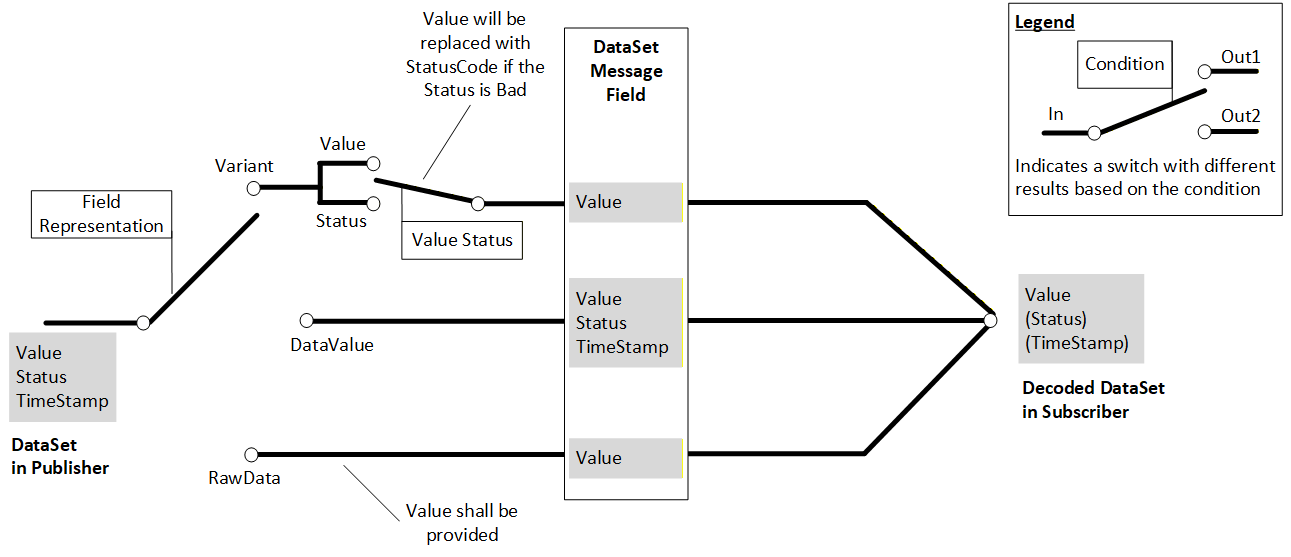
The representation of the DataSet fields in a DataSetMessage on the Publisher side and the decoding back to the DataSet fields on the Subscriber side is defined in Table 34 for UADP message mapping and in Table 35 for JSON message mapping. The representation on the Publisher side depends on the field representation defined in the DataSetFieldContentMask.
| DataSet Publisher | Field | DataSetMessage | DataSet Subscriber | ||||
| Value | Status (a) | Value | Value Status (a) | Header Status | Value | Status (a) | |
| Value 1 | Good_* | Variant | Value 1 | N/A | Good | Value 1 | Good |
| Value 1 | Uncertain_* | Value 1 Uncertain_* (b) | Good | Value 1 (b) | Uncertain_* (b) | ||
| Null | Bad_* | Bad_* (c) | Good | Null | Bad_* (c) | ||
| Value 1 | Good_* | DataValue | Value 1 | Good_* | Good | Value 1 | Good_* |
| Value 1 | Uncertain_* | Value 1 | Uncertain_* | Good | Value 1 | Uncertain_* | |
| Null | Bad_* | Null | Bad_* | Good | Null | Bad_* | |
| Value 1 | Good_* | RawData | Value 1 | N/A | Good | Value 1 | Good |
| Value 1 | Uncertain_* | Value 1(d) | Uncertain (d) | Value 1 | Uncertain | ||
| Null | Bad_* | Default value for DataType (e) | Uncertain_ SubNormal (e) | Default value for DataType | Uncertain_ SubNormal | ||
| All fields Bad_* | Default value for DataType (e) | Bad (e) | Null | Bad | |||
| The header status is set to a bad code in a fatal error situation. | Bad_* | Null | Bad_* | ||||
(a) If no specific StatusCode is used, the grouping into severity Good, Uncertain or Bad is used. (b) If the status is uncertain in variant encoding, the value and the status are encoded as DataValue. (c) A bad status is transferred instead of a value for the variant encoding. (d) If the status for one or more fields is uncertain in raw filed encoding, the header status shall be set to Uncertain. (e) If the worst status for some fields is bad, the header status shall be set to Uncertain_SubNormal. If the status for all fields is bad, the header status shall be set to Bad. | |||||||
| DataSet Publisher | Field | DataSetMessage | DataSet Subscriber | ||||
| Value | Status (a) | Value | Value Status (a) | Header Status | Value | Status (a) | |
| Value 1 | Good_* | Variant (d) | Value 1 | N/A | Good | Value 1 | Good |
| Value 1 | Uncertain_* | Value 1 | Uncertain (b) | Value 1 | Uncertain (b) | ||
| Null | Bad_* | Bad_* (c) | Good | Null | Bad_* (c) | ||
| Value 1 | Good_* | DataValue(d) | Value 1 | Good_* | Good | Value 1 | Good_* |
| Value 1 | Uncertain_* | Value 1 | Uncertain_* | Good | Value 1 | Uncertain_* | |
| Null | Bad_* | Null | Bad_* | Good | Null | Bad_* | |
| The header status is set to a bad code in a fatal error situation. | Bad_* | Null | Bad_* | ||||
(a) If no specific StatusCode is used, the grouping into severity Good, Uncertain or Bad is used. (b) A uncertain status is ignored on the field level and results in a header status of Uncertain. (c) A bad status is transferred instead of a value for the variant encoding. (d) The RawData bit only affects the presence of UaType and UaTypeId. | |||||||
6.2.4.3 KeyFrameCount
The KeyFrameCount with DataType UInt32 is the multiplier of the PublishingInterval that defines the maximum number of times the PublishingInterval expires before a key frame message with values for all published Variables is sent. The delta frame DataSetMessages contains just the changed values. If no changes exist, the delta frame DataSetMessage shall not be sent. If the KeyFrameCount is set to 1, every message contains a key frame.
For PublishedDataSets that provide cyclic updates of the DataSet, the value shall be greater than or equal to 1. PublishedDataItems or custom sources with CyclicDataSet set to true provide cyclic updates.
For non-cyclic PublishedDataSets that provide acyclic event based DataSets, the value shall be 0. PublishedEvents or custom sources with CyclicDataSet set to false provide acyclic updates.
For a heartbeat DataSetMessage, the value shall be 1.
6.2.4.4 DataSetWriterProperties
The DataSetWriterProperties parameter is an array of DataType KeyValuePair that specifies additional properties for the configured DataSetWriter. The KeyValuePair DataType is defined in OPC 10000-5 and consists of a QualifiedName and a value of BaseDataType.
The mapping of the name and value to concrete functionality may be defined by transport protocol mappings, future versions of this document or vendor-specific extensions.
6.2.4.5 DataSetWriter definition
6.2.4.5.1 DataSetWriterDataType
This Structure DataType is used to represent the DataSetWriter parameters. The DataSetWriterDataType is formally defined in Table 36.
| Name | Type | Description | Allow Subtypes |
| DataSetWriterDataType | Structure | ||
Name | String | The name of the DataSetWriter. The name shall be unique across the WriterGroup. It is recommended to use a human readable name. | |
Enabled | Boolean | The enabled state of the DataSetWriter. | |
DataSetWriterId | UInt16 | Defined in 6.2.4.1. | |
DataSetFieldContentMask | DataSetFieldContentMask | Defined in 6.2.4.2. | |
KeyFrameCount | UInt32 | Defined in 6.2.4.3. | |
DataSetName | String | The name of the corresponding PublishedDataSet. If the DataSetWriter is used to create heartbeat DataSetMessages, the dataSetName shall be null or empty. | |
DataSetWriterProperties | KeyValuePair[] | Defined in 6.2.4.4. | |
TransportSettings | DataSetWriterTransportDataType | Transport mapping specific DataSetWriter parameters. The abstract base type is defined in 6.2.4.5.2. The concrete subtypes are defined in the subclauses for transport mapping specific parameters. If no concrete subtype is defined for the transport mapping, the field shall be null. | True |
MessageSettings | DataSetWriterMessageDataType | DataSetMessage mapping specific DataSetWriter parameters. The abstract base type is defined in 6.2.4.5.3. The concrete subtypes are defined in the subclauses for message mapping specific parameters. If no concrete subtype is defined for the message mapping, the field shall be null. | True |
Its representation in the AddressSpace is defined in Table 37.
| Attributes | Value |
| BrowseName | DataSetWriterDataType |
| IsAbstract | False |
| Subtype of Structure defined in OPC 10000-5. | |
| Conformance Units | |
| PubSub Parameters Discovery | |
6.2.4.5.2 DataSetWriterTransportDataType
This Structure DataType is an abstract base type for transport mapping specific DataSetWriter parameters. The abstract DataType does not define fields.
The DataSetWriterTransportDataType Structure representation in the AddressSpace is defined in Table 38.
| Attributes | Value |
| BrowseName | DataSetWriterTransportDataType |
| IsAbstract | True |
| Subtype of Structure defined in OPC 10000-5. | |
| Conformance Units | |
| PubSub Parameters Discovery | |
6.2.4.5.3 DataSetWriterMessageDataType
This Structure DataType is an abstract base type for message mapping specific DataSetWriter parameters. The abstract DataType does not define fields.
The DataSetWriterMessageDataType Structure representation in the AddressSpace is defined in Table 39.
| Attributes | Value |
| BrowseName | DataSetWriterMessageDataType |
| IsAbstract | True |
| Subtype of Structure defined in OPC 10000-5. | |
| Conformance Units | |
| PubSub Parameters Discovery | |
6.2.5 Shared PubSubGroup parameters
6.2.5.1 General
The parameters are shared between WriterGroup and ReaderGroup.
The parameters are related to PubSub NetworkMessage security. See 5.4.5 for an introduction of PubSub security and Clause 8 for the definition of the PubSub Security Key Service.
6.2.5.2 SecurityMode
The SecurityMode indicates the level of security applied to the NetworkMessages published by a WriterGroup or received by a ReaderGroup. The MessageSecurityMode DataType is defined in OPC 10000-4.
6.2.5.3 SecurityGroupId
The SecurityGroupId with DataType String is the identifier for a SecurityGroup in the Security Key Server. It is unique within a SKS.
The parameter is null if the SecurityMode is NONE.
If the SecurityMode is not NONE the SecurityGroupId identifies the SecurityGroup. The SecurityGroup defines the SecurityPolicy and the security keys used for the NetworkMessage security. The PubSubGroup defines the SecurityMode for the NetworkMessages sent by the group.
6.2.5.4 SecurityKeyServices
SecurityKeyServices is an array of the DataType EndpointDescription and defines one or more Security Key Servers (SKS) that manage the security keys for the SecurityGroup assigned to the PubSubGroup. The EndpointDescription DataType is defined in OPC 10000-4.
The parameter is null if the SecurityMode is NONE.
Each element in the array is an Endpoint for an SKS that can supply the security keys for the SecurityGroupId. Multiple Endpoints exist because an SKS may have multiple redundant instances. If the SKS supports non-transparent redundancy, each Server in the redundant set shall have one entry in the array.
The use of the EndpointDescription parameters for the SKS selection are defined in Table 40. The main key for the identification of the SKS is the ApplicationUri.
The ApplicationUri is used in the different Server discovery mechanisms to get the OPC UA endpoint information necessary to connect to the SKS.
The combination of SecurityGroupId and SKS ApplicationUri is the unique key for a SecurityGroup in a PubSub application.
| Field | Type | Definition for the values |
| EndpointUrl | String | Shall be null or empty. |
| Server | ApplicationDescription | The ApplicationDescription DataType is defined in OPC 10000-4. |
ApplicationUri | String | The ServerUri of the SKS. |
ProductUri | String | Can be null or empty. |
ApplicationName | LocalizedText | Can be null or empty. |
ApplicationType | Enum ApplicationType | SERVER The security keys are pulled from the SKS using the Method GetSecurityKeys. CLIENT The security keys are pushed from the SKS to the PubSub application using the Method SetSecurityKeys. CLIENTANDSERVER Invalid value. DISCOVERYSERVER Invalid value. If the SKS information is sent as part of a discovery announcement message for a WriterGroup, the ApplicationType shall be set to SERVER even if the Publisher is configured for push. |
GatewayServerUri | String | Shall be null or empty. |
DiscoveryProfileUri | String | Shall be null or empty. |
DiscoveryUrls [] | String | A list of URLs for the DiscoveryEndpoints provided by the SKS. |
| ServerCertificate | ApplicationInstance Certificate | Shall be null or empty. |
| SecurityMode | MessageSecurityMode | The value shall be SIGNANDENCRYPT. |
| SecurityPolicyUri | String | ApplicationType SERVER The URI for SecurityPolicy to use to connect to the SKS. If the URI is null or empty, the pull access shall use the best available security policy that is also supported by the pull Client. ApplicationType CLIENT Shall be null or empty. |
| UserIdentityTokens [] | UserTokenPolicy | ApplicationType SERVER The user identity tokens that should be used to connect to the SKS. The default is ANONYMOUS if the array is empty. For ANONYMOUS the authorization for accessing the keys is based on the application authentication. If the UserTokenType is USERNAME, a KeyCredentialConfigurationType instance is used to configure user name and password. The ResourceUri of the KeyCredentialConfigurationType instance shall match the ApplicationUri of the SKS. The ProfileUri of the KeyCredentialConfigurationType instance shall be “http://opcfoundation.org/UA-Profile/Security/UserToken/Server/UserNamePassword”. The KeyCredentialConfigurationType is defined in OPC 10000-12. The UserTokenPolicies are defined in OPC 10000-4. ApplicationType CLIENT The array shall be null or empty. |
| TransportProfileUri | String | Can be null or empty. |
| SecurityLevel | Byte | Shall be 0. |
6.2.5.5 MaxNetworkMessageSize
The MaxNetworkMessageSize with DataType UInt32 indicates the maximum size in bytes for NetworkMessages created by the WriterGroup. It refers to the size of the complete NetworkMessage including padding and signature without any additional headers added by the transport protocol mapping. If the size of a NetworkMessage exceeds the MaxNetworkMessageSize, the behaviour depends on the message mapping.
The transport protocol mappings defined in 7.3 may define restrictions for the maximum value of this parameter.
NOTE The value for the MaxNetworkMessageSize should be configured in a way that ensures that NetworkMessages together with additional headers added by the transport protocol are still smaller than or equal than the transport protocol MTU.
6.2.5.6 GroupProperties
The GroupProperties parameter is an array of DataType KeyValuePair that specifies additional properties for the configured group. The KeyValuePair DataType is defined in OPC 10000-5 and consists of a QualifiedName and a value of BaseDataType.
The mapping of the name and value to concrete functionality may be defined by transport protocol mappings, future versions of this document or vendor-specific extensions.
6.2.5.7 PubSubGroup structure
This Structure DataType is an abstract base type for PubSubGroups. The PubSubGroupDataType is formally defined in Table 41.
| Name | Type | Description |
| PubSubGroupDataType | Structure | |
Name | String | The name of the PubSubGroup. The name shall be unique across all writer groups and reader groups of a PubSubConnection. It is recommended to use a human readable name. |
Enabled | Boolean | The enabled state of the PubSubGroup. |
SecurityMode | MessageSecurityMode | Defined in 6.2.5.2. |
SecurityGroupId | String | Defined in 6.2.5.3. |
SecurityKeyServices | EndpointDescription[] | Defined in 6.2.5.4. |
MaxNetworkMessageSize | UInt32 | Defined in 6.2.5.5. |
GroupProperties | KeyValuePair[] | Defined in 6.2.5.6. |
The PubSubGroupDataType Structure representation in the AddressSpace is defined in Table 42.
| Attributes | Value |
| BrowseName | PubSubGroupDataType |
| IsAbstract | True |
| Subtype of Structure defined in OPC 10000-5. | |
| Conformance Units | |
| PubSub Parameters Discovery | |
6.2.6 WriterGroup parameters
6.2.6.1 WriterGroupId
The WriterGroupId with DataType UInt16 is an identifier for the WriterGroup and shall be unique across all WriterGroups for a PublisherId. All values, except for 0, are valid. The value 0 is defined as null value.
The WriterGroupId shall be within the range 0x0001 - 0x7FFF for external assignment by configuration tools, and 0x8000 - 0xFFFF for internal assignment like through the Method CloseAndUpdate of the PubSubConfigurationType.
6.2.6.2 PublishingInterval
The PublishingInterval with the DataType Duration defines the interval in milliseconds for publishing NetworkMessages and the embedded DataSetMessages created by the related DataSetWriters.
Negative values are invalid. If the PublishingInterval is 0, the KeyFrameCount of all DataSetWriters in the WriterGroup shall be 0.
For cyclic PublishedDataSets one DataSet is produced for one PublishedDataSet in a PublishingInterval. If no new DataSet is available in a PublishingInterval, then either the previous DataSetMessage is resent or no DataSetMessage is sent.
In the case non-cyclic PublishedDataSets like Event based DataSets, this may result in zero to many DataSetMessages produced for one PublishedDataSet in a PublishingInterval. All Events that occur between two PublishingIntervals shall be buffered until the next NetworkMessage is sent. If the number of Events exceeds the buffer capability of the DataSetWriter, an Event of type EventQueueOverflowEventType is inserted as last entry into the buffer and all Events that do not fit into the buffer are discarded.
The Duration DataType is a subtype of Double and allows configuration of intervals smaller than a millisecond.
6.2.6.3 KeepAliveTime
The KeepAliveTime with DataType Duration defines the time in milliseconds until the Publisher sends a keep alive DataSetMessage in the case where no DataSetMessage was sent in this period by a DataSetWriter. The minimum value shall equal the PublishingInterval but shall be larger than 0.
6.2.6.4 Priority
The Priority with DataType Byte defines the relative priority of the WriterGroup to all other WriterGroups across all PubSubConnections of the Publisher.
If more than one WriterGroup needs to be processed, the priority number defines the order of processing. The highest priority is processed first.
The lowest priority is zero and the highest is 255.
6.2.6.5 LocaleIds
The LocaleIds, with DataType LocaleId, defines a list of locale ids in priority order for localized strings for all DataSetWriters in the WriterGroup. The first LocaleId in the list has the highest priority.
If the Publisher sends a localized String, the Publisher shall send the translation with the highest priority that it can. If it does not have a translation for any of the locales identified in this list, then it shall send the String value that it has and include the LocaleId with the String. If no locale id is configured, the Publisher shall use any that it has. See OPC 10000-3 for more detail on LocaleId.
6.2.6.6 HeaderLayoutUri
The HeaderLayoutUri, with DataType String, defines the selection of a well defined configuration for a subset of the PubSub communication parameters. The affected subset is defined by the header layout.
A null or empty String is defined as no layout selected.
If a layout is selected, all affected parameters shall be set to the values defined for the layout.
Available layouts and the corresponding URI Strings are defined in Annex A.
6.2.6.7 WriterGroup structures
6.2.6.7.1 WriterGroupDataType
This Structure DataType is used to represent the configuration parameters for WriterGroups. It is a subtype of PubSubGroupDataType defined in 6.2.5.7.
The WriterGroupDataType is formally defined in Table 43.
| Name | Type | Description | Allow Subtypes |
| WriterGroupDataType | Structure | Subtype of PubSubGroupDataType defined in 6.2.5.7. | |
WriterGroupId | UInt16 | Defined in 6.2.6.1. | |
PublishingInterval | Duration | Defined in 6.2.6.2. | |
KeepAliveTime | Duration | Defined in 6.2.6.3. | |
Priority | Byte | Defined in 6.2.6.4. | |
LocaleIds | LocaleId[] | Defined in 6.2.6.5. | |
HeaderLayoutUri | String | Defined in 6.2.6.6. | |
TransportSettings | WriterGroupTransportDataType | Transport mapping specific WriterGroup parameters. The abstract base type is defined in 6.2.6.7.2. The concrete subtypes are defined in the subclauses for transport mapping specific parameters. If no concrete subtype is defined for the transport mapping, the field shall be null. | True |
MessageSettings | WriterGroupMessageDataType | NetworkMessage mapping specific WriterGroup parameters. The abstract base type is defined in 6.2.6.7.3. The concrete subtypes are defined in the subclauses for message mapping specific parameters. If no concrete subtype is defined for the message mapping, the field shall be null. | True |
DataSetWriters | DataSetWriterDataType[] | The DataSetWriters contained in the WriterGroup. The DataSetWriter parameters are defined in 6.2.3.10.5. |
The WriterGroupDataType Structure representation in the AddressSpace is defined in Table 44.
| Attributes | Value | ||
| BrowseName | WriterGroupDataType | ||
| IsAbstract | False | ||
| References | NodeClass | BrowseName | IsAbstract |
|---|---|---|---|
| Subtype of PubSubGroupDataType defined in 6.2.5.7. | |||
| Conformance Units | |||
| PubSub Parameters Discovery | |||
6.2.6.7.2 WriterGroupTransportDataType
This Structure DataType is an abstract base type for transport mapping specific WriterGroup parameters. The abstract DataType does not define fields.
The WriterGroupTransportDataType Structure representation in the AddressSpace is defined in Table 45.
| Attributes | Value |
| BrowseName | WriterGroupTransportDataType |
| IsAbstract | True |
| Subtype of Structure defined in OPC 10000-5. | |
| Conformance Units | |
| PubSub Parameters Discovery | |
6.2.6.7.3 WriterGroupMessageDataType
This Structure DataType is an abstract base type for message mapping specific WriterGroup parameters. The abstract DataType does not define fields.
The WriterGroupMessageDataType Structure representation in the AddressSpace is defined in Table 46.
| Attributes | Value |
| BrowseName | WriterGroupMessageDataType |
| IsAbstract | True |
| Subtype of Structure defined in OPC 10000-5. | |
| Conformance Units | |
| PubSub Parameters Discovery | |
6.2.7 PubSubConnection parameters
6.2.7.1 PublisherId
The PublisherId is a unique identifier for a Publisher within a Message Oriented Middleware. It can be included in sent NetworkMessage for identification or filtering. The value of the PublisherId is typically shared between PubSubConnections but the assignment of the PublisherId is vendor specific.
The PublisherId parameter is only relevant for the Publisher functionality inside a PubSubConnection. The filter setting on the Subscriber side is contained in the DataSetReader parameters.
Valid DataTypes are UInteger and String. A zero UInteger and a Null or empty String are invalid PublisherIds.
The default PublisherId for datagram transport protocols has a DataType of UInt64. If the default PublisherId is created by the OPC UA Application, it is recommended to set the first 6 bytes with the MAC address of one of the network interfaces and to set the two remaining bytes to the OPC UA Server port of the OPC UA Application.
The default PublisherId for broker based transports equals the PublisherId for datagram transport protocols but the DataType is UInt64 for UADP message mapping and String for JSON message mapping. For the String, the UInt64 value is converted to a String. The PublisherId may be used in message headers, as part of a QueueName or as a client identifier for the broker connection. In these cases the size of the PublisherId and the characters used in the PublisherId may have limitations or impact to the communication performance.
The default PublisherId is used if it is not assigned by a configuration tool.
6.2.7.2 TransportProfileUri
The TransportProfileUri parameter with DataType String indicates the transport protocol mapping and the message mapping used.
The possible TransportProfileUri values are defined as URI of the transport protocols defined as PubSub transport Facet in OPC 10000-7.
6.2.7.3 Address
The Address parameter contains the network address information for the communication middleware. The different Structure DataTypes used to represent the Address are defined in 6.2.7.5.3.
6.2.7.4 ConnectionProperties
The ConnectionProperties parameter is an array of DataType KeyValuePair that specifies additional properties for the configured connection. The KeyValuePair type is defined in OPC 10000-5 and consists of a QualifiedName and a value of BaseDataType.
The mapping of the namespace, name, and value to concrete functionality may be defined by transport protocol mappings or vendor-specific extensions.
The NamespaceIndex of the QualifiedName in the KeyValuePair for properties defined in this document shall be 0. The Name of the QualifiedName is the property name from Table 47. The DataType of the Value in the KeyValuePair shall be the DataType defined in Table 47.
Table 47 formally defines the ConnectionProperties.
| Key | DataType | Description |
| 0:SksPullRetryInterval | Duration | The interval the PubSub application shall use to retry pulling keys after an error appeared. The PubSub application shall have a default value for the retry interval in the case this value is not configured. |
6.2.7.5 PubSubConnection structure
6.2.7.5.1 PubSubConnectionDataType
This Structure DataType is used to represent the configuration parameters for PubSubConnections. The PubSubConnectionDataType is formally defined in Table 48.
| Name | Type | Description | Allow Subtypes |
| PubSubConnectionDataType | Structure | ||
Name | String | The name of the PubSubConnection. The name shall be unique across a PubSubConfiguration. It is recommended to use a human readable name. | |
Enabled | Boolean | The enabled state of the PubSubConnection. | |
PublisherId | BaseDataType | Defined in 6.2.7.1. | |
TransportProfileUri | String | Defined in 6.2.7.2. | |
Address | NetworkAddressDataType | Defined in 6.2.7.3. The NetworkAddressDataType is defined in 6.2.7.5.3. | True |
ConnectionProperties | KeyValuePair[] | Defined in 6.2.7.4. | |
TransportSettings | ConnectionTransportDataType | Transport mapping specific PubSubConnection parameters. The abstract base type is defined in 6.2.7.5.2. The concrete subtypes are defined in the subclauses for transport mapping specific parameters. If no concrete subtype is defined for the transport mapping, the field shall be null. | True |
WriterGroups | WriterGroupDataType[] | The WriterGroups contained in the PubSubConnection. The WriterGroup is defined in 6.2.6. | |
ReaderGroups | ReaderGroupDataType[] | The ReaderGroups contained in the PubSubConnection. The ReaderGroup is defined in 6.2.8. |
Its representation in the AddressSpace is defined in Table 49.
| Attributes | Value |
| BrowseName | PubSubConnectionDataType |
| IsAbstract | False |
| Subtype of Structure defined in OPC 10000-5. | |
| Conformance Units | |
| PubSub Parameters Discovery Extended | |
6.2.7.5.2 ConnectionTransportDataType
This Structure DataType is an abstract base type for transport mapping specific PubSubConnection parameters. The abstract DataType does not define fields.
The ConnectionTransportDataType Structure representation in the AddressSpace is defined in Table 50.
| Attributes | Value |
| BrowseName | ConnectionTransportDataType |
| IsAbstract | True |
| Subtype of Structure defined in OPC 10000-5. | |
| Conformance Units | |
| PubSub Parameters Discovery Extended | |
6.2.7.5.3 NetworkAddressDataType
Subtypes of this abstract Structure DataType are used to represent network address information. The NetworkAddressDataType is formally defined in Table 51.
| Name | Type | Description |
| NetworkAddressDataType | Structure | |
NetworkInterface | String | The name of the network interface used for the communication relation. The default value is an empty String. In this case the network interface used is determined by the address provided by the subtypes of this Structure. The name can be an IP address, MAC address or the system specific name of the interface. |
The NetworkAddressDataType Structure representation in the AddressSpace is defined in Table 52.
| Attributes | Value |
| BrowseName | NetworkAddressDataType |
| IsAbstract | True |
| Subtype of Structure defined in OPC 10000-5. | |
| Conformance Units | |
| PubSub Parameters Discovery Extended | |
6.2.7.5.4 NetworkAddressUrlDataType
This Structure DataType is used to represent network address information in the form of an URL String. The NetworkAddressUrlDataType is formally defined in Table 53.
| Name | Type | Description |
| NetworkAddressUrlDataType | Structure | Subtype of NetworkAddressDataType defined in 6.2.7.5.3. |
Url | String | The address string for the communication relation in the form on an URL String. |
The NetworkAddressUrlDataType Structure representation in the AddressSpace is defined in Table 54.
| Attributes | Value | ||
| BrowseName | NetworkAddressUrlDataType | ||
| IsAbstract | False | ||
| References | NodeClass | BrowseName | IsAbstract |
|---|---|---|---|
| Subtype of NetworkAddressDataType defined in 6.2.7.5.3. | |||
| Conformance Units | |||
| PubSub Parameters Discovery Extended | |||
6.2.8 ReaderGroup parameters
6.2.8.1 General
The ReaderGroup does not add parameters to the shared PubSubGroup parameters.
The ReaderGroup is used to group a list of DataSetReaders. It is not symmetric to a WriterGroup and it is not related to a particular NetworkMessage. The NetworkMessage related filter settings are on the DataSetReaders.
6.2.8.2 ReaderGroup structures
6.2.8.2.1 ReaderGroupDataType
This Structure DataType is used to represent the configuration parameters for ReaderGroups. The ReaderGroupDataType is formally defined in Table 55.
| Name | Type | Description | Allow Subtypes |
| ReaderGroupDataType | Structure | Subtype of PubSubGroupDataType defined in 6.2.5.7. | |
TransportSettings | ReaderGroupTransportDataType | Transport mapping specific ReaderGroup parameters. The abstract base type is defined in 6.2.8.2.2. The concrete subtypes are defined in the subclauses for transport mapping specific parameters. If no concrete subtype is defined for the transport mapping, the field shall be null. | True |
MessageSettings | ReaderGroupMessageDataType | NetworkMessage mapping specific ReaderGroup parameters. The abstract base type is defined in 6.2.8.2.3. The concrete subtypes are defined in the subclauses for message mapping specific parameters. If no concrete subtype is defined for the message mapping, the field shall be null. | True |
DataSetReaders | DataSetReaderDataType[] | The DataSetReaders contained in the ReaderGroup. The DataSetReader is defined in 6.2.9. |
The ReaderGroupDataType Structure representation in the AddressSpace is defined in Table 56.
| Attributes | Value | ||
| BrowseName | ReaderGroupDataType | ||
| IsAbstract | False | ||
| References | NodeClass | BrowseName | IsAbstract |
|---|---|---|---|
| Subtype of PubSubGroupDataType defined in 6.2.5.7. | |||
| Conformance Units | |||
| PubSub Parameters Discovery Extended | |||
6.2.8.2.2 ReaderGroupTransportDataType
This Structure DataType is an abstract base type for transport mapping specific ReaderGroup parameters. The abstract DataType does not define fields.
The ReaderGroupTransportDataType Structure representation in the AddressSpace is defined in Table 57.
| Attributes | Value | ||
| BrowseName | ReaderGroupTransportDataType | ||
| IsAbstract | True | ||
| References | NodeClass | BrowseName | IsAbstract |
|---|---|---|---|
| Subtype of Structure defined in OPC 10000-5. | |||
| Conformance Units | |||
| PubSub Parameters Discovery Extended | |||
6.2.8.2.3 ReaderGroupMessageDataType
This Structure DataType is an abstract base type for message mapping specific ReaderGroup parameters. The abstract DataType does not define fields.
The ReaderGroupMessageDataType Structure representation in the AddressSpace is defined in Table 58.
| Attributes | Value | ||
| BrowseName | ReaderGroupMessageDataType | ||
| IsAbstract | True | ||
| References | NodeClass | BrowseName | IsAbstract |
|---|---|---|---|
| Subtype of Structure defined in OPC 10000-5. | |||
| Conformance Units | |||
| PubSub Parameters Discovery Extended | |||
6.2.9 DataSetReader parameters
6.2.9.1 PublisherId
The parameter PublisherId defines the Publisher to receive NetworkMessages from.
If the value is null, the parameter shall be ignored and all received NetworkMessages pass the PublisherId filter.
Valid DataTypes are UInteger and String.
6.2.9.2 WriterGroupId
The parameter WriterGroupId with DataType UInt16 defines the identifier of the corresponding WriterGroup.
The default value 0 is defined as null value, and means this parameter shall be ignored.
6.2.9.3 DataSetWriterId
The parameter DataSetWriterId with DataType UInt16 defines the DataSet selected in the Publisher for the DataSetReader.
If the value is 0 (null), the parameter shall be ignored and all received DataSetMessages pass the DataSetWriterId filter.
6.2.9.4 DataSetMetaData
The parameter DataSetMetaData provides the information necessary to decode DataSetMessages from the Publisher. If the DataSetMetaData changes in the Publisher and the MajorVersion was changed, the DataSetReader needs an update of the DataSetMetaData for further operation. If the update cannot be retrieved in the duration of the MessageReceiveTimeout, the State of the DataSetReader shall change to Error. The related PublishedDataSet is defined in 6.2.3. The DataSetMetaDataType is defined in 6.2.3.2.3. The options for retrieving the update of the DataSetMetaData are described in 5.2.3.
The Subscriber must map namespace indices in received messages if the data is processed in the context of an OPC UA Server information model e.g. if the values are written to target Variables. This affects encoding NodeIds in ExtensionObjects but also all other namespace indices in NodeIds and BrowseNames contained in the messages. If the Subscriber receives Structure DataTypes where the target Variables DataTypes have the same structure but different DataType NodeIds, the Subscriber must verify the consistency of the layout at start-up and must map the complete encoding NodeId when receiving the data.
The Subscriber should verify that the target Variables can handle array and string sizes if the Subscriber has limits and the DataSetMetaData contains size information. This includes ArrayDimensions and MaxStringLength information in the FieldMetaData and the StructureFields of Structure DataTypes. The verification should be executed at the start-up of the DataSetReader and when the DataSetMetaData is updated. The DataSetReader should go into Error state if the verification fails.
If the DataSetMetaData contains an empty fields array, the DataSetReader is configured to receive heartbeat DataSetMessages. For heartbeat DataSetMessages the majorVersion and minorVersion in the configurationVersion shall always be 0 in the configuration and in the DataSetMessages.
6.2.9.5 DataSetFieldContentMask
The parameter DataSetFieldContentMask with DataType DataSetFieldContentMask indicates the fields of a DataValue included in the DataSetMessages. The parameter shall be ignored for heartbeat messages.
The DataSetFieldContentMask DataType is defined in 6.2.4.2.
6.2.9.6 MessageReceiveTimeout
The parameter MessageReceiveTimeout is the maximum acceptable time between two DataSetMessages. The time starts when the state of the DataSetReader changes to Operational. If there is no new DataSetMessage received within this period, the DataSetReader State shall be changed to Error until the next DataSetMessage is received. The DataSetMessages that reset the period include keep-alive and heartbeat messages. A DataSetMessage is considered new if the sequence number increments or if a new keep-alive message is received. If no sequence number is contained in the DataSetMessage, each received DataSetMessage is considered new.
The MessageReceiveTimeout is related to the Publisher side parameters PublishingInterval, KeepAliveTime and KeyFrameCount.
6.2.9.7 KeyFrameCount
The KeyFrameCount with DataType UInt32 is the multiplier of the PublishingInterval that defines the maximum number of times the PublishingInterval expires before a key frame message, with all field values, is received.
For DataSets that provide cyclic updates, the value shall be greater than or equal to 1. For non-cyclic DataSets, like PublishedEvents, that provide event based DataSets, the value shall be 0.
6.2.9.8 HeaderLayoutUri
The HeaderLayoutUri, with DataType String, defines the selection of a well defined configuration for a subset of the PubSub communication parameters. The affected subset is defined by the header layout.
A null or empty String is defined as no layout selected.
If a layout is selected, all affected parameters shall be set to the values defined for the layout.
Available layouts and the corresponding URI Strings are defined in Annex A.
6.2.9.9 SecurityMode
The parameter is defined in 6.2.5.2.
This parameter overwrites the corresponding setting on the ReaderGroup if the value is not INVALID.
6.2.9.10 SecurityGroupId
The parameter is defined in 6.2.5.3.
The parameter shall be null if the SecurityMode is INVALID.
6.2.9.11 SecurityKeyServices
The parameter is defined in 6.2.5.4.
The parameter shall be null if the SecurityMode is INVALID.
The parameter is only used to overwrite the SecurityKeyServices parameter of the ReaderGroup if the SKS is different for the DataSetReader.
6.2.9.12 DataSetReaderProperties
The DataSetReaderProperties parameter is an array of DataType KeyValuePair that specifies additional properties for the configured DataSetReader. The KeyValuePair DataType is defined in OPC 10000-5 and consists of a QualifiedName and a value of BaseDataType.
The mapping of the name and value to concrete functionality may be defined by transport protocol mappings, future versions of this document or vendor-specific extensions.
6.2.9.13 DataSetReader structure
6.2.9.13.1 DataSetReaderDataType
This Structure DataType is used to represent the DataSetReader parameters. The DataSetReaderDataType is formally defined in Table 59.
| Name | Type | Description | Allow Subtypes |
| DataSetReaderDataType | Structure | ||
Name | String | The name of the DataSetReader. The name shall be unique across a ReaderGroup. It is recommended to use a human readable name. | |
Enabled | Boolean | The enabled state of the DataSetReader. | |
PublisherId | BaseDataType | Defined in 6.2.9.1. | |
WriterGroupId | UInt16 | Defined in 6.2.9.2. | |
DataSetWriterId | UInt16 | Defined in 6.2.9.3. | |
DataSetMetaData | DataSetMetaDataType | Defined in 6.2.9.4. If the DataSetReaderDataType is provided as part of a create or update operation and the subscribedDataSet contains a StandaloneSubscribedDataSetRefDataType, this field shall be null and shall be replaced with the DataSetMetaDataType contained in the referenced StandaloneSubscribedDataSetDataType. | |
DataSetFieldContentMask | DataSetFieldContentMask | Defined in 6.2.9.5. | |
MessageReceiveTimeout | Duration | Defined in 6.2.9.6. | |
KeyFrameCount | UInt32 | Defined in 6.2.9.7. | |
HeaderLayoutUri | String | Defined in 6.2.9.8. | |
SecurityMode | MessageSecurityMode | Defined in 6.2.9.9. | |
SecurityGroupId | String | Defined in 6.2.9.10. | |
SecurityKeyServices | EndpointDescription[] | Defined in 6.2.9.11. | |
DataSetReaderProperties | KeyValuePair[] | Defined in 6.2.9.12. | |
TransportSettings | DataSetReaderTransportDataType | Transport-specific DataSetReader parameters. The abstract base type is defined in 6.2.9.13.2. The concrete subtypes are defined in the subclauses for transport mapping specific parameters. If no concrete subtype is defined for the transport mapping, the field shall be null. | True |
MessageSettings | DataSetReaderMessageDataType | DataSetMessage mapping specific DataSetReader parameters. The abstract base type is defined in 6.2.9.13.3. The concrete subtypes are defined in the subclauses for message mapping specific parameters. If no concrete subtype is defined for the message mapping, the field shall be null. | True |
SubscribedDataSet | SubscribedDataSetDataType | The SubscribedDataSet specific parameters. The abstract base type and the concrete subtypes are defined in 6.2.10. If the DataSetReader is configured to receive heartbeat DataSetMessages, the field shall be null. The StandaloneSubscribedDataSetDataType subtype shall not be used in this structure field. | True |
Its representation in the AddressSpace is defined in Table 60.
| Attributes | Value |
| BrowseName | DataSetReaderDataType |
| IsAbstract | False |
| Subtype of Structure defined in OPC 10000-5. | |
| Conformance Units | |
| PubSub Parameters Discovery Extended | |
6.2.9.13.2 DataSetReaderTransportDataType
This Structure DataType is an abstract base type for transport-specific DataSetReader parameters. The DataSetReaderTransportDataType is formally defined in Table 61.
| Name | Type | Description |
| DataSetReaderTransportDataType | Structure |
The DataSetReaderTransportDataType Structure representation in the AddressSpace is defined in Table 62.
| Attributes | Value |
| BrowseName | DataSetReaderTransportDataType |
| IsAbstract | True |
| Subtype of Structure defined in OPC 10000-5. | |
| Conformance Units | |
| PubSub Parameters Discovery Extended | |
6.2.9.13.3 DataSetReaderMessageDataType
This Structure DataType is an abstract base type for message mapping specific DataSetReader parameters. The DataSetReaderMessageDataType is formally defined in Table 63.
| Name | Type | Description |
| DataSetReaderMessageDataType | Structure |
The DataSetReaderMessageDataType Structure representation in the AddressSpace is defined in Table 64.
| Attributes | Value |
| BrowseName | DataSetReaderMessageDataType |
| IsAbstract | True |
| Subtype of Structure defined in OPC 10000-5. | |
| Conformance Units | |
| PubSub Parameters Discovery Extended | |
6.2.10 SubscribedDataSet parameters
6.2.10.1 SubscribedDataSetDataType
This Structure DataType is an abstract base type for SubscribedDataSet parameters. A SubscribedDataSet defines the metadata for the subscribed DataSet and the information for the processing of DataSetMessages. See 5.4.2.2 for an introduction to the processing options for received DataSetMessages.
The SubscribedDataSetDataType is formally defined in Table 65.
| Name | Type | Description |
| SubscribedDataSetDataType | Structure |
The SubscribedDataSetDataType Structure representation in the AddressSpace is defined in Table 66.
| Attributes | Value | |
| BrowseName | SubscribedDataSetDataType | |
| IsAbstract | True | |
| Subtype of Structure defined in OPC 10000-5. | ||
| Conformance Units | ||
| PubSub Parameters Discovery Extended | ||
6.2.10.2 TargetVariables
6.2.10.2.1 General
The SubscribedDataSet option TargetVariables defines a list of Variable mappings between received DataSet fields and target Variables in the Subscriber AddressSpace. The FieldTargetDataType is defined in 6.2.10.2.3. Target Variables shall only be used once within the same TargetVariables list.
6.2.10.2.2 TargetVariablesDataType
This Structure DataType is used to represent TargetVariables specific parameters. It is a subtype of the SubscribedDataSetDataType defined in 6.2.10.1.
The TargetVariablesDataType is formally defined in Table 67.
| Name | Type | Description |
| TargetVariablesDataType | Structure | |
TargetVariables | FieldTargetDataType[] | Defined in 6.2.10.2.3. |
Its representation in the AddressSpace is defined in Table 68.
| Attributes | Value |
| BrowseName | TargetVariablesDataType |
| IsAbstract | False |
| Subtype of SubscribedDataSetDataType defined in 6.2.10.1. | |
| Conformance Units | |
| PubSub Parameters SubscribedDataSet | |
6.2.10.2.3 FieldTargetDataType
This DataType is used to provide the metadata for the relation between a field in a DataSetMessage and a target Variable in a DataSetReader. The FieldTargetDataType is formally defined in Table 69.
| Name | Type | Description |
| FieldTargetDataType | Structure | |
DataSetFieldId | Guid | The unique ID of the field in the DataSet. The fields and their unique IDs are defined in the DataSetMetaData Structure. |
ReceiverIndexRange | NumericRange | Index range used to extract parts of an array out of the received data. It is used to identify a single element of an array, or a single range of indexes for arrays for the received DataSet field. If a range of elements is specified, the values are returned as a composite. The first element is identified by index 0 (zero). The NumericRange type is defined in OPC 10000-4. This parameter is null if the specified Attribute is not an array. However, if the specified Attribute is an array, and this parameter is null, then the complete array is used. The resulting data array size of this NumericRange shall match the resulting data array size of the writeIndexRange NumericRange setting. If the resulting array size is one and the target node ValueRank is scalar, the value shall be applied as scalar value. |
TargetNodeId | NodeId | The NodeId of the Variable to which the received DataSetMessage field value is written. |
AttributeId | IntegerId | Id of the Attribute to write e.g. the Value Attribute. This shall be a valid AttributeId. The Attributes are defined in OPC 10000-3. The IntegerId DataType is defined in OPC 10000-4. The IntegerIds for the Attributes are defined in OPC 10000-6. |
WriteIndexRange | NumericRange | The index range used for writing received data to the target node. It is used to identify a single element of an array, or a single range of indexes for arrays for the write operation to the target Node. If a range of elements is specified, the values are written as a composite. The first element is identified by index 0 (zero). The NumericRange type is defined in OPC 10000-4. This parameter is null if the specified Attribute is not an array. However, if the specified Attribute is an array, and this parameter is null, then the complete array is used. |
OverrideValueHandling | OverrideValueHandling | The value is used to define the override value handling behaviour if the State of the DataSetReader is not Operational or if the corresponding field in the DataSet contains a Bad StatusCode. The handling of the OverrideValue in different scenarios is defined in 6.2.11. The OverrideValueHandling enumeration DataType is defined in 6.2.10.2.4. |
OverrideValue | BaseDataType | This value is used if the OverrideValueHandling is set to OverrideValue and the State of the DataSetReader is not Operational or if the corresponding field in the DataSet contains a Bad StatusCode. The handling of the OverrideValue in different scenarios is defined in 6.2.11. This Value shall match the DataType of the target Node. If a writeIndexRange is configured, the Value shall match the resulting size of the writeIndexRange. For example if the writeIndexRange is “5:7”, the overrideValue must be an array with length 3. |
Its representation in the AddressSpace is defined in Table 70.
| Attributes | Value |
| BrowseName | FieldTargetDataType |
| IsAbstract | False |
| Subtype of Structure defined in OPC 10000-5. | |
| Conformance Units | |
| PubSub Parameters SubscribedDataSet | |
6.2.10.2.4 OverrideValueHandling
The OverrideValueHandling is an enumeration that specifies the possible options for the handling of Override values. The possible enumeration values are described in Table 71.
| Name | Value | Description |
|---|---|---|
| Disabled | 0 | The override value handling is disabled. |
| LastUsableValue | 1 | In the case of an error, the last usable value is used. If no last usable value is available, the default value for the data type is used. |
| OverrideValue | 2 | In the case of an error, the configured override value is used. |
The OverrideValueHandling representation in the AddressSpace is defined in Table 72.
| Attribute | Value | ||||
| BrowseName | OverrideValueHandling | ||||
| IsAbstract | False | ||||
| References | Node Class | BrowseName | DataType | TypeDefinition | Others |
|---|---|---|---|---|---|
| Subtype of Enumeration defined in OPC 10000-5 | |||||
| HasProperty | Variable | EnumStrings | LocalizedText [] | PropertyType | |
| Conformance Units | |||||
|---|---|---|---|---|---|
| PubSub Parameters SubscribedDataSet |
6.2.10.3 SubscribedDataSetMirror
6.2.10.3.1 General
The SubscribedDataSet option SubscribedDataSetMirror defines an Object in the Subscriber AddressSpace with a mirror Variable for each DataSet field in the received DataSetMessages.
6.2.10.3.2 ParentNodeName
This parameter with DataType String defines the BrowseName and DisplayName of the parent Node for the Variables representing the fields of the subscribed DataSet.
6.2.10.3.3 RolePermissions
This parameter with DataType RolePermissionType defines the value of the RolePermissions Attribute to be set on the parent Node. This value is also used as RolePermissions for all Variables of the DataSet mirror.
6.2.10.3.4 SubscribedDataSetMirrorDataType
This Structure DataType is used to represent SubscribedDataSetMirror specific parameters. It is a subtype of the SubscribedDataSetDataType defined in 6.2.10.1.
The SubscribedDataSetMirrorDataType is formally defined in Table 73.
| Name | Type | Description |
| SubscribedDataSetMirrorDataType | Structure | |
ParentNodeName | String | Defined in 6.2.10.3.1. |
RolePermissions | RolePermissionType[] | Defined in 6.2.10.3.3. |
Its representation in the AddressSpace is defined in Table 74.
| Attributes | Value |
| BrowseName | SubscribedDataSetMirrorDataType |
| IsAbstract | False |
| Subtype of SubscribedDataSetDataType defined in in 6.2.10.1. | |
| Conformance Units | |
| PubSub Parameters SubscribedDataSet Mirror | |
6.2.10.4 StandaloneSubscribedDataSetRefDataType
This Structure DataType references a standalone subscribed DataSet. It is a subtype of the SubscribedDataSetDataType defined in 6.2.10.1.
The StandaloneSubscribedDataSetRefDataType is formally defined in Table 75.
| Name | Type | Description |
| StandaloneSubscribedDataSetRefDataType | Structure | |
DataSetName | String | The name of the corresponding standalone subscribed DataSet. |
Its representation in the AddressSpace is defined in Table 76.
| Attributes | Value |
| BrowseName | StandaloneSubscribedDataSetRefDataType |
| IsAbstract | False |
| Subtype of SubscribedDataSetDataType defined in 6.2.10.1. | |
| Conformance Units | |
| PubSub Parameters SubscribedDataSet Standalone | |
6.2.10.5 StandaloneSubscribedDataSetDataType
This Structure DataType is define a standalone subscribed DataSet. It is a subtype of the SubscribedDataSetDataType defined in 6.2.10.1.
The StandaloneSubscribedDataSetDataType is formally defined in Table 77.
| Name | Type | Description | Allow Subtypes |
| StandaloneSubscribedDataSetDataType | Structure | ||
Name | String | Name of the standalone SubscribedDataSet. It is recommended to use a human readable name. The name of the standalone SubscribedDataSet shall be unique in the Subscriber. | |
DataSetFolder | String[] | Optional path of the SubscribedDataSet folder used to group SubscribedDataSets where each entry in the String array represents one level in a folder hierarchy. If no grouping is needed the parameter is a null or empty String array. | |
DataSetMetaData | DataSetMetaDataType | Defined in 6.2.9.4. A Publisher must be configured to send DataSetMessages that comply with the DataSetMetaData in the standalone subscribed DataSet. | |
SubscribedDataSet | SubscribedDataSetDataType | The SubscribedDataSet specific parameters. The abstract base type and the concrete subtypes are defined in 6.2.10. The StandaloneSubscribedDataSetDataType and the StandaloneSubscribedDataSetRefDataType subtypes shall not be used in this structure field. | True |
Its representation in the AddressSpace is defined in Table 78.
| Attributes | Value |
| BrowseName | StandaloneSubscribedDataSetDataType |
| IsAbstract | False |
| Subtype of SubscribedDataSetDataType defined in 6.2.10.1. | |
| Conformance Units | |
| PubSub Parameters SubscribedDataSet Standalone | |
6.2.11 Information flow and status handling
6.2.11.1 Published data items
The configuration model defines different parameters that influence the information flow from Publisher to Subscriber in the case of a Bad Value Status or other error situations. Figure 25 depicts the parameters and the information flow inside a Publisher and inside a Subscriber.
The parameters and behaviour relevant for the encoding of a DataSetMessage on the Publisher side and the decoding of the DataSetMessage on the Subscriber side are defined in 6.2.4.2 together with the DataSetFieldContentMask.
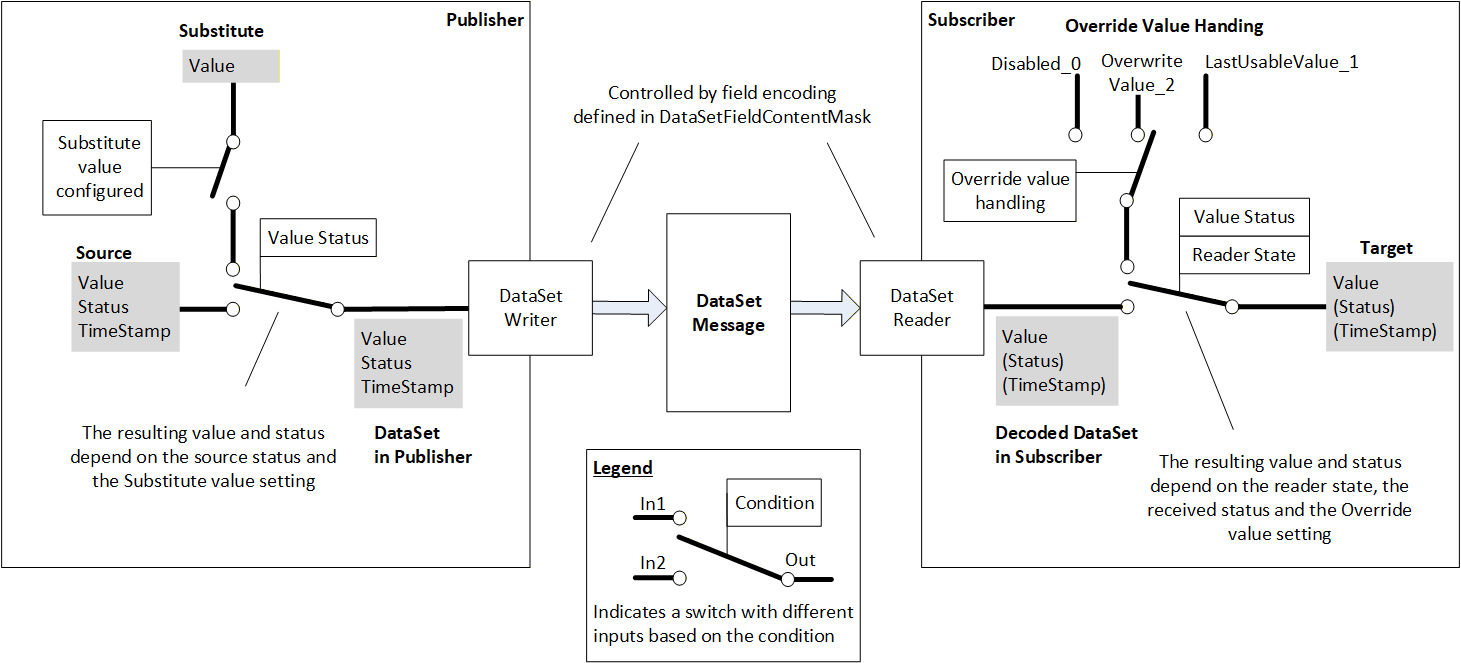
The mapping of source value and status to the DataSet in the Publisher depends on the substitute value. The dependencies are defined in Table 79.
| Source | Substitute Value | DataSet Publisher side | ||
| Value (b) | Status (a) | Value | Status (a) | |
| Value 1 | Good_* | Value 2 | Value 1 | Good_* |
| Value 1 | Uncertain_* | Value 1 | Uncertain_* | |
| Ignored | Bad_* | Value 2 | Uncertain_SubstituteValue | |
| Value 1 | Good_* | Null | Value 1 | Good_* |
| Value 1 | Uncertain_* | Value 1 | Uncertain_* | |
| Ignored | Bad_* | Null | Bad_* | |
(a) If no specific StatusCode is used, the grouping into severity Good, Uncertain or Bad is used.
(b) Any error that happens during processing of source value e.g. DataType does not match DataSetField | ||||
The mapping of the decoded DataSet on the Subscriber side to the value and status of the target Variable depends on the override value. The dependencies are defined in Table 80.
| Decoded DataSet Subscriber | Override Value Handling Enum | Override Value | Reader State | Target | ||
| Value | Status (a) | Value | Status (a) | |||
| Value 1 | Good_* | OverrideValue | Value 2 | Operational | Value 1 | Good_* |
| Value 1 | Uncertain_* | Value 1 | Uncertain_* | |||
| Ignored | Bad_* | Value 2 | Good_LocalOverride | |||
| Value 1 | Good_* | LastUsableValue | Ignored | Value 1 | Good_* | |
| Value 1 | Uncertain_* | Value 1 | Uncertain_* | |||
| Ignored | Bad_* | LastValue (b) | Uncertain_LastUsableValue | |||
| Value 1 | Good_* | Disabled | Ignored | Value 1 | Good_* | |
| Value 1 | Uncertain_* | Value 1 | Uncertain_* | |||
| Ignored | Bad_* | Null | Bad_* | |||
No message received. The target values are updated once after a reader state change. | OverrideValue | Value 2 | Disabled Paused | Value 2 | Good_LocalOverride | |
| LastUsableValue | Ignored | LastValue (b) | Uncertain_LastUsableValue | |||
| Disabled | Ignored | Null | Bad_OutOfService | |||
| OverrideValue | Value 2 | Error | Value 2 | Good_LocalOverride | ||
| LastUsableValue | Ignored | LastValue (b) | Uncertain_LastUsableValue | |||
| Disabled | Ignored | Null | Bad_NoCommunication | |||
(a) If no specific StatusCode is used, the grouping into severity Good, Uncertain or Bad is used. (b) The last value is either the last received value or the default value for the data type if there was never a value received before. | ||||||
If one of the target Variables in the SubscribedDataSet does not allow writing of the StatusCode and the OverrideValueHandling is set to Disabled, the DataSetReader shall indicate the configuration error by setting the DataSetReader state to Error. In all other configurations of OverrideValueHandling when the target Variable does not allow writing of the StatusCode, only the Value is transferred to the target Variable.
If a target Variable in the SubscribedDataSet does not allow writing of timestamp, any received timestamp shall not be used and only the received value shall be written to the target Variable.
6.2.11.2 Actions
6.2.11.2.1 ActionState
The ActionState is used to indicate the current state of an Action execution. It is an enumeration of the possible states. The enumeration values are described in Table 81.
| Name | Value | Description |
|---|---|---|
| Idle | 0 | The Action is waiting for activation by a Requestor |
| Executing | 1 | The Action is managing an Action execution. |
| Done | 2 | The Action was completed, The related return values of the last Action call are available |
The ActionState representation in the AddressSpace is defined in Table 82.
| Attribute | Value | ||||
| BrowseName | ActionState | ||||
| IsAbstract | False | ||||
| References | Node Class | BrowseName | DataType | TypeDefinition | Others |
|---|---|---|---|---|---|
| Subtype of Enumeration defined in OPC 10000-5 | |||||
| HasProperty | Variable | EnumStrings | LocalizedText [] | PropertyType | |
| Conformance Units | |||||
|---|---|---|---|---|---|
| PubSub Parameters PublishedDataSet Action |
6.2.11.2.2 Action execution sequence
The Action execution sequence and the related ActionMetaData for an Action execution through a reliable transport protocol like MQTT is described in Figure 26.
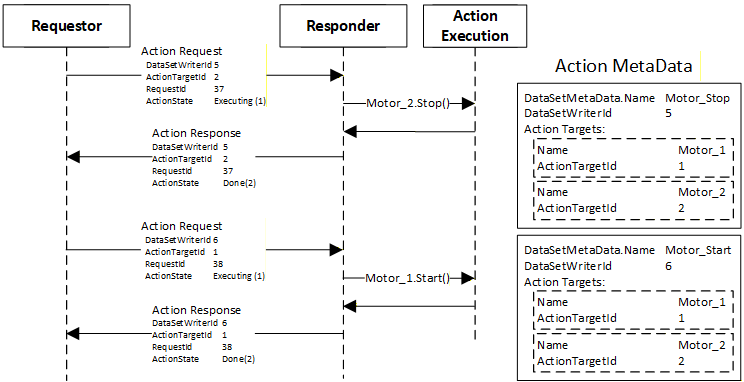
The RequestId is unique within the context of a RequestorId and CorrelationData. Each Action request in a single NetworkMessage has a different RequestId. Multiple NetworkMessages with the same RequestorId and CorrelationData may be sent.
Multiple Responses may be sent in the same NetworkMessage if the corresponding requests have the same RequestorId and CorrelationData. The grouping of requests in NetworkMessages does not affect the grouping of Responses into NetworkMessages.
The Action execution sequence for an Action execution through a non-reliable transport protocol like UDP is described in Figure 27. The related ActionMetaData is described in Figure 26. It shows the use of the ActionState for a non-reliable transport protocol. The request and response messages are send in the PublishingInterval of the Responder as long as the ActionState requires the exchange of messages for a Action execution.
The state changes for Action execution are defined in Table 83 for the Requestor and in Table 84 for the Responder.
| Current State | Condition | Event | State for next message |
| Idle | Start Action execution | Requestor sends Request Message with ActionState = Executing. | Executing |
| Executing | PublishingInterval expired and no Done or Executing received from Responder. | Requestor sends Request Message again with ActionState = Executing. | Executing |
| Executing | Received Done from Responder | Requestor sends Request Message with ActionState = Idle | Idle |
| Done | PublisihingInterval expire and no Idle received. | Requestor sends Request Message again with ActionState = Idle. | Idle |
| Done | Received Idle from Responder | None |
| Current State | Condition | Event | State for next message |
| Idle | Receives RequestMessage for a new combination of RequestorId, CorrelationData and RequestId. | Begins processing Action. | Executing |
| Executing | PublishingInterval expired and Action execution is still in progress. | Responder sends Response Message with ActionState = Executing, Status = Good and the payload is empty. | Executing |
| Executing | Action execution completed. | Responder sends Response Message with ActionState = Done, Status = Action result and payload provided for Good and Uncertain Status and payload is empty for Bad Status. | Done |
| Done | PublishingInterval expired and did not receive Idle from Requestor yet | Responder sends Response Message again with ActionState = Done until Idle is received from the Requestor or the time duration defined by the TimeoutHint request parameter ends. | Done |
| Done | Received Idle from Requestor | None |
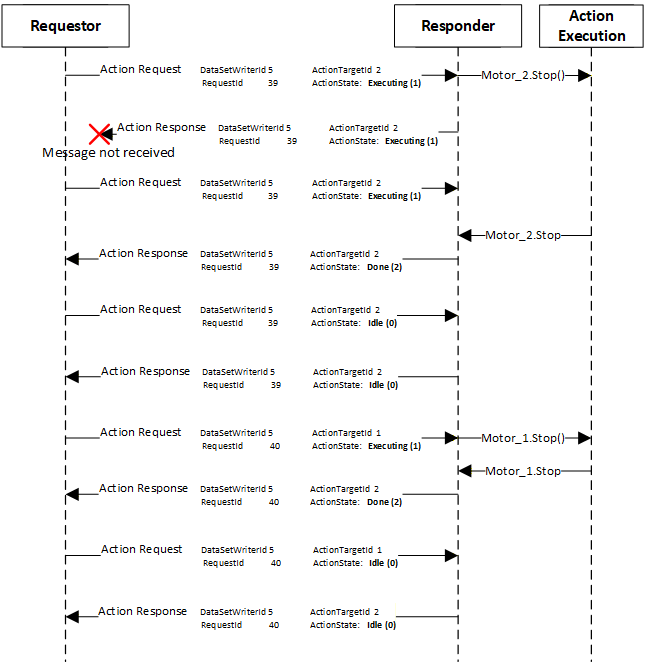
Errors during the execution of an Action are reported in the Status of the Action response message.
For some errors such as decoding errors for the request message, addressing errors or failing security checks, the Responder does not produce a response message. Therefore the Requestor should have an internal timeout setting to stop waiting for a response message.
6.2.11.2.3 Action specific use of parameters
The Action specific use of PubSub configuration parameters is defined in Table 85.
Note that the reliability of the protocol depends on the QoS levels supported by the protocol. Any Broker-based middleware that is using a QoS of AtLeastOnce or greater is reliable (see 6.4.2.5.4). Broker-less middle is not reliable if it does not support any DatagramQoS (see 6.4.1.2.6).
| PubSubComponent | Parameter | Description |
| PubSubConnectionDataType | ReaderGroups | Readers are not used for Actions. |
| WriterGroupDataType | PublishingInterval | The value is 0 for reliable transport protocols. The value shall be larger than 0 for non-reliable transport protocols. The Requestor and Responder resends Action messages that have not been acknowledged by the receiver with this frequency. |
| KeepAliveTime | This value is not used and set to 0. | |
| HeaderLayoutUri | For JSON messages the JSON-NetworkMessage header layout URI is used (see A.3.4). For UADP messages this value is UADP-Dynamic header layout URI is used (see A.2.2). | |
| BrokerWriterGroupTransportDataType | QueueName | The address that the Requestor uses to send requests to the Responder. |
| RequestedDeliveryGuarantee | Shall be AtLeastOnce or better | |
| UadpWriterGroupMessageDataType | SamplingOffset | Always -1. |
| NetworkMessageContentMask | Bit 0: PublisherId is always 1 | |
| JsonWriterGroupMessageDataType | NetworkMessageContentMask | Bit 0: NetworkMessageHeader is always 1. Bit 1: DataSetMessageHeader is always 1. Bit 2: SingleDataSetMessage is always 0. Bit 3: PublisherId is always 1 Bit 5: ReplyTo is is always 0. |
| DataSetWriterDataType | DataSetFieldContentMask | Always 0. |
| KeyFrameCount | Always 0. | |
| DataSetName | The name of the ActionMetaData. | |
| UadpDataSetWriterMessageDataType | DataSetMessageContentMask | Bit 1: PicoSeconds is always 0. Bit 2: Status is always 1, however, it is not sent in requests. |
| JsonDataSetWriterMessageDataType | DataSetMessageContentMask | Bit 2: SequenceNumber is always 0. Bit 4: Status is always 1, however, it is not sent in requests. Bit 5: MessageType is always 0. Bit 8: PublisherId is always 0 |
| DatagramWriterGroupTransport2DataType | MessageRepeatCount | Always 0 |
| MessageRepeatDelay | Always 0 | |
| BrokerDataSetWriterTransportDataType | QueueName | Not used. |
| RequestedDeliveryGuarantee | Not used. | |
| MetaDataQueueName | The address used to send ActionMetaData Messages. | |
6.2.12 PubSubConfiguration
6.2.12.1 PubSubConfigurationDataType
This Structure DataType is used to represent the PubSub configuration of an OPC UA Application. The PubSubConfigurationDataType is formally defined in Table 86.
| Name | Type | Description |
| PubSubConfigurationDataType | Structure | |
PublishedDataSets | PublishedDataSetDataType[] | The PublishedDataSets contained in the configuration. The PublishedDataSetDataType is defined in 6.2.3.5. |
Connections | PubSubConnectionDataType[] | The PubSubConnections contained in the configuration. The PubSubConnectionDataType is defined in 6.2.7. The connection includes WriterGroups and ReaderGroups. |
Enabled | Boolean | The enabled state of the PubSub configuration. This Enable state corresponds to the PubSub Status of the PublishSubscribe Object. |
Its representation in the AddressSpace is defined in Table 87.
| Attributes | Value |
| BrowseName | PubSubConfigurationDataType |
| IsAbstract | False |
| Subtype of Structure defined in OPC 10000-5. | |
| Conformance Units | |
| PubSub Parameters Configuration | |
If the PubSub configuration is stored in a file, the UABinaryFileDataType and the related definitions in OPC 10000-5 shall be used to encode the file content. The structure of the UABinaryFileDataType file with typical values for a PubSub configuration is described in Table 88.
| Field | Type | Typical Values |
| Namespaces | String[] | Namespace URIs for namespace indices used in the body. Examples are NodeIds contained in PublishedDataSets. The OPC UA namespace is skipped. The DataTypes used for configuration are defined in the OPC UA namespace. |
| structureDataTypes | StructureDescription[] | Null or empty DataTypes used for configuration are defined by OPC UA. The DataTypes used in DataSetMetaData are described in the DataTypeSchemaHeader of the associated DataSetMetaData. This field is only used if KeyValuePairs for configuration properties contain Structure DataTypes not defined by OPC UA. |
| enumDataTypes | EnumDescription[] | Null or empty DataTypes used for configuration are defined by OPC UA. The DataTypes used in DataSetMetaData are described in the DataTypeSchemaHeader of the associated DataSetMetaData. This field is only used if KeyValuePairs for configuration properties contain Structure DataTypes not defined by OPC UA. |
| simpleDataTypes | SimpleTypeDescription[] | Null or empty DataTypes used for configuration are defined by OPC UA. The DataTypes used in DataSetMetaData are described in the DataTypeSchemaHeader of the associated DataSetMetaData. This field is only used if KeyValuePairs for configuration properties contain Structure DataTypes not defined by OPC UA. |
| schemaLocation | String | Null or empty |
| fileHeader | KeyValuePair[] | Null or empty |
| Body | BaseDataType | PubSubConfigurationDataType Structure The PubSub configuration represented by the PubSubConfigurationDataType. |
6.2.12.2 SecurityGroupDataType
This Structure DataType is used to represent the configuration of a SecurityGroup in a PubSub configuration of an OPC UA Application.
If the SecurityPolicyUri or the KeyLifetime of an existing SecurityGroup are modified, all existing keys of the SecurityGroup are invalidated. The behaviour is described for the InvalidateKeys Method in 8.4.2.
The SecurityGroupDataType is formally defined in Table 89.
| Name | Type | Description |
| SecurityGroupDataType | Structure | |
Name | String | Name of the SecurityGroup. |
SecurityGroupFolder | String[] | Optional path of the SecurityGroupFolders used to group SecurityGroups where each entry in the String array represents one level in a folder hierarchy. If no grouping is needed the parameter is a null or empty String array. |
KeyLifetime | Duration | The lifetime of a key in milliseconds. If the last available key expires and the Publisher does not receive a new key in two times the KeyLifetime it shall go into Error state and shall stop sending messages secured with the expired key. If a Subscriber receives messages for a key longer than two times the KeyLifetime it shall stop processing messages with the expired key. |
SecurityPolicyUri | String | The SecurityPolicy used for the SecurityGroup. |
MaxFutureKeyCount | UInt32 | The maximum number of future keys returned by the Method GetSecurityKeys. |
MaxPastKeyCount | UInt32 | The maximum number of historical keys stored by the SKS. |
SecurityGroupId | String | The identifier for the SecurityGroup. The SecurityGroupId shall match the Name field. |
RolePermissions | RolePermissionType[] | The permissions that apply to the security key access through GetSecurityKeys for the SecurityGroup. |
GroupProperties | KeyValuePair[] | Specifies additional properties for the security group. |
Its representation in the AddressSpace is defined in Table 90.
| Attributes | Value |
| BrowseName | SecurityGroupDataType |
| IsAbstract | False |
| Subtype of Structure defined in OPC 10000-5. | |
| Conformance Units | |
| PubSub Parameters Configuration2 | |
6.2.12.3 PubSubKeyPushTargetDataType
This Structure DataType is used to represent the configuration of a PubSubKeyServicePushTarget in a PubSub configuration of an OPC UA Application. The PubSubKeyPushTargetDataType is formally defined in Table 91.
| Name | Type | Description |
| PubSubKeyPushTargetDataType | Structure | |
ApplicationUri | String | ApplicationUri of the Server that is the target of a push. |
PushTargetFolder | String[] | Optional path of the PubSubKeyPushTargetFolder used to group the push targets where each entry in the String array represents one level in a folder hierarchy. If no grouping is needed the parameter is a null or empty String array. |
EndpointUrl | String | URL of the Endpoint of the Server that is the target of a push. |
SecurityPolicyUri | String | The security policy the SKS shall use to establish a SecureChannel to the push target. |
UserTokenType | UserTokenPolicy | The type of user toke to be used for the connection to the push target. The default is Anonymous. |
RequestedKeyCount | UInt16 | The number of keys that are to be pushed on each update. The minimum setting for this is three |
RetryInterval | Duration | The interval the SKS shall use to retry pushing keys after an error appeared |
PushTargetProperties | KeyValuePair[] | Specifies additional properties for the push target |
SecurityGroups | String[] | List of security groups related to the push target |
Its representation in the AddressSpace is defined in Table 92.
| Attributes | Value |
| BrowseName | PubSubKeyPushTargetDataType |
| IsAbstract | False |
| Subtype of Structure defined in OPC 10000-5. | |
| Conformance Units | |
| PubSub Parameters Configuration2 | |
6.2.12.4 PubSubConfiguration2DataType
This Structure DataType is used to represent the extended PubSub configuration of an OPC UA Application. It is a subtype of the PubSubConfigurationDataType defined in 6.2.12.1.
The PubSubConfiguration2DataType is formally defined in Table 93.
| Name | Type | Description |
| PubSubConfiguration2DataType | Structure | Subtype of PubSubConfigurationDataType defined in 6.2.12.1. |
SubscribedDataSets | StandaloneSubscribedDataSetDataType[] | The standalone SubscribedDataSets contained in the configuration. The StandaloneSubscribedDataSetDataType is defined in 6.2.10.5. |
DataSetClasses | DataSetMetaDataType[] | DataSetClasses supported by the Publisher. |
DefaultSecurityKeyServices | EndpointDescription[] | The default SecurityKeyServices used for the PubSub configuration. The value is as default if not overwritten in the groups or DataSetReaders. The general definition for the SecurityKeyServices parameter is in 6.2.5.4. |
SecurityGroups | SecurityGroupDataType[] | The SecurityGroups contained in the configuration. The SecurityGroupDataType is defined in 6.2.12.2. |
PubSubKeyPushTargets | PubSubKeyPushTarget DataType[] | The PubSubKeyPushTargets contained in the configuration. The PubSubKeyPushTargetDataType is defined in 6.2.12.3. |
ConfigurationVersion | VersionTime | The ConfigurationVersion reflects the time of the last change. |
ConfigurationProperties | KeyValuePair[] | The configurationProperties is an array of DataType KeyValuePair that specifies additional properties for the PubSub configuration. The KeyValuePair type is defined in OPC 10000-5 and consists of a QualifiedName and a value of BaseDataType. The mapping of the namespace, name, and value to concrete functionality may be defined by transport protocol mappings, future versions of this document or vendor-specific extensions. |
Its representation in the AddressSpace is defined in Table 94.
| Attributes | Value |
| BrowseName | PubSubConfiguration2DataType |
| IsAbstract | False |
| Subtype of PubSubConfigurationDataType defined in 6.2.12.1. | |
| Conformance Units | |
| PubSub Parameters Configuration2 | |