A.2.1 Message headers for periodic data with fixed layout
A.2.1.1 Motivation
One of the use cases for PubSub is the cyclic exchange of real-time data. In such a use case, the layout of the data that needs to be transferred is the same in every PublishingInterval. When the message layout is the same in every PublishingInterval, and the Subscriber knows this in advance, several optimizations are possible:
Both Publisher and the Subscriber can be optimized for sending and receiving messages with a fixed layout, therefore offsets of send/receive fields can be pre-calculated based on the configuration.
Certain encodings may result in varying size of DataSetMessages, which requires extra fields in the messages to allow the Subscriber to parse these messages. These extra fields can be omitted when the size of the DataSetMessages is constant.
The header layout described in this section is optimized for this use case.
A.2.1.2 Overview
The basic assumption for these header layouts is that the data layout in the published messages is static. This implies the following:
Each NetworkMessage contains the same number of DataSetMessages
The sequence of the DataSetMessages within a NetworkMessage is the same in every PublishingInterval
The layout of the fields within every DataSetMessage is the same in every PublishingInterval
Note: These assumptions have to be fulfilled by appropriate configuration of the Publisher.
Subscribers have to know the static message layout in advance. This means all fields in the headers which would be required for ad-hoc parsing of messages with dynamic layout can be omitted (e.g. PayloadHeader or Sizes).
Finally, a Subscriber needs an easy way to verify that a received message matches the expected message layout. Fields of the NetworkMessage header and the GroupHeader will be used for this purpose.
PublisherId and WriterGroupId identify the WriterGroup. The NetworkMessageNumber is important for WriterGroups which distribute their DataSets over more than one NetworkMessage, and the GroupVersion allows the Subscriber to verify the expected layout of the DataSetMessages and their DataSet fields.
A.2.1.3 Header layout URI
The header layout URI for the fixed layout for periodic data as specified in A.2.1.4, A.2.1.5, A.2.1.6 and A.2.1.7 is
A.2.1.4 Header layout for NetworkMessages
A UADP NetworkMessage header shall contain the following fields according to this header layout:
Version/Flags
ExtendedFlags1
PublisherId
GroupFlags
WriterGroupId
GroupVersion
NetworkMessageNumber
SequenceNumber
Additional restrictions:
The datatype for the PublisherId shall be UInt16 or UInt64
The NetworkMessage header layout is shown in Figure A.1.

Table A.1 shows the configuration for the NetworkMessage header.
| Name | Type | Restrictions |
| UADPVersion | Bit[0-3] | The version shall be 1 |
| UADPFlags | Bit[4-7] | Bit 4: PublisherId enabled = 1 Bit 5: GroupHeader enabled = 1 Bit 6: PayloadHeader enabled = 0 Bit 7: ExtendedFlags1 enabled = 1 |
| ExtendedFlags1 | Byte | Bit range 0-2: PublisherId Type with one of the two following options 001 The PublisherId is of DataType UInt16 011 The PublisherId is of DataType UInt64 Bit 3: DataSetClassId enabled = 0 Bit 4: SecurityHeader enabled = 0 Bit 5: Timestamp enabled = 0 Bit 6: PicoSeconds enabled = 0 Bit 7: ExtendedFlags2 enabled = 0 |
| PublisherId | UInt16 or UInt64 | Configured value for the PubSubConnection. The datatype shall be UInt16 or UInt64. |
| GroupHeader | ||
GroupFlags | Byte | Bit 0: WriterGroupId enabled = 1 Bit 1: GroupVersion enabled = 1 Bit 2: NetworkMessageNumber enabled = 1 Bit 3: SequenceNumber enabled = 1 Bits 4-6: 0 Bit 7: 0 |
WriterGroupId | UInt16 | Configured value for the WriterGroup. |
GroupVersion | VersionTime | Configured value for the WriterGroup. |
NetworkMessage Number | UInt16 | Configured value for the WriterGroup. |
SequenceNumber | UInt16 | Defined by Table 154. |
Table A.2 defines the values for the configuration parameters representing this layout.
| Parameter | Value |
| UadpNetworkMessageContentMask | 0x0000003F This value results of the following options: Bit 0: PublisherId enabled = 1 Bit 1: GroupHeader enabled = 1 Bit 2: WriterGroupId enabled = 1 Bit 3: GroupVersion enabled = 1 Bit 4: NetworkMessageNumber enabled = 1 Bit 5: SequenceNumber enabled = 1 |
When a PubSubConnection is created by using the Method AddConnection() the element PublisherId contained in the argument PubSubConnectionDataType shall be of the datatype UInt16 or UInt64.
A.2.1.5 Header layout for NetworkMessages with integrity (signing)
UADP messages may be signed to ensure integrity. In this case the SecurityHeader and the Signature have to be added to the message. See clause 7.2.4.4.3 for a complete description of the signing mechanism.
This header layout is basically the same as the header layout defined in A.2.1.4 but with additional security level 'signing but no encryption'.
The NetworkMessage header layout with signing is shown in Figure A.2.

Table A.3 shows the configuration for the NetworkMessage header with signing. The table contains only the added or modified rows from Table A.1.
| Name | Type | Restrictions |
| ExtendedFlags1 | Byte | Bit 4: SecurityHeader enabled = 1 |
| SecurityHeader | ||
SecurityFlags | Byte | Bit 0: NetworkMessage Signed enabled = 1 Bit 1: NetworkMessage Encryption enabled = 0 Bit 2: SecurityFooter enabled = 0 Bit 3: Force key reset enabled = 0 Bit range 4-7: Reserved |
SecurityTokenId | IntegerId | The ID of the security token that identifies the security key in a SecurityGroup. |
NonceLength | Byte | 8 |
MessageNonce | Byte[8] | A number used exactly once for a given security key. |
A.2.1.6 Header layout for NetworkMessages with integrity and confidentiality (signing and encryption)
UADP messages may be signed and encrypted. In this case the SecurityHeader and the Signature have to be added to the message. See clause 7.2.4.4.3 for a complete description of the security mechanisms.
This header layout is basically the same as the header layout defined in A.2.1.4 but with additional security level 'signing and encryption'.
The NetworkMessage header layout with signing is shown in Figure A.3.
Table A.4 shows the configuration for the NetworkMessage header with signing and encryption. The table contains only the added or modified rows from Table A.1.
| Name | Type | Restrictions |
| ExtendedFlags1 | Byte | Bit 4: SecurityHeader enabled = 1 |
| SecurityHeader | ||
SecurityFlags | Byte | Bit 0: NetworkMessage Signed enabled = 1 Bit 1: NetworkMessage Encryption enabled = 1 Bit 2: SecurityFooter enabled = 0 Bit 3: Force key reset enabled = 0 Bit range 4-7: Reserved |
SecurityTokenId | IntegerId | The ID of the security token that identifies the security key in a SecurityGroup. |
NonceLength | Byte | 8 |
MessageNonce | Byte[8] | A number used exactly once for a given security key. |
A.2.1.7 Header layout for DataSetMessages
A UADP DataSetMessage header shall consist of the following fields according to this header layout:
DataSetFlags1
DataSetMessageSequenceNumber
Status
Additional restrictions:
Fields within the payload use RawData Field Encoding
Only data key frame DataSetMessages are supported
The DataSetMessage header layout is shown in Figure A.4.
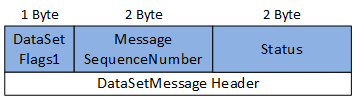
Table A.5 shows the configuration for the DataSetMessage header.
| Name | Type | Restrictions |
| DataSetFlags1 | Byte | Bit 0: Indicates whether this DataSetMessage is valid Bit range 1-2: Field Encoding 01 RawData Field Encoding Bit 3: DataSetMessageSequenceNumber enabled = 1 Bit 4: Status enabled Bit 5: ConfigurationVersionMajorVersion enabled = 0 Bit 6: ConfigurationVersionMinorVersion enabled = 0 Bit 7: DataSetFlags2 enabled = 0 |
| DataSetMessageSequenceNumber | UInt16 | Defined by Table 162. |
| StatusCode | UInt16 | Defined by Table 162. |
Table A.6 defines the values for the configuration parameters representing this layout.
| Parameter | Value |
| KeyFrameCount | 1 |
| UadpDataSetMessageContentMask | 0x00000024 This value results of the following options: Bit 2: StatusCode enabled = 1 Bit 5: SequenceNumber enabled = 1 |
| DataSetFieldContentMask | 0x00000020 This value results of the following options: Bit 5: RawData |
| DataSetOrdering | AscendingWriterId or AscendingWriterIdSingle |
A.2.1.8 Example fixed message layout without security
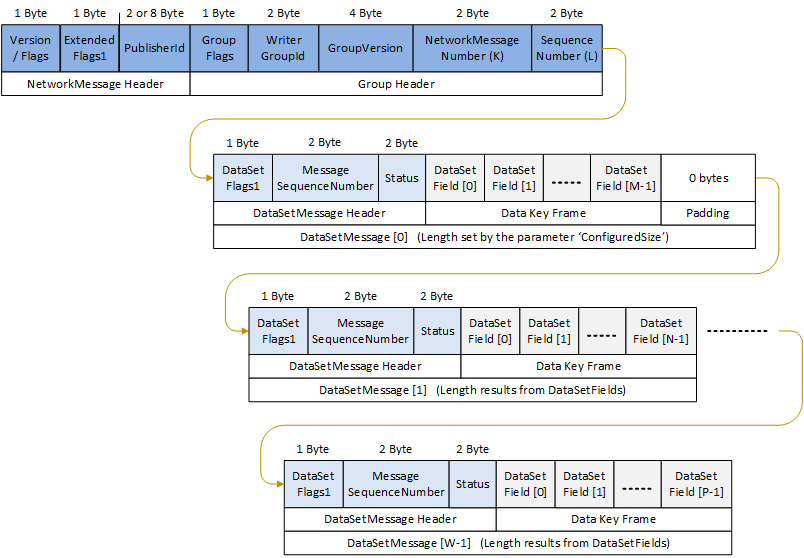
Figure A.5 shows an example for a UADP NetworkMessage with fixed layout as defined in A.2.1.3 and A.2.1.7.
The configuration ensures that every NetworkMessage sent has the same layout of header fields and also the same layout of DataSet fields. This allows a highly efficient encoding and decoding of the message because the offset of all fields is constant and can be pre-calculated. The Payload Header (Count and Sizes for the DataSetMessages and DataSetWriterIds) is deactivated and the Subscriber has to retrieve this information through the DataSetMetaData, DataSetWriter and WriterGroup settings.
The configuration has to ensure that the size of each DataSetMessage is constant. This can be achieved by avoiding DataSet fields of types with variable size, or by using the parameter ConfiguredSize. In this example it is assumed that DataSetMessage[1] and DataSetMessage[W-1] are using RawData field encoding and all DataSet fields are from constant size, so the total length of theses DataSetMessages can be calculated from the DataSetMetaData. For DataSetMessage[0] in this example the Subscriber does not have to calculate the total length but it should take it from the parameter ConfiguredSize. This allows to provide spare bytes for future extension of DataSetMessage[0] without effect on the size of the complete NetworkMessage or the position of other DataSetMessages in this NetworkMessage.
By setting-specific values for KeyFrameCount and DataSetOrdering (see Table A.6) it is guaranteed that the number of DataSetMessages and their order inside the NetworkMessage is the same in every NetworkMessage that is sent.
A.2.1.9 Example fixed message layout with integrity
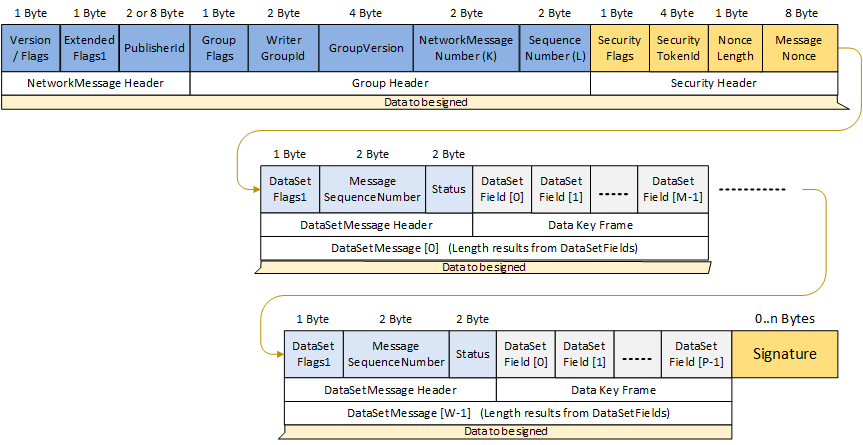
Figure A.6 shows an example for a UADP NetworkMessage with fixed layout and security activated (signing, no encryption) as defined in A.2.1.5 and A.2.1.7.
The layout of all header fields and DataSet fields is constant like described in A.2.1.8. Additional to this the SecurityHeader is activated for signing (but no encryption).