
6.2.11.2 Actions
6.2.11.2.1 ActionState
The ActionState is used to indicate the current state of an Action execution. It is an enumeration of the possible states. The enumeration values are described in Table 81.
| Name | Value | Description |
|---|---|---|
| Idle | 0 | The Action is waiting for activation by a Requestor |
| Executing | 1 | The Action is managing an Action execution. |
| Done | 2 | The Action was completed, The related return values of the last Action call are available |
The ActionState representation in the AddressSpace is defined in Table 82.
| Attribute | Value | ||||
| BrowseName | ActionState | ||||
| IsAbstract | False | ||||
| References | Node Class | BrowseName | DataType | TypeDefinition | Others |
|---|---|---|---|---|---|
| Subtype of Enumeration defined in OPC 10000-5 | |||||
| HasProperty | Variable | EnumStrings | LocalizedText [] | PropertyType | |
| Conformance Units | |||||
|---|---|---|---|---|---|
| PubSub Parameters PublishedDataSet Action |
6.2.11.2.2 Action execution sequence
The Action execution sequence and the related ActionMetaData for an Action execution through a reliable transport protocol like MQTT is described in Figure 26.
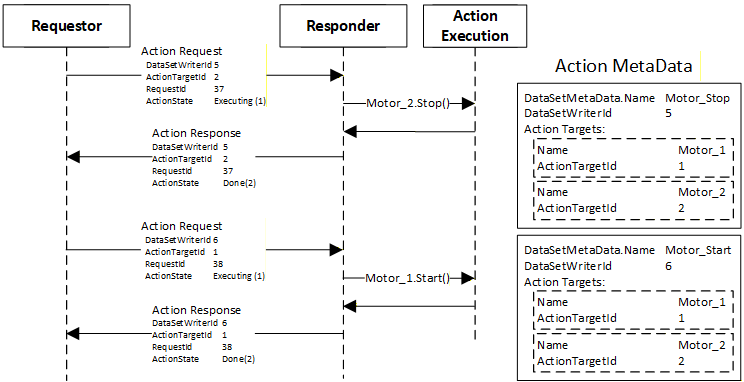
The RequestId is unique within the context of a RequestorId and CorrelationData. Each Action request in a single NetworkMessage has a different RequestId. Multiple NetworkMessages with the same RequestorId and CorrelationData may be sent.
Multiple Responses may be sent in the same NetworkMessage if the corresponding requests have the same RequestorId and CorrelationData. The grouping of requests in NetworkMessages does not affect the grouping of Responses into NetworkMessages.
The Action execution sequence for an Action execution through a non-reliable transport protocol like UDP is described in Figure 27. The related ActionMetaData is described in Figure 26. It shows the use of the ActionState for a non-reliable transport protocol. The request and response messages are send in the PublishingInterval of the Responder as long as the ActionState requires the exchange of messages for a Action execution.
The state changes for Action execution are defined in Table 83 for the Requestor and in Table 84 for the Responder.
| Current State | Condition | Event | State for next message |
| Idle | Start Action execution | Requestor sends Request Message with ActionState = Executing. | Executing |
| Executing | PublishingInterval expired and no Done or Executing received from Responder. | Requestor sends Request Message again with ActionState = Executing. | Executing |
| Executing | Received Done from Responder | Requestor sends Request Message with ActionState = Idle | Idle |
| Done | PublisihingInterval expire and no Idle received. | Requestor sends Request Message again with ActionState = Idle. | Idle |
| Done | Received Idle from Responder | None |
| Current State | Condition | Event | State for next message |
| Idle | Receives RequestMessage for a new combination of RequestorId, CorrelationData and RequestId. | Begins processing Action. | Executing |
| Executing | PublishingInterval expired and Action execution is still in progress. | Responder sends Response Message with ActionState = Executing, Status = Good and the payload is empty. | Executing |
| Executing | Action execution completed. | Responder sends Response Message with ActionState = Done, Status = Action result and payload provided for Good and Uncertain Status and payload is empty for Bad Status. | Done |
| Done | PublishingInterval expired and did not receive Idle from Requestor yet | Responder sends Response Message again with ActionState = Done until Idle is received from the Requestor or the time duration defined by the TimeoutHint request parameter ends. | Done |
| Done | Received Idle from Requestor | None |
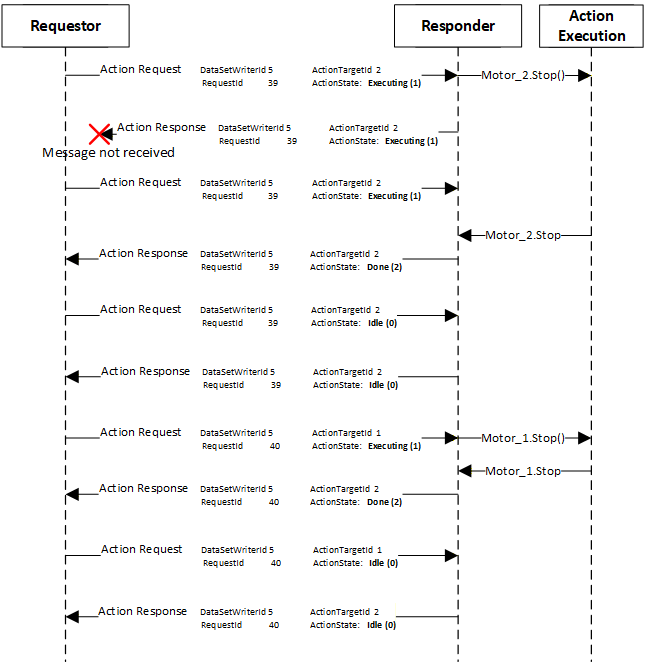
Errors during the execution of an Action are reported in the Status of the Action response message.
For some errors such as decoding errors for the request message, addressing errors or failing security checks, the Responder does not produce a response message. Therefore the Requestor should have an internal timeout setting to stop waiting for a response message.
6.2.11.2.3 Action specific use of parameters
The Action specific use of PubSub configuration parameters is defined in Table 85.
Note that the reliability of the protocol depends on the QoS levels supported by the protocol. Any Broker-based middleware that is using a QoS of AtLeastOnce or greater is reliable (see 6.4.2.5.4). Broker-less middle is not reliable if it does not support any DatagramQoS (see 6.4.1.2.6).
| PubSubComponent | Parameter | Description |
| PubSubConnectionDataType | ReaderGroups | Readers are not used for Actions. |
| WriterGroupDataType | PublishingInterval | The value is 0 for reliable transport protocols. The value shall be larger than 0 for non-reliable transport protocols. The Requestor and Responder resends Action messages that have not been acknowledged by the receiver with this frequency. |
| KeepAliveTime | This value is not used and set to 0. | |
| HeaderLayoutUri | For JSON messages the JSON-NetworkMessage header layout URI is used (see A.3.4). For UADP messages this value is UADP-Dynamic header layout URI is used (see A.2.2). | |
| BrokerWriterGroupTransportDataType | QueueName | The address that the Requestor uses to send requests to the Responder. |
| RequestedDeliveryGuarantee | Shall be AtLeastOnce or better | |
| UadpWriterGroupMessageDataType | SamplingOffset | Always -1. |
| NetworkMessageContentMask | Bit 0: PublisherId is always 1 | |
| JsonWriterGroupMessageDataType | NetworkMessageContentMask | Bit 0: NetworkMessageHeader is always 1. Bit 1: DataSetMessageHeader is always 1. Bit 2: SingleDataSetMessage is always 0. Bit 3: PublisherId is always 1 Bit 5: ReplyTo is is always 0. |
| DataSetWriterDataType | DataSetFieldContentMask | Always 0. |
| KeyFrameCount | Always 0. | |
| DataSetName | The name of the ActionMetaData. | |
| UadpDataSetWriterMessageDataType | DataSetMessageContentMask | Bit 1: PicoSeconds is always 0. Bit 2: Status is always 1, however, it is not sent in requests. |
| JsonDataSetWriterMessageDataType | DataSetMessageContentMask | Bit 2: SequenceNumber is always 0. Bit 4: Status is always 1, however, it is not sent in requests. Bit 5: MessageType is always 0. Bit 8: PublisherId is always 0 |
| DatagramWriterGroupTransport2DataType | MessageRepeatCount | Always 0 |
| MessageRepeatDelay | Always 0 | |
| BrokerDataSetWriterTransportDataType | QueueName | Not used. |
| RequestedDeliveryGuarantee | Not used. | |
| MetaDataQueueName | The address used to send ActionMetaData Messages. | |