
1 Scope
This standard defines a communication interface for commercial kitchen equipment.
This standard specifies manufacturer-neutral communication systems and serves as a design basis for communication protocols in commercial kitchen equipment as well as devices in these networks.
This standard does not specify any safety requirements with regard to device technology and data access.
OPC Foundation
OPC is the interoperability standard for the secure and reliable exchange of data and information in the industrial automation space and in other industries. It is platform independent and ensures the seamless flow of information among devices from multiple vendors. The OPC Foundation is responsible for the development and maintenance of this standard.
OPC UA is a platform independent service-oriented architecture that integrates all the functionality of the individual OPC Classic specifications into one extensible framework. This multi-layered approach accomplishes the original design specification goals of:
Platform independence: from an embedded microcontroller to cloud-based infrastructure
Secure: encryption, authentication, authorization and auditing
Extensible: ability to add new features including transports without affecting existing applications
Comprehensive information modelling capabilities: for defining any model from simple to complex
HKI
Manufacturers of commercial kitchen equipment and domestic heating and cooking appliances are organized in HKI industrial association of House, Heating and Kitchen Technology. Both manufacturer groups are organized in separate associations which are subdivided into device-specific departments.
2 Normative references
The following referenced documents are indispensable for the application of this specification. For dated references, only the edition cited applies. For undated references, the latest edition of the referenced document (including any amendments) applies.
| OPC 10000-1, | OPC Unified Architecture - Part 1: Overview and Concepts |
| OPC 10000-3, | OPC Unified Architecture - Part 3: Address Space Model |
| OPC 10000-4, | OPC Unified Architecture - Part 4: Services |
| OPC 10000-5, | OPC Unified Architecture - Part 5: Information Model |
| OPC 10000-6, | OPC Unified Architecture - Part 6: Mappings |
| OPC 10000-7, | OPC Unified Architecture - Part 7: Profiles |
| OPC 10000-8, | OPC Unified Architecture - Part 8: Data Access |
| OPC 10000-9, | OPC Unified Architecture - Part 9: Alarms and Conditions |
| OPC 10000-100, | OPC Unified Architecture - Part 100: Device Information Model |
3 Terms, definitions and conventions
3.1 Overview
It is assumed that basic concepts of OPC UA information modelling and commercial kitchen devices are understood in this specification. This specification will use these concepts to describe the commercial kitchen devices information model. For the purposes of this document, the terms and definitions given in OPC 10000-1, OPC 10000-3, OPC 10000-4, OPC 10000-5, OPC 10000-7, OPC 10000-100 as well as the following apply.
Note that OPC UA terms and terms defined in this specification are italicized in the specification.
3.2 OPC UA for commercial kitchen devices terms
3.2.1 Communication interface
electronic interface for the exchange of data
3.2.2 Device
3.3 Abbreviations and symbols
| HACCP | Hazard Analysis and Critical Control Points |
| IEC | International Electrotechnical Commission |
| OPC UA | OPC Unified Architecture |
| UTC | Universal Time Coordinated |
3.4 Conventions used in this document
3.4.1 Conventions for Node descriptions
Node definitions are specified using tables (see Table 2).
Attributes are defined by providing the Attribute name and a value, or a description of the value.
References are defined by providing the ReferenceType name, the BrowseName of the TargetNode and its NodeClass.
If the TargetNode is a component of the Node being defined in the table the Attributes of the composed Node are defined in the same row of the table.
The DataType is only specified for Variables; "[<number>]" indicates a single-dimensional array, for multi-dimensional arrays the expression is repeated for each dimension (e.g. [2][3] for a two-dimensional array). For all arrays the ArrayDimensions is set as identified by <number> values. If no <number> is set, the corresponding dimension is set to 0, indicating an unknown size. If no number is provided at all the ArrayDimensions can be omitted. If no brackets are provided, it identifies a scalar DataType and the ValueRank is set to the corresponding value. In addition, ArrayDimensions is set to null or is omitted. If it can be Any or ScalarOrOneDimension, the value is put into "{<value>}", so either "{Any}" or "{ScalarOrOneDimension}" and the ValueRank is set to the corresponding value and the ArrayDimensions is set to null or is omitted. Examples are given in Table 1.
| Notation | DataType | ValueRank | ArrayDimensions | Description |
| Int32 | Int32 | -1 | omitted or null | A scalar Int32. |
| Int32[] | Int32 | 1 | omitted or {0} | Single-dimensional array of Int32 with an unknown size. |
| Int32[][] | Int32 | 2 | omitted or {0,0} | Two-dimensional array of Int32 with unknown sizes for both dimensions. |
| Int32[3][] | Int32 | 2 | {3,0} | Two-dimensional array of Int32 with a size of 3 for the first dimension and an unknown size for the second dimension. |
| Int32[5][3] | Int32 | 2 | {5,3} | Two-dimensional array of Int32 with a size of 5 for the first dimension and a size of 3 for the second dimension. |
| Int32{Any} | Int32 | -2 | omitted or null | An Int32 where it is unknown if it is scalar or array with any number of dimensions. |
| Int32{ScalarOrOneDimension} | Int32 | -3 | omitted or null | An Int32 where it is either a single-dimensional array or a scalar. |
The TypeDefinition is specified for Objects and Variables.
The TypeDefinition column specifies a symbolic name for a NodeId, i.e. the specified Node points with a HasTypeDefinition Reference to the corresponding Node.
The ModellingRule of the referenced component is provided by specifying the symbolic name of the rule in the ModellingRule column. In the AddressSpace, the Node shall use a HasModellingRule Reference to point to the corresponding ModellingRule Object.
If the NodeId of a DataType is provided, the symbolic name of the Node representing the DataType shall be used.
Nodes of all other NodeClasses cannot be defined in the same table; therefore only the used ReferenceType, their NodeClass and their BrowseName are specified. A reference to another part of this document points to their definition.
Table 2 illustrates the table. If no components are provided, the DataType, TypeDefinition and ModellingRule columns may be omitted and only a Comment column is introduced to point to the Node definition.
| Attribute | Value | ||||
| Attribute name | Attribute value. If it is an optional Attribute that is not set "--" will be used. | ||||
| References | NodeClass | BrowseName | DataType | TypeDefinition | ModellingRule |
|---|---|---|---|---|---|
| ReferenceType name | NodeClass of the TargetNode. | BrowseName of the target Node. If the Reference is to be instantiated by the server, then the value of the target Node's BrowseName is "--". | DataType of the referenced Node, only applicable for Variables. | TypeDefinition of the referenced Node, only applicable for Variables and Objects. | Referenced ModellingRule of the referenced Node and AccessLevel of the Node if it is a Variable. |
| NOTE Notes referencing footnotes of the table content. | |||||
In addition, the following abbreviations defined in Table 3 are used in the ModellingRule column in the tables for the definition of ObjectTypes.
| Abbreviation | Description |
| O | Modelling Rule Optional |
| M | Modelling Rule Mandatory |
| OP | Modelling Rule OptionalPlaceholder |
| MP | Modelling Rule MandatoryPlaceholder |
| R | AccessLevel Readable |
| W | AccessLevel Writable |
| RW | AccessLevel Readable and Writable |
As example for the use of the Modelling Rule Mandatory and AccessLevel Readable and Writable variables, the abbreviation is "M, RW".
Components of Nodes can be complex that is containing components by themselves. The TypeDefinition, NodeClass, DataType and ModellingRule can be derived from the type definitions, and the symbolic name can be created as defined in 3.4.3.1. Therefore, those containing components are not explicitly specified; they are implicitly specified by the type definitions.
3.4.2 NodeIds and BrowseNames
3.4.2.1 NodeIds
The NodeIds of all Nodes described in this standard are only symbolic names. Annex A defines the actual NodeIds.
The symbolic name of each Node defined in this specification is its BrowseName, or, when it is part of another Node, the BrowseName of the other Node, a ".", and the BrowseName of itself. In this case "part of" means that the whole has a HasProperty or HasComponent Reference to its part. Since all Nodes not being part of another Node have a unique name in this specification, the symbolic name is unique.
The namespace for all NodeIds defined in this specification is defined in Annex A. The namespace for this NamespaceIndex is Server-specific and depends on the position of the namespace URI in the server namespace table.
Note that this specification not only defines concrete Nodes, but also requires that some Nodes shall be generated, for example one for each Session running on the Server. The NodeIds of those Nodes are Server-specific, including the namespace. But the NamespaceIndex of those Nodes cannot be the NamespaceIndex used for the Nodes defined in this specification, because they are not defined by this specification but generated by the Server.
3.4.2.2 BrowseNames
The text part of the BrowseNames for all Nodes defined in this specification is specified in the tables defining the Nodes. The NamespaceIndex for all BrowseNames defined in this specification is defined in Annex A.
If the BrowseName is not defined by this specification, a namespace index prefix like '0:EngineeringUnits' or '2:DeviceRevision' is added to the BrowseName. This is typically necessary if a Property of another specification is overwritten or used in the OPC UA types defined in this specification. Table 75 provides a list of namespaces and their indexes as used in this specification.
3.4.3 Common Attributes
3.4.3.1 General
The Attributes of Nodes, their DataTypes and descriptions are defined in OPC 10000-3OPC 10000-3. Attributes not marked as optional are mandatory and shall be provided by a Server. The following tables define if the Attribute value is defined by this specification or if it is server-specific.
For all Nodes specified in this specification, the Attributes named in Table 4 shall be set as specified in the table.
| Attribute | Value |
| DisplayName | The DisplayName is a LocalizedText. Each server shall provide the DisplayName identical to the BrowseName of the Node for the LocaleId "en". Whether the server provides translated names for other LocaleIds is server-specific. |
| Description | Optionally a server-specific description is provided. |
| NodeClass | Shall reflect the NodeClass of the Node. |
| NodeId | The NodeId is described by BrowseNames as defined in 3.4.2.1. |
| WriteMask | Optionally the WriteMask Attribute can be provided. If the WriteMask Attribute is provided, it shall set all non-server-specific Attributes to not writable. For example, the Description Attribute may be set to writable since a Server may provide a server-specific description for the Node. The NodeId shall not be writable, because it is defined for each Node in this specification. |
| UserWriteMask | Optionally the UserWriteMask Attribute can be provided. The same rules as for the WriteMask Attribute apply. |
| RolePermissions | Optionally server-specific role permissions can be provided. |
| UserRolePermissions | Optionally the role permissions of the current Session can be provided. The value is server-specifc and depend on the RolePermissions Attribute (if provided) and the current Session. |
| AccessRestrictions | Optionally server-specific access restrictions can be provided. |
3.4.3.2 Objects
For all Objects specified in this specification, the Attributes named in Table 5 shall be set as specified in the Table 5. The definitions for the Attributes can be found in OPC 10000-3.
| Attribute | Value |
| EventNotifier | Whether the Node can be used to subscribe to Events or not is server-specific. |
3.4.3.3 Variables
For all Variables specified in this specification, the Attributes named in Table 6 shall be set as specified in the table. The definitions for the Attributes can be found in OPC 10000-3.
| Attribute | Value |
| MinimumSamplingInterval | Optionally, a server-specific minimum sampling interval is provided. |
| AccessLevel | The access level for Variables used for type definitions is server-specific, for all other Variables defined in this specification, the access level shall allow reading; other settings are server-specific. |
| UserAccessLevel | The value for the UserAccessLevel Attribute is server-specific. It is assumed that all Variables can be accessed by at least one user. |
| Value | For Variables used as InstanceDeclarations, the value is server-specific; otherwise it shall represent the value described in the text. |
| ArrayDimensions | If the ValueRank does not identify an array of a specific dimension (i.e. ValueRank <= 0) the ArrayDimensions can either be set to null or the Attribute is missing. This behaviour is server-specific. If the ValueRank specifies an array of a specific dimension (i.e. ValueRank > 0) then the ArrayDimensions Attribute shall be specified in the table defining the Variable. |
| Historizing | The value for the Historizing Attribute is server-specific. |
| AccessLevelEx | If the AccessLevelEx Attribute is provided, it shall have the bits 8, 9, and 10 set to 0, meaning that read and write operations on an individual Variable are atomic, and arrays can be partly written. |
3.4.3.4 VariableTypes
For all VariableTypes specified in this specification, the Attributes named in Table 7 shall be set as specified in the table. The definitions for the Attributes can be found in OPC 10000-3.
| Attributes | Value |
| Value | Optionally a server-specific default value can be provided. |
| ArrayDimensions | If the ValueRank does not identify an array of a specific dimension (i.e. ValueRank <= 0) the ArrayDimensions can either be set to null or the Attribute is missing. This behaviour is server-specific. If the ValueRank specifies an array of a specific dimension (i.e. ValueRank > 0) then the ArrayDimensions Attribute shall be specified in the table defining the VariableType. |
3.4.3.5 Methods
For all Methods specified in this specification, the Attributes named in Table 8 shall be set as specified in the table. The definitions for the Attributes can be found in OPC 10000-3.
| Attributes | Value |
| Executable | All Methods defined in this specification shall be executable (Executable Attribute set to "True"), unless it is defined differently in the Method definition. |
| UserExecutable | The value of the UserExecutable Attribute is server-specific. It is assumed that all Methods can be executed by at least one user. |
4 Introduction to OPC Unified Architecture
4.1 What is OPC UA?
OPC UA is an open and royalty free set of standards designed as a universal communication protocol. While there are numerous communication solutions available, OPC UA has key advantages:
A state of art security model (see OPC 10000-2).
A fault tolerant communication protocol.
An information modelling framework that allows application developers to represent their data in a way that makes sense to them.
OPC UA has a broad scope which delivers for economies of scale for application developers. This means that a larger number of high quality applications at a reasonable cost are available. When combined with semantic models such as commercial kitchen devices, OPC UA makes it easier for end users to access data via generic commercial applications.
The OPC UA model is scalable from small devices to ERP systems. OPC UA Servers process information locally and then provide that data in a consistent format to any application requesting data - ERP, MES, PMS, Maintenance Systems, HMI, Smartphone or a standard Browser, for examples. For a more complete overview see OPC 10000-1.
4.2 Basics of OPC UA
As an open standard, OPC UA is based on standard internet technologies, like TCP/IP, HTTP, Web Sockets.
As an extensible standard, OPC UA provides a set of Services (see OPC 10000-4) and a basic information model framework. This framework provides an easy manner for creating and exposing vendor defined information in a standard way. More importantly all OPC UA Clients are expected to be able to discover and use vendor-defined information. This means OPC UA users can benefit from the economies of scale that come with generic visualization and historian applications. This specification is an example of an OPC UA Information Model designed to meet the needs of developers and users.
OPC UA Clients can be any consumer of data from another device on the network to browser based thin clients and ERP systems. The full scope of OPC UA applications is shown in Figure 1.
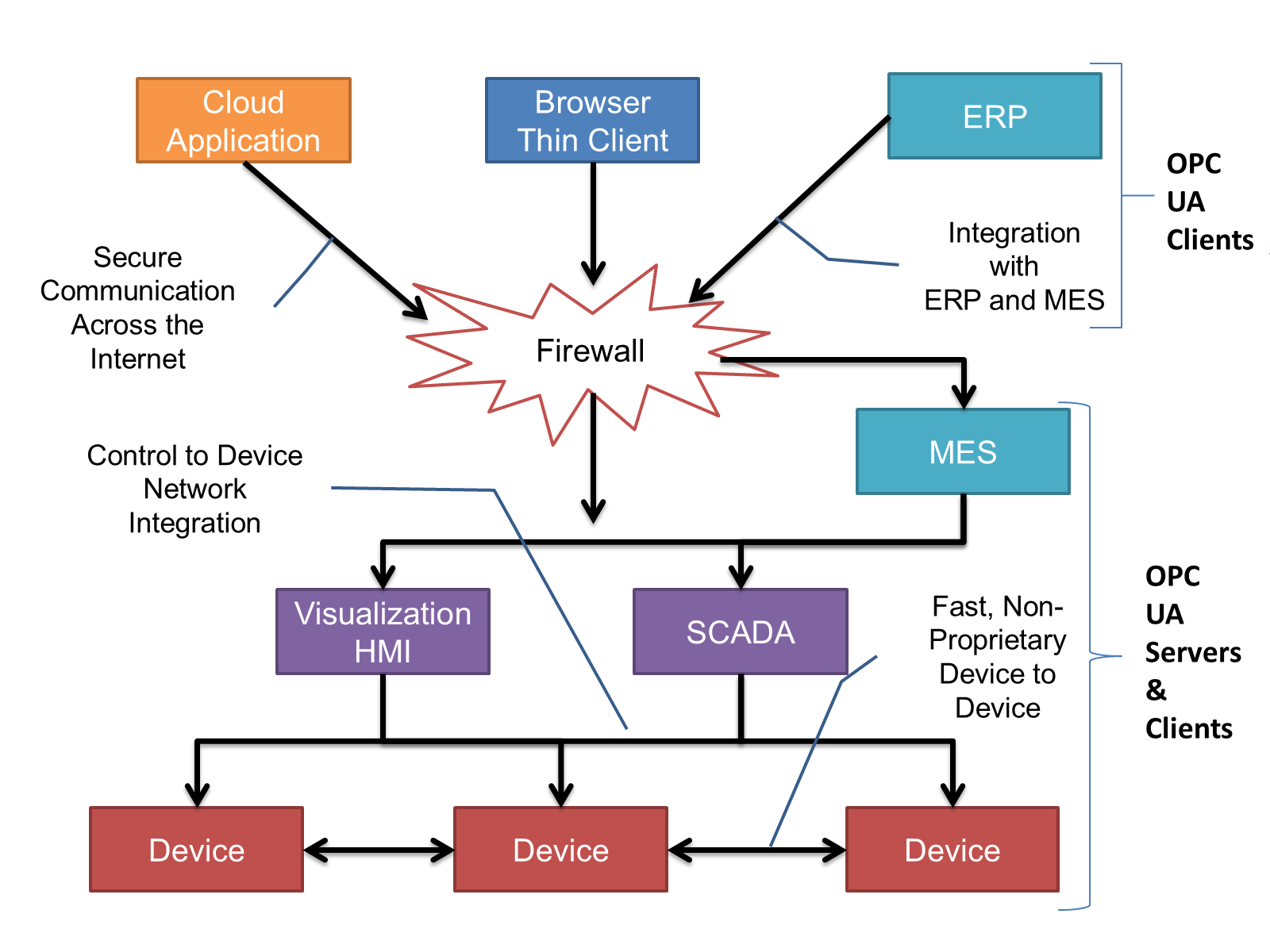
OPC UA provides a robust and reliable communication infrastructure having mechanisms for handling lost messages, failover, heartbeat, etc. With its binary encoded data, it offers a high-performing data exchange solution. Security is built into OPC UA as security requirements become more and more important especially since environments are connected to the office network or the internet and attackers are starting to focus on automation systems.
4.3 Information modelling in OPC UA
4.3.1 Concepts
OPC UA provides a framework that can be used to represent complex information as Objects in an AddressSpace which can be accessed with standard services. These Objects consist of Nodes connected by References. Different classes of Nodes convey different semantics. For example, a Variable Node represents a value that can be read or written. The Variable Node has an associated DataType that can define the actual value, such as a string, float, structure etc. It can also describe the Variable value as a variant. A Method Node represents a function that can be called. Every Node has a number of Attributes including a unique identifier called a NodeId and non-localized name called as BrowseName. An Object representing a 'Reservation' is shown in Figure 2.
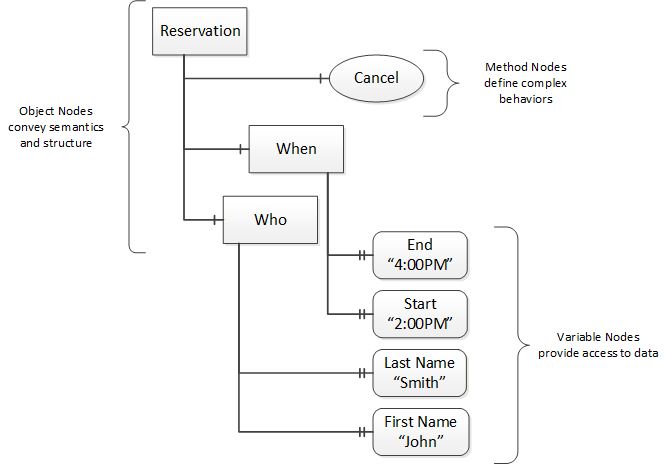
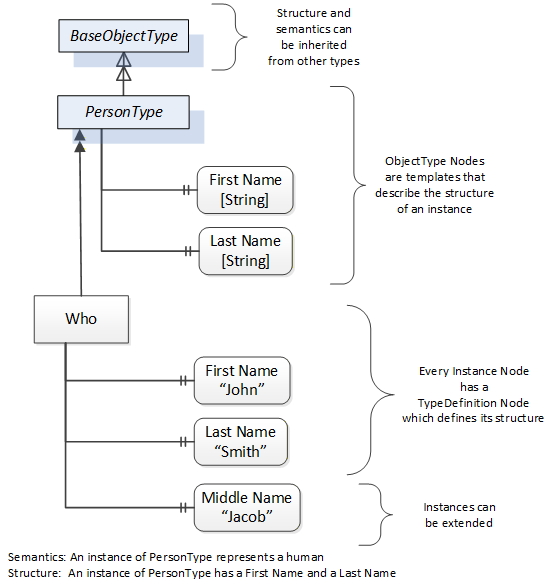
Object and Variable Nodes represent instances and they always reference a TypeDefinition (ObjectType or VariableType) Node which describes their semantics and structure. Figure 3 illustrates the relationship between an instance and its TypeDefinition.
The type Nodes are templates that define all of the children that can be present in an instance of the type. In the example in Figure 3 the PersonType ObjectType defines two children: First Name and Last Name. All instances of PersonType are expected to have the same children with the same BrowseNames. Within a type the BrowseNames uniquely identify the children. This means Client applications can be designed to search for children based on the BrowseNames from the type instead of NodeIds. This eliminates the need for manual reconfiguration of systems if a Client uses types that multiple Servers implement.
OPC UA also supports the concept of sub-typing. This allows a modeller to take an existing type and extend it. There are rules regarding sub-typing defined in OPC 10000-3, but in general they allow the extension of a given type or the restriction of a DataType. For example, the modeller may decide that the existing ObjectType in some cases needs an additional Variable. The modeller can create a subtype of the ObjectType and add the Variable. A Client that is expecting the parent type can treat the new type as if it was of the parent type. Regarding DataTypes, subtypes can only restrict. If a Variable is defined to have a numeric value, a sub type could restrict it to a float.
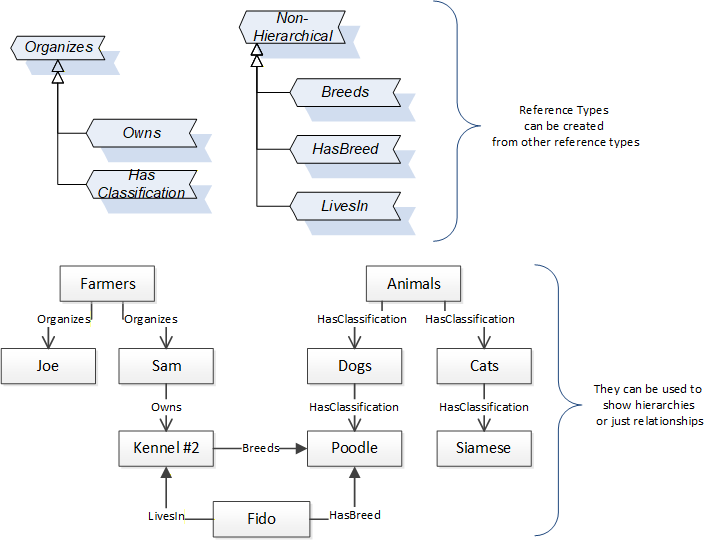
References allow Nodes to be connected in ways that describe their relationships. All References have a ReferenceType that specifies the semantics of the relationship. References can be hierarchical or non-hierarchical. Hierarchical references are used to create the structure of Objects and Variables. Non-hierarchical are used to create arbitrary associations. Applications can define their own ReferenceType by creating subtypes of an existing ReferenceType. Subtypes inherit the semantics of the parent but may add additional restrictions. Figure 4 depicts several References, connecting different Objects.
The figures above use a notation that was developed for the OPC UA specification. The notation is summarized in Figure 5. UML representations can also be used; however, the OPC UA notation is less ambiguous because there is a direct mapping from the elements in the figures to Nodes in the AddressSpace of an OPC UA Server.
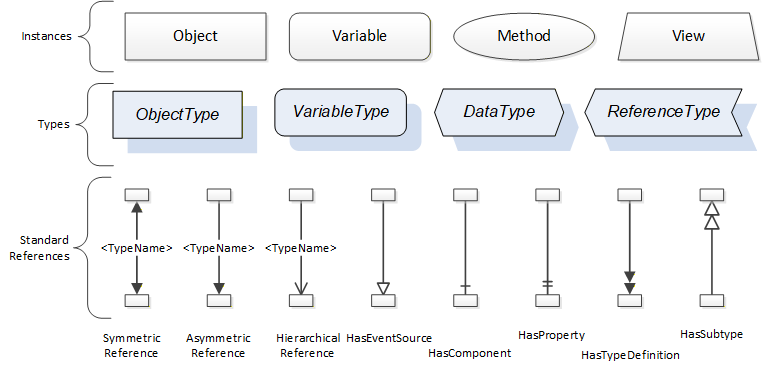
A complete description of the different types of Nodes and References can be found in OPC 10000-3 and the base structure is described in OPC 10000-5.
OPC UA specification defines a very wide range of functionality in its basic information model. It is not expected that all Clients or Servers support all functionality in the OPC UA specifications. OPC UA includes the concept of Profiles, which segment the functionality into testable certifiable units. This allows the definition of functional subsets (that are expected to be implemented) within a companion specification. The Profiles do not restrict functionality, but generate requirements for a minimum set of functionality (see OPC 10000-7)
4.3.2 Namespaces
OPC UA allows information from many different sources to be combined into a single coherent AddressSpace. Namespaces are used to make this possible by eliminating naming and id conflicts between information from different sources. Namespaces in OPC UA have a globally unique string called a NamespaceUri and a locally unique integer called a NamespaceIndex. The NamespaceIndex is only unique within the context of a Session between an OPC UA Client and an OPC UA Server. The Services defined for OPC UA use the NamespaceIndex to specify the Namespace for qualified values.
There are two types of values in OPC UA that are qualified with Namespaces: NodeIds and QualifiedNames. NodeIds are globally unique identifiers for Nodes. This means the same Node with the same NodeId can appear in many Servers. This, in turn, means Clients can have built in knowledge of some Nodes. OPC UA Information Models generally define globally unique NodeIds for the TypeDefinitions defined by the Information Model.
QualifiedNames are non-localized names qualified with a Namespace. They are used for the BrowseNames of Nodes and allow the same names to be used by different information models without conflict. TypeDefinitions are not allowed to have children with duplicate BrowseNames; however, instances do not have that restriction.
4.3.3 Companion Specifications
An OPC UA companion specification for an industry specific vertical market describes an Information Model by defining ObjectTypes, VariableTypes, DataTypes and ReferenceTypes that represent the concepts used in the vertical market, and potentially also well-defined Objects as entry points into the AddressSpace.
5 General type definitions for commercial kitchen devices
5.1 Definitions for the properties of the DeviceType
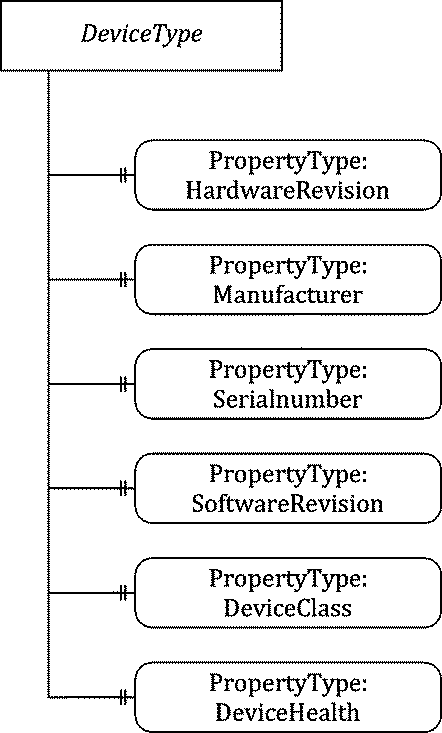
Figure 6 shows an overview of the DeviceType with its Properties.
5.1.1 General
The general DeviceType from the OPC UA information model for the device configuration is taken as the basis in this specification. This information model is defined in IEC62541-100:2015.
All sub types derived from CommercialKitchenDevice can be supplemented by vendor-specific types.
5.1.2 DeviceClass property
The DeviceType defines the DeviceClass property. The classification is industry-specific and is defined for commercial kitchen devices in Table 9.
| DeviceClass | Description |
| Fryer | Fryer Device |
| Frying Pan | Frying Pan Device |
| Combi Steamer | Combi Steamer Device |
| Convection Oven, Multiple Deck Oven | Convection Oven, Multiple Deck Oven Device |
| Pressure Cooking Kettle | Pressure Cooking Kettle Device |
| Cooking Kettle | Cooking Kettle Device |
| Multi Function Pan | Multi Function Pan Device |
| Pasta Cooker / Cook Marie | Pasta Cooker / Cook Marie Device |
| Coffee Machine | Coffee Machine Device |
| Dishwashing Machine | Dishwashing Machine Device |
| Servery System | Servery System Device |
| Cooking Zone | Cooking Zone Device |
| Frying And Grilling Appliance | Frying And Grilling Appliance Device |
| Microwave Combination Oven | Microwave Combination Oven Device |
| Ice Machine | Ice Machine Device |
5.1.3 Manufacturer property
The manufacturer of the device is provided as freely definable text in the Manufacturer property.
5.1.4 Model property
The device designation is provided as freely definable text in the Model property.
5.1.5 SerialNumber property
The identification number, e.g. the serial number of the device, is provided as freely definable text in the SerialNumber property.
5.1.6 HardwareRevision property
The hardware version of the device is provided as freely definable text in the HardwareRevision property.
5.1.7 SoftwareRevision property
The software version of the device is provided as freely definable text in the SoftwareRevision property.
5.1.8 DeviceHealth property
The status of the device is provided as DeviceHealth enumeration in the DeviceHealth property. The possible values are NORMAL_0, FAILURE_1, CHECK_FUNCTION_2, OFF_SPEC_3 and MAINTENANCE_REQUIRED_4.
| NORMAL_0 | The device functions normally. |
| FAILURE_1 | Malfunction of the device or any of its peripherals. Typically caused device-internal or process related. |
| CHECK_FUNCTION_2 | Functional checks are currently performed. Examples: Change of configuration, local operation, substitute value entered. |
| OFF_SPEC_3 | Off-spec means that the device is operating outside its specified range (e.g. measuring or temperature range) or that internal diagnoses indicate deviations from measured or set values due to internal problems in the device or process characteristics. |
| MAINTENANCE_REQUIRED_4 | Although the output signal is valid, the wear reserve is nearly exhausted or a function will soon be restricted due to operational conditions e.g. build-up of deposits. |
5.2 CommercialKitchenDeviceType
5.2.1 General
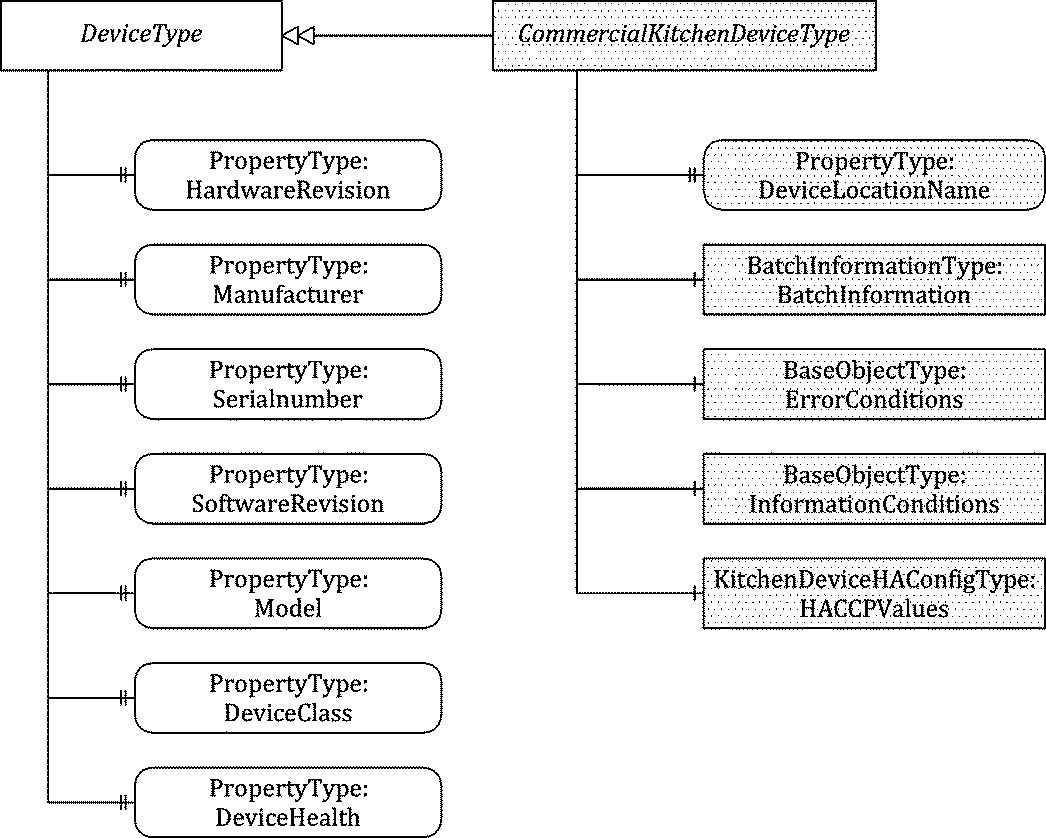
The CommercialKitchenDeviceType represents the basic type for all device classes according to Table 9. It is derived from the general DeviceType from the OPC UA information model for the device configuration. This information model is defined in IEC 62541-100:2015.
Figure 7 shows an overview of the CommercialKitchenDeviceType with its properties and associated Objects. The type is formally defined in Table 10.
5.2.2 Object type definition
The CommercialKitchenDeviceType is formally defined in Table 10.
| Attribute | Value | |||||
| BrowseName | CommercialKitchenDeviceType | |||||
| IsAbstract | True | |||||
| References | NodeClass | BrowseName | DataType | TypeDefinition |
Modelling
Rule | |
|---|---|---|---|---|---|---|
| Subtype of the DeviceType defined in OPC 10000-100. | ||||||
| HasProperty | Variable | 1:DeviceClass | String | PropertyType | M | |
| HasProperty | Variable | DeviceLocationName | String | PropertyType | O | |
| HasComponent | Object | BatchInformation | BatchInformationType | O | ||
| HasComponent | Object | ErrorConditions | BaseObjectType | M | ||
| HasComponent | Object | InformationConditions | BaseObjectType | M | ||
| HasComponent | Object | HACCPValues | FunctionalGroupType | O | ||
5.2.3 Object type description
5.2.3.1 DeviceClass Property
The property DeviceClass of the DeviceType is overwritten in order to change the ModellingRule to Mandatory. The DeviceClass Strings used for this specification are defined in Table 9.
5.2.3.2 DeviceLocationName Property
The DeviceLocationName property represents a user-defined designation of the machine location.
Using this property the user can assign a name to the location, e.g. a room number.
5.2.3.3 BatchInformation Object
The BatchInformation object contains information on batch and article tracking. The BatchInformationType is defined in section 5.3.
5.2.3.4 ErrorConditions Object
The ErrorConditions object contains a list of currently pending error messages.
The basis for the processing of error messages is the Alarm and Condition Model from OPC UA, which is defined in IEC 62541-9:2015.
An error message is represented by an object of the type AlarmConditionType or by a type derived from it.
The AlarmConditionType and its base types define various states such as EnabledState, AckedState or ActiveState and further properties such as Severity, Message, Time and SourceNode. The Retain Property indicates whether an error message is of interest to the client.
Changes to the status of an error message are supplied to the clients via Events. A client can request the current status for all error messages where Retain = true as an event via the ConditionRefresh method. Clients can thus request a list of pending error messages after establishment of a connection.
Clients can confirm error messages via Methods in order, for example, to change the AckedState of the error message.
5.2.3.5 InformationConditions Object
The InformationConditions object contains a list of currently pending information messages.
The basis for the processing of information messages is the Alarm and Condition Model from OPC UA, which is defined in IEC 62541-0:2015.
An item of information is represented by an object of the type AlarmConditionType or by a type derived from it.
5.2.3.6 HACCPValues object
The HACCPValues object contains a list of HACCP-relevant measured values.
If a device provides HACCP-relevant measured values, these measured values must be referenced via the FunctionalGroup HACCPValues.
For HACCP-relevant measured values the corresponding variable must reference an information object of the type KitchenDeviceHAConfigType with the name "HA Configuration". The KitchenDeviceHAConfigType and its use are defined in section 5.4.
5.3 BatchInformationType
5.3.1 General
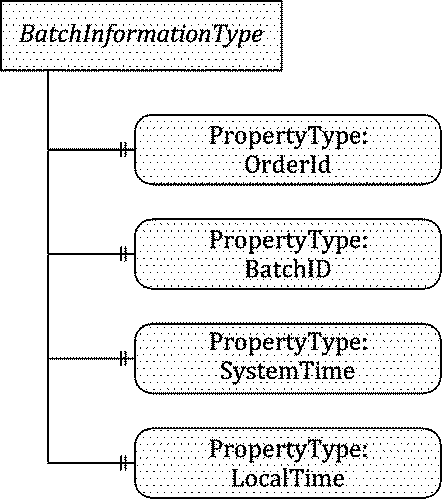
The BatchInformationType defines the data for the tracking of batches and articles.
Figure 8 shows an overview of the BatchInformationType with its Properties. The type is formally defined in Table 11.
5.3.2 Object type definition
The BatchInformationType is formally defined in Table 11.
| Attribute | Value | |||||
| BrowseName | BatchInformationType | |||||
| IsAbstract | False | |||||
| References | NodeClass | BrowseName | DataType | TypeDefinition |
Modelling
Rule | |
|---|---|---|---|---|---|---|
| Subtype of the BaseObjectType defined in OPC 10000-5. | ||||||
| HasProperty | Variable | OrderId | String | PropertyType | M | |
| HasProperty | Variable | BatchId | String | PropertyType | M | |
| HasProperty | Variable | SystemTime | UtcTime | PropertyType | M | |
| HasProperty | Variable | LocalTime | TimeZoneDataType | PropertyType | O | |
5.3.3 ObjectType description
5.3.3.1 OrderId property
The OrderId Property represents the machine user's order number for the traceability.
5.3.3.2 BatchId property
The BatchId Property represents the machine user's batch number for the traceability.
5.3.3.3 SystemTime property
The SystemTime Property represents the current system time as a coordinated world time in UTC format.
5.3.3.3.1 LocalTime property
The LocalTime property represents the current difference between the local time and the UTC time. The data type TimeZoneDataType is defined in OPC 10000-5.
5.4 KitchenDeviceHAConfigType
5.4.1 General
The KitchenDeviceHAConfigType configures the logging of HACCP-relevant data.
Figure 9 shows an overview of the KitchenDeviceHAConfigType with its Properties. The type is formally defined in Table 12.
In the case of variables for which HACCP-relevant measured values are logged on the device, the corresponding variable must offer the settings relevant for the logging via an object with the name "HA Configuration". The BrowseName must have the Namespace Index 0. The KitchenDeviceHAConfigType or a type derived from it is used as the type for this Object.
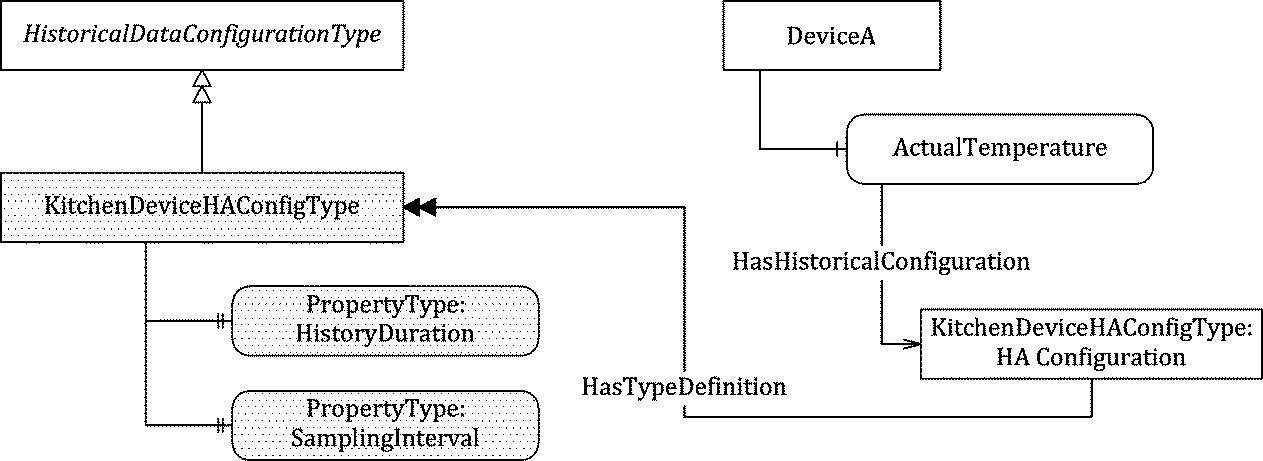
5.4.2 Object type definition
The KitchenDeviceHAConfigType is formally defined in Table 12.
| Attribute | Value | |||||
| BrowseName | KitchenDeviceHAConfigType | |||||
| IsAbstract | False | |||||
| References | NodeClass | BrowseName | DataType | TypeDefinition |
Modelling
Rule | |
|---|---|---|---|---|---|---|
| Subtype of the HistoricalDataConfigurationType defined in OPC 10000-11. | ||||||
| HasProperty | Variable | HistoryDuration | Duration | PropertyType | M | |
| HasProperty | Variable | SamplingInterval | Duration | PropertyType | M | |
5.4.3 ObjectType description
5.4.3.1 HistoryDuration property
The HistoryDuration Property represents the logging time in milliseconds for which data are stored in the device.
5.4.3.2 SamplingInterval property
The SamplingInterval Property represents the sampling rate for the logging in milliseconds.
5.5 KitchenDeviceParameterType
5.5.1 Object type definition
The KitchenDeviceParameterType is formally defined in Table 13. It represents the abstract base type for the device-specific parameter object types.
| Attribute | Value | |||||
| BrowseName | KitchenDeviceParameterType | |||||
| IsAbstract | True | |||||
| References | NodeClass | BrowseName | DataType | TypeDefinition |
Modelling
Rule | |
|---|---|---|---|---|---|---|
| Subtype of the BaseObjectType defined in OPC 10000-5. | ||||||
| HasComponent | Variable | ProgramId | Int32 | BaseDataVariableType | O, R | |
| HasComponent | Variable | ProgramName | LocalizedText | BaseDataVariableType | O, R | |
| HasComponent | Variable | ProgramUId | Guid | BaseDataVariableType | O, R | |
5.5.2 ObjectType description
5.5.2.1 ProgramId variable
The ProgramId Variable with the data type Int32 represents the program number of the currently selected program.
5.5.2.2 ProgramName variable
The ProgramName Variable with the data type LocalizedText represents the program name of the currently selected program. If no names are available, the program number can also be used as text.
5.5.2.3 ProgramUId variable
The ProgramUId Variable with the data type Guid represents the globally unique identifier of the currently selected program.
6 Type definitions for Fryer
6.1 General
The fryer is used to fry various cooked foods, such as French fries and others. A system may consist of one or more fryer vats. Each fryer vat can be operated individually.
If the device is equipped with a lift, the frying basket of each vat can be automatically lowered and raised again after an adjustable cooking time.
Figure 10 shows an overview of the object types for the Fryer device class.
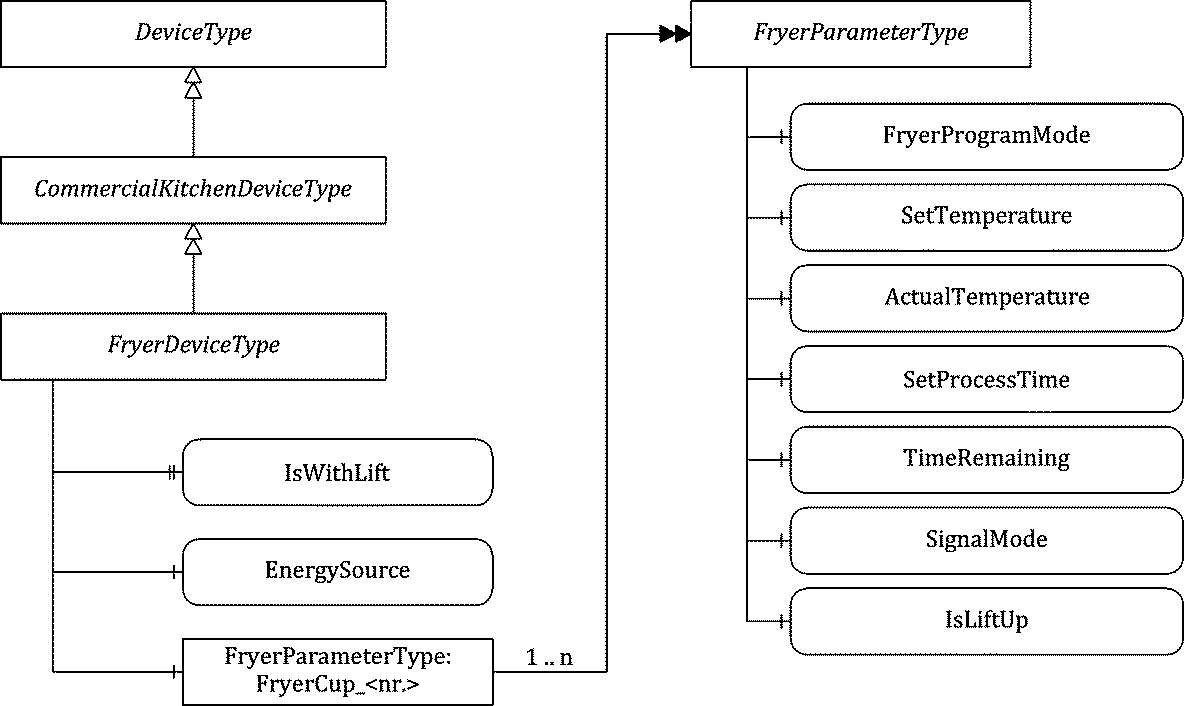
6.2 FryerParameterType
6.2.1 General
FryerParameterType provides information about the state, the set values and the current actual values of a frying vat.
6.2.2 Definition of the object type
The FryerParameterType is formally defined in Table 14.
| Attribute | Value | |||||
| BrowseName | FryerParameterType | |||||
| IsAbstract | False | |||||
| References | NodeClass | BrowseName | DataType | TypeDefinition |
Modelling
Rule AccessLevel | |
|---|---|---|---|---|---|---|
| Subtype of KitchenDeviceParameterType | ||||||
| HasComponent | Variable | ProgramMode | FryerModeEnumeration | BaseDataVariableType | M, R | |
| HasComponent | Variable | SetTemperature | Float | AnalogItemType | M, R | |
| HasComponent | Variable | ActualTemperature | Float | AnalogItemType | M, R | |
| HasComponent | Variable | SetProcessTime | Int32 | AnalogItemType | M, R | |
| HasComponent | Variable | TimeRemaining | Int32 | AnalogItemType | M, R | |
| HasComponent | Variable | SignalMode | SignalModeEnumeration | BaseDataVariableType | M, R | |
| HasComponent | Variable | IsLiftUp | Boolean | BaseDataVariableType | O, R | |
6.2.3 Description of the object type
6.2.3.1 ProgramMode variable
This variable describes the state of the device, e.g. heating up or frying.
The data type for the FryerModeEnumeration is defined in 6.4.1.
6.2.3.2 SetTemperature variable
This variable contains the set temperature to which the frying fat is to be heated.
The EngineeringUnit property of the AnalogItemType has the value °C. The value for the EURange property is device-specific.
6.2.3.3 ActualTemperature variable
This variable describes the currently measured frying temperature.
The EngineeringUnit property of the AnalogItemType has the value °C. The value for the EURange property is device-specific.
6.2.3.4 SetProcessTime variable
This variable describes the set cooking time in seconds.
The EngineeringUnit property of the AnalogItemType has the value s. The value for the EURange property is device-specific.
6.2.3.5 TimeRemaining variable
This variable describes the remaining frying time in seconds.
The EngineeringUnit property of the AnalogItemType has the value s. The value for the EURange property is device-specific.
6.2.3.6 SignalMode variable
This variable describes the state of the signal output. In addition to the on and off states, the "Signal was acknowledged" state is also saved.
The data type for the SignalModeEnumeration is defined in 6.4.2.
6.2.3.7 IsLiftUp variable
This variable describes whether the frying basket is raised.
6.3 FryerDeviceType
6.3.1 General
A fryer may consist of one or more frying vats. Each fryer vat can be operated individually. The device can be equipped with a lift for the frying basket for each existing frying vat.
6.3.2 Definition of the object type
The FryerDeviceType is formally defined in Table 15.
| Attribute | Value | |||||
| BrowseName | FryerDeviceType | |||||
| IsAbstract | False | |||||
| References | NodeClass | BrowseName | DataType | TypeDefinition |
Modelling
Rule AccessLevel | |
|---|---|---|---|---|---|---|
| Subtype of CommercialKitchenDeviceType | ||||||
| HasProperty | Variable | IsWithLift | Boolean | PropertyType | M, R | |
| HasProperty | Variable | EnergySource | EnergySourceEnumeration | PropertyType | M, R | |
| HasComponent | Object | FryerCup_<No.> | FryerParameterType | MP | ||
6.3.3 Descripiton of the object type
6.3.3.1 IsWithLift property
This property describes whether the device has an automatic lift for raising and lowering the frying basket.
6.3.3.2 EnergySource property
The EnergySource property returns the type of energy supply. The data type for the EnergySourceEnumeration is defined in 21.1.
6.3.3.3 FryerCup_<No.> objects
A fryer may consist of one or more frying vats. The FryerCup_<No.> object contains the data of a frying vat.
6.4 Data types for enumerations
6.4.1 FryerModeEnumeration
The data type is an enumeration of the current status of the fryer.
The enumeration values are defined in Table 16.
| Value | Description |
| Off_0 | Off |
| Preheat_1 | Heating up |
| Melting_2 | Fat melting stage (95 °C) |
| Frying_3 | Frying procedure |
| StandBy_4 | Eco-mode, lowering of the temperature |
| Filtering_5 | Oil is being filtered |
| Error_6 | Error state |
6.4.2 SignalModeEnumeration
This data type is an enumeration of the signal state.
The enumeration values are defined in Table 17.
| Value | Description |
| SignalOff_0 | Signal switched off |
| SignalOn_1 | Signal switched on |
| SignalAck_2 | Signal acknowledged |
7 Type definitions for Frying Pan
7.1 General
The term "frying pan" includes the following device types
tilting frying pan;
braising pan
pressure braising pan.
Figure 11 shows an overview of the object types for the Frying Pan device class.
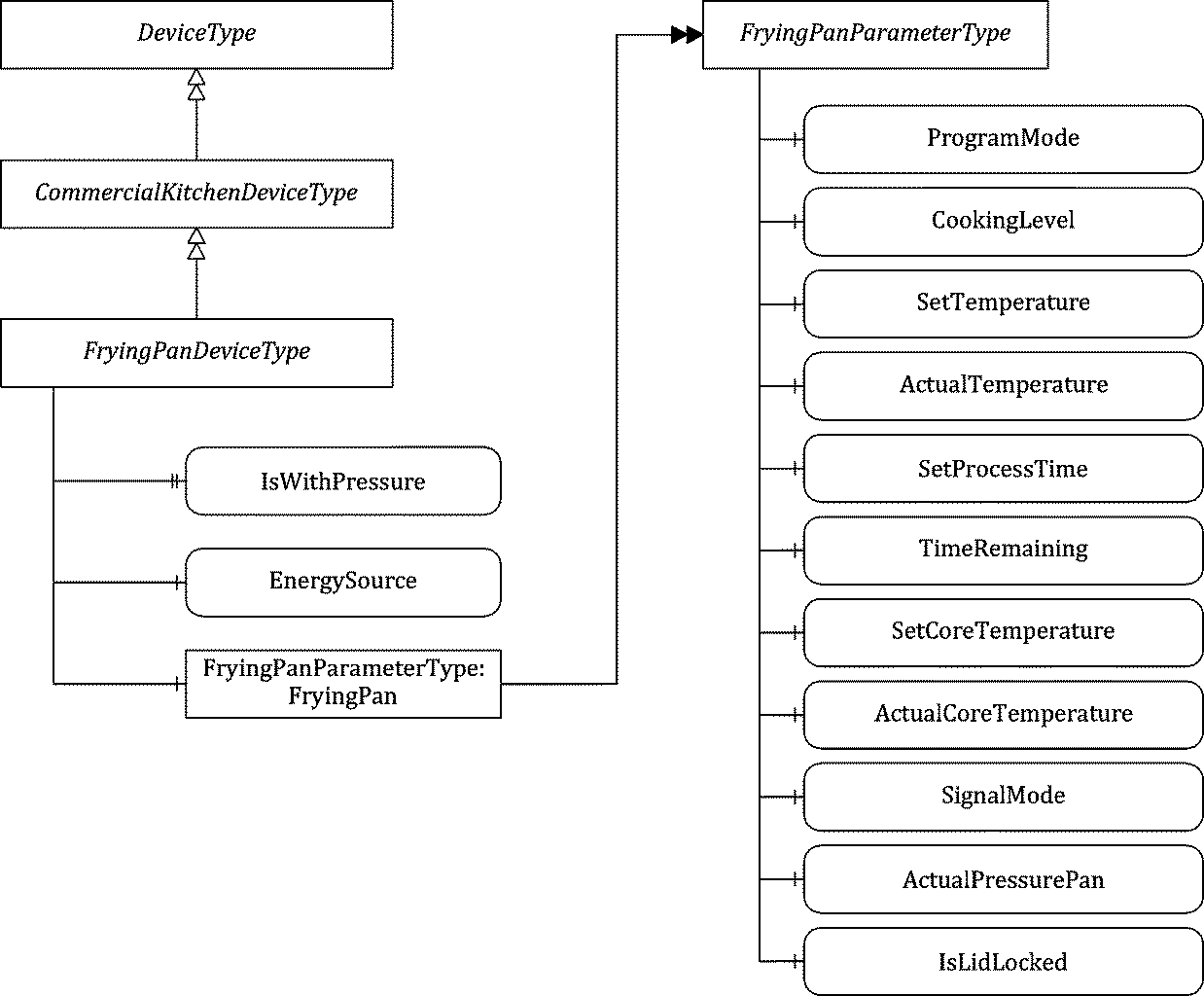
7.2 FryingPanParameterType
7.2.1 General
FryingPanParameterType provides information about the state of the device, the set values and the current actual values.
7.2.2 Definition of the object type
The FryingPanParameterType is formally defined in Table 18.
| Attribute | Value | |||||
| BrowseName | FryingPanParameterType | |||||
| IsAbstract | False | |||||
| References | NodeClass | BrowseName | DataType | TypeDefinition |
Modelling
Rule AccessLevel | |
|---|---|---|---|---|---|---|
| Subtype of KitchenDeviceParameterType | ||||||
| HasComponent | Variable | ProgramMode | FryingPanModeEnumeration | BaseDataVariableType | M, R | |
| HasComponent | Variable | CookingLevel | Int32 | BaseDataVariableType | M, R | |
| HasComponent | Variable | SetTemperature | Float | AnalogItemType | M, R | |
| HasComponent | Variable | ActualTemperature | Float | AnalogItemType | M, R | |
| HasComponent | Variable | SetProcessTime | Int32 | AnalogItemType | M, R | |
| HasComponent | Variable | TimeRemaining | Int32 | AnalogItemType | M, R | |
| HasComponent | Variable | SetCoreTemperature | Float | AnalogItemType | M, R | |
| HasComponent | Variable | ActualCoreTemperature | Float | AnalogItemType | M, R | |
| HasComponent | Variable | SignalMode | SignalModeEnumeration | BaseDataVariableType | M, R | |
| HasComponent | Variable | ActualPressurePan | Float | AnalogItemType | O, R | |
| HasComponent | Variable | IsLidLocked | Boolean | BaseDataVariableType | O, R | |
7.2.3 Description of the object type
7.2.3.1 ProgramMode variable
This variable describes the state of the device, e.g. heating up or frying.
The data type for the FryingPanModeEnumeration is defined in section 7.4.1.
7.2.3.2 CookingLevel variable
This variable describes the cooking level with which heating up is to take place.
The value is used only in the Cook and CookSlow ProgramMode.
7.2.3.3 SetTemperature variable
This variable contains the set temperature to which heating up is to take place. With pressure cooking the set pressure is calculated on the basis of the set temperature.
The EngineeringUnit property of the AnalogItemType has the value °C. The value for the EURange property is device-specific.
7.2.3.4 ActualTemperatur variable
This variable describes the currently measured temperature.
The EngineeringUnit property of the AnalogItemType has the value °C. The value for the EURange property is device-specific.
7.2.3.5 SetProcessTime variable
This variable describes the set process time in seconds.
The EngineeringUnit property of the AnalogItemType has the value s. The value for the EURange property is device-specific.
7.2.3.6 TimeRemaining variable
This variable describes the remaining process time in seconds.
The EngineeringUnit property of the AnalogItemType has the value s. The value for the EURange property is device-specific.
7.2.3.7 SetCoreTemperature variable
This variable describes the set core temperature.
The EngineeringUnit property of the AnalogItemType has the value °C. The value for the EURange property is device-specific.
7.2.3.8 ActualCoreTemperature variable
This variable describes the currently measured core temperature.
The EngineeringUnit property of the AnalogItemType has the value °C. The value for the EURange property is device-specific.
7.2.3.9 SignalMode variable
This variable describes the state of the signal output. In addition to the on and off states, the "Signal was acknowledged" state is also saved.
The data type for the SignalModeEnumeration is defined in 7.4.2.
7.2.3.10 ActualPressurePan variable
This variable describes the currently measured pressure in the pan.
The EngineeringUnit property of the AnalogItemType has the value mbar. The value for the EURange property is device-specific.
7.2.3.11 IsLidLocked variable
This variable describes whether the lid is locked.
7.3 FryingPanDeviceType
7.3.1 General
FryingPanDeviceType describes a device from the FryingPan device class. The following device types belong to this device class:
| - | tilting frying pan; |
| - | braising pan |
| - | pressure braising pan. |
7.3.2 Definition of the object type
The FryingPanDeviceType is formally defined in Table 19.
| Attribute | Value | |||||
| BrowseName | FryingPanDeviceType | |||||
| IsAbstract | False | |||||
| References | NodeClass | BrowseName | DataType | TypeDefinition |
Modelling
Rule AccessLevel | |
|---|---|---|---|---|---|---|
| Subtype of CommercialKitchenDeviceType | ||||||
| HasProperty | Variable | IsWithPressure | Boolean | PropertyType | M, R | |
| HasProperty | Variable | EnergySource | EnergySourceEnumeration | PropertyType | M, R | |
| HasComponent | Object | FryingPan | FryingPanParameterType | M, R | ||
7.3.3 Description of the object type
7.3.3.1 IsWithPressure property
This property describes whether the device has the equipment for pressure cooking.
7.3.3.2 EnergySource property
The Energy property returns the type of energy supply. The data type for the EnergySourceEnumeration is defined in 21.1.
7.3.3.3 Object FryingPan
The FryingPan object contains the parameters for a device of the type FryingPan.
7.4 Data types for enumerations
7.4.1 FryingPanModeEnumeration
The data type is an enumeration of the possible status values of the device.
The enumeration values are defined in Table 20.
| Value | Description |
| Off_0 | Off |
| Preheat_1 | Heating up |
| SoftCook_2 | Gently bring to boil |
| Cook_3 | Bring to boil with 3 simmering stages |
| CookSlow_4 | Boiling with 3 power stages |
| Frying_5 | Frying |
| PressureCooking_6 | Pressure cooking |
| KeepWarming_7 | Keeping warm |
| PresetStart_8 | Start time preselection active |
| Error_9 | Error state |
7.4.2 SignalModeEnumeration
This data type is an enumeration of the signal state.
The enumeration values are defined in Table 21.
| Value | Description |
| SignalOff_0 | Signal switched off |
| SignalOn_1 | Signal switched on |
| SignalAck_2 | Signal acknowledged |
8 Type definitions for Combi Steamer
8.1 General
Various methods of cooking are possible with a combi steamer; these include:
| - | steaming; |
| - | combi steaming; |
| - | hot air; |
| - | regeneration; |
| - | low-temperature cooking; |
| - | delta-T cooking. |
In addition, further vendor-specific types of cooking and actions are possible in a cooking process:
| - | sous-vide cooking; |
| - | keeping warm; |
| - | smoking; |
| - | steaming; |
| - | rest time; |
| - | info display. |
A cooking program may consist of one or more cooking steps. Each cooking step may consist of a cooking method or one of the other actions.
Figure 12 shows an overview of the object types for the Combi Steamer device class.
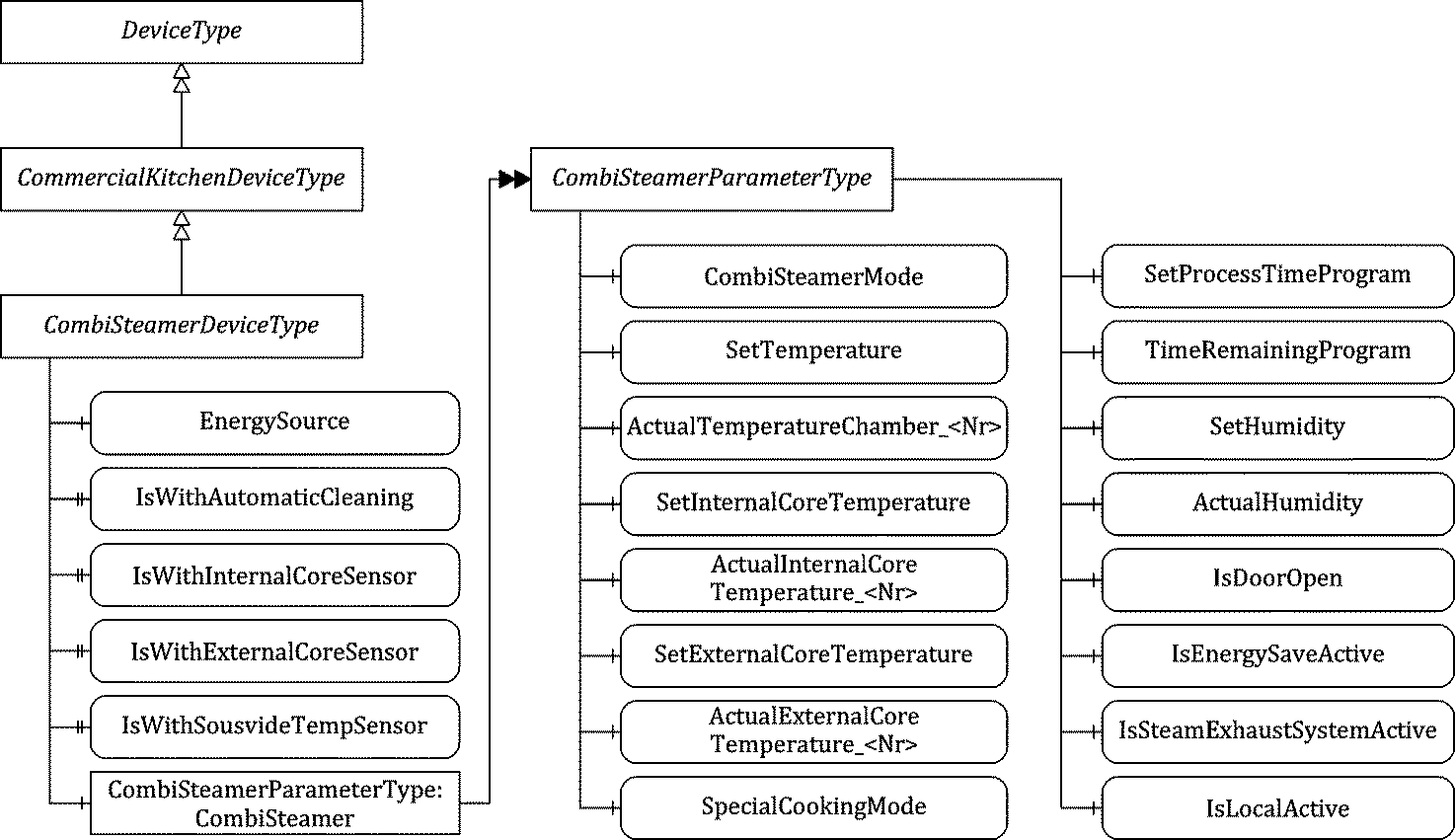
8.2 CombiSteamerParameterType
8.2.1 General
CombiSteamerParameterType provides information about the state of a combi steamer, the set values and the current actual values.
8.2.2 Definition of the object type
The CombiSteamerParameterType is formally defined in Table 22.
| Attribute | Value | ||||
| BrowseName | CombiSteamerParameterType | ||||
| IsAbstract | False | ||||
| References | Node Class | BrowseName | DataType | TypeDefinition |
Modelling
Rule AccessLevel |
|---|---|---|---|---|---|
| Subtype of KitchenDeviceParameterType | |||||
| HasComponent | Variable | CombiSteamerMode | CombiSteamerModeEnumeration | BaseDataVariableType | M, R |
| HasComponent | Variable | SetTemperature | Float | AnalogItemType | M, R |
| HasComponent | Variable | ActualTemperatureChamber_<No.> | Float | AnalogItemType | MP, R |
| HasComponent | Variable | SetProcessTimeProgram | Int32 | AnalogItemType | M, R |
| HasComponent | Variable | TimeRemainingProgram | Int32 | AnalogItemType | M, R |
| HasComponent | Variable | SetInternalCoreTemperature | Float | AnalogItemType | O, R |
| HasComponent | Variable | ActualInternalCoreTemperature_<No.> | Float | AnalogItemType | OP, R |
| HasComponent | Variable | SetExternalCoreTemperature | Float | AnalogItemType | O, R |
| HasComponent | Variable | ActualExternalCoreTemperature_<No.> | Float | AnalogItemType | OP, R |
| HasComponent | Variable | SpecialCookingMode | SpecialCookingModeEnumeration | BaseDataVariableType | O, R |
| HasComponent | Variable | SetProcessTimeStep | Int32 | AnalogItemType | O, R |
| HasComponent | Variable | TimeRemainingStep | Int32 | AnalogItemType | O, R |
| HasComponent | Variable | SetHumidity | Int32 | AnalogItemType | O, R |
| HasComponent | Variable | ActualHumidity | Int32 | AnalogItemType | O, R |
| HasComponent | Variable | IsDoorOpen | Boolean | BaseDataVariableType | M, R |
| HasComponent | Variable | IsEnergySavingActive | Boolean | BaseDataVariableType | O, R |
| HasComponent | Variable | IsSteamExhaustSystemActive | Boolean | BaseDataVariableType | O, R |
| HasComponent | Variable | IsLoaActive | Boolean | BaseDataVariableType | O, R |
8.2.3 Description of the object type
8.2.3.1 CombiSteamerMode variable
This variable describes the state of the device, e.g. preheating, active, cleaning, etc. The data type for the CombiSteamerModeEnumeration is defined in section 8.4.1.
8.2.3.2 SetTemperature variable
This variable contains the set temperature to which heating up is to take place and be regulated.
The EngineeringUnit property of the AnalogItemType has the value °C. The value for the EURange property is device-specific.
8.2.3.3 ActualTemperatureChamber_<No.> variable
The numbered variable ActualTemperaturChamber_<No.> contains the current temperature of a cooking chamber. This variable may be used several times (numbered consecutively), depending on the number of cooking chambers that exist.
The EngineeringUnit property of the AnalogItemType has the value °C. The value for the EURange property is device-specific.
8.2.3.4 SetProcessTimeProgram variable
This variable describes the set process time of the entire cooking program in seconds.
The EngineeringUnit property of the AnalogItemType has the value s. The value for the EURange property is device-specific.
8.2.3.5 TimeRemainingProgram variable
This variable describes the remaining process time of the entire cooking program in seconds, i.e. of the current and all subsequent cooking steps.
The EngineeringUnit property of the AnalogItemType has the value s. The value for the EURange property is device-specific.
8.2.3.6 SetInternalCoreTemperature variable
This variable describes the set core temperature for the internal core temperature sensor.
The EngineeringUnit property of the AnalogItemType has the value °C. The value for the EURange property is device-specific.
8.2.3.7 ActualInternalCoreTemperature_<No.> variable
The numbered variable ActualInternalCoreTemperature_<No.> contains the current temperature of an internal core temperature sensor. This variable may be used several times (numbered consecutively), depending on the number of internal core temperature sensors that exist.
The EngineeringUnit property of the AnalogItemType has the value °C. The value for the EURange property is device-specific.
8.2.3.8 SetExternalCoreTemperature variable
This variable describes the set core temperature for the external core temperature sensor, if the sensor exists.
The EngineeringUnit property of the AnalogItemType has the value °C. The value for the EURange property is device-specific.
8.2.3.9 ActualExternalCoreTemperature_<No.> variable
The numbered variable ActualExternalCoreTemperatur_<No.> contains the current temperature of an external core temperature sensor. This variable may be used several times (numbered consecutively), depending on the number of external core temperature sensors that exist.
The EngineeringUnit property of the AnalogItemType has the value °C. The value for the EURange property is device-specific.
8.2.3.10 SpecialCookingMode variable
This variable describes additional cooking methods that do not belong to the standard scope of a combi steamer.
The data type for the SpecialCookingModeEnumeration is defined in 8.4.2.
8.2.3.11 SetProcessTimeStep variable
This variable describes the set process time of the current cooking step in seconds.
The EngineeringUnit property of the AnalogItemType has the value s. The value for the EURange property is device-specific.
8.2.3.12 TimeRemainingStep variable
This variable describes the remaining process time of the current cooking step in seconds.
The EngineeringUnit property of the AnalogItemType has the value s. The value for the EURange property is device-specific.
8.2.3.13 SetHumidity variable
This variable describes the set humidity in percent.
The EngineeringUnit property of the AnalogItemType has the value %. The value for the EURange property is device-specific.
8.2.3.14 ActualHumidity variable
This variable describes the actual humidity in percent.
The EngineeringUnit property of the AnalogItemType has the value %. The value for the EURange property is device-specific.
8.2.3.15 IsDoorOpen variable
This variable describes whether the door is open.
8.2.3.16 IsEnergySavingActive variable
This variable describes whether the energy saving mode is active. The heating power is reduced in this mode.
8.2.3.17 IsSteamExhaustSystemActive variable
This variable describes whether the steam extraction is active.
8.2.3.18 IsLoaActive variable
This variable describes whether the device, when connected to a power optimisation system (LOA), has received the release for heating. The value applies only to those devices that are equipped with a LOA connection and are connected.
8.3 CombiSteamerDeviceType
8.3.1 General
CombiSteamerDeviceType describes a device from the CombiSteamer device class.
8.3.2 Definition of the object type
The CombiSteamerDeviceType is formally defined in Table 23.
| Attribute | Value | |||||
| BrowseName | CombiSteamerDeviceType | |||||
| IsAbstract | False | |||||
| References | NodeClass | BrowseName | DataType | TypeDefinition |
Modelling
Rule AccessLevel | |
|---|---|---|---|---|---|---|
| Subtype of CommercialKitchenDeviceType | ||||||
| HasProperty | Variable | EnergySource | EnergySourceEnumeration | PropertyType | M, R | |
| HasProperty | Variable | IsWithAutomaticCleaning | Boolean | PropertyType | M, R | |
| HasProperty | Variable | IsWithInternalCoreTempSensor | Boolean | PropertyType | M, R | |
| HasProperty | Variable | IsWithExternalCoreTempSensor | Boolean | PropertyType | M, R | |
| HasProperty | Variable | IsWithSousvideTempSensor | Boolean | PropertyType | M, R | |
| HasComponent | Object | CombiSteamer | CombiSteamerParameterType | M | ||
8.3.3 Description of the object type
8.3.3.1 EnergySource property
The EnergySource property returns the type of energy supply. The data type for the EnergySourceEnumeration is defined in 21.1.
8.3.3.2 IsWithAutomaticCleaning property
This property describes whether the device is equipped with automatic cleaning.
8.3.3.3 IsWithInternalCoreTempSensor property
This property describes whether the device is equipped with an internal core temperature sensor.
8.3.3.4 IsWithExternalCoreTempSensor property
This property describes whether the device is equipped with an external core temperature sensor.
8.3.3.5 IsWithSousvideTempSensor property
This property describes whether the device is equipped with a sous-vide temperature sensor.
8.3.3.6 Object CombiSteamer
The CombiSteamer object contains the parameters for a device of the type CombiSteamer.
8.4 Data types for enumerations
8.4.1 CombiSteamerModeEnumeration
The data type is an enumeration of the current status of the device.
The enumeration values are defined in Table 24.
| Value | Description |
| Off_0 | Off |
| On_1 | On |
| Preheat_2 | Heating up |
| StandBy_3 | Eco mode |
| Steaming_4 | Steaming |
| CombiSteaming_5 | Combi steaming |
| HotAir_6 | Hot air |
| Perfection_7 | Regeneration |
| Cleaning_8 | Cleaning |
| PresetStart_9 | Start time preselection active |
| Error_10 | Error state |
8.4.2 SpecialCookingModeEnumeration
This data type is an enumeration of the various special cooking modes.
The enumeration values are defined in Table 25.
| Value | Description |
| NoSpecialMode_0 | No special mode active |
| Baking_1 | Baking |
| SousVide_2 | Cooking sous-vide |
| RestStage_3 | Resting step |
| Humidification_4 | Steaming |
| PerfectHold_5 | Keeping warm |
| InfoStep_6 | Info step |
| Smoking_7 | Smoking |
| LowTemp-Cooking_8 | LT cooking |
| DeltaTSteaming_9 | Delta-T steaming |
9 Type definitions for Convection Oven, Multiple Deck Oven
9.1 General
Figure 13 shows an overview of the object types for the Convection Oven, Multiple Deck Oven device class.
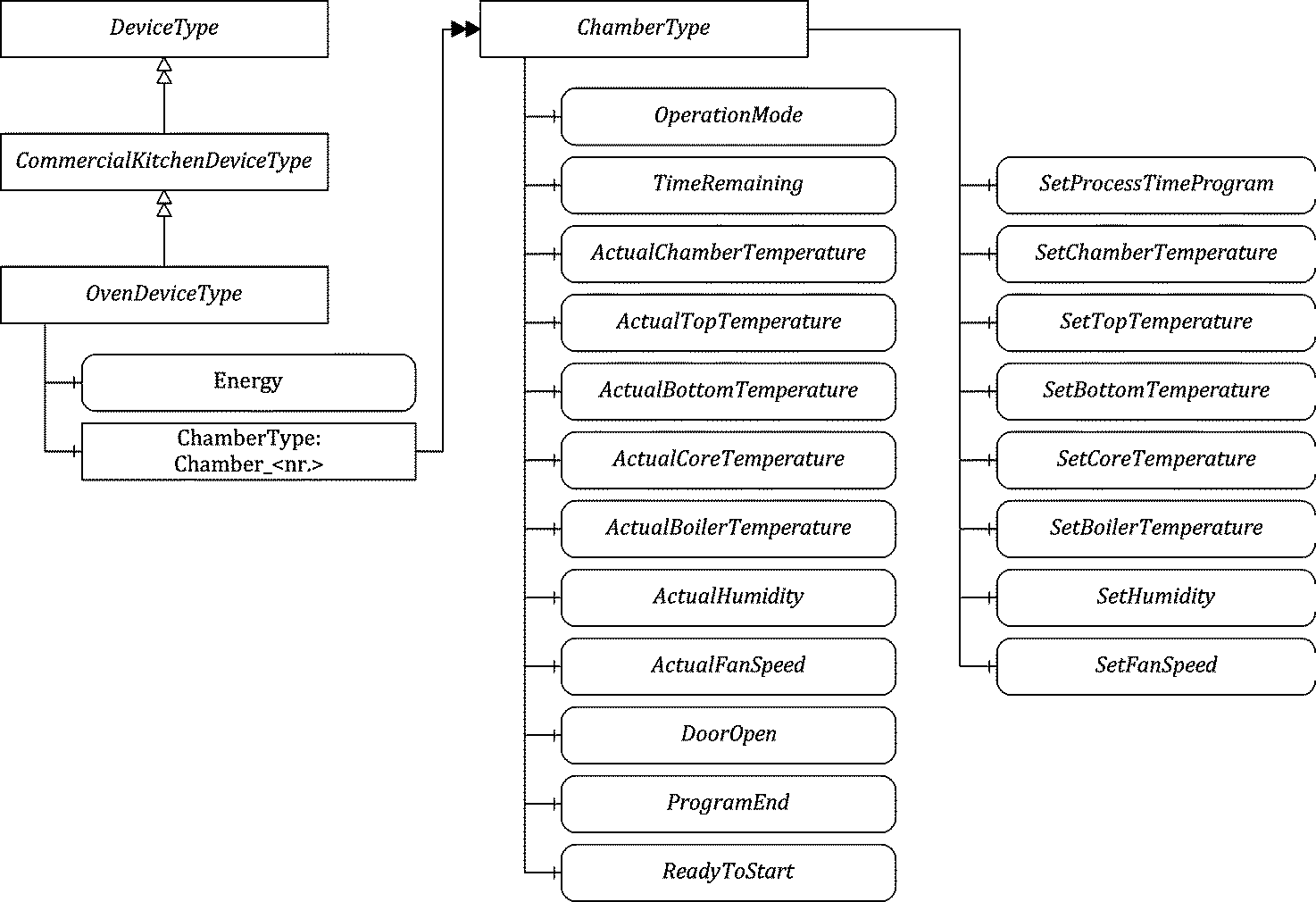
9.2 ChamberType
9.2.1 Definition of the object type
The ChamberType is formally defined in Table 26.
| Attribute | Value | |||||
| BrowseName | ChamberType | |||||
| IsAbstract | False | |||||
| References | NodeClass | BrowseName | DataType | TypeDefinition |
Modelling
Rule AccessLevel | |
|---|---|---|---|---|---|---|
| Subtype of KitchenDeviceParameterType | ||||||
| HasComponent | Variable | OperationMode | ChamberMode Enumeration | BaseDataVariableType | M, R | |
| HasComponent | Variable | TimeRemaining | Int32 | AnalogItemType | O, R | |
| HasComponent | Variable | SetChamberTemperature | Float | AnalogItemType | O, R | |
| HasComponent | Variable | SetTopTemperature | Float | AnalogItemType | O, R | |
| HasComponent | Variable | SetBottomTemperature | Float | AnalogItemType | O, R | |
| HasComponent | Variable | SetCoreTemperature | Float | AnalogItemType | O, R | |
| HasComponent | Variable | SetBoilerTemperature | Float | AnalogItemType | O, R | |
| HasComponent | Variable | ActualChamberTemperature_<No.> | Float | AnalogItemType | OP, R | |
| HasComponent | Variable | SetProcessTimeProgram | Int32 | AnalogItemType | O, R | |
| HasComponent | Variable | ActualTopTemperature_<No.> | Float | AnalogItemType | OP, R | |
| HasComponent | Variable | ActualBottomTemperature_<No.> | Float | AnalogItemType | OP, R | |
| HasComponent | Variable | ActualCoreTemperature_<No.> | Float | AnalogItemType | OP, R | |
| HasComponent | Variable | ActualBoilerTemperature_<No.> | Float | AnalogItemType | OP, R | |
| HasComponent | Variable | SetHumidity | Float | AnalogItemType | O, R | |
| HasComponent | Variable | ActualHumidity_<No.> | Float | AnalogItemType | OP, R | |
| HasComponent | Variable | IsReadyToStart | Boolean | BaseDataVariableType | O, R | |
| HasComponent | Variable | IsProgramEnd | Boolean | BaseDataVariableType | O, R | |
| HasComponent | Variable | IsDoorOpen | Boolean | BaseDataVariableType | O, R | |
| HasComponent | Variable | ActualFanSpeed_<No.> | Int32 | AnalogItemType | OP, R | |
| HasComponent | Variable | SetFanSpeed | Int32 | AnalogItemType | O, R | |
9.2.2 Description of the object type
9.2.2.1 OperationMode variable
The OperationMode variable with the data type ChamberModeEnumeration represents the current operation mode of the chamber.
The data type for the ChamberModeEnumeration is defined in section 9.4.1.
9.2.2.2 TimeRemaining variable
The TimeRemaining variable with the data type Int32 represents the remaining running time of the current process (baking, cooling, cleaning, etc.). 0 is returned if no process running time is intended.
The EngineeringUnit property of the AnalogItemType has the value s. The value for the EURange property is device-specific.
9.2.2.3 SetChamberTemperature variable
This variable represents the set value for the chamber temperature.
The EngineeringUnit property of the AnalogItemType has the value °C. The value for the EURange property is device-specific.
9.2.2.4 SetTopTemperature variable
This variable represents the set value for the top chamber temperature.
The EngineeringUnit property of the AnalogItemType has the value °C. The value for the EURange property is device-specific.
9.2.2.5 SetBottomTemperature variable
This variable represents the set value for the bottom chamber temperature.
The EngineeringUnit property of the AnalogItemType has the value °C. The value for the EURange property is device-specific.
9.2.2.6 SetCoreTemperature variable
This variable represents the set value for the core temperature.
The EngineeringUnit property of the AnalogItemType has the value °C. The value for the EURange property is device-specific.
9.2.2.7 SetBoilerTemperature variable
This variable represents the set value for the temperature of the steam generator.
The EngineeringUnit property of the AnalogItemType has the value °C. The value for the EURange property is device-specific.
9.2.2.8 ActualChamberTemperature_<No.> variable
This variable represents the actual value of the chamber temperature.
The EngineeringUnit property of the AnalogItemType has the value °C. The value for the EURange property is device-specific.
9.2.2.9 SetProcessTimeProgram variable
This variable represents the actual value of the process program time in seconds.
The EngineeringUnit property of the AnalogItemType has the value s. The value for the EURange property is device-specific.
9.2.2.10 ActualTopTemperature_<No.> variable
This variable represents the actual value of the top chamber temperature.
The EngineeringUnit property of the AnalogItemType has the value °C. The value for the EURange property is device-specific.
9.2.2.11 ActualBottomTemperature_<No.> variable
This variable represents the actual value of the bottom chamber temperature.
The EngineeringUnit property of the AnalogItemType has the value °C. The value for the EURange property is device-specific.
9.2.2.12 ActualCoreTemperature_<No.> variable
This variable represents the actual value of the core temperature.
The EngineeringUnit property of the AnalogItemType has the value °C. The value for the EURange property is device-specific.
9.2.2.13 ActualBoilerTemperature_<No.> variable
This variable represents the actual value of the temperature of the steam generator.
The EngineeringUnit property of the AnalogItemType has the value °C. The value for the EURange property is device-specific.
9.2.2.14 SetHumidity variable
This variable represents the set humidity in the chamber.
The EngineeringUnit property of the AnalogItemType has the value rel%. The value for the EURange property is device-specific.
9.2.2.15 ActualHumidity_<No.> variable
This variable represents the actual humidity in the chamber.
The EngineeringUnit property of the AnalogItemType has the value rel%. The value for the EURange property is device-specific.
9.2.2.16 IsReadyToStart variable
This variable is set when all conditions for a program start are satisfied. (Boolean).
9.2.2.17 IsProgramEnd variable
This variable is set when the program has completely finished. (Boolean).
9.2.2.18 IsDoorOpen variable
This variable is set when the chamber door is open. (Boolean).
9.2.2.19 ActualFanSpeed_<No.> variable
This variable represents the current fan speed in percent.
9.2.2.20 SetFanSpeed variable
This variable represents the set fan speed in percent.
9.3 OvenDeviceType
9.3.1 Definition of the object type
The OvenDeviceType is formally defined in Table 27.
| Attribute | Value | |||||
| BrowseName | OvenDeviceType | |||||
| IsAbstract | False | |||||
| References | NodeClass | BrowseName | DataType | TypeDefinition |
Modelling
Rule AccessLevel | |
|---|---|---|---|---|---|---|
| Subtype of CommercialKitchenDeviceType | ||||||
| HasComponent | Object | Chamber_<No.> | ChamberType | MP, R | ||
9.3.2 Description of the object type
9.3.2.1 Chamber_<No.> objects
List of chambers. At least one baking chamber exists. Optionally, further baking chambers (e.g. stoves in the case of multiple deck ovens) may exist. The ChamberType is defined in section 9.2.
Baking chambers are numbered consecutively from bottom to top or from left to right.
9.4 Data types for enumerations
9.4.1 ChamberModeEnumeration
This data type is an enumeration of the signal state.
The enumeration values are defined in Table 28.
| Value | Description |
| NoSpecialMode_0 | No special mode active |
| Off_1 | Off state |
| Autostart_2 | Autostart |
| Standby_3 | Standby |
| PreHeat_4 | Preheating |
| CoolDown_5 | Cooling |
| Working_6 | Process running |
| Cleaning_7 | Cleaning |
| EnergySave_8 | Energy-saving mode |
| ServiceMode_9 | Service mode |
| QuickCool_10 | Quick cooling |
| FlashFreeze_11 | Flash freezing |
| ProofingInterruption_12 | Proofing interruption |
| ProofingDelay_13 | Proofing delay |
| Proofing_14 | Proofing |
| Setting_15 | Setting |
| Defrost_16 | Defrosting |
| Baking_17 | Baking |
| Steaming_18 | Steaming |
10 Type definitions for Pressure Cooking Kettle
10.1 General
Figure 14 shows an overview of the object types for the Pressure Cooking Kettle device class.
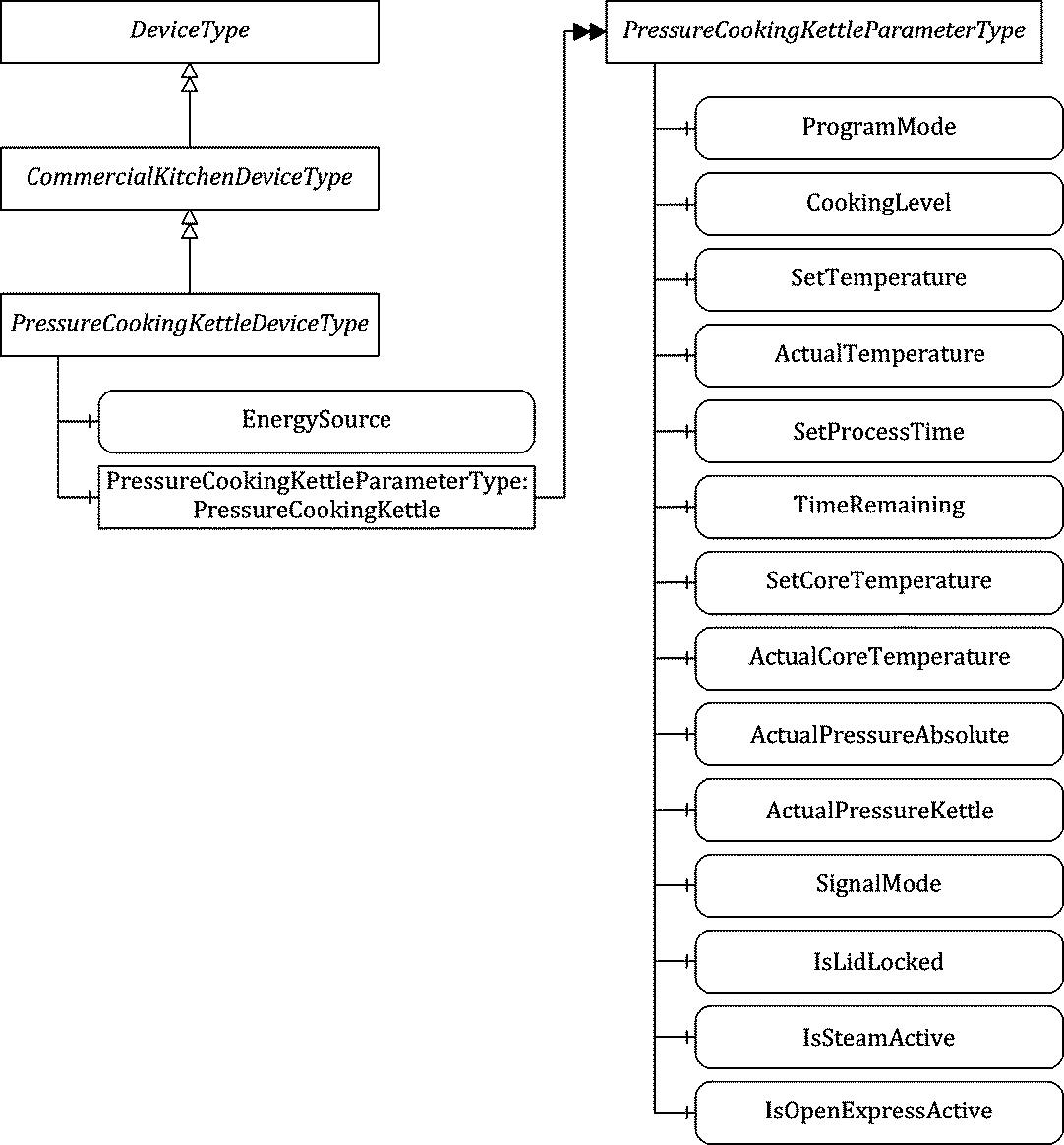
10.2 PressureCookingKettleParameterType
10.2.1 General
Various cooking processes are possible with a pressure cooking kettle; these include:
| - | Gently bring to boil; |
| - | Cooking with various power and simmering stages; |
| - | Pressure cooking; |
| - | Keeping warm. |
In addition, an agitator can be used.
PressureCookingKettleParameterType provides information about the state of the device, the set values and the current actual values.
10.2.2 Definition of the object type
The PressureCookingKettleParameterType is formally defined in Table 29.
| Attribute | Value | |||||
| BrowseName | PressureCookingKettleParameterType | |||||
| IsAbstract | False | |||||
| References | NodeClass | BrowseName | DataType | TypeDefinition |
Modelling
Rule AccessLevel | |
|---|---|---|---|---|---|---|
| Subtype of KitchenDeviceParameterType | ||||||
| HasComponent | Variable | ProgramMode | PressureCookingKettle ModeEnumeration | BaseDataVariableType | M, R | |
| HasComponent | Variable | CookingLevel | Int32 | BaseDataVariableType | M, R | |
| HasComponent | Variable | SetTemperature | Float | AnalogItemType | M, R | |
| HasComponent | Variable | ActualTemperature | Float | AnalogItemType | M, R | |
| HasComponent | Variable | SetProcessTime | Int32 | AnalogItemType | M, R | |
| HasComponent | Variable | TimeRemaining | Int32 | AnalogItemType | M, R | |
| HasComponent | Variable | SetCoreTemperature | Float | AnalogItemType | M, R | |
| HasComponent | Variable | ActualCoreTemperature | Float | AnalogItemType | M, R | |
| HasComponent | Variable | ActualPressureAbsolute | Float | AnalogItemType | M, R | |
| HasComponent | Variable | ActualPressureKettle | Float | AnalogItemType | M, R | |
| HasComponent | Variable | SignalMode | SignalModeEnumeration | BaseDataVariableType | M, R | |
| HasComponent | Variable | IsLidLocked | Boolean | BaseDataVariableType | M, R | |
| HasComponent | Variable | IsSteamActive | Boolean | BaseDataVariableType | M, R | |
| HasComponent | Variable | IsOpenExpressActive | Boolean | BaseDataVariableType | O, R | |
10.2.3 Description of the object type
10.2.3.1 ProgramMode variable
This variable describes the state of the device, e.g. heating up, frying.
The data type for the PressureCookingKettleModeEnumeration is defined in section 10.4.1.
10.2.3.2 CookingLevel variable
This variable describes the cooking level with which heating up is to take place. The value is used only in the Cook and CookSlow ProgramMode.
10.2.3.3 SetTemperature variable
This variable contains the set temperature to which heating up is to take place.
The EngineeringUnit property of the AnalogItemType has the value °C. The value for the EURange property is device-specific.
10.2.3.4 ActualTemperature variable
This variable describes the currently measured temperature.
The EngineeringUnit property of the AnalogItemType has the value °C. The value for the EURange property is device-specific.
10.2.3.5 SetProcessTime variable
This variable describes the set process time in seconds.
The EngineeringUnit property of the AnalogItemType has the value s. The value for the EURange property is device-specific.
10.2.3.6 TimeRemaining variable
This variable describes the remaining process time in seconds.
The EngineeringUnit property of the AnalogItemType has the value s. The value for the EURange property is device-specific.
10.2.3.7 SetCoreTemperature variable
This variable describes the set core temperature.
The EngineeringUnit property of the AnalogItemType has the value °C. The value for the EURange property is device-specific.
10.2.3.8 ActualCoreTemperature variable
This variable describes the currently measured core temperature.
The EngineeringUnit property of the AnalogItemType has the value °C. The value for the EURange property is device-specific.
10.2.3.9 ActualPressureAbsolute variable
This variable describes the current absolute pressure in the cooking chamber.
The EngineeringUnit property of the AnalogItemType has the value mbar. The value for the EURange property is device-specific.
10.2.3.10 ActualPressureKettle variable
This variable describes the current absolute pressure in the steam chamber.
The EngineeringUnit property of the AnalogItemType has the value mbar. The value for the EURange property is device-specific.
10.2.3.11 SignalMode variable
This variable describes the state of the signal output. In addition to the on and off states, the "Signal was acknowledged" state is also saved.
The data type for the SignalModeEnumeration is defined in 10.4.2.
10.2.3.12 IsLidLocked variable
This variable describes whether the lid is locked.
10.2.3.13 IsSteamActive variable
This variable describes whether the use of low-pressure steam is active.
10.2.3.14 IsOpenExpressActive variable
This variable describes whether the express pressure relief is active.
10.3 PressureCookingKettleDeviceType
10.3.1 General
PressureCookingKettleDeviceType describes a device from the PressureCookingKettle device class.
10.3.2 Definition of the object type
The PressureCookingKettleDeviceType is formally defined in Table 30.
| Attribute | Value | |||||
| BrowseName | PressureCookingKettleDeviceType | |||||
| IsAbstract | False | |||||
| References | NodeClass | BrowseName | DataType | TypeDefinition |
Modelling
Rule AccessLevel | |
|---|---|---|---|---|---|---|
| Subtype of CommercialKitchenDeviceType | ||||||
| HasProperty | Variable | EnergySource | EnergySourceEnumeration | PropertyType | M, R | |
| HasComponent | Object | PressureCookingKettle | PressureCookingKettleParameterType | M, R | ||
10.3.3 Description of the object type
10.3.3.1 EnergySource property
The EnergySource property returns the type of energy supply. The data type for the EnergySourceEnumeration is defined in 21.1.
10.3.3.2 Object PressureCookingKettle
The PressureCookingKettle object contains the parameters for a device of the type PressureCookingKettle.
10.4 Data types for enumerations
10.4.1 PressureCookingKettleModeEnumeration
The data type is an enumeration of the current status of the device.
The enumeration values are defined in Table 31.
| Value | Description |
| Off_0 | off |
| Preheat_1 | Heating up |
| SoftCook_2 | Gently bring to boil |
| Cook_3 | Bring to boil with 3 simmering stages |
| CookSlow_4 | Boiling with 3 power stages |
| Pressure_5 | Pressure cooking |
| KeepWarming_6 | Keeping warm |
| PresetStart_7 | Start time preselection active |
| Error_8 | Error state |
10.4.2 SignalModeEnumeration
This data type is an enumeration of the signal state.
The enumeration values are defined in Table 32.
| Value | Description |
| SignalOff_0 | Signal switched off |
| SignalOn_1 | Signal switched on |
| SignalAck_2 | Signal acknowledged |
11 Type definitions for Cooking Kettle
11.1 General
Figure 15 shows an overview of the object types for the Cooking Kettle device class.
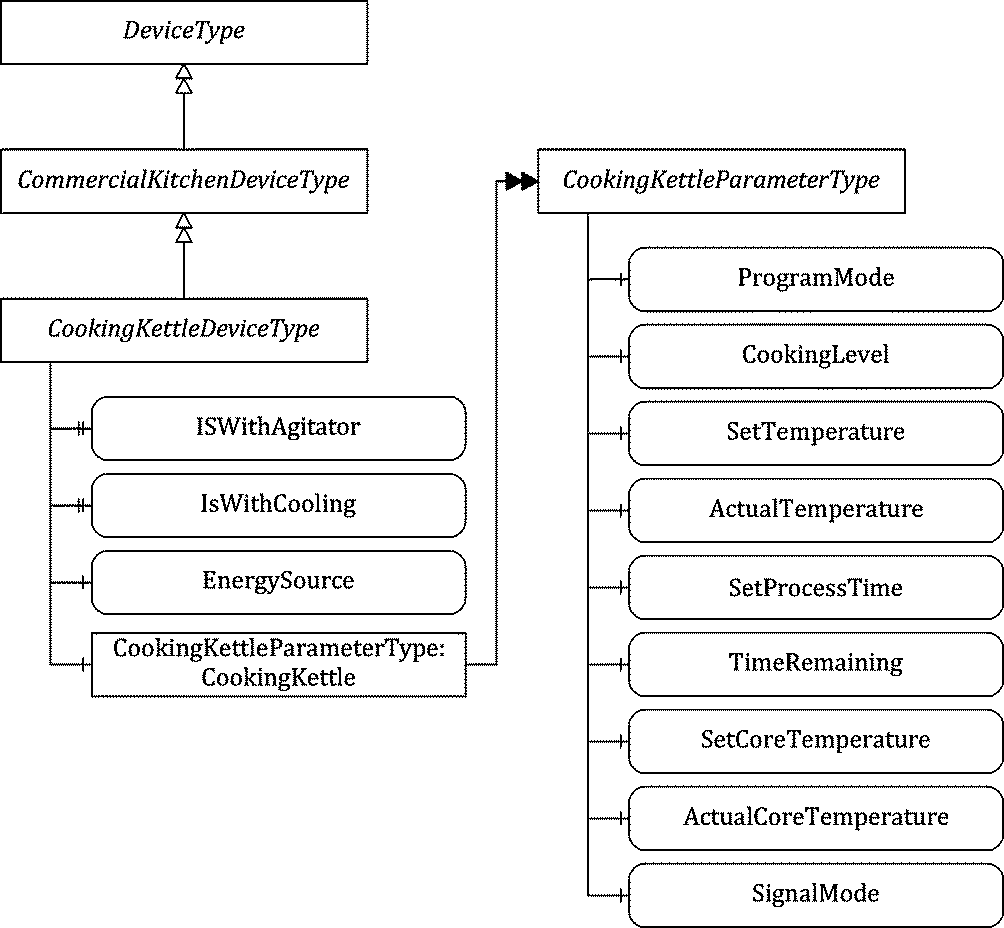
11.2 CookingKettleParameterType
11.2.1 General
Various cooking processes are possible with a cooking kettle; these include:
| - | Gently bring to boil; |
| - | Cooking with various power and simmering stages; |
| - | Keeping warm. |
In addition, an agitator can be used.
CookingKettleParameterType provides information about the state of the device, the set values and the current actual values.
11.2.2 Definition of the object type
The CookingKettleParameterType is formally defined in Table 33.
| Attribute | Value | |||||
| BrowseName | CookingKettleParameterType | |||||
| IsAbstract | False | |||||
| References | NodeClass | BrowseName | DataType | TypeDefinition |
Modelling
Rule AccessLevel | |
|---|---|---|---|---|---|---|
| Subtype of KitchenDeviceParameterType | ||||||
| HasComponent | Variable | ProgramMode | CookingKettleModeEnumeration | BaseDataVariableType | M, R | |
| HasComponent | Variable | CookingLevel | Int32 | BaseDataVariableType | M, R | |
| HasComponent | Variable | SetTemperature | Float | AnalogItemType | M, R | |
| HasComponent | Variable | ActualTemperature | Float | AnalogItemType | M, R | |
| HasComponent | Variable | SetProcessTime | Int32 | AnalogItemType | M, R | |
| HasComponent | Variable | TimeRemaining | Int32 | AnalogItemType | M, R | |
| HasComponent | Variable | SetCoreTemperature | Float | AnalogItemType | M, R | |
| HasComponent | Variable | ActualCoreTemperature | Float | AnalogItemType | M, R | |
| HasComponent | Variable | SignalMode | SignalModeEnumeration | BaseDataVariableType | M, R | |
11.2.3 Description of the object type
11.2.3.1 ProgramMode variable
This variable describes the state of the device, e.g. heating up, frying.
The data type for the CookingKettleModeEnumeration is defined in section 11.4.1.
11.2.3.2 CookingLevel variable
This variable describes the cooking level with which heating up is to take place. The value is used only in the Cook and CookSlow ProgramMode.
11.2.3.3 SetTemperatur variable
This variable contains the set temperature to which heating up is to take place.
The EngineeringUnit property of the AnalogItemType has the value °C. The value for the EURange property is device-specific.
11.2.3.4 ActualTemperature variable
This variable describes the currently measured temperature.
The EngineeringUnit property of the AnalogItemType has the value °C. The value for the EURange property is device-specific.
11.2.3.5 SetProcessTime variable
This variable describes the set process time in seconds.
The EngineeringUnit property of the AnalogItemType has the value s. The value for the EURange property is device-specific.
11.2.3.6 RemainingTime variable
This variable describes the remaining process time for cooking in seconds.
The EngineeringUnit property of the AnalogItemType has the value s. The value for the EURange property is device-specific.
11.2.3.7 SetCoreTemperature variable
This variable describes the set core temperature.
The EngineeringUnit property of the AnalogItemType has the value °C. The value for the EURange property is device-specific.
11.2.3.8 ActualCoreTemperature variable
This variable describes the currently measured core temperature.
The EngineeringUnit property of the AnalogItemType has the value °C. The value for the EURange property is device-specific.
11.2.3.9 SignalMode variable
This variable describes the state of the signal output. In addition to the on and off states, the "Signal was acknowledged" state is also saved.
The data type for the SignalModeEnumeration is defined in 11.4.2.
11.3 CookingKettleDeviceType
11.3.1 General
CookingKettleDeviceType describes a device from the Cooking Kettle device class.
11.3.2 Definition of the object type
The CookingKettleDeviceType is formally defined in Table 34.
| Attribute | Value | |||||
| BrowseName | CookingKettleDeviceType | |||||
| IsAbstract | False | |||||
| References | NodeClass | BrowseName | DataType | TypeDefinition |
Modelling
Rule AccessLevel | |
|---|---|---|---|---|---|---|
| Subtype of CommercialKitchenDeviceType | ||||||
| HasProperty | Variable | IsWithAgitator | Boolean | PropertyType | M, R | |
| HasProperty | Variable | IsWithCooling | Boolean | PropertyType | M, R | |
| HasProperty | Variable | EnergySource | EnergySourceEnumeration | PropertyType | M, R | |
| HasComponent | Object | CookingKettle | CookingKettleParameterType | M, R | ||
11.3.3 Description of the object type
11.3.3.1 IsWithAgitator property
This property describes whether the device is equipped with an agitator.
11.3.3.2 IsWithCooling property
This property describes whether the device is equipped with a cooling function.
11.3.3.3 EnergySource property
The Energy property returns the type of energy supply. The data type for the EnergySourceEnumeration is defined in 21.1.
11.3.3.4 Object CookingKettle
The CookingKettle object contains the parameters for a device of the type Cooking Kettle.
11.4 Data types for enumerations
11.4.1 CookingKettleModeEnumeration
The data type is an enumeration of the current status of the device.
The enumeration values are defined in Table 35.
| Value | Description |
| Off_0 | off |
| Preheat_1 | Heating up |
| SoftCook_2 | Gently bring to boil |
| Cook_3 | Bring to boil with 3 simmering stages |
| CookSlow_4 | Boiling with 3 power stages |
| KeepWarming_5 | Keeping warm |
| Stiring_6 | only agitator active |
| PresetStart_7 | Start time preselection active |
| Error_8 | Error state |
11.4.2 SignalModeEnumeration
This data type is an enumeration of the signal state.
The enumeration values are defined in Table 36.
| Value | Description |
| SignalOff_0 | Signal switched off |
| SignalOn_1 | Signal switched on |
| SignalAck_2 | Signal acknowledged |
12 Type definitions for Multi Function Pan
12.1 General
Various cooking processes are possible with a multi function pan; these include:
| - | Gentle cooking; |
| - | Cooking; |
| - | Grilling; |
| - | Frying; |
| - | Regeneration; |
| - | Delta-T cooking; |
| - | Pressure cooking. |
In addition, further manufacturer-specific types of cooking and actions are possible in a cooking process:
| - | Zone grilling; |
| - | Zone cooking; |
| - | Keeping warm. |
A multi function pan may consist of one or two pots. Each pot is independently operable. There are various pot sizes and depths.
Figure 16 shows an overview of the object types for the Multi Function Pan device class.
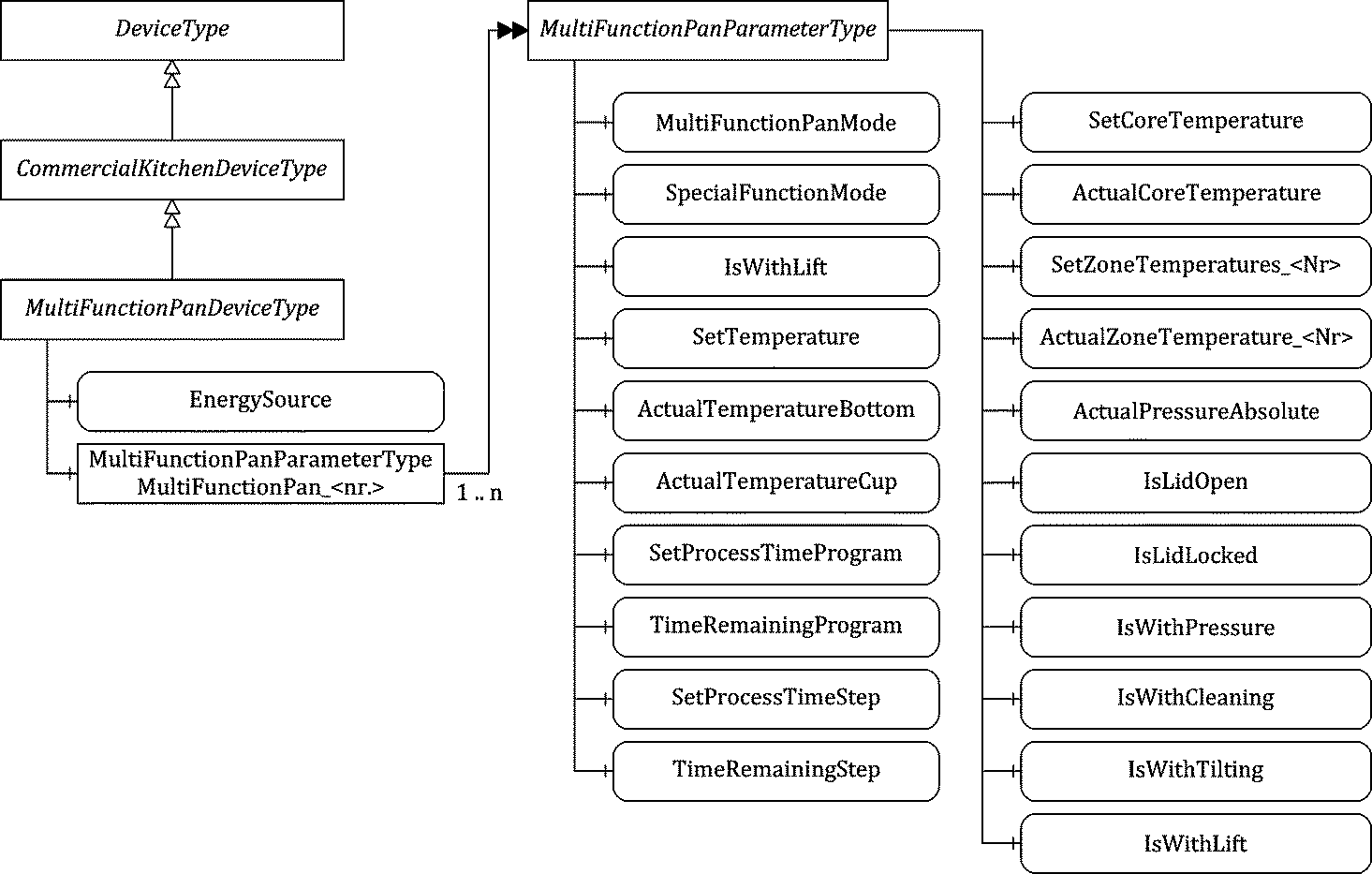
12.2 MultiFunctionPanParameterType
12.2.1 General
MultiFunctionPanParameterType provides information about the state of a pot, the set values and the current actual values.
12.2.2 Definition of the object type
The MultiFunctionPanParameterType is formally defined in Table 37.
| Attribute | Value | |||||
| BrowseName | MultiFunctionPanParameterType | |||||
| IsAbstract | False | |||||
| References | NodeClass | BrowseName | DataType | TypeDefinition |
Modelling
Rule AccessLevel | |
|---|---|---|---|---|---|---|
| Subtype of KitchenDeviceParameterType | ||||||
| HasComponent | Variable | MultiFunctionPanMode | MultiFunctionPanModeEnumeration | BaseDataVariableType | M, R | |
| HasComponent | Variable | SpecialFunctionMode | SpecialFunctionModeEnumeration | BaseDataVariableType | O, R | |
| HasComponent | Variable | CookingLevel | Int32 | BaseDataVariableType | O, R | |
| HasComponent | Variable | SetTemperature | Float | AnalogItemType | M, R | |
| HasComponent | Variable | ActualTemperatureBottom | Float | AnalogItemType | M, R | |
| HasComponent | Variable | ActualTemperatureCup | Float | AnalogItemType | M, R | |
| HasComponent | Variable | SetProcessTimeProgram | Int32 | AnalogItemType | M, R | |
| HasComponent | Variable | TimeRemainingProgram | Int32 | AnalogItemType | M, R | |
| HasComponent | Variable | SetCoreTemperature | Float | AnalogItemType | M, R | |
| HasComponent | Variable | ActualCoreTemperature | Float | AnalogItemType | M, R | |
| HasComponent | Variable | ActualPressureAbsolute | Float | AnalogItemType | O, R | |
| HasComponent | Variable | SetProcessTimeStep | Int32 | AnalogItemType | O, R | |
| HasComponent | Variable | TimeRemainingStep | Int32 | AnalogItemType | O, R | |
| HasComponent | Variable | SetZoneTemperature_<No.> | Float | AnalogItemType | OP, R | |
| HasComponent | Variable | ActualZoneTemperature_<No.> | Float | AnalogItemType | OP, R | |
| HasComponent | Variable | IsLidLocked | Boolean | BaseDataVariableType | O, R | |
| HasComponent | Variable | IsWithPressure | Boolean | BaseDataVariableType | O, R | |
| HasComponent | Variable | IsWithCleaning | Boolean | BaseDataVariableType | O, R | |
| HasComponent | Variable | IsWithTilting | Boolean | BaseDataVariableType | O, R | |
| HasComponent | Variable | IsWithLift | Boolean | BaseDataVariableType | O, R | |
| HasComponent | Variable | IsLidOpen | Boolean | BaseDataVariableType | O, R | |
ActualPressureAbsolute and IsLidLocked are required for devices with pressure function.
12.2.3 Description of the object type
12.2.3.1 MultiFunctionPanMode variable
This variable describes the state of the device, e.g. preheating, active, cleaning
The data type for the MultiFunctionPanModeEnumeration is defined in section 12.4.1.
12.2.3.2 SpecialFunctionMode variable
This variable describes special device functions, e.g. pour in water, tilt pot, lift/lower lid.
The data type for the SpecialFunctionModeEnumeration is defined in section 12.4.2.
12.2.3.3 CookingLevel variable
This variable describes the cook/grill/pressure stage with which the process should run. The cooking process takes place with different control values or pressure presets, depending on the stage.
12.2.3.4 SetTemperature variable
This variable contains the set temperature to which heating up is to take place.
The EngineeringUnit property of the AnalogItemType has the value °C. The value for the EURange property is device-specific.
12.2.3.5 ActualTemperatureBottom variable
This variable describes the currently measured bottom temperature in the pot.
The EngineeringUnit property of the AnalogItemType has the value °C. The value for the EURange property is device-specific.
12.2.3.6 ActualTemperatureCup variable
This variable describes the currently measured cup temperature in the pot.
The EngineeringUnit property of the AnalogItemType has the value °C. The value for the EURange property is device-specific.
12.2.3.7 SetProcessTimeProgram variable
This variable describes the set process time of the entire cooking program in seconds.
The EngineeringUnit property of the AnalogItemType has the value s. The value for the EURange property is device-specific.
12.2.3.8 TimeRemainingProgram variable
This variable describes the remaining process time of the entire cooking program in seconds.
The EngineeringUnit property of the AnalogItemType has the value s. The value for the EURange property is device-specific.
12.2.3.9 SetCoreTemperature variable
This variable describes the set core temperature.
The EngineeringUnit property of the AnalogItemType has the value °C. The value for the EURange property is device-specific.
12.2.3.10 ActualCoreTemperature variable
This variable describes the currently measured core temperature.
The EngineeringUnit property of the AnalogItemType has the value °C. The value for the EURange property is device-specific.
12.2.3.11 ActualPressureAbsolute variable
This variable describes the current absolute pressure in the pot.
The EngineeringUnit property of the AnalogItemType has the value mbar. The value for the EURange property is device-specific.
12.2.3.12 SetProcessTimeStep variable
This variable describes the set process time of the current cooking step in seconds.
The EngineeringUnit property of the AnalogItemType has the value s. The value for the EURange property is device-specific.
12.2.3.13 TimeRemainingStep variable
This variable describes the remaining process time of the current cooking step in seconds.
The EngineeringUnit property of the AnalogItemType has the value s. The value for the EURange property is device-specific.
12.2.3.14 SetZoneTemperature_<No.> variable
The numbered variable SetZoneTemperatur_<No.> contains the set temperature of a zone in °C. This variable may be used several times (numbered consecutively), depending on the number of zones that exist.
The value applies only to the MultiFunctionPanMode ZoneGrilling
The EngineeringUnit property of the AnalogItemType has the value °C. The value for the EURange property is device-specific.
12.2.3.15 ActualZoneTemperature_<No.> variable
The numbered variable ActualZoneTemperatur_<No.> contains the current temperature of a zone in °C. This variable may be used several times (numbered consecutively), depending on the number of zones that exist.
The value applies only to the MultiFunctionPanMode ZoneGrilling
The EngineeringUnit property of the AnalogItemType has the value °C. The value for the EURange property is device-specific.
12.2.3.16 IsLidLocked variable
This variable describes whether the lid is locked. The value applies only to devices with a pressure cooking function.
12.2.3.17 IsWithPressure property
This variable describes whether the device has the equipment for pressure cooking.
12.2.3.18 IsWithCleaning property
This variable describes whether the device is equipped with automatic cleaning.
12.2.3.19 IsWithTilting property
This variable describes whether the device has an automatic tilting facility.
12.2.3.20 IsWithLift property
This variable describes whether the device has a lift.
12.2.3.21 IsLidOpen property
This variable describes whether the lid is open.
12.3 MultiFunctionPanDeviceType
12.3.1 General
MultiFunctionPanDeviceType describes a device from the Multi Function Pan device class.
12.3.2 Definition of the object type
The MultiFunctionPanDeviceType is formally defined in Table 38.
| Attribute | Value | |||||
| BrowseName | MultiFunctionPanDeviceType | |||||
| IsAbstract | False | |||||
| References | NodeClass | BrowseName | DataType | TypeDefinition |
Modelling
Rule AccessLevel | |
|---|---|---|---|---|---|---|
| Subtype of CommercialKitchenDeviceType | ||||||
| HasProperty | Variable | EnergySource | EnergySourceEnumeration | PropertyType | M, R | |
| HasComponent | Object | MultiFunctionPan_<No.> | MultiFunctionPanParameterType | MP, R | ||
12.3.3 Description of the object type
12.3.3.1 EnergySource property
The EnergySource property returns the type of energy supply. The data type for the EnergySourceEnumeration is defined in 21.1.
12.3.3.2 MultiFunctionPan objects
The MultiFunctionPan object contains the parameters for a device of the type Multi Function Pan and may consist of one or two pots.
12.4 Data types for enumerations
12.4.1 MultiFunctionPanModeEnumeration
The data type is an enumeration of the current status of the device.
The enumeration values are defined in Table 39.
| Value | Description |
| Off_0 | off |
| On_1 | switched on, but no cooking process is active |
| Preheat_2 | Heating up |
| StandBy_3 | Eco-mode, lowering of the temperature |
| PressureCooking_4 | Pressure cooking |
| SoftCooking_5 | Gentle cooking |
| Cooking_6 | Cooking |
| Grilling_7 | Grilling |
| Frying_8 | Frying |
| Regenerate_9 | Regeneration |
| DeltaTcooking_10 | Delta-T cooking |
| ZoneGrilling_11 | Zone grilling |
| ZoneCooking_12 | Zone cooking |
| Cleaning_13 | Cleaning |
| PresetStart_14 | Start time preselection active |
| Error_15 | Error state |
12.4.2 SpecialFunctionModeEnumeration
This data type is an enumeration of various special functions.
The enumeration values are defined in Table 40.
| Value | Description |
| LidUpDown_0 | Open/close lid |
| PanTilt_1 | Tilt pot/tilt pot back |
| WaterSupply_2 | Water supply |
| DrainOnOff_3 | Open/close drain |
13 Type definitions for Pasta Cooker / Bain Marie
13.1 General
Various cooking processes are possible with a pasta cooker; these include:
| - | Gently bring to boil; |
| - | Cooking with various power and simmering stages; |
| - | Keeping warm. |
Figure 17 shows an overview of the object types for the device class Pasta Cooker / Cook Marie.
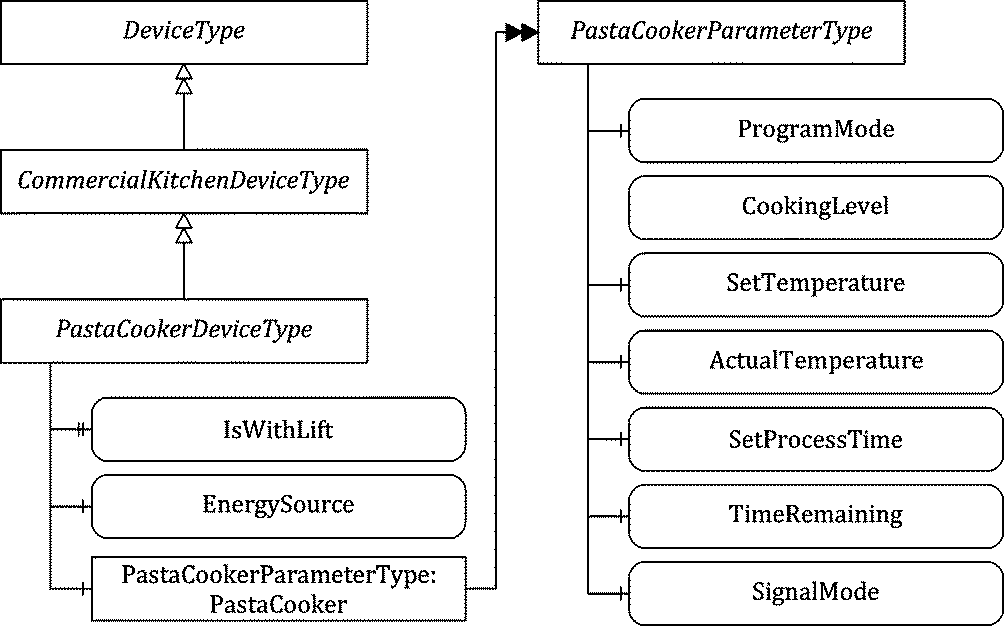
13.2 PastaCookerParameterType
13.2.1 General
PastaCookerParameterType provides information about the state of the device, the set values and the current actual values.
13.2.2 Definition of the object type
The PastaCookerParameterType is formally defined in Table 41.
| Attribute | Value | |||||
| BrowseName | PastaCookerParameterType | |||||
| IsAbstract | False | |||||
| References | NodeClass | BrowseName | DataType | TypeDefinition |
Modelling
Rule AccessLevel | |
|---|---|---|---|---|---|---|
| Subtype of KitchenDeviceParameterType | ||||||
| HasComponent | Variable | ProgramMode | PastaCookerModeEnumeration | BaseDataVariableType | M, R | |
| HasComponent | Variable | CookingLevel | Int32 | BaseDataVariableType | M, R | |
| HasComponent | Variable | SetTemperature | Float | AnalogItemType | M, R | |
| HasComponent | Variable | ActualTemperature | Float | AnalogItemType | M, R | |
| HasComponent | Variable | SetProcessTime | Int32 | AnalogItemType | M, R | |
| HasComponent | Variable | TimeRemaining | Int32 | AnalogItemType | M, R | |
| HasComponent | Variable | SignalMode | SignalModeEnumeration | BaseDataVariableType | M, R | |
13.2.3 Description of the object type
13.2.3.1 ProgramMode variable
This variable describes the state of the device, e.g. heating up, frying, etc.
The data type for the PastaCookerModeEnumeration is defined in section 13.4.1.
13.2.3.2 CookingLevel variable
This variable describes the cooking level with which heating up is to take place. The value is used only in the Cook and CookSlow ProgramMode.
13.2.3.3 SetTemperature variable
This variable contains the set temperature to which heating up is to take place.
The EngineeringUnit property of the AnalogItemType has the value °C. The value for the EURange property is device-specific.
13.2.3.4 ActualTemperature variable
This variable describes the currently measured temperature.
The EngineeringUnit property of the AnalogItemType has the value °C. The value for the EURange property is device-specific.
13.2.3.5 SetProcessTime variable
This variable describes the set process time in seconds.
The EngineeringUnit property of the AnalogItemType has the value s. The value for the EURange property is device-specific.
13.2.3.6 TimeRemaining variable
This variable describes the remaining process time in seconds.
The EngineeringUnit property of the AnalogItemType has the value s. The value for the EURange property is device-specific.
13.2.3.7 SignalMode variable
This variable describes the state of the signal output. In addition to the on and off states, the "Signal was acknowledged" state is also saved.
The data type for the SignalModeEnumeration is defined in 13.4.2.
13.3 PastaCookerDeviceType
13.3.1 General
PastaCookerDeviceType describes a device from the Pasta Cooker / Cook Marie device class.
13.3.2 Definition of the object type
The PastaCookerDeviceType is formally defined in Table 42.
| Attribute | Value | |||||
| BrowseName | PastaCookerDeviceType | |||||
| IsAbstract | False | |||||
| References | NodeClass | BrowseName | DataType | TypeDefinition |
Modelling
Rule AccessLevel | |
|---|---|---|---|---|---|---|
| Subtype of CommercialKitchenDeviceType | ||||||
| HasProperty | Variable | IsWithLift | Boolean | PropertyType | M, R | |
| HasProperty | Variable | EnergySource | EnergySourceEnumeration | PropertyType | M, R | |
| HasComponent | Object | PastaCooker | PastaCookerParameterType | M, R | ||
13.3.3 Description of the object type
13.3.3.1 IsWithLift property
This property describes whether the device has an automatic lift for raising and lowering the pasta basket.
13.3.3.2 EnergySource property
The EnergySource property returns the type of energy supply. The data type for the EnergySourceEnumeration is defined in 21.1.
13.3.3.3 Object PastaCooker
The PastaCooker object contains the parameters for a device of the type Pasta Cooker / Cook Marie.
13.4 Data types for enumerations
13.4.1 PastaCookerModeEnumeration
The data type is an enumeration of the current status of the device.
The enumeration values are defined in Table 43.
| Value | Description |
| Off_0 | off |
| Preheat_1 | heating up |
| SoftCook_2 | Gently bring to boil |
| Cook_3 | Bring to boil with 3 simmering stages |
| CookSlow_4 | Boiling with 3 power stages |
| KeepWarming_5 | Keeping warm |
| PresetStart_6 | Start time preselection active |
| Error_7 | Error state |
13.4.2 SignalModeEnumeration
This data type is an enumeration of the signal state.
The enumeration values are defined in Table 44.
| Value | Description |
| SignalOff_0 | Signal switched off |
| SignalOn_1 | Signal switched on |
| SignalAck_2 | Signal acknowledged |
14 Type definitions for Coffee Machines
14.1 General
Figure 18 shows an overview of the object types for the Coffee Machine device class.
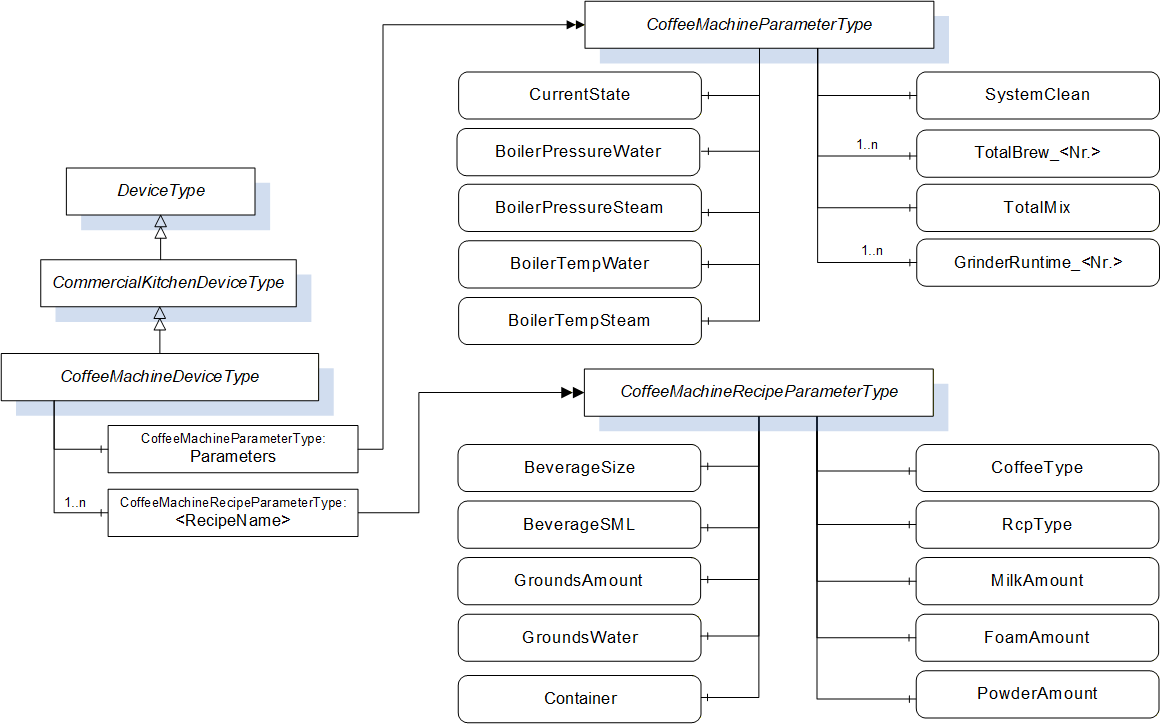
14.2 CoffeeMachineParameterType
14.2.1 General
The CoffeeMachineParameterType defines the parameters of a Coffee Machine.
14.2.2 Definition of the object type
The CoffeeMachineParameterType is formally defined in Table 45.
| Attribute | Value | |||||
| BrowseName | CoffeeMachineParameterType | |||||
| IsAbstract | False | |||||
| References | NodeClass | BrowseName | DataType | TypeDefinition |
Modelling
Rule AccessLevel | |
|---|---|---|---|---|---|---|
| Subtype of KitchenDeviceParameterType | ||||||
| HasComponent | Variable | CurrentState | CoffeeMachineMode Enumeration | BaseDataVariableType | M, RW | |
| HasComponent | Variable | BoilerPressureWater | Float | AnalogItemType | M, R | |
| HasComponent | Variable | BoilerPressureSteam | Float | AnalogItemType | M, R | |
| HasComponent | Variable | BoilerTempWater | Float | AnalogItemType | M, R | |
| HasComponent | Variable | BoilerTempSteam | Float | AnalogItemType | O, R | |
| HasComponent | Variable | SystemClean | DateTime | BaseDataVariableType | M, R | |
| HasComponent | Variable | TotalBrew_<No.> | UInt64 | BaseDataVariableType | MP, R | |
| HasComponent | Variable | TotalMix | UInt64 | BaseDataVariableType | M, R | |
| HasComponent | Variable | GrinderRuntime_<No.> | UInt64 | AnalogItemType | MP, R | |
14.2.3 ObjectType description
14.2.3.1 CurrentState variable
The CurrentState variable represents the current operating state of a Coffee Machine.
The data type for the CoffeeMachineModeEnumeration is defined in section 14.5.2.
14.2.3.2 BoilerPressureWater variable
The BoilerPressureWater variable represents the pressure of the water boiler in Pa. The pressure of the water boiler can only be read.
The EngineeringUnit property of the AnalogItemType has the value Pa. The value for the EURange property is device-specific.
14.2.3.3 BoilerPressureSteam variable
The BoilerPressureSteam variable represents the pressure of the steam boiler in Pa. The pressure of the steam boiler is not available in every machine. The pressure of the steam boiler can only be read.
The EngineeringUnit property of the AnalogItemType has the value Pa. The value for the EURange property is device-specific.
14.2.3.4 BoilerTempWater variable
This variable represents the temperature in the water boiler in °C. The temperature of the water boiler can only be read.
The EngineeringUnit property of the AnalogItemType has the value °C. The value for the EURange property is device-specific.
14.2.3.5 BoilerTempSteam variable
The BoilerTempSteam variable represents the temperature of the steam boiler in °C. The temperature of the steam boiler is not available in every machine. The temperature of the steam boiler can only be read.
The EngineeringUnit property of the AnalogItemType has the value °C. The value for the EURange property is device-specific.
14.2.3.6 SystemClean variable
The SystemClean variable represents the time in UTC format at which the system cleaning was last carried out. The time can only be read.
14.2.3.7 TotalBrew_<No.> variables
The TotalBrew_<No.> variables represent the number of brews per brewer. At least one brewer exists. Further brewers are named with ascending numbers. The counters can only be read.
14.2.3.8 TotalMix variable
The TotalMix variables represent the number of cycles of the mixer. The number of mixer cycles can only be read.
14.2.3.9 GrinderRuntime_<No.> variables
The GrinderRuntime_<No.> variables represent the running times of the grinders in seconds. At least one grinder exists. Further grinders are named with ascending numbers. The running times can only be read.
The EngineeringUnit property of the AnalogItemType has the value s. The value for the EURange property is device-specific.
14.3 CoffeeMachineRecipeParameterType
14.3.1 General
The CoffeeMachineRecipeParameterType defines the parameters of a recipe for coffee machines.
14.3.2 Definition of the object type
The CoffeeMachineRecipeParameterType is formally defined in Table 46.
| Attribute | Value | |||||
| BrowseName | CoffeeMachineRecipeParameterType | |||||
| IsAbstract | False | |||||
| References | NodeClass | BrowseName | DataType | TypeDefinition |
Modelling
Rule AccessLevel | |
|---|---|---|---|---|---|---|
| Subtype of KitchenDeviceParameterType | ||||||
| HasComponent | Variable | BeverageSize | Float | AnalogItemType | M, RW | |
| HasComponent | Variable | BeverageSML | BeverageSMLEnumeration | BaseDataVariableType | M, RW | |
| HasComponent | Variable | GroundsAmount | Float | AnalogItemType | M, RW | |
| HasComponent | Variable | GroundsWater | Float | AnalogItemType | M, RW | |
| HasComponent | Variable | Container | UInt32 | MultiStateDiscreteType | M, R | |
| HasComponent | Variable | CoffeeType | UInt32 | MultiStateDiscreteType | M, RW | |
| HasComponent | Variable | RcpType | UInt32 | MultiStateDiscreteType | M, RW | |
| HasComponent | Variable | MilkAmount | Float | AnalogItemType | M, RW | |
| HasComponent | Variable | FoamAmount | Float | AnalogItemType | M, RW | |
| HasComponent | Variable | PowderAmount | Float | AnalogItemType | M, RW | |
14.3.3 ObjectType description
14.3.3.1 BeverageSize variable
The BeverageSize variable with the data type Float represents the beverage size as a percentage change in the set recipe parameters. The value of the variable can be read and written.
The EngineeringUnit property of the AnalogItemType has the value % and the EURange property has the minimum value 50 and the maximum value 150.
14.3.3.2 BeverageSML variable
The BeverageSML variable with the data type BeverageSMLEnumeration represents the beverage size preselection. The data type is defined in section 14.4.2. The value of the variable can be read and written.
14.3.3.3 GroundsAmount variable
The GroundsAmount variable with the data type Float represents the coffee grounds quantity. The value of the variable can be read and written.
The EngineeringUnit property of the AnalogItemType has the value g. The value for the EURange property is device-specific.
14.3.3.4 GroundsWater variable
The GroundsWater variable with the data type Float represents the water quantity. The value of the variable can be read and written.
The EngineeringUnit property of the AnalogItemType has the value ml. The value for the EURange property is device-specific.
14.3.3.5 Container variable
The Container variable represents the coffee container.
A selection of possible containers can be made available for the specific device via the EnumStrings property of the MultiStateDiscreteType.
14.3.3.6 CoffeeType variable
The CoffeeType variable represents the beverage type, for example espresso, cafe crème or filter coffee, and thus defines the basic recipe.
The beverage type can be made available via the EnumStrings property of the MultiStateDiscreteType.
14.3.3.7 RcpType variable
The RcpType variable represents the recipe type of the beverage.
The recipe type of the beverage can be made available via the EnumStrings property of the MultiStateDiscreteType.
14.3.3.8 MilkAmount variable
The MilkAmount variable represents the amount of milk in a beverage. The value of the variable can be read and written.
The EngineeringUnit property of the AnalogItemType has the value ml. The value for the EURange property is device-specific.
14.3.3.9 FoamAmount variable
The FoamAmount variable represents the amount of milk foam in a beverage. The value of the variable can be read and written.
The EngineeringUnit property of the AnalogItemType has the value ml. The value for the EURange property is device-specific.
14.3.3.10 PowderAmount variable
The PowderAmount variable represents the amount of powder in a beverage. The value of the variable can be read and written.
The EngineeringUnit property of the AnalogItemType has the value g. The value for the EURange property is device-specific.
14.4 CoffeeMachineDeviceType
14.4.1 General
CoffeeMachineDeviceType describes a device from the commercial Coffee Machine device class.
14.4.2 Definition of the object type
The CoffeeMachineDeviceType is formally defined in Table 47.
| Attribute | Value | |||||
| BrowseName | CoffeeMachineDeviceType | |||||
| IsAbstract | False | |||||
| References | NodeClass | BrowseName | DataType | TypeDefinition |
Modelling
Rule AccessLevel | |
|---|---|---|---|---|---|---|
| Subtype of CommercialKitchenDeviceType | ||||||
| HasComponent | Object | Parameters | CoffeeMachineParameterType | M, R | ||
| HasComponent | Object | <RecipeName> | CoffeeMachineRecipeParameterType | MP, RW | ||
14.4.3 Description of the object type
14.4.3.1 Parameters object
The Parameters object contains the parameters for the Coffee Machine.
14.4.3.2 <RecipeName> objects
The objects from the <RecipeName> list represent the recipes of the Coffee Machine. The names of the objects arise from the recipe name or a recipe number.
14.5 Data types for enumerations
14.5.1 BevarageSMLEnumeration
This data type is an enumeration of the possible SML values. The possible values are defined in Table 48.
| Value | Description |
| Inactive_0 | Standard SML is medium |
| Small_1 | Small |
| Large_2 | Large |
| ExtraLarge_3 | Extra Large |
14.5.2 CoffeeMachineModeEnumeration
This data type is an enumeration of the possible operating states of the commercial coffee machine. The possible values are defined in Table 49.
| Value | Description |
| Off_0 | Machine off |
| Standby_1 | Ready to operate |
| Error_2 | Error |
| Cleaning_3 | Cleaning running |
15 Type definitions for Dishwashing Machine
15.1 General
Figure 19 shows an overview of the object types for the Dishwashing Machine device class.
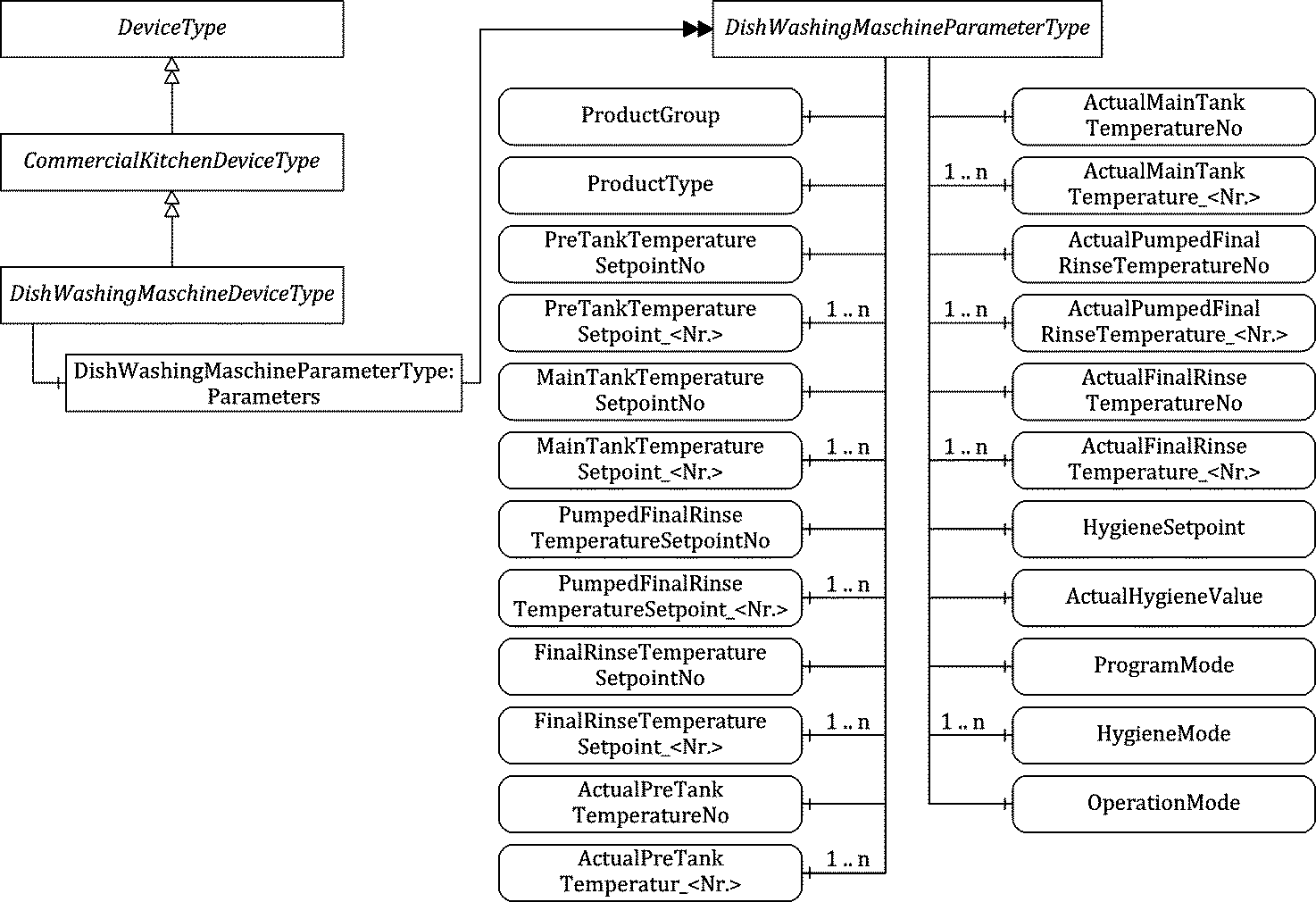
15.2 DishWashingMachineProgramParameterType
15.2.1 General
15.2.1.1 Device types
15.2.1.1.1 Programmable automatic machine
With a programmable automatic machine, the basket is manually placed into and removed from the machine alternatively via the front door or, in the case of pass through dishwashers, via a table feeder. With these machine types the pre-cleaning takes place manually outside the machine. The various program steps such as detergent circulation and rinsing take place successively, but not spatially separated, in a single zone (tank).
15.2.1.1.2 Dishwashing machine with transport system
In this case the dishes and cutlery pass automatically through the successive zones in which the individual functions take place. Distinction is made between two machine designs:
15.2.1.1.2.1 Basket transport machine
The baskets loaded with dishes and cutlery are transported automatically through the machine.
15.2.1.1.2.2 Belt transport machine
The dishes and cutlery are placed directly on an endless belt and transported automatically through the machine.
15.2.1.2 Device zones
The following zones in the dishwashing machine should be mentioned as examples:
15.2.1.2.1 Fresh water pre-cleaning
This is an upstream zone in continuous flow systems in which the dishes and cutlery are freed of adhering food residues with fresh water preheated to max. 40 °C.
| REMARKS | In the case of pass through dishwashers, this is usually done by hand using a spraying device. |
15.2.1.2.2 Pumped pre-cleaning
This is the first circulating tank in the multi-tank dishwashing machine in which the dishes and cutlery are freed from coarse food residues with grey water.
| REMARKS | Detergent is not directly dosed in this zone. The pumped pre-cleaning is the location of the overflow. This tank is normally not heated. |
15.2.1.2.3 Detergent circulation tank
This is the tank in which the final removal of all remaining food residues from the dishes and cutlery takes place.
| REMARKS | The associated tank is/tanks are heated. |
15.2.1.2.4 Detergent circulation zone
This is the zone in which the final removal of all remaining food residues from the dishes and cutlery takes place.
15.2.1.2.5 Pumped rinsing
This is the circulating rinsing, which is located upstream of the fresh water rinsing and to which no detergent is dosed.
15.2.1.2.6 Fresh water rinsing
This is the last rinsing procedure before drying in which the dishes and cutlery are sprayed with a hot rinsing solution.
| REMARKS | Remaining dirt particles and grey water residues are removed. |
15.2.1.2.7 Drying zone
This is the zone in which drying takes place.
| REMARKS | Drying zones operate with fresh or recirculated air and are heated electrically, with steam or with hot water. |
15.2.2 Definition of the object type
The DishWashingMachineProgramParameterType is formally defined in Table 50.
| Attribute | Value | |||||
| BrowseName | DishWashingMachineProgramParameterType | |||||
| IsAbstract | False | |||||
| References | NodeClass | BrowseName | DataType | TypeDefinition |
Modelling
Rule AccessLevel | |
|---|---|---|---|---|---|---|
| Subtype of KitchenDeviceParameterType | ||||||
| HasProperty | Variable | ProductGroup | String | PropertyType | O, R | |
| HasProperty | Variable | ProductType | UInt32 | PropertyType | O, R | |
| HasComponent | Variable | PreTankTemperatureSetpointNo | UInt16 | BaseDataVariableType | M, R | |
| HasComponent | Variable | PreTankTemperatureSetpoint_<No.> | UInt16 | AnalogItemType | MP, R | |
| HasComponent | Variable | MainTankTemperatureSetpointNo | UInt16 | BaseDataVariableType | M, R | |
| HasComponent | Variable | MainTankTemperatureSetpoint_<No.> | UInt16 | AnalogItemType | MP, R | |
| HasComponent | Variable | PumpedFinalRinseTemperatureSetpointNo | UInt16 | BaseDataVariableType | M, R | |
| HasComponent | Variable | PumpedFinalRinseTemperatureSetpoint_<No.> | UInt16 | AnalogItemType | MP, R | |
| HasComponent | Variable | FinalRinseTemperatureSetpointNo | UInt16 | BaseDataVariableType | M, R | |
| HasComponent | Variable | FinalRinseTemperatureSetpoint_<No.> | UInt16 | AnalogItemType | MP, R | |
| HasComponent | Variable | ActualPreTankTemperatureNo | UInt16 | BaseDataVariableType | M, R | |
| HasComponent | Variable | ActualPreTankTemperature_<No.> | UInt16 | AnalogItemType | MP, R | |
| HasComponent | Variable | ActualMainTankTemperatureNo | UInt16 | BaseDataVariableType | M, R | |
| HasComponent | Variable | ActualMainTankTemperature_<No.> | UInt16 | AnalogItemType | MP, R | |
| HasComponent | Variable | ActualPumpedFinalRinseTemperatureNo | UInt16 | BaseDataVariableType | M, R | |
| HasComponent | Variable | ActualPumpedFinalRinseTemperature_<No.> | UInt16 | AnalogItemType | MP, R | |
| HasComponent | Variable | ActualFinalRinseTemperatureNo | UInt16 | BaseDataVariableType | M, R | |
| HasComponent | Variable | ActualFinalRinseTemperature_<No.> | UInt16 | AnalogItemType | MP, R | |
| HasComponent | Variable | HygieneSetpoint | UInt16 | BaseDataVariableType | O, R | |
| HasComponent | Variable | ActualHygieneValue | UInt16 | BaseDataVariableType | O, R | |
| HasComponent | Variable | ProgramMode | ProgramModeEnumeration | BaseDataVariableType | O, R | |
| HasComponent | Variable | HygieneMode | HygieneModeEnumeration | BaseDataVariableType | O, R | |
| HasComponent | Variable | OperationMode | OperationModeEnumeration | BaseDataVariableType | M, R | |
15.2.3 Description of the object type
15.2.3.1 ProductGroup property
The ProductGroup property represents the parent product group.
15.2.3.2 ProductType property
The ProductType property represents the special product type within a product group.
The specific product model is represented by the Model property of the DeviceType.
15.2.3.3 PreTankTemperatureSetpointNo property
Specifies the number of possible washing tank temperatures (this concerns the pre-wash zone). Value range 0 ... 1; 0 means that no module exists.
15.2.3.4 PreTankTemperatureSetpoint_<No.> property
The numbered variable PreTankTemperatureSetpoint_<No.> contains the current set temperature of a washing tank (pre-wash zone). One temperature per washing tank. This variable may be used several times (numbered consecutively), depending on the number of washing tanks that exist.
The EngineeringUnit property of the AnalalogItemType has the value °C.
15.2.3.5 MainTankTemperatureSetpointNo property
Specifies the number of possible washing tank temperatures (this concerns the main washing zone). Value range 0 ... 5; 0 means that no module exists.
15.2.3.6 MainTankTemperatureSetpoint_<No.> property
The numbered variable MainTankTemperatureSetpoint_<No.> contains the current set temperature of a washing tank (main washing zone). One temperature per washing tank. This variable may be used several times (numbered consecutively), depending on the number of washing tanks that exist.
The EngineeringUnit property of the AnalalogItemType has the value °C.
15.2.3.7 PumpedFinalRinseTemperatureSetpointNo property
Specifies the number of possible rinsing temperatures (circulating tank). Value range 0 ... 3; 0 means that no module exists.
15.2.3.8 PumpedFinalRinseTemperatureSetpoint_<No.> property
The numbered variable PumpedFinalRinseTemperatureSetpoint_<No.> contains the current set temperature of a rinsing tank. One temperature per rinsing tank. This variable may be used several times (numbered consecutively), depending on the number of rinsing tanks that exist.
The EngineeringUnit property of the AnalalogItemType has the value °C.
15.2.3.9 FinalRinseTemperatureSetpointNo property
Specifies the number of possible fresh water rinsing temperatures. Value range 0 ... 3; 0 means that no module exists.
15.2.3.10 FinalRinseTemperatureSetpoint_<No.> property
The numbered variable FinalRinseTemperatureSetpoint_<No.> contains the current set temperature of a rinsing tank (fresh water rinsing). One temperature per rinsing tank. This variable may be used several times (numbered consecutively), depending on the number of rinsing tanks that exist.
The EngineeringUnit property of the AnalalogItemType has the value °C.
15.2.3.11 ActualPreTankTemperatureNo property
Specifies the number of possible washing tank temperatures (this concerns the pre-wash zone). Value range 0 ... 1; 0 means that no module exists.
15.2.3.12 ActualPreTankTemperature_<No.> property
The numbered variable ActualPreTankTemperature_<No.> contains the current actual temperature of a washing tank (pre-wash zone). One temperature per washing tank. This variable may be used several times (numbered consecutively), depending on the number of washing tanks that exist.
The EngineeringUnit property of the AnalalogItemType has the value °C.
15.2.3.13 ActualMainTankTemperatureNo property
Specifies the number of possible washing tank temperatures (this concerns the main washing zone). Value range 0 ... 5; 0 means that no module exists.
15.2.3.14 ActualMainTankTemperature_<No.> property
The numbered variable ActualMainTankTemperature_<No.> contains the current actual temperature of a washing tank (main washing zone). One temperature per washing tank. This variable may be used several times (numbered consecutively), depending on the number of washing tanks that exist.
The EngineeringUnit property of the AnalalogItemType has the value °C.
15.2.3.15 ActualPumpedFinalRinseTemperatureNo property
Specifies the number of possible fresh water rinsing temperatures (circulation). Value range 0 ... 3; 0 means that no module exists.
15.2.3.16 ActualPumpedFinalRinseTemperature_<No.> property
The numbered variable ActualPumpedFinalRinseTemperature_<No.> contains the current actual temperature of a rinsing tank (circulation). One temperature per rinsing tank. This variable may be used several times (numbered consecutively), depending on the number of rinsing tanks that exist.
The EngineeringUnit property of the AnalalogItemType has the value °C.
15.2.3.17 ActualFinalRinseTemperatureNo property
Specifies the number of possible rinsing temperatures (fresh water rinsing). Value range 0 ... 3; 0 means that no module exists.
15.2.3.18 ActualFinalRinseTemperature_<No.> property
The numbered variable ActualFinalRinseTemperature_<No.> contains the current actual temperature of a rinsing tank (fresh water rinsing). One temperature per rinsing tank. This variable may be used several times (numbered consecutively), depending on the number of rinsing tanks that exist.
The EngineeringUnit property of the AnalalogItemType has the value °C.
15.2.3.19 HygieneSetpoint property
A variable for the Hygiene setpoint. This variable has no unit. The evaluation depends on the hygiene process.
15.2.3.20 ActualHygieneValue property
A variable for the actual Hygiene value. This variable has no unit. The evaluation depends on the hygiene process.
15.2.3.21 ProgramMode property
A variable that makes the state of the machine available via the ProgramModeEnumeration.
15.2.3.22 HygieneMode property
A variable that makes the state of the machine available via the HygieneModeEnumeration.
15.2.3.23 OperationMode property
A variable that makes the state of the machine available via the OperationModeEnumeration.
15.3 DishWashingMachineDeviceType
15.3.1 General
A distinction is made between types of commercial dishwashing machines according to their use. Examples:
| - | Glasswashers; |
| - | Crockery washing machines; |
| - | Dishwashing machines for working crockery/containers. |
According to the working method, one can distinguish between:
| - | Programmable automatic machines; |
| - | Front-door machines; |
| - | Pass through machines; |
| - | Dishwashing machine with transport system; |
| - | Belt and basket transport machines; |
| - | Belt and basket transport machines. |
15.3.2 Definition of the object type
The DishWashingMachineDeviceType is formally defined in Table 51.
| Attribute | Value | |||||
| BrowseName | DishWashingMachineDeviceType | |||||
| IsAbstract | False | |||||
| References | NodeClass | BrowseName | DataType | TypeDefinition |
Modelling
Rule AccessLevel | |
|---|---|---|---|---|---|---|
| Subtype of CommercialKitchenDeviceType | ||||||
| HasComponent | Object | Parameters | DishWashingMachineProgramParameterType | M, R | ||
15.3.3 Description of the object type
15.3.3.1 Object Parameters property
The Parameters Object describes the parameters of the dishwashing machine.
15.4 Data types for enumerations
15.4.1 ProgramModeEnumeration
This data type is an enumeration of the possible program modes of the dishwashing machine. The enumeration values are defined in Table 52.
| Value | Description |
| OperationOFF_0 | Program end |
| PreWash_1 | Prerinsing |
| Cleaning1_2 | Washing to pumping out |
| WashTimeIncreased_3 | Washing time extension |
| Cleaning2_4 | Washing with pumping out |
| DrainingPause_5 | Drip phase |
| Draining_6 | Pumping out |
| FinalRinse_7 | Rinsing |
| WaitingTime_8 | Delay time |
| HeatRecovery_9 | Heat recovery |
15.4.2 HygieneModeEnumeration
This data type is an enumeration of the possible hygiene modes of the dishwashing machine. The enumeration values are defined in Table 53.
| Value | Description |
| HygieneOperationOFF_0 | No hygiene process |
| HygieneA0_1 | A0 value |
| HygieneHUE_2 | HUE |
| HygieneMU_3 | M-units |
| HygieneThermolable_4 | Thermolabel |
| HygieneA0_TD_5 | A0-TD |
15.4.3 OperationModeEnumeration
This data type is an enumeration of the possible hygiene modes of the dishwashing machine. The enumeration values are defined in Table 54.
| Value | Description |
| Init_0 | Initialization |
| MachineOff_1 | Machine off |
| Filling_2 | Filling |
| FillingHeating_3 | Filling + heating |
| Heating_4 | Heating |
| EnableOperation_5 | Ready to start |
| ReadyForOperation_6 | Ready to operate |
| Operation_7 | Washing mode |
| Cycle_pause_8 | Cycle pause |
| NotDefined1_9 | |
| SelfCleaning_10 | Self-cleaning/emptying |
| NotDefined2_11 | |
| RemoteControl_12 | Remote control |
| ControllingOutputs_13 | Control outputs |
| NotDefined3_14 | |
| Error_15 | Error/fault |
16 Type definitions for Servery System
16.1 General
Figure 20 shows an overview of the object types for the Servery System device class.
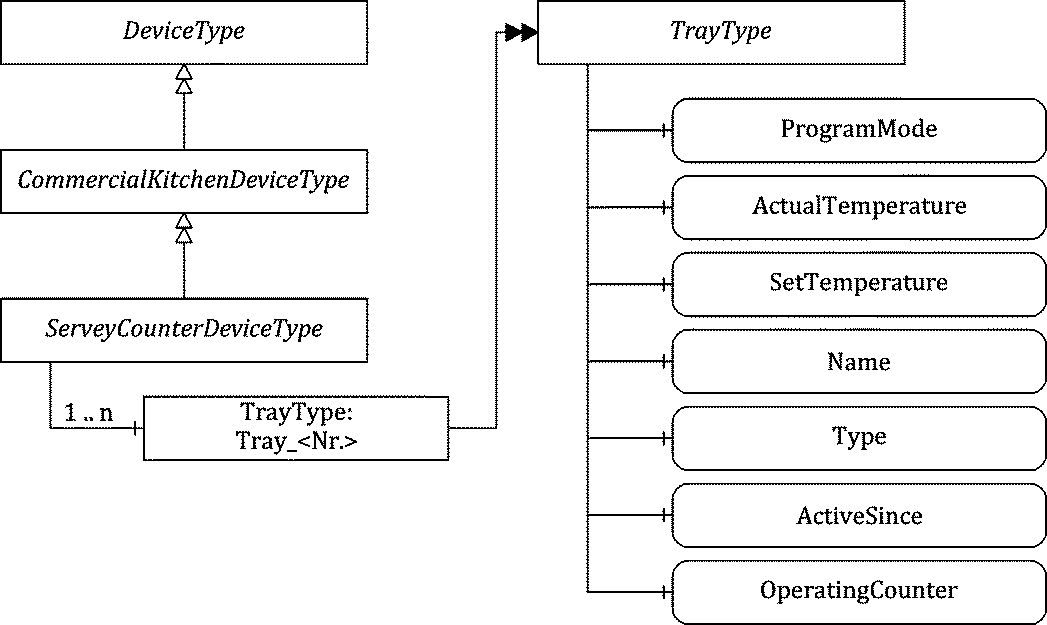
16.2 TrayType
16.2.1 Definition of the object type
The TrayType is formally defined in Table 55.
| Attribute | Value | |||||
| BrowseName | TrayType | |||||
| IsAbstract | False | |||||
| References | NodeClass | BrowseName | DataType | TypeDefinition |
Modelling
Rule AccessLevel | |
|---|---|---|---|---|---|---|
| Subtype of KitchenDeviceParameterType | ||||||
| HasComponent | Variable | ProgramMode | TrayModeEnumeration | BaseDataVariableType | M, RW | |
| HasComponent | Variable | ActualTemperature | Float | AnalogItemType | M, R | |
| HasComponent | Variable | SetTemperature | Float | AnalogItemType | M, RW | |
| HasProperty | Variable | Name | String | PropertyType | M, RW | |
| HasComponent | Variable | Type | TrayTypeEnumeration | BaseDataVariableType | M, R | |
| HasComponent | Variable | ActiveSince | Int32 | AnalogItemType | M, R | |
| HasComponent | Variable | OperatingCounter | Int32 | AnalogItemType | M, R | |
16.2.2 Description of the object type
16.2.2.1 ProgramMode variable
Represents the current operation mode.
The data type for the TrayModeEnumeration is defined in 16.4.1.
16.2.2.2 ActualTemperature variable
This variable contains the currently measured temperature.
The EngineeringUnit property of the AnalogItemType has the value °C. The value for the EURange property is device-specific.
16.2.2.3 SetTemperature variable
This variable contains the set temperature.
The EngineeringUnit property of the AnalogItemType has the value °C. The value for the EURange property is device-specific.
16.2.2.4 Name variable
Specifies a free-text designation for the tray.
16.2.2.5 Type variable
This variable represents the tray type.
The data type for the TrayModeEnumeration is defined in 16.4.2.
16.2.2.6 ActiveSince variable
Indicates the time in seconds since the start of the current operating state. If no valid count can be specified for the current state, the value -1 is signalled.
The EngineeringUnit property of the AnalogItemType has the value s. The value for the EURange property is device-specific.
16.2.2.7 OperatingCounter variable
This variable describes the accumulated operating time in seconds.
The EngineeringUnit property of the AnalogItemType has the value s. The value for the EURange property is device-specific.
16.3 ServeryCounterDeviceType
16.3.1 Definition of the object type
The ServeryCounterDeviceType is formally defined in Table 56.
| Attribute | Value | |||||
| BrowseName | ServeryCounterDeviceType | |||||
| IsAbstract | False | |||||
| References | NodeClass | BrowseName | DataType | TypeDefinition |
Modelling
Rule AccessLevel | |
|---|---|---|---|---|---|---|
| Subtype of CommercialKitchenDeviceType | ||||||
| HasComponent | Object | Tray_<No.> | TrayType | MP, R | ||
16.3.2 Description of the object type
16.3.2.1 Tray_<No.> objects
The objects of the type TrayType each contain the parameters for one tray.
16.4 Data types for enumerations
16.4.1 TrayModeEnumeration
The data type is an enumeration of the possible status values of the device. The enumeration values are defined in Table 57.
| Value | Description |
| Off_0 | Off |
| PreHeat_1 | Preheating |
| PreCool_2 | Precooling |
| HoldWarm_3 | Keeping warm |
| HoldCool_4 | Keeping cool |
| Regenerating_5 | Regeneration |
16.4.2 TrayTypeEnumeration
The data type is an enumeration of the possible status values of the device.
The enumeration values are defined in Table 58.
| Value | Description |
| Generic_0 | no details / no suitable type / generic |
| HeaterPlate_1 | Hotplate |
| CoolingPlate_2 | Cooled plate |
| CombiPlate_3 | Hot /cooling plate |
| BainMarie_4 | Water bath |
| HeaterCabinet_5 | Heated compartment |
| CoolingCabinet_6 | Cooled compartment |
| HeatBridge_7 | Thermal bridge |
| CombiCabinet_8 | Hot/cold compartment |
| RegenCabinet_9 | Regeneration compartment |
17 Type definitions for Cooking Zone
17.1 General
Figure 21 shows an overview of the object types for the Cooking Zone device class.
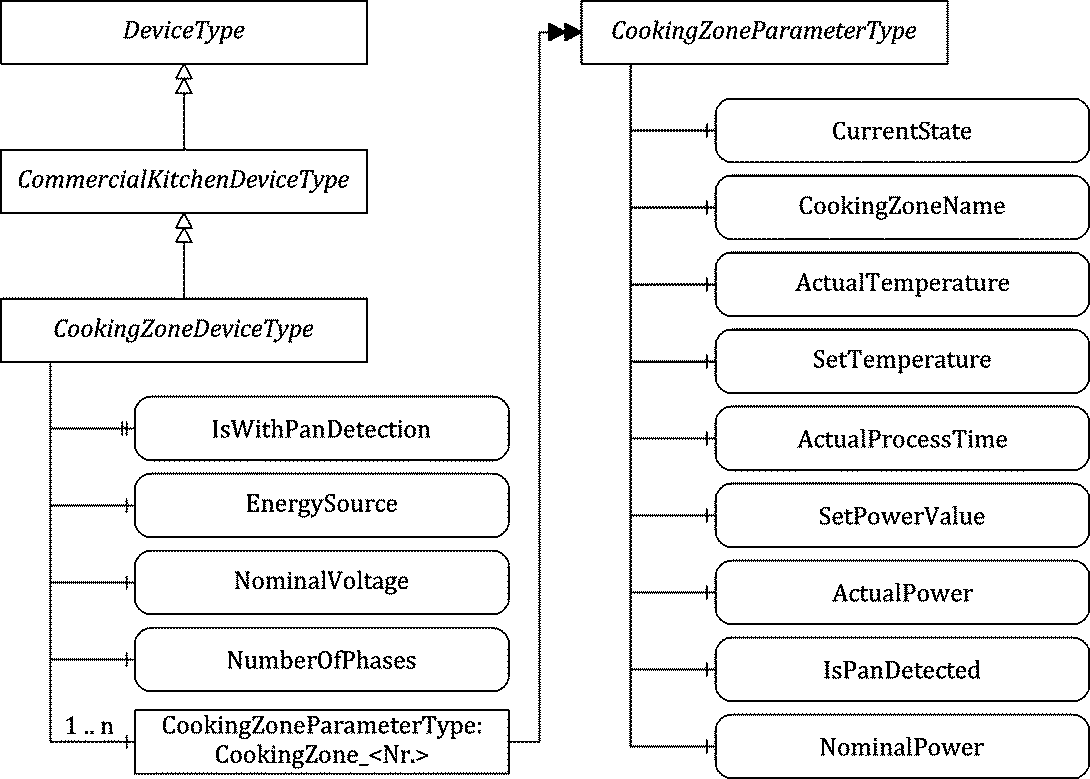
17.2 CookingZoneParameterType
17.2.1 Definition of the object type CookingZoneParameterType
The CookingZoneParameterType is formally defined in Table 59.
| Attribute | Value | |||||
| BrowseName | CookingZoneParameterType | |||||
| IsAbstract | False | |||||
| References | NodeClass | BrowseName | DataType | TypeDefinition |
Modelling
Rule AccessLevel | |
|---|---|---|---|---|---|---|
| Subtype of KitchenDeviceParameterType | ||||||
| HasComponent | Variable | CurrentState | CurrentStateEnumeration | BaseDataVariableType | O, R | |
| HasComponent | Variable | CookingZoneName | String | BaseDataVariableType | O, R | |
| HasComponent | Variable | ActualTemperature | Float | AnalogItemType | O, R | |
| HasComponent | Variable | SetTemperature | Float | AnalogItemType | O, R | |
| HasComponent | Variable | ActualProcessTime | Int32 | AnalogItemType | O, R | |
| HasComponent | Variable | SetPowerValue | Int32 | AnalogItemType | O, R | |
| HasComponent | Variable | ActualPower | Float | AnalogItemType | O, R | |
| HasComponent | Variable | IsPanDetected | Boolean | BaseDataVariableType | O, R | |
| HasComponent | Variable | NominalPower | Int32 | AnalogItemType | M, R | |
17.2.2 Description of the CookingZoneParameterType object type
17.2.2.1 CurrentState variable
This variable describes the state of the device, e.g. standby or power output.
The data type for the CurrentStateEnumeration is defined in section 17.4.1.
17.2.2.2 CookingZoneName variable
This variable describes, for example, the position of the cooking zone, such as left cooking zone, right cooking zone.
17.2.2.3 ActualTemperature variable
This variable describes the currently measured cooking zone temperature.
The EngineeringUnit property of the AnalogItemType has the value °C. The value for the EURange property is device-specific.
17.2.2.4 SetTemperature variable
This variable contains the set temperature to which the cooking zone is to be heated.
The EngineeringUnit property of the AnalogItemType has the value °C. The value for the EURange property is device-specific.
17.2.2.5 ActualProcessTime variable
This variable contains the operating time of the cooking zone.
The EngineeringUnit property of the AnalogItemType has the value s. The value for the EURange property is device-specific.
17.2.2.6 SetPowerValue variable
This variable contains the set value for the power.
The EngineeringUnit property of the AnalogItemType has the value % and the EURange property has the minimum value 0 and the maximum value 100.
17.2.2.7 ActualPower variable
The ActualPower variable returns the current power of the cooking zone.
The EngineeringUnit property of the AnalogItemType has the value W. The value for the EURange property is device-specific.
17.2.2.8 IsPanDetected variable
This variable describes whether a pan has been detected on the cooking zone.
17.2.2.9 NominalPower variable
This variable contains the nominal power of the cooking zone.
The EngineeringUnit property of the AnalogItemType has the value W. The value for the EURange property is device-specific.
17.3 CookingZoneDeviceType
17.3.1 Definition of the object type
The CookingZoneDeviceType is formally defined in Table 60.
| Attribute | Value | |||||
| BrowseName | CookingZoneDeviceType | |||||
| IsAbstract | False | |||||
| References | NodeClass | BrowseName | DataType | TypeDefinition |
Modelling
Rule AccessLevel | |
|---|---|---|---|---|---|---|
| Subtype of CommercialKitchenDeviceType | ||||||
| HasProperty | Variable | IsWithPanDetection | Boolean | PropertyType | M, R | |
| HasProperty | Variable | EnergySource | EnergySourceEnumeration | PropertyType | M, R | |
| HasComponent | Variable | NominalVoltage | Int32 | AnalogItemType | M, R | |
| HasProperty | Variable | NumberOfPhases | Int32 | PropertyType | M, R | |
| HasComponent | Object | CookingZone_<No.> | CookingZoneParameterType | MP, R | ||
17.3.2 Description of the object type
17.3.2.1 IsWithPanDetection property
This property describes whether the device is equipped with pan detection.
17.3.2.2 EnergySource property
The EnergySource property returns the type of energy supply. The data type for the EnergySourceEnumeration is defined in 21.1.
17.3.2.3 NominalVoltage property
The NominalVoltage property contains the nominal voltage of the cooking zone combination.
The EngineeringUnit property of the AnalogItemType has the value V. The value for the EURange property is device-specific.
17.3.2.4 NumberOfPhases property
The NumberOfPhases property returns the number of phases of the cooking zone combination (1-phase, 2-phase, 3-phase).
17.3.2.5 CookingZone_<No.> objects
A cooking zone combination may consist of one or more cooking zones. The CookingZone_<No.> object contains the data for a cooking zone.
17.4 Data types for enumerations
17.4.1 CurrentStateEnumeration
This DataType is an enumeration of the possible operating states of a cooking zone.
The possible values are defined in Table 61.
| Value | Description |
| Off_0 | Off |
| Standby_1 | Device is in standby |
| Power_2 | Power output |
| PotDetection_3 | Pan detection |
18 Type definitions for Frying And Grilling Appliance
18.1 General
Figure 22 shows an overview of the object types for the Frying And Grilling Appliance device class.
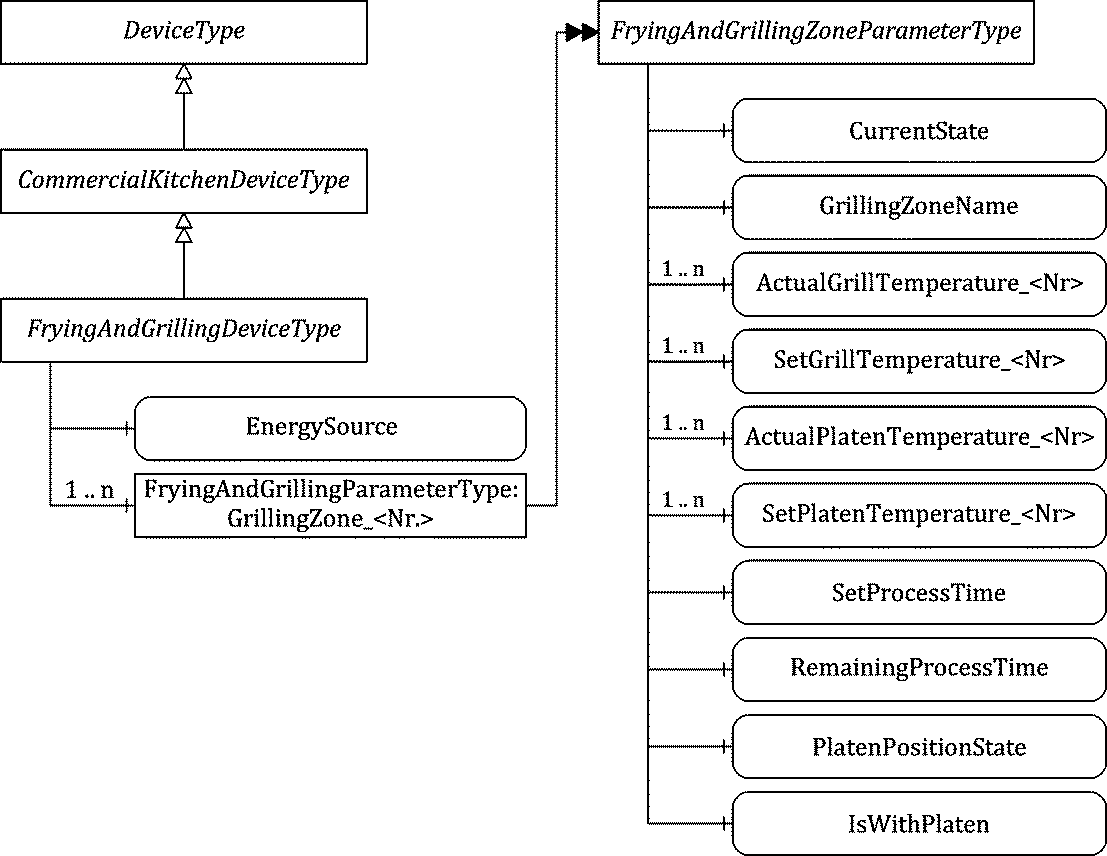
18.2 FryingAndGrillingParameterType
18.2.1 Definition of the object type
The FryingAndGrillingParameterType is formally defined in Table 62.
| Attribute | Value | |||||
| BrowseName | FryingAndGrillingParameterType | |||||
| IsAbstract | False | |||||
| References | Node Class | BrowseName | DataType | TypeDefinition |
Modelling
Rule AccessLevel | |
|---|---|---|---|---|---|---|
| Subtype of KitchenDeviceParameterType | ||||||
| HasComponent | Variable | CurrentState | GrillingZoneStateEnumeration | BaseDataVariableType | O, R | |
| HasComponent | Variable | GrillingZoneName | String | BaseDataVariableType | O, R | |
| HasComponent | Variable | ActualGrillTemperature_<No.> | Float | AnalogItemType | OP, R | |
| HasComponent | Variable | SetGrillTemperature_<No.> | Float | AnalogItemType | OP, R | |
| HasComponent | Variable | ActualPlatenTemperature_<No.> | Float | AnalogItemType | OP, R | |
| HasComponent | Variable | SetPlatenTemperature_<No.> | Float | AnalogItemType | OP, R | |
| HasComponent | Variable | SetProcessTime | Int32 | AnalogItemType | O, R | |
| HasComponent | Variable | RemainingProcessTime | Int32 | AnalogItemType | O, R | |
| HasComponent | Variable | PlatenPositionState | PlatenPositionStateEnumeration | BaseDataVariableType | O, R | |
| HasComponent | Variable | IsWithPlaten | Boolean | BaseDataVariableType | M, R | |
18.2.2 Description of the object type
18.2.2.1 CurrentState variable
This variable describes the state of the device, e.g. standby or power output.
The data type for the GrillingZoneStateEnumeration is defined in section 18.4.1.
18.2.2.2 GrillingZoneName variable
This variable describes, for example, the position of the grilling zone, such as left grilling zone, right grilling zone.
18.2.2.3 ActualGrillTemperature_<No.> variable
This variable describes the currently measured grilling zone temperature. A grilling zone may consist of one or more areas (e.g. rear, middle, front).
The EngineeringUnit property of the AnalogItemType has the value °C. The value for the EURange property is device-specific.
18.2.2.4 SetGrillTemperature_<No.> variable
This variable contains the set temperature to which the grilling zone is to be heated. A grilling zone may consist of one or more areas (e.g. rear, middle, front).
The EngineeringUnit property of the AnalogItemType has the value °C. The value for the EURange property is device-specific.
18.2.2.5 ActualPlatenTemperature_<No.> variable
This variable describes the currently measured grill platen temperature. A grilling zone may consist of one or more areas (e.g. rear, middle, front).
The EngineeringUnit property of the AnalogItemType has the value °C. The value for the EURange property is device-specific.
18.2.2.6 SetPlatenTemperature_<No.> variable
This variable contains the set temperature to which the grill platen is to be heated. A grilling zone may consist of one or more areas (e.g. rear, middle, front).
The EngineeringUnit property of the AnalogItemType has the value °C. The value for the EURange property is device-specific.
18.2.2.7 SetProcessTime variable
This variable contains the set value for the grilling zone operating time.
The EngineeringUnit property of the AnalogItemType has the value s. The value for the EURange property is device-specific.
18.2.2.8 RemainingProcessTime variable
This variable contains the remaining running time of the grilling zone.
The EngineeringUnit property of the AnalogItemType has the value s. The value for the EURange property is device-specific.
18.2.2.9 PlatenPositionState variable
The variable contains the operating position of the disk.
The data type for the enumeration PlatenPositionState is defined in 18.4.2.
18.2.2.10 IsWithPlaten property
This property indicates whether the grill has a top grill platen (double-sided grilling).
18.3 FryingAndGrillingDeviceType
18.3.1 Definition of the object type
The FryingAndGrillingDeviceType is formally defined in Table 63.
| Attribute | Value | |||||
| BrowseName | FryingAndGrillingDeviceType | |||||
| IsAbstract | False | |||||
| References | NodeClass | BrowseName | DataType | TypeDefinition |
Modelling
Rule AccessLevel | |
|---|---|---|---|---|---|---|
| Subtype of CommercialKitchenDeviceType | ||||||
| HasProperty | Variable | EnergySource | EnergySourceEnumeration | PropertyType | M, R | |
| HasComponent | Object | GrillingZone_<No.> | FryingAndGrillingParameterType | MP, R | ||
18.3.2 Description of the FryingAndGrillingDeviceType object type
18.3.2.1 EnergySource property
The EnergySource property returns the type of energy supply. The data type for the EnergySourceEnumeration is defined in 21.1.
18.3.2.2 GrillingZone_<No.> objects
A grill may consist of one or more grilling zones. The GrillingZone_<No.> object contains the data for a grilling zone.
18.4 Data types for enumerations
18.4.1 GrillingZoneStateEnumeration
The data type is an enumeration of the possible operating states of the device.
The possible values are defined in Table 64.
| Value | Description |
| Off_0 | Off |
| Standby_1 | Device is in standby |
| Idle_2 | Device is in idle mode |
| Grilling_3 | Device is grilling |
18.4.2 PlatenPositionStateEnumeration
This data type is an enumeration of the possible operating positions of the platen.
The possible values are defined in Table 65.
| Value | Description |
| Home_0 | Platen is in the home position |
| Cooking_1 | Platen is in the grilling position |
| Idle_2 | Platen is in idle mode |
| Open_3 | Platen is open |
19 Type definitions for Microwave Combination Oven
19.1 General
Figure 23 shows an overview of the object types for the Microwave Combination Oven device class.
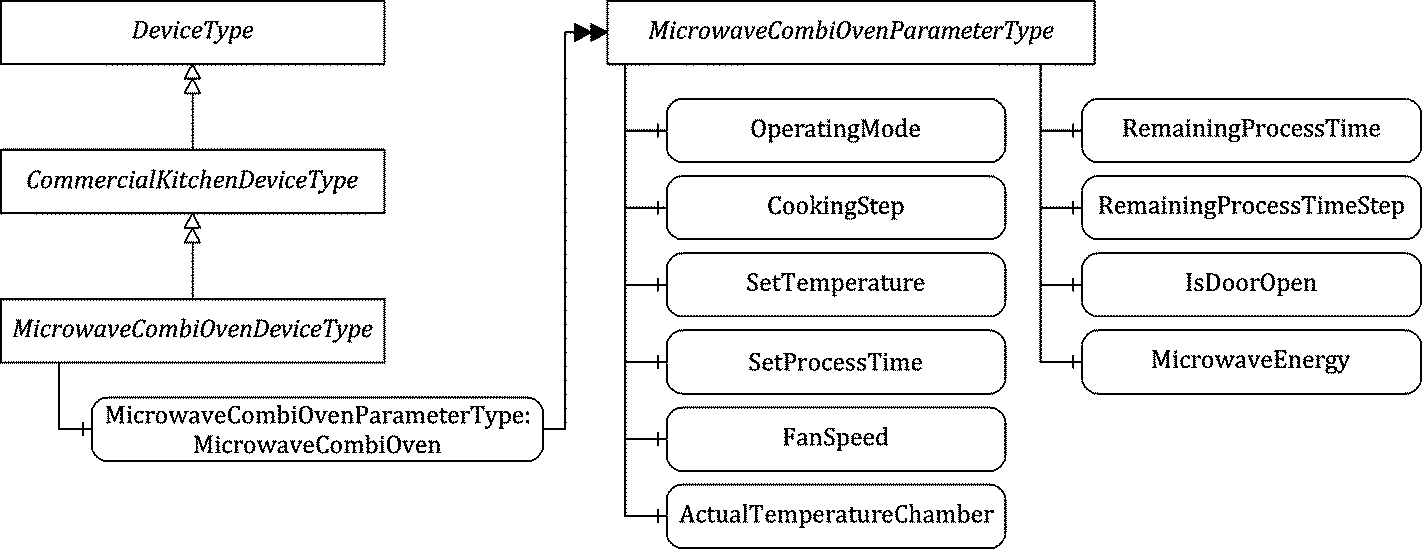
19.2 MicrowaveCombiOvenParameterType
19.2.1 Definition of the object type
The MicrowaveCombiOvenParameterType is formally defined in Table 66.
| Attribute | Value | |||||
| BrowseName | MicrowaveCombiOvenParameterType | |||||
| IsAbstract | False | |||||
| References | NodeClass | BrowseName | DataType | TypeDefinition |
Modelling
Rule AccessLevel | |
|---|---|---|---|---|---|---|
| Subtype of KitchenDeviceParameterType | ||||||
| HasComponent | Variable | ActualTemperatureChamber | Float | AnalogItemType | M, R | |
| HasComponent | Variable | SetTemperature | Float | AnalogItemType | M, R | |
| HasComponent | Variable | SetProcessTime | Int32 | AnalogItemType | M, R | |
| HasComponent | Variable | RemainingProcessTime | Int32 | AnalogItemType | M, R | |
| HasComponent | Variable | RemainingProcessTimeStep | Int32 | AnalogItemType | O, R | |
| HasComponent | Variable | CookingStep | Int32 | BaseDataVariableType | O, R | |
| HasComponent | Variable | FanSpeed | Int32 | AnalogItemType | O, R | |
| HasComponent | Variable | MicrowaveEnergy | Int32 | AnalogItemType | O, R | |
| HasComponent | Variable | OperatingMode | OperatingModeEnumeration | BaseDataVariableType | M, R | |
| HasComponent | Variable | IsDoorOpen | Boolean | BaseDataVariableType | M, R | |
19.2.2 Description of the object type
19.2.2.1 ActualTemperatureChamber variable
The ActualTemperatureChamber variable contains the current cooking chamber temperature. This should always be available, even if the microwave combination oven is not currently running a program/recipe.
The EngineeringUnit property of the AnalogItemType has the value °C. The value for the EURange property is device-specific.
19.2.2.2 SetTemperature variable
The SetTemperature variable contains the set temperature of the cooking chamber.
The EngineeringUnit property of the AnalogItemType has the value °C. The value for the EURange property is device-specific.
19.2.2.3 SetProcessTime variable
The SetProcessTime variable contains the set time of a cooking process in seconds. The time is 0 if the device is in the idle state.
The EngineeringUnit property of the AnalogItemType has the value s. The value for the EURange property is device-specific.
19.2.2.4 RemainingProcessTime variable
The RemainingProcessTime contains the (estimated) remaining time in seconds of a running program/recipe or a cleaning routine. The time is 0 if the device is in the idle state or no pre-programmed routine is running. Negative values mean an unknown time.
The EngineeringUnit property of the AnalogItemType has the value s. The value for the EURange property is device-specific.
19.2.2.5 RemainingProcessTimeStep variable
The RemainingProcessTimeStep variable contains the (estimated) remaining time of cooking step in a running program/recipe. The time is 0 if the device is in the idle state or no pre-programmed routine is running. Negative values mean an unknown time.
The EngineeringUnit property of the AnalogItemType has the value s. The value for the EURange property is device-specific.
19.2.2.6 CookingStep variable
The CookingStep variable indicates the current cooking step of the currently running cooking program.
19.2.2.7 FanSpeed variable
The FanSpeed variable contains the rotary speed of the fan impeller.
The EngineeringUnit property of the AnalogItemType has the value % and the EURange property has the minimum value 0 and the maximum value 100.
19.2.2.8 MicrowaveEnergy variable
The MicrowaveEnergy variable contains the microwave output power.
The EngineeringUnit property of the AnalogItemType has the value % and the EURange property has the minimum value 0 and the maximum value 100.
19.2.2.9 OperatingMode variable
The OperationMode variable indicates the current operating state of the device on the basis of a prefabricated state list. Only the operation modes given in the corresponding list are possible.
The data type for the OperatingModeEnumeration is defined in section 19.4.1.
19.2.2.10 IsDoorOpen variable
This variable describes whether the door is open.
19.3 MicrowaveCombiOvenDeviceType
19.3.1 General
The MicrowaveCombiOvenDeviceType describes the composition of the fundamental operational data of a microwave combination oven, which applies in addition to the DeviceType.
These operational data enable the current state of the device or its current task to be comprehended and mapped in other systems, e.g. a monitoring database.
19.3.2 Definition of the object type
The MicrowaveCombiOvenDeviceType is formally defined in Table 67.
| Attribute | Value | |||||
| BrowseName | MicrowaveCombiOvenDeviceType | |||||
| IsAbstract | False | |||||
| References | NodeClass | BrowseName | DataType | TypeDefinition |
Modelling
Rule AccessLevel | |
|---|---|---|---|---|---|---|
| Subtype of CommercialKitchenDeviceType | ||||||
| HasComponent | Object | MicrowaveCombiOven | MicrowaveCombiOvenParameterType | M | ||
19.4 Data types for enumerations
19.4.1 OperatingModeEnumeration
This data type is an enumeration of the possible operation modes of the microwave combination oven.
The enumeration values are defined in Table 68.
| Value | Description |
| Preheat_0 | Preheating (to target temperature) |
| CoolDown_1 | Device cooling down |
| Process_2 | Cooking process active |
| PowerSaving_3 | Energy-saving resting mode |
| Standby_4 | Standby mode |
| Service_5 | Device in service mode |
| Cleaning_6 | Cleaning program(s) running |
| Off_7 | Shutdown or off |
| Error_8 | Error state |
20 Type definitions for Ice Machine
20.1 General
Figure 24 shows an overview of the object types for the Ice Machine device class.
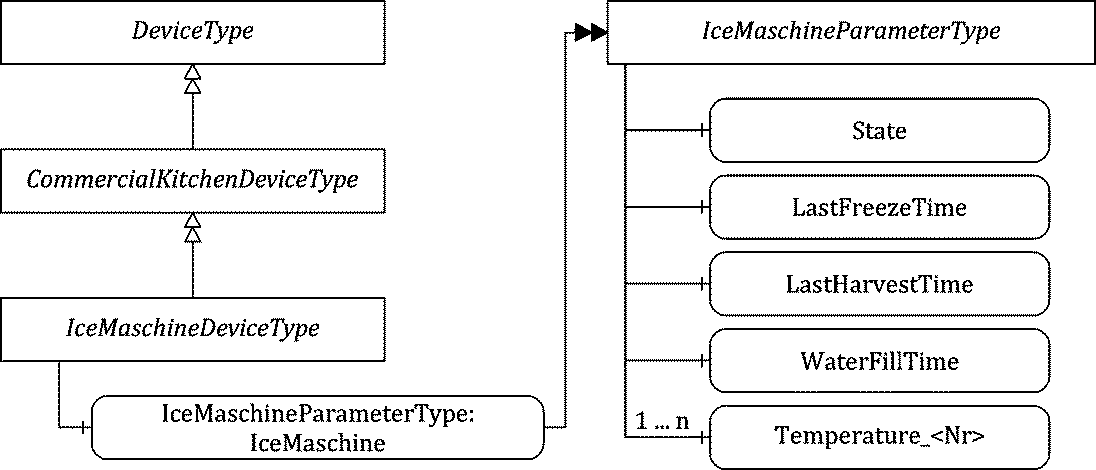
20.2 IceMachineParameterType
20.2.1 Definition of the object type
The IceMachineParameterType is formally defined in Table 69.
| Attribute | Value | |||||
| BrowseName | IceMachineParameterType | |||||
| IsAbstract | False | |||||
| References | NodeClass | BrowseName | DataType | TypeDefinition |
Modelling
Rule AccessLevel | |
|---|---|---|---|---|---|---|
| Subtype of KitchenDeviceParameterType | ||||||
| HasComponent | Variable | Status | StatusEnumeration | BaseDataVariableType | O, R | |
| HasComponent | Variable | LastFreezeTime | Int32 | AnalogItemType | O, R | |
| HasComponent | Variable | LastHarvestTime | Int32 | AnalogItemType | O, R | |
| HasComponent | Variable | WaterFillTime | Int32 | AnalogItemType | O, R | |
| HasComponent | Variable | Temperature_<No.> | Float | AnalogItemType | OP, R | |
20.2.2 Description of the object type
20.2.2.1 Status variable
The Status variable contains the current status of the ice machine.
The data type for the StatusEnumeration is defined in 20.4.1.
20.2.2.2 LastFreezeTime variable
The LastFreezeTime variable contains the time that was needed for the last freeze cycle.
The EngineeringUnit property of the AnalogItemType has the value s. The value for the EURange property is device-specific.
20.2.2.3 LastHarvestTime variable
The LastHarvestTime variable contains the time that was needed for the last ice harvest.
The EngineeringUnit property of the AnalogItemType has the value s. The value for the EURange property is device-specific.
20.2.2.4 WaterFillTime variable
The WaterFillTime variable contains the time that was needed for the last water filling.
The EngineeringUnit property of the AnalogItemType has the value s. The value for the EURange property is device-specific.
20.2.2.5 Temperature_<No.> variable
The Temperature variable contains temperatures such as ambient temperature, compressor outlet temperature, evaporator outlet temperature, evaporator inlet temperature, etc.
The contents of these variables depend on the device type and device equipment. The meaning of the individual temperatures can be taken from the description of the respective ice machine.
The EngineeringUnit property of the AnalogItemType has the value °C. The value for the EURange property is device-specific.
20.3 IceMachineDeviceType
20.3.1 General
IceMachineDeviceType describes the composition of the fundamental operational data of an ice machine, which are to apply in addition to the DeviceType.
These operational data enable the current state of the device or its current task to be comprehended and mapped in other systems, e.g. a monitoring database.
20.3.2 Definition of the object type
The IceMachineDeviceType is formally defined in Table 70.
| Attribute | Value | |||||
| BrowseName | IceMachineDeviceType | |||||
| IsAbstract | False | |||||
| References | NodeClass | BrowseName | DataType | TypeDefinition |
Modelling
Rule AccessLevel | |
|---|---|---|---|---|---|---|
| Subtype of CommercialKitchenDeviceType | ||||||
| HasComponent | Object | IceMachine | IceMachineParameterType | M | ||
20.4 Data types for enumerations
20.4.1 StatusEnumeration
This data type is an enumeration of the possible operation modes of the ice machine. The enumeration values are defined in Table 71.
| Value | Description |
| INIT_0 | Commissioning, started manually (switch on) or automatically (after cleaning) |
| WATER_PURGE_1 | Existing water in the tray is flushed out and fresh water is filled for the next cycle |
| PRE_CHILL_2 | Precooling of the evaporator for xx seconds during the initial commissioning |
| FREEZE_3 | The water freezes on the evaporator to form ice |
| HARVEST_4 | Ice is harvested |
| BIN_FULL_5 | The state indicates that the ice container is full and that ice making has been stopped |
| CLEAN_6 | Ice machine is running through the cleaning steps |
| OFF_7 | Ice machine is switched off |
| SLEEP_MODE_8 | Power failure detected, system clock continues to run |
| STANDBY_9 | State after a temperature sensor error |
| SAFE_MODE_10 | Continue with ice making following an error |
| WATER_OUTAGE_11 | State with a lack of water |
| HPCO_DELAY_ACTIVE_12 | Maintenance state when the overpressure switch is activated and no ice is made for xx minutes |
| CURTAIN_OPEN_13 | Curtain was opened because there is an ice slab between the evaporator and the container. |
| PRODUCTION_TEST_14 | Ice machine is in the function test mode (at the manufacturer) |
| SAFE_MODE_PRECHILL_15 | Like the PRE_CHILL_2 state, but after a SAFE_MODE_10 state |
| SAFE_MODE_FREEZE_16 | Like the FREEZE_3 state, but after a SAFE_MODE_10 state |
| SAFE_MODE_HARVEST_17 | Like the HARVEST_4 state, but after a SAFE_MODE_10 state |
| SAFE_MODE_FULL_BIN_18 | Like the BIN_FULL_5 state, but after a SAFE_MODE_10 state |
21 OPC UA DataTypes
21.1 EnergySourceEnumeration
This data type is an enumeration of the energy source types. The enumeration values are defined in Table 72.
| Value | Description |
|---|---|
| Electric_0 | Electrical heating |
| Gas_1 | Gas heating |
| Steam_2 | Steam heating |
22 Profiles and Namespaces
22.1 Namespace Metadata
Table 73 defines the namespace metadata for this specification. The Object is used to provide version information for the namespace and an indication about static Nodes. Static Nodes are identical for all Attributes in all Servers, including the Value Attribute. See Part5 for more details.
The information is provided as Object of type NamespaceMetadataType. This Object is a component of the Namespaces Object that is part of the Server Object. The NamespaceMetadataType ObjectType and its Properties are defined in Part5.
The version information is also provided as part of the ModelTableEntry in the UANodeSet XML file. The UANodeSet XML schema is defined in OPC 10000-6.
| Attribute | Value | |||
| BrowseName | http://opcfoundation.org/UA/CommercialKitchenEquipment/ | |||
| References | BrowseName | DataType | Value | |
|---|---|---|---|---|
| HasProperty | NamespaceUri | String | http://opcfoundation.org/UA/CommercialKitchenEquipment/ | |
| HasProperty | NamespaceVersion | String | 1.00 | |
| HasProperty | NamespacePublicationDate | DateTime | 2019-03-13 | |
| HasProperty | IsNamespaceSubset | Boolean | False | |
| HasProperty | StaticNodeIdTypes | IdType[] | {Numeric} | |
| HasProperty | StaticNumericNodeIdRange | NumericRange[] | Zero | |
| HasProperty | StaticStringNodeIdPattern | String | Zero | |
22.2 Conformance Units and Profiles
This chapter defines the corresponding Profiles and Conformance Units for the OPC UA Information Model for commercial kitchen devices. Profiles are named groupings of Conformance Units. Facets are Profiles that will be combined with other Profiles to define the complete functionality of an OPC UA Server or Client.
22.3 Handling of OPC UA Namespaces
Namespaces are used by OPC UA to create unique identifiers across different naming authorities. The Attributes NodeId and BrowseName are identifiers. A Node in the UA AddressSpace is unambiguously identified using a NodeId. Unlike NodeIds, the BrowseName cannot be used to unambiguously identify a Node. Different Nodes may have the same BrowseName. They are used to build a browse path between two Nodes or to define a standard Property.
Servers may often choose to use the same namespace for the NodeId and the BrowseName. However, if they want to provide a standard Property, its BrowseName shall have the namespace of the standards body although the namespace of the NodeId reflects something else, for example the EngineeringUnits Property. All NodeIds of Nodes not defined in this specification shall not use the standard namespaces.
Table 74 provides a list of mandatory and optional namespaces used in a commercial kitchen devices OPC UA Server.
| NamespaceURI | Description | Use |
| http://opcfoundation.org/UA/ | Namespace for NodeIds and BrowseNames defined in the OPC UA specification. This namespace shall have namespace index 0. | Mandatory |
| Local Server URI | Namespace for nodes defined in the local server. This may include types and instances used in an AutoID Device represented by the Server. This namespace shall have namespace index 1. | Mandatory |
| http://opcfoundation.org/UA/DI/ | Namespace for NodeIds and BrowseNames defined in OPC 10000-100. The namespace index is Server specific. | Mandatory |
| http://opcfoundation.org/UA/ CommercialKitchenEquipment/ | Namespace for NodeIds and BrowseNames defined in this specification. The namespace index is Server specific. | Mandatory |
| Vendor specific types | A Server may provide vendor-specific types like types derived from ObjectTypes defined in this specification in a vendor-specific namespace. | Optional |
| Vendor specific instances | A Server provides vendor-specific instances of the standard types or vendor-specific instances of vendor-specific types in a vendor-specific namespace. It is recommended to separate vendor specific types and vendor specific instances into two or more namespaces. | Mandatory |
Table 75 provides a list of namespaces and their index used for BrowseNames in this specification. The default namespace of this specification is not listed since all BrowseNames without prefix use this default namespace.
| NamespaceURI | Namespace Index | Example |
| http://opcfoundation.org/UA/ | 0 | 0:EngineeringUnits |
| http://opcfoundation.org/UA/DI/ | 1 | 1:DeviceRevision |
Annex A (normative): Commercial Kitchen Devices Namespace and mappings
A.1 Namespace and identifiers for commercial kitchen devices Information Model
This appendix defines the numeric identifiers for all of the numeric NodeIds defined in this specification. The identifiers are specified in a CSV file with the following syntax:
<SymbolName>, <Identifier>, <NodeClass>Where the SymbolName is either the BrowseName of a Type Node or the BrowsePath for an Instance Node that appears in the specification and the Identifier is the numeric value for the NodeId.
The BrowsePath for an Instance Node is constructed by appending the BrowseName of the instance Node to the BrowseName for the containing instance or type. An underscore character is used to separate each BrowseName in the path. Let's take for example, the CommercialKitchenDeviceType ObjectType Node which has the DeviceLocationName Property. The Name for the DeviceLocationName InstanceDeclaration within the CommercialKitchenDeviceType declaration is: CommercialKitchenDeviceType_DeviceLocationName.
The NamespaceUri for all NodeIds defined here is http://opcfoundation.org/UA/CommercialKitchenEquipment/
The CSV released with this version of the specification can be found here:
http://www.opcfoundation.org/UA/schemas/CommercialKitchenEquipment/NodeIds.csv
A computer processible version of the complete Information Model defined in this specification is also provided. It follows the XML Information Model schema syntax defined in OPC 10000-6.
The Information Model Schema released with this version of the specification can be found here:
Agreement of Use
COPYRIGHT RESTRICTIONS
This document is provided "as is" by the OPC Foundation and the HKI (industrial association of House, Heating and Kitchen Technology).
Right of use for this specification is restricted to this specification and does not grant rights of use for referred documents.
Right of use for this specification will be granted without cost.
This document may be distributed through computer systems, printed or copied as long as the content remains unchanged and the document is not modified.
OPC Foundation and HKI do not guarantee usability for any purpose and shall not be made liable for any case using the content of this document.
The user of the document agrees to indemnify OPC Foundation and HKI and their officers, directors and agents harmless from all demands, claims, actions, losses, damages (including damages from personal injuries), costs and expenses (including attorneys' fees) which are in any way related to activities associated with its use of content from this specification.
The document shall not be used in conjunction with company advertising, shall not be sold or licensed to any party.
The intellectual property and copyright is solely owned by the OPC Foundation and the HKI.
PATENTS
The attention of adopters is directed to the possibility that compliance with or adoption of OPC or HKI specifications may require use of an invention covered by patent rights. OPC Foundation or HKI shall not be responsible for identifying patents for which a license may be required by any OPC or HKI specification, or for conducting legal inquiries into the legal validity or scope of those patents that are brought to its attention. OPC or HKI specifications are prospective and advisory only. Prospective users are responsible for protecting themselves against liability for infringement of patents.
WARRANTY AND LIABILITY DISCLAIMERS
WHILE THIS PUBLICATION IS BELIEVED TO BE ACCURATE, IT IS PROVIDED "AS IS" AND MAY CONTAIN ERRORS OR MISPRINTS. THE OPC FOUDATION NOR HKI MAKES NO WARRANTY OF ANY KIND, EXPRESSED OR IMPLIED, WITH REGARD TO THIS PUBLICATION, INCLUDING BUT NOT LIMITED TO ANY WARRANTY OF TITLE OR OWNERSHIP, IMPLIED WARRANTY OF MERCHANTABILITY OR WARRANTY OF FITNESS FOR A PARTICULAR PURPOSE OR USE. IN NO EVENT SHALL THE OPC FOUNDATION NOR HKI BE LIABLE FOR ERRORS CONTAINED HEREIN OR FOR DIRECT, INDIRECT, INCIDENTAL, SPECIAL, CONSEQUENTIAL, RELIANCE OR COVER DAMAGES, INCLUDING LOSS OF PROFITS, REVENUE, DATA OR USE, INCURRED BY ANY USER OR ANY THIRD PARTY IN CONNECTION WITH THE FURNISHING, PERFORMANCE, OR USE OF THIS MATERIAL, EVEN IF ADVISED OF THE POSSIBILITY OF SUCH DAMAGES.
The entire risk as to the quality and performance of software developed using this specification is borne by you.
RESTRICTED RIGHTS LEGEND
This Specification is provided with Restricted Rights. Use, duplication or disclosure by the U.S. government is subject to restrictions as set forth in (a) this Agreement pursuant to DFARs 227.7202-3(a); (b) subparagraph (c)(1)(i) of the Rights in Technical Data and Computer Software clause at DFARs 252.227-7013; or (c) the Commercial Computer Software Restricted Rights clause at FAR 52.227-19 subdivision (c)(1) and (2), as applicable. Contractor / manufacturer are the OPC Foundation, 16101 N. 82nd Street, Suite 3B, Scottsdale, AZ, 85260-1830
COMPLIANCE
The combination of HKI and OPC Foundation shall at all times be the sole entities that may authorize developers, suppliers and sellers of hardware and software to use certification marks, trademarks or other special designations to indicate compliance with these materials as specified within this document. Products developed using this specification may claim compliance or conformance with this specification if and only if the software satisfactorily meets the certification requirements set by HKI or the OPC Foundation. Products that do not meet these requirements may claim only that the product was based on this specification and must not claim compliance or conformance with this specification.
Trademarks
Most computer and software brand names have trademarks or registered trademarks. The individual trademarks have not been listed here.
GENERAL PROVISIONS
Should any provision of this Agreement be held to be void, invalid, unenforceable or illegal by a court, the validity and enforceability of the other provisions shall not be affected thereby.
This Agreement shall be governed by and construed under the laws of Germany.
This Agreement embodies the entire understanding between the parties with respect to, and supersedes any prior understanding or agreement (oral or written) relating to, this specification.