
6.15 AssetVerificationType
6.15.1 Overview
The AssetVerificationType ObjectType holds the information to be used for compatibility verification of an Asset.
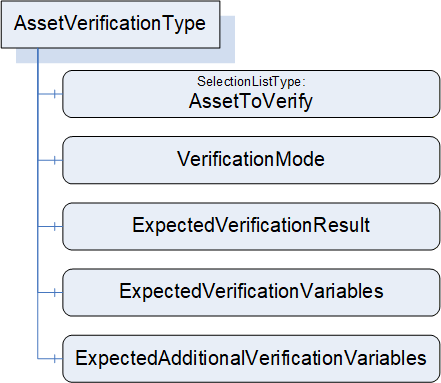
The AssetVerificationType is illustrated in Figure 46.
6.15.2 AssetVerificationType definition
The AssetVerificationType is formally defined in Table 101.
| Attribute | Value | ||||
| BrowseName | 4:AssetVerificationType | ||||
| IsAbstract | False | ||||
| References |
Node
Class | BrowseName | DataType | TypeDefinition | Other |
|---|---|---|---|---|---|
| Subtype of the 0:BaseObjectType defined in OPC 10000-5 | |||||
| 0:HasComponent | Variable | 4:AssetToVerify | 4:PortableNodeIdentifier | 0:SelectionListType | M |
| 0:HasComponent | Variable | 4:VerificationMode | 2:AssetVerificationModeEnum | 0:BaseDataVariableType | M |
| 0:HasComponent | Variable | 4:ExpectedVerificationResult | 2:AssetVerificationResultEnum | 0:BaseDataVariableType | M |
| 0:HasComponent | Variable | 4:ExpectedVerificationVariables | 4:PortableNodeIdentifierValuePair[] | 0:BaseDataVariableType | M |
| 0:HasComponent | Variable | 4:ExpectedAdditionalVerificationVariables | 4:PortableNodeIdentifierValuePair[] | 0:BaseDataVariableType | M |
| ConformanceUnits | |||||
|---|---|---|---|---|---|
| UAFX ConnectionManager Base |
AssetToVerify specifies the expected Asset to be verified. If a PortableRelativePath is specified, the path shall be relative to AutomationComponentNode.
VerificationMode is the mode to use for the verification (compatibility and/or identity).
ExpectedVerificationResult is the expected level of compatibility that this Asset shall provide.
ExpectedVerificationVariables hold the variables to be verified for compatibility and/or identity. It is expected that this list contains IdentifierBrowsePath with a PortableRelativePath as Keys using BrowseNames as defined in Table 31.
ExpectedAdditionalVerificationVariables hold the variables to be verified for compatibility and/or identity. If a PortableRelativePath is specified, the path shall be relative to the expected Asset.