OPC Unified Architecture - Part 5: Information Model
8 Standard Objects and their Variables
8.1 General
Objects and Variables described in the following subclauses can be extended by additional Properties or References to other Nodes, except where it is stated in the text that it is restricted.
8.2 Objects used to organise the AddressSpace structure
8.2.1 Overview
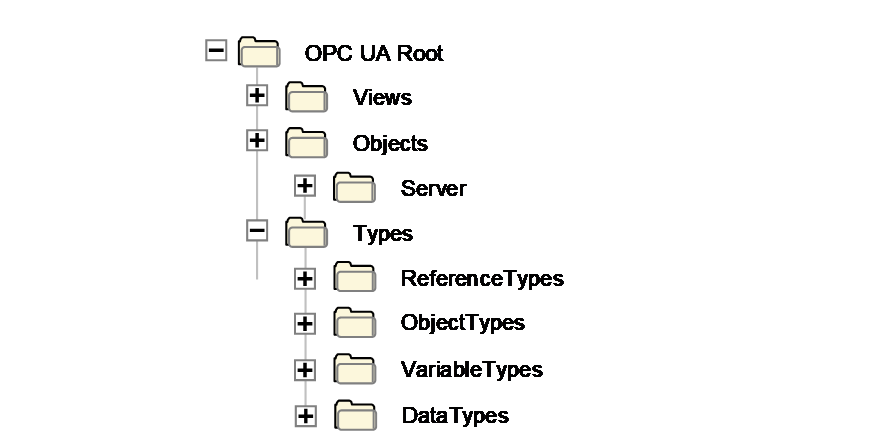
To promote interoperability of clients and Servers, the OPC UA AddressSpace is structured as a hierarchy, with the top levels standardised for all Servers. Figure 1 illustrates the structure of the AddressSpace. All Objects in this figure are organised using OrganizesReferences and have the ObjectType FolderType as type definition.
Figure 1 - Standard AddressSpace structure
The remainder of this provides descriptions of these standard Nodes and the organization of Nodes beneath them. Servers typically implement a subset of these standard Nodes, depending on their capabilities.
8.2.2 Root
This standard Object is the browse entry point for the AddressSpace. It contains a set of OrganizesReferences that point to the other standard Objects. The "Root" Object shall not reference any other NodeClasses. It is formally defined in Table 100.
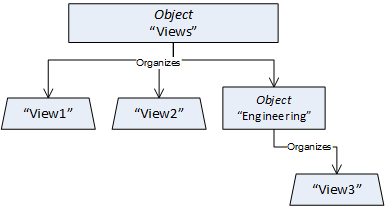
This standard Object is the browse entry point for Views. Only OrganizesReferences are used to relate View Nodes to the "Views" standard Object. All View Nodes in the AddressSpace shall be referenced by this Node, either directly or indirectly. That is, the "Views" Object may reference other Objects using OrganizesReferences. Those Objects may reference additional Views. Figure 2 illustrates the Views organization. The "Views" standard Object directly references the Views "View1" and "View2" and indirectly "View3" by referencing another Object called "Engineering".
Figure 2 - Views organization
The "Views" Object shall not reference any other NodeClasses. The "Views" Object is formally defined in Table 101.
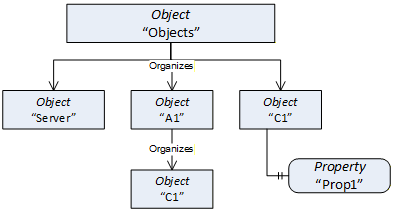
This standard Object is the browse entry point for Object Nodes. Figure 3 illustrates the structure beneath this Node. Only OrganizesReferences are used to relate Objects to the "Objects" standard Object. A ViewNode can be used as entry point into a subset of the AddressSpace containing Objects and Variables and thus the "Objects" Object can also reference ViewNodes using OrganizesReferences. The intent of the "Objects" Object is that all Objects and Variables that are not used for type definitions or other organizational purposes (e.g. organizing the Views) are accessible through hierarchical References starting from this Node. However, this is not a requirement, because not all Servers may be able to support this. This Object references the standard Server Object defined in 8.3.2.
Figure 3 - Objects organization
The "Objects" Object is formally defined in Table 102.
This standard Object Node is the browse entry point for type Nodes. Figure 1 illustrates the structure beneath this Node. Only OrganizesReferences are used to relate Objects to the "Types" standard Object. The "Types" Object shall not reference any other NodeClasses. It is formally defined in Table 103.
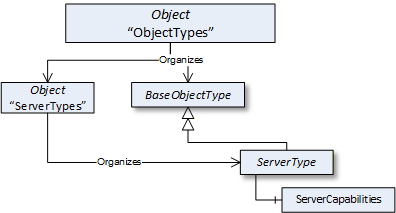
This standard Object Node is the browse entry point for ObjectType Nodes. Figure 4 illustrates the structure beneath this Node showing some of the standard ObjectTypes defined in Clause 6. Only OrganizesReferences are used to relate Objects and ObjectTypes to the "ObjectTypes" standard Object. The "ObjectTypes" Object shall not reference any other NodeClasses.
Figure 4 - ObjectTypes organization
The intention of the "ObjectTypes" Object is that all ObjectTypes of the Server are either directly or indirectly accessible browsing HierarchicalReferences starting from this Node. However, this is not required and Servers might not provide some of their ObjectTypes because they may be well-known in the industry, such as the ServerType defined in 6.3.1.
This Object also indirectly references the BaseEventType defined in 6.4.2, which is the base type of all EventTypes. Thereby it is the entry point for all EventTypes provided by the Server. It is required that the Server expose all its EventTypes, so a client can usefully subscribe to Events.
The "ObjectTypes" Object is formally defined in Table 104.
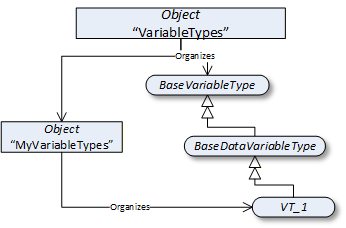
This standard Object is the browse entry point for VariableType Nodes. Figure 5 illustrates the structure beneath this Node. Only OrganizesReferences are used to relate Objects and VariableTypes to the "VariableTypes" standard Object. The "VariableTypes" Object shall not reference any other NodeClasses.
Figure 5 - VariableTypes organization
The intent of the "VariableTypes" Object is that all VariableTypes of the Server are either directly or indirectly accessible browsing HierarchicalReferences starting from this Node. However, this is not required and Servers might not provide some of their VariableTypes, because they may be well-known in the industry, such as the "BaseVariableType" defined in 7.2.
The "VariableTypes" Object is formally defined in Table 105.
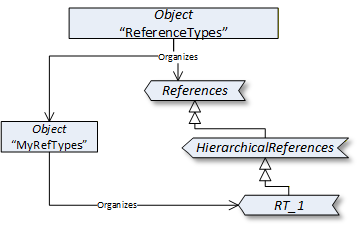
This standard Object is the browse entry point for ReferenceType Nodes. Figure 6 illustrates the organization of ReferenceTypes. OrganizesReferences are used to define ReferenceTypes and Objects referenced by the "ReferenceTypes" Object. The "ReferenceTypes" Object shall not reference any other NodeClasses. See Clause 11 for a discussion of the standard ReferenceTypes that appear beneath the "ReferenceTypes" Object.
Figure 6 - ReferenceType definitions
Since ReferenceTypes will be used as filters in the browse Service and in queries, the Server shall provide all its ReferenceTypes, directly or indirectly following hierarchical References starting from the "ReferenceTypes" Object. This means that, whenever the client follows a Reference, the Server shall expose the type of this Reference in the ReferenceType hierarchy. It shall provide all ReferenceTypes so that the client would be able, following the inverse subtype of References, to come to the base ReferencesReferenceType. It does not mean that the Server shall expose the ReferenceTypes that the client has not used any Reference of.
The "ReferenceTypes" Object is formally defined in Table 106.
This standard Object is the browse entry point for DataTypes that the Server wishes to expose in the AddressSpace.
DataTypeNodes should be made available using OrganizesReferences pointing either directly from the "DataTypes" Object to the DataTypeNodes or using additional FolderObjects for grouping purposes. The intent is that all DataTypes of the Server exposed in the AddressSpace are accessible following hierarchical References starting from the "DataTypes" Object. However, this is not required.
The "DataTypes" Object is formally defined in Table 107.
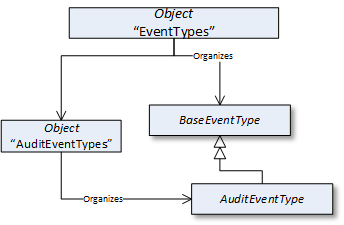
This standard Object Node is the browse entry point for EventType Nodes. Figure 7 illustrates the structure beneath this Node showing some of the standard EventTypes defined in Clause 6. Only OrganizesReferences are used to relate Objects and ObjectTypes to the "EventTypes" standard Object. The "EventTypes" Object shall not reference any other NodeClasses.
Figure 7 - EventTypes organization
The intention of the "EventTypes" Object is that all EventTypes of the Server are either directly or indirectly accessible browsing HierarchicalReferences starting from this Node. It is required that the Server expose all its EventTypes, so a client can usefully subscribe to Events.
The "EventTypes" Object is formally defined in Table 108.
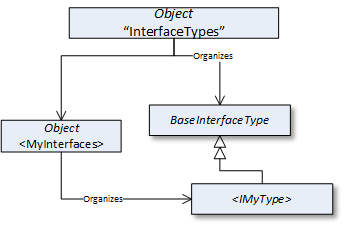
This standard Object Node is the browse entry point for ObjectType Nodes that represent Interfaces. Figure 8 illustrates the structure beneath this Node showing some of the standard ObjectTypes defined in clause 6. Only OrganizesReferences are used to relate Objects and Interfaces to the "InterfaceTypes" standard Object. The "InterfaceTypes" Object shall not reference any other NodeClasses.
Figure 8 - InterfaceTypes Organization
The intention of the "InterfaceTypes" Object is that all Interfaces of the Server are either directly or indirectly accessible browsing HierarchicalReferences starting from this Node. However, this is not required and Servers might not provide some of their Interfaces because they may be well-known in the industry.
The "InterfaceTypes" Object is formally defined in Table 109.
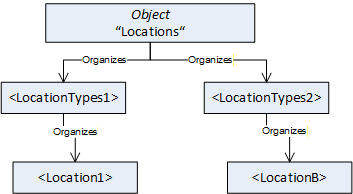
This standard Object is the browse entry point for Object Nodes which represent different types of locations. Figure 9 illustrates the structure beneath this Node. Only OrganizesReferences are used to relate Objects.
Figure 9 - Locations organization
The intent of the "Locations" Object is an entry point for different types of locations. The types of locations organize locations.
The "Locations" Object is formally defined in Table 110.
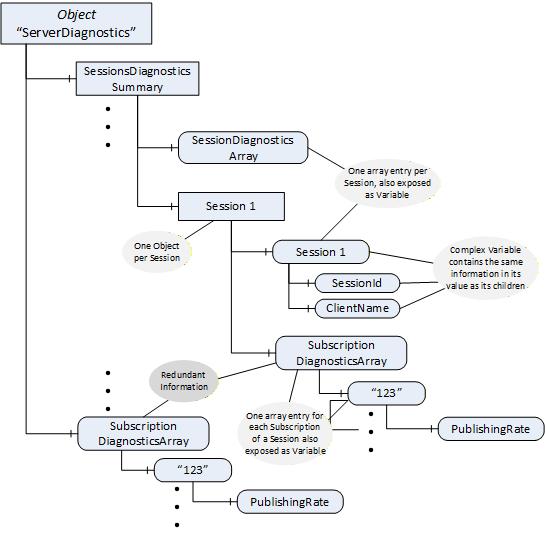
The ServerObject and its containing Objects and Variables are built in a way that the information can be gained in several ways, suitable for different kinds of clients having different requirements. Annex A gives an overview of the design decisions made in providing the information in that way and discusses the pros and cons of the different approaches. Figure 10 gives an overview of the containing Objects and Variables of the diagnostic information of the Server Object and where the information can be found.
The SessionsDiagnosticsSummary Object contains one Object per session and a Variable with an array with one entry per session. This array is of a complex DataType holding the diagnostic information about the session. Each Object representing a session references a complex Variable containing the information about the session using the same DataType as the array containing information about all sessions. Such a Variable also exposes all its information as Variables with simple DataTypes containing the same information as in the complex DataType. Not shown in Figure 10 is the security-related information per session, which follows the same rules.
The Server provides an array with an entry per subscription containing diagnostic information about this subscription. Each entry of this array is also exposed as a complex Variable with Variables for each individual value. Each Object representing a session also provides such an array, but provides the subscriptions of that session.
The arrays containing information about the sessions or the subscriptions may be of different length for different connections with different user credentials since not all users may see all entries of the array. That also implies that the length of the array may change if the user is impersonated. Therefore, clients that subscribe to a specific index range may get unexpected results.
Figure 10 - Excerpt of diagnostic information of the Server
8.3.2 Server Object
This Object is used as the browse entry point for information about the Server. The content of this Object is already defined by its type definition in 6.3.1. It is formally defined in Table 111. The ServerObject serves as root notifier, that is, its EventNotifierAttribute shall be set providing Events. All Events of the Server shall be accessible subscribing to the Events of the ServerObject.
The additional definition for the conformance units of the Server Object are defined in Table 112.
Table 112 - Server Additional Conformance Units
BrowsePath
Conformance Units
ServerArray
Base Info Core Structure 2
NamespaceArray
Base Info Core Structure 2
ServerStatus
Base Info Core Structure 2
ServiceLevel
Base Info Core Structure 2
Auditing
Base Info Core Structure 2
VendorServerInfo
Base Info Core Structure 2
ServerRedundancy
Base Info Core Structure 2
ServerStatus
StartTime
Base Info Core Structure 2
ServerStatus
CurrentTime
Base Info Core Structure 2
ServerStatus
State
Base Info Core Structure 2
ServerStatus
BuildInfo
Base Info Core Structure 2
ServerStatus
BuildInfo
ProductUri
Base Info Core Structure 2
ServerStatus
BuildInfo
ManufacturerName
Base Info Core Structure 2
ServerStatus
BuildInfo
ProductName
Base Info Core Structure 2
ServerStatus
BuildInfo
SoftwareVersion
Base Info Core Structure 2
ServerStatus
BuildInfo
BuildNumber
Base Info Core Structure 2
ServerStatus
BuildInfo
BuildDate
Base Info Core Structure 2
ServerStatus
SecondsTillShutdown
Base Info Core Structure 2
ServerStatus
ShutdownReason
Base Info Core Structure 2
ServerRedundancy
RedundancySupport
Base Info Core Structure 2
ServerCapabilities
Base Info Server Capabilities 2
ServerCapabilities
ServerProfileArray
Base Info Server Capabilities 2
ServerCapabilities
LocaleIdArray
Base Info Server Capabilities 2
ServerCapabilities
MinSupportedSampleRate
Base Info Server Capabilities 2
ServerCapabilities
MaxBrowseContinuationPoints
Base Info Server Capabilities 2
ServerCapabilities
SoftwareCertificates
Base Info Server Capabilities 2
ServerCapabilities
MaxArrayLength
Base Info Server Capabilities 2
ServerCapabilities
MaxStringLength
Base Info Server Capabilities 2
ServerCapabilities
MaxByteStringLength
Base Info Server Capabilities 2
ServerCapabilities
OperationLimits
Base Info Server Capabilities 2
ServerCapabilities
ModellingRules
Base Info Server Capabilities 2
ServerCapabilities
MaxSessions
Base Info Server Capabilities 2
ServerCapabilities
ConformanceUnits
Base Info Server Capabilities 2
ServerCapabilities
OperationLimits
MaxNodesPerRead
Base Info Server Capabilities 2
ServerCapabilities
OperationLimits
MaxNodesPerWrite
Base Info Server Capabilities 2
ServerCapabilities
OperationLimits
MaxNodesPerBrowse
Base Info Server Capabilities 2
ServerCapabilities
OperationLimits
MaxNodesPerRegisterNodes
Base Info Server Capabilities 2
ServerCapabilities
OperationLimits
MaxNodesPerTranslateBrowsePathsToNodeIds
Base Info Server Capabilities 2
ServerCapabilities
AggregateFunctions
Base Info Server Capabilities Subscriptions
ServerCapabilities
MaxSubscriptions
Base Info Server Capabilities Subscriptions
ServerCapabilities
MaxMonitoredItems
Base Info Server Capabilities Subscriptions
ServerCapabilities
MaxSubscriptionsPerSession
Base Info Server Capabilities Subscriptions
ServerCapabilities
MaxMonitoredItemsPerSubscription
Base Info Server Capabilities Subscriptions
ServerCapabilities
OperationLimits
MaxMonitoredItemsPerCall
Base Info Server Capabilities Subscriptions
ServerDiagnostics
Base Info Diagnostics
ServerDiagnostics
ServerDiagnosticsSummary
Base Info Diagnostics
ServerDiagnostics
ServerDiagnosticsSummary
ServerViewCount
Base Info Diagnostics
ServerDiagnostics
ServerDiagnosticsSummary
CurrentSessionCount
Base Info Diagnostics
ServerDiagnostics
ServerDiagnosticsSummary
CumulatedSessionCount
Base Info Diagnostics
ServerDiagnostics
ServerDiagnosticsSummary
SecurityRejectedSessionCount
Base Info Diagnostics
ServerDiagnostics
ServerDiagnosticsSummary
RejectedSessionCount
Base Info Diagnostics
ServerDiagnostics
ServerDiagnosticsSummary
SessionTimeoutCount
Base Info Diagnostics
ServerDiagnostics
ServerDiagnosticsSummary
SessionAbortCount
Base Info Diagnostics
ServerDiagnostics
ServerDiagnosticsSummary
PublishingIntervalCount
Base Info Diagnostics
ServerDiagnostics
ServerDiagnosticsSummary
CurrentSubscriptionCount
Base Info Diagnostics
ServerDiagnostics
ServerDiagnosticsSummary
CumulatedSubscriptionCount
Base Info Diagnostics
ServerDiagnostics
ServerDiagnosticsSummary
SecurityRejectedRequestsCount
Base Info Diagnostics
ServerDiagnostics
ServerDiagnosticsSummary
RejectedRequestsCount
Base Info Diagnostics
ServerDiagnostics
SubscriptionDiagnosticsArray
Base Info Diagnostics
ServerDiagnostics
SessionsDiagnosticsSummary
Base Info Diagnostics
ServerDiagnostics
SessionsDiagnosticsSummary
SessionDiagnosticsArray
Base Info Diagnostics
ServerDiagnostics
SessionsDiagnosticsSummary
SessionSecurityDiagnosticsArray
Base Info Diagnostics
ServerDiagnostics
EnabledFlag
Base Info Diagnostics
ServerDiagnostics
SamplingIntervalDiagnosticsArray
Base Info Fixed SamplingInterval
ServerCapabilities
RoleSet
Base Info Security Role Capabilities
ServerCapabilities
MaxSelectClauseParameters
Base Info Events Capabilities
ServerCapabilities
MaxWhereClauseParameters
Base Info Events Capabilities
ServerCapabilities
OperationLimits
MaxNodesPerMethodCall
Base Info Method Capabilities
GetMonitoredItems
Base Info GetMonitoredItems Method
ResendData
Base Info ResendData Method
SetSubscriptionDurable
Subscription Durable
EstimatedReturnTime
Base Info Estimated Return Time
UrisVersion
Session Sessionless Invocation
RequestServerStateChange
Base Info RequestServerStateChange Method
LocalTime
Base Info LocalTime
ServerCapabilities
MaxHistoryContinuationPoints
Base Info History Read Capabilities
ServerCapabilities
OperationLimits
MaxNodesPerHistoryReadData
Base Info History ReadData Capabilities
ServerCapabilities
OperationLimits
MaxNodesPerHistoryReadEvents
Base Info History ReadEvents Capabilities
ServerCapabilities
OperationLimits
MaxNodesPerHistoryUpdateData
Base Info History UpdateEvents Capabilities
ServerCapabilities
OperationLimits
MaxNodesPerHistoryUpdateEvents
Base Info History UpdateData Capabilities
ServerCapabilities
OperationLimits
MaxNodesPerNodeManagement
Base Info Node Management Capabilities
ServerCapabilities
MaxQueryContinuationPoints
Base Info Query Capabilities
8.4 ModellingRule Objects
8.4.1 ExposesItsArray
The ModellingRuleExposesItsArray is defined in OPC 10000-3. Its representation in the AddressSpace, the "ExposesItsArray" Object, is formally defined in Table 113.
The ModellingRuleMandatory is defined in OPC 10000-3. Its representation in the AddressSpace, the "Mandatory" Object, is formally defined in Table 114.
The ModellingRuleOptionalPlaceholder is defined in OPC 10000-3. Its representation in the AddressSpace, the "OptionalPlaceholder" Object, is formally defined in Table 116.
The ModellingRuleMandatoryPlaceholder is defined in OPC 10000-3. Its representation in the AddressSpace, the "MandatoryPlaceholder" Object, is formally defined in Table 117.