
5.3 Network
A Network is the logical representation of wired and wireless technologies and represents the communication means for Devices that are connected to it. A Network instance is qualified by its Communication Profile components.
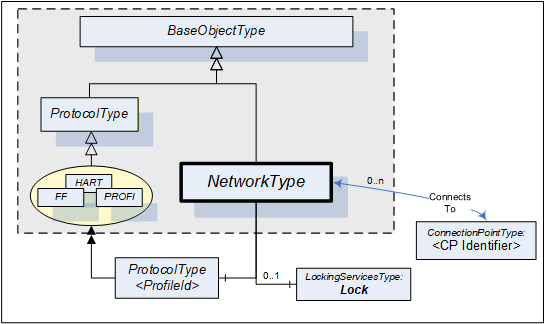
Figure 19 shows the type hierarchy and the NetworkType components. It is formally defined in Table 46.
| Attribute | Value | ||||
| BrowseName | 1:NetworkType | ||||
| IsAbstract | False | ||||
| References | NodeClass | BrowseName | DataType | TypeDefinition | Other |
|---|---|---|---|---|---|
| Subtype of the 0:BaseObjectType defined in OPC 10000-5. | |||||
| 0:HasComponent | Object | 1:<ProfileIdentifier> | 1:ProtocolType | MP | |
| ConnectsTo | Object | 1:<CPIdentifier> | 1:ConnectionPointType | OP | |
| 0:HasComponent | Object | 1:Lock | 1:LockingServicesType | O | |
| Conformance Units | |||||
|---|---|---|---|---|---|
| DI Network |
The <ProfileIdentifier> specifies the Protocol and Communication Profile that this Network is used for.
Clients shall use the LockingServices if they possibly make a set of changes (for example, several Write operations and Method invocations) and where a consistent state is available only after all of these changes have been performed. The main purpose of locking a Network is avoiding concurrent topology changes.
The lock on a Network applies to the Network, all connected TopologyElements and their components. If any of the connected TopologyElements provides access to a sub-ordinate Network (like a gateway), the sub-ordinate Network and its connected TopologyElements are locked as well.
If InitLock is requested for a Network, it will be rejected if any of the Devices connected to this Network or any sub-ordinate Network including their connected Devices is already locked.
If the Online/Offline model is supported (see 6.3), the lock always applies to both the online and the offline version.