
4.5.2 VendorNameplate Interface
IVendorNameplateType includes Properties that are commonly used to describe a TopologyElement from a manufacturer point of view. They can be used as part of the identification. The Values of these Properties are typically provided by the component vendor.
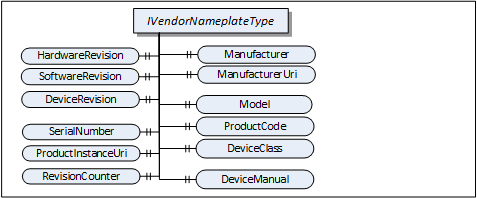
The VendorNameplate Interface is illustrated in Figure 5 and formally defined in Table 17.
| Attribute | Value | ||||
| BrowseName | 1:IVendorNameplateType | ||||
| IsAbstract | True | ||||
| References | NodeClass | BrowseName | DataType | TypeDefinition | Other |
|---|---|---|---|---|---|
| Subtype of the BaseInterfaceType defined in OPC 10000-5 | |||||
| Product-specific Properties | |||||
|---|---|---|---|---|---|
| 0:HasProperty | Variable | 1:Manufacturer | 0:LocalizedText | 0:PropertyType | O |
| 0:HasProperty | Variable | 1:ManufacturerUri | 0:String | 0:PropertyType | O |
| 0:HasProperty | Variable | 1:Model | 0:LocalizedText | 0:PropertyType | O |
| 0:HasProperty | Variable | 1:ProductCode | 0:String | 0:PropertyType | O |
| 0:HasProperty | Variable | 1:HardwareRevision | 0:String | 0:PropertyType | O |
| 0:HasProperty | Variable | 1:SoftwareRevision | 0:String | 0:PropertyType | O |
| 0:HasProperty | Variable | 1:DeviceRevision | 0:String | 0:PropertyType | O |
| 0:HasProperty | Variable | 1:DeviceManual | 0:String | 0:PropertyType | O |
| 0:HasProperty | Variable | 1:DeviceClass | 0:String | 0:PropertyType | O |
| Product instance-specific Properties | |||||
|---|---|---|---|---|---|
| 0:HasProperty | Variable | 1:SerialNumber | 0:String | 0:PropertyType | O |
| 0:HasProperty | Variable | 1:ProductInstanceUri | 0:String | 0:PropertyType | O |
| 0:HasProperty | Variable | 1:RevisionCounter | 0:Int32 | 0:PropertyType | O |
| 0:HasProperty | Variable | 1:SoftwareReleaseDate | 0:DateTime | 0:PropertyType | O |
| 0:HasProperty | Variable | 1:PatchIdentifiers | 0:String[] | 0:PropertyType | O |
| Conformance Units | |||||
|---|---|---|---|---|---|
| DI Nameplate |
Product type specific Properties:
Manufacturer provides the name of the company that manufactured the item this Interface is applied to. ManufacturerUri provides a unique identifier for this company. This identifier should be a fully qualified domain name; however, it can be a GUID or similar construct that ensures global uniqueness.
Model provides the name of the product.
ProductCode provides a unique combination of numbers and letters used to identify the product. It can be the order information displayed on type shields or in ERP systems.
HardwareRevision provides the revision level of the hardware. SemanticVersionString (a sub-type of String defined in OPC 10000-5) can be used when using the Semantic Versioning format.
SoftwareRevision provides the version or revision level of the software component, the software/firmware of a hardware component, or the software/firmware of the Device. SemanticVersionString (a sub-type of String defined in OPC 10000-5) can be used when using the Semantic Versioning format.
DeviceRevision provides the overall revision level of a hardware component or the Device. As an example, this Property can be used in ERP systems together with the ProductCode Property. SemanticVersionString (a sub-type of String defined in OPC 10000-5) can be used when using the Semantic Versioning format.
DeviceManual allows specifying an address of the user manual. It can be a pathname in the file system or a URL (Web address).
DeviceClass indicates in which domain or for what purpose a certain item for which the Interface is applied is used. Examples are “ProgrammableController”, “RemoteIO”, and “TemperatureSensor”. This standard does not predefine any DeviceClass names. Companion standards that utilize this Interface (device models) will likely introduce such classifications.
Product instance specific Properties:
SerialNumber is a unique production number provided by the manufacturer. This is often stamped on the outside of a physical component and can be used for traceability and warranty purposes.
ProductInstanceUri is a globally unique resource identifier provided by the manufacturer. This is often stamped on the outside of a physical component and can be used for traceability and warranty purposes. The maximum length is 255 characters. If used as QR code, 80 characters is a reasonable size. The recommended syntax of the ProductInstanceUri is: <ManufacturerUri>/<any string> where <any string> is unique among all instances using the same ManufacturerUri.
Examples: “some-company.com/5ff40f78-9210-494f-8206-c2c082f0609c”, “some-company.com/snr-16273849” or “some-company.com/model-xyz/snr-16273849”.
RevisionCounter is an incremental counter indicating the number of times the configuration data has been modified. An example would be a temperature sensor where the change of the unit would increment the RevisionCounter but a change of the measurement value would not affect the RevisionCounter.
SoftwareReleaseDate defines the date when the software is released. If the version information is about patches, this should be the date of the latest patch. It is additional information for the user.
PatchIdentifiers identify the list of patches that are applied to a software version. The format and semantics of the strings are vendor-specific. The order of the strings shall not be relevant.
Companion specifications can specify additional semantics for the contents of these Properties.
Table 18 specifies the mapping of these Properties to the International Registration Data Identifiers (IRDI) defined in ISO/IEC 11179-6. They should be used if a Server wants to expose a dictionary reference as defined in OPC 10000-19.
| Property | IRDI | Legacy IRDI |
| Manufacturer | 0112/2///61360_7#CBA031 | 0112/2///61987#ABA565#007 |
| ManufacturerUri | 0112/2///61360_7#CBA032 | 0112/2///61987#ABN591#001 |
| Model | 0112/2///61360_7#CBA039 | 0112/2///61987#ABA567#007 |
| SerialNumber | 0112/2///61360_7#CBA050 | 0112/2///61987#ABA951#007 |
| HardwareRevision | 0112/2///61360_7#CBA047 | 0112/2///61987#ABA926#006 |
| SoftwareRevision | 0112/2///61360_7#CBA046 | 0112/2///61987#ABA601#006 |
| DeviceRevision | 0112/2///61987#ABP643#002 | |
| RevisionCounter | 0112/2///61987#ABN603#001 | |
| ProductCode | 0112/2///61360_7#CBA040 | 0112/2///61987#ABA300#006 |
| ProductInstanceUri | 0112/2///61360_7#CBA055 | 0112/2///61987#ABN590#001 |
| DeviceManual | - | - |
| DeviceClass | 0112/2///61360_7#CBA037 | 0112/2///61987#ABA566 - type of product |
| SoftwareReleaseDate | - | |
| PatchIdentifiers | - |