
3 Terms, definitions, abbreviations and conventions
3.1 Terms and definitions
For the purposes of this document, the terms and definitions given in OPC 10000-1 and the following apply.
3.1.1 AddIn
a widely applicable feature or feature-set represented by an ObjectType that will be applied using aggregation
3.1.2 DataType
instance of a DataType Node that is used together with the ValueRank Attribute to define the data type of a Variable
3.1.3 Built-in DataType
a fundamental building block DataType defined by this standard
3.1.4 Simple DataType
a DataType which is not a Structure, Enumeration or OptionSet
3.1.5 DataTypeId
NodeId of a DataType Node
3.1.6 DataTypeRefinement
refinement of a Structured DataType restricting the usage of fields and adding meta data to fields
3.1.7 DataVariable
Variables that represent values of Objects, either directly or indirectly for complex Variables, where the Variables are always the TargetNode of a HasComponent Reference
3.1.8 EventType
ObjectType Node that represents the type definition of an Event
3.1.9 Hierarchical Reference
Reference that is used to construct hierarchies in the AddressSpace
3.1.10 InstanceDeclaration
Node that is used by a complex TypeDefinitionNode to expose its complex structure
3.1.11 Interface
an abstract ObjectType used to specify a feature or feature-set that shall be implemented by the Object or ObjectType where it is applied to
3.1.12 ModellingRule
metadata of an InstanceDeclaration that defines how the InstanceDeclaration will be used for instantiation and also defines subtyping rules for an InstanceDeclaration
3.1.13 Property
Variables that are the TargetNode for a HasProperty Reference
3.1.14 SourceNode
Node having a Reference to another Node
3.1.15 SubtypeRestriction
restriction of the usage of a subtype of a DataType to only allow a subset of all its subtypes
3.1.16 TargetNode
Node that is referenced by another Node
3.1.17 TypeDefinitionNode
Node that is used to define the type of another Node
3.1.18 VariableType
Node that represents the type definition for a Variable
3.2 Abbreviated terms
UA Unified Architecture
UML Unified Modeling Language
URI Uniform Resource Identifier as defined by RFC 3986
W3C World Wide Web Consortium
XML Extensible Markup Language
3.3 Conventions
3.3.1 Conventions for AddressSpace figures
Nodes and their References to each other are illustrated using figures. Figure 1 illustrates the conventions used in these figures.
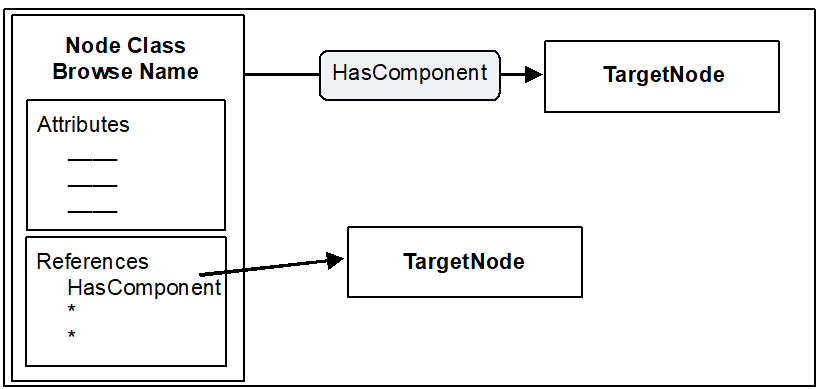
In these figures, rectangles represent Nodes. Node rectangles may be titled with one or two lines of text. When two lines are used, the first text line in the rectangle identifies the NodeClass and the second line contains the BrowseName. When one line is used, it contains the BrowseName.
Node rectangles may contain boxes used to define their Attributes and References. Specific names in these boxes identify specific Attributes and References.
Shaded rectangles with rounded corners and with arrows passing through them represent References. The arrow that passes through them begins at the SourceNode and points to the TargetNode. References may also be shown by drawing an arrow that starts at the Reference name in the "References" box and ends at the TargetNode.
3.3.2 Conventions for defining NodeClasses
Clause 4.10 defines AddressSpace NodeClasses. Table 1 describes the format of the tables used to define NodeClasses.
| Name | Use | Data Type | Description |
|---|---|---|---|
| Attributes | |||
"Attribute name" | "M" or "O" | Data type of the Attribute | Defines the Attribute |
| References | |||
|---|---|---|---|
"Reference name" | "1", "0..1" or "0..*" | Not used | Describes the use of the Reference by the NodeClass |
| Standard Properties | |||
|---|---|---|---|
"Property name" | "M" or "O" | Data type of the Property | Defines the Property |
The Name column contains the name of the Attribute, the name of the ReferenceType used to create a Reference or the name of a Property referenced using the HasProperty Reference.
The Use column defines whether the Attribute or Property is mandatory (M) or optional (O). When mandatory the Attribute or Property shall exist for every Node of the NodeClass. For References it specifies the cardinality. The following values may apply:
"0..*" identifies that there are no restrictions, that is, the Reference does not have to be provided but there is no limitation how often it can be provided;
"0..1" identifies that the Reference is provided at most once;
"1" identifies that the Reference shall be provided exactly once.
The Data Type column contains the name of the DataType of the Attribute or Property. It is not used for References.
The Description column contains the description of the Attribute, the Reference or the Property.
Only this document may define Attributes. Thus, all Attributes of the NodeClass are specified in the table and may only be extended by other parts of this series of standards.
This document also defines ReferenceTypes, but ReferenceTypes may also be specified by a Server or by a client using the NodeManagement Services specified in OPC 10000-4. Thus, the NodeClass tables contained in this document may contain the base ReferenceType called References identifying that any ReferenceType may be used for the NodeClass, including system specific ReferenceTypes. The NodeClass tables only specify how the NodeClasses can be used as SourceNodes of References, not as TargetNodes. If a NodeClass table allows a ReferenceType for its NodeClass to be used as SourceNode, this is also true for subtypes of the ReferenceType. However, subtypes of the ReferenceType may restrict its SourceNodes.
This document defines Properties, but Properties can be defined by other standard organizations or vendors and Nodes can have Properties that are not standardised. Properties defined in this standard are defined by their name, which is mapped to the BrowseName having the NamespaceIndex 0, which represents the Namespace for OPC UA.
The Use column (optional or mandatory) does not imply a specific ModellingRule for Properties. Different Server implementations will choose to use ModellingRules appropriate for them.