OPC Unified Architecture – Part 9: Alarms & Conditions
5.9 ConditionClasses
5.9.1 Overview
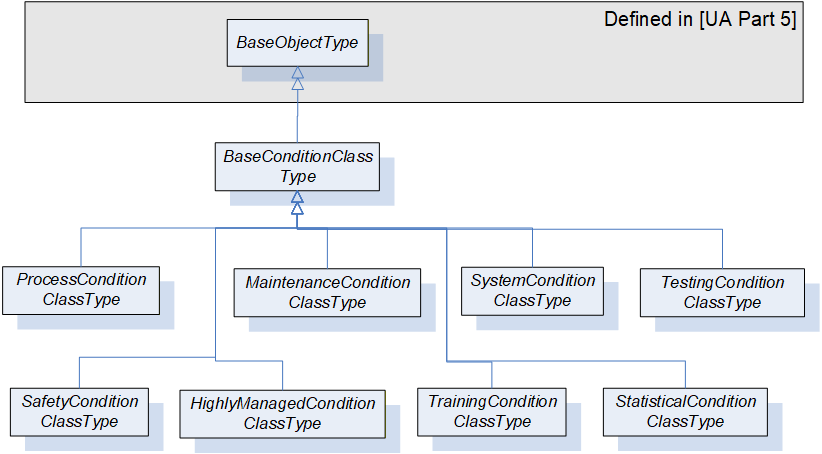
Conditions are used in specific application domains like Maintenance, System or Process. The ConditionClass hierarchy is used to specify domains and is orthogonal to the ConditionType hierarchy. The ConditionClassId Property of the ConditionType is used to assign a Condition to a ConditionClass. Clients can use this Property to filter out essential classes. OPC UA defines the base ObjectType for all ConditionClasses and a set of common classes used across many industries. Figure 23 informally describes the hierarchy of ConditionClassTypes defined in this document.
Figure 23 – ConditionClass type hierarchy
ConditionClasses are not representations of Objects in the underlying system and, therefore, only exist as Type Nodes in the Address Space.
5.9.2 BaseConditionClassType
BaseConditionClassType is used as class whenever a Condition cannot be assigned to a more concrete class. Servers should use a more specific ConditionClass, if possible. All ConditionClassTypes derive from BaseConditionClassType. It is formally defined in Table 113.
The ProcessConditionClassType is used to classify Conditions related to the process itself. Examples of a process would be a control system in a boiler or the instrumentation associated with a chemical plant or paper machine. The ProcessConditionClassType is formally defined in Table 114.
Table 114 – ProcessConditionClassType definition
Attribute
Value
BrowseName
ProcessConditionClassType
IsAbstract
True
References
NodeClass
BrowseName
DataType
TypeDefinition
Modelling Rule
Subtype of the BaseConditionClassType defined in clause 5.9.2.
ConformanceUnits
A & C ConditionClasses
5.9.4 MaintenanceConditionClassType
The MaintenanceConditionClassType is used to classify Conditions related to maintenance. Examples of maintenance would be Asset Management systems or conditions, which occur in process control systems, which are related to calibration of equipment. The MaintenanceConditionClassType is formally defined in Table 115. No further definition is provided here. It is expected that other standards groups will define domain-specific sub-types.
Subtype of the BaseConditionClassType defined in clause 5.9.2.
ConformanceUnits
A & C ConditionClasses
5.9.5 SystemConditionClassType
The SystemConditionClassType is used to classify Conditions related to the System. It is formally defined in Table 116. System Conditions occur in the controlling or monitoring system process. Examples of System related items could include available disk space on a computer, Archive media availability, network loading issues or a controller error. It is expected that other standards groups or vendors will define domain-specific sub-types.
Table 116 – SystemConditionClassType definition
Attribute
Value
BrowseName
SystemConditionClassType
IsAbstract
True
References
NodeClass
BrowseName
DataType
TypeDefinition
ModellingRule
Subtype of the BaseConditionClassType defined in clause 5.9.2.
ConformanceUnits
A & C ConditionClasses
5.9.6 SafetyConditionClassType
The SafetyConditionClassType is used to classify Conditions related to safety. It is formally defined in Table 117.
Safety Conditions occur in the controlling or monitoring system process. Examples of safety related items could include, emergency shutdown systems or fire suppression systems.
Table 117 – SafetyConditionClassType definition
Attribute
Value
BrowseName
SafetyConditionClassType
IsAbstract
True
References
NodeClass
BrowseName
DataType
TypeDefinition
ModellingRule
Subtype of the BaseConditionClassType defined in clause 5.9.2.
ConformanceUnits
A & C ConditionClasses
5.9.7 HighlyManagedAlarmConditionClassType
In Alarm systems some Alarms may be classified as HighlyManagedAlarms. This class of Alarm requires special handling that varies according to the individual requirements. It might require individual acknowledgement or not allow suppression or any number of other special behaviours. The HighlyManagedAlarmConditionClassType is used to classify Conditions as highly managed Alarms. It is formally defined in Table 118.
Subtype of the BaseConditionClassType defined in clause 5.9.2.
ConformanceUnits
A & C ConditionClasses
5.9.8 TrainingConditionClassType
The TrainingConditionClassType is used to classify Conditions related to training system or training exercises. It is formally defined in Table 119. These Conditions typically occur in a training system or are generated as part of a simulation for a training exercise. Training Conditions might be process or system conditions. It is expected that other standards groups or vendors will define domain-specific sub-types.
Table 119 – TrainingConditionClassType definition
Attribute
Value
BrowseName
TrainingConditionClassType
IsAbstract
True
References
NodeClass
BrowseName
DataType
TypeDefinition
ModellingRule
Subtype of the BaseConditionClassType defined in clause.
ConformanceUnits
A & C ConditionClasses
5.9.9 StatisticalConditionClassType
The StatisticalConditionClassType is used to classify Conditions related that are based on statistical calculations. It is formally defined in Table 120. These Conditions are generated as part of a statistical analysis. They might be any of an Alarm number of types.
Subtype of the BaseConditionClassType defined in clause.
ConformanceUnits
A & C ConditionClasses
5.9.10 TestingConditionClassType
The TestingConditionClassType is used to classify Conditions related to testing of an Alarm system or Alarm function. It is formally defined in Table 121. Testing Conditions might include a condition to test an alarm annunciation such as a horn or other panel. It might also be used to temporarily reclassify a Condition to check response times or suppression logic. It is expected that other standards groups or vendors will define domain-specific sub-types.
Table 121 – TestingConditionClassType definition
Attribute
Value
BrowseName
TestingConditionClassType
IsAbstract
True
References
NodeClass
BrowseName
DataType
TypeDefinition
ModellingRule
Subtype of the BaseConditionClassType defined in clause 5.9.2.