OPC Unified Architecture – Part 9: Alarms & Conditions
5.10 Audit Events
5.10.1 Overview
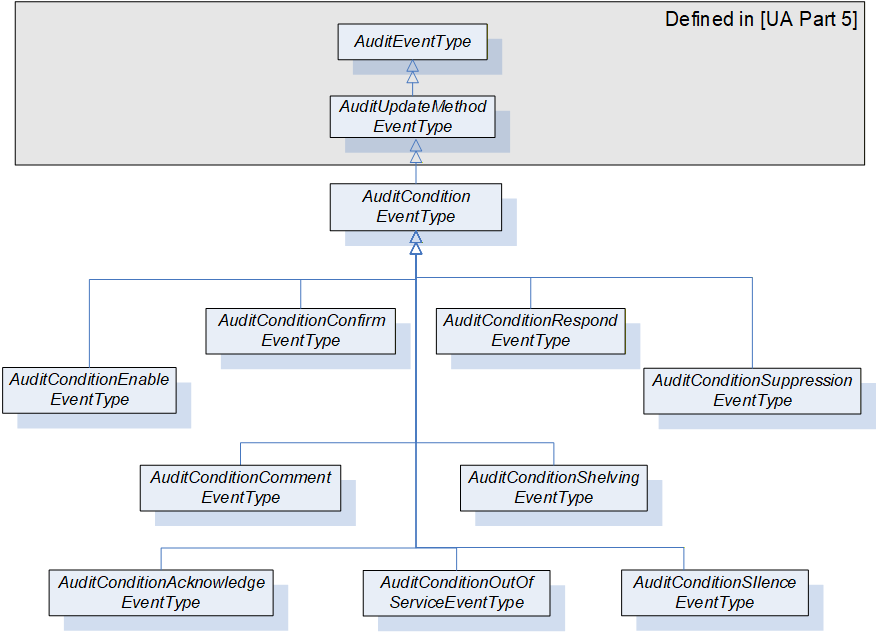
If Auditing is supported by a Server, Events of AuditConditionEventType shall be generated. Following are the sub-types of AuditUpdateMethodEventType that will be generated in response to the Methods defined in this document. They are illustrated in Figure 24.
Figure 24 – AuditEvent hierarchy
AuditConditionEventTypes are normally used in response to a Method call. However, these Events shall also be notified if the functionality of such a Method is performed by some other Server-specific means. In this case, the SourceName Property shall contain a proper description of this internal means and the other Properties should be filled in as described for the given EventType.
5.10.2 AuditConditionEventType
This EventType is used to subsume all AuditConditionEventTypes. It is formally defined in Table 122.
Table 122 – AuditConditionEventType definition
Attribute
Value
BrowseName
AuditConditionEventType
IsAbstract
False
References
NodeClass
BrowseName
DataType
TypeDefinition
ModellingRule
Subtype of the AuditUpdateMethodEventType defined in 10000-5
ConformanceUnits
A & C Auditing
AuditConditionEventTypes inherit all Properties of the AuditUpdateMethodEventType defined in 10000-5. Unless a subtype overrides the definition, the inherited Properties of the Condition will be used as defined.
The inherited PropertySourceNode shall be filled with the ConditionId.
The SourceName shall be “Method/” and the name of the Service that generated the Event (e.g. Disable, Enable, Acknowledge, etc.).
This EventType can be further customized to reflect particular Condition related actions.
5.10.3 AuditConditionEnableEventType
This EventType is used to indicate a change in the enabled state of a Condition instance. It is formally defined in Table 123.
Subtype of the AuditConditionEventType defined in 5.10.2 that is, inheriting the InstanceDeclarations of that Node.
ConformanceUnits
A & C Auditing
The SourceName shall indicate Method/Enable or Method/Disable. If the audit Event is not the result of a Method call, but due to an internal action of the Server, the SourceName shall reflect Enable or Disable, it may be preceded by an appropriate description such as “Internal/Enable” or “Remote/Enable”.
5.10.4 AuditConditionCommentEventType
This EventType is used to report an AddComment action. It is formally defined in Table 124.
Subtype of the AuditConditionEventType defined in 5.10.2 that is, inheriting the InstanceDeclarations of that Node.
ConformanceUnits
A & C Shelving Auditing
If the Method indicates a TimedShelve operation, the ShelvingTime field shall contain duration for which to shelve the Alarm. For other ShelvingMethods, this parameter may be omitted or NULL.
5.10.9 AuditConditionSuppressionEventType
This EventType is used to indicate a change to the Suppression state of a Condition instance. It is formally defined in Table 129.
Subtype of the AuditConditionEventType defined in 5.10.2 that is, inheriting the InstanceDeclarations of that Node.
ConformanceUnits
A & C Suppression Auditing
This Event indicates an Alarm suppression operation. An audit Event of this type shall be generated, if audit events are supported for any suppression action, including automatic system based suppression.
5.10.10 AuditConditionSilenceEventType
This EventType is used to indicate a change to the Silence state of a Condition instance. It is formally defined in Table 130.
Subtype of the AuditConditionEventType defined in 5.10.2 that is, inheriting the InstanceDeclarations of that Node.
ConformanceUnits
A & C Silencing Auditing
This event indicates that an Alarm was silenced, but not acknowledged. An audit event of this type shall be generated, if Audit events are supported for any silence action, including automatic system based silence.
5.10.11 AuditConditionResetEventType
This EventType is used to indicate a change to the Latched state of a Condition instance. It is formally defined in Table 130.