
5.8.20 NonExclusiveLimitAlarmType
The NonExclusiveLimitAlarmType is used to specify the common behaviour for Alarm Types with multiple non-exclusive limits. The NonExclusiveLimitAlarmType is illustrated in Figure 21.
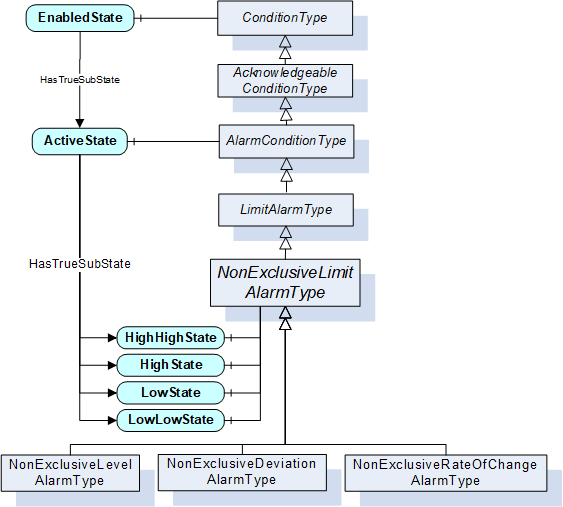
The NonExclusiveLimitAlarmType is formally defined in Table 97 and Table 98.
| Attribute | Value | ||||
| BrowseName | NonExclusiveLimitAlarmType | ||||
| IsAbstract | False | ||||
| References | NodeClass | BrowseName | DataType | TypeDefinition |
Modelling
Rule |
|---|---|---|---|---|---|
| Subtype of the LimitAlarmType defined in clause 5.8.18. | |||||
| HasSubtype | ObjectType | NonExclusiveLevelAlarmType | Defined in Clause 5.8.21.2 | ||
| HasSubtype | ObjectType | NonExclusiveDeviationAlarmType | Defined in Clause 5.8.22.2 | ||
| HasSubtype | ObjectType | NonExclusiveRateOfChangeAlarmType | Defined in Clause 5.8.23.2 | ||
| HasComponent | Variable | HighHighState | LocalizedText | TwoStateVariableType | Optional |
| HasComponent | Variable | HighState | LocalizedText | TwoStateVariableType | Optional |
| HasComponent | Variable | LowState | LocalizedText | TwoStateVariableType | Optional |
| HasComponent | Variable | LowLowState | LocalizedText | TwoStateVariableType | Optional |
| ConformanceUnits | |||||
|---|---|---|---|---|---|
| A & C Non-Exclusive Limit |
| BrowsePath | References | NodeClass | BrowseName | DataType | TypeDefinition | Others |
| HighHighState | HasProperty | Variable | TrueState | LocalizedText | PropertyType | |
| HighHighState | HasProperty | Variable | FalseState | LocalizedText | PropertyType | |
| HighState | HasProperty | Variable | TrueState | LocalizedText | PropertyType | |
| HighState | HasProperty | Variable | FalseState | LocalizedText | PropertyType | |
| LowState | HasProperty | Variable | TrueState | LocalizedText | PropertyType | |
| LowState | HasProperty | Variable | FalseState | LocalizedText | PropertyType | |
| LowLowState | HasProperty | Variable | TrueState | LocalizedText | PropertyType | |
| LowLowState | HasProperty | Variable | FalseState | LocalizedText | PropertyType |
The empty “Others” column indicates that no ModellingRule applies.
HighHighState, HighState, LowState, and LowLowState represent the non-exclusive states. As an example, it is possible that both HighState and HighHighState are in their True state. Vendors may choose to support any subset of these states. Recommended state names are described in A.1.
Four optional limits are defined that configure these states. At least the HighState or the LowState shall be provided even though all states are optional. It is implied by the definition of a HighState and a LowState, that these groupings are mutually exclusive. A value cannot exceed both a HighState value and a LowState value simultaneously.