OPC Unified Architecture – Part 9: Alarms & Conditions
5.8.24 Discrete Alarms
5.8.24.1 DiscreteAlarmType
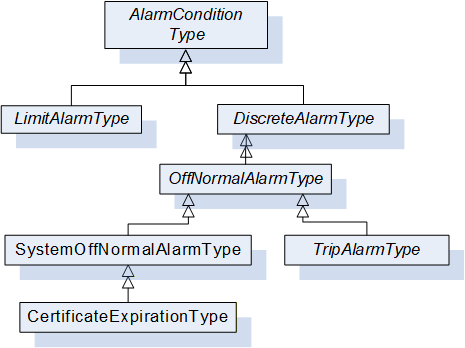
The DiscreteAlarmType is used to classify Types into Alarm Conditions where the input for the Alarm may take on only a certain number of possible values (e.g. True/False, running/stopped/terminating). The DiscreteAlarmType with sub types defined in this document is illustrated in Figure 22. It is formally defined in Table 105.
Figure 22 – DiscreteAlarmType Hierarchy
Table 105 – DiscreteAlarmType definition
Attribute
Value
BrowseName
DiscreteAlarmType
IsAbstract
False
References
NodeClass
BrowseName
DataType
TypeDefinition
Modelling Rule
Subtype of the AlarmConditionType defined in clause 5.8.2.
The OffNormalAlarmType is a specialization of the DiscreteAlarmType intended to represent a discrete Condition that is considered to be not normal. It is formally defined in Table 106. This sub type is usually used to indicate that a discrete value is in an Alarm state, it is active as long as a non-normal value is present.
Table 106 – OffNormalAlarmType definition
Attribute
Value
BrowseName
OffNormalAlarmType
IsAbstract
False
References
NodeClass
BrowseName
DataType
TypeDefinition
ModellingRule
Subtype of the DiscreteAlarmType defined in clause 5.8.24.1
The NormalState Property is a Property that points to a Variable which has a value that corresponds to one of the possible values of the Variable pointed to by the InputNodeProperty where the NormalStatePropertyVariable value is the value that is considered to be the normal state of the Variable pointed to by the InputNodeProperty. When the value of the Variable referenced by the InputNode Property is not equal to the value of the NormalState Property the Alarm is Active. If this Variable is not in the AddressSpace, a NULL NodeId shall be provided.
5.8.24.3 SystemOffNormalAlarmType
This Condition is used by a Server to indicate that an underlying system that is providing Alarm information is having a communication problem and that the Server may have invalid or incomplete Condition state in the Subscription. Its representation in the AddressSpace is formally defined in Table 107.
Subtype of the OffNormalAlarmType, i.e. it has HasProperty References to the same Nodes.
ConformanceUnits
A & C SystemOffNormal
5.8.24.4 TripAlarmType
The TripAlarmType is a specialization of the OffNormalAlarmType intended to represent an equipment trip Condition. The Alarm becomes active when the monitored piece of equipment experiences some abnormal fault such as a motor shutting down due to an overload condition. It is formally defined in Table 108. This Type is mainly used for categorization.
Table 108 – TripAlarmType definition
Attribute
Value
BrowseName
TripAlarmType
IsAbstract
False
References
NodeClass
BrowseName
DataType
TypeDefinition
Modelling Rule
Subtype of the OffNormalAlarmType defined in clause 5.8.24.2.
ConformanceUnits
A & C Trip
5.8.24.5 InstrumentDiagnosticAlarmType
The InstrumentDiagnosticAlarmType is a specialization of the OffNormalAlarmType intended to represent a fault in a field device. The Alarm becomes active when the monitored device experiences a fault such as a sensor failure. It is formally defined in Table 108. This Type is mainly used for categorization.
Subtype of the OffNormalAlarmType defined in clause 5.8.24.2.
ConformanceUnits
A & C InstrumentDiagnostic
5.8.24.6 SystemDiagnosticAlarmType
The SystemDiagnosticAlarmType is a specialization of the OffNormalAlarmType intended to represent a fault in a system or sub-system. The Alarm becomes active when the monitored system experiences a fault. It is formally defined in Table 108. This Type is mainly used for categorization.
Table 110 – SystemDiagnosticAlarmType definition
Attribute
Value
BrowseName
SystemDiagnosticAlarmType
IsAbstract
False
References
NodeClass
BrowseName
DataType
TypeDefinition
Modelling Rule
Subtype of the OffNormalAlarmType defined in clause 5.8.24.2.
ConformanceUnits
A & C SystemDiagnostic
5.8.24.7 CertificateExpirationAlarmType
This SystemOffNormalAlarmType is raised by the Server when the Server’s Certificate is within the ExpirationLimit of expiration. This Alarm automatically returns to normal when the certificate is updated.
Subtype of the SystemOffNormalAlarmType defined in clause 5.8.24.3
HasProperty
Variable
ExpirationDate
DateTime
PropertyType
Mandatory
HasProperty
Variable
ExpirationLimit
Duration
PropertyType
Optional
HasProperty
Variable
CertificateType
NodeId
PropertyType
Mandatory
HasProperty
Variable
Certificate
ByteString
PropertyType
Mandatory
ConformanceUnits
A & C CertificateExpiration
ExpirationDate is the date and time this certificate will expire.
ExpirationLimit is the time interval before the ExpirationDate at which this Alarm will trigger. This shall be a positive number. If the property is not provided, a default of 2 weeks shall be used.
CertificateType – See Part 12 for definition of CertificateType.
Certificate is the certificate that is about to expire.