
1 Scope
1.1 Scope of this Companion Specification
This document specifies an OPC UA Information Model for the representation of a machine tool. OPC UA for Machine Tools, Part 1 aims at straightforward integration of a machine tool into higher level IT systems. The scope is to create a common interface among machine tools of different technologies, manufacturers and model series. This first part of the OPC UA Companion Specification for Machine Tools aims to provide the basics for such an interface. These allow for monitoring the machine tool and giving an overview of the jobs on it. This information is mostly technology neutral. The OPC UA for Machine Tools interface allows an exchange of information between a machine tool and software systems like MES, SCADA, ERP or data analytics systems.
1.2 Organizations
OPC Foundation
OPC is the interoperability standard for the secure and reliable exchange of data and information in the industrial automation space and in other industries. It is platform independent and ensures the seamless flow of information among devices from multiple vendors. The OPC Foundation is responsible for the development and maintenance of this standard.
OPC UA is a platform independent service-oriented architecture that integrates all the functionality of the individual OPC Classic specifications into one extensible framework. This multi-layered approach accomplishes the original design specification goals of:
Platform independence: from an embedded microcontroller to cloud-based infrastructure
Secure: encryption, authentication, authorization and auditing
Extensible: ability to add new features including transports without affecting existing applications
Comprehensive information modelling capabilities: for defining any model from simple to complex
German Machine Tool Builders' Association (VDW)
The VDW, headquartered in Frankfurt am Main, Germany, represents the German machine tool industry. Together with the Sector Association Machine Tools and Manufacturing Systems within the VDMA (German Engineering Federation) the VDW comprises about 290 predominantly mid-tier companies. They account for approximately 90 per cent of the sector's total turnover, which most recently exceeded 17 billion euros.
The VDW represents its members to the public, the politicians, business associates and the academic community, both nationally and internationally. It is also a can-do service provider for its members when it comes to opening up sales markets, keeping the business cycle under observation and acquiring market data, handling technical, commercial and legal issues, cooperation with the international machine tool industry, standardisation and recruitment of new talent. On the basis of in-depth sectoral knowledge, it provides information, consultancy and support in response to individual questions and problems. Permanent committees and working groups guarantee the exchange of sector-specific views and empirical feedback. We provide regular information for our members on topical technical, commercial and legal issues.
In this context VDW is interested in increasing the innovation and competitive capacity of machine tool builders and manufacturers of machine tool controllers by introducing a unified machine tool interface. This universal interface is understood as essential prerequisite towards digital manufacturing.
2 Normative references
The following referenced documents are indispensable for the application of this document. For dated references, only the edition cited applies. For undated references, the latest edition of the referenced document (including any amendments and errata) applies.
OPC 10000-1, OPC Unified Architecture - Part 1: Overview and Concepts
http://www.opcfoundation.org/documents/10000-1/
OPC 10000-2, OPC Unified Architecture - Part 2: Security Model
http://www.opcfoundation.org/documents/10000-2/
OPC 10000-3, OPC Unified Architecture - Part 3: Address Space Model
http://www.opcfoundation.org/documents/10000-3/
OPC 10000-4, OPC Unified Architecture - Part 4: Services
http://www.opcfoundation.org/documents/10000-4/
OPC 10000-5, OPC Unified Architecture - Part 5: Information Model
http://www.opcfoundation.org/documents/10000-5/
OPC 10000-6, OPC Unified Architecture - Part 6: Mappings
http://www.opcfoundation.org/documents/10000-6/
OPC 10000-7, OPC Unified Architecture - Part 7: Profiles
http://www.opcfoundation.org/documents/10000-7/
OPC 10000-8, OPC Unified Architecture - Part 8: Data Access
http://www.opcfoundation.org/documents/10000-8/
OPC 10000-9, OPC Unified Architecture - Part 9: Alarms and Conditions
http://www.opcfoundation.org/documents/10000-9/
OPC 10000-20, OPC Unified Architecture - Part 20: File Transfer
http://www.opcfoundation.org/documents/10000-20/
OPC 10000-100, OPC Unified Architecture - Part 100: Devices
http://www.opcfoundation.org/documents/10000-100/
OPC 10000-200, OPC Unified Architecture - Part 200: Industrial Automation
http://www.opcfoundation.org/documents/10000-200/
OPC 10031-4, OPC UA for ISA-95 - Part 4: Job Control
http://www.opcfoundation.org/documents/10031-4/
OPC 40001-1, OPC UA for Machinery - Part 1: Basic Building Blocks
http://www.opcfoundation.org/documents/40001-1/
OPC 40001-3, OPC UA for Machinery - Part 3: Job Management
http://www.opcfoundation.org/documents/40001-3/
3 Terms, abbreviated terms and conventions
3.1 Overview
It is assumed that basic concepts of OPC UA information modelling are understood in this document. This document will use these concepts to describe the Machine Tools Information Model. For the purposes of this document, the terms and definitions given in OPC 10000-1, OPC 10000-3, OPC 10000-4, OPC 10000-5, OPC 10000-7, OPC 10000-9, OPC 10000-20 OPC 10000-100, OPC 10000-200, OPC 10031-4, OPC 40001-1, OPC 40001-3 as well as the following apply.
Note that OPC UA terms and terms defined in this document are italicised in the document.
3.2 OPC UA for Machine Tools terms
3.2.1 Alert
3.2.2 Channel
3.2.3 Controller
3.2.4 Machine Tool
3.2.5 Manual Tool Change
3.2.6 Multitool
3.2.7 Part
3.2.8 Production Plan
list of all job elements a specific machine knows about
EXAMPLE: All jobs which were transferred to the machine in some way.
3.2.9 Job
3.2.10 Program
also: production program; list of operations that the controller performs in sequence;
usually a machine-readable file, such as an NC program, which is needed for the controller to fulfil the job; NC programs may also carry a hierarchy of further sub-(NC)programs
3.2.11 Replacement Tool
tool with equivalent (identical) process capabilities (size and functionality) to an existing tool; used by the controller if the designated tool is locked due to wear, done automatically and/or after user interaction
3.2.12 Stacklight
3.2.13 Tool
3.2.14 Utility
3.3 Abbreviated terms
| CNC | Computerized Numerical Control |
| EDM | Electrical Discharge Machining |
| ERP | Enterprise Resource Planning |
| HMI | Human Machine Interface |
| KPI | Key Performance Indicator |
| MES | Manufacturing Execution System |
| MO | Mode of Operation |
| NC | Numerical Control |
| OEE | Overall Equipment Effectiveness |
| SCADA | Supervisory Control and Data Acquisition |
| VDW | Verein Deutscher Werkzeugmaschinenfabriken e.V. (German Machine Tool Builders' Association) |
3.4 Conventions used in this document
3.4.1 Conventions for Node descriptions
Node definitions are specified using tables (see Table 2).
Attributes are defined by providing the Attribute name and a value, or a description of the value.
References are defined by providing the ReferenceType name, the BrowseName of the TargetNode and its NodeClass.
If the TargetNode is a component of the Node being defined in the table the Attributes of the composed Node are defined in the same row of the table.
The DataType is only specified for Variables; "[<number>]" indicates a single-dimensional array, for multi-dimensional arrays the expression is repeated for each dimension (e.g., [2][3] for a two-dimensional array). For all arrays the ArrayDimensions is set as identified by <number> values. If no <number> is set, the corresponding dimension is set to 0, indicating an unknown size. If no number is provided at all the ArrayDimensions can be omitted. If no brackets are provided, it identifies a scalar DataType and the ValueRank is set to the corresponding value (see OPC 10000-3). In addition, ArrayDimensions is set to null or is omitted. If it can be Any or ScalarOrOneDimension, the value is put into "{<value>}", so either "{Any}" or "{ScalarOrOneDimension}" and the ValueRank is set to the corresponding value (see OPC 10000-3) and the ArrayDimensions is set to null or is omitted. Examples are given in Table 1.
| Notation | DataType | ValueRank | ArrayDimensions | Description |
| 0:Int32 | 0:Int32 | -1 | omitted or null | A scalar Int32. |
| 0:Int32[] | 0:Int32 | 1 | omitted or {0} | Single-dimensional array of Int32 with an unknown size. |
| 0:Int32[][] | 0:Int32 | 2 | omitted or {0,0} | Two-dimensional array of Int32 with unknown sizes for both dimensions. |
| 0:Int32[3][] | 0:Int32 | 2 | {3,0} | Two-dimensional array of Int32 with a size of 3 for the first dimension and an unknown size for the second dimension. |
| 0:Int32[5][3] | 0:Int32 | 2 | {5,3} | Two-dimensional array of Int32 with a size of 5 for the first dimension and a size of 3 for the second dimension. |
| 0:Int32{Any} | 0:Int32 | -2 | omitted or null | An Int32 where it is unknown if it is scalar or array with any number of dimensions. |
| 0:Int32{ScalarOrOneDimension} | 0:Int32 | -3 | omitted or null | An Int32 where it is either a single-dimensional array or a scalar. |
The TypeDefinition is specified for Objects and Variables.
The TypeDefinition column specifies a symbolic name for a NodeId, i.e. the specified Node points with a HasTypeDefinition Reference to the corresponding Node.
The ModellingRule of the referenced component is provided by specifying the symbolic name of the rule in the ModellingRule column. In the AddressSpace, the Node shall use a HasModellingRule Reference to point to the corresponding ModellingRule Object.
If the NodeId of a DataType is provided, the symbolic name of the Node representing the DataType shall be used.
Note that if a symbolic name of a different namespace is used, it is prefixed by the NamespaceIndex (see 3.4.2.2).
Nodes of all other NodeClasses cannot be defined in the same table; therefore, only the used ReferenceType, their NodeClass and their BrowseName are specified. A reference to another part of this document points to their definition.
Table 2 illustrates the table. If no components are provided, the DataType, TypeDefinition and Other columns may be omitted and only a Comment column is introduced to point to the Node definition.
| Attribute | Value | ||||
| Attribute name | Attribute value. If it is an optional Attribute that is not set "--" is used. | ||||
| References | NodeClass | BrowseName | DataType | TypeDefinition | Other |
|---|---|---|---|---|---|
| ReferenceType name | NodeClass of the TargetNode. | BrowseName of the target Node. If the Reference is to be instantiated by the server, then the value of the target Node's BrowseName is "--". | DataType of the referenced Node, only applicable for Variables. | TypeDefinition of the referenced Node, only applicable for Variables and Objects. | Additional characteristics of the TargetNode such as the ModellingRule or AccessLevel. |
| NOTE Notes referencing footnotes of the table content. | |||||
Components of Nodes can be complex that is containing components by themselves. The TypeDefinition, NodeClass and DataType can be derived from the type definitions, and the symbolic name can be created as defined in 3.4.3.1. Therefore, those containing components are not explicitly specified; they are implicitly specified by the type definitions.
The Other column defines additional characteristics of the Node. Examples of characteristics that can appear in this column are show in Table 3.
| Name | Short Name | Description |
| 0:Mandatory | M | The Node has the Mandatory ModellingRule. |
| 0:Optional | O | The Node has the Optional ModellingRule. |
| 0:MandatoryPlaceholder | MP | The Node has the MandatoryPlaceholder ModellingRule. |
| 0:OptionalPlaceholder | OP | The Node has the OptionalPlaceholder ModellingRule. |
| ReadOnly | RO | The Node AccessLevel has the CurrentRead bit set but not the CurrentWrite bit. |
| ReadWrite | RW | The Node AccessLevel has the CurrentRead and CurrentWrite bits set. |
| WriteOnly | WO | The Node AccessLevel has the CurrentWrite bit set but not the CurrentRead bit. |
If multiple characteristics are defined they are separated by commas. The name or the short name may be used.
3.4.2 NodeIds and BrowseNames
3.4.2.1 NodeIds
The NodeIds of all Nodes described in this standard are only symbolic names. Annex A defines the actual NodeIds.
The symbolic name of each Node defined in this document is its BrowseName, or, when it is part of another Node, the BrowseName of the other Node, a ".", and the BrowseName of itself. In this case "part of" means that the whole has a HasProperty or HasComponent Reference to its part. Since all Nodes not being part of another Node have a unique name in this document, the symbolic name is unique.
The NamespaceUri for all NodeIds defined in this document is defined in Annex A. The NamespaceIndex for this NamespaceUri is vendor-specific and depends on the position of the NamespaceUri in the server namespace table.
Note that this document not only defines concrete Nodes, but also requires that some Nodes shall be generated, for example one for each Session running on the Server. The NodeIds of those Nodes are Server-specific, including the namespace. But the NamespaceIndex of those Nodes cannot be the NamespaceIndex used for the Nodes defined in this document, because they are not defined by this document but generated by the Server.
3.4.2.2 BrowseNames
The text part of the BrowseNames for all Nodes defined in this document is specified in the tables defining the Nodes. The NamespaceUri for all BrowseNames defined in this document is defined in Annex A.
If the BrowseName is not defined by this document, a namespace index prefix like '0:EngineeringUnits' or '2:DeviceRevision' is added to the BrowseName. This is typically necessary if a Property of another specification is overwritten or used in the OPC UA types defined in this document. Table 136 provides a list of namespaces and their indexes as used in this document.
3.4.3 Common Attributes
3.4.3.1 General
The Attributes of Nodes, their DataTypes and descriptions are defined in OPC 10000-3. Attributes not marked as optional are mandatory and shall be provided by a Server. The following tables define if the Attribute value is defined by this document or if it is server-specific.
For all Nodes specified in this document, the Attributes named in Table 4 shall be set as specified in the table.
| Attribute | Value |
| DisplayName | The DisplayName is a LocalizedText. Each server shall provide the DisplayName identical to the BrowseName of the Node for the LocaleId "en". Whether the server provides translated names for other LocaleIds are server-specific. |
| Description | Optionally a server-specific description is provided. |
| NodeClass | Shall reflect the NodeClass of the Node. |
| NodeId | The NodeId is described by BrowseNames as defined in 3.4.2.1. |
| WriteMask | Optionally the WriteMask Attribute can be provided. If the WriteMask Attribute is provided, it shall set all non-server-specific Attributes to not writable. For example, the Description Attribute may be set to writable since a Server may provide a server-specific description for the Node. The NodeId shall not be writable, because it is defined for each Node in this document. |
| UserWriteMask | Optionally the UserWriteMask Attribute can be provided. The same rules as for the WriteMask Attribute apply. |
| RolePermissions | Optionally server-specific role permissions can be provided. |
| UserRolePermissions | Optionally the role permissions of the current Session can be provided. The value is server-specific and depends on the RolePermissions Attribute (if provided) and the current Session. |
| AccessRestrictions | Optionally server-specific access restrictions can be provided. |
3.4.3.2 Objects
For all Objects specified in this document, the Attributes named in Table 5 shall be set as specified in the Table 5. The definitions for the Attributes can be found in OPC 10000-3.
| Attribute | Value |
| EventNotifier | Whether the Node can be used to subscribe to Events or not is server-specific. |
3.4.3.3 Variables
For all Variables specified in this document, the Attributes named in Table 6 shall be set as specified in the table. The definitions for the Attributes can be found in OPC 10000-3.
| Attribute | Value |
| MinimumSamplingInterval | Optionally, a server-specific minimum sampling interval is provided. |
| AccessLevel | The access level for Variables used for type definitions is server-specific, for all other Variables defined in this document, the access level shall allow reading; other settings are server-specific. |
| UserAccessLevel | The value for the UserAccessLevel Attribute is server-specific. It is assumed that all Variables can be accessed by at least one user. |
| Value | For Variables used as InstanceDeclarations, the value is server-specific; otherwise it shall represent the value described in the text. |
| ArrayDimensions | If the ValueRank does not identify an array of a specific dimension (i.e. ValueRank <= 0) the ArrayDimensions can either be set to null or the Attribute is missing. This behaviour is server-specific. If the ValueRank specifies an array of a specific dimension (i.e. ValueRank > 0) then the ArrayDimensions Attribute shall be specified in the table defining the Variable. |
| Historizing | The value for the Historizing Attribute is server-specific. |
| AccessLevelEx | If the AccessLevelEx Attribute is provided, it shall have the bits 8, 9, and 10 set to 0, meaning that read and write operations on an individual Variable are atomic, and arrays can be partly written. |
3.4.3.4 VariableTypes
For all VariableTypes specified in this document, the Attributes named in Table 7 shall be set as specified in the table. The definitions for the Attributes can be found in OPC 10000-3.
| Attributes | Value |
| Value | Optionally a server-specific default value can be provided. |
| ArrayDimensions | If the ValueRank does not identify an array of a specific dimension (i.e. ValueRank <= 0) the ArrayDimensions can either be set to null or the Attribute is missing. This behaviour is server-specific. If the ValueRank specifies an array of a specific dimension (i.e. ValueRank > 0) then the ArrayDimensions Attribute shall be specified in the table defining the VariableType. |
3.4.3.5 Methods
For all Methods specified in this document, the Attributes named in Table 8 shall be set as specified in the table. The definitions for the Attributes can be found in OPC 10000-3.
| Attributes | Value |
| Executable | All Methods defined in this document shall be executable (Executable Attribute set to "True"), unless it is defined differently in the Method definition. |
| UserExecutable | The value of the UserExecutable Attribute is server-specific. It is assumed that all Methods can be executed by at least one user. |
4 General Information to Machine Tools and OPC UA
4.1 Introduction to Machine Tools
According to ISO standards, a "machine tool is a mechanical device, which is fixed and powered, typically used to process workpieces by selective removal/addition of material or mechanical deformation (…). Machine tools operation can be mechanical, controlled by humans or by computers (…)". There is a great variety of metalworking machine tools: milling machines, lathes, sheet metal forming machines, EDM machines and additive manufacturing machines are just some examples. Stainless steel, aluminium, titanium and copper are some of the main metals processed by these machine tools. In addition, to manufacture components for key industries like automotive, aerospace, energy and medical technology, machine tools enable the production of all the other machines, including themselves. This is why we call them the mother machines.
For the scope of the standard, mainly machine tools for machining metal and other hard materials were considered. Most of these machine tools are equipped with a CNC Control and a PLC. In order to represent these machine tools with a common OPC UA interface, several use cases were considered.
4.2 Introduction to OPC Unified Architecture
4.2.1 What is OPC UA?
OPC UA is an open and royalty free set of standards designed as a universal communication protocol. While there are numerous communication solutions available, OPC UA has key advantages:
A state of art security model (see OPC 10000-2).
A fault tolerant communication protocol.
An information modelling framework that allows application developers to represent their data in a way that makes sense to them.
OPC UA has a broad scope which delivers for economies of scale for application developers. This means that a larger number of high-quality applications at a reasonable cost are available. When combined with semantic models such as the MachineTool model, OPC UA makes it easier for end users to access data via generic commercial applications.
The OPC UA model is scalable from small devices to ERP systems. OPC UA Servers process information locally and then provide that data in a consistent format to any application requesting data - ERP, MES, PMS, Maintenance Systems, HMI, Smartphone or a standard Browser, for examples. For a more complete overview see OPC 10000-1.
4.2.2 Basics of OPC UA
As an open standard, OPC UA is based on standard internet technologies, like TCP/IP, HTTP, Web Sockets.
As an extensible standard, OPC UA provides a set of Services (see OPC 10000-4) and a basic information model framework. This framework provides an easy manner for creating and exposing vendor defined information in a standard way. More importantly all OPC UA Clients are expected to be able to discover and use vendor-defined information. This means OPC UA users can benefit from the economies of scale that come with generic visualization and historian applications. This specification is an example of an OPC UA Information Model designed to meet the needs of developers and users.
OPC UA Clients can be any consumer of data from another device on the network to browser based thin clients and ERP systems. The full scope of OPC UA applications is shown in Figure 1.
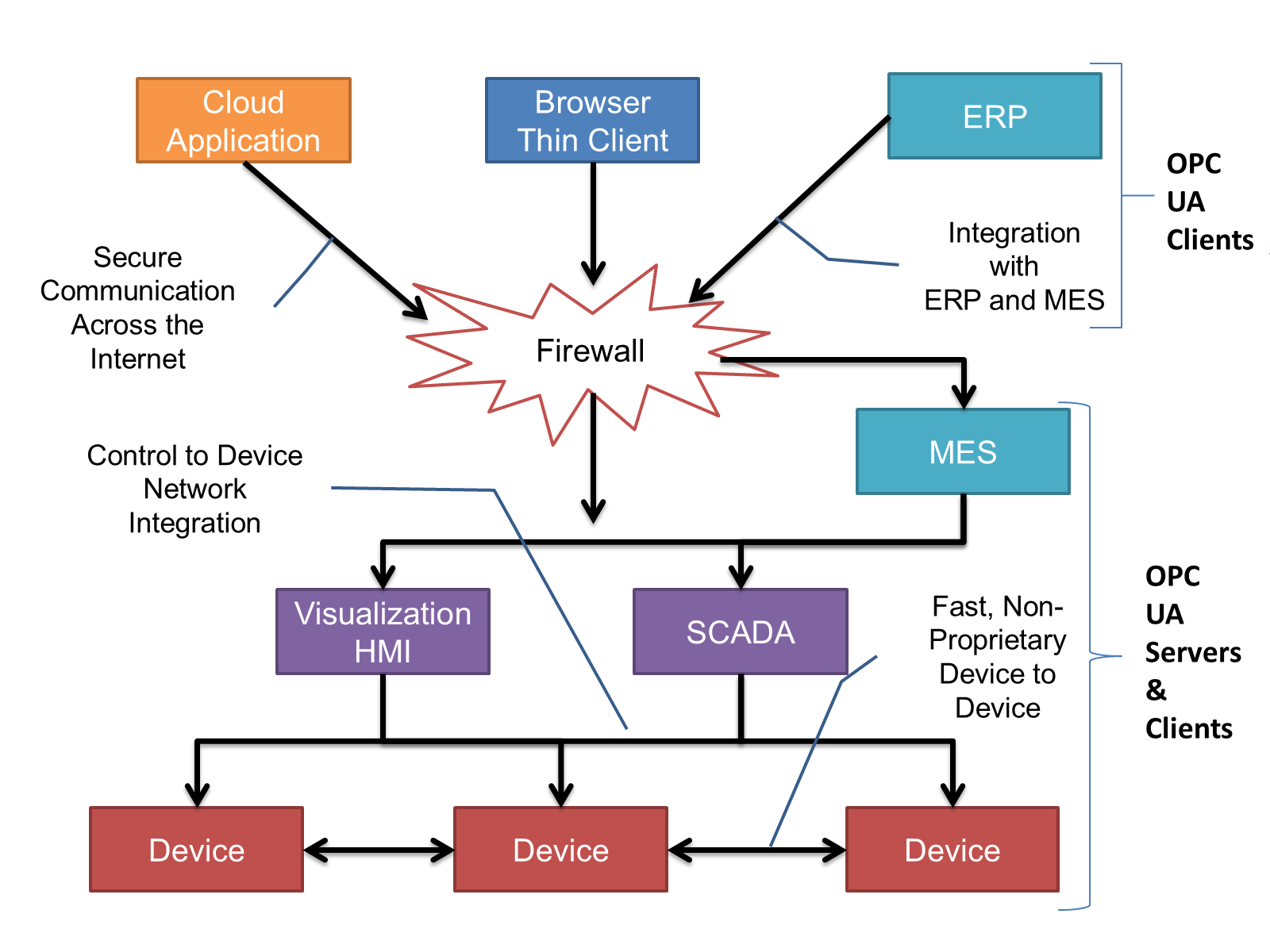
OPC UA provides a robust and reliable communication infrastructure having mechanisms for handling lost messages, failover, heartbeat, etc. With its binary encoded data, it offers a high-performing data exchange solution. Security is built into OPC UA as security requirements become more and more important especially since environments are connected to the office network or the internet and attackers are starting to focus on automation systems.
4.2.3 Information modelling in OPC UA
4.2.3.1 Concepts
OPC UA provides a framework that can be used to represent complex information as Objects in an AddressSpace which can be accessed with standard services. These Objects consist of Nodes connected by References. Different classes of Nodes convey different semantics. For example, a Variable Node represents a value that can be read or written. The Variable Node has an associated DataType that can define the actual value, such as a string, float, structure etc. It can also describe the Variable value as a variant. A Method Node represents a function that can be called. Every Node has a number of Attributes including a unique identifier called a NodeId and non-localized name called as BrowseName. An Object representing a 'Reservation' is shown in Figure 2.
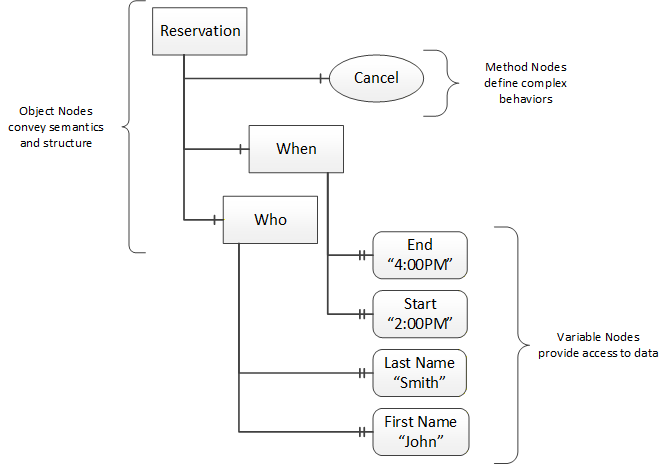
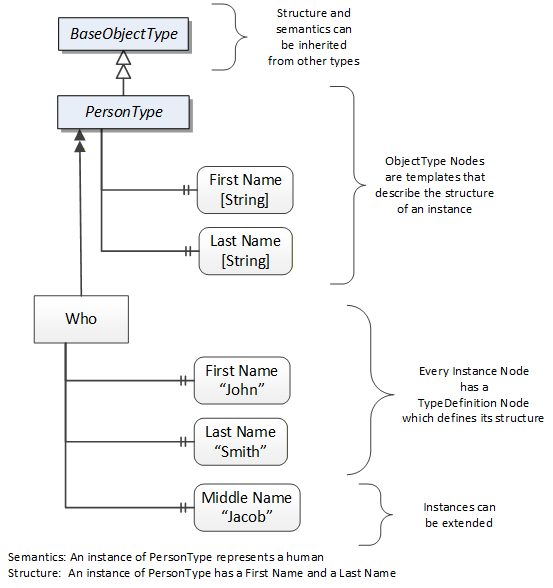
Object and Variable Nodes represent instances and they always reference a TypeDefinition (ObjectType or VariableType) Node which describes their semantics and structure. Figure 3 illustrates the relationship between an instance and its TypeDefinition.
The type Nodes are templates that define all of the children that can be present in an instance of the type. In the example in Figure 3 the PersonType ObjectType defines two children: First Name and Last Name. All instances of PersonType are expected to have the same children with the same BrowseNames. Within a type the BrowseNames uniquely identify the children. This means Client applications can be designed to search for children based on the BrowseNames from the type instead of NodeIds. This eliminates the need for manual reconfiguration of systems if a Client uses types that multiple Servers implement.
OPC UA also supports the concept of sub-typing. This allows a modeller to take an existing type and extend it. There are rules regarding sub-typing defined in OPC 10000-3, but in general they allow the extension of a given type or the restriction of a DataType. For example, the modeller may decide that the existing ObjectType in some cases needs an additional Variable. The modeller can create a subtype of the ObjectType and add the Variable. A Client that is expecting the parent type can treat the new type as if it was of the parent type. Regarding DataTypes, subtypes can only restrict. If a Variable is defined to have a numeric value, a subtype could restrict it to a float.
References allow Nodes to be connected in ways that describe their relationships. All References have a ReferenceType that specifies the semantics of the relationship. References can be hierarchical or non-hierarchical. Hierarchical references are used to create the structure of Objects and Variables. Non-hierarchical are used to create arbitrary associations. Applications can define their own ReferenceType by creating subtypes of an existing ReferenceType. Subtypes inherit the semantics of the parent but may add additional restrictions. Figure 4 depicts several References, connecting different Objects.
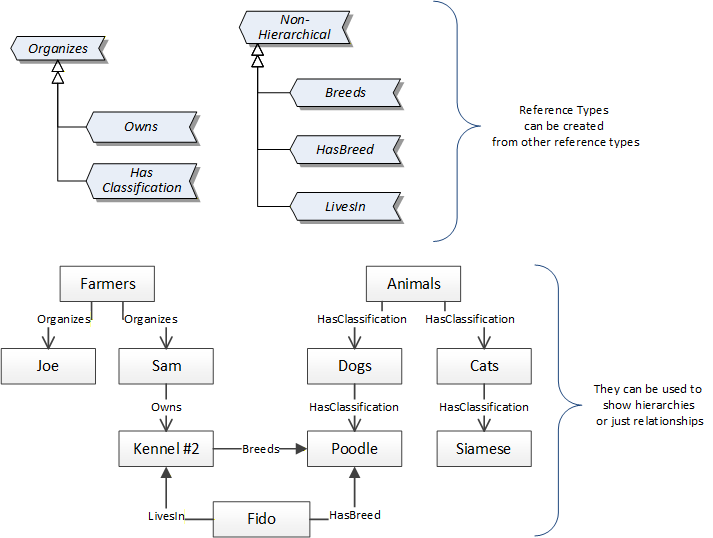
The figures above use a notation that was developed for the OPC UA specification. The notation is summarised in Figure 5. UML representations can also be used; however, the OPC UA notation is less ambiguous because there is a direct mapping from the elements in the figures to Nodes in the AddressSpace of an OPC UA Server.
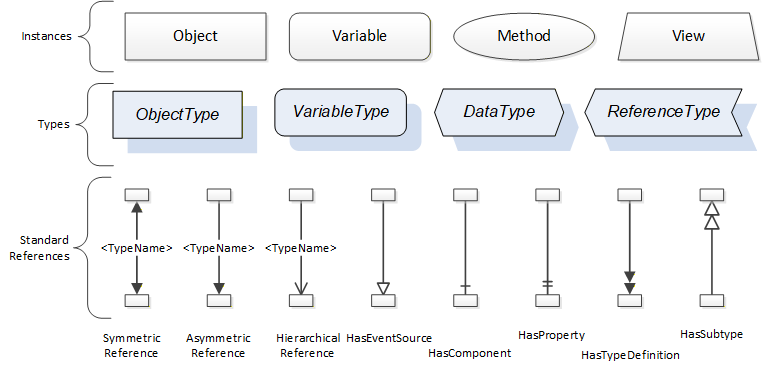
A complete description of the different types of Nodes and References can be found in OPC 10000-3 and the base structure is described in OPC 10000-5.
The OPC UA specification defines a very wide range of functionality in its basic information model. It is not expected that all Clients or Servers support all functionality in the OPC UA specifications. OPC UA includes the concept of Profiles, which segment the functionality into testable certifiable units. This allows the definition of functional subsets (that are expected to be implemented) within a companion specification. The Profiles do not restrict functionality, but generate requirements for a minimum set of functionality (see OPC 10000-7).
4.2.3.2 Namespaces
OPC UA allows information from many different sources to be combined into a single coherent AddressSpace. Namespaces are used to make this possible by eliminating naming and id conflicts between information from different sources. Namespaces in OPC UA have a globally unique string called a NamespaceUri and a locally unique integer called a NamespaceIndex. The NamespaceIndex is only unique within the context of a Session between an OPC UA Client and an OPC UA Server. The Services defined for OPC UA use the NamespaceIndex to specify the Namespace for qualified values.
There are two types of values in OPC UA that are qualified with Namespaces: NodeIds and QualifiedNames. NodeIds are globally unique identifiers for Nodes. This means the same Node with the same NodeId can appear in many Servers. This, in turn, means Clients can have built in knowledge of some Nodes. OPC UA Information Models generally define globally unique NodeIds for the TypeDefinitions defined by the Information Model.
QualifiedNames are non-localized names qualified with a Namespace. They are used for the BrowseNames of Nodes and allow the same names to be used by different information models without conflict. TypeDefinitions are not allowed to have children with duplicate BrowseNames; however, instances do not have that restriction.
4.2.3.3 Companion Specifications
An OPC UA companion specification for an industry specific vertical market describes an Information Model by defining ObjectTypes, VariableTypes, DataTypes and ReferenceTypes that represent the concepts used in the vertical market, and potentially also well-defined Objects as entry points into the AddressSpace.
5 Use Cases
This section introduces the use cases for the OPC UA for Machine Tools specification. For the use cases described in sections 5.2 to 5.9, a maximum sampling rate of 1 Hz is considered to be sufficient.
5.1 Identify Machines of Different Manufacturers
The machines of different manufacturers shall be identifiable in a standardised manner. To realize this, a number of basic and static information like manufacturer name and serial number are offered on the Machine Tools interface. This information can be found on the interface in an instance of the MachineToolIdentificationType.
5.2 Overview if Production is Running
Using information provided by the Machine Tools interface, an overview if the machine tool is in production or not should be possible. Additionally, if the machine tool is in an erroneous state, it needs to be evident over the interface.
If the machine tool is not in production, the reason for this state should also be identifiable.
The information of the machine tool and controller state can be found in the information model in the Monitoring Component (defined by the MonitoringType) of the MachineToolType. Other nodes that provide important information for an overview if the production is running are the override values of NC channels and working units in the ChannelMonitoringType and the WorkingUnitMonitoringType.
Another indication of the machine tool status is the machine stacklight. Its representation in the Machine Tools information model can be found in the StacklightType.
The errors and warnings on the machine tool shall be available on the Machine Tools interface with the OPC UA mechanism described in OPC UA Part 9 - Alarms and Conditions.
5.3 Overview of Parts in a Job
Using the Machine Tools interface, an overview of the target and actual manufactured parts is possible. The relevant information can be found in the information model in the MaterialActuals field of the ISA95JobResponseDataType as defined by OPC 10031-4 and OPC 40001-3.
5.4 Overview of Runtimes for a Job
In order to calculate cycle times and prognoses for production, the Machine Tools interface provides the time data of start and end of job orders on the machine tool.
The events can be found in the information model as InterruptionConditionType with its ConditionClassId and ConditionClassName (that specify the reason for the interruption further), and the StartTime and EndTime fields of the ISA95JobResponseDataType as defined by OPC 10031-4 and the ActualProductionTime as defined by OPC 40001-3.
To receive the events for a specific program, job order or controller, the OPC UA client can subscribe to the ISA95JobOrderStatusEventType generated by the ISA95JobResponseProviderObjectType.
5.5 Overview of Machine Tool State
With the interface, information on the machine tool state is available, e.g., in the MachineOperationMonitoringType. The MachineOperationMonitoring type also contains the MachineryItemState and MachineryOperation mode from OPC 40001-1.The states of NC channels and controllers in the machine tool are available as well.
In the information model, the status of the production is shown for each job order in the JobOrderList.
The control mode of the channel is represented in the ChannelMode of the ChannelMonitoringType.
5.6 Overview of Upcoming Manual Activities
For a machine operator who works on multiple machine tools in his shift, an indication which of the machine tools has the soonest need of a manual intervention is helpful (e.g., tool change, part change, preparation for the next job…).
To achieve this, the Machine Tools interface offers the possibility to give prognoses for different events. These prognoses can of course only be provided if the machine tool can estimate the time of the respective future event.
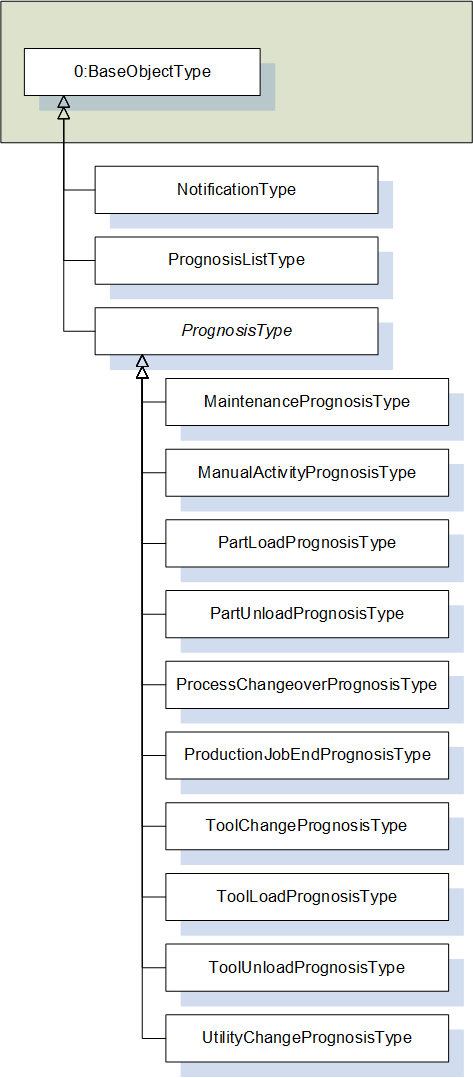
The available types of prognoses are: MaintenancePrognosisType, ManualActivityPrognosisType, PartUnloadPrognosisType, ProcessChangeoverPrognosisType, ProductionJobEndPrognosisType, PartLoadPrognosisType, ToolLoadPrognosisType, ToolUnloadPrognosisType, ToolChangePrognosisType and UtilityChangePrognosisType.
On the Machine Tools interface, there is a list of available prognoses, which is of PrognosisListType. It contains all known prognoses with their times to happen.
5.7 Overview of Errors and Warnings
The machine tool is expected to offer all current errors and warnings over the Machine Tools interface.
These errors and warnings shall be mapped to OPC UA event types accordingly. For errors, the Machine Tools information model offers the AlertType. For messages with lower urgency, there is the NotificationEventType.
5.8 Providing Data for KPI Calculations
To facilitate the calculation of different KPIs like for example OEE, the Machine Tools interface offers different machine times. These times allow to calculate the durations of different machine modes. To calculate the KPI, additional data not provided by the interface may be necessary.
Some of these relevant times are transferred via the event mechanism in OPC UA.
For detailed information about KPI calculation and possible values of the information model to use, please refer to Annex C.
5.9 Providing an Overview of Tool Data
On the Machine Tools interface, data concerning the tools in the machine tool is available.
In the Machine Tools interface, tools are modelled with the MultiToolType and ToolType and aggregated in a list with the ToolListType.
In the Machine Tools information model, the tool data are constrained to very basic information. Especially all geometric information about the tool is omitted on the interface. This is mainly due to the multitude of different norms for different tools.
On the interface, there are the identifiers of the tools in the machine tool. With these, it can be verified if a machine tool is prepared to execute a certain machining task.
There is also some information about the tool life condition of the tool. The interface will show at which tool life value a warning to change the tool is issued and the tool life limit value at which the tool is intended to be changed.
If there are multiple tools of the same type equipped in the machine tool, the one that will primarily be used in the machining process is marked as planned for operating. Using this information, the tool distribution among different machines can be planned remotely and changed without disturbing the current machine operation.
5.10 Provide OPC UA for Machinery Use Cases
The Machine Tools interface makes use of OPC 40001-1. As such, it is providing the use cases "Machine Identification and Nameplate", "Finding all Machines in a Server", "Finding all Components of a Machine" and "Machine Monitoring". It also provides the MachineryBuildingBlocks folder, directly referencing all Machinery Building blocks used by the Machine Tools interface instance.
In addition, the Machine Tools interface incorporates OPC 40001-3. This specification provides the use cases "provide job orders", "control job orders", "get information about the state of execution and intermediate as well as end results" and "delete job orders".
6 Machine Tools Information Model Overview
This section introduces the "OPC UA Information Model for Machine Tools".
This Information Model provides the necessary ObjectTypes to model a machine tool interface in a structure as illustrated in Figure 6. There are ObjectTypes that are used to identify the machine tool (MachineToolIdentificationType), to monitor the machine tool (Monitoring Type), to manage the production (Production Type) on the machine tool, to handle the Equipment of the machine tool (EquipmentType) and to give notification on the status of the machine tool (NotificationType).
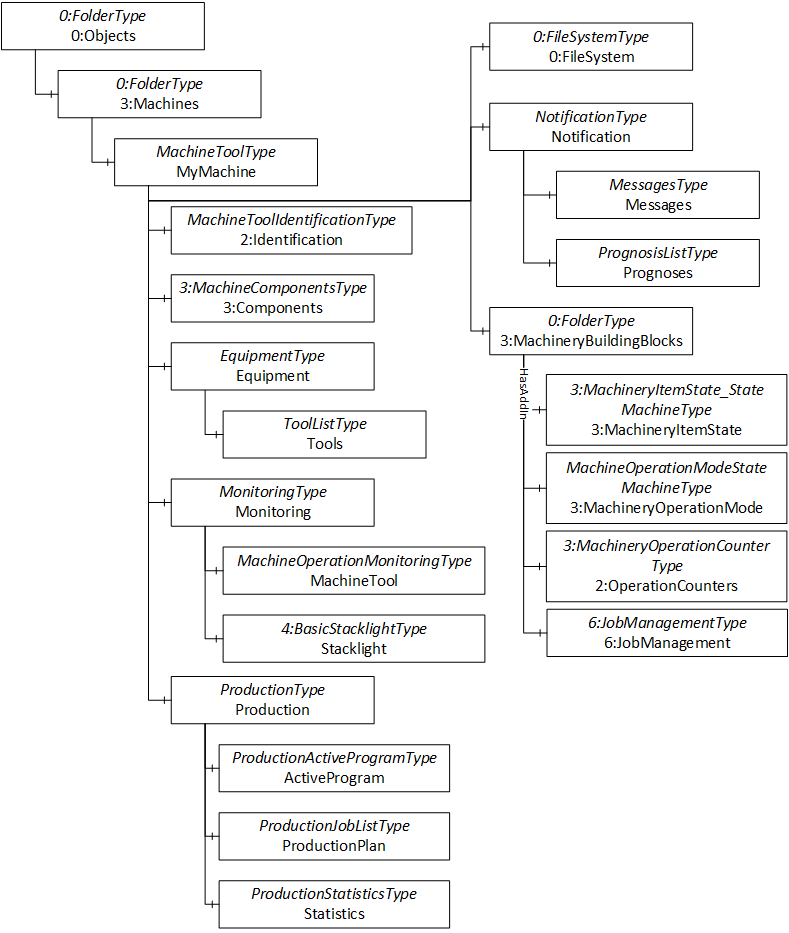
The ObjectType hierarchy of this Companion Specification is shown within the Figures 7-12. Objects from external specifications are positioned within greyish-green boxes.
Figure 7 shows the inheritance relations of the MachineToolType.
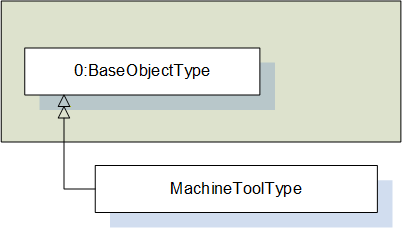
Figure 8 shows the inheritance hierarchy of all ObjectTypes used in the MachineToolType's Identification component. This relates to the document structure in 8.3.
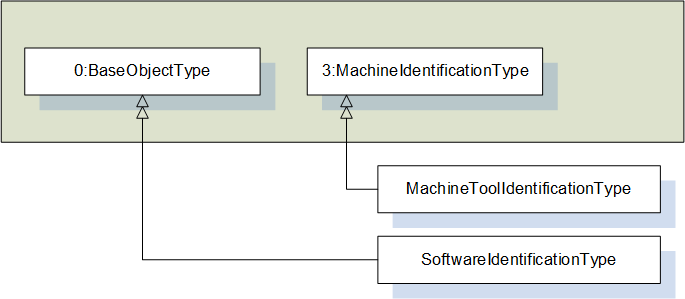
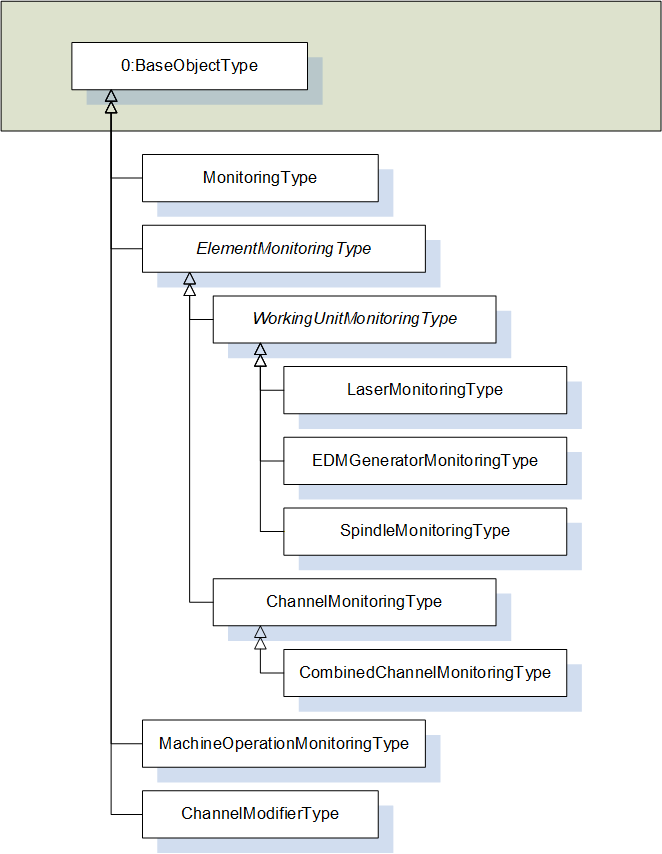
Figure 9 shows the inheritance hierarchy of all types used in the MachineToolType's Monitoring component. This conforms to the structure of the section Monitoring.
[DEPRECATED in version 1.02] Figure 10 shows the inheritance hierarchy of all types used in the MachineToolType's Production component. This conforms to the structure of the section Production.
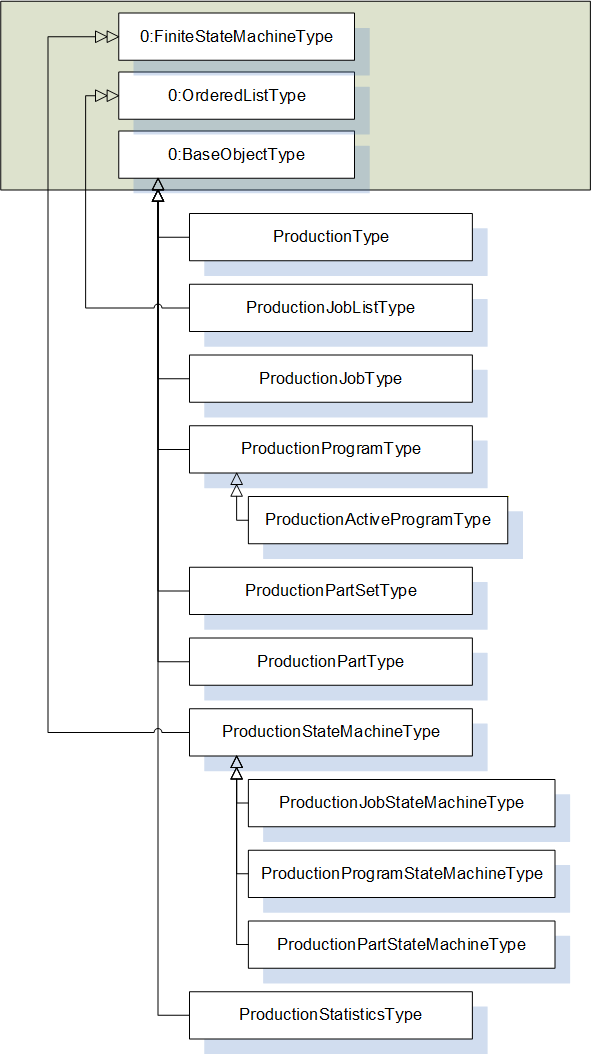
Figure 11 shows the inheritance hierarchy of all types used in the MachineToolType's Equipment component. This conforms to the structure of the section Equipment.
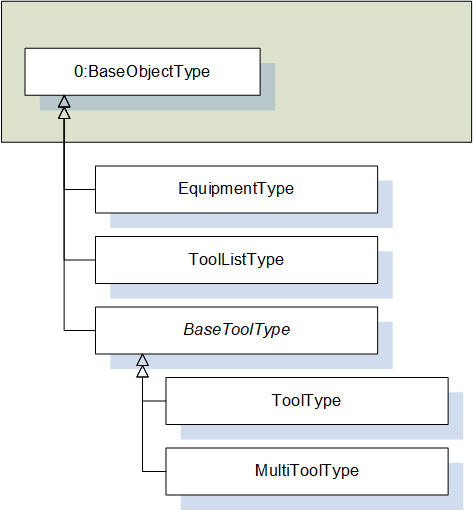
Figure 12 shows the inheritance hierarchy of all types used in the MachineToolType's Notification component. This conforms to the structure of the section Notification.
7 General Recommendations for Implementation
7.1 Localization
If the text part of a value of DataType LocalizedText, like the Manufacturer or the Model of a machine tool, is language neutral, i.e., it is the same in all languages, the locale of the LocalizedText shall be null or an empty string.
For all LocalizedText that have a language, the English version may be provided if possible.
7.2 Extending the Specification
If a type in this specification lacks information for a specific scenario, it is possible to extend the type. This is done in a specific namespace to indicate that it is outside the scope of this specification. To extend a type, a subtype containing the additional information is created. Instances of this subtype can be used interchangeably with instances of its parent type in the overall Machine Tools node structure. As the subtyped object needs to contain all information the parent type requires, all clients using this specification can handle the information of the supertype in the subtype. Clients that don't know the subtype might not use its additional information though.
7.3 GeneralModelChangeEvent and NodeVersion
This specification provides the possibility to indicate changes in the AddressSpace to a client. Most often this concept is used in list representations, to add or delete Nodes from the list. OPC 10000-3 defines the property NodeVersion and the GeneralModelChangeEventType to indicate such changes. Whenever the address space in this specification is changing, the NodeVersion and the GeneralModelChangeEvent shall be used in the way defined in OPC 10000-3.
As content for the NodeVersion Property, a timestamp of the moment the node structure was changed converted to a string with the format yyyy-MM-ddTHH:mm:ss.sZ (using UTC time for display) shall be used.
8 OPC UA ObjectTypes
8.1 MachineToolType
The MachineToolType represents the entire machine tool interface of the information model. It is the entry point to the OPC UA interface of a machine tool. It gives a basic structure to the interface. An instance of this type aggregates all information related to one machine tool.
All instances of MachineToolType have to be referenced from the 3:Machines node defined in OPC 40001-1. At least one MachineToolType instance shall be present to qualify for any profile of OPC UA for Machine Tools.
The MachineToolType is formally defined in Table 9.
| Attribute | Value | ||||
| BrowseName | MachineToolType | ||||
| IsAbstract | False | ||||
| References | Node Class | BrowseName | DataType | TypeDefinition | Other |
|---|---|---|---|---|---|
| Subtype of the 0:BaseObjectType defined in OPC 10000-5 i.e. inheriting the InstanceDeclarations of that Node. | |||||
| 0:HasAddIn | Object | 3:Components | 3:MachineComponentsType | O | |
| 0:HasComponent | Object | Equipment | EquipmentType | M | |
| 0:HasAddIn | Object | 2:Identification | MachineToolIdentificationType | M | |
| 0:HasComponent | Object | 3:MachineryBuildingBlocks | 0:FolderType | O | |
| 0:HasComponent | Object | Monitoring | MonitoringType | M | |
| 0:HasComponent | Object | Notification | NotificationType | M | |
| 0:HasComponent | Object | Production | ProductionType | M | |
| 0:HasComponent | Object | 0:FileSystem | 0:FileDirectoryType | O | |
| Conformance Units | |||||
|---|---|---|---|---|---|
| MachineTool MachineToolType Mandatory Nodes | |||||
| MachineTool Components | |||||
| MachineTool FileSystem | |||||
| MachineTool Production Machinery Job Management |
Equipment (see 8.5 ), 2:Identification (see 8.2), Monitoring (see 8.3), Notification (see 8.6) and Production (see 8.4) are instances of the respective types. They are used to structure the information in the MachineToolType topically. 3:Components and 3:MachineryBuildingBlocks are used as described in OPC 40001-1. To differentiate between 3:Components and Equipment, 3:Components should contain elements that are an inseparable part of the machine and Equipment should contain removable elements (e.g., tools).
The components of the MachineToolType have additional subcomponentns which are defined in Table 10.
| Source Path | Reference | NodeClass | BrowseName | DataType | TypeDefinition | Others |
| 0:FileSystem | 0:HasComponent | Object | WorkMasters | 0:FileDirectoryType | O | |
| 3:MachineryBuildingBlocks | 0:HasAddIn | Object | 6:JobManagement | 6:JobManagementType | O |
The 0:FileSystem is the root of all file directories of the OPC UA server and the underlying machine.
Note: While a direct coupling is not essential, aligning the file paths in both OPC UA 0:FileSystem and actual file systems is recommended (e.g. "/Directory1/FileA" in Unix and "ns=1;i=1001 Directory1/FileA" in OPC UA BrowsePath). Harmonizing OPC UA 0:FileSystem with actual file systems is advised for a more intuitive and efficient work environment.
The components of the MachineToolType have additional references which are defined in Table 11. The Production component will be replaced by the 6:JobManagement AddIn of the 3:MachineryBuildingBlocks in future versions of this specification. Hence, Table 11 defines its 0:IsDeprecated Reference.
| SourceBrowsePath | ReferenceType | Is Forward | TargetBrowsePath | ||||
| 3:MachineryBuildingBlocks | 0:HasAddIn | True |
| ||||
| 3:MachineryBuildingBlocks | 0:HasAddIn | True |
| ||||
| 3:MachineryBuildingBlocks | 0:HasAddIn | True |
| ||||
| Production | 0:IsDeprecated | True |
|
8.2 Identification
8.2.1 MachineToolIdentificationType
The MachineToolIdentificationType of the Machine Tools information model holds static data which shall uniquely identify a machine tool among a pool of the machine tool operating entity. It is a subtype of the 3:MachineIdentificationType defined in OPC 40001-1, so it inherits all InstanceDeclarations specified there.
The MachineToolIdentificationType is formally defined in Table 12.
| Attribute | Value | ||||
| BrowseName | MachineToolIdentificationType | ||||
| IsAbstract | False | ||||
| References | Node Class | BrowseName | DataType | TypeDefinition | Other |
|---|---|---|---|---|---|
| Subtype of the 3:MachineIdentificationType defined in OPC 40001-1 i.e. inheriting the InstanceDeclarations of that Node. | |||||
| 0:HasComponent | Object | SoftwareIdentification | 0:BaseObjectType | O | |
| Conformance Units | |||||
|---|---|---|---|---|---|
| MachineTool Identification SoftwareInformation | |||||
| MachineTool Identification Machinery additional |
SoftwareIdentification contains a list of instances of the SoftwareIdentificationType (see Table 14). This list contains the machine tool's software identification information. It allows to add multiple software items, e.g., one for each of PLC, NC and HMI.
2:SoftwareRevision inherited from the 3:MachineIdentificationType shall contain an overall software patch level of the machine tool. Individual software revision numbers may be given using SoftwareIdentification.
For the 2:DeviceClass inherited from the 3:MachineIdentificationType, the values in Table 13 should be used but might be extended by specifications using OPC 40501-1. The most appropriate value, based on the main machine tool technology shall be chosen.
Additive manufacturing machines are not defined in the source mentioned. They include every additive technology currently available.
| DeviceClasses for Machine Tools | |||
| Additive manufacturing machine | Forming machine | Mill-turn machining centre | Shaping machine |
| Additive manufacturing hybrid machine | Gear cutting machine | Nibbling machine | Shearing machine |
| Beading machine | Grinding machine | Other | Slotting machine |
| Bending machine | Hammer machine | Planer | Straightening machine |
| Broaching machine | Hardening machine | Planing machine | Testing machine |
| Copy milling machine | Honing machine | Plasma cutting machine | Thermal deburring machine (TEM) |
| Curling machine | Lapping machine | Polishing machine | Transfer machine |
| Deburring machine | Laser ablation machine | Press | Trimming machine |
| Drawing machine | Laser cutting machine | Profiling machine | Turn-mill machining centre |
| Drilling / Boring machine | Laser drilling machine | Punch laser machine | Turning machine |
| Electrical discharge machine (EDM) | Laser texturing machine | Punching machine | Water jet cutting machine |
| Electro chemical machine (ECM) | Laser welding machine | Riveting machine | |
| Finishing machine | Machining centre | Rolling machine | |
| Flanging machine | Machining centre (other) | Rotary transfer machine | |
| Folding machine | Measuring machine | Sawing machine | |
| Forging machine | Milling machine | Seaming machine | |
All other properties of the MachineToolIdentificationType are defined in OPC 40001-1 and are intended to be used as indicated there.
| BrowsePath | References | NodeClass | BrowseName | DataType | TypeDefinition | Others |
| SoftwareIdentification | 0:HasComponent | Object | <SoftwareItem> | SoftwareIdentificationType | MP |
8.2.2 SoftwareIdentificationType
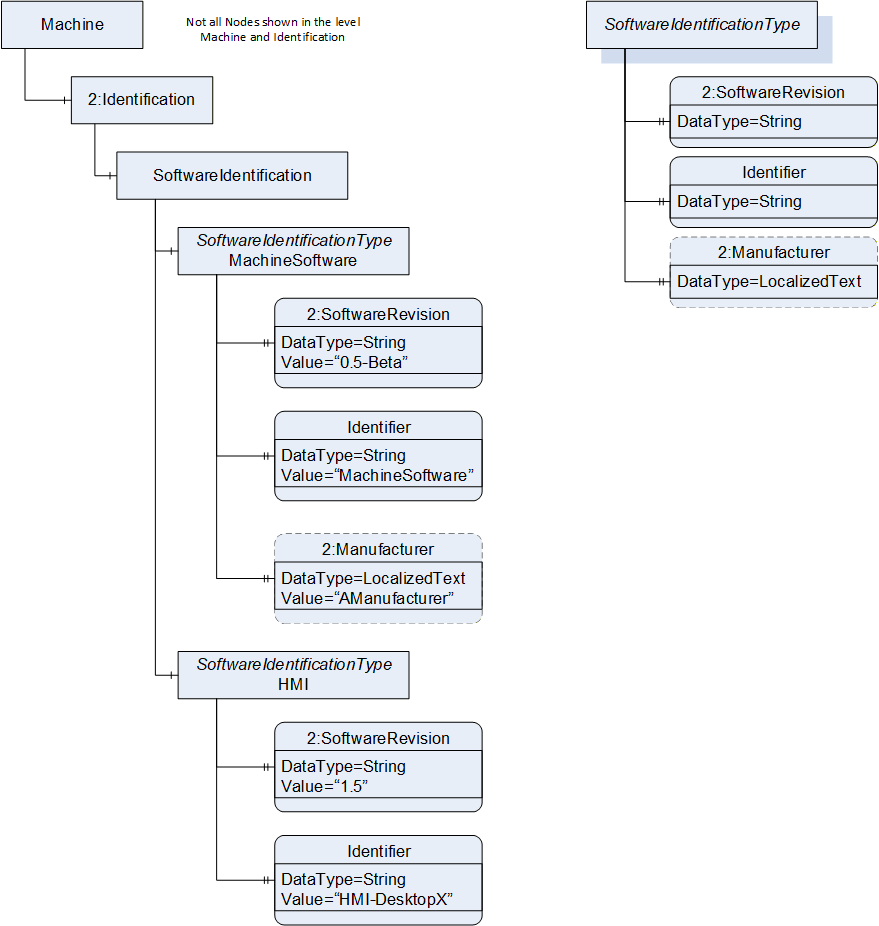
The SoftwareIdentificationType holds information about the specific software in operation in the machine tool. Almost all modern machine tools operate on several software system components, this shall enable presentation of software components (NC Kernel, HMI base system, etc.). Figure 13 shows an example instance of the application of this type within the 2:Identification component of the MachineToolType.
The SoftwareIdentificationType is formally defined in Table 15.
| Attribute | Value | ||||
| BrowseName | SoftwareIdentificationType | ||||
| IsAbstract | False | ||||
| References | Node Class | BrowseName | DataType | TypeDefinition | Other |
|---|---|---|---|---|---|
| Subtype of the 0:BaseObjectType defined in OPC 10000-5 i.e. inheriting the InstanceDeclarations of that Node. | |||||
| 0:HasProperty | Variable | 2:SoftwareRevision | 0:String | 0:PropertyType | M, RO |
| 0:HasProperty | Variable | Identifier | 0:String | 0:PropertyType | M, RO |
| 0:HasProperty | Variable | 2:Manufacturer | 0:LocalizedText | 0:PropertyType | O, RO |
| Conformance Units | |||||
|---|---|---|---|---|---|
| MachineTool Identification SoftwareInformation |
In most cases, machine tools consist of several software components. A software component can be an individual application, or plugin of an application involved in controlling the machine tool.
2:SoftwareRevision provides a string representation of the version or revision level of the software component, the software/firmware of a hardware component. Examples are: "PLL01 1.10.0.3", "V05.01.01.15", "3.1 R1293", "70.0.1".
The Identifier Property provides an identifier to distinguish the software component.
2:Manufacturer refers to the manufacturer/producer of the software.
8.3 Monitoring
8.3.1 MonitoringType
The MonitoringType is used to structure information given in the MachineToolType. It contains the monitoring information of the machine tool and its subsystems.
The MonitoringType is formally defined in Table 16.
| Attribute | Value | ||||
| BrowseName | MonitoringType | ||||
| IsAbstract | False | ||||
| References | Node Class | BrowseName | DataType | TypeDefinition | Other |
|---|---|---|---|---|---|
| Subtype of the 0:BaseObjectType defined in OPC 10000-5 i.e. inheriting the InstanceDeclarations of that Node. | |||||
| 0:HasComponent | Object | <MonitoredElement> | ElementMonitoringType | OP | |
| 0:HasComponent | Object | MachineTool | MachineOperationMonitoringType | M | |
| 0:HasComponent | Object | Stacklight | 4:BasicStacklightType | O | |
| Conformance Units | |||||
|---|---|---|---|---|---|
| MachineTool Monitoring Basic - Stacklight | |||||
| MachineTool Monitoring Basic - Channels |
<MonitoredElement> is an optional Placeholder for ElementMonitoringType instances. This allows for any number of such instances as a component of the MonitoringType. For the DisplayName, it is recommended to use the value of the Name Property of the respective ElementMonitoringType instance.
MachineTool provides overall monitoring information of the machine tool.
Stacklight contains the information about a stacklight's composition and status. It is an object of 4:BasicStacklightType, defined in OPC 10000-200. If the machine tool has a stacklight available, the Stacklight shall be present.
The optional 4:StackLevelType and 4:StackRunningType of the 4:BasicStacklightType shall not be used, only a segmented light shall be shown. Thus, the 4:StacklightMode of each stacklight has to be "Segmented" (0).
As 4:<StackElement>, only elements of 4:StackElementLightType shall be used. For these, the 4:SignalOn, 4:SignalColor and 4:SignalMode shall be used, not the 4:ControlChannelType (see Table 17).
| BrowsePath | References | NodeClass | BrowseName | DataType | TypeDefinition | Other | ||
| Stacklight | 0:HasOrderedComponent | Object | 0:<OrderedObject> | 4:StackElementLightType | MP | |||
| 0:HasProperty | Variable | 4:SignalOn | 0:Boolean | 0:PropertyType | M, RO | ||
| 0:HasComponent | Variable | 4:SignalColor | 4:SignalColor | 0:BaseDataVariableType | M, RO | ||
| 0:HasComponent | Variable | 4:SignalMode | 4:SignalModeLight | 0:BaseDataVariableType | M, RO |
8.3.2 ElementMonitoringType
The ElementMonitoringType is intended to be a supertype for all monitoring information that is specific to a particular element within the machine tool. An element doesn't have to be a physical component. Examples for such elements are NC channels or spindles. It is an abstract type, meaning it is not instantiated, only the subtypes are.
The ElementMonitoringType is formally defined in Table 18.
| Attribute | Value | ||||
| BrowseName | ElementMonitoringType | ||||
| IsAbstract | True | ||||
| References | Node Class | BrowseName | DataType | TypeDefinition | Other |
|---|---|---|---|---|---|
| Subtype of the 0:BaseObjectType defined in OPC 10000-5 i.e. inheriting the InstanceDeclarations of that Node. | |||||
| 0:HasProperty | Variable | Name | 0:String | 0:PropertyType | M, RO |
| Conformance Units |
|---|
The Name property refers to a name of the element.
8.3.3 WorkingUnitMonitoringType
The WorkingUnitMonitoringType is a supertype used to group monitoring information of machine tool elements that are a direct and active part of the machining process. It is an abstract type, meaning it is not instantiated, only the subtypes are.
The WorkingUnitMonitoringType is formally defined in Table 19.
| Attribute | Value | ||||
| BrowseName | WorkingUnitMonitoringType | ||||
| IsAbstract | True | ||||
| References | Node Class | BrowseName | DataType | TypeDefinition | Other |
|---|---|---|---|---|---|
| Subtype of the ElementMonitoringType defined in 8.3.2 i.e. inheriting the InstanceDeclarations of that Node. | |||||
| Conformance Units | |||||
|---|---|---|---|---|---|
| MachineTool Monitoring WorkingUnit |
The WorkingUnitMonitoringType has no other explicitly defined References.
8.3.4 LaserMonitoringType
The LaserMonitoringType provides basic monitoring information of a laser device used in the machining process, e.g., a beam source for a laser beam used as a tool.
The LaserMonitoringType is formally defined in Table 20.
| Attribute | Value | ||||
| BrowseName | LaserMonitoringType | ||||
| IsAbstract | False | ||||
| References | Node Class | BrowseName | DataType | TypeDefinition | Other |
|---|---|---|---|---|---|
| Subtype of the WorkingUnitMonitoringType defined in 8.3.3 i.e. inheriting the InstanceDeclarations of that Node. | |||||
| 0:HasComponent | Variable | ControllerIsOn | 0:Boolean | 0:BaseDataVariableType | M, RO |
| 0:HasComponent | Variable | LaserState | LaserState | 0:BaseDataVariableType | M, RO |
| Conformance Units | |||||
|---|---|---|---|---|---|
| MachineTool Monitoring WorkingUnit |
ControllerIsOn being True indicates that the controller of the laser device is running. This gives no indication whether laser light is currently emitted.
LaserState indicates the current state of a laser device. It is defined in 12.4.
8.3.5 EDMGeneratorMonitoringType
The EDMGeneratorMonitoringType is a collection of information about the EDM spark generator
The EDMGeneratorMonitoringType is formally defined in Table 21
| Attribute | Value | ||||
| BrowseName | EDMGeneratorMonitoringType | ||||
| IsAbstract | False | ||||
| References | Node Class | BrowseName | DataType | TypeDefinition | Other |
|---|---|---|---|---|---|
| Subtype of the WorkingUnitMonitoringType defined in 8.3.3 i.e. inheriting the InstanceDeclarations of that Node. | |||||
| 0:HasComponent | Variable | IsOn | 0:Boolean | 0:BaseDataVariableType | M, RO |
| 0:HasComponent | Variable | EDMGeneratorState | EDMGeneratorState | 0:BaseDataVariableType | M, RO |
| Conformance Units | |||||
|---|---|---|---|---|---|
| MachineTool Monitoring WorkingUnit |
IsOn being True indicates that the EDM spark generator has a valid set of technology parameters, meets all safety conditions required and is switched on.
EDMGeneratorState indicates the current state of the EDM spark generator. It is defined in 12.3.
8.3.6 SpindleMonitoringType
The SpindleMonitoringType is a collection of information about the rotary process axis.
Depending on the actual context of the machine tool, this may for example be a tool-holding milling spindle or a workpiece-holding turning spindle.
The SpindleMonitoringType is formally defined in Table 22.
| Attribute | Value | ||||
| BrowseName | SpindleMonitoringType | ||||
| IsAbstract | False | ||||
| References | Node Class | BrowseName | DataType | TypeDefinition | Other |
|---|---|---|---|---|---|
| Subtype of the WorkingUnitMonitoringType defined in 8.3.3 i.e. inheriting the InstanceDeclarations of that Node. | |||||
| 0:HasComponent | Variable | IsRotating | 0:Boolean | 0:BaseDataVariableType | M, RO |
| 0:HasComponent | Variable | Override | 0:Double | 0:AnalogUnitRangeType | O, RO |
| 0:HasComponent | Variable | IsUsedAsAxis | 0:Boolean | 0:BaseDataVariableType | O, RO |
| Conformance Units | |||||
|---|---|---|---|---|---|
| MachineTool Monitoring WorkingUnit |
IsRotating being True indicates if the spindle is rotating and has a valid commanded rotation speed.
Override is representing the current value of the spindle override.
IsUsedAsAxis being True indicates if the monitored element is used as an axis or, if False, as a spindle. If IsUsedAsAxis is True, the values of IsRotating and Override shall not be used by a client.
8.3.7 ChannelMonitoringType
The ChannelMonitoringType provides the monitoring information about one NC channel.
The ChannelMonitoringType is formally defined in Table 23.
| Attribute | Value | ||||
| BrowseName | ChannelMonitoringType | ||||
| IsAbstract | False | ||||
| References | Node Class | BrowseName | DataType | TypeDefinition | Other |
|---|---|---|---|---|---|
| Subtype of the ElementMonitoringType defined in 8.3.2 i.e. inheriting the InstanceDeclarations of that Node. | |||||
| 0:HasComponent | Variable | ChannelState | ChannelState | 0:BaseDataVariableType | M, RO |
| 0:HasComponent | Variable | ChannelMode | ChannelMode | 0:BaseDataVariableType | M, RO |
| 0:HasComponent | Variable | FeedOverride | 0:Double | 0:AnalogUnitRangeType | M, RO |
| 0:HasComponent | Variable | RapidOverride | 0:Double | 0:AnalogUnitRangeType | O, RO |
| 0:HasComponent | Object | ChannelModifiers | ChannelModifierType | O | |
| Conformance Units | |||||
|---|---|---|---|---|---|
| MachineTool Monitoring Basic - Channels |
ChannelState is representing the current status of the NC channel and is defined in 12.1.
ChannelMode is representing the current mode the NC channel operates in. It is defined in 12.2.
FeedOverride is representing the current value of the feed override of the NC channel.
RapidOverride is representing the current value of the rapid override of the NC channel.
ChannelModifiers is representing additional program modifiers usually used during special operations of the machine tool, e.g., preparation of production (see 8.3.10).
8.3.8 CombinedChannelMonitoringType
The CombinedChannelMonitoringType is a subtype of the ChannelMonitoringType and inherits all its InstanceDeclarations. Using this type instead of a ChannelMonitoringType provides an aggregated representation of the channels in a machine tool. The rules for aggregation are given in Table 24. Sometimes it is not necessary to provide one representation per individual channel, e.g., if one channel is of primary interest, the status of the remaining channels is irrelevant for the machine tool status. It could be used together with the separate channels. Typical applications are multi-spindle machines in which a large number of channels are used for interlinked work steps.
| Component of the CombinedChannelMonitoringType | Rule for Aggregation |
| ChannelState | Mode of the channel not in "active", otherwise "active" - if all channels active --> active - if >0 channel reset --> reset - else interrupted |
| ChannelMode | Mode of the channel not in "automatic", otherwise "automatic" If one or more channel of the combined channels is not in "automatic" the machine tool is not producing (except if the channel is not currently in use). If for example the operator is in JogManual and moving one axis, the whole machine tool is not producing in automatic and the combined channel can be viewed as in JogManual |
| FeedOverride | selection from HMI mirrored On most multi spindle machines there is one HMI which controls the whole machine tool, so most of the input is applied to all combined channels |
| RapidOverride | selection from HMI mirrored On most multi spindle machines there is one HMI which controls the whole machine tool, so most of the input is applied to all combined channels |
| ChannelModifiers | If an element of ChannelModifiers is True in any channel, it has to be True in the combined channel. |
The CombinedChannelMonitoringType is formally defined in Table 25.
| Attribute | Value | ||||
| BrowseName | CombinedChannelMonitoringType | ||||
| IsAbstract | False | ||||
| References | Node Class | BrowseName | DataType | TypeDefinition | Other |
|---|---|---|---|---|---|
| Subtype of the ChannelMonitoringType defined in 8.3.7 i.e. inheriting the InstanceDeclarations of that Node. | |||||
| Conformance Units | |||||
|---|---|---|---|---|---|
| MachineTool Monitoring Basic - Channels |
The CombinedChannelMonitoringType contains no further References than the ones inherited.
8.3.9 MachineOperationMonitoringType
The MachineOperationMonitoringType provides overall monitoring information of the machine tool.
The MachineOperationMonitoringType is formally defined in Table 26.
| Attribute | Value | ||||
| BrowseName | MachineOperationMonitoringType | ||||
| IsAbstract | False | ||||
| References | Node Class | BrowseName | DataType | TypeDefinition | Other |
|---|---|---|---|---|---|
| Subtype of the 0:BaseObjectType defined in OPC 10000-5 i.e. inheriting the InstanceDeclarations of that Node. | |||||
| 0:HasComponent | Variable | FeedOverride | 0:Double | 0:AnalogUnitRangeType | O, RO |
| 0:HasComponent | Variable | IsWarmUp | 0:Boolean | 0:BaseDataVariableType | O, RO |
| 0:HasAddIn | Object | 3:MachineryItemState | 3:MachineryItemState_StateMachineType | O | |
| 0:HasAddIn | Object | 3:MachineryOperationMode | MachineOperationModeStateMachineType | O | |
| 0:HasComponent | Object | Obligation | ObligationType | O | |
| 0:HasComponent | Variable | OperationMode | MachineOperationMode | 0:BaseDataVariableType | M, RO |
| 0:HasComponent | Variable | PowerOnDuration | 0:UInt32 | 0:BaseDataVariableType | O, RO |
| 0:HasAddIn | Object | 2:OperationCounters | 3:MachineryOperationCounterType | O, RO | |
| Conformance Units | |||||
|---|---|---|---|---|---|
| MachineTool MachineToolType Mandatory Nodes | |||||
| MachineTool Monitoring Obligation | |||||
| MachineTool Monitoring Basic - PowerOnDuration | |||||
| MachineTool Monitoring Machinery PowerOnDuration | |||||
| MachineTool Production PartsProducedInLifetime |
FeedOverride is the combined actual feed override value that is effective for the manufacturing program of the machine tool.
IsWarmUp being True indicates if the machine tool is performing a warmup task. A warmup is not used for production, it is the mode used to reach a stable operating point for the machine tool. An example is reaching the optimal operating temperature. This might be indicated by a hardware switch on the machine tool, a special control command, a special production program (referenced by program name) or otherwise. In combination with the 3:MachineryItemState and the 3:MachineryOperationMode, the following behaviour is expected: If IsWarmUp is True, the 3:MachineryItemState is in state 3:Executing and the 3:MachineryOperationMode is in state 3:Setup.
3:MachineryItemState is used as defined in OPC 40001-1. Shall also be referenced as AddIn in the 3:MachineryBuildingBlocks folder.
3:MachineryOperationMode is used as defined in OPC 40001-1. Shall also be referenced as AddIn in the 3:MachineryBuildingBlocks folder.
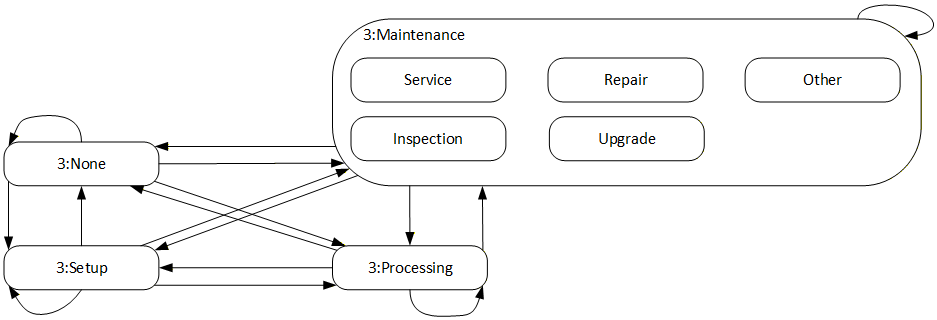
MaintenanceMode, as a SubStateMachine of the 3:MachineryOperationMode (see Table 29), is only valid if the 0:CurrentState of 3:MachineryOperationMode is 3:Maintenance.
Obligation indicates the instance responsible for the current activities of the machine.
OperationMode contains a MachineOperationMode value as defined in 12.5. The values of the MachineOperationMode enum are derived from the MO modes of machinery functional safety standards. For a machine adhering to such a standard, the OperationMode shall show the respective mode. For a machine not adhering to such a standard, the OperationMode shall be filled with the appropriate mode available from the MachineOperationMode Enum. The OperationMode is only a representation of the machine mode, it shall not be used in a safety relevant manner.
[DEPRECATED in version 1.02] PowerOnDuration is the duration the machine has been powered, meaning all systems have line voltage. It is counted in full hours. This value only increases during the lifetime of the machine and is not reset when the machine is power cycled.
2:OperationCounters with 3:MachineryOperationCounterType is used as defined in OPC 40001-1. Shall also be referenced as AddIn in the 3:MachineryBuildingBlocks folder. It shall contain the 2:PowerOnDuration defined in OPC 40001-1.
2:OperationCounters optionally contains the counter PartsProducedInLifetime, which is the counter for the total number of produced parts during the machine's lifetime. The exact way this number is acquired may differ between different machines. No quality information of PartsProducedInLifetime can be given.
| BrowsePath | References | NodeClass | BrowseName | DataType | TypeDefinition | Other |
| 2:OperationCounters | 0:HasProperty | Variable | 2:PowerOnDuration | 0:Duration | 0:PropertyType | M |
| 2:OperationCounters | 0:HasComponent | Variable | PartsProducedInLifetime | 0:UInt64 | 0:BaseDataVariableType | O, RO |
The PowerOnDuration component will be replaced by the 2:PowerOnDuration of the 2:OperationCounters in future versions of this specification. Hence, Table 28 defines its 0:IsDeprecated Reference.
| SourceBrowsePath | ReferenceType | Is Forward | TargetBrowsePath | ||||
| PowerOnDuration | 0:IsDeprecated | True |
|
8.3.10 MachineOperationModeStateMachineType
For this specification, the 3:MachineryOperationModeStateMachineType defined in OPC 40001-1 is extended by a sub state for 3:Maintenance. An overview is shown in Figure 14.
| Attribute | Value | ||||
| BrowseName | MachineOperationModeStateMachineType | ||||
| IsAbstract | False | ||||
| References | Node Class | BrowseName | DataType | TypeDefinition | Other |
|---|---|---|---|---|---|
| Subtype of the 3:MachineryOperationModeStateMachineType defined in OPC 40001-1 i.e. inheriting the InstanceDeclarations of that Node. | |||||
| 0:HasProperty | Variable | 0:DefaultInstanceBrowseName | 0:QualifiedName | 0:PropertyType | None |
| 0:HasComponent | Object | 3:None | 0:StateType | None | |
| 0:HasComponent | Object | 3:Maintenance | 0:StateType | None | |
| 0:HasComponent | Object | 3:Processing | 0:StateType | None | |
| 0:HasComponent | Object | 3:Setup | 0:StateType | None | |
| 0:HasComponent | Object | MaintenanceMode | MaintenanceModeStateMachineType | O | |
| 0:HasComponent | Object | 3:FromNoneToMaintenance | 0:TransitionType | None | |
| 0:HasComponent | Object | 3:FromNoneToSetup | 0:TransitionType | None | |
| 0:HasComponent | Object | 3:FromNoneToProcessing | 0:TransitionType | None | |
| 0:HasComponent | Object | 3:FromNoneToNone | 0:TransitionType | None | |
| 0:HasComponent | Object | 3:FromMaintenanceToNone | 0:TransitionType | None | |
| 0:HasComponent | Object | 3:FromMaintenanceToSetup | 0:TransitionType | None | |
| 0:HasComponent | Object | 3:FromMaintenanceToProcessing | 0:TransitionType | None | |
| 0:HasComponent | Object | 3:FromMaintenanceToMaintenance | 0:TransitionType | None | |
| 0:HasComponent | Object | 3:FromSetupToNone | 0:TransitionType | None | |
| 0:HasComponent | Object | 3:FromSetupToMaintenance | 0:TransitionType | None | |
| 0:HasComponent | Object | 3:FromSetupToProcessing | 0:TransitionType | None | |
| 0:HasComponent | Object | 3:FromSetupToSetup | 0:TransitionType | None | |
| 0:HasComponent | Object | 3:FromProcessingToNone | 0:TransitionType | None | |
| 0:HasComponent | Object | 3:FromProcessingToMaintenance | 0:TransitionType | None | |
| 0:HasComponent | Object | 3:FromProcessingToSetup | 0:TransitionType | None | |
| 0:HasComponent | Object | 3:FromProcessingToProcessing | 0:TransitionType | None | |
| Conformance Units | |||||
|---|---|---|---|---|---|
| MachineTool Monitoring MaintenanceMode | |||||
| 3:Machinery Operation Mode |
The state 3:Maintenance is overridden in the MachineOperationModeStateMachineType. The additional references are defined in Table 31. The remaining contents of the state machine are left unchanged, as defined in OPC 40001-1.
| BrowsePath | Value Attribute | Description Attribute | ||
| State Numbers | ||||
| 0:DefaultInstanceBrowseName | 3:MachineryOperationMode | The default BrowseName for instances of the type | ||
| 3:None | - | There is currently no operation mode available | ||
| 3:Maintenance | - | MachineryItem is set into maintenance mode with the intention to carry out maintenance or servicing activities | ||
| 3:Setup | - | MachineryItem is set into setup mode with the intention to carry out setup, preparation or postprocessing activities of a production process | ||
| 3:Processing | - | MachineryItem is set into processing mode with the intention to carry out the value adding activities | ||
| 3:FromNoneToMaintenance | - | Transition from state None to state Maintenance | ||
| 3:FromNoneToSetup | - | Transition from state None to state Setup | ||
| 3:FromNoneToProcessing | - | Transition from state None to state Processing | ||
| 3:FromNoneToNone | - | Transition from state None to state None | ||
| 3:FromMaintenanceToNone | - | Transition from state Maintenance to state None | ||
| 3:FromMaintenanceToSetup | - | Transition from state Maintenance to state Setup | ||
| 3:FromMaintenanceToProcessing | - | Transition from state Maintenance to state Processing | ||
| 3:FromMaintenanceToMaintenance | - | Transition from state Maintenance to state Maintenance | ||
| 3:FromSetupToNone | - | Transition from state Setup to state None | ||
| 3:FromSetupToMaintenance | - | Transition from state Setup to state Maintenance | ||
| 3:FromSetupToProcessing | - | Transition from state Setup to state Processing | ||
| 3:FromSetupToSetup | - | Transition from state Setup to state Setup | ||
| 3:FromProcessingToNone | - | Transition from state Processing to state None | ||
| 3:FromProcessingToMaintenance | - | Transition from state Processing to state Maintenance | ||
| 3:FromProcessingToSetup | - | Transition from state Processing to state Setup | ||
| 3:FromProcessingToProcessing | - | Transition from state Processing to state Processing | ||
| 0 | - | ||
| 1 | - | ||
| 2 | - | ||
| 3 | - | ||
| 0 | |||
| 1 | |||
| 2 | |||
| 3 | |||
| 4 | - | ||
| 5 | - | ||
| 6 | - | ||
| 7 | - | ||
| 8 | - | ||
| 9 | - | ||
| 10 | - | ||
| 11 | - | ||
| 12 | - | ||
| 13 | - | ||
| 14 | - | ||
| 15 | - | ||
| SourceBrowsePath | ReferenceType | Is Forward | TargetBrowsePath |
| 3:Maintenance | 0:HasSubStateMachine | True | MaintenanceMode |
| 3:FromNoneToMaintenance | 0:FromState | True | 3:None |
| 0:ToState | True | 3:Maintenance | |
| 3:FromNoneToProcessing | 0:FromState | True | 3:None |
| 0:ToState | True | 3:Processing | |
| 3:FromNoneToSetup | 0:FromState | True | 3:None |
| 0:ToState | True | 3:Setup | |
| 3:FromMaintenanceToNone | 0:FromState | True | 3:Maintenance |
| 0:ToState | True | 3:None | |
| 3:FromMaintenanceToProcessing | 0:FromState | True | 3:Maintenance |
| 0:ToState | True | 3:Processing | |
| 3:FromMaintenanceToSetup | 0:FromState | True | 3:Maintenance |
| 0:ToState | True | 3:Setup | |
| 3:FromProcessingToNone | 0:FromState | True | 3:Processing |
| 0:ToState | True | 3:None | |
| 3:FromProcessingToMaintenance | 0:FromState | True | 3:Processing |
| 0:ToState | True | 3:Maintenance | |
| 3:FromProcessingToSetup | 0:FromState | True | 3:Processing |
| 0:ToState | True | 3:Setup | |
| 3:FromSetupToNone | 0:FromState | True | 3:Setup |
| 0:ToState | True | 3:None | |
| 3:FromSetupToMaintenance | 0:FromState | True | 3:Setup |
| 0:ToState | True | 3:Maintenance | |
| 3:FromSetupToProcessing | 0:FromState | True | 3:Setup |
| 0:ToState | True | 3:Processing | |
| 3:FromNoneToNone | 0:FromState | True | 3:None |
| 0:ToState | True | 3:None | |
| 3:FromMaintenanceToMaintenance | 0:FromState | True | 3:Maintenance |
| 0:ToState | True | 3:Maintenance | |
| 3:FromProcessingToProcessing | 0:FromState | True | 3:Processing |
| 0:ToState | True | 3:Processing | |
| 3:FromSetupToSetup | 0:FromState | True | 3:Setup |
| 0:ToState | True | 3:Setup |
8.3.11 MaintenanceModeStateMachineType
The MaintenanceModeStateMachineType defines the different modes of maintenance being perfomed on a machine. It is used as a SubStateMachine. If the parent state is not active, the 0:CurrentState Variable of the MaintenanceModeStateMachineType shall have a status equal to Bad_StateNotActive.
The MaintenanceModeStateMachineType is formally defined in Table 32.
| Attribute | Value | ||||
| BrowseName | MaintenanceModeStateMachineType | ||||
| IsAbstract | False | ||||
| References | Node Class | BrowseName | DataType | TypeDefinition | Other |
|---|---|---|---|---|---|
| Subtype of the 0:FiniteStateMachineType defined in OPC 10000-5 i.e. inheriting the InstanceDeclarations of that Node. | |||||
| 0:HasComponent | Object | Service | 0:StateType | None | |
| 0:HasComponent | Object | Inspection | 0:StateType | None | |
| 0:HasComponent | Object | Repair | 0:StateType | None | |
| 0:HasComponent | Object | Upgrade | 0:StateType | None | |
| 0:HasComponent | Object | Other | 0:StateType | None | |
| Conformance Units | |||||
|---|---|---|---|---|---|
| MachineTool Monitoring MaintenanceMode |
The MaintenanceModeStateMachineType does not define an initial state.
The Service state indicates that measures to maintain or increase availability and duration of life are implemented. For example, linear guides are replaced, the bearings are lubricated, or the working area is cleaned.
The Inspection state indicates that the status is evaluated. For example, the lubrication is checked, the expendable parts are examined for wear and tear or the functionality of a workpiece holder is checked.
The Repair state indicates that the functionality of the unit is restored. For example, errors are fixed, or components are replaced.
The Upgrade state indicates that the performance, functionality, etc. of the unit are improved. For example, software upgrades, retrofitting of more powerful modules or modules with a longer duration of life.
The Other state is used if none of the other states apply.
The InstanceDeclarations of the MaintenanceModeStateMachineType have additional Attribute values defined in Table 33.
| BrowsePath | Value Attribute | ||
| 0 | ||
| 1 | ||
| 2 | ||
| 3 | ||
| 4 |
8.3.12 ChannelModifierType
The ChannelModifierType allows to show which modifiers are used while the machine is performing pre-production tests and similar tasks.
The ChannelModifierType is formally defined in Table 34.
| Attribute | Value | ||||
| BrowseName | ChannelModifierType | ||||
| IsAbstract | False | ||||
| References | Node Class | BrowseName | DataType | TypeDefinition | Other |
|---|---|---|---|---|---|
| Subtype of the 0:BaseObjectType defined in OPC 10000-5 i.e. inheriting the InstanceDeclarations of that Node. | |||||
| 0:HasComponent | Variable | BlockSkip | 0:Boolean | 0:BaseDataVariableType | O, RO |
| 0:HasComponent | Variable | DryRun | 0:Boolean | 0:BaseDataVariableType | M, RO |
| 0:HasComponent | Variable | OptionalStop | 0:Boolean | 0:BaseDataVariableType | M, RO |
| 0:HasComponent | Variable | TestMode | 0:Boolean | 0:BaseDataVariableType | O, RO |
| 0:HasComponent | Variable | SingleStep | 0:Boolean | 0:BaseDataVariableType | M, RO |
| Conformance Units | |||||
|---|---|---|---|---|---|
| MachineTool Monitoring Basic - Channels |
BlockSkip being True indicates that specially marked NC program blocks are skipped.
DryRun being True indicates that a test run using with a dedicated axis feed is being performed.
OptionalStop being True indicates that the execution will stop at special machine commands.
TestMode being True indicates a test mode which enables execution of a program without physical axis movement. The machining process may be simulated during program execution.
SingleStep being True indicates if the NC channel operates in single block/single step mode.
8.3.13 ObligationType
The ObligationType is used to indicate the entity responsible for the current activities of the machine. This value is needed for certain KPI standards.
The ObligationType is formally defined in Table 35.
| Attribute | Value | ||||
| BrowseName | ObligationType | ||||
| IsAbstract | False | ||||
| References | Node Class | BrowseName | DataType | TypeDefinition | Other |
|---|---|---|---|---|---|
| Subtype of the 0:BaseObjectType defined in OPC 10000-5 i.e. inheriting the InstanceDeclarations of that Node. | |||||
| 0:HasComponent | Variable | EndUserObligated | 0:Boolean | 0:BaseDataVariableType | M, RO |
| 0:HasComponent | Variable | MachineBuilderObligated | 0:Boolean | 0:BaseDataVariableType | M, RO |
| Conformance Units | |||||
|---|---|---|---|---|---|
| MachineTool Monitoring Obligation |
EndUserObligated being True indicates that the machine's activity is the responsibility of the end user/operator.
MachineBuilderObligated being True indicates that the machine's activity is the responsibility of the machine builder.
Typically, only one of EndUserObligated or MachineBuilderObligated is True, indicating the respective entity as responsible. Both being False indicates the obligation being unclear (e.g., unknown, third entity responsible). Both variables being True should not be used. It is foreseen that further obligation entities may be added in later versions; this way of representation allows for extension.
8.4 Production
8.4.1 ProductionType
[DEPRECATED in version 1.02] The ProductionType will be replaced by the job management defined in OPC 40001-3 in future versions of this specification. Hence the 0:IsDeprecated Reference was added.
As a minimal implementation please only instantiate the mandatory variables. Set NumberInList to the value 0, fill Name according to the mapping in Annex B.2 and implement State, as described below in the respective sections.
The ProductionType is used to structure information given in the MachineToolType. It groups the information about the production plan and the production statistics.
The ProductionType is formally defined in Table 36.
| Attribute | Value | ||||
| BrowseName | ProductionType | ||||
| IsAbstract | False | ||||
| References | Node Class | BrowseName | DataType | TypeDefinition | Other |
|---|---|---|---|---|---|
| Subtype of the 0:BaseObjectType defined in OPC 10000-5 i.e. inheriting the InstanceDeclarations of that Node. | |||||
| 0:HasComponent | Object | ProductionPlan | ProductionJobListType | O | |
| 0:HasComponent | Object | ActiveProgram | ProductionActiveProgramType | M | |
| 0:HasComponent | Object | Statistics | ProductionStatisticsType | O | |
| 0:IsDeprecated | Object | MachineTool_v102 | 0:BaseObjectType | ||
| Conformance Units | |||||
|---|---|---|---|---|---|
| MachineTool MachineToolType Mandatory Nodes | |||||
| MachineTool Production Basic |
ProductionPlan is a list of all job elements currently running and planned for execution.
If there is no job on the machine, there may be no ProductionJob object in the list.
In case the ProductionPlan is used as a dynamic list (i.e., ProductionJobType nodes are being added and deleted), the precondition for deleting any node is that all values of variables represent the final state of the job and are sent to all clients in active subscriptions.
ActiveProgram contains the program that is currently running on the machine. If the machine control discriminates between main and subprograms, this program shall be the main program. It is used in parallel to the ProductionPlan, so it allows for an access of the running program without browsing the jobs in the ProductionPlan. The 0:NumberInList Property of the ActiveProgram shall match the one used in the ProductionPlan for the same program. If the ProductionPlan is not used, it shall be 0.
Statistics is the object that contains statistics information related to production.
8.4.2 ProductionJobListType
[DEPRECATED in version 1.02] The ProductionJobListType will be replaced by the job management defined in OPC 40001-3 in future versions of this specification. Hence the 0:IsDeprecated Reference was added.
The ProductionJobListType is a type used for structuring objects of ProductionJobType in an ordered list structure.
The ProductionJobListType is formally defined in Table 37.
| Attribute | Value | ||||
| BrowseName | ProductionJobListType | ||||
| IsAbstract | False | ||||
| References | Node Class | BrowseName | DataType | TypeDefinition | Other |
|---|---|---|---|---|---|
| Subtype of the 0:OrderedListType defined in OPC 10000-5 i.e. inheriting the InstanceDeclarations of that Node. | |||||
| 0:HasOrderedComponent | Object | 0:<OrderedObject> | ProductionJobType | OP | |
| 0:IsDeprecated | Object | MachineTool_v102 | 0:BaseObjectType | ||
| Conformance Units | |||||
|---|---|---|---|---|---|
| MachineTool Production Job | |||||
| MachineTool Production Dynamic Job List | |||||
| MachineTool Production Job Available |
0:<OrderedObject> is a placeholder for any number of ProductionJobType instances. To indicate the order of jobs on the machine, the 0:NumberInList parameter of the ProductionJobType is used. This index shall be 0 for the first list element and increase by one for each subsequent list element. If jobs are deleted from the list or inserted into the list, the 0:NumberInList has to be adjusted for all following ProductionJobType instances in the list, such that the 0:NumberInList elements always form a sequential series of numbers. For the DisplayName of the 0:<OrderedObject>, it is recommended to use the value of the Identifier Property of the respective ProductionJobType instance.
The 0:NodeVersion and the 0:GeneralModelChangeEventType inherited from the 0:OrderedListType are intended to be used in the way defined in OPC 10000-3 and 7.3.
8.4.3 ProductionJobType
[DEPRECATED in version 1.02] The ProductionJobType will be replaced by the job management defined in OPC 40001-3 in future versions of this specification. Hence the 0:IsDeprecated Reference was added.
The ProductionJobType provides aggregated production data for running a sequence to produce several parts after one preparation mounting.
Examples for such a mounting are putting four raw parts on a pallet for a machining centre, setting up the fitting diameter bars in a turning centre bar feeder or loading a metal sheet from which hundreds of parts can be cut or punched. This sequence shall represent several parts which will usually (but not always) be several identical products. A job may be executed several times.
The ProductionJobType is formally defined in Table 38.
| Attribute | Value | ||||
| BrowseName | ProductionJobType | ||||
| IsAbstract | False | ||||
| References | Node Class | BrowseName | DataType | TypeDefinition | Other |
|---|---|---|---|---|---|
| Subtype of the 0:BaseObjectType defined in OPC 10000-5 i.e. inheriting the InstanceDeclarations of that Node | |||||
| 0:HasProperty | Variable | CustomerOrderIdentifier | 0:String | 0:PropertyType | O, RO |
| 0:HasProperty | Variable | Identifier | 0:String | 0:PropertyType | M, RO |
| 0:HasProperty | Variable | OrderIdentifier | 0:String | 0:PropertyType | O, RO |
| 0:HasComponent | Variable | PartsCompleted | 0:UInt32 | 0:BaseDataVariableType | O, RO |
| 0:HasComponent | Object | PartSets | 0:BaseObjectType | O | |
| 0:HasComponent | Variable | PartsGood | 0:UInt32 | 0:BaseDataVariableType | O, RO |
| 0:HasComponent | Object | ProductionPrograms | 0:OrderedListType | M | |
| 0:HasComponent | Variable | RunsCompleted | 0:UInt32 | 0:BaseDataVariableType | M, RO |
| 0:HasComponent | Variable | RunsPlanned | 0:UInt32 | 0:BaseDataVariableType | M, RO |
| 0:HasComponent | Object | State | ProductionJobStateMachineType | M | |
| 0:HasInterface | ObjectType | 0:IOrderedObjectType | |||
| Applied from 0:IOrderedObjectType | |||||
| 0:HasProperty | Variable | 0:NumberInList | 0:UInt16 | 0:PropertyType | M, RO |
| 0:IsDeprecated | Object | MachineTool_v102 | 0:BaseObjectType | ||
| Conformance Units | |||||
|---|---|---|---|---|---|
| MachineTool Production Job | |||||
| MachineTool Production Dynamic Job List | |||||
| MachineTool Production Job Available | |||||
| MachineTool Production Simple Parts Monitoring |
The components of the ProductionJobType have additional references which are defined in Table 39.
| BrowsePath | References | NodeClass | BrowseName | DataType | TypeDefinition | Others |
| PartSets | 0:HasComponent | Object | <PartSet> | ProductionPartSetType | MP | |
| ProductionPrograms | 0:HasOrderedComponent | Object | 0:<OrderedObject> | ProductionProgramType | MP | |
| RunsPlanned | 0:HasProperty | Variable | IsValid | Boolean | PropertyType | M, RO |
The Identifier is the identifier of the job. This Identifier is used to reference the job in other places of the AddressSpace, e.g., in the ProductionPartTransitionEventType. For this reason, the Identifier shall be unique.
The CustomerOrderIdentifier is used to reference the customer order this job belongs to. This information often originates from an external system handling production organisation (e.g., MES).
The OrderIdentifier is used to reference a company internal order the job belongs to. This information often originates from an external system handling production organisation (e.g., MES).
PartsCompleted indicates how many parts have been completed in the current job including all runs. This counter does not give any indication about the part quality. If PartSets are used, this counter shall be in sync with the respective PartsCompletedPerRun counter.
PartSets contains a list of ProductionPartSetType nodes related to the job. It is a list of the part sets, which contain the parts produced in the current run of the job. For the DisplayName of the <PartSet>, it is recommended to use the value of the Name Property of the respective ProductionPartSetType instance.
PartsGood indicates how many good parts have been completed in the current job including all runs. A part is counted as long as there is no contradicting evidence. Note that such evidence may arise in subsequent processing steps (on different machines), even if a part was counted as good. In this case, the data on the OPC UA Server are not changed retrospectively. If individual Parts are modelled, this counter shall be identical to the number of PartType instances with PartQuality set to Good, CapabilityUnavailable or WillNotBeMeasured.
ProductionPrograms contains a list of ProductionProgramType nodes representing the programs used in the job. This list is made out of at least one instance of ProductionProgramType. The ordering of the programs is displayed using the 0:HasOrderedComponent Reference and the 0:NumberInList component of the ProductionProgramType instance applied from the 0:IOrderedObjectType. The underlying ordering is the call sequence of the programs. The program called first shall have the number 0 and appear first along the OrderedComponents. For the DisplayName of the 0:<OrderedObject>, it is recommended to use the value of the Name Property of the respective ProductionProgramType instance.
The ProductionPrograms may include one single ProductionProgramType instance. If it contains more than one ProductionProgramType instance, the call hierarchy of the programs is not shown in this list. Neither is the relation of programs and channels modelled in the ProductionProgramType. Which programs to include in the list can be chosen by the integrator of the information model (e.g., main program only, subprograms included, …). The list shall include programs relevant to the job and manufacturing of the job, macros and cycles for general purpose tasks are usually not included.
RunsCompleted is a counter that increases after each completed run of the job. This means, the run was not aborted and finished regularly. This counter does not give any indication about the part quality.
RunsPlanned indicates how many times a job should be executed. RunsPlanned has a Property called IsValid, which indicates if the planned number of job runs is known to the machine (True) or not (False). The number of planned job runs not being known occurs in continuous production, that is if the machine is started with the respective job and job runs are repeated endlessly. The production process only ends when the machine is stopped by an external measure (operator or system).
State is an instance representation of the ProductionJobStateMachineType. It indicates the current state the job is in and the transition used to get into this state.
0:NumberInList is used to enumerate ProductionJobType instances used as list elements. This index shall be 0 for the first list element and increase by one for each subsequent list element. If nodes are deleted from the list or inserted into the list, the 0:NumberInList has to be adjusted for all following nodes in the list, such that the 0:NumberInList elements always form a sequential series of numbers.
8.4.4 ProductionProgramType
[DEPRECATED in version 1.02] The ProductionProgramType will be replaced by the job management defined in OPC 40001-3 in future versions of this specification. Hence the 0:IsDeprecated Reference was added.
The ProductionProgramType is the representation of a program. A program is a list of operations that the controller performs in sequence. It's usually a machine-readable file which is needed for the controller to fulfil the job.
The ProductionProgramType is formally defined in Table 40.
| Attribute | Value | ||||
| BrowseName | ProductionProgramType | ||||
| IsAbstract | False | ||||
| References | Node Class | BrowseName | DataType | TypeDefinition | Other |
|---|---|---|---|---|---|
| Subtype of the 0:BaseObjectType defined in OPC 10000-5 i.e. inheriting the InstanceDeclarations of that Node | |||||
| 0:HasProperty | Variable | Name | 0:String | 0:PropertyType | M, RO |
| 0:HasComponent | Object | State | ProductionProgramStateMachineType | O | |
| 0:HasInterface | ObjectType | 0:IOrderedObjectType | |||
| Applied from 0:IOrderedObjectType | |||||
| 0:HasProperty | Variable | 0:NumberInList | 0:UInt16 | 0:PropertyType | M, RO |
| 0:IsDeprecated | Object | MachineTool_v102 | 0:BaseObjectType | ||
| Conformance Units | |||||
|---|---|---|---|---|---|
| MachineTool MachineToolType Mandatory Nodes | |||||
| MachineTool Production Basic |
The Name is used to distinguish and identify programs on a machine.
State is an instance representation of the ProductionProgramStateMachineType. It indicates the current state the part is in and the transition used to get into this state.
0:NumberInList is used to enumerate ProductionProgramType instances used as list elements. This index shall be 0 for the first list element and increase by one for each subsequent list element. If nodes are deleted from the list or inserted into the list, the 0:NumberInList has to be adjusted for all following nodes in the list, such that the 0:NumberInList elements always form a sequential series of numbers.
8.4.5 ProductionActiveProgramType
[DEPRECATED in version 1.02] The ProductionActiveProgramType will be replaced by the job management defined in OPC 40001-3 in future versions of this specification. Hence the 0:IsDeprecated Reference was added.
The ProductionActiveProgramType is used to represent programs that are currently running within the machine.
The ProductionActiveProgramType is formally defined in Table 41.
| Attribute | Value | ||||
| BrowseName | ProductionActiveProgramType | ||||
| IsAbstract | False | ||||
| References | Node Class | BrowseName | DataType | TypeDefinition | Other |
|---|---|---|---|---|---|
| Subtype of the ProductionProgramType defined in 8.4.4 i.e. inheriting the InstanceDeclarations of that Node. | |||||
| 0:HasComponent | Variable | JobNodeId | 0:NodeId | 0:BaseDataVariableType | O, RO |
| 0:HasComponent | Variable | JobIdentifier | 0:String | 0:BaseDataVariableType | O, RO |
| 0:HasComponent | Object | State | ProductionProgramStateMachineType | M | |
| 0:IsDeprecated | Object | MachineTool_v102 | 0:BaseObjectType | ||
| Conformance Units | |||||
|---|---|---|---|---|---|
| MachineTool MachineToolType Mandatory Nodes | |||||
| MachineTool Production Basic |
JobNodeId contains the 0:NodeId of the ProductionJobType instance this program is used in.
JobIdentifier holds the same content as the Identifier Property of the ProductionJobType instance this program is used in.
State is inherited from the ProductionProgramType and overridden to be mandatory.
8.4.6 ProductionPartSetType
[DEPRECATED in version 1.02] The ProductionPartSetType will be replaced by the job management defined in OPC 40001-3 in future versions of this specification. Hence the 0:IsDeprecated Reference was added.
The ProductionPartSetType is used to group parts within a production job. It also contains information about the parts in the group.
It is formally defined in Table 42. Its additional subcomponents are defined in Table 43.
| Attribute | Value | ||||
| BrowseName | ProductionPartSetType | ||||
| IsAbstract | False | ||||
| References | Node Class | BrowseName | DataType | TypeDefinition | Other |
|---|---|---|---|---|---|
| Subtype of the 0:BaseObjectType defined in OPC 10000-5 i.e. inheriting the InstanceDeclarations of that Node | |||||
| 0:HasProperty | Variable | Name | 0:String | 0:PropertyType | O, RO |
| 0:HasComponent | Variable | PartsPlannedPerRun | 0:UInt32 | 0:BaseDataVariableType | M, RO |
| 0:HasComponent | Variable | PartsCompletedPerRun | 0:UInt32 | 0:BaseDataVariableType | M, RO |
| 0:HasComponent | Object | PartsPerRun | 0:BaseObjectType | O | |
| 0:HasProperty | Variable | ContainsMixedParts | 0:Boolean | 0:PropertyType | M, RO |
| 0:IsDeprecated | Object | MachineTool_v102 | 0:BaseObjectType | ||
| Conformance Units | |||||
|---|---|---|---|---|---|
| MachineTool Production Job | |||||
| MachineTool Production Dynamic Job List | |||||
| MachineTool Production Job Available |
| BrowsePath | References | NodeClass | BrowseName | DataType | TypeDefinition | Others |
| PartsPerRun | 0:HasComponent | Object | <Part> | ProductionPartType | MP |
Name is used to specify the type of parts in a group.
PartsPlannedPerRun indicates how many of the parts in this group are intended to be produced in one run of a job.
PartsCompletedPerRun indicates how many parts of this group have been completed in the current run of the job. This counter does not give any indication about the part quality.
PartsPerRun contains a list of the parts in the current run of the job. This list is made out of at least one <Part> instance of ProductionPartType. In each new run of the job, all variables in the part nodes are reset to their initial values. For the DisplayName of the <Part>, it is recommended to use the value of the Name Property of the respective ProductionPartType instance.
ContainsMixedParts indicates if the parts in a ProductionPartSetType may be different from each other (True) or if they are parts of the same type (False).
8.4.7 ProductionPartType
[DEPRECATED in version 1.02] The ProductionPartType will be replaced by the job management defined in OPC 40001-3 in future versions of this specification. Hence the 0:IsDeprecated Reference was added.
The ProductionPartType represents a part. A part is the workpiece of the machine which is treated in the purpose of the machine.
This may be for the purpose of machining, measuring or others, depending on the type of machine.
The ProductionPartType is formally defined in Table 44.
| Attribute | Value | ||||
| BrowseName | ProductionPartType | ||||
| IsAbstract | False | ||||
| References | Node Class | BrowseName | DataType | TypeDefinition | Other |
|---|---|---|---|---|---|
| Subtype of the 0:BaseObjectType defined in OPC 10000-5 i.e. inheriting the InstanceDeclarations of that Node | |||||
| 0:HasProperty | Variable | CustomerOrderIdentifier | 0:String | 0:PropertyType | O, RO |
| 0:HasProperty | Variable | Name | 0:String | 0:PropertyType | M, RO |
| 0:HasProperty | Variable | Identifier | 0:String | 0:PropertyType | O, RO |
| 0:HasComponent | Variable | PartQuality | PartQuality | 0:BaseDataVariableType | M, RO |
| 0:HasComponent | Variable | ProcessIrregularity | ProcessIrregularity | 0:BaseDataVariableType | M, RO |
| 0:HasComponent | Object | State | ProductionPartStateMachineType | O | |
| 0:IsDeprecated | Object | MachineTool_v102 | 0:BaseObjectType | ||
| Conformance Units | |||||
|---|---|---|---|---|---|
| MachineTool Production Job | |||||
| MachineTool Production Dynamic Job List | |||||
| MachineTool Production Job Available |
The Name is used to name a part in production in a machine. This name can be specific to the part (e.g., "MBL30/PartNo32001") or to the type of part (e.g., "M8x10 Bolt Type 15").
The CustomerOrderIdentifier is used to reference the customer order this job belongs to. This information often originates from an external system handling production organisation (e.g., MES).
The Identifier is used to distinguish and identify an individual part in production in a machine. It shall be unique.
PartQuality indicates the part quality. The PartQuality DataType is defined in 12.6.
ProcessIrregularity is used to tell if a process irregularity has been detected. A process irregularity might for example be the breakage of a tool or exceeding a temperature limit on coolant. The ProcessIrregularity DataType is defined in 12.7.
State is an instance representation of the ProductionPartStateMachineType. It indicates the current state in manufacturing the part is in and the transition used to get into this state.
8.4.8 ProductionStateMachineType
[DEPRECATED in version 1.02] The ProductionStateMachineType will be replaced by the job management defined in OPC 40001-3 in future versions of this specification. Hence the 0:IsDeprecated Reference was added.
The ProductionStateMachineType shows the states an element in production can be in and the possible transitions between those states. The states and transitions are depicted in Figure 15. Their representation in the OPC UA address space is given in Table 45. The name of each transition consists of the names of the states it connects: [FromState]To[ToState]. Their References are specified in Table 48.
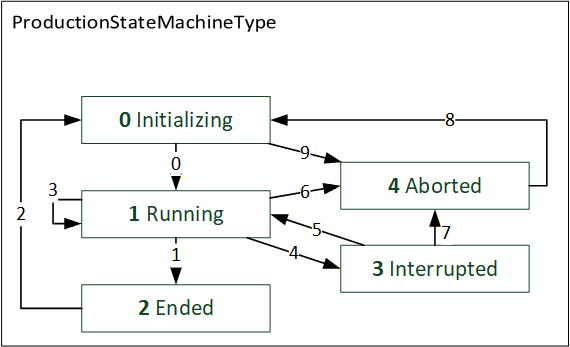
The ProductionStateMachineType is formally defined in Table 45.
| Attribute | Value | ||||
| BrowseName | ProductionStateMachineType | ||||
| IsAbstract | False | ||||
| References | Node Class | BrowseName | DataType | TypeDefinition | Other |
|---|---|---|---|---|---|
| Subtype of the 0:FiniteStateMachineType defined in OPC 10000-5 i.e. inheriting the InstanceDeclarations of that Node. | |||||
| 0:HasComponent | Object | Aborted | 0:StateType | None | |
| 0:HasComponent | Object | AbortedToInitializing | 0:TransitionType | None | |
| 0:HasComponent | Variable | 0:CurrentState | 0:LocalizedText | 0:FiniteStateVariableType | M, RO |
| 0:HasComponent | Object | Ended | 0:StateType | None | |
| 0:HasComponent | Object | EndedToInitializing | 0:TransitionType | None | |
| 0:HasComponent | Object | Initializing | 0:InitialStateType | None | |
| 0:HasComponent | Object | InitializingToAborted | 0:TransitionType | None | |
| 0:HasComponent | Object | InitializingToRunning | 0:TransitionType | None | |
| 0:HasComponent | Object | Interrupted | 0:StateType | None | |
| 0:HasComponent | Object | InterruptedToAborted | 0:TransitionType | None | |
| 0:HasComponent | Object | InterruptedToRunning | 0:TransitionType | None | |
| 0:HasComponent | Variable | 0:LastTransition | 0:LocalizedText | 0:FiniteTransitionVariableType | O, RO |
| 0:HasComponent | Object | Running | 0:StateType | None | |
| 0:HasComponent | Object | RunningToAborted | 0:TransitionType | None | |
| 0:HasComponent | Object | RunningToEnded | 0:TransitionType | None | |
| 0:HasComponent | Object | RunningToInterrupted | 0:TransitionType | None | |
| 0:HasComponent | Object | RunningToRunning | 0:TransitionType | None | |
| 0:IsDeprecated | Object | MachineTool_v102 | 0:BaseObjectType | ||
| Conformance Units | |||||
|---|---|---|---|---|---|
| MachineTool Production LastTransition |
The states and transitions shall have the numbers indicated in Table 47. The 0:Number property of 0:CurrentState and 0:LastTransition shall use those same numbers for the respective state/transition.
The components 0:CurrentState and 0:LastTransition of the ProductionStateMachineType have their optional property 0:Number changed to be mandatory, as defined in Table 46.
| BrowsePath | References | NodeClass | BrowseName | DataType | TypeDefinition | Others |
| 0:CurrentState | 0:HasProperty | Variable | 0:Number | 0:UInt32 | 0:PropertyType | M, RO |
| 0:LastTransition | 0:HasProperty | Variable | 0:Number | 0:UInt32 | 0:PropertyType | M, RO |
The state Aborted indicates that the operation of or on an element in production has been irreversibly stopped before finishing.
Ended is reached when the operation of or on an element in production has finished.
Initializing is the state in which the element in production is being prepared. During this state, the machine doesn't have to be ready for production, although it has to be as soon as the transition InitializingToRunning is used. The production is not yet started.
Interrupted indicates that the execution of or on the element in production has been reversibly halted. This is usually due to an error or an intervention by the operating personnel. It is possible to restart operation of or on the element in production after it was in the interrupted state.
Running indicates that the operation of or on an element in production has been started or re-started and is currently running.
| BrowsePath | Value Attribute | ||
| 0 | ||
| 1 | ||
| 2 | ||
| 3 | ||
| 4 | ||
| 0 | ||
| 1 | ||
| 2 | ||
| 3 | ||
| 4 | ||
| 5 | ||
| 6 | ||
| 7 | ||
| 8 | ||
| 9 |
InitializingToRunning is triggered when the operation of or on an element in production starts.
RunningToEnded is triggered when the operation of or on an element in production finishes.
EndedToInitializing is triggered when re-initialization of the operation of or on an element in production starts.
RunningToRunning is triggered when another consecutive run of the operation of or on an element in production in direct succession starts.
RunningToInterrupted is triggered when the operation of or on an element in production is interrupted.
InterruptedToRunning is triggered when an interruption ends and the operation of or on an element in production continues running.
RunningToAborted is triggered when the operation of or on an element in production is aborted while in the Running state.
InterruptedToAborted is triggered when the operation of or on an element in production is aborted while in the Interrupted state.
AbortedToInitializing is triggered if the operation of or on an element in production is being re-initialized after an abort.
InitializingToAborted is triggered when the operation of or on an element in production is aborted while in the Initializing state.
| SourceBrowsePath | ReferenceType | Is Forward | TargetBrowsePath |
| AbortedToInitializing | 0:FromState | True | Aborted |
| 0:ToState | True | Initializing | |
| EndedToInitializing | 0:FromState | True | Ended |
| 0:ToState | True | Initializing | |
| InitializingToAborted | 0:FromState | True | Initializing |
| 0:ToState | True | Aborted | |
| InitializingToRunning | 0:FromState | True | Initializing |
| 0:ToState | True | Running | |
| InterruptedToAborted | 0:FromState | True | Interrupted |
| 0:ToState | True | Aborted | |
| InterruptedToRunning | 0:FromState | True | Interrupted |
| 0:ToState | True | Running | |
| RunningToAborted | 0:FromState | True | Running |
| 0:ToState | True | Aborted | |
| RunningToEnded | 0:FromState | True | Running |
| 0:ToState | True | Ended | |
| RunningToInterrupted | 0:FromState | True | Running |
| 0:ToState | True | Interrupted | |
| RunningToRunning | 0:FromState | True | Running |
| 0:ToState | True | Running |
8.4.9 ProductionJobStateMachineType
[DEPRECATED in version 1.02] The ProductionJobStateMachineType will be replaced by the job management defined in OPC 40001-3 in future versions of this specification. Hence the 0:IsDeprecated Reference was added.
The ProductionJobStateMachineType shows the states a production job can be in and the possible transitions between those states.
The ProductionJobStateMachineType is formally defined in Table 49.
| Attribute | Value | ||||
| BrowseName | ProductionJobStateMachineType | ||||
| IsAbstract | False | ||||
| References | Node Class | BrowseName | DataType | TypeDefinition | Other |
|---|---|---|---|---|---|
| Subtype of the ProductionStateMachineType defined in 8.4.8 i.e. inheriting the InstanceDeclarations of that Node. | |||||
| 0:GeneratesEvent | ObjectType | InterruptionConditionType | |||
| 0:HasComponent | Object | Aborted | 0:StateType | None | |
| 0:HasComponent | Object | AbortedToInitializing | 0:TransitionType | None | |
| 0:HasComponent | Object | Ended | 0:StateType | None | |
| 0:HasComponent | Object | EndedToInitializing | 0:TransitionType | None | |
| 0:HasComponent | Object | Initializing | 0:InitialStateType | None | |
| 0:HasComponent | Object | InitializingToAborted | 0:TransitionType | None | |
| 0:HasComponent | Object | InitializingToRunning | 0:TransitionType | None | |
| 0:HasComponent | Object | Interrupted | 0:StateType | None | |
| 0:HasComponent | Object | InterruptedToAborted | 0:TransitionType | None | |
| 0:HasComponent | Object | InterruptedToRunning | 0:TransitionType | None | |
| 0:HasComponent | Object | Running | 0:StateType | None | |
| 0:HasComponent | Object | RunningToAborted | 0:TransitionType | None | |
| 0:HasComponent | Object | RunningToEnded | 0:TransitionType | None | |
| 0:HasComponent | Object | RunningToInterrupted | 0:TransitionType | None | |
| 0:HasComponent | Object | RunningToRunning | 0:TransitionType | None | |
| 0:IsDeprecated | Object | MachineTool_v102 | 0:BaseObjectType | ||
| Conformance Units | |||||
|---|---|---|---|---|---|
| MachineTool Production ProductionJobStateMachineType | |||||
| MachineTool Production InterruptionConditionType |
When a new interruption occurs in the production job, an event of InterruptionConditionType can be sent to clarify the reason for the interruption. This is an option in addition to the Interrupted state of the ProductionStateMachineType. It is possible that other interruptions occur while the state machine is in the Interrupted state, e.g., the first interruption being due to a missing part and while the part is still missing, a utility change becomes necessary. In such a case, Events of InterruptionConditionType may be sent for each subsequent interruption. The transition InterruptedToRunning may only be used if no interruption is active. If the interrupted job is aborted (via InterruptedToAborted), the interruption may persist. If a job is then re-initialized via AbortedToInitializing, there are multiple possible cases. In one case the interruption is solved before the job enters the Initializing state. In this case, the same job can transition to Initializing. Another option, when the ProductionPlan is used statically, the job node can be overwritten with the new job being in the Initializing state. Depending on the production context, the interruption of the old job might persist. When the ProductionPlan is used dynamically, a new job node can be created. Whether the interruption can persist is again depending on the production context.
The ProductionJobStateMachineType allows to send Events of ProductionJobTransitionEventType with every transition, as indicated in Table 51. This makes it possible to send all relevant information of the ProductionJobType the state machine instance belongs to with the TransitionEvent.
The state Aborted indicates that the job has been irreversibly stopped before finishing. If the job enters this state, the state machines of any ProductionProgramType and ProductionPartType instances associated with it shall not remain in the state Running.
Ended is reached when the job has finished all its runs, so the value of RunsCompleted is the same as the one for RunsPlanned.
Initializing is the state in which the job is being prepared. That implies the job being scheduled for production in the near future. In this state, actions like e.g., loading and configuring programs, inserting tools and utilities and mounting workpieces may be conducted.
InitializingToRunning is triggered when the job starts. This can only be triggered if all preconditions to start the job are met. A job is usually started by starting a related control routine. This does not result in changes to the components and properties (other than State) of the ProductionJobType instance being started.
RunningToEnded is triggered when the last run of a job finishes. The value of RunsCompleted in the affected ProductionJobType instance is increased by one (and equal to the value of RunsPlanned) due to this transition. In the ProductionJobTransitionEventType, this increased value is sent. This transition also implies that all parts and programs related to the job will no longer change, so e.g., the quality information for each part is finally set.
EndedToInitializing is triggered when initialization of a new job starts. This transition is only used if the nodes in the ProductionPlan are never added or deleted, but remain static in the address space. In this case, all values of the ProductionJobType instance the state machine belongs to are changed to represent a different job. The values of this new job are sent with the ProductionJobTransitionEventType.
RunningToRunning is triggered when a new run of the job starts. The RunsCompleted of the affected ProductionJobType instance increases by one. The ProductionJobTransitionEventType shall send this increased value.
RunningToInterrupted is triggered when the job is interrupted. The point in time the interruption starts shall be when the machine gets the command to interrupt the job process. To indicate the reason for the interruption, an InterruptionConditionType with the appropriate ConditionClass may be sent. The components and properties (other than State) of the affected ProductionJobType instance stay unchanged.
InterruptedToRunning is triggered when an interruption ends and production continues running. This transition requires that no interruption is active, regardless of what interruption initially led to the RunningToInterrupted transition. The components and properties (other than State) of the affected ProductionJobType instance stay unchanged.
InterruptedToAborted is triggered when the job is aborted while in the Interrupted state. This transition does not require the reason for the interruption to be solved. The components and properties (other than State) of the affected ProductionJobType instance stay unchanged.
AbortedToInitializing is triggered if production is being re-initialized after an abort. This transition is only used if the nodes in the ProductionPlan are never added or deleted, but remain static in the address space. In this case, all values of the ProductionJobType instance the state machine belongs to are changed to represent a different job. The values of this new job are sent with the ProductionJobTransitionEventType.
The states and transitions shall have the numbers indicated in Table 50. The 0:Number property of 0:CurrentState and 0:LastTransition shall use those same numbers for the respective state/transition.
| BrowsePath | Value Attribute | ||
| 0 | ||
| 1 | ||
| 2 | ||
| 3 | ||
| 4 | ||
| 0 | ||
| 1 | ||
| 2 | ||
| 3 | ||
| 4 | ||
| 5 | ||
| 6 | ||
| 7 | ||
| 8 | ||
| 9 |
| SourceBrowsePath | ReferenceType | Is Forward | TargetBrowsePath |
| AbortedToInitializing | 0:FromState | True | Aborted |
| 0:ToState | True | Initializing | |
| 0:HasEffect | True | ProductionJobTransitionEventType | |
| EndedToInitializing | 0:FromState | True | Ended |
| 0:ToState | True | Initializing | |
| 0:HasEffect | True | ProductionJobTransitionEventType | |
| InitializingToAborted | 0:FromState | True | Initializing |
| 0:ToState | True | Aborted | |
| 0:HasEffect | True | ProductionJobTransitionEventType | |
| InitializingToRunning | 0:FromState | True | Initializing |
| 0:ToState | True | Running | |
| 0:HasEffect | True | ProductionJobTransitionEventType | |
| InterruptedToAborted | 0:FromState | True | Interrupted |
| 0:ToState | True | Aborted | |
| 0:HasEffect | True | ProductionJobTransitionEventType | |
| InterruptedToRunning | 0:FromState | True | Interrupted |
| 0:ToState | True | Running | |
| 0:HasEffect | True | ProductionJobTransitionEventType | |
| RunningToAborted | 0:FromState | True | Running |
| 0:ToState | True | Aborted | |
| 0:HasEffect | True | ProductionJobTransitionEventType | |
| RunningToEnded | 0:FromState | True | Running |
| 0:ToState | True | Ended | |
| 0:HasEffect | True | ProductionJobTransitionEventType | |
| RunningToInterrupted | 0:FromState | True | Running |
| 0:ToState | True | Interrupted | |
| 0:HasEffect | True | ProductionJobTransitionEventType | |
| RunningToRunning | 0:FromState | True | Running |
| 0:ToState | True | Running | |
| 0:HasEffect | True | ProductionJobTransitionEventType |
8.4.10 ProductionProgramStateMachineType
[DEPRECATED in version 1.02] The ProductionProgramStateMachineType will be replaced by the job management defined in OPC 40001-3 in future versions of this specification. Hence the 0:IsDeprecated Reference was added.
The ProductionProgramStateMachineType shows the states a program can be in and the possible transitions between those states. Their representation in the OPC UA address space is given in Table 54. The name of each transition consists of the names of the states it connects: [FromState]To[ToState].
The ProductionProgramStateMachineType is formally defined in Table 52.
| Attribute | Value | |||||
| BrowseName | ProductionProgramStateMachineType | |||||
| IsAbstract | False | |||||
| References | Node Class | BrowseName | DataType | TypeDefinition | Other | |
|---|---|---|---|---|---|---|
| Subtype of the ProductionStateMachineType defined in 8.4.8 i.e. inheriting the InstanceDeclarations of that Node. | ||||||
| 0:HasComponent | Object | Aborted | 0:StateType | None | ||
| 0:HasComponent | Object | AbortedToInitializing | 0:TransitionType | None | ||
| 0:HasComponent | Object | Ended | 0:StateType | None | ||
| 0:HasComponent | Object | EndedToInitializing | 0:TransitionType | None | ||
| 0:HasComponent | Object | Initializing | 0:InitialStateType | None | ||
| 0:HasComponent | Object | InitializingToAborted | 0:TransitionType | None | ||
| 0:HasComponent | Object | InitializingToRunning | 0:TransitionType | None | ||
| 0:HasComponent | Object | Interrupted | 0:StateType | None | ||
| 0:HasComponent | Object | InterruptedToAborted | 0:TransitionType | None | ||
| 0:HasComponent | Object | InterruptedToRunning | 0:TransitionType | None | ||
| 0:HasComponent | Object | Running | 0:StateType | None | ||
| 0:HasComponent | Object | RunningToAborted | 0:TransitionType | None | ||
| 0:HasComponent | Object | RunningToEnded | 0:TransitionType | None | ||
| 0:HasComponent | Object | RunningToInterrupted | 0:TransitionType | None | ||
| 0:HasComponent | Object | RunningToRunning | 0:TransitionType | None | ||
| 0:IsDeprecated | Object | MachineTool_v102 | 0:BaseObjectType | |||
| Conformance Units | ||||||
|---|---|---|---|---|---|---|
| MachineTool Production ProductionProgramStateMachineType |
The ProductionProgramStateMachineType allows to send Events of ProductionProgramTransitionEventType with every transition, as indicated in Table 54. This makes it possible to send all relevant information of the ProductionProgramType the state machine instance belongs to with the TransitionEvent.
Initializing is the state in which the program is not yet started.
Interrupted indicates that the execution of the program has been paused and can be continued. This might be due to waiting for the execution of a subprogram or until a certain condition is met, e.g., the doors of the machine are closed.
EndedToInitializing is only used if the nodes in the ProductionPlan are never added or deleted, but remain static in the address space. The Transition is triggered when a new program is loaded. In this case, all values of the ProductionProgramType instance the state machine belongs to are changed to represent a different program. The values of this new job are sent with the ProductionProgramTransitionEventType.
The states and transitions shall have the numbers indicated in Table 53. The 0:Number property of 0:CurrentState and 0:LastTransition shall use those same numbers for the respective state/transition.
| BrowsePath | Value Attribute | ||
| 0 | ||
| 1 | ||
| 2 | ||
| 3 | ||
| 4 | ||
| 0 | ||
| 1 | ||
| 2 | ||
| 3 | ||
| 4 | ||
| 5 | ||
| 6 | ||
| 7 | ||
| 8 | ||
| 9 |
| SourceBrowsePath | ReferenceType | Is Forward | TargetBrowsePath |
| AbortedToInitializing | 0:FromState | True | Aborted |
| 0:ToState | True | Initializing | |
| 0:HasEffect | True | ProductionProgramTransitionEventType | |
| EndedToInitializing | 0:FromState | True | Ended |
| 0:ToState | True | Initializing | |
| 0:HasEffect | True | ProductionProgramTransitionEventType | |
| InitializingToAborted | 0:FromState | True | Initializing |
| 0:ToState | True | Aborted | |
| 0:HasEffect | True | ProductionProgramTransitionEventType | |
| InitializingToRunning | 0:FromState | True | Initializing |
| 0:ToState | True | Running | |
| 0:HasEffect | True | ProductionProgramTransitionEventType | |
| InterruptedToAborted | 0:FromState | True | Interrupted |
| 0:ToState | True | Aborted | |
| 0:HasEffect | True | ProductionProgramTransitionEventType | |
| InterruptedToRunning | 0:FromState | True | Interrupted |
| 0:ToState | True | Running | |
| 0:HasEffect | True | ProductionProgramTransitionEventType | |
| RunningToAborted | 0:FromState | True | Running |
| 0:ToState | True | Aborted | |
| 0:HasEffect | True | ProductionProgramTransitionEventType | |
| RunningToEnded | 0:FromState | True | Running |
| 0:ToState | True | Ended | |
| 0:HasEffect | True | ProductionProgramTransitionEventType | |
| RunningToInterrupted | 0:FromState | True | Running |
| 0:ToState | True | Interrupted | |
| 0:HasEffect | True | ProductionProgramTransitionEventType | |
| RunningToRunning | 0:FromState | True | Running |
| 0:ToState | True | Running | |
| 0:HasEffect | True | ProductionProgramTransitionEventType |
8.4.11 ProductionPartStateMachineType
[DEPRECATED in version 1.02] The ProductionPartStateMachineType will be replaced by the job management defined in OPC 40001-3 in future versions of this specification. Hence the 0:IsDeprecated Reference was added.
The ProductionPartStateMachineType shows the states a part can be in and the possible transitions between those states. Their representation in the OPC UA address space is given in Table 57. The name of each transition consists of the names of the states it connects: [FromState]To[ToState].
The ProductionPartStateMachineType is formally defined in Table 55.
| Attribute | Value | |||||
| BrowseName | ProductionPartStateMachineType | |||||
| IsAbstract | False | |||||
| References | Node Class | BrowseName | DataType | TypeDefinition | Other | |
|---|---|---|---|---|---|---|
| Subtype of the ProductionStateMachineType defined in 8.4.8 i.e. inheriting the InstanceDeclarations of that Node. | ||||||
| 0:HasComponent | Object | Aborted | 0:StateType | None | ||
| 0:HasComponent | Object | AbortedToInitializing | 0:TransitionType | None | ||
| 0:HasComponent | Object | Ended | 0:StateType | None | ||
| 0:HasComponent | Object | EndedToInitializing | 0:TransitionType | None | ||
| 0:HasComponent | Object | Initializing | 0:InitialStateType | None | ||
| 0:HasComponent | Object | InitializingToAborted | 0:TransitionType | None | ||
| 0:HasComponent | Object | InitializingToRunning | 0:TransitionType | None | ||
| 0:HasComponent | Object | Interrupted | 0:StateType | None | ||
| 0:HasComponent | Object | InterruptedToAborted | 0:TransitionType | None | ||
| 0:HasComponent | Object | InterruptedToRunning | 0:TransitionType | None | ||
| 0:HasComponent | Object | Running | 0:StateType | None | ||
| 0:HasComponent | Object | RunningToAborted | 0:TransitionType | None | ||
| 0:HasComponent | Object | RunningToEnded | 0:TransitionType | None | ||
| 0:HasComponent | Object | RunningToInterrupted | 0:TransitionType | None | ||
| 0:HasComponent | Object | RunningToRunning | 0:TransitionType | None | ||
| 0:IsDeprecated | Object | MachineTool_v102 | 0:BaseObjectType | |||
| Conformance Units | ||||||
|---|---|---|---|---|---|---|
| MachineTool Production ProductionPartStateMachineType |
The ProductionPartStateMachineType allows to send Events of ProductionPartTransitionEventType with every transition, as indicated in Table 57. This makes it possible to send all relevant information of the ProductionPartType the state machine instance belongs to with the TransitionEvent.
Ended is reached when the production on the part has finished. The PartQuality may be changed while in this state, implying that the part is measured after the production process. The part does not have to be mounted inside the machine while in this state.
Initializing implies the part is scheduled for production, but the machining process on the part has not yet started. The part does not have to be mounted inside the machine while in this state.
Running indicates that the processing of the part within the machine has been started or re-started and is currently running.
InitializingToRunning is triggered when the processing of the part starts. This Transition requires the part to be mounted within the machine.
RunningToEnded is triggered when the processing of the part finishes. This Transition does not require an update of the PartQuality.
The states and transitions shall have the numbers indicated in Table 56. The 0:Number property of 0:CurrentState and 0:LastTransition shall use those same numbers for the respective state/transition.
| BrowsePath | Value Attribute | ||
| 0 | ||
| 1 | ||
| 2 | ||
| 3 | ||
| 4 | ||
| 0 | ||
| 1 | ||
| 2 | ||
| 3 | ||
| 4 | ||
| 5 | ||
| 6 | ||
| 7 | ||
| 8 | ||
| 9 |
| SourceBrowsePath | ReferenceType | Is Forward | TargetBrowsePath |
| AbortedToInitializing | 0:FromState | True | Aborted |
| 0:ToState | True | Initializing | |
| 0:HasEffect | True | ProductionPartTransitionEventType | |
| EndedToInitializing | 0:FromState | True | Ended |
| 0:ToState | True | Initializing | |
| 0:HasEffect | True | ProductionPartTransitionEventType | |
| InitializingToAborted | 0:FromState | True | Initializing |
| 0:ToState | True | Aborted | |
| 0:HasEffect | True | ProductionPartTransitionEventType | |
| InitializingToRunning | 0:FromState | True | Initializing |
| 0:ToState | True | Running | |
| 0:HasEffect | True | ProductionPartTransitionEventType | |
| InterruptedToAborted | 0:FromState | True | Interrupted |
| 0:ToState | True | Aborted | |
| 0:HasEffect | True | ProductionPartTransitionEventType | |
| InterruptedToRunning | 0:FromState | True | Interrupted |
| 0:ToState | True | Running | |
| 0:HasEffect | True | ProductionPartTransitionEventType | |
| RunningToAborted | 0:FromState | True | Running |
| 0:ToState | True | Aborted | |
| 0:HasEffect | True | ProductionPartTransitionEventType | |
| RunningToEnded | 0:FromState | True | Running |
| 0:ToState | True | Ended | |
| 0:HasEffect | True | ProductionPartTransitionEventType | |
| RunningToInterrupted | 0:FromState | True | Running |
| 0:ToState | True | Interrupted | |
| 0:HasEffect | True | ProductionPartTransitionEventType | |
| RunningToRunning | 0:FromState | True | Running |
| 0:ToState | True | Running | |
| 0:HasEffect | True | ProductionPartTransitionEventType |
8.4.12 ProductionStatisticsType
[DEPRECATED in version 1.02] The ProductionType containing the ProductionStatisticsType will be replaced by the job management defined in OPC 40001-3 in future versions of this specification. Hence the 0:IsDeprecated Reference was added for the ProductionStatisticsType. The PartsProducedInLifetime counter is added to the 2:OperationCounters in the MachineOperationMonitoringType (see section 8.3.9).
The ProductionStatisticsType aggregates statistics information related to production on the machine.
The ProductionStatisticsType is formally defined in Table 58.
| Attribute | Value | ||||
| BrowseName | ProductionStatisticsType | ||||
| IsAbstract | False | ||||
| References | Node Class | BrowseName | DataType | TypeDefinition | Other |
|---|---|---|---|---|---|
| Subtype of the 0:BaseObjectType defined in OPC 10000-5 i.e. inheriting the InstanceDeclarations of that Node. | |||||
| 0:HasComponent | Variable | PartsProducedInLifetime | 0:UInt32 | 0:BaseDataVariableType | O, RO |
| 0:IsDeprecated | Object | MachineTool_v102 | 0:BaseObjectType | ||
| Conformance Units | |||||
|---|---|---|---|---|---|
| MachineTool Production Job | |||||
| MachineTool Production PartsProducedInLifetime |
PartsProducedInLifetime is the counter for the total number of produced parts during the machine's lifetime. The exact way this number is acquired may differ between different machines. No quality information of PartsProducedInLifetime can be given.
8.5 Equipment
8.5.1 EquipmentType
The EquipmentType is used to structure elements for machine equipment.
The EquipmentType is formally defined in Table 59.
| Attribute | Value | ||||
| BrowseName | EquipmentType | ||||
| IsAbstract | False | ||||
| References | Node Class | BrowseName | DataType | TypeDefinition | Other |
|---|---|---|---|---|---|
| Subtype of the 0:BaseObjectType defined in OPC 10000-5 i.e. inheriting the InstanceDeclarations of that Node. | |||||
| 0:HasComponent | Object | Tools | ToolListType | O | |
| Conformance Units | |||||
|---|---|---|---|---|---|
| MachineTool MachineToolType Mandatory Nodes | |||||
| MachineTool Equipment ToolIdentification |
Tools is the entry point to the list of BaseToolType subtype instances in the machine. The list of tools provided here shall contain the tools that are present in the machine and the magazines the machine has automated access to.
8.5.2 ToolListType
The ToolListType is a list of tools, where a tool may be a single tool or a multitool.
The ToolListType is formally defined in Table 60.
| Attribute | Value | ||||
| BrowseName | ToolListType | ||||
| IsAbstract | False | ||||
| References | Node Class | BrowseName | DataType | TypeDefinition | Other |
|---|---|---|---|---|---|
| Subtype of the 0:BaseObjectType defined in OPC 10000-5 i.e. inheriting the InstanceDeclarations of that Node. | |||||
| 0:HasComponent | Object | <Tool> | BaseToolType | OP | |
| 0:HasProperty | Variable | 0:NodeVersion | 0:String | 0:PropertyType | O, RO |
| 0:GeneratesEvent | ObjectType | 0:GeneralModelChangeEventType | |||
| Conformance Units | |||||
|---|---|---|---|---|---|
| MachineTool Equipment ToolIdentification | |||||
| MachineTool Equipment Dynamic Tool List |
<Tool> is an OptionalPlaceholder for nodes of BaseToolType. The tool list can thus contain any number of tools, including none. For the DisplayName of the <Tool>, it is recommended to use the value of the Name Property of the respective BaseToolType instance.
The contents of the ToolListType instance can change during the Server runtime (e.g., if tools are inserted into the machine or removed from it). A change in the list can be indicated using the 0:NodeVersion Property and the 0:GeneralModelChangeEventType. The 0:NodeVersion and the 0:GeneralModelChangeEventType are intended to be used in the way defined in OPC 10000-3 and 7.3.
8.5.3 BaseToolType
The BaseToolType serves as a supertype to the ToolType and the MultiToolType. It is an abstract type, meaning it is not instantiated, only the subtypes are.
The BaseToolType is formally defined in Table 61.
| Attribute | Value | |||||
| BrowseName | BaseToolType | |||||
| IsAbstract | True | |||||
| References | Node Class | BrowseName | DataType | TypeDefinition | Other | |
|---|---|---|---|---|---|---|
| Subtype of the 0:BaseObjectType defined in OPC 10000-5 i.e. inheriting the InstanceDeclarations of that Node. | ||||||
| 0:HasProperty | Variable | Identifier | 0:String | 0:PropertyType | O, RO | |
| 0:HasComponent | Object | Location | 0:BaseObjectType | O | ||
| 0:HasProperty | Variable | Name | 0:String | 0:PropertyType | O, RO | |
| Conformance Units | ||||||
|---|---|---|---|---|---|---|
| MachineTool Equipment ToolIdentification | ||||||
| MachineTool Equipment Dynamic Tool List |
| BrowsePath | References | NodeClass | BrowseName | DataType | TypeDefinition | Others |
| Location | 0:HasProperty | Variable | Name | 0:String | 0:PropertyType | M, RO |
| Location | 0:HasProperty | Variable | PlaceNumber | 0:UInt16 | 0:PropertyType | M, RO |
Identifier is a unique identifier for a tool. The Identifier can be used to provide a unique ID given by a superordinated management system. This ID can't be generated on the machine, it has to be transferred to the machine by a global tool management system.
The Location indicates where the tool is located, represented by Name, a name for the tool's location (e.g., the tool magazine) and PlaceNumber, the place number at this location (refer to Table 62). If there is a shared magazine for multiple machines, a tool will be shown in the tool list (see 8.5.1 and 8.5.2) of all machines for which the tool is available.
The Name is used to name a tool to ease recognition. This name can be specific to the tool (e.g., "special_formpress_part294"), to the type of tool (e.g., "8mm drill") or to the program (e.g., "T3").
8.5.4 ToolType
The ToolType is the representation of a tool. Tools are exchangeable components used in a machine to execute the production process and may for example be drills, ball milling heads, cutting inserts, pinching tools and so forth. It may also be a non-contact tool, for example a processing laser.
The ToolType is formally defined in Table 63.
| Attribute | Value | ||||
| BrowseName | ToolType | ||||
| IsAbstract | False | ||||
| References | Node Class | BrowseName | DataType | TypeDefinition | Other |
|---|---|---|---|---|---|
| Subtype of the BaseToolType defined in 8.5.3 i.e. inheriting the InstanceDeclarations of that Node. | |||||
| 0:HasComponent | Variable | ControlIdentifier1 | 0:UInt32 | 0:BaseDataVariableType | M, RO |
| 0:HasComponent | Variable | ControlIdentifier2 | 0:UInt32 | 0:BaseDataVariableType | O, RO |
| 0:HasComponent | Variable | ControlIdentifierInterpretation | ToolManagement | 0:BaseDataVariableType | M, RO |
| 0:HasComponent | Variable | LastUsage | 0:UtcTime | 0:BaseDataVariableType | O, RO |
| 0:HasComponent | Variable | Locked | 0:Boolean | 0:BaseDataVariableType | M, RO |
| 0:HasComponent | Variable | PlannedForOperating | 0:Boolean | 0:BaseDataVariableType | O, RO |
| 0:HasComponent | Object | ToolLife | 0:BaseObjectType | O | |
| Conformance Units | |||||
|---|---|---|---|---|---|
| MachineTool Equipment ToolIdentification | |||||
| MachineTool Equipment Dynamic Tool List | |||||
| MachineTool Equipment ToolLife |
The components of the ToolType have additional references which are defined in Table 64.
| BrowsePath | References | NodeClass | BrowseName | DataType | TypeDefinition | Others |
| Locked | 0:HasProperty | Variable | ReasonForLocking | ToolLocked | 0:PropertyType | M, RO |
| ToolLife | 0:HasComponent | Variable | <ToolLifeEntry> | 0:Number | ToolLifeType | MP, RO |
The two components ControlIdentifier1, ControlIdentifier2 are to be interpreted depending on ControlIdentifierInterpretation (refer to 12.10). This reflects the main methods which CNC-based tool management approaches use. In a ToolNumberBased approach, only ControlIdentifier1 is provided and sufficient to identify the tool. In a system with a ToolGroupBasedManagemet, tools are identified by a group and an indexing number inside this group, which are provided as ControlIdentifier1 and ControlIdentifier2 respectively. Should yet another approach be present in a given system, this is indicated by the ControlIdentifierInterpretation being reported as custom. It shall be noted that this identification data is used to identify the tool in the reference frame of the tool management system inside the machine. In many applications the machine control system uses these identifiers to handle multiple tools which are equivalent and present in the machine as spares. For an identification of the tool inside the NC program or globally, independent of the machine management view, the properties Name and Identifier are provided by the BaseToolType.
LastUsage is the time, where the specific tool was the active tool on a tool carrier for the last time, while the machine was operating in an automatic mode (e.g., for CNC controllers: in Mdi- or Automatic-mode).
The property Locked represents whether the tool was locked from use in processing. If True, the tool was locked. It has an additional property as seen in Table 64, ReasonForLocking. ReasonForLocking is defined in 12.9.
The component PlannedForOperating marks tools which the machine control can already mark as being needed for the running NC program or process when being True.
The ToolLife reports on how the tool use and tool life is being currently managed and how far the use of the tool has progressed. If more than one measurement is provided as <ToolLifeEntry>, they shall show the same value as if only one entry was provided, so they shall not be accumulated by a Client.
8.5.5 MultiToolType
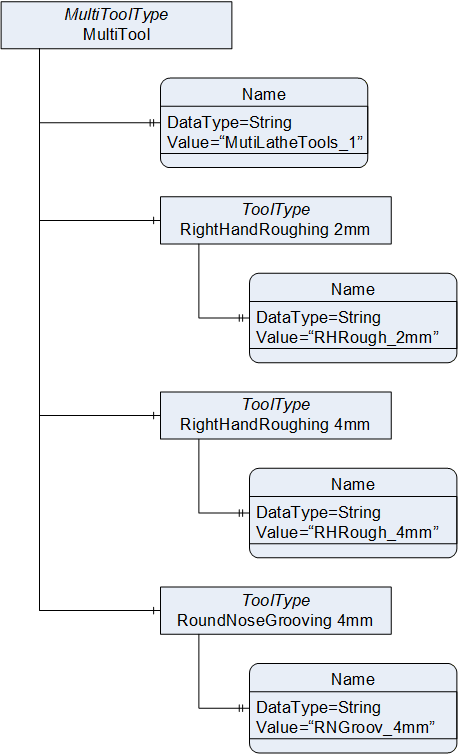
The MultiToolType represents a unit of different tools, usually used in order to have several tools available in-process without requiring explicit tool-changes. Multitools carry several tools on one tool magazine socket or one revolver index position and will be mounted into the machine as one prepared unit.
Typical applications are in turning, when one indexed position of the tool revolver holds several outer-diameter cutting inserts and boring tools, such that a tool change process can quickly complete by merely readjusting the CNC setpoint position tool compensation.
An instance example on how to instantiate the MultiToolType is shown in Figure 16.
The MultiToolType is formally defined in Table 65.
| Attribute | Value | ||||
| BrowseName | MultiToolType | ||||
| IsAbstract | False | ||||
| References | Node Class | BrowseName | DataType | TypeDefinition | Other |
|---|---|---|---|---|---|
| Subtype of the BaseToolType defined in 8.5.3 i.e. inheriting the InstanceDeclarations of that Node. | |||||
| 0:HasComponent | Object | <Tool> | ToolType | OP | |
| Conformance Units | |||||
|---|---|---|---|---|---|
| MachineTool Equipment ToolIdentification | |||||
| MachineTool Equipment Dynamic Tool List |
<Tool> is a placeholder for instances of ToolType. Using this placeholder, the individual ToolType instances making up the MultiTool can be represented in the information model. For individual tools within the MultiTool, use of the Location object is not recommended.
8.6 Notification
8.6.1 NotificationType
The NotificationType is used to structure information given in the MachineToolType. It groups the messages and alerts of the machine and contains the prognoses for the machining operation.
The NotificationType is formally defined in Table 66.
| Attribute | Value | ||||
| BrowseName | NotificationType | ||||
| IsAbstract | False | ||||
| References | Node Class | BrowseName | DataType | TypeDefinition | Other |
|---|---|---|---|---|---|
| Subtype of the 0:BaseObjectType defined in OPC 10000-5 i.e. inheriting the InstanceDeclarations of that Node. | |||||
| 0:HasComponent | Object | Messages | MessagesType | O | |
| 0:HasComponent | Object | Prognoses | PrognosisListType | O | |
| Conformance Units | |||||
|---|---|---|---|---|---|
| MachineTool Notification - Errors and Alerts | |||||
| MachineTool PrognosisType | |||||
| MachineTool Prognoses Dynamic List |
Messages is the node sending events, which are used for errors, warnings and messages. The respective references are formally defined in Table 67.
Prognoses contains a list of the current prognoses for machine operation. Reliability for any prognosis in the list will rely on the specific case and cannot be guaranteed to be precise.
8.6.2 MessagesType
The MessagesType is used to define the object sending events. These events are used for errors, warnings and messages.
The MessagesType is formally defined in Table 67.
| Attribute | Value | ||||
| BrowseName | MessagesType | ||||
| IsAbstract | False | ||||
| References | Node Class | BrowseName | DataType | TypeDefinition | Other |
|---|---|---|---|---|---|
| Subtype of the 0:BaseObjectType defined in OPC 10000-5 i.e. inheriting the InstanceDeclarations of that Node. | |||||
| 0:GeneratesEvent | ObjectType | AlertType | |||
| 0:GeneratesEvent | ObjectType | NotificationEventType | |||
| Conformance Units | |||||
|---|---|---|---|---|---|
| MachineTool Notification - Errors and Alerts |
To differentiate between errors, warnings and messages on the interface, the following convention shall be used, with regard to the recommendations in OPC 10000-5:
Errors have a high 0:Severity between 667 and 1000 and are using an AlertType.
Warnings have a medium 0:Severity between 334 and 666 and are using an AlertType.
Messages have a low 0:Severity lower or equal to 333 and are using a NotificationEventType.
8.6.3 PrognosisListType
The PrognosisListType is a structuring node to collect predictions about future times when certain interaction with the machine may be necessary.
The PrognosisListType is formally defined in Table 68.
| Attribute | Value | ||||
| BrowseName | PrognosisListType | ||||
| IsAbstract | False | ||||
| References | Node Class | BrowseName | DataType | TypeDefinition | Other |
|---|---|---|---|---|---|
| Subtype of the 0:BaseObjectType defined in OPC 10000-5 i.e. inheriting the InstanceDeclarations of that Node. | |||||
| 0:HasComponent | Object | <Prognosis> | PrognosisType | OP | |
| 0:HasProperty | Variable | 0:NodeVersion | String | 0:PropertyType | O, RO |
| 0:GeneratesEvent | ObjectType | 0:GeneralModelChangeEventType | |||
| Conformance Units | |||||
|---|---|---|---|---|---|
| MachineTool PrognosisType | |||||
| MachineTool Prognoses Dynamic List |
<Prognosis> is an optional placeholder for PrognosisType nodes. Thus, the PrognosisListType can have any number of prognoses as components, including none. If the number of prognoses in this list changes during the runtime of the OPC UA server, the 0:NodeVersion and 0:GeneralModelChangeEventType can be used to indicate those changes. The 0:NodeVersion and the 0:GeneralModelChangeEventType are intended to be used in the way defined in OPC 10000-3 and 7.3.
8.6.4 PrognosisType
The PrognosisType is the most basic prognosis type and the supertype to more specific prognosis types. It is an abstract type, meaning it is not instantiated, only the subtypes are.
The PrognosisType is formally defined in Table 69.
| Attribute | Value | ||||
| BrowseName | PrognosisType | ||||
| IsAbstract | True | ||||
| References | Node Class | BrowseName | DataType | TypeDefinition | Other |
|---|---|---|---|---|---|
| Subtype of the 0:BaseObjectType defined in OPC 10000-5 i.e. inheriting the InstanceDeclarations of that Node. | |||||
| 0:HasProperty | Variable | PredictedTime | 0:UtcTime | 0:PropertyType | M, RO |
| Conformance Units | |||||
|---|---|---|---|---|---|
| MachineTool PrognosisType |
PredictedTime is used to indicate the point in time the predicted user interaction will become necessary.
8.6.5 MaintenancePrognosisType
The MaintenancePrognosisType is a prognosis indicating at which time in the future a specific maintenance action may become necessary. The MaintenancePrognosisType is also used if an upcoming maintenance is scheduled for the machine.
Examples may be oil changes, filter mat replacements or regular checks.
The MaintenancePrognosisType is formally defined in Table 70.
| Attribute | Value | ||||
| BrowseName | MaintenancePrognosisType | ||||
| IsAbstract | False | ||||
| References | Node Class | BrowseName | DataType | TypeDefinition | Other |
|---|---|---|---|---|---|
| Subtype of the PrognosisType defined in 8.6.4 i.e. inheriting the InstanceDeclarations of that Node. | |||||
| 0:HasComponent | Variable | Activity | 0:LocalizedText | 0:BaseDataVariableType | M, RO |
| Conformance Units | |||||
|---|---|---|---|---|---|
| MachineTool PrognosisType | |||||
| MachineTool Prognoses Dynamic List |
Activity indicates the specific maintenance task to perform.
8.6.6 ManualActivityPrognosisType
The ManualActivityPrognosisType is a prognosis indicating at which time in the future a manual intervention may become necessary.
An example for a manual intervention is a measurement or control activity, which needs to be carried out during the run of the program.
The ManualActivityPrognosisType is formally defined in Table 71.
| Attribute | Value | ||||
| BrowseName | ManualActivityPrognosisType | ||||
| IsAbstract | False | ||||
| References | Node Class | BrowseName | DataType | TypeDefinition | Other |
|---|---|---|---|---|---|
| Subtype of the PrognosisType defined in 8.6.4 i.e. inheriting the InstanceDeclarations of that Node. | |||||
| 0:HasComponent | Variable | Activity | 0:LocalizedText | 0:BaseDataVariableType | M, RO |
| Conformance Units | |||||
|---|---|---|---|---|---|
| MachineTool PrognosisType | |||||
| MachineTool Prognoses Dynamic List |
Activity indicates the specific maintenance task to perform.
8.6.7 PartLoadPrognosisType
The PartLoadPrognosisType is a prognosis indicating at which time in the future a part needs to be loaded into the machine in order to be processed further.
The PartLoadPrognosisType is formally defined in Table 72.
| Attribute | Value | ||||
| BrowseName | PartLoadPrognosisType | ||||
| IsAbstract | False | ||||
| References | Node Class | BrowseName | DataType | TypeDefinition | Other |
|---|---|---|---|---|---|
| Subtype of the PrognosisType defined in 8.6.4 i.e. inheriting the InstanceDeclarations of that Node. | |||||
| 0:HasComponent | Variable | Location | 0:LocalizedText | 0:BaseDataVariableType | M, RO |
| 0:HasComponent | Variable | PartIdentifier | 0:String | 0:BaseDataVariableType | O, RO |
| 0:HasComponent | Variable | PartName | 0:String | 0:BaseDataVariableType | M, RO |
| 0:HasComponent | Variable | PartNodeId | 0:NodeId | 0:BaseDataVariableType | O, RO |
| Conformance Units | |||||
|---|---|---|---|---|---|
| MachineTool PrognosisType | |||||
| MachineTool Prognoses Dynamic List |
Location is the place where the part to load will be located within the machine. This may for example be the indication and number of the working area.
PartIdentifier shall be identical to the SerialNumber field of the OutputInformationDataType defined in OPC 40001-3 if available. Otherwhise, if the ProductionType is used instead, it shall be identical to the Identifier property of the ProductionPartType instance the prognosis relates to.
PartName shall be identical to the ItemNumber field of the OutputInformationDataType defined in OPC 40001-3. If the ProductionType is used, it shall be identical to the Name property of the ProductionPartType instance the prognosis relates to. If both of these values are unavailable, PartName is filled with the most appropriate value as a name of the part.
[DEPRECATED in version 1.02] PartNodeId shall reference the ProductionPartType instance the prognosis relates to.
The PartNodeId component will not be included in future versions of this specification. Hence, Table 73 defines its 0:IsDeprecated Reference.
| SourceBrowsePath | ReferenceType | Is Forward | TargetBrowsePath | ||||
| PartNodeId | 0:IsDeprecated | True |
|
8.6.8 PartUnloadPrognosisType
The PartUnloadPrognosisType is a prognosis indicating at which time in the future a part unload may become necessary.
The PartUnloadPrognosisType is formally defined in Table 74.
| Attribute | Value | ||||
| BrowseName | PartUnloadPrognosisType | ||||
| IsAbstract | False | ||||
| References | Node Class | BrowseName | DataType | TypeDefinition | Other |
|---|---|---|---|---|---|
| Subtype of the PrognosisType defined in 8.6.4 i.e. inheriting the InstanceDeclarations of that Node. | |||||
| 0:HasComponent | Variable | Location | 0:LocalizedText | 0:BaseDataVariableType | M, RO |
| 0:HasComponent | Variable | PartIdentifier | 0:String | 0:BaseDataVariableType | O, RO |
| 0:HasComponent | Variable | PartName | 0:String | 0:BaseDataVariableType | M, RO |
| 0:HasComponent | Variable | PartNodeId | 0:NodeId | 0:BaseDataVariableType | O, RO |
| Conformance Units | |||||
|---|---|---|---|---|---|
| MachineTool PrognosisType | |||||
| MachineTool Prognoses Dynamic List |
Location is the place where the part to unload is located within the machine. This may for example be the indication and number of the working area.
PartIdentifier shall be identical to the SerialNumber field of the OutputInformationDataType defined in OPC 40001-3 if available. Otherwhise, if the ProductionType is used instead, it shall be identical to the Identifier property of the ProductionPartType instance the prognosis relates to.
PartName shall be identical to the ItemNumber field of the OutputInformationDataType defined in OPC 40001-3. If the ProductionType is used, it shall be identical to the Name property of the ProductionPartType instance the prognosis relates to. If both of these values are unavailable, PartName is filled with the most appropriate value as a name of the part.
[DEPRECATED in version 1.02] PartNodeId shall reference the ProductionPartType instance the prognosis relates to.
The PartNodeId component will not be included in future versions of this specification. Hence, Table 75 defines its 0:IsDeprecated Reference.
| SourceBrowsePath | ReferenceType | Is Forward | TargetBrowsePath | ||||
| PartNodeId | 0:IsDeprecated | True |
|
8.6.9 ProcessChangeoverPrognosisType
The ProcessChangeoverPrognosisType is a prognosis indicating at which time in the future the machine has to be prepared for its next manufacturing process. This might e.g., be the change of a fixture within the machine. It can also be used to group different manual steps like tool changes and loading new parts when done between processes, usually given as setup instruction.
The ProcessChangeoverPrognosisType is formally defined in Table 76.
| Attribute | Value | ||||
| BrowseName | ProcessChangeoverPrognosisType | ||||
| IsAbstract | False | ||||
| References | Node Class | BrowseName | DataType | TypeDefinition | Other |
|---|---|---|---|---|---|
| Subtype of the PrognosisType defined in 8.6.4 i.e. inheriting the InstanceDeclarations of that Node. | |||||
| 0:HasComponent | Variable | Activity | 0:LocalizedText | 0:BaseDataVariableType | M, RO |
| 0:HasComponent | Variable | Location | 0:LocalizedText | 0:BaseDataVariableType | M, RO |
| Conformance Units | |||||
|---|---|---|---|---|---|
| MachineTool PrognosisType | |||||
| MachineTool Prognoses Dynamic List |
Activity indicates the specific task(s) to perform or the indication of the setup instruction.
Location is the place where the activity for the process changeover is located within the machine. This may for example be the indication and number of the working area.
8.6.10 ProductionJobEndPrognosisType
The ProductionJobEndPrognosisType is the estimated point in time of the end of the current Job.
The ProductionJobEndPrognosisType is formally defined in Table 77.
| Attribute | Value | ||||
| BrowseName | ProductionJobEndPrognosisType | ||||
| IsAbstract | False | ||||
| References | Node Class | BrowseName | DataType | TypeDefinition | Other |
|---|---|---|---|---|---|
| Subtype of the PrognosisType defined in 8.6.4 i.e. inheriting the InstanceDeclarations of that Node. | |||||
| 0:HasComponent | Variable | SourceIdentifier | 0:String | 0:BaseDataVariableType | M, RO |
| 0:HasComponent | Variable | JobNodeId | 0:NodeId | 0:BaseDataVariableType | O, RO |
| 0:IsDeprecated | Object | MachineTool_v102 | 0:BaseObjectType | ||
| Conformance Units | |||||
|---|---|---|---|---|---|
| MachineTool PrognosisType | |||||
| MachineTool Prognoses Dynamic List |
The SourceIdentifier Variable shall be identical to the JobOrderID field of the ISA95JobOrderDataType defined in OPC 10031-4. Otherwise, if the ProductionType is used, it shall be identical to the Identifier property belonging to the ProductionJobType the prognosis refers to if modelled in the AddressSpace. Otherwise, it shall contain the identifier of the job.
[DEPRECATED in version 1.02] The JobNodeId shall reference the 0:NodeId of the ProductionJobType instance the prognosis refers to.
The JobNodeId component will not be included in future versions of this specification. Hence, Table 78 defines its 0:IsDeprecated Reference.
| SourceBrowsePath | ReferenceType | Is Forward | TargetBrowsePath | ||||
| JobNodeId | 0:IsDeprecated | True |
|
8.6.11 ToolChangePrognosisType
The ToolChangePrognosisType is a prognosis indicating at which time in the future a tool within the machine or a magazine shall be exchanged with a similar tool (usually due to wear).
The ToolChangePrognosisType is formally defined in Table 79.
| Attribute | Value | ||||
| BrowseName | ToolChangePrognosisType | ||||
| IsAbstract | False | ||||
| References | Node Class | BrowseName | DataType | TypeDefinition | Other |
|---|---|---|---|---|---|
| Subtype of the PrognosisType defined in 8.6.4 i.e. inheriting the InstanceDeclarations of that Node. | |||||
| 0:HasComponent | Variable | Location | 0:LocalizedText | 0:BaseDataVariableType | M, RO |
| 0:HasComponent | Variable | ToolIdentifier | 0:String | 0:BaseDataVariableType | O, RO |
| 0:HasComponent | Variable | ToolName | 0:String | 0:BaseDataVariableType | O, RO |
| 0:HasComponent | Variable | ToolNodeId | 0:NodeId | 0:BaseDataVariableType | O, RO |
| Conformance Units | |||||
|---|---|---|---|---|---|
| MachineTool PrognosisType | |||||
| MachineTool Prognoses Dynamic List |
Location refers to the place the tool shall be removed from within the machine's system boundary, e.g., a tool magazine or the workspace of the machine.
ToolIdentifier is identical to the Identifier property of the tool to change, if applicable. If the tool is not modelled in the AddressSpace of the OPC UA Server, this component shall be filled accordingly.
ToolName contains the name of the tool to change, as described for the BaseToolType in 8.5.3. If the tool is not available in the AddressSpace, the ToolName shall be given in a similar manner.
ToolNodeId is the 0:NodeId of the BaseToolType subtype instance this prognosis refers to.
8.6.12 ToolLoadPrognosisType
The ToolLoadPrognosisType is a prognosis indicating at which time in the future a tool will be loaded into the machine. This prognosis indicates loading a tool within the machine's workspace or a tool magazine the machine has access to. The ToolLoadPrognosisType shall also be used for prognoses to load tools larger than standard tools (which might imply different work routines).
If a tool that already is in the machine is intended to be exchanged with a similar tool, the ToolChangePrognosisType shall be used.
The ToolLoadPrognosisType is formally defined in Table 80.
| Attribute | Value | ||||
| BrowseName | ToolLoadPrognosisType | ||||
| IsAbstract | False | ||||
| References | Node Class | BrowseName | DataType | TypeDefinition | Other |
|---|---|---|---|---|---|
| Subtype of the PrognosisType defined in 8.6.4 i.e. inheriting the InstanceDeclarations of that Node. | |||||
| 0:HasComponent | Variable | Location | 0:LocalizedText | 0:BaseDataVariableType | M, RO |
| 0:HasComponent | Variable | ToolIdentifier | 0:String | 0:BaseDataVariableType | O, RO |
| 0:HasComponent | Variable | ToolName | 0:String | 0:BaseDataVariableType | O, RO |
| Conformance Units | |||||
|---|---|---|---|---|---|
| MachineTool PrognosisType | |||||
| MachineTool Prognoses Dynamic List |
Location refers to the place the tool shall be put within the machine's system boundary, e.g., a tool magazine or the workspace of the machine.
ToolIdentifier contains the unique identifier of the tool. This value shall be the same as for the Identifier Property of the BaseToolType. If the tool is not available in the AddressSpace, the ToolIdentifier shall be given in a similar manner. The ToolIdentifier of ToolLoadPrognosisType and ToolUnloadPrognosisType shall match exactly for the same tool.
ToolName contains the name of the tool, as described for the BaseToolType in 8.5.3. If the tool is not available in the AddressSpace, the ToolName shall be given in a similar manner.
8.6.13 ToolUnloadPrognosisType
The ToolUnloadPrognosisType is a prognosis indicating at which time in the future a tool will be loaded out of the machine or a tool magazine.
The ToolUnloadPrognosisType is formally defined in Table 81.
| Attribute | Value | ||||
| BrowseName | ToolUnloadPrognosisType | ||||
| IsAbstract | False | ||||
| References | Node Class | BrowseName | DataType | TypeDefinition | Other |
|---|---|---|---|---|---|
| Subtype of the PrognosisType defined in 8.6.4 i.e. inheriting the InstanceDeclarations of that Node. | |||||
| 0:HasComponent | Variable | Location | 0:LocalizedText | 0:BaseDataVariableType | M, RO |
| 0:HasComponent | Variable | ToolIdentifier | 0:String | 0:BaseDataVariableType | O, RO |
| 0:HasComponent | Variable | ToolName | 0:String | 0:BaseDataVariableType | O, RO |
| 0:HasComponent | Variable | ToolNodeId | 0:NodeId | 0:BaseDataVariableType | O, RO |
| Conformance Units | |||||
|---|---|---|---|---|---|
| MachineTool PrognosisType | |||||
| MachineTool Prognoses Dynamic List |
Location refers to the place the tool shall be removed from within the machine's system boundary, e.g., a tool magazine or the workspace of the machine.
ToolIdentifier contains the unique identifier of the tool. This value shall be the same as for the Identifier Property of the BaseToolType. If the tool is not available in the AddressSpace, the ToolIdentifier shall be given in a similar manner. The ToolIdentifier of ToolLoadPrognosisType and ToolUnloadPrognosisType shall match exactly for the same tool.
ToolName contains the name of the tool, as described for the BaseToolType in 8.5.3. If the tool is not available in the AddressSpace, the ToolName shall be given in a similar manner.
ToolNodeId contains the 0:NodeId of the appropriate BaseToolType subtype instance.
8.6.14 UtilityChangePrognosisType
The UtilityChangePrognosisType is the estimated point in time at which a utility needs to be refilled or changed. Utilities are for example coolants, filters or scrap material storages.
The UtilityChangePrognosisType is formally defined in Table 82.
| Attribute | Value | ||||
| BrowseName | UtilityChangePrognosisType | ||||
| IsAbstract | False | ||||
| References | Node Class | BrowseName | DataType | TypeDefinition | Other |
|---|---|---|---|---|---|
| Subtype of the PrognosisType defined in 8.6.4 i.e. inheriting the InstanceDeclarations of that Node. | |||||
| 0:HasComponent | Variable | UtilityName | 0:String | 0:BaseDataVariableType | M, RO |
| Conformance Units | |||||
|---|---|---|---|---|---|
| MachineTool PrognosisType | |||||
| MachineTool Prognoses Dynamic List |
UtilityName provides an identifier of the utility to be changed inside the machine. This variable can for example be used by human personnel to prepare the right material for the utility change.
9 OPC UA EventTypes
9.1 AlertType
The AlertType is used to transport errors and warnings.
The AlertType is formally defined in Table 83.
| Attribute | Value | ||||||
| BrowseName | AlertType | ||||||
| IsAbstract | False | ||||||
| References | NodeClass | BrowseName | DataType | TypeDefinition | Other | ||
|---|---|---|---|---|---|---|---|
| Subtype of the 0:AlarmConditionType defined in OPC 10000-9 which means it inherits the InstanceDeclarations of that Node. | |||||||
| 0:HasProperty | Variable | ErrorCode | 0:String | 0:PropertyType | M, RO | ||
| Conformance Units | ||||||
|---|---|---|---|---|---|---|
| MachineTool Notification - Errors and Alerts |
The ErrorCode is used for the manufacturer defined error code. Often this is a numeric code whose meaning can be found in the manufacturer's documentation for the machine.
It is supposed that any error message shown to users of the machine is transmitted with the AlertType in the 0:Message Property inherited from the 0:BaseEventType.
9.2 InterruptionConditionType
The InterruptionConditionType is used to indicate interruptions in the production process and give information about the underlying reason.
The InterruptionConditionType is formally defined in Table 84.
| Attribute | Value | ||||||||
| BrowseName | InterruptionConditionType | ||||||||
| IsAbstract | True | ||||||||
| References | NodeClass | BrowseName | DataType | TypeDefinition | Other | ||||
|---|---|---|---|---|---|---|---|---|---|
| Subtype of the 0:ConditionType defined in OPC 10000-9, which means it inherits the InstanceDeclarations of that Node. | |||||||||
| 0:HasProperty | Variable | IsAutomated | 0:Boolean | 0:PropertyType | M, RO | ||||
| Conformance Units | ||||||||
|---|---|---|---|---|---|---|---|---|
| MachineTool Production InterruptionConditionType |
IsAutomated being True indicates that the interruption will automatically end in normal operation of the machine. A tool change for example can be automated and handled by the machine itself. The tool change might also not be automated. In that case an operator has to change the tool manually.
To indicate the reason for the process to be interrupted, the Components 0:ConditionClassId and 0:ConditionClassName of the InterruptionConditionType shall indicate the most appropriate ConditionClass. This specification defines special ConditionClasses relevant to the domain of machine tools (see 10). Of the ConditionClasses defined in OPC 10000-9, especially the 0:SafetyConditionClassType shall be considered as well.
9.3 NotificationEventType
The NotificationEventType is used to send simple messages from the machine. It is used in all cases that do not require an AlertType, because they don't have an activated and a deactivated state.
The NotificationEventType is formally defined in Table 85.
| Attribute | Value | ||||||
| BrowseName | NotificationEventType | ||||||
| IsAbstract | True | ||||||
| References | NodeClass | BrowseName | DataType | TypeDefinition | Other | ||
|---|---|---|---|---|---|---|---|
| Subtype of the 0:BaseEventType defined in OPC 10000-5 which means it inherits the InstanceDeclarations of that Node. | |||||||
| 0:HasProperty | Variable | Identifier | 0:String | 0:PropertyType | M, RO | ||
| Conformance Units | ||||||
|---|---|---|---|---|---|---|
| MachineTool Notification - Errors and Alerts |
Identifier is used to identify the notification. It should match the code given in the machine manufacturer's specification for the respective message.
9.4 ProductionJobTransitionEventType
[DEPRECATED in version 1.02] The ProductionType, which ultimately uses the ProductionJobTransitionEventType, will be replaced by the job management defined in OPC 40001-3 in future versions of this specification. Hence the 0:IsDeprecated Reference was added for the ProductionJobTransitionEventType.
The ProductionJobTransitionEventType is sent after a transition of the ProductionJobStateMachineType is triggered. It purposely contains a consistent snapshot of the properties and components of the ProductionJobType in order to transport the information valid in the state reached by the transition.
The ProductionJobTransitionEventType is formally defined in Table 86.
| Attribute | Value | ||||||
| BrowseName | ProductionJobTransitionEventType | ||||||
| IsAbstract | True | ||||||
| References | NodeClass | BrowseName | DataType | TypeDefinition | Other | ||
|---|---|---|---|---|---|---|---|
| Subtype of the 0:TransitionEventType defined in OPC 10000-5 which means it inherits the InstanceDeclarations of that Node. | |||||||
| 0:HasProperty | Variable | CustomerOrderIdentifier | 0:String | 0:PropertyType | O, RO | ||
| 0:HasProperty | Variable | Identifier | 0:String | 0:PropertyType | M, RO | ||
| 0:HasProperty | Variable | OrderIdentifier | 0:String | 0:PropertyType | O, RO | ||
| 0:HasComponent | Variable | RunsCompleted | 0:UInt32 | 0:BaseDataVariableType | M, RO | ||
| 0:HasComponent | Variable | RunsPlanned | 0:UInt32 | 0:BaseDataVariableType | M, RO | ||
| 0:IsDeprecated | Object | MachineTool_v102 | 0:BaseObjectType | ||||
| Conformance Units | ||||||
|---|---|---|---|---|---|---|
| MachineTool Production ProductionJobStateMachineType |
All Properties and Components in Table 86 are described in 8.4.3 for the ProductionJobType. Their values in the ProductionJobTransitionEventType shall be the values of those Variables valid after the transition.
The additional subcomponents of the ProductionJobTransitionEventType are defined in Table 87.
| BrowsePath | References | NodeClass | BrowseName | DataType | TypeDefinition | Others |
| RunsPlanned | 0:HasProperty | Variable | IsValid | 0:Boolean | 0:PropertyType | M, RO |
9.5 ProductionPartTransitionEventType
[DEPRECATED in version 1.02] The ProductionType, which ultimately uses the ProductionPartTransitionEventType, will be replaced by the job management defined in OPC 40001-3 in future versions of this specification. Hence the 0:IsDeprecated Reference was added for the ProductionPartTransitionEventType.
The ProductionPartTransitionEventType is sent after a transition of the ProductionPartStateMachineType is triggered. It purposely contains a consistent snapshot of the properties and components of the ProductionPartType in order to transport the information valid in the state reached by the transition.
The ProductionPartTransitionEventType is formally defined in Table 88.
| Attribute | Value | ||||||
| BrowseName | ProductionPartTransitionEventType | ||||||
| IsAbstract | True | ||||||
| References | NodeClass | BrowseName | DataType | TypeDefinition | Other | ||
|---|---|---|---|---|---|---|---|
| Subtype of the 0:TransitionEventType defined in OPC 10000-5 which means it inherits the InstanceDeclarations of that Node. | |||||||
| 0:HasProperty | Variable | CustomerOrderIdentifier | 0:String | 0:PropertyType | O, RO | ||
| 0:HasProperty | Variable | JobIdentifier | 0:String | 0:PropertyType | M, RO | ||
| 0:HasProperty | Variable | Name | 0:String | 0:PropertyType | M, RO | ||
| 0:HasProperty | Variable | Identifier | 0:String | 0:PropertyType | O, RO | ||
| 0:HasComponent | Variable | PartQuality | PartQuality | 0:BaseDataVariableType | M, RO | ||
| 0:HasComponent | Variable | ProcessIrregularity | ProcessIrregularity | 0:BaseDataVariableType | M, RO | ||
| 0:IsDeprecated | Object | MachineTool_v102 | 0:BaseObjectType | ||||
| Conformance Units | ||||||
|---|---|---|---|---|---|---|
| MachineTool Production ProductionPartStateMachineType |
JobIdentifier is a copy of the Identifier property of the ProductionJobType instance this part belongs to.
All other Properties and Components in Table 88 are described in 8.4.7 for the ProductionPartType. Their values in the ProductionPartTransitionEventType shall be the values of those Variables valid after the transition.
9.6 ProductionProgramTransitionEventType
[DEPRECATED in version 1.02] The ProductionType, which ultimately uses the ProductionProgramTransitionEventType, will be replaced by the job management defined in OPC 40001-3 in future versions of this specification. Hence the 0:IsDeprecated Reference was added for the ProductionProgramTransitionEventType.
The ProductionProgramTransitionEventType is sent after a transition of the ProductionProgramStateMachineType is triggered.
The ProductionProgramTransitionEventType is formally defined in Table 89.
| Attribute | Value | ||||||
| BrowseName | ProductionProgramTransitionEventType | ||||||
| IsAbstract | True | ||||||
| References | NodeClass | BrowseName | DataType | TypeDefinition | Other | ||
|---|---|---|---|---|---|---|---|
| Subtype of the 0:TransitionEventType defined in OPC 10000-5 which means it inherits the InstanceDeclarations of that Node. | |||||||
| 0:HasProperty | Variable | Name | 0:String | 0:PropertyType | M, RO | ||
| 0:HasProperty | Variable | JobIdentifier | 0:String | 0:PropertyType | M, RO | ||
| 0:IsDeprecated | Object | MachineTool_v102 | 0:BaseObjectType | ||||
| Conformance Units | ||||||
|---|---|---|---|---|---|---|
| MachineTool Production ProductionProgramStateMachineType |
All Variable values in the ProductionProgramTransitionEventType shall be the values of those Variables valid after the transition.
Name is used as defined in 8.4.4.
JobIdentifier is a copy of the Identifier property of the ProductionJobType instance this program belongs to.
10 OPC UA ConditionClassTypes
10.1 OperatorConditionClassType
The OperatorConditionClassType is used to classify Conditions related to a human operator on the machine. An example of an operator interaction would be pressing a button on the HMI.
The OperatorConditionClassType is formally defined in Table 90.
| Attribute | Value | ||||||
| BrowseName | OperatorConditionClassType | ||||||
| IsAbstract | True | ||||||
| References | NodeClass | BrowseName | DataType | TypeDefinition | Other | ||
|---|---|---|---|---|---|---|---|
| Subtype of the 0:BaseConditionClassType defined in OPC 10000-9, which means it inherits the InstanceDeclarations of that Node. | |||||||
| Conformance Units | ||||||
|---|---|---|---|---|---|---|
| MachineTool Production InterruptionConditionType |
10.2 UtilityConditionClassType
The UtilityConditionClassType is used to classify Conditions related to a utility need. This might for example be a utility that has to be exchanged or refilled.
The UtilityConditionClassType is formally defined in Table 91.
| Attribute | Value | ||||||
| BrowseName | UtilityConditionClassType | ||||||
| IsAbstract | True | ||||||
| References | NodeClass | BrowseName | DataType | TypeDefinition | Other | ||
|---|---|---|---|---|---|---|---|
| Subtype of the 0:BaseConditionClassType defined in OPC 10000-9, which means it inherits the InstanceDeclarations of that Node. | |||||||
| Conformance Units | ||||||
|---|---|---|---|---|---|---|
| MachineTool Production InterruptionConditionType |
10.3 ClampingConditionClassType
The ClampingConditionClassType is used to classify Conditions that indicate that a workpiece is being clamped within the machine's workspace.
The ClampingConditionClassType is formally defined in Table 92.
| Attribute | Value | ||||||
| BrowseName | ClampingConditionClassType | ||||||
| IsAbstract | True | ||||||
| References | NodeClass | BrowseName | DataType | TypeDefinition | Other | ||
|---|---|---|---|---|---|---|---|
| Subtype of the 0:ProcessConditionClassType defined in OPC 10000-9, which means it inherits the InstanceDeclarations of that Node. | |||||||
| Conformance Units | ||||||
|---|---|---|---|---|---|---|
| MachineTool Production InterruptionConditionType |
10.4 ManualProcessStepConditionClassType
The ManualProcessStepConditionClassType is used to classify Conditions that indicate a manual process step (e.g., cleaning the working area of chips during the manufacturing process).
The ManualProcessStepConditionClassType is formally defined in Table 93.
| Attribute | Value | ||||||
| BrowseName | ManualProcessStepConditionClassType | ||||||
| IsAbstract | True | ||||||
| References | NodeClass | BrowseName | DataType | TypeDefinition | Other | ||
|---|---|---|---|---|---|---|---|
| Subtype of the 0:ProcessConditionClassType defined in OPC 10000-9, which means it inherits the InstanceDeclarations of that Node. | |||||||
| Conformance Units | ||||||
|---|---|---|---|---|---|---|
| MachineTool Production InterruptionConditionType |
10.5 MeasurementConditionClassType
The MeasurementConditionClassType is used to classify Conditions that indicate a measuring step in the process.
The MeasurementConditionClassType is formally defined in Table 94.
| Attribute | Value | ||||||
| BrowseName | MeasurementConditionClassType | ||||||
| IsAbstract | True | ||||||
| References | NodeClass | BrowseName | DataType | TypeDefinition | Other | ||
|---|---|---|---|---|---|---|---|
| Subtype of the 0:ProcessConditionClassType defined in OPC 10000-9, which means it inherits the InstanceDeclarations of that Node. | |||||||
| Conformance Units | ||||||
|---|---|---|---|---|---|---|
| MachineTool Production InterruptionConditionType |
10.6 PartMissingConditionClassType
The PartMissingConditionClassType is used to classify Conditions that indicate that part(s) still need to be placed in the machine.
The PartMissingConditionClassType is formally defined in Table 95.
| Attribute | Value | ||||||
| BrowseName | PartMissingConditionClassType | ||||||
| IsAbstract | True | ||||||
| References | NodeClass | BrowseName | DataType | TypeDefinition | Other | ||
|---|---|---|---|---|---|---|---|
| Subtype of the 0:ProcessConditionClassType defined in OPC 10000-9, which means it inherits the InstanceDeclarations of that Node. | |||||||
| Conformance Units | ||||||
|---|---|---|---|---|---|---|
| MachineTool Production InterruptionConditionType |
10.7 ProcessIrregularityConditionClassType
The ProcessIrregularityConditionClassType is used to classify Conditions that indicate an irregularity in the machining process (e.g., indicated by sensor readings outside the normal operation range)
The ProcessIrregularityConditionClassType is formally defined in Table 96.
| Attribute | Value | ||||||
| BrowseName | ProcessIrregularityConditionClassType | ||||||
| IsAbstract | True | ||||||
| References | NodeClass | BrowseName | DataType | TypeDefinition | Other | ||
|---|---|---|---|---|---|---|---|
| Subtype of the 0:ProcessConditionClassType defined in OPC 10000-9, which means it inherits the InstanceDeclarations of that Node. | |||||||
| Conformance Units | ||||||
|---|---|---|---|---|---|---|
| MachineTool Production InterruptionConditionType |
10.8 ToolBreakageConditionClassType
The ToolBreakageConditionClassType is used to classify Conditions that indicate a detected broken tool.
The ToolBreakageConditionClassType is formally defined in Table 97.
| Attribute | Value | ||||||
| BrowseName | ToolBreakageConditionClassType | ||||||
| IsAbstract | True | ||||||
| References | NodeClass | BrowseName | DataType | TypeDefinition | Other | ||
|---|---|---|---|---|---|---|---|
| Subtype of the 0:ProcessConditionClassType defined in OPC 10000-9, which means it inherits the InstanceDeclarations of that Node. | |||||||
| Conformance Units | ||||||
|---|---|---|---|---|---|---|
| MachineTool Production InterruptionConditionType |
10.9 ToolChangeConditionClassType
The ToolChangeConditionClassType is used to classify Conditions related to a tool change.
The ToolChangeConditionClassType is formally defined in Table 98.
| Attribute | Value | ||||||
| BrowseName | ToolChangeConditionClassType | ||||||
| IsAbstract | True | ||||||
| References | NodeClass | BrowseName | DataType | TypeDefinition | Other | ||
|---|---|---|---|---|---|---|---|
| Subtype of the 0:ProcessConditionClassType defined in OPC 10000-9, which means it inherits the InstanceDeclarations of that Node. | |||||||
| Conformance Units | ||||||
|---|---|---|---|---|---|---|
| MachineTool Production InterruptionConditionType |
11 OPC UA VariableTypes
11.1 ToolLifeType
The ToolLifeType is used to indicate tool life information of a tool.
The ToolLifeType is formally defined in Table 99.
| Attribute | Value | ||||||
| BrowseName | ToolLifeType | ||||||
| IsAbstract | False | ||||||
| ValueRank | -1 | ||||||
| DataType | Number | ||||||
| References | NodeClass | BrowseName | DataType | TypeDefinition | Other | ||
|---|---|---|---|---|---|---|---|
| Subtype of the 0:BaseDataVariableType defined in OPC 10000-5 | |||||||
| 0:HasProperty | Variable | 0:EngineeringUnits | 0:EUInformation | 0:PropertyType | M, RO | ||
| 0:HasProperty | Variable | StartValue | 0:Number | 0:PropertyType | O, RO | ||
| 0:HasProperty | Variable | LimitValue | 0:Number | 0:PropertyType | O, RO | ||
| 0:HasProperty | Variable | Indication | ToolLifeIndication | 0:PropertyType | M, RO | ||
| 0:HasProperty | Variable | WarningValue | 0:Number | 0:PropertyType | O, RO | ||
| 0:HasProperty | Variable | IsCountingUp | 0:Boolean | 0:PropertyType | M, RO | ||
| Conformance Units | ||||||
|---|---|---|---|---|---|---|
| MachineTool Equipment ToolLife |
0:EngineeringUnits is used as defined in OPC 10000-8.
StartValue is the initial value for the tool life measurement (the one a new tool has).
LimitValue is the chosen value at which the tool shall be changed.
Indication is shows what property is measured to indicate the tool life. The ToolLifeIndication DataType is defined in 12.8.
WarningValue is the chosen value at which a warning is sent, that the tool is intended to be changed soon.
IsCountingUp indicates if the value of the ToolLifeType instance is counting upwards if True. If False, the value is counted downwards.
12 OPC UA DataTypes
12.1 ChannelState
This enumeration shows the state of a channel in a numerical control (NC).
The enumeration is defined in Table 100.
| Name | Value | Description |
|---|---|---|
| Active | 0 | There is an active command being executed by the NC channel. |
| Interrupted | 1 | The NC execution is interrupted. Execution of a program in the channel can be restarted. |
| Reset | 2 | No NC command is active in the NC channel. E.g., channel is idle. |
Its representation in the AddressSpace is defined in Table 101.
| Attribute | Value | ||||||
| BrowseName | ChannelState | ||||||
| IsAbstract | False | ||||||
| References | NodeClass | BrowseName | DataType | TypeDefinition | Other | ||
|---|---|---|---|---|---|---|---|
| Subtype of the 0:Enumeration type defined in OPC 10000-3 | |||||||
| 0:HasProperty | Variable | 0:EnumValues | 0:EnumValueType [] | 0:PropertyType | |||
| Conformance Units | ||||||
|---|---|---|---|---|---|---|
| MachineTool Monitoring Basic - Channels |
12.2 ChannelMode
This enumeration describes possible operation modes of a NC channel.
The enumeration is defined in Table 102.
| Name | Value | Description |
|---|---|---|
| Automatic | 0 | NC channel mode Automatic - execute CNC part programs. |
| MdaMdi | 1 | NC channel mode Mda/Mdi - manual data input and execution. |
| JogManual | 2 | NC channel mode Jog Manual - axis movement triggered by user. |
| JogIncrement | 3 | NC channel mode Jog Increment - incremental axis movement triggered by user. |
| TeachingHandle | 4 | NC channel mode Teaching Handle - teaching a machine tool by moving axes of the machine tool by hand. |
| Remote | 5 | NC channel mode Remote - the machine tool can receive CNC files via a remote access mechanism. |
| Reference | 6 | NC channel mode Reference - The machine tool returns to its reference point/ zero position. |
| Other | 7 | NC channel mode is different from the values defined in this enumeration. |
Its representation in the AddressSpace is defined in Table 103.
| Attribute | Value | ||||||
| BrowseName | ChannelMode | ||||||
| IsAbstract | False | ||||||
| References | NodeClass | BrowseName | DataType | TypeDefinition | Other | ||
|---|---|---|---|---|---|---|---|
| Subtype of the 0:Enumeration type defined in OPC 10000-3 | |||||||
| 0:HasProperty | Variable | 0:EnumValues | 0:EnumValueType [] | 0:PropertyType | |||
| Conformance Units | ||||||
|---|---|---|---|---|---|---|
| MachineTool Monitoring Basic - Channels |
12.3 EDMGeneratorState
This enumeration contains possible states of the EDM spark generator.
The enumeration is defined in Table 104.
| Name | Value | Description |
|---|---|---|
| Undefined | 0 | The EDM spark generator state cannot be indicated. |
| Ready | 1 | Generator is initialized and can receive a set of technology parameters. |
| Active_Low_Voltage | 2 | Generator is switched on and is supplying pulses respecting the low voltage (≤ 25 V AC or ≤ 60 V DC) requirements of safety standard (ISO 28881). |
| Active_High_Voltage | 3 | Generator is switched on and is supplying pulse at high voltage (> 25 V AC or > 60 V DC). |
| Error | 4 | Generator is in an error state. |
Its representation in the AddressSpace is defined in Table 105.
| Attribute | Value | ||||||
| BrowseName | EDMGeneratorState | ||||||
| IsAbstract | False | ||||||
| References | NodeClass | BrowseName | DataType | TypeDefinition | Other | ||
|---|---|---|---|---|---|---|---|
| Subtype of the 0:Enumeration type defined in OPC 10000-3 | |||||||
| 0:HasProperty | Variable | 0:EnumValues | 0:EnumValueType [] | 0:PropertyType | |||
| Conformance Units | ||||||
|---|---|---|---|---|---|---|
| MachineTool Monitoring WorkingUnit |
12.4 LaserState
This enumeration indicates the state of a laser device.
The enumeration is defined in Table 106.
| Name | Value | Description |
|---|---|---|
| Undefined | 0 | The laser state cannot be indicated, for example because the device does not provide this information or because it is currently unavailable. This can be e.g., during the startup phase. |
| Ready | 1 | The laser is ready and laser programs can be started. No error state is active. In this state, laser emission is prohibited. |
| Active | 2 | In this state, safety clearances have to be set for processing and emission can be activated. For devices that can run programs themselves it indicates that a program is running on the laser device. |
| Error | 3 | An error state is reported from the laser device. |
Its representation in the AddressSpace is defined in Table 107.
| Attribute | Value | ||||||
| BrowseName | LaserState | ||||||
| IsAbstract | False | ||||||
| References | NodeClass | BrowseName | DataType | TypeDefinition | Other | ||
|---|---|---|---|---|---|---|---|
| Subtype of the 0:Enumeration type defined in OPC 10000-3 | |||||||
| 0:HasProperty | Variable | 0:EnumValues | 0:EnumValueType [] | 0:PropertyType | |||
| Conformance Units | ||||||
|---|---|---|---|---|---|---|
| MachineTool Monitoring WorkingUnit |
12.5 MachineOperationMode
This enumeration contains possible operation modes for the machine. The values of the MachineOperationMode enum are derived from the MO modes of machinery functional safety standards. The values of the MachineOperationMode only represent the machine status and shall not be used in a safety relevant manner.
The enumeration is defined in Table 108.
| Name | Value | Description |
|---|---|---|
| Manual | 0 | The machine tool is controlled manually, by the operator. Depending on technology specific norms, the maximum axis movement speeds of the machine tool are limited. |
| Automatic | 1 | Operating mode for the automatic, programmed and continuous operation of the machine. Manual loading and unloading workpieces are possible when the automatic program is stopped. Axis movement speeds are fully available to the machine tool's ability. |
| Setup | 2 | Depending on technology specific norms, the maximum axis movement speeds of the machine tool are limited. In this mode, the operator can make settings for the subsequent work processes. |
| AutoWithManualIntervention | 3 | Operating mode with the possibility of manual interventions in the machining process as well as limited automatic operation started by the operator. Depending on technology specific norms, the maximum axis movement speeds of the machine tool are limited. |
| Service | 4 | Operating mode for service purposes. This mode shall not be used for manufacturing any parts. This mode shall only be used by authorized personnel. |
| Other | 5 | The machine operation mode is different from the values defined in this enumeration. |
Its representation in the AddressSpace is defined in Table 109.
| Attribute | Value | ||||||
| BrowseName | MachineOperationMode | ||||||
| IsAbstract | False | ||||||
| References | NodeClass | BrowseName | DataType | TypeDefinition | Other | ||
|---|---|---|---|---|---|---|---|
| Subtype of the 0:Enumeration type defined in OPC 10000-3 | |||||||
| 0:HasProperty | Variable | 0:EnumValues | 0:EnumValueType [] | 0:PropertyType | |||
| Conformance Units | ||||||
|---|---|---|---|---|---|---|
| MachineTool MachineToolType Mandatory Nodes |
12.6 PartQuality
[DEPRECATED in version 1.02]
This enumeration provides possible values for the quality of a part. The value represents the quality for the production process step(s) in the machine, not the quality of possible previous production steps.
The enumeration is defined in Table 110.
| Name | Value | Description |
|---|---|---|
| CapabilityUnavailable | 0 | The machine tool is not able to give a statement about the part quality. |
| Good | 1 | The part quality is determined good. |
| Bad | 2 | The part quality is determined bad. |
| NotYetMeasured | 3 | The PartQuality will still be determined in the machine tool to be either Good or Bad. |
| WillNotBeMeasured | 4 | The machine tool will not give a statement about the part quality. |
Its representation in the AddressSpace is defined in Table 111.
| Attribute | Value | ||||||
| BrowseName | PartQuality | ||||||
| IsAbstract | False | ||||||
| References | NodeClass | BrowseName | DataType | TypeDefinition | Other | ||
|---|---|---|---|---|---|---|---|
| Subtype of the 0:Enumeration type defined in OPC 10000-3 | |||||||
| 0:HasProperty | Variable | 0:EnumValues | 0:EnumValueType [] | 0:PropertyType | |||
| Conformance Units | ||||||
|---|---|---|---|---|---|---|
| MachineTool Production Job |
12.7 ProcessIrregularity
[DEPRECATED in version 1.02]
This enumeration contains the possible values for indication if an irregularity in the production process can be detected and if it is detected.
The enumeration is defined in Table 112.
| Name | Value | Description |
|---|---|---|
| CapabilityUnavailable | 0 | The machine tool is not able to give a statement about process irregularities. |
| Detected | 1 | A process irregularity has been detected. |
| NotDetected | 2 | There was no process irregularity detected. |
| NotYetDetermined | 3 | A statement about the process irregularity is to be expected. |
Its representation in the AddressSpace is defined in Table 113.
| Attribute | Value | ||||||
| BrowseName | ProcessIrregularity | ||||||
| IsAbstract | False | ||||||
| References | NodeClass | BrowseName | DataType | TypeDefinition | Other | ||
|---|---|---|---|---|---|---|---|
| Subtype of the 0:Enumeration type defined in OPC 10000-3 | |||||||
| 0:HasProperty | Variable | 0:EnumValues | 0:EnumValueType [] | 0:PropertyType | |||
| Conformance Units | ||||||
|---|---|---|---|---|---|---|
| MachineTool Production Job |
12.8 ToolLifeIndication
Tool life is the state of decay/ usage of a tool. The tool life can be measured in usage e.g., number of times the tool has been changed into the spindle, minutes of run time or deviation of a defined geometry.
This enumeration contains the values to indicate the subject of tool life measurement.
The enumeration is defined in Table 114.
| Name | Value | Description |
|---|---|---|
| Time | 0 | The tool life indicates the time the tool has been in use or can still be used. The value shall be given in hours (decimal value). |
| NumberOfParts | 1 | The tool life indicates the total number of parts that have been produced or can still be produced using the tool. The unit shall be "one". |
| NumberOfUsages | 2 | The tool life indicates counting the process steps this tool has been used or can still be used (for example usages of a punching tool). The unit shall be "one". |
| Feed_Distance | 3 | The tool life indicates the sum of the feed path covered by the tool and the workpiece relative to each other during machining. This value shall be given in one of the following units: millimetres, metres, kilometres. |
| Cutting_Distance | 4 | The tool life indicates the sum of the lengths that the cutting knife works in the workpiece. If the knife is not fixed, this includes the lengths of the arc segments of the knife path. This value shall be given in one of the following units: millimetres, metres, kilometres. This value is likely only available for serial production with clearly defined machining conditions. |
| Length | 5 | The tool life indicates the abraded length of the tool. This value shall be given in one of the following units: micrometres, millimetres, metres, kilometres. |
| Diameter | 6 | The tool life indicates the abraded diameter of the tool. This value shall be given in one of the following units: micrometres, millimetres, metres, kilometres. |
| Other | 7 | The tool life is indicated in a way not covered by the remaining enum values. |
Its representation in the AddressSpace is defined in Table 115.
| Attribute | Value | ||||||
| BrowseName | ToolLifeIndication | ||||||
| IsAbstract | False | ||||||
| References | NodeClass | BrowseName | DataType | TypeDefinition | Other | ||
|---|---|---|---|---|---|---|---|
| Subtype of the 0:Enumeration type defined in OPC 10000-3 | |||||||
| 0:HasProperty | Variable | 0:EnumValues | 0:EnumValueType [] | 0:PropertyType | |||
| Conformance Units | ||||||
|---|---|---|---|---|---|---|
| MachineTool Equipment ToolLife |
12.9 ToolLocked
This enumeration provides the values to indicate for what reason a tool is locked.
The enumeration is defined in Table 116.
| Name | Value | Description |
|---|---|---|
| CapabilityUnavailable | 0 | The reason for locking the tool cannot be given. |
| ByOperator | 1 | The tool is locked by an operator. |
| ToolBreak | 2 | The tool is locked because a tool break has been detected. |
| ToolLife | 3 | The tool is locked because it reached a tool life limit. |
| MeasurementError | 4 | The tool is locked due to a measurement error of the tool. |
| Other | 5 | The tool is locked for another reason. |
Its representation in the AddressSpace is defined in Table 117.
| Attribute | Value | |||||
| BrowseName | ToolLocked | |||||
| IsAbstract | False | |||||
| References | NodeClass | BrowseName | DataType | TypeDefinition | Other | |
|---|---|---|---|---|---|---|
| Subtype of the 0:Enumeration type defined in OPC 10000-3 | ||||||
| 0:HasProperty | Variable | 0:EnumValues | 0:EnumValueType [] | 0:PropertyType | ||
| Conformance Units | ||||||
|---|---|---|---|---|---|---|
| MachineTool Equipment ToolIdentification | ||||||
| MachineTool Equipment Dynamic Tool List |
12.10 ToolManagement
This enumeration contains the values to indicate how a tool is addressed by a control/controller.
The enumeration is defined in Table 118.
| Name | Value | Description |
|---|---|---|
| NumberBased | 0 | The tool is addressed using a single identifier. |
| GroupBased | 1 | The tool is addressed using an identifier for the group and a second one for the tool within the group. |
| Other | 2 | The tool is addressed by a different, custom defined system. |
Its representation in the AddressSpace is defined in Table 119.
| Attribute | Value | ||||||
| BrowseName | ToolManagement | ||||||
| IsAbstract | False | ||||||
| References | NodeClass | BrowseName | DataType | TypeDefinition | Other | ||
|---|---|---|---|---|---|---|---|
| Subtype of the 0:Enumeration type defined in OPC 10000-3 | |||||||
| 0:HasProperty | Variable | 0:EnumValues | 0:EnumValueType [] | 0:PropertyType | |||
| Conformance Units | ||||||
|---|---|---|---|---|---|---|
| MachineTool Equipment ToolIdentification | ||||||
| MachineTool Equipment Dynamic Tool List |
13 Finding Machine Tools in a Server
All instances of MachineToolType in a Server shall be referenced from the 3:Machines Object as defined in OPC 40001-1. This provides the capability to easily find all machine tools managed in a Server.
The 3:Machines Object may contain other nodes than instances of MachineToolType. As only the MachineToolType offers the 3:MachineIdentificationType AddIn with the subtype MachineToolIdentificationType, no other type defined in this specification can be referenced directly from the 3:Machines Object.
14 Profiles and ConformanceUnits
14.1 ConformanceUnits
This section defines the corresponding ConformanceUnits for the OPC UA Information Model for Machine Tools.
| Category | Title | Description |
| Server | MachineTool MachineToolType Mandatory Nodes | [Contains deprecated Nodes] All nodes declared as mandatory in the MachineToolType are available in the AddressSpace. The nodes declared as optional may be included in the AddressSpace. |
| Server | MachineTool Monitoring Basic - Stacklight | All available stacklights on the machine tool are modelled in the AddressSpace using the 4:BasicStacklightType. |
| Server | MachineTool Monitoring Basic - PowerOnDuration | [DEPRECATED] The Variable PowerOnDuration is available in the AddressSpace. |
| Server | MachineTool Monitoring Machinery PowerOnDuration | The Variable 2:PowerOnDuration is available in the AddressSpace. |
| Server | MachineTool Monitoring Basic - Channels | All available channels on the machine tool are modelled using the ChannelMonitoringType or CombinedChannelMonitoringType and all its mandatory subcomponents. The channels can optionally include the optional subcomponents. |
| Server | MachineTool Production Basic | [DEPRECATED] The ProductionActiveProgramType is available in the AddressSpace as a Component of the Production Node in the MachineToolType. This node has to include all mandatory components of the ProductionActiveProgramType and may include the optional components. The StateMachine of the ProductionActiveProgramType does not have to send out TransitionEvents. The ProductionActiveProgramType shall relate to the correct job, if a job is modelled in the ProductionPlan Node. |
| Server | MachineTool Identification SoftwareInformation | All nodes declared as mandatory in the SoftwareIdentificationType are available in the AddressSpace. The nodes declared as optional may be included in the AddressSpace. |
| Server | MachineTool Identification Machinery additional | The Properties 2:ComponentName, 2:Model, 3:YearOfConstruction, 3:MonthOfConstruction and 2:DeviceClass shall be available in the 2:Identification node of 3:MachineryItemIdentificationType. They are used as defined in the 3:MachineIdentificationType in OPC 40001-1. |
| Server | MachineTool Monitoring WorkingUnit | All elements fitting the WorkingUnitMonitoringType subtypes defined in this specification physically available on the machine tool are modelled in the AddressSpace using the respective subtypes of the WorkingUnitMonitoringType. |
| Server | MachineTool Equipment ToolIdentification | The Tools component of the EquipmentType is available in the AddressSpace and contains a list of all physically available tools in the machine tool. |
| Server | MachineTool Equipment Dynamic Tool List | In the Tools List, BaseToolType subtype nodes are added/deleted during runtime by the underlying logic of the server. The 0:NodeVersion attribute of Tools is available and the 0:GeneralModelChangeEvent is sent every time the node structure changes. |
| Server | MachineTool Notification - Errors and Alerts | All errors and warnings shown to the machine operator by the machine tool shall be sent via the MachineTool interface. This shall happen using the EventType defined by this specification fitting the best or a subtype of it. The EventNotifier shall be the Messages Object of the MonitoringType, this Object shall be present in the AddressSpace. |
| Server | MachineTool Production Job | [DEPRECATED] The ProductionPlan Node is available in the AddressSpace. At least one ProductionJobType instance is available in the AddressSpace as a Component of the ProductionPlan Node in the MachineToolType. This node has to include all mandatory components of the ProductionJobType and may include the optional components. |
| Server | MachineTool Production LastTransition | [DEPRECATED] The Component 0:LastTransition of the ProductionStateMachineType and their derived types is available in all instances as specified in this CS. |
| Server | MachineTool Production ProductionJobStateMachineType | [DEPRECATED] The ProductionJobTransitionEventType shall be sent for each transition of the ProductionJobStateMachineType. |
| Server | MachineTool Production ProductionProgramStateMachineType | [DEPRECATED] The ProductionProgramTransitionEventType shall be sent for each transition of the ProductionProgramStateMachineType. |
| Server | MachineTool Production ProductionPartStateMachineType | [DEPRECATED] The ProductionPartTransitionEventType shall be sent for each transition of the ProductionPartStateMachineType. |
| Server | MachineTool Production InterruptionConditionType | [Contains deprecated Nodes] For all interruptions of the production job where a reason is known to the machine tool, the InterruptionConditionType shall be sent. It is sent by the instance node of the ProductionJobType where the interruption occurred. The Properties 0:ConditionClassId and 0:ConditionClassName are set to the 0:BaseConditionClassType subtype fitting the best to the reason for the interruption. |
| Server | MachineTool Equipment ToolLife | The Component ToolLife has to be present for every tool. Within ToolLife, at least one ToolLifeEntry has to be provided. |
| Server | MachineTool PrognosisType | The Notification component of the MachineToolType shall contain the Prognoses object. The PrognosisType 8.6.4 is the most basic prognosis type and the supertype to more specific prognosis types. At least one of the PrognosisType subtypes defined in this specification is required for the Prognoses Facet. If the respective prognosis can be given, it shall be referenced as a component by the Prognoses Object in the Notification component of the MachineToolType. If the PrognosisType subtype refers to a node in the AddressSpace via a 0:NodeId and the respective node exists in the AddressSpace, the respective Component of the PrognosisType shall be present. |
| Server | MachineTool Prognoses Dynamic List | In the Prognoses List, PrognosisType nodes are added/deleted during runtime by the underlying logic of the server. The 0:NodeVersion attribute of Prognoses is available and the 0:GeneralModelChangeEvent is sent every time the node structure changes. |
| Server | MachineTool Production Dynamic Job List | [DEPRECATED] The ProductionPlan Node is available in the AddressSpace. In the ProductionPlan, ProductionJobType nodes are added/deleted during runtime by the underlying logic of the server. The 0:NodeVersion attribute of the ProductionPlan is available and the 0:GeneralModelChangeEvent is sent every time the node structure changes. |
| Server | MachineTool Production Job Available | [DEPRECATED] Either the CU Machine Tool Production Job or the CU MachineTool Production Dynamic Job List shall be supported. |
| Server | MachineTool Monitor Items Min | Supports to monitor all exposed instances of Variables and Objects that have the EventNotifier set, that are defined in the MachineTool specification in a Subscription. The server should support at least 20 MonitoredItems for at least one Subscription and one Session. The server may set the revisedPublishingInterval as appropriate. |
| Server | MachineTool Monitor Items | Supports to monitor all exposed instances of Variables and Objects that have the EventNotifier set, that are defined in the MachineTool specification in a Subscription. The resulting maximum number of possible MonitoredItems has to be supported for at least half (at least one) of the required Subscriptions for half (at least one) of the required Sessions. The server may set the revisedPublishingInterval as appropriate. |
| Server | MachineTool Event Propagation | When Events are generated by a node, all nodes connected with inverse hierarchical References that have SubscribeToEvents set in the EventNotifier Attribute, shall also generate the Event. This propagates over all inverse hierarchical References up to the instance of MachineToolType. Each instance of MachineToolType shall have SubscribeToEvents set in the EventNotifier Attribute and thus propagate all Events generated by nodes aggregated by this instance. |
| Server | MachineTool Event Tools | All instances of ToolListType shall have SubscribeToEvents set in the EventNotifier Attribute. |
| Server | MachineTool Event Production | [DEPRECATED] All instances of ProductionStateMachine and its subtypes, ProductionJobType and ProductionJobListType shall have SubscribeToEvents set in the EventNotifier Attribute. |
| Server | MachineTool Event Messages | The Messages node shall have SubscribeToEvents set in the EventNotifier Attribute. |
| Server | MachineTool Event Prognoses | All instances of PrognosisListType shall have SubscribeToEvents set in the EventNotifier Attribute. |
| Server | MachineTool Monitoring Obligation | Instances of MachineToolType shall provide the component Obligation of ObligationType. This is provided via 0:HasComponent Reference in the MachineOperationMonitoringType. |
| Server | MachineTool Production PartsProducedInLifetime | Instances of MachineToolType shall provide the component PartsProducedInLifetime. This is provided via 0:HasComponent Reference in the 2:OperationCounters in the MachineOperationMonitoringType. |
| Server | MachineTool Production Simple Parts Monitoring | [DEPRECATED] Instances of MachineToolType shall provide the components PartsCompleted and PartsGood in each instance of the ProductionJobType. If individual Parts are modelled, this counter shall be identical to the number of PartType instances with PartQuality set to Good, CapabilityUnavailable or WillNotBeMeasured. |
| Server | MachineTool Monitoring MaintenanceMode | Instances of MachineToolType shall provide the SubStateMachine Maintenance (MaintenanceModeStateMachineType) of the 3:MachineryOperationMode. |
| Server | MachineTool Components | Supports the 3:MachineComponentsType for all machines managed by the Server, each one referencing the exposed components of the corresponding machine. Each instance of MachineToolType shall reference an instance of 3:MachineComponentsType or a subtype using the 0:DefaultInstanceBrowseName with a Reference of 0:HasAddIn or a subtype. |
| Server | MachineTool Production Machinery Job Management | Supports the 6:JobManagementType for all machines managed by the Server. Each instance of MachineToolType shall reference an instance of 6:JobManagementType or a subtype using the 0:DefaultInstanceBrowseName with a Reference of 0:HasAddIn or a subtype. |
| Server | MachineTool FileSystem | Supports the 0:FileSystem and 0:FileDirectoryType as well as 0:FileType and corresponding methods for at least one machine instance of the MachineToolType or subtypes managed by the Server. |
14.2 Profiles
14.2.1 Profile list
Table 121 lists all Profiles defined in this document and defines their URIs.
| Profile | URI |
| MachineTool Basic Server Profile | http://opcfoundation.org/UA-Profile/MachineTool/Server/Basic |
| MachineTool Basic Secure Server Profile | http://opcfoundation.org/UA-Profile/MachineTool/Server/BasicSecure |
| MachineTool Monitoring Server Facet | http://opcfoundation.org/UA-Profile/MachineTool/Server/Monitoring |
| MachineTool Tools Server Facet | http://opcfoundation.org/UA-Profile/MachineTool/Server/Tools |
| MachineTool Tool Life Server Facet | http://opcfoundation.org/UA-Profile/MachineTool/Server/ToolLife |
| MachineTool Production Server Facet | http://opcfoundation.org/UA-Profile/MachineTool/Server/Production |
| MachineTool Production Plan Server Facet | http://opcfoundation.org/UA-Profile/MachineTool/Server/ProductionPlan |
| MachineTool Errors and Alerts Server Facet | http://opcfoundation.org/UA-Profile/MachineTool/Server/ErrorsAndAlerts |
| MachineTool Prognoses Server Facet | http://opcfoundation.org/UA-Profile/MachineTool/Server/Prognoses |
| MachineTool KPI Monitoring Server Facet | http://opcfoundation.org/UA-Profile/MachineTool/Server/KPIMonitoring |
| MachineTool Components Server Facet | http://opcfoundation.org/UA-Profile/MachineTool/Server/Components |
| MachineTool Job Management Server Facet | http://opcfoundation.org/UA-Profile/MachineTool/Server/JobManagement |
14.2.2 Server Facets and Profiles
14.2.2.1 Overview
The following sections specify the Facets and Profiles available for Servers that implement the Machine Tools companion specification. Each section defines and describes a Facet or Profile.
14.2.2.2 MachineTool Basic Server Profile
[Contains deprecated ConformanceUnits]
Table 122 defines a Profile that describes the minimum required content and address space functionality any MachineTool server shall at least provide. Concerning Stacklights and Channels, it is expected that a server models these elements if they are available on the machine tool.
| Group | ConformanceUnit / Profile Title | M / O |
| Profile | 0:Micro Embedded Device 2017 Server Profile | M |
| Base Information | 0:Base Info Custom Type System | M |
| Base Information | 0:Base Info Engineering Units | M |
| Base Information | 0:Base Info Placeholder Modelling Rules | M |
| Profile | 0:SecurityPolicy [B] - Basic256Sha256 | M |
| MachineTool | MachineTool Monitor Items Min | M |
| MachineTool | MachineTool Monitor Items | O |
| Profile | 3:Machinery Machine Identification Server Facet | M |
| MachineTool | MachineTool MachineToolType Mandatory Nodes | M |
| Profile | 4:IA Stacklight Server Profile | M |
| MachineTool | MachineTool Monitoring Basic - Stacklight | M |
| MachineTool | MachineTool Monitoring Basic - PowerOnDuration | O |
| MachineTool | MachineTool Monitoring Machinery PowerOnDuration | O |
| MachineTool | MachineTool Monitoring Basic - Channels | M |
| MachineTool | MachineTool Production Basic | M |
| Machinery | 3:Machinery Building Block Organization | O |
14.2.2.3 MachineTool Basic Secure Server Profile
[Contains deprecated ConformanceUnits]
Table 123 defines a Profile that adds security features for client authentication to the MachineTool Basic Server Profile.
| Group | ConformanceUnit / Profile Title | M / O |
| Profile | MachineTool Basic Server Profile | M |
| Profile | 0:SecurityPolicy [A] - Aes128-Sha256-RsaOaep | M |
| Profile | 0:User Token - X509 Certificate Server Facet | M |
14.2.2.4 MachineTool Monitoring Server Facet
This Facet provides additional monitoring information.
| Group | ConformanceUnit / Profile Title | M / O |
| MachineTool | MachineTool Identification SoftwareInfo | M |
| MachineTool | MachineTool Identification Machinery additional | M |
| MachineTool | MachineTool Monitoring WorkingUnit | M |
14.2.2.5 MachineTool Tools Server Facet
This Facet contains the information about tools in the machine tool. If the list of tools is used dynamically, the ConformanceUnits MachineTool Event Propagation and MachineTool Event Tools shall be provided.
| Group | ConformanceUnit / Profile Title | M / O |
| Profile | 0:Address Space Notifier Server Facet | M |
| MachineTool | MachineTool Equipment ToolIdentification | M |
| MachineTool | MachineTool Equipment Dynamic Tool List | O |
| MachineTool | MachineTool Event Propagation | O |
| MachineTool | MachineTool Event Tools | O |
14.2.2.6 MachineTool Tool Life Server Facet
This Facet provides the tool life data for tools in the machine tool.
| Group | ConformanceUnit / Profile Title | M / O |
| MachineTool | MachineTool Equipment ToolLife | M |
14.2.2.7 MachineTool Production Server Facet
[DEPRECATED in version 1.02]
This Facet contains enhanced information about the production on the machine tool compared to the MachineTool Basic Server Profile. It adds TransitionEvents for the state machine of each ProductionJobType node.
| Group | ConformanceUnit / Profile Title | M / O |
| Profile | 0:A & C Acknowledgeable Alarm Server Facet | M |
| Profile | 0:Address Space Notifier Server Facet | M |
| Profile | 0:State Machine Server Facet | M |
| MachineTool | MachineTool Production Job | M |
| MachineTool | MachineTool Production LastTransition | M |
| MachineTool | MachineTool Production ProductionJobStateMachineType | M |
| MachineTool | MachineTool Production ProductionProgramStateMachineType | M |
| MachineTool | MachineTool Production ProductionPartStateMachineType | M |
| MachineTool | MachineTool Production InterruptionConditionType | O |
| MachineTool | MachineTool Event Propagation | M |
| MachineTool | MachineTool Event Production | M |
14.2.2.8 MachineTool Production Plan Server Facet
[DEPRECATED in version 1.02]
The Production Plan Server Facet uses the ProductionPlan as a dynamic list. Jobs can be added and deleted to mirror the job list on the machine tool more closely. The OPC UA server can show jobs scheduled for future production and jobs that are finished in this list along with one or multiple active jobs. The ProductionJobStateMachine enables OPC UA Clients to distinguish between these states.
| Group | ConformanceUnit / Profile Title | M / O |
| Profile | 0:A & C Acknowledgeable Alarm Server Facet | M |
| Profile | 0:Address Space Notifier Server Facet | M |
| Profile | 0:State Machine Server Facet | M |
| MachineTool | MachineTool Production LastTransition | M |
| MachineTool | MachineTool Production ProductionJobStateMachineType | M |
| MachineTool | MachineTool Production ProductionProgramStateMachineType | M |
| MachineTool | MachineTool Production ProductionPartStateMachineType | M |
| MachineTool | MachineTool Production InterruptionConditionType | O |
| MachineTool | MachineTool Production Dynamic Job List | M |
| MachineTool | MachineTool Event Propagation | M |
| MachineTool | MachineTool Event Production | M |
14.2.2.9 MachineTool Errors and Alerts Server Facet
This Facet contains the ConformanceUnits concerning errors and alerts sent by the machine tool.
| Group | ConformanceUnit / Profile Title | M / O |
| Profile | 0:A & C Acknowledgeable Alarm Server Facet | M |
| MachineTool | MachineTool Notification - Errors and Alerts | M |
| MachineTool | MachineTool Event Propagation | M |
| MachineTool | MachineTool Event Messages | M |
14.2.2.10 MachineTool Prognoses Server Facet
This Facet provides prognoses for the machine tool.
| Group | ConformanceUnit / Profile Title | M / O |
| Profile | 0:Address Space Notifier Server Facet | M |
| Profile | 0:Standard Event Subscription Server Facet | M |
| MachineTool | MachineTool PrognosisType | M |
| MachineTool | MachineTool Prognoses Dynamic List | M |
| MachineTool | MachineTool Event Propagation | M |
| MachineTool | MachineTool Event Prognoses | M |
14.2.2.11 MachineTool KPI Monitoring Server Facet
[Contains deprecated ConformanceUnits]
This Facet provides values to aid KPI calculation.
| Group | ConformanceUnit / Profile Title | M / O |
| Profile | 0:Address Space Notifier Server Facet | M |
| Profile | 0:State Machine Server Facet | M |
| Profile | 3:Machinery State Server Facet | M |
| Machinery | 3:Machinery Operation Mode | M |
| Profile | MachineTool Errors and Alerts Server Facet | M |
| Profile | MachineTool Monitoring Server Facet | M |
| MachineTool | MachineTool Production LastTransition | M |
| MachineTool | MachineTool Production ProductionJobStateMachineType | M |
| MachineTool | MachineTool Production ProductionProgramStateMachineType | M |
| MachineTool | MachineTool Production ProductionPartStateMachineType | M |
| MachineTool | MachineTool Production InterruptionConditionType | O |
| MachineTool | MachineTool Event Production | M |
| MachineTool | MachineTool Production Job Available | M |
| MachineTool | MachineTool Monitoring Obligation | M |
| MachineTool | MachineTool Production PartsProducedInLifetime | M |
| MachineTool | MachineTool Production Simple Parts Monitoring | M |
14.2.2.12 MachineTool Components Server Facet
This Facet contains the elements used to model machine tool components in the sense of elements of the 3:MachineComponentsType from OPC 40001-1.
| Group | ConformanceUnit / Profile Title | M / O |
| MachineTools | MachineTool Components | M |
| Profile | 3:Machinery Component Identification Server Facet | M |
14.2.2.13 MachineTool Job Management Server Facet
This Facet contains the elements used to model the job orders on a machine according to OPC 40001-3.
| Group | ConformanceUnit / Profile Title | M / O |
| Profile | 6:Machinery Job Management Base Server Facet | M |
| MachineTools | MachineTool Production Job Management | M |
| MachineTools | MachineTool FileSystem | O |
15 Namespaces
15.1 Namespace Metadata
Table 134 defines the namespace metadata for this document. The Object is used to provide version information for the namespace and an indication about static Nodes. Static Nodes are identical for all Attributes in all Servers, including the Value Attribute. See OPC 10000-5 for more details.
The information is provided as Object of type 0:NamespaceMetadataType. This Object is a component of the 0:Namespaces Object that is part of the Server Object. The 0:NamespaceMetadataType ObjectType and its Properties are defined in OPC 10000-5.
The version information is also provided as part of the ModelTableEntry in the UANodeSet XML file. The UANodeSet XML schema is defined in OPC 10000-6.
| Attribute | Value | ||
| BrowseName | http://opcfoundation.org/UA/MachineTool/ | ||
| Property | DataType | Value | |
|---|---|---|---|
| NamespaceUri | String | http://opcfoundation.org/UA/MachineTool/ | |
| NamespaceVersion | String | 1.02.0 | |
| NamespacePublicationDate | DateTime | 2024-11-01 | |
| IsNamespaceSubset | Boolean | False | |
| StaticNodeIdTypes | IdType [] | 0 | |
| StaticNumericNodeIdRange | NumericRange [] | - | |
| StaticStringNodeIdPattern | String | - | |
15.2 Handling of OPC UA Namespaces
Namespaces are used by OPC UA to create unique identifiers across different naming authorities. The Attributes NodeId and BrowseName are identifiers. A Node in the UA AddressSpace is unambiguously identified using a NodeId. Unlike NodeIds, the BrowseName cannot be used to unambiguously identify a Node. Different Nodes may have the same BrowseName. They are used to build a browse path between two Nodes or to define a standard Property.
Servers may often choose to use the same namespace for the NodeId and the BrowseName. However, if they want to provide a standard Property, its BrowseName shall have the namespace of the standards body although the namespace of the NodeId reflects something else, for example the EngineeringUnits Property. All NodeIds of Nodes not defined in this document shall not use the standard namespaces.
Table 135 provides a list of mandatory and optional namespaces used in a Machine Tools OPC UA Server.
| NamespaceURI | Description | Use |
| http://opcfoundation.org/UA/ | Namespace for NodeIds and BrowseNames defined in the OPC UA specification. This namespace shall have namespace index 0. | Mandatory |
| Local Server URI | Namespace for nodes defined in the local server. This namespace shall have namespace index 1. | Mandatory |
| http://opcfoundation.org/UA/DI/ | Namespace for NodeIds and BrowseNames defined in OPC 10000-100. The namespace index is Server specific. | Mandatory |
| http://opcfoundation.org/UA/Machinery/ | Namespace for NodeIds and BrowseNames defined in OPC 40001-1. The namespace index is Server specific. | Mandatory |
| http://opcfoundation.org/UA/IA/ | Namespace for NodeIds and BrowseNames defined in OPC 10000-200. The namespace index is Server specific. | Mandatory |
| http://opcfoundation.org/UA/ISA95-JOBCONTROL_V2/ | Namespace for NodeIds and BrowseNames defined in OPC 10031-4. The namespace index is Server specific. | Mandatory |
| http://opcfoundation.org/UA/Machinery/Jobs/ | Namespace for NodeIds and BrowseNames defined in OPC 40001-3. The namespace index is Server specific. | Mandatory |
| http://opcfoundation.org/UA/MachineTool/ | Namespace for NodeIds and BrowseNames defined in this document. The namespace index is Server specific. | Mandatory |
| Vendor specific types | A Server may provide vendor-specific types like types derived from ObjectTypes defined in this document in a vendor-specific namespace. | Optional |
| Vendor specific instances | A Server provides vendor-specific instances of the standard types or vendor-specific instances of vendor-specific types in a vendor-specific namespace. It is recommended to separate vendor specific types and vendor specific instances into two or more namespaces. | Mandatory |
Table 136 provides a list of namespaces and their index used for BrowseNames in this document. The default namespace of this document is not listed since all BrowseNames without prefix use this default namespace.
| NamespaceURI | Namespace Index | Example |
| http://opcfoundation.org/UA/ | 0 | 0:EngineeringUnits |
| http://opcfoundation.org/UA/DI/ | 2 | 2:DeviceRevision |
| http://opcfoundation.org/UA/Machinery/ | 3 | 3:YearOfConstruction |
| http://opcfoundation.org/UA/IA/ | 4 | 4:BasicStacklightType |
| http://opcfoundation.org/UA/ISA95-JOBCONTROL_V2/ | 5 | 5:ISA95JobOrderReceiverObjectType |
| http://opcfoundation.org/UA/Machinery/Jobs/ | 6 | 6:JobManagementType |
16 Deprecation of Nodes in the current version
In version 1.02, some Nodes are marked as deprecated. All those Nodes reference the MachineTool_v102 Node with an 0:IsDeprecated Reference as described in OPC 10000-3. The MachineTool_v102 is defined in Table 137.
| Attribute | Value | |||
| BrowseName | MachineTool_v102 | |||
| Description | Machine Tool Version 1.02 deprecates objects referencing here. | |||
| DisplayName | MachineTool_v102 | |||
| References | Node Class | BrowseName | DataType | TypeDefinition |
|---|---|---|---|---|
| ComponentOf of the http://opcfoundation.org/UA/MachineTool/ Object defined in 15.1. | ||||
| 0:HasTypeDefinition | ObjectType | 0:BaseObjectType | Defined in OPC 10000-5 | |
| Conformance Units | ||||
|---|---|---|---|---|
Annex A OPC UA for MachineTools Namespace and mappings (Normative)
A.1 NodeSet and supplementary files for Machine Tool Information Model
The Machine Tool Information Model is identified by the following URI:
http://opcfoundation.org/UA/MachineTool/
Documentation for the NamespaceUri can be found here.
The NodeSet associated with this version of specification can be found here:
The NodeSet associated with the latest version of the specification can be found here:
https://reference.opcfoundation.org/nodesets/?u=http://opcfoundation.org/UA/MachineTool/&i=1
Supplementary files for the Machine Tool Information Model can be found here:
The files associated with the latest version of the specification can be found here:
https://reference.opcfoundation.org/nodesets/?u=http://opcfoundation.org/UA/MachineTool/&i=2
A.2 Capability Identifier
The capability identifier for this document shall be:
MachineTool___________
Annex B Signal Mapping (Informative)
B.1 Signal Mapping
In the past, machine tool builders typically provided legacy interfaces defined by leading customers in a similar way. Often these interfaces were quasi-standardized as they were integrated in the PLC libraries of the leading control manufacturers. The signal names were often the same.
The following table gives an overview how the standardized variables of OPC 40501-1 could be mapped to these legacy signals.
| Legacy Signal | Variables defined by OPC 40501-1 v1.00 | Additional variables defined by OPC 40501-1 v1.01 |
| Number of total parts | (Not identical to legacy signal) ProductionStatisticsType/ PartsProducedInLifetime |
ProductionJobType/
PartsCompleted |
| Number of good parts | (Not identical to legacy signal) the information to each part ProductionPartType/ PartQuality |
ProductionJobType/
PartsGood |
| Number of scrap parts | (Not identical to legacy signal) the information to each part ProductionPartType/ PartQuality | Can be calculated directly from
ProductionJobType/
minus
ProductionJobType/
|
| Production |
ChannelMonitoringType/
ProductionType
ChannelMonitoringType/
ChannelMonitoringType/
|
MachineryItemState_StateMachineType/
AND
MachineryOperationModeStateMachineType/
Note: The FeedOverride may also be included. |
| Motors OFF (Energies OFF) | (Not identical to legacy signal) MachineryItemState_StateMachineType/ CurrentState = OutOfService | |
Override >=70 to 99 Override >= 100 Override = 0 Override = 100 |
ChannelMonitoringType/
as absolute value | |
| Active Program Number |
ProductionActiveProgramType/
Name | |
Automatic Mode MDA Mode JOG Mode |
ChannelMonitoringType
ChannelMode | |
Start is active Stop is active |
ProductionActiveProgramType/
State/ CurrentState | |
| Spindle running |
SpindleMonitoringType/
IsRotating | |
| Program stop in reason of a programmed stop |
ChannelMonitoringType/
ChannelModifiers/ OptionalStop | |
| Program aborted in reason of a failure | (incomplete) ProductionActiveProgramType/
|
ProductionActiveProgramType/
AND AND
MachineryOperationModeStateMachineType/
|
| Program interrupted in reason of single step |
Monitoring/
ChannelModifiers/ SingleStep | |
| Error in general | Occurrence of any Alarm with Severity >= 667 |
MachineryItemState_StateMachineType/
CurrentState= OutOfService |
| Technical breakdown |
MachineryItemState_StateMachineType/
AND
MachineryOperationModeStateMachineType/
| |
| Organisation breakdown |
MachineryItemState_StateMachineType/
AND
MachineryOperationModeStateMachineType/
|
B.2 OPC 40501-1 Job Management to OPC 40001-3 Job Management
With version 1.02 of OPC 40501-1, the job management with ProductionJobListType and ProductionActiveProgramType is deprecated. The job management for machine tools is intended to use OPC 40001-3 exclusively in the future.
The following table tries to map the previous 40501-1 variables to the OPC 40001-3 variables. Please note that the general idea for representing jobs, programs and parts in 40501-1 differs from the concept of OPC 40001-3 with job orders, work masters and OPC UA Structures for JobOrderParameters and JobOrderResults.
Most of the table's contents are derived using section 7 and Annex B.2 of OPC 40001-3.
| OPC 40501 | OPC 40001-3 |
| ActiveProgram/Name | WorkMaster - ID (ID of ISA95WorkMasterDataType) |
| ActiveProgram/State | - |
| ActiveProgram/NumberInList | - |
| ActiveProgram/JobNodeId | WorkMaster is a Component of ISA95JobOrderReceiverObjectType. Individual JobOrders can reference WorkMasters. |
| ActiveProgram/JobIdentifier | WorkMaster is a Component of ISA95JobOrderReceiverObjectType. Individual JobOrders can reference WorkMasters. |
| ProductionPlan/[Job]/CustomerOrderIdentifier | In JobOrderParameters: CustomerOrderNumbers |
| ProductionPlan/[Job]/Identifier | JobOrderID in ISA95JobOrderReceiverObjectType/JobOrderList |
| ProductionPlan/[Job]/OrderIdentifier | In JobOrderParameters: OrderNumbers |
| ProductionPlan/[Job]/PartsCompleted | In JobOrderParameters: ProducedQuantity |
| ProductionPlan/[Job]/PartsSets/[Set]/Name | Entries for MaterialRequirements in JobOrderDataType for job input Entries for MaterialActuals in JobResponseDataType for job output Entries in AsBuiltBOM for job output |
| ProductionPlan/[Job]/PartsSets/[Set]/PartsPlannedPerRun | Quantity for entries for MaterialRequirements in JobOrderDataType for job input |
| ProductionPlan/[Job]/PartsSets/[Set]/PartsCompletedPerRun | Quantity for entries for MaterialActuals in JobResponseDataType for job output |
| ProductionPlan/[Job]/PartsSets/[Set]/PartsPerRun/[Part]/CustomerOrderIdentifier | - |
| ProductionPlan/[Job]/PartsSets/[Set]/PartsPerRun/[Part]/Name | [same as Identifier] ItemNumber in entries for MaterialRequirements in JobOrderDataType for job input ItemNumber in entries for MaterialActuals in JobResponseDataType for job output |
| ProductionPlan/[Job]/PartsSets/[Set]/PartsPerRun/[Part]/Identifier | [same as name] ItemNumber in entries for MaterialRequirements in JobOrderDataType for job input ItemNumber in entries for MaterialActuals in JobResponseDataType for job output |
| ProductionPlan/[Job]/PartsSets/[Set]/PartsPerRun/[Part]/PartQuality | - |
| ProductionPlan/[Job]/PartsSets/[Set]/PartsPerRun/[Part]/ProcessIrregularity | Not defined per individual part, but for MaterialActuals ProcessIrregularity as Property for the ISA95MaterialDataType |
| ProductionPlan/[Job]/PartsSets/[Set]/PartsPerRun/[Part]/State | - |
| ProductionPlan/[Job]/PartsSets/[Set]/ContainsMixedParts | Entries in MaterialRequirements and MaterialActuals allow to represent different kinds of parts |
| ProductionPlan/[Job]/PartsGood | In JobOrderParameters: GoodQuantity |
| ProductionPlan/[Job]/ProductionPrograms/[Program]/Name | WorkMaster - ID (ID of ISA95WorkMasterDataType) |
| ProductionPlan/[Job]/ProductionPrograms/[Program]/State | - |
| ProductionPlan/[Job]/ProductionPrograms/[Program]/NumberInList | - |
| ProductionPlan/[Job]/RunsCompleted | In JobOrderParameters: RunsCompleted |
| ProductionPlan/[Job]/RunsPlanned | In JobOrderParameters: RunsPlanned |
| ProductionPlan/[Job]/State | Given for a job order with the ISA95JobOrderAndStateDataType / ISA95StateDataType |
| ProductionPlan/[Job]/NumberInList | - |
Annex C KPI Calculation (Informative)
C.1 Abbreviations used in this Annex
| ADET | Actual Unit Delay Time |
| ADOT | Actual Unit Downtime |
| AOET | Actual Order Execution Time |
| APT | Actual Production Time |
| AQT | Actual Queuing Time |
| ATT | Actual Transport Time |
| AUST | Actual Unit Setup Time |
| ERP | Enterprise Resource Planning System |
| GQ | Good Quantity |
| KPI | Key Performance Indicator |
| MES | Manufacturing Execution System |
| OEE | Overall Equipment Effectiveness |
| PBT | Planned Busy Time |
| PQ | Produced Quantity |
| PRI | Planned Run Time Per Item |
| RQ | Rework Quantity |
| SQ | Scrap Quantity |
C.2 KPI Calculation
KPI's are important metrics for quantifying and optimizing the manufacturing performance of a company. In the following, selected examples are used to explain how the required KPI's can be calculated using this specification. The KPI definitions used are taken from the ISO 22400-2 [1] specification.
C.2.1 Quantity based KPI's
Produced Quantity (PQ) and Good Quantity (GQ)
The following options are available for determining quantities.
Determination with Job Management (OPC 40001-3)
| In 2:JobResponseData there are the fields ProducedQuantity and GoodQuantity. |
Determination via PartsProducedInLifetime
The variable MachineOperationMonitoringType/2:OperationCounters/PartsProducedInLifetime can be used to determine PQ (produced quantity). To do this, the OPC UA Client must determine the variable value at the start and end of the production order and then calculate the difference.
Note: GQ cannot be determined via the PartsProducedInLifetime because no corresponding variable is available.
[Deprecated] Determination using job variables
In the case where a job represents a production order to be processed by the machine tool, the current values for PQ and GQ can be read from the ProductionJobType/PartsCompleted and ProductionJobType/PartsGood variables of the associated job data structure. This also applies if the individual parts to be produced are modelled below this data structure.
[Deprecated] Determination by means of events
Alternatively, client-side tracking of PQ and GQ can be achieved by subscribing to the event type ProductionPartTransitionEventType. For transitions that signal the completion of processing of a part (new State is Ended or Aborted), the value of PQ must be increased; depending on the entry for PartQuality, the value of GQ must also be increased, as applicable.
The JobIdentifier and CustomerOrderIdentifier variables can be used to establish a reference to the relevant production order.
[Deprecated] Determination via ProductionStatisticsType
The variable ProductionStatisticsType/PartsProducedInLifetime can be used to determine PQ (produced quantity). To do this, the OPC UA Client must determine the variable value at the start and end of the production order and then calculate the difference.
Note: GQ cannot be determined via the ProductionStatisticsType because no corresponding variable is available.
Scrap Quantity (SQ)
The scrap quantity SQ can be derived from the values of PQ and GQ:
SQ = PQ - GQ
Rework Quantity (RQ)
The machine does not usually provide a count of rework and for this reason rework has not been included in the model. Therefore, the value for RQ cannot be determined via the interface.
C.2.2 Time-based KPI's (Actual times)
Time KPI's may depend on external parameters that are not available in the machine tool controls. For this reason, in some cases relevant statuses are presented rather than absolute time values. To determine the time KPI's from the statuses, the status duration must be measured. For complex time KPI's, the value results from measuring the combined duration of multiple relevant statuses.
OPC 40001-1 Annex C.2 gives an overview about example interpretation for ISO 22400, how the time values of the below state machines are to be used to calculate KPI time elements.
General: Determination with the use of status variables
This specification provides two StateMachines in the MachineOperationMonitoringType:
MachineryItemState (MachineryItemState_StateMachineType) to represent the machine status in terms of production and technical availability (error status).
MachineryOperationMode (MachineryOperationModeStateMachineType) to represent the operation mode (production, order-related setup, general maintenance).
Both the above data types are defined in OPC 40001-1 (from version 1.02 onwards)[2]. Both objects each contain a CurrentState variable that represents the current state.
General: Determination with Job Management (OPC 40001-3)
In 2:JobResponseData there are the fields ActualUnitBusyTime, ActualUnitSetupTime, ActualUnitDelayTime, and ActualProductionTime. In addition, there is the JobState in the 5:ISA95JobResponseDataType and the 0:CurrentState of the 6:JobOrderControl (5:ISA95JobOrderReceiverObjectType).
[Deprecated] General: Determination by means of Events
Production jobs are modelled as objects of the type ProductionJobType. The objects are stored as a list in the ProductionPlan variable of the type ProductionType.
The current status of the production job is represented in the State variable of the ProductionJobType. State is of the type ProductionJobStateMachineType and sends an event of the type ProductionJobTransitionEventType with every state change. When processing these events, the variable State can be used to determine the current state by evaluating the respective value ToState.
In case of an interruption, an event of the type InterruptionConditionType can be sent. The type of interruption can be classified using the variables ConditionClassId and ConditionClassName.
C.2.3 Calculation of times
It might also be necessary to take additional timespans into account, especially if the Higher Level System Condition State is known. For details see Annex C.2 of OPC 40001-1 (v1.03 onwards)[2].
Actual Order Execution Time (AOET)
This value can be determined from the above defined KPI's as follows:
AOET = APT + AUST + ADET + ADOT
Here, ADOT represents the sum of ATT (actual transport time) and AQT (actual queuing time), which are not defined individually in this specification.
C.2.4 Calculation of the OEE
The OEE (Overall Equipment Effectiveness) is the product of Availability, Effectiveness and Quality Rate. These measures are calculated as follows:
Availability = APT / PBT
Effectiveness = PRI x PQ / APT
Quality rate = GQ / PQ
In addition to the indicators APT, PQ and GQ as previously defined, the planned variables PBT (Planned busy time) and PRI (Planned run time per item) are required. This information usually comes from an MES or ERP and not from the machine, so it has not been included in this specification. To calculate the OEE, this information must therefore be determined from the connected MES or ERP.
Bibliography
Agreement of Use
COPYRIGHT RESTRICTIONS
This document is provided "as is" by the OPC Foundation and the VDW.
Right of use for this specification is restricted to this specification and does not grant rights of use for referred documents.
Right of use for this specification will be granted without cost.
This document may be distributed through computer systems, printed or copied as long as the content remains unchanged and the document is not modified.
OPC Foundation and VDW do not guarantee usability for any purpose and shall not be made liable for any case using the content of this document.
The user of the document agrees to indemnify OPC Foundation and VDW and their officers, directors and agents harmless from all demands, claims, actions, losses, damages (including damages from personal injuries), costs and expenses (including attorneys' fees) which are in any way related to activities associated with its use of content from this specification.
The document shall not be used in conjunction with company advertising, shall not be sold or licensed to any party.
The intellectual property and copyright is solely owned by the OPC Foundation and the VDW.
PATENTS
The attention of adopters is directed to the possibility that compliance with or adoption of OPC or VDW specifications may require use of an invention covered by patent rights. OPC Foundation or VDW shall not be responsible for identifying patents for which a license may be required by any OPC or VDW specification, or for conducting legal inquiries into the legal validity or scope of those patents that are brought to its attention. OPC or VDW specifications are prospective and advisory only. Prospective users are responsible for protecting themselves against liability for infringement of patents.
WARRANTY AND LIABILITY DISCLAIMERS
WHILE THIS PUBLICATION IS BELIEVED TO BE ACCURATE, IT IS PROVIDED "AS IS" AND MAY CONTAIN ERRORS OR MISPRINTS. THE OPC FOUDATION NOR VDW MAKES NO WARRANTY OF ANY KIND, EXPRESSED OR IMPLIED, WITH REGARD TO THIS PUBLICATION, INCLUDING BUT NOT LIMITED TO ANY WARRANTY OF TITLE OR OWNERSHIP, IMPLIED WARRANTY OF MERCHANTABILITY OR WARRANTY OF FITNESS FOR A PARTICULAR PURPOSE OR USE. IN NO EVENT SHALL THE OPC FOUNDATION NOR VDW BE LIABLE FOR ERRORS CONTAINED HEREIN OR FOR DIRECT, INDIRECT, INCIDENTAL, SPECIAL, CONSEQUENTIAL, RELIANCE OR COVER DAMAGES, INCLUDING LOSS OF PROFITS, REVENUE, DATA OR USE, INCURRED BY ANY USER OR ANY THIRD PARTY IN CONNECTION WITH THE FURNISHING, PERFORMANCE, OR USE OF THIS MATERIAL, EVEN IF ADVISED OF THE POSSIBILITY OF SUCH DAMAGES.
The entire risk as to the quality and performance of software developed using this specification is borne by you.
RESTRICTED RIGHTS LEGEND
This Specification is provided with Restricted Rights. Use, duplication or disclosure by the U.S. government is subject to restrictions as set forth in (a) this Agreement pursuant to DFARs 227.7202-3(a); (b) subparagraph (c)(1)(i) of the Rights in Technical Data and Computer Software clause at DFARs 252.227-7013; or (c) the Commercial Computer Software Restricted Rights clause at FAR 52.227-19 subdivision (c)(1) and (2), as applicable. Contractor / manufacturer are the OPC Foundation, 16101 N. 82nd Street, Suite 3B, Scottsdale, AZ, 85260-1830.
COMPLIANCE
The combination of VDW and OPC Foundation shall at all times be the sole entities that may authorize developers, suppliers and sellers of hardware and software to use certification marks, trademarks or other special designations to indicate compliance with these materials as specified within this document. Products developed using this specification may claim compliance or conformance with this specification if and only if the software satisfactorily meets the certification requirements set by VDW or the OPC Foundation. Products that do not meet these requirements may claim only that the product was based on this specification and must not claim compliance or conformance with this specification.
Trademarks
Most computer and software brand names have trademarks or registered trademarks. The individual trademarks have not been listed here.
GENERAL PROVISIONS
Should any provision of this Agreement be held to be void, invalid, unenforceable or illegal by a court, the validity and enforceability of the other provisions shall not be affected thereby.
This Agreement shall be governed by and construed under the laws of Germany.
This Agreement embodies the entire understanding between the parties with respect to, and supersedes any prior understanding or agreement (oral or written) relating to, this specification.
OPC UA for Machine Tools -
Part 1: Machine Monitoring and Job Management