
7.5 JoiningSystemResultManagementType ObjectType
7.5.1 Overview
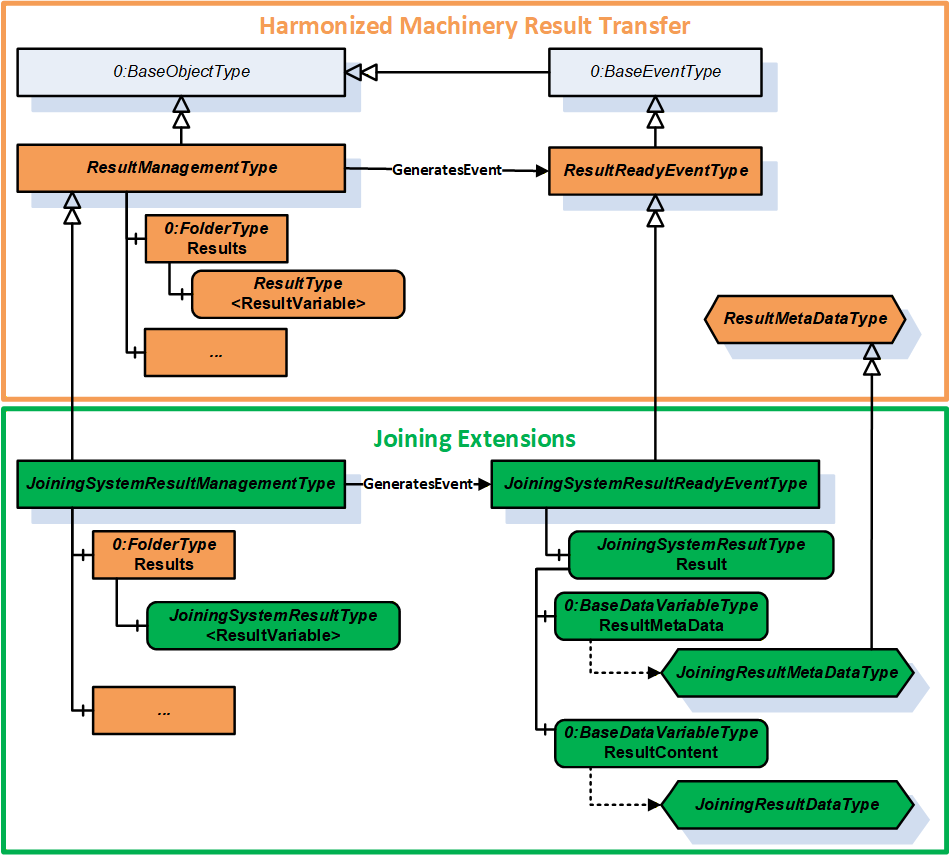
7.5.2 JoiningSystemResultManagementType ObjectType Definition
The JoiningSystemResultManagementType is a subtype of ResultManagementType and provides mechanism to access results generated by the underlying joining system. It is formally defined in Table 56.
| Attribute | Value | ||||
| BrowseName | JoiningSystemResultManagementType | ||||
| IsAbstract | False | ||||
| References | Node Class | BrowseName | DataType | TypeDefinition | Other |
|---|---|---|---|---|---|
| Subtype of the 5:ResultManagementType defined in OPC 40001-101, which means it inherits the InstanceDeclarations of that Node. | |||||
| 0:HasComponent | Object | 5:Results | 0:FolderType | O | |
| 0:GeneratesEvent | ObjectType | JoiningSystemResultReadyEventType | |||
| 0:GeneratesEvent | ObjectType | RequestedResultEventType | |||
| 0:HasComponent | Method | RequestResults | O | ||
| 0:HasComponent | Method | RequestUnacknowledgedResults | O | ||
| Conformance Units | |||||
|---|---|---|---|---|---|
| IJT Get Latest Result | |||||
| IJT Get Result by Id | |||||
| IJT Get Result with Filter Criteria | |||||
| IJT Result Variable Access | |||||
| IJT Result Event Access | |||||
| IJT Acknowledge Results | |||||
| IJT Requested Result Variable Access | |||||
| IJT Requested Result Event Access | |||||
| IJT Request Results | |||||
| IJT Request Unacknowledged Results | |||||
| IJT Self Contained Consolidated Result | |||||
| IJT Consolidated Result with References | |||||
| IJT Partial Consolidated Result |
Note:
5:ResultTransfer Object is not used in the Joining System.
The definition of the methods is available in OPC 40001-101.
The components of the JoiningSystemResultManagementType have additional subcomponents which are defined in Table 57.
| Source Path | Reference | NodeClass | BrowseName | DataType | TypeDefinition | Others |
| 5:Results | 0:HasComponent | Variable | <ResultVariable> | 5:ResultDataType | JoiningSystemResultType | OP |
| 5:Results | 0:HasComponent | Variable | <RequestedResultVariable> | 5:ResultDataType | JoiningSystemResultType | OP |
Each <ResultVariable> represents a result.
Note: It is recommended to use the BrowseName of the <ResultVariable> as “Result” if only one instance of the variable is exposed in the address space. The implementation of ResultVariable is application specific.
Each <RequestedResultVariable> represents a result returned by calling the RequestResults method or the RequestUnacknowledgedResults method.
Note: It is recommended to use the BrowseName of the <ResultVariable> as “RequestedResult” if only one instance of the variable is exposed in the address space. The implementation of RequestedResultVariable is application specific.
7.5.3 RequestResults
The Method RequestResults is used to receive stored results from the Server. A joining system can send live results or stored results.
The successful execution of this method will generate instances of RequestedResultEventType and update RequestedResultVariable.
The signature of this Method is specified below. Table 58 and Table 59 specify the Arguments and AddressSpace representation, respectively.
Signature
	RequestResults (
		[in]	0:UInt64	fromSequenceNumber,
		[in]	0:UInt64	toSequenceNumber,
		[in]	0:UtcTime	fromTime,
		[in]	0:UtcTime	toTime,
		[in]	0:Duration	requestedMinimumDurationBetweenResults,
		[out]	0:Duration	revisedMinimumDurationBetweenResults,
		[out]	0:Int64	status,
[out] 0:LocalizedText statusMessage)| Argument | Description |
| fromSequenceNumber | The starting sequence number for the Requested Results. It is a required argument if results are requested based on the input sequence number range. It shall be a valid value > 0. If 0, then fromTime and toTime are used. |
| toSequenceNumber | The ending sequence number of the Requested Results. It is a required argument if results are requested based on the input sequence number range. It shall be a valid value > 0 and shall be >= fromSequenceNumber. If 0, then fromTime and toTime are used. |
| fromTime | It is the start time for the Requested Results. This argument is considered only when fromSequenceNumber and toSequenceNumber are set as 0. |
| toTime | It is the end time for the Requested Results. This argument is considered only when fromSequenceNumber and toSequenceNumber are set as 0. |
| requestedMinimumDurationBetweenResults | The client can use this argument to configure a time interval between each Result to optimize the number of Results sent from the Server. The Server can return the revised interval if the requested interval is not supported. Note: It is only a requested minimum time interval by the client and the server could take additional time for processing. |
| revisedMinimumDurationBetweenResults | It is the minimum revised interval supported by the server. |
| status | It provides the status of the Method execution. Refer 7.4 for details. |
| statusMessage | It provides the high-level status information in a user-friendly text. |
| Attribute | Value | ||||
| BrowseName | RequestResults | ||||
| References | Node Class | BrowseName | DataType | TypeDefinition | ModellingRule |
|---|---|---|---|---|---|
| 0:HasProperty | Variable | 0:InputArguments | 0:Argument[] | 0:PropertyType | 0:Mandatory |
| 0:HasProperty | Variable | 0:OutputArguments | 0:Argument[] | 0:PropertyType | 0:Mandatory |
7.5.4 RequestUnacknowledgedResults
The Method RequestUnacknowledgedResults is used to receive unacknowledged results available in the joining system.
The successful execution of this method will generate instances of RequestedResultEventType and update RequestedResultVariable.
Note: It is recommended that this Method is used only by the Client that is responsible for exclusively storing the results.
The signature of this Method is specified below. Table 58 and Table 59 specify the Arguments and AddressSpace representation, respectively.
Signature
	RequestUnacknowledgedResults (
		[in]	0:UInt32	maxResults,
		[in]	0:Duration	requestedMinimumDurationBetweenResults,
		[out]	0:Duration	revisedMinimumDurationBetweenResults,
		[out]	0:UInt32	unacknowledgedResultCount,
		[out]	0:Int64	status,
[out] 0:LocalizedText statusMessage)| Argument | Description |
| maxResults | It is the maximum results requested by the Client. If 0, then the Server shall send all the unacknowledged results. |
| requestedMinimumDurationBetweenResults | The client can use this argument to configure a time interval between each Result to optimize the number of Results sent from the Server. The Server can return the revised interval if the requested interval is not supported. Note: It is only a requested minimum time interval by the client and the server could take additional time for processing. |
| revisedMinimumDurationBetweenResults | It is the minimum revised interval supported by the server. |
| unacknowledgedResultCount | It is the total count of unacknowledged results in the server. |
| status | It provides the status of the Method execution. Refer 7.4 for details. |
| statusMessage | It provides the high-level status information in a user-friendly text. |
| Attribute | Value | ||||
| BrowseName | RequestUnacknowledgedResults | ||||
| References | Node Class | BrowseName | DataType | TypeDefinition | ModellingRule |
|---|---|---|---|---|---|
| 0:HasProperty | Variable | 0:InputArguments | 0:Argument[] | 0:PropertyType | 0:Mandatory |
| 0:HasProperty | Variable | 0:OutputArguments | 0:Argument[] | 0:PropertyType | 0:Mandatory |