
1 Scope
OPC Unified Architecture (OPC UA) is a platform-independent standard designed to facilitate seamless information exchange in industrial automation and other domains. It provides a comprehensive framework for modelling information, secure communication, and ensuring interoperability between diverse systems and devices.
This part of OPC 10000 introduces the fundamental concepts and provides a high-level overview of the OPC Unified Architecture. It covers key architectural principles, fundamental models such as the AddressSpace Model and the Security Model, and the roles of core OPC UA components like Clients and Servers. It is intended for developers, system integrators, and anyone needing a high-level understanding of OPC UA. This part of the specification focuses on providing a conceptual foundation and does not delve into detailed implementation specifics or protocol mappings, which are covered in other parts of the OPC 10000 series.
This part provides the foundational knowledge necessary to understand the subsequent parts of the OPC 10000 series, which delve into specific aspects of the architecture, such as security (Part 2), the AddressSpace model (Part 3), and Services (Part 4). Each of the other parts is briefly explained along with a suggested reading order.
2 Terms, definitions, and abbreviated terms
2.1 Terms and definitions
For the purposes of this document, the following terms apply.
ISO and IEC maintain terminology databases for use in standardization at the following addresses:
IEC Electropedia: available at https://www.electropedia.org/
ISO Online browsing platform: available at https://www.iso.org/obp
2.1.1 AddressSpace
collection of information that a Server makes visible to its Clients
2.1.2 Aggregate
function that calculates derived values from Raw data
2.1.3 Alarm
type of Event associated with a state condition that typically requires acknowledgement
2.1.4 Attribute
primitive characteristic of a Node
2.1.5 Broker
intermediary program module that routes NetworkMessages from Publishers to Subscribers
2.1.6 Certificate
digitally signed data structure that contains a public key and an identity
2.1.7 Client
software application that sends Messages to OPC UA Servers conforming to the Services specified in this set of specifications
2.1.8 ClientServer
OPC UA variant of the client-server messaging pattern
2.1.9 Condition
generic term that is an extension to an Event
2.1.10 Communication Stack
layered set of software modules between the application and the hardware that provides various functions to encode, encrypt and format a Message for sending, and to decode, decrypt and unpack a Message that was received
2.1.11 Complex Data
data that is composed of elements of more than one primitive data type, such as a structure
2.1.12 DataSet
list of named data values
2.1.13 DataSetMessage
payload of a NetworkMessage created from a DataSet
2.1.14 Discovery
process by which Client obtains information about Servers, including endpoint and security information
2.1.15 Event
generic term used to describe an occurrence of some significance within a system or system component
2.1.16 EventNotifier
special Attribute of a Node that signifies that a Client may subscribe to that particular Node to receive Notifications of Event occurrences
2.1.17 Information Model
organizational framework that defines, characterizes, and relates information resources of a given system or set of systems.
2.1.18 Message
data unit conveyed between Client and Server that represents a specific Service request or response
2.1.19 Message Oriented Middleware
infrastructure supporting sending and receiving NetworkMessages between distributed systems
2.1.20 Method
callable software function that is a component of an Object
2.1.21 MonitoredItem
Client-defined entity in the Server used to monitor Attributes or EventNotifiers for new values or Event occurrences and that generates Notifications for them
2.1.22 NetworkMessage
DataSetMessages and header to facilitate delivery, routing, security, and filtering
2.1.23 Node
fundamental component of an AddressSpace
2.1.24 NodeClass
class of a Node in an AddressSpace
2.1.25 Notification
generic term for data that announces the detection of an Event or of a changed Attribute value; Notifications are sent in NotificationMessages.
2.1.26 NotificationMessage
Message published from a Subscription that contains one or more Notifications
2.1.27 Object
Node that represents a physical or abstract element of a system
2.1.28 Object Instance
synonym for Object
2.1.29 ObjectType
Node that represents the type definition for an Object
2.1.30 OPC UA Application
Client, which calls OPC UA Services, or a Server, which performs those Services, or an OPC UA Publisher or an OPC UA Subscriber.
2.1.31 Profile
specific set of capabilities to which a Server may claim conformance.
2.1.32 Program
executable Object that, when invoked, immediately returns a response to indicate that execution has started, and then returns intermediate and final results through Subscriptions identified by the Client during invocation
2.1.33 Publisher
entity sending NetworkMessages to a Message Oriented Middleware
2.1.34 PubSub
OPC UA variant of the publish subscribe messaging pattern
2.1.35 Reference
explicit relationship (a named pointer) from one Node to another
2.1.36 ReferenceType
Node that represents the type definition of a Reference
2.1.37 Secure Channel
in OPC UA, a communication path established between an OPC UA Client and Server that have authenticated each other using certain OPC UA services and for which security parameters have been negotiated and applied
2.1.38 Server
software application that implements and exposes the Services specified in this set of specifications
2.1.39 Service
Client-callable operation in a Server
2.1.40 Service Set
group of related Services
2.1.41 Session
logical long-running connection between a Client and a Server.
2.1.42 Subscriber
entity receiving DataSetMessages from a Message Oriented Middleware
2.1.43 Subscription
Client-defined endpoint in the Server, used to return Notifications to the Client
2.1.44 Underlying System
hardware or software platforms that exist as an independent entity. UA Applications are dependent on an entity's existence in order to perform UA services. However, the entity is not dependent on UA Applications.
2.1.45 Variable
Node that contains a value
2.1.46 View
specific subset of the AddressSpace that is of interest to the Client.
2.2 Abbreviated terms
| A&E | Alarms and Events |
| AMQP | Advanced Message Queuing Protocol |
| API | Application Programming Interface |
| COM | Component Object Model |
| DA | Data Access |
| DCS | Distributed Control System |
| DDS | Data Distribution Service |
| HDA | Historical Data Access |
| HMI | Human-Machine Interface |
| JSON | JavaScript Object Notation |
| LDAP | Lightweight Directory Access Protocol |
| MES | Manufacturing Execution System |
| MQTT | Message Queue Telemetry Transport |
| OAuth2 | Open Authorization |
| OPC | Open Platform Communications |
| PLC | Programmable Logic Controller |
| SCADA | Supervisory Control And Data Acquisition |
| UA | Unified Architecture |
| UADP | UA Datagram Protocol |
| WSDL | Web Services Definition Language |
| XML | Extensible Markup Language |
| XMPP | Extensible Messaging and Presence Protocol |
3 Structure of the OPC UA series
3.1 Specification organization
The OPC UA specification is organized as a multi-part series to provide a modular and extensible framework. This structure allows for focused development and maintenance of specific aspects of the technology, while ensuring overall coherence. The parts are broadly categorized into core concepts, information models, services, mappings, profiles, and domain-specific applications. Parts 1 through 5 describe core concepts of OPC UA, therefore, readers are encouraged to read Parts 1 through 5 of the specification before reading the other Parts.
3.2 Specification parts
At the time of publication of this document, the OPC 10000 series is composed of the following parts:
Part 1 (OPC 10000-1) - Overview and Concepts
Part 1 (this part) presents the concepts and overview of OPC UA.
Part 2 (OPC 10000-2) - Security Model
Part 2 describes the model for securing interactions between OPC UA Applications.
Part 3 (OPC 10000-3) - Address Space Model
Part 3 describes the contents and structure of the Server's AddressSpace.
Part 4 (OPC 10000-4) - Services
Part 4 specifies the Services provided by Servers.
Part 5 (OPC 10000-5) - Information Model
Part 5 specifies the types and their relationships defined for Servers.
Part 6 (OPC 10000-6) - Mappings
Part 6 specifies the mappings to transport protocols and data encodings supported by OPC UA.
Part 7 (OPC 10000-7) - Profiles
Part 7 specifies the Profiles that are available for OPC UA Applications. These Profiles provide groupings of functionality that can be used for conformance level certification. OPC UA Applications will be tested against the Profiles.
Part 8 (OPC 10000-8) - Data Access
Part 8 specifies the use of OPC UA for data access.
Part 9 (OPC 10000-9) - Alarms and Conditions
Part 9 specifies use of OPC UA support for access to Alarms and Conditions. The base system includes support for simple Events; this specification extends that support to include support for Alarms and Conditions.
Part 10 (OPC 10000-10) - Programs
Part 10 specifies OPC UA support for access to Programs.
Part 11 (OPC 10000-11) - Historical Access
Part 11 specifies use of OPC UA for historical access. This access includes both historical data and historical Events.
Part 12 (OPC 10000-12) - Discovery and Global Services
Part 12 specifies how Discovery Servers operate in different scenarios and describes how UA Clients and Servers should interact with them. It also defines Information Models for Certificate management, key credential management, and authorization services.
Part 13 (OPC 10000-13) - Aggregates
Part 13 specifies how to compute and return aggregates like minimum, maximum, average etc. Aggregates can be used with current and historical data.
Part 14 (OPC 10000-14) - PubSub
Part 14 specifies the OPC Unified Architecture (OPC UA) PubSub communication model. The PubSub communication model defines an OPC UA publish subscribe pattern in addition to the ClientServer pattern defined by the Services in OPC 10000-4.
Part 15 (OPC 10000-15) - Safety
Part 15 extends OPC UA to fulfil the requirements of functional safety as defined in the IEC 61508 series of standards and in IEC 61784-3:2017.
Part 16 (OPC 10000-16) - State Machines
Part 16 specifies the basic infrastructure to model state machines.
Part 17 (OPC 10000-17) - Alias Names
Part 17 specifies a manner of configuring and exposing an alternate well-defined name for any OPC UA Node in a Server or system.
Part 18 (OPC 10000-18) - Role-Based Security
Part 18 specifies the basic infrastructure to model role-based access control (RBAC)
Part 19 (OPC 10000-19) - Dictionary References
Part 19 specifies the basic infrastructure to reference from an OPC UA Information Model to external dictionaries like IEC Common Data Dictionary or ECLASS.
Part 20 (OPC 10000-20) - File Transfer
Part 20 specifies the basic infrastructure to model file transfers and file systems.
Part 21 (OPC 10000-21) - Device Onboarding
Part 21 specifies the life cycle of Devices and Composites and mechanisms to verify their authenticity, set up their security and maintain their configuration.
Part 22 (OPC 10000-22) - Base Network Model
Part 22 specifies an OPC UA Information Model for a basic set of network related components to be used in more specific Information Models.
Part 23 (OPC 10000-23) - Common ReferenceTypes
Part 23 specifies common types of references between Nodes.
Part 24 (OPC 10000-24) - Scheduler
Part 24 specifies an OPC UA information model to expose and configure the dates and times specific actions are executed by the OPC UA Server.
Part 25 (OPC 10000-25) - Object Serialization
Part 25 specifies an OPC UA information model to configure and expose a merged compact representation of the selected subtree of a root Node.
Part 26 (OPC 10000-26) - LogObject
Part 26 specifies an OPC UA information model for a set of Objects and Events that can be used to collect diagnostic information in a system.
4 Overview
4.1 Scope
OPC UA is applicable to components in all industrial domains, such as industrial sensors and actuators, control systems, Manufacturing Execution Systems and Enterprise Resource Planning Systems, including the Industrial Internet of Things (IIoT), Machine To Machine (M2M) and others. It is designed to enable seamless information exchange and to support command and control functionalities for diverse industrial processes, spanning from device-level communication to enterprise-wide and cloud integration.
OPC UA defines a common infrastructure model to facilitate this information exchange. OPC UA specifies the following:
the information model to represent structure, behaviour and semantics;
the message model to interact between applications;
the communication model to transfer the data between end-points;
the conformance model to guarantee interoperability between systems.
4.2 General
OPC UA is a platform-independent standard that enables various systems and devices to communicate securely and reliably. It employs mechanisms for authentication, encryption, and integrity checks to ensure the identity of OPC UA Applications as well as identification of users and protect against attacks.
Using the ClientServer model, OPC UA defines sets of Services that Servers provide, and it utilizes both OPC UA-defined and vendor-defined data types, along with flexible object models, to facilitate interoperability and dynamic information discovery by Clients. Supporting a variety of communication protocols and data encodings, such as TCP, HTTPS, WebSockets, XML/text, UA Binary, and JSON, OPC UA allows for trade-offs between portability and efficiency to suit different application requirements. Servers can provide access to both current and historical data, as well as Alarms and Events to notify Clients of important changes.
In addition to the ClientServer model, OPC UA also supports information transfer from Publishers to Subscribers using the PubSub model.
4.3 Design goals
OPC UA provides a consistent, integrated AddressSpace and service model. This allows a single Server to integrate data, Alarms and Events, and history into its AddressSpace, and to provide access to them using an integrated set of Services. These Services also include an integrated security model.
OPC UA also allows Servers to provide Clients with type definitions for the Objects accessed from the AddressSpace. This allows Information Models to be used to describe the contents of the AddressSpace. OPC UA allows data to be exposed in many different formats, including binary structures and XML or JSON documents. The format of the data may be defined by OPC, other standard organizations or vendors. Through the AddressSpace, Clients can query the Server for the metadata that describes the format for the data. In many cases, Clients with no pre-programmed knowledge of the data formats will be able to determine the formats at runtime and properly utilize the data.
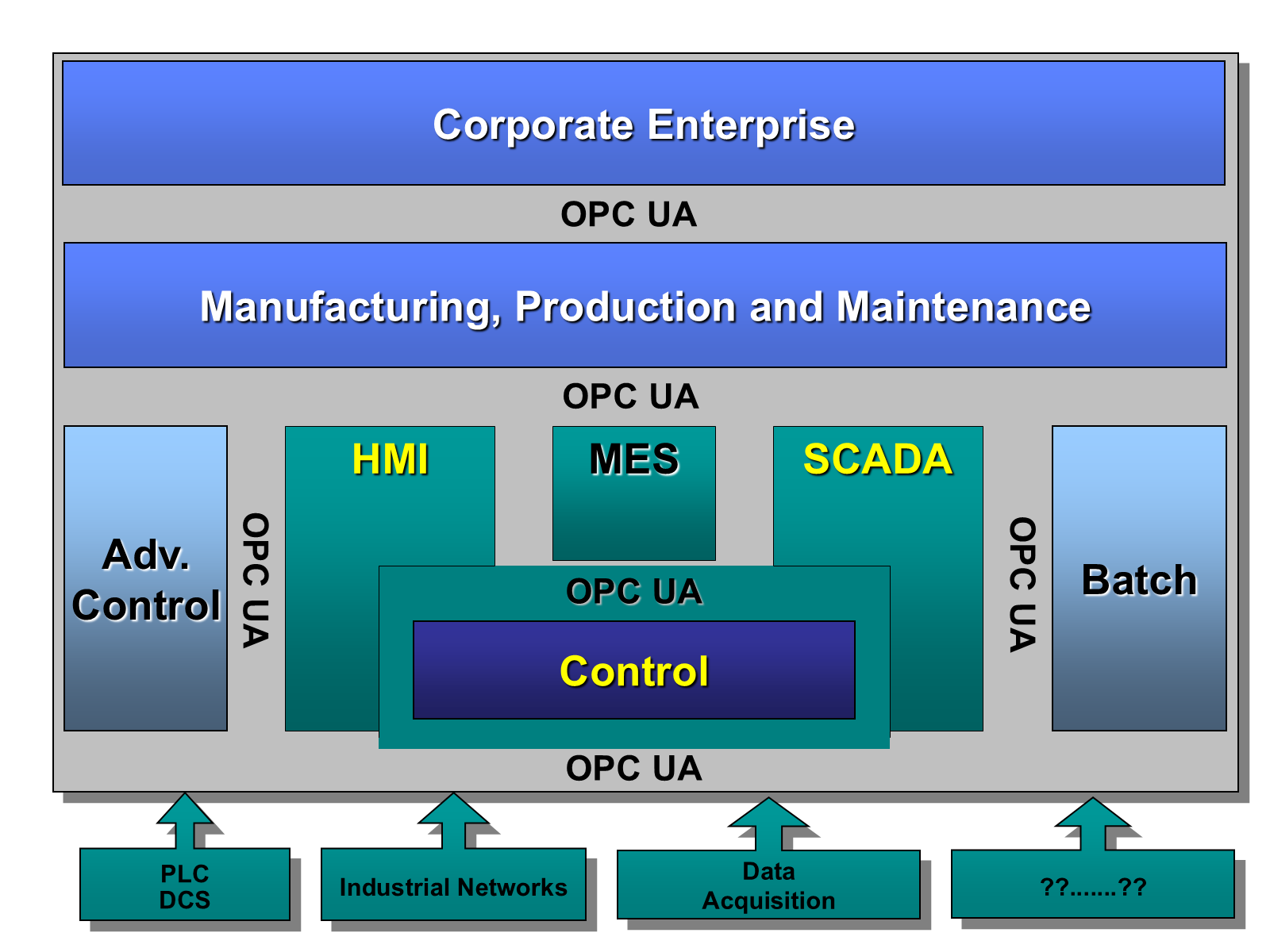
OPC UA adds support for many relationships between Nodes instead of being limited to just a single hierarchy. In this way, a Server may present data in a variety of hierarchies tailored to the way a set of Clients would typically like to view the data. This flexibility, combined with support for type definitions, makes OPC UA applicable to a wide array of problem domains. As illustrated in Figure 1, OPC UA is not targeted at just the SCADA, PLC and DCS interface, but also as a way to provide greater interoperability between higher level functions.
OPC UA is designed to provide robustness of published data. A major feature of all OPC servers is the ability to publish data and Event Notifications. OPC UA provides mechanisms for Clients to quickly detect and recover from communication failures associated with these transfers without having to wait for long timeouts provided by the underlying protocols.
OPC UA is designed to support a wide range of Servers, from plant floor PLCs to enterprise Servers. These Servers are characterized by a broad scope of size, performance, execution platforms and functional capabilities. Therefore, OPC UA defines a comprehensive set of capabilities, and Servers may implement a subset of these capabilities. To promote interoperability, OPC UA defines subsets, referred to as Profiles, to which Servers may claim conformance. Clients can then discover the Profiles of a Server, and tailor their interactions with that Server based on the Profiles. Profiles are defined in OPC 10000-7.
The OPC UA is layered to isolate the core design from the underlying computing technology and network transport. This allows OPC UA to be mapped to future technologies as necessary, without negating the basic design. Mappings and data encodings are described in OPC 10000-6. Several data encodings are defined:
XML/text,
UA Binary,
JSON.
In addition, several protocols are defined:
OPC UA TCP,
HTTPS,
WebSockets.
OPC UA Applications that support multiple transports and encodings will allow the end users to make decisions about trade-offs between performance and compatibility at the time of deployment, rather than having these trade-offs determined by the OPC vendor at the time of product definition.
OPC UA is designed as the migration path for OPC clients and servers that are based on Microsoft COM technology (OPC Classic). Care has been taken in the design of OPC UA so that existing data exposed by OPC COM servers (DA, HDA and A&E) can easily be mapped and exposed via OPC UA. Vendors may choose migrating their products natively to OPC UA or use external wrappers to convert from OPC COM to OPC UA and vice-versa. Each of the specifications of OPC Classic developed by OPC Foundation defined its own address space model and its own set of Services. OPC UA unifies the previous models into a single integrated address space with a single set of Services.
OPC UA PubSub opens new application fields for OPC UA. The following are some example uses for PubSub:
Configurable peer to peer communication between controllers and between controllers and HMIs. The peers are not directly connected and do not even need to know about the existence of each other. The data exchange often requires a fixed time-window; it may be point-to-point or a multi-point connection.
Asynchronous workflows. For example, an order processing application can place an order on a message queue or an enterprise service bus. From there it can be processed by one or more workers.
Logging to multiple systems; for example, sensors or actuators can write logs to a monitoring system, an HMI, an archive application for later querying, and so on.
Servers representing services or devices can stream data to applications hosted in the cloud. For example, backend servers, big data analytics for system optimization and predictive maintenance.
PubSub is not bound to a particular messaging system. Rather it can be mapped to various different systems as illustrated with two examples:
PubSub with UDP may be well-suited in production environments for frequent transmissions of small amounts of data. It also allows data exchange in one-to-one and one-to-many configurations.
The use of established messaging protocols (e.g. the ISO/IEC AMQP 1.0 protocol or the MQTT 5.0 protocol) with JSON data encoding supports the cloud integration path and readily allows handling of the information in modern stream and batch analytics systems.
4.4 Integrated models and services
4.4.1 Security model
4.4.1.1 General
OPC UA security is concerned with the authentication of Clients and Servers, the authentication of users, the integrity and confidentiality of their communications, and the verifiability of claims of functionality. It does not specify the circumstances under which various security mechanisms are required. That specification is crucial, but it is made by the designers of the system at a given site and may be specified by other standards.
Rather, OPC UA provides a security model, described in OPC 10000-2, in which security measures can be selected and configured to meet the security needs of a given installation. This model includes security mechanisms and parameters. In some cases, the mechanism for exchanging security parameters is defined, but the way that applications use these parameters is not. This framework also defines a minimum set of security Profiles that all OPC UA Applications support, a subset of which can be enabled in each installation. Profiles are defined in OPC 10000-7.
4.4.1.2 Discovery and Session establishment
Application level security relies on a secure communication channel that is active for the duration of the application Session and ensures the integrity of all Messages that are exchanged. This means users need to be authenticated only once, when the application Session is established. The mechanisms for discovering Servers and establishing secure communication channels and application Sessions are described in OPC 10000-4 and OPC 10000-6. Additional information about the Discovery process is described in OPC 10000-12.
4.4.1.3 Auditing
OPC UA includes support for security audit trails with traceability between Client and Server audit logs. If a security-related problem is detected at the Server, the associated Client audit log entry can be located and examined. OPC UA also provides the capability for Servers to generate Event Notifications that report auditable Events to Clients capable of processing and logging them. OPC UA defines security audit parameters that can be included in audit log entries and in audit Event Notifications. OPC 10000-5 defines the data types for these parameters. Not all Servers and Clients provide all of the auditing features. Profiles, found in OPC 10000-7, indicate which features are supported.
4.4.1.4 Transport security
OPC UA security complements the security infrastructure provided by most web service capable platforms.
Transport level security can be used to encrypt and sign Messages. Encryption and signatures protect against disclosure of information and protect the integrity of Messages. Encryption capabilities are provided by the underlying communications technology used to exchange Messages between OPC UA Applications. OPC 10000-7 defines the encryption and signature algorithms to be used for a given Profile.
4.4.2 Integrated AddressSpace model
The set of Objects and related information that the Server makes available to Clients is referred to as its AddressSpace. The OPC UA AddressSpace represents its contents as a set of Nodes connected by References.
Primitive characteristics of Nodes are described by Attributes. Attributes are the only elements of a Server that have data values. Data types that define attribute values may be simple or complex.
Nodes in the AddressSpace are typed according to their use and their meaning. NodeClasses define the metadata for the OPC UA AddressSpace. OPC 10000-3 defines the OPC UA NodeClasses.
The Base NodeClass defines Attributes common to all Nodes, allowing identification, classification, and naming. Each NodeClass inherits these Attributes and may additionally define its own Attributes.
To promote interoperability of Clients and Servers, the OPC UA AddressSpace is structured hierarchically with the top levels the same for all Servers. Although Nodes in the AddressSpace are typically accessible via the hierarchy, they may have References to each other, allowing the AddressSpace to represent an interrelated network of Nodes. The model of the AddressSpace is defined in OPC 10000-3.
Servers may subset the AddressSpace into Views to simplify Client access. Subclause 5.3.4.3 describes AddressSpace Views in more detail.
4.4.3 Integrated object model
The OPC UA Object Model provides a consistent, integrated set of NodeClasses for representing Objects in the AddressSpace. This model represents Objects in terms of their Variables, Events and Methods, and their relationships with other Objects. OPC 10000-3 describes this model.
The OPC UA object model allows Servers to provide type definitions for Objects and their components. Type definitions may be subclassed. They also may be common or they may be system-specific. ObjectTypes may be defined by standards organizations, vendors, or end-users.
This model allows data, Alarms and Events, and their history to be integrated into a single Server. For example, Servers are able to represent a temperature transmitter as an Object that is composed of a temperature value, a set of alarm parameters, and a corresponding set of alarm limits.
4.4.4 Integrated services
The interface between Clients and Servers is defined as a set of Services. These Services are organized into logical groupings called Service Sets. Service Sets are discussed in clause 6 and specified in OPC 10000-4.
OPC UA Services provide two capabilities to Clients. They allow Clients to issue requests to Servers and receive responses from them. They also allow Clients to subscribe to Servers for Notifications. Notifications are used by the Server to report occurrences such as Alarms, data value changes, Events, and Program execution results.
OPC UA Messages may be encoded as text (XML or JSON) or in binary format for efficiency purposes. They may be transferred using multiple underlying transports, for example TCP or HTTP. Servers may provide different encodings and transports as defined by OPC 10000-6.
4.5 Sessions
OPC UA ClientServer interaction requires a stateful model. The state information is maintained inside an application Session. Examples of state-information are Subscriptions, user credentials and continuation points for operations that span multiple requests.
Sessions are defined as logical connections between Clients and Servers. Servers may limit the number of concurrent Sessions based on resource availability, licensing restrictions, or other constraints. Each Session is independent of the underlying communications protocols. Failures of these protocols do not automatically cause the Session to terminate. Sessions terminate based on Client or Server request, or based on inactivity of the Client. The inactivity time interval is negotiated during Session establishment.
5 Systems concepts
5.1 ClientServer overview
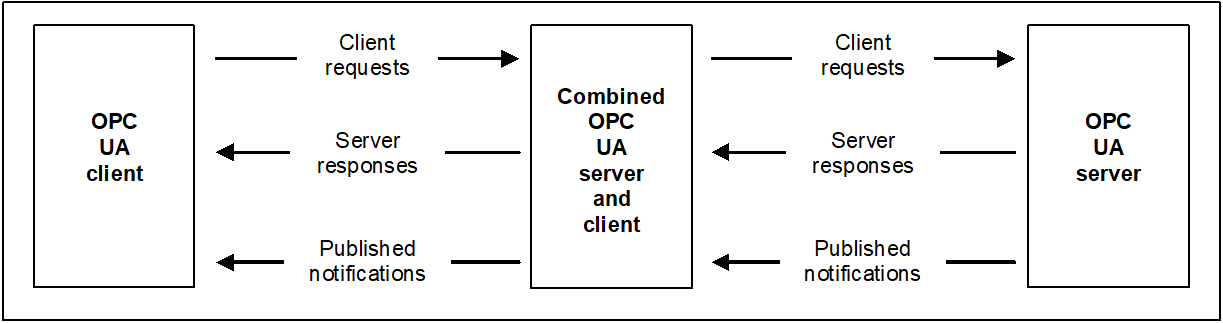
The OPC UA systems architecture models Clients and Servers as interacting partners. Each system may contain multiple Clients and Servers. Each Client may interact concurrently with one or more Servers, and each Server may interact concurrently with one or more Clients. This model enables Clients to access data, invoke Services, and receive Events from Servers. An application can embody both Server and Client functionalities, allowing it to exchange information with other Servers and Clients as described in 5.3.7.
Clients and Servers are described in 5.2 and 5.3. Figure 2 illustrates the architecture that includes a combined Server and Client.
5.2 OPC UA Clients
The OPC UA Client architecture models the Client endpoint of ClientServer interactions. Figure 3 illustrates the major elements of a typical Client and how they relate to each other.
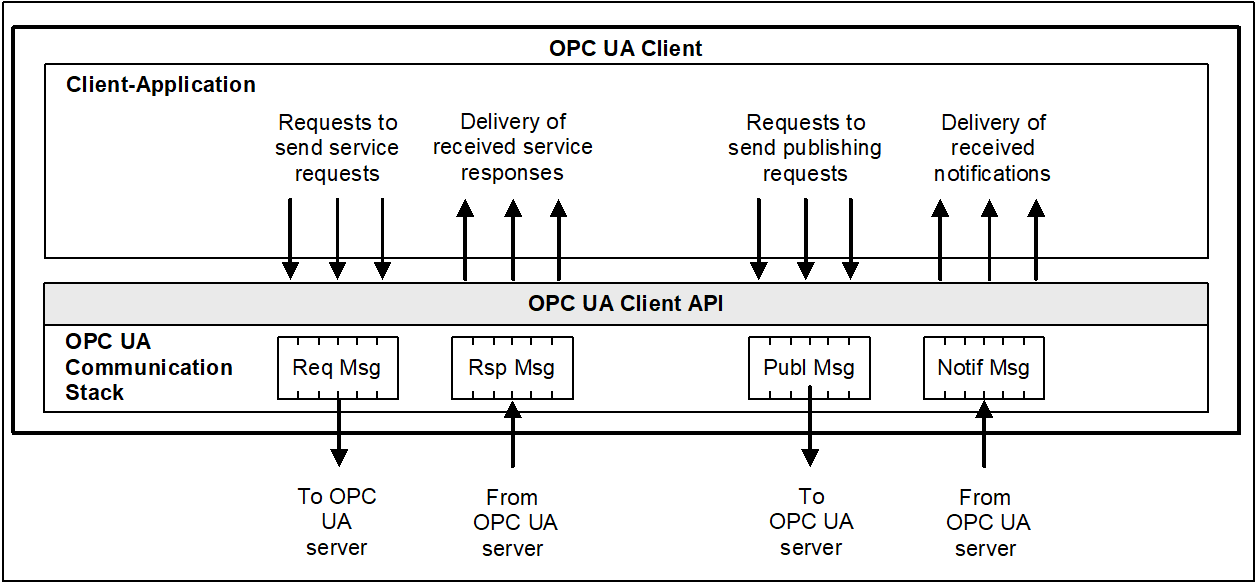
The Client Application utilizes a Client API to initiate OPC UA Service requests and receive responses from Servers. The Communication Stack handles the conversion of Client API calls into messages and manages the underlying communication with the Server. The Services defined for OPC UA are described in clause 6, and specified in OPC 10000-4.
Note that the "Client API" is an internal interface that isolates the Client application code from an OPC UA Communication Stack. The OPC UA Communication Stack converts Client API calls into Messages and sends them through the underlying communications entity to the Server at the request of the Client application. The OPC UA Communication Stack also receives response and NotificationMessages from the underlying communications entity and delivers them to the Client application through the Client API.
5.3 OPC UA Servers
5.3.1 General
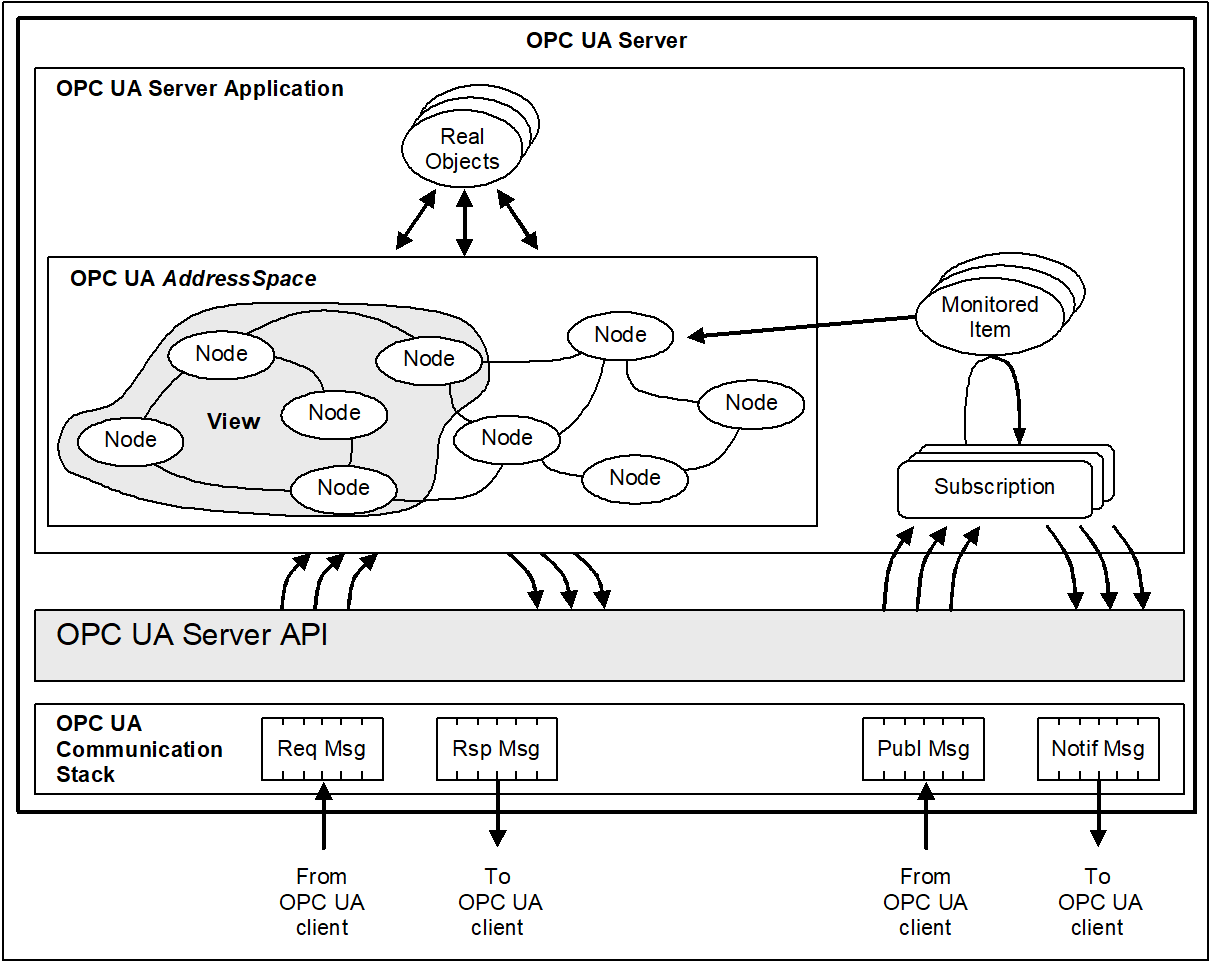
The OPC UA Server architecture models the Server endpoint of client/server interactions. Figure 4 illustrates the major elements of the Server and how they relate to each other.
5.3.2 Real objects
Real objects are physical or software objects that are accessible by the Server application or that it maintains internally. Examples include physical devices (e.g. sensors, actuators, motors) and diagnostics counters.
5.3.3 Server application
The Server application is the code that implements the function of the Server. It uses the Server API to send and receive OPC UA Messages from Clients. Note that the "Server API" is an internal interface that isolates the Server application code from an OPC UA Communication Stack.
5.3.4 OPC UA AddressSpace
5.3.4.1 AddressSpace Nodes
The AddressSpace is modelled as a set of Nodes accessible by Clients using OPC UA Services (interfaces and methods). Nodes in the AddressSpace are used to represent real objects, their definitions and their References to each other.
5.3.4.2 AddressSpace organization
OPC 10000-3 contains the details of the meta model "building blocks" used to create an AddressSpace out of interconnected Nodes in a consistent manner. Servers are free to organize their Nodes within the AddressSpace as they choose. The use of References between Nodes permits Servers to organize the AddressSpace into hierarchies, a full mesh network of Nodes, or any possible mix.
OPC 10000-5 defines OPC UA Nodes and References and their expected organization in the AddressSpace. Some Profiles will not require that all of the UA Nodes be implemented.
5.3.4.3 AddressSpace Views
A View is a subset of the AddressSpace. Views are used to restrict the Nodes that the Server makes visible to the Client, thus restricting the size of the AddressSpace for the Service requests submitted by the Client. The default View is the entire AddressSpace. Servers may optionally define other Views. Views hide some of the Nodes or References in the AddressSpace. Views are visible via the AddressSpace and Clients are able to browse Views to determine their structure. Views are often hierarchies, which are easier for Clients to navigate and represent in a tree.
5.3.4.4 Support for information models
The OPC UA AddressSpace supports Information Models. This support is provided through:
Node References that allow Objects in the AddressSpace to be related to each other.
ObjectType Nodes that provide semantic information for real Objects (type definitions).
ObjectType Nodes to support subclassing of type definitions.
Data type definitions exposed in the AddressSpace that allow industry specific data types to be used.
Industry groups can define how their specific information models are to be represented in Server AddressSpace.
5.3.5 Subscription entities
5.3.5.1 MonitoredItems
MonitoredItems are entities in the Server created by the Client that monitor AddressSpace Nodes and, indirectly, their real-world counterparts. When they detect a data change or an event/alarm occurrence, they generate a Notification that is transferred to the Client by a Subscription.
5.3.5.2 Subscriptions
A Subscription is an endpoint in the Server that publishes Notifications to Clients. Clients control the rate at which publishing occurs by sending Publish Messages.
5.3.6 OPC UA Service interface
5.3.6.1 General
The Services defined for OPC UA are described in clause 6, and specified in OPC 10000-4.
5.3.6.2 Request/response Services
Request/response Services are Services invoked by the Client through the OPC UA Service Interface to perform a specific task on one or more Nodes in the AddressSpace and to return a response.
5.3.6.3 Subscription Services
The Publish Service is invoked through the OPC UA Service Interface for the purpose of periodically sending Notifications to Clients. Notifications include Events, Alarms, data changes and Program outputs.
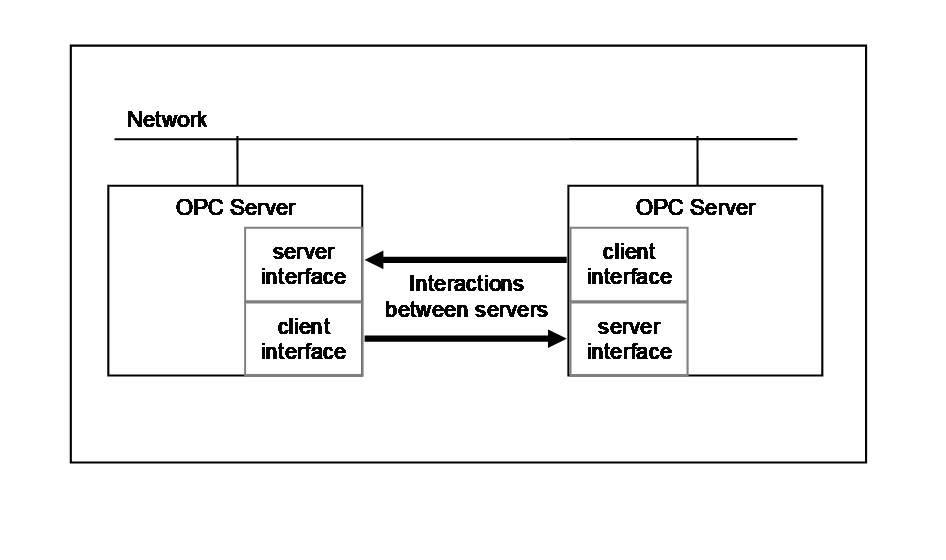
5.3.7 Server to Server interactions
Server to Server interactions in the ClientServer model are interactions in which one Server acts as a Client of another Server. Server to Server interactions allow for the development of servers that:
exchange information with each other on a peer-to-peer basis, this could include redundancy or remote Servers that are used for maintaining system wide type definitions (see Figure 5),
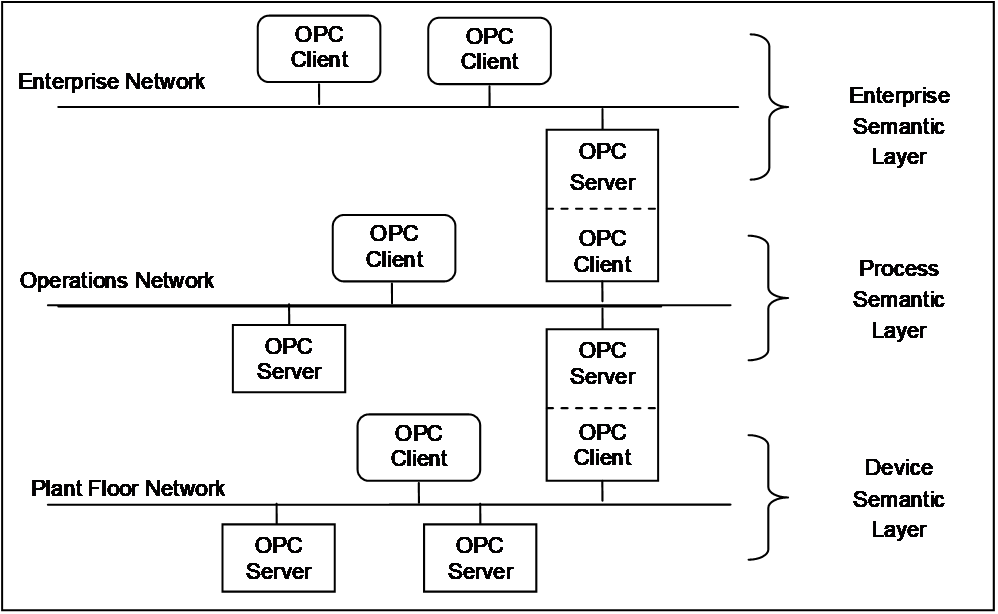
are chained in a layered architecture of Servers to provide:
aggregation of data from lower-layer Servers,
higher-layer data constructs to Clients, and
concentrator interfaces to Clients for single points of access to multiple underlying Servers.
Figure 5 illustrates interactions between Servers.
Similar peer-to-peer interactions can also be accomplished using the OPC UA PubSub model where each peer Application is both a Publisher and a Subscriber.
Figure 6 extends the previous example and illustrates the chaining of Servers together for vertical access to data in an enterprise.
5.4 Redundancy
OPC UA provides the data structures and services by which Redundancy may be achieved in a standardized manner. Redundancy may be used for high availability, fault tolerance and load balancing. OPC 10000-4 formally defines Client, Server and Network Redundancy. Whether and what Redundancy is supported by an OPC UA Application is defined by its Profiles. Profiles are described in OPC 10000-7.
Required Client and Server behaviours are associated with two distinct modes of Server Redundancy, transparent and non-transparent. The Client and Server responsibilities when using either transparent or non-transparent redundancy are defined in OPC 10000-4.
Servers that support non-transparent redundancy can also support client-controlled load balancing. The health of a Server including its ability to Service requests is collectively defined as ServiceLevel. See OPC 10000-5 for a formal definition of ServiceLevel. OPC 10000-4 defines four distinct ServiceLevel sub-ranges and example usage.
5.5 Publish-Subscribe
The Publish-Subscribe (PubSub) communication model in OPC UA offers an alternative to the ClientServer model, enabling efficient and/or decoupled communication. With PubSub, OPC UA Applications do not directly exchange requests and responses. Instead, Publishers send messages to a Message Oriented Middleware, without knowledge of what, if any, Subscribers there may be. Similarly, Subscribers express interest in specific types of data, and process messages that contain this data, without knowledge of what Publishers there are.
Message Oriented Middleware is software or hardware infrastructure supporting sending and receiving messages between distributed systems. It depends on the Message Oriented Middleware how this distribution is implemented.
To cover a large number of use cases, OPC UA PubSub supports two largely different Message Oriented Middleware variants. These are:
A broker-less form, where the Message Oriented Middleware is the network infrastructure that is able to route datagram-based messages. Subscribers and Publishers use datagram protocols like UDP multicast.
A broker-based form, where the Message Oriented Middleware is a Broker. Subscribers and Publishers use standard messaging protocols like AMQP or MQTT to communicate with the Broker. All messages are published to specific queues (e.g. topics, nodes) that the Broker exposes and Subscribers can listen to these queues. The Broker may translate messages from the formal messaging protocol of the Publisher to the formal messaging protocol of the Subscriber.
PubSub is used to communicate messages between different system components without these components having to know each other's identity.
A Publisher is pre-configured with what data to send. There is no connection establishment between Publisher and Subscriber.
The knowledge about who Subscribers are and the forwarding of published data to the Subscribers is off-loaded to the Message Oriented Middleware. The Publisher does not know or even care if there is one or many Subscribers. Effort and resource requirements for the Publisher are predictable and do not depend on the number of Subscribers.
OPC 10000-14 describes the details of the OPC UA PubSub model.
5.6 Synergy of models
OPC UA PubSub and ClientServer models are complementary and can be combined and used synergistically. The OPC UA Information Model is the foundation for both. A typical scenario involves using ClientServer interactions for configuration, control, and on-demand data access, while PubSub is used for efficient, high-speed dissemination of real-time data. For instance, a Client application might use ClientServer to configure a Server and set up PubSub connections. Subsequently, the Server/Publisher publishes real-time data updates using PubSub, and the Client/Subscriber subscribes to this data stream for continuous monitoring.
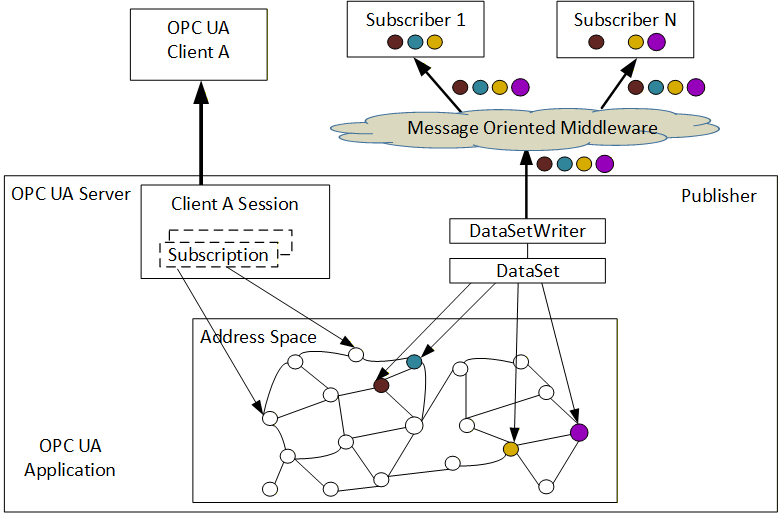
OPC PubSub can easily be integrated into Servers and Clients. Quite typically, a Publisher will be a Server (the owner of information) and a Subscriber is often a Client. Above all, the PubSub Information Model for configuration promotes the configuration of Publishers and Subscribers using the OPC UA ClientServer model.
Figure 7 depicts a single OPC UA Application that acts as both a Server and a Publisher.
Nevertheless, the PubSub communication does not require such a role dependency. I.e., Clients can be Publishers and Servers can be Subscribers. In fact, there is no necessity for Publishers or Subscribers to be either a Server or a Client to participate in PubSub communications.
5.7 Global Services
5.7.1 General
OPC Unified Architecture is highly decentralized and is mostly concerned with the standardization of the independent interactions between UA Applications (i.e. between Clients and Servers and between Publishers and Subscribers). However, as the number of Applications in a given system grows, there are advantages to having some information centralized and interactions that are uniform among all Applications in a system. For example, if a system consists of one Server and one or more Clients, it is reasonable for the Server to be configured with the usernames and passwords of all users that can access the Server. If instead a system has hundreds of Servers, then it becomes unmanageable for each Server to independently store and maintain the usernames and passwords for all users of the system. For scenarios like this, the Unified Architecture includes certain centralized, global components to provide consistency and alleviate administration burden.
Ideally all Applications should work with all the defined global services when they are present in a system, but Applications that wish to utilize a particular global service need to be designed and built to do so. Keep in mind that the use of the global services in a system is always optional, so Applications should not be written to require their presence.
5.7.2 Discovery Services
Discovery Services enable OPC UA Applications to locate other OPC UA Applications. For example, a Client application can use a Local Discovery Server (LDS) to find Servers on the local network. In a larger, more complex network, a Global Discovery Server (GDS) might be used to discover Servers across different network segments. The Client sends a Discovery request, and the Discovery Server responds with a list of available Servers and their connection details.
OPC UA defines three levels of dedicated Discovery Servers:
Local Discover Servery (LDS)
Local Discovery Server with multicast extension (LDS-ME)
Global Discovery Server (GDS)
OPC 10000-12 describes how to use the Discovery services with dedicated Discovery Servers.
5.7.3 Certificate management
OPC UA Applications rely on Digital (X.509) Certificates as the basis for trust. In systems it is highly desirable to assign and manage the Certificates used by the Applications centrally as they all need periodic maintenance (e.g., updates to trust lists and revocation lists, Certificate renewals, etc.). OPC 10000-12 describes the centralize Certificate management services.
5.7.4 KeyCredential management
Some OPC UA Applications may need to access external entities (e.g. authorization services, Brokers, etc.) that require an identifier and a secret (called a "key credential") to be presented for access. The assignment and management of key credentials can be centralized using the services described in OPC 10000-12.
5.7.5 Authorization services
The authorization services described in OPC 10000-12 allows OPC UA Applications to delegate the user authentication, user management and the assignment of users to roles (see OPC 10000-18) to an external central entity (e.g. an OAuth2 server).
5.7.6 Device Onboarding
Historically, devices with network connectivity have been allowed to communicate as soon as they are plugged into the network. For enhanced security, many networks will now require that physical network devices be uniquely identified and authorized to communicate on the network before any additional network based provisioning can be done. For example, the assignment of a Certificate using the Certificate management services as described in 5.7.3.
OPC 10000-21 defines a standard process for devices to be allowed to communicate on the network so that OPC UA Applications can be installed, updated, and provisioned with Certificates over the network.
5.7.7 Alias Names
In large systems unique well-known names are often assigned to a piece of equipment, a measurement, or a control artifact. Such user-assigned names are often referred to as "Tag Names". When a Node in a Server represents an entity with an assigned Tag Name, the Tag Name is often used as the Name or Description attribute for that Node, but short of browsing all Nodes in all Servers, there is no easy way to find a Node with a particular Name or Description. OPC 10000-17 defines a mechanism to assign a well-known name called an "alias name" to any Node in a Server and a centralized way to look up that Node by its alias name.
5.7.8 Security Key Service (SKS)
OPC UA Publishers and Subscribers utilize a security key service (SKS) to secure the messages sent between them. The SKS is responsible for managing the keys used to publish or consume the secured messages. The SKS may be implemented directly by a Publisher, or it may be centralized where a single SKS is used by a group of Publishers and Subscribers in a system. The SKS is described in OPC 10000-14.
6 Client/Server Service Sets
6.1 General
OPC UA Services are organized into logical groupings called Service Sets. Each Service Set defines a collection of related Services that enable Clients to access specific aspects of a Server's functionality. The Service Sets and their Services are specified in OPC 10000-4. These Service Sets are fundamental to the ClientServer interaction model, providing Clients with the means to discover Servers, establish secure communication, access and manipulate data, subscribe to events, and perform other operations. The availability of specific Service Sets and the Services within them depends on the Profiles supported by the Server. Profiles are described in OPC 10000-7.
6.2 Discovery Service Set
This Service Set defines Services used to discover Servers that are available in a system. It also provides a manner in which clients can read the security configuration required for connection to the Server. The Discovery Services are implemented by individual Servers and by dedicated Discovery Servers. Well known dedicated Discovery Servers provide a way for Clients to discover all registered Servers. OPC 10000-12 describes how to use the Discovery Services with dedicated Discovery Servers.
6.3 SecureChannel Service Set
This Service Set defines Services used to open a communication channel that ensures the confidentiality and integrity of all Messages exchanged with the Server. The base concepts for UA security are defined in OPC 10000-2.
The SecureChannel Services are unlike other Services because they are typically not implemented by the OPC UA Application directly. Instead, they are provided by the communication stack that the OPC UA Application is built on. OPC UA Applications simply need to verify that a SecureChannel is active whenever it receives a Message. OPC 10000-6 describes how the SecureChannel Services are implemented with different types of communication stacks.
A SecureChannel is a long-running logical connection between a single Client and a single Server. This channel maintains a set of keys that are known only to the Client and Server and that are used to authenticate and encrypt Messages sent across the network. The SecureChannel Services allow the Client and Server to securely negotiate the keys to use.
The exact algorithms used to authenticate and encrypt Messages are described in the security policies for a Server. These policies are exposed via the Discovery Service Set. A Client selects the appropriate endpoint that supports the desired security policy by the Server when it creates a SecureChannel.
When a Client and Server are communicating via a SecureChannel they verify that all incoming Messages have been signed and/or encrypted according to the security policy. A UA application is expected to ignore any Message that does not conform to the security policy for the channel.
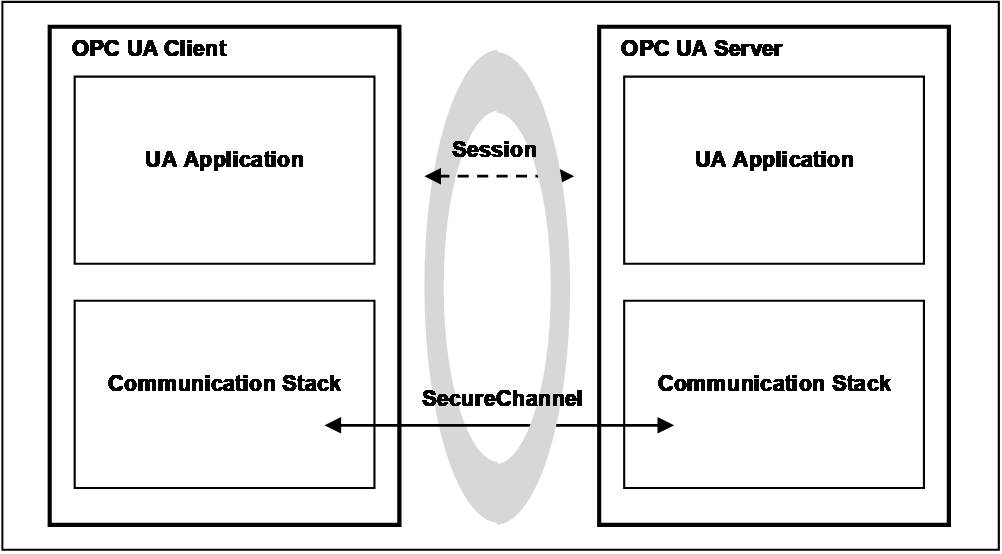
A SecureChannel is separate from the UA Application Session; however, a single UA Application Session may only be accessed via a single SecureChannel. This implies that the UA application is able to determine what SecureChannel is associated with each Message. A communication stack that provides a SecureChannel mechanism but that does not allow the application to know what SecureChannel was used for a given Message cannot be used to implement the SecureChannel Service Set.
The relationship between the UA Application Session and the SecureChannel is illustrated in Figure 8. The UA applications use the communication stack to exchange Messages. First, the SecureChannel Services are used to establish a SecureChannel between the two communication stacks, allowing them to exchange Messages in a secure way. Second, the UA applications use the Session Service Set to establish a UA application Session.
6.4 Session Service Set
This Service Set defines Services used to establish an application-layer connection in the context of a Session on behalf of a specific user.
6.5 NodeManagement Service Set
The NodeManagement Service Set allows Clients to add, modify, and delete Nodes in the AddressSpace. These Services provide an interface for the configuration of Servers.
6.6 View Service Set
Views are publicly defined, Server-created subsets of the AddressSpace. The entire AddressSpace is the default View, and therefore, the View Services are capable of operating on the entire AddressSpace. Future versions of this specification may also define Services to create Client defined Views.
The View Service Set allows Clients to discover Nodes in a View by browsing. Browsing allows Clients to navigate up and down the hierarchy, or to follow References between Nodes contained in the View. In this manner, browsing also allows Clients to discover the structure of the View.
6.7 Attribute Service Set
The Attribute Service Set is used to read and write Attribute values. Attributes are primitive characteristics of Nodes that are defined by OPC UA. They may not be defined by Clients or Servers. Attributes are the only elements in the AddressSpace permitted to have data values. A special Attribute, the Value Attribute is used to define the value of Variables.
6.8 Method Service Set
Methods represent the function calls of Objects. They are defined in OPC 10000-4. Methods are invoked and return after completion, whether successful or unsuccessful. Execution times for Methods may vary, depending on the function they are performing.
The Method Service Set defines the means to invoke Methods. A Method is always a component of an Object. Discovery is provided through the browse Services. Clients discover the Methods supported by a Server by browsing for the owning Objects that identify their supported Methods.
Because Methods may control some aspect of plant operations, method invocation may depend on environmental or other conditions. This may be especially true when attempting to re-invoke a Method immediately after it has completed execution. Conditions that are required to invoke the Method may not yet have returned to the state that permits the Method to start again. In addition, some Methods may be capable of supporting concurrent invocations, while others may have a single invocation executing at a given time.
6.9 MonitoredItem Service Set
The MonitoredItem Service Set is used by the Client to create and maintain MonitoredItems. MonitoredItems monitor Variables, Attributes and EventNotifiers. They generate Notifications when they detect certain conditions. They monitor Variables for a change in value or status; Attributes for a change in value; and EventNotifiers for newly generated Alarm and Event reports.
Each MonitoredItem identifies the item to monitor and the Subscription to use to periodically publish Notifications to the Client (see 6.10). Each MonitoredItem also specifies the rate at which the item is to be monitored (sampled) and, for Variables and EventNotifiers, the filter criteria used to determine when a Notification is to be generated. Filter criteria for Attributes are specified by their Attribute definitions in OPC 10000-4.
The sample rate defined for a MonitoredItem may be faster than the publishing rate of the Subscription. For this reason, the MonitoredItem may be configured to either queue all Notifications or to queue only the latest Notification for transfer by the Subscription. In this latter case, the queue size is one.
MonitoredItem Services also define a monitoring mode. The monitoring mode is configured to disable sampling and reporting, to enable sampling only, or to enable both sampling and reporting. When sampling is enabled, the Server samples the item. In addition, each sample is evaluated to determine if a Notification should be generated. If so, the Notification is queued. If reporting is enabled, the queue is made available to the Subscription for transfer.
Finally, MonitoredItems can be configured to trigger the reporting of other MonitoredItems. In this case, the monitoring mode of the items to report is typically set to sampling only, and when the triggering item generates a Notification, any queued Notifications of the items to report are made available to the Subscription for transfer.
6.10 Subscription Service Set
The Subscription Service Set is used by the Client to create and maintain Subscriptions. Subscriptions are entities that periodically publish NotificationMessages for the MonitoredItem assigned to them (see 6.9). The NotificationMessage contains a common header followed by a series of Notifications. The format of Notifications is specific to the type of item being monitored (i.e. Variables, Attributes, and EventNotifiers).
Once created, the existence of a Subscription is independent of the Client's Session with the Server. This allows one Client to create a Subscription, and a second, possibly a redundant Client, to receive NotificationMessages from it.
To protect against non-use by Clients, Subscriptions have a configured lifetime that Clients periodically renew. If any Client fails to renew the lifetime, the lifetime expires and the Subscription is closed by the Server. When a Subscription is closed, all MonitoredItems assigned to the Subscription are deleted.
Subscriptions include features that support detection and recovery of lost Messages. Each NotificationMessage contains a sequence number that allows Clients to detect missed Messages. When there are no Notifications to send within the keep-alive time interval, the Server sends a keep-alive Message that contains the sequence number of the next NotificationMessage sent. If a Client fails to receive a Message after the keep-alive interval has expired, or if it determines that it has missed a Message, it can request the Server to resend one or more Messages.
Bibliography
Agreement of Use
COPYRIGHT RESTRICTIONS
Any unauthorized use of this specification may violate copyright laws, trademark laws, and communications regulations and statutes. This document contains information which is protected by copyright. All Rights Reserved. No part of this work covered by copyright herein may be reproduced or used in any form or by any means--graphic, electronic, or mechanical, including photocopying, recording, taping, or information storage and retrieval systems--without permission of the copyright owner.
OPC Foundation members and non-members are prohibited from copying and redistributing this specification. All copies must be obtained on an individual basis, directly from the OPC Foundation Web site
http://www.opcfoundation.org.
PATENTS
The attention of adopters is directed to the possibility that compliance with or adoption of OPC specifications may require use of an invention covered by patent rights. OPC shall not be responsible for identifying patents for which a license may be required by any OPC specification, or for conducting legal inquiries into the legal validity or scope of those patents that are brought to its attention. OPC specifications are prospective and advisory only. Prospective users are responsible for protecting themselves against liability for infringement of patents.
WARRANTY AND LIABILITY DISCLAIMERS
WHILE THIS PUBLICATION IS BELIEVED TO BE ACCURATE, IT IS PROVIDED "AS IS" AND MAY CONTAIN ERRORS OR MISPRINTS. THE OPC FOUDATION MAKES NO WARRANTY OF ANY KIND, EXPRESSED OR IMPLIED, WITH REGARD TO THIS PUBLICATION, INCLUDING BUT NOT LIMITED TO ANY WARRANTY OF TITLE OR OWNERSHIP, IMPLIED WARRANTY OF MERCHANTABILITY OR WARRANTY OF FITNESS FOR A PARTICULAR PURPOSE OR USE. IN NO EVENT SHALL THE OPC FOUNDATION BE LIABLE FOR ERRORS CONTAINED HEREIN OR FOR DIRECT, INDIRECT, INCIDENTAL, SPECIAL, CONSEQUENTIAL, RELIANCE OR COVER DAMAGES, INCLUDING LOSS OF PROFITS, REVENUE, DATA OR USE, INCURRED BY ANY USER OR ANY THIRD PARTY IN CONNECTION WITH THE FURNISHING, PERFORMANCE, OR USE OF THIS MATERIAL, EVEN IF ADVISED OF THE POSSIBILITY OF SUCH DAMAGES.
The entire risk as to the quality and performance of software developed using this specification is borne by you.
RESTRICTED RIGHTS LEGEND
This Specification is provided with Restricted Rights. Use, duplication or disclosure by the U.S. government is subject to restrictions as set forth in (a) this Agreement pursuant to DFARs 227.7202-3(a); (b) subparagraph (c)(1)(i) of the Rights in Technical Data and Computer Software clause at DFARs 252.227-7013; or (c) the Commercial Computer Software Restricted Rights clause at FAR 52.227-19 subdivision (c)(1) and (2), as applicable. Contractor / manufacturer are the OPC Foundation, 16101 N. 82nd Street, Suite 3B, Scottsdale, AZ, 85260-1830.
COMPLIANCE
The OPC Foundation shall at all times be the sole entity that may authorize developers, suppliers and sellers of hardware and software to use certification marks, trademarks or other special designations to indicate compliance with these materials. Products developed using this specification may claim compliance or conformance with this specification if and only if the software satisfactorily meets the certification requirements set by the OPC Foundation. Products that do not meet these requirements may claim only that the product was based on this specification and must not claim compliance or conformance with this specification.
Trademarks
Most computer and software brand names have trademarks or registered trademarks. The individual trademarks have not been listed here.
GENERAL PROVISIONS
Should any provision of this Agreement be held to be void, invalid, unenforceable or illegal by a court, the validity and enforceability of the other provisions shall not be affected thereby.
This Agreement shall be governed by and construed under the laws of the State of Minnesota, excluding its choice or law rules.
This Agreement embodies the entire understanding between the parties with respect to, and supersedes any prior understanding or agreement (oral or written) relating to, this specification.
ISSUE REPORTING
The OPC Foundation strives to maintain the highest quality standards for its published specifications, hence they undergo constant review and refinement. Readers are encouraged to report any issues and view any existing errata here: http://www.opcfoundation.org/errata
Revision 1.05.06 Highlights
The following table includes the Mantis issues resolved with this revision.