
1 Scope
The OPC UA for Machinery specification contains various building blocks for Machinery that allow to address use cases across different types of machines and components of machines defined in various companion specifications.
The content of this specification is applicable for any piece of equipment or parts of equipment that converts energy (e.g., electricity, steam, gas, human power, pressure) to mechanical movements, heat, electrical signals, pressure etc. to do a particular task in the mechanical engineering industry. This includes for example:
Different types of Machines (see ISO 12100:2010, [1]), e.g., machine tools, injection moulding machines, woodworking machines, packaging machinery
Partly completed machines, e.g., robotic systems
Accessory and auxiliary equipment, e.g., interchangeable equipment, load-carrying equipment
Devices and modules for the process industry, e.g., ovens, power systems
Measuring, analysis and testing equipment, e.g., machine vision systems
Control systems
The environment with which entities are energetically and/or communicatively connected
Installations consisting of multiple entities
This version contains building blocks for
Machine Identification and Nameplate (see section 8)
Finding all Machines in a Server (see section 9)
Component Identification and Nameplate (see section 10)
Finding all identifiable Components of a Machine (see section 11)
MachineryItemState (see section 12)
MachineryOperationMode (see section 13)
Operation Counter (see section 14)
Lifetime Counter (see section 15)
Monitoring (see section 16)
MachineryEquipment (see section 17)
Notifications (see section 18)
2 Normative References
The following documents are referred to in the text in such a way that some or all of their content constitutes requirements of this document. For dated references, only the edition cited applies. For undated references, the latest edition of the referenced document (including any amendments and errata) applies
OPC 10000-1, OPC Unified Architecture - Part 1: Overview and Concepts
http://www.opcfoundation.org/documents/10000-1/
OPC 10000-2, OPC Unified Architecture - Part 2: Security Model
http://www.opcfoundation.org/documents/10000-2/
OPC 10000-3, OPC Unified Architecture - Part 3: Address Space Model
http://www.opcfoundation.org/documents/10000-3/
OPC 10000-4, OPC Unified Architecture - Part 4: Services
http://www.opcfoundation.org/documents/10000-4/
OPC 10000-5, OPC Unified Architecture - Part 5: Information Model
http://www.opcfoundation.org/documents/10000-5/
OPC 10000-6, OPC Unified Architecture - Part 6: Mappings
http://www.opcfoundation.org/documents/10000-6/
OPC 10000-7, OPC Unified Architecture - Part 7: Profiles
http://www.opcfoundation.org/documents/10000-7/
OPC 10000-16, OPC Unified Architecture - Part 16: State Machines
http://www.opcfoundation.org/documents/10000-16/
OPC 10000-100, OPC Unified Architecture - Part 100: Devices
http://www.opcfoundation.org/documents/10000-100/
3 Terms, Definitions and Conventions
3.1 Overview
It is assumed that basic concepts of OPC UA information modelling are understood in this document. This document will use these concepts to describe the OPC UA for Machinery Information Model. For the purposes of this document, the terms and definitions given in OPC 10000-1, OPC 10000-3, OPC 10000-4, OPC 10000-5, OPC 10000-7, and OPC 10000-100 as well as the following apply.
3.2 OPC UA for Machinery Terms
3.2.1 MachineryItem
Machine or component of a Machine
3.2.2 MachineryEquipment
Equipment temporarily used by a MachineryItem
3.3 Abbreviated Terms
| e.g. | for example |
| (OL: exempli gratia) | |
| ERP | Enterprise-Resource-Planning |
| HMI | Human-Machine Interface |
| HTTP | Hypertext Transfer Protocol |
| i.e. | that is to say |
| (OL: id est) | |
| IP | Internet Protocol |
| ISO | International Organization for Standardization |
| KPI | Key Performance Indicator |
| MES | Manufacturing Execution System |
| OL | Original Language |
| OPC UA | Open Platform Communications Unified Architecture |
| PLC | Programmable Logical Controller |
| PMS | Production Management System |
| TCP | Transmission Control Protocol |
| UML | Unified Modeling Language |
| URI | Uniform Resource Identifier |
| VDMA | German Mechanical Engineering Industry Association |
| (OL: Verband Deutscher Maschinen- und Anlagenbau) | |
| XML | Extensible Markup Language |
3.4 Conventions used in this Document
3.4.1 Conventions for Node Descriptions
3.4.1.1 Node Definitions
Node definitions are specified using tables (see Table 2).
Attributes are defined by providing the Attribute name and a value, or a description of the value.
References are defined by providing the ReferenceType name, the BrowseName of the TargetNode and its NodeClass.
If the TargetNode is a component of the Node being defined in the table the Attributes of the composed Node are defined in the same row of the table.
The DataType is only specified for Variables; "[<number>]" indicates a single-dimensional array, for multi-dimensional arrays the expression is repeated for each dimension (e.g., [2][3] for a two-dimensional array). For all arrays the ArrayDimensions is set as identified by <number> values. If no <number> is set, the corresponding dimension is set to 0, indicating an unknown size. If no number is provided at all the ArrayDimensions can be omitted. If no brackets are provided, it identifies a scalar DataType and the ValueRank is set to the corresponding value (see OPC 10000-3). In addition, ArrayDimensions is set to null or is omitted. If it can be Any or ScalarOrOneDimension, the value is put into "{<value>}", so either "{Any}" or "{ScalarOrOneDimension}" and the ValueRank is set to the corresponding value (see OPC 10000-3) and the ArrayDimensions is set to null or is omitted. Examples are given in Table 1.
| Notation | DataType | ValueRank | ArrayDimensions | Description |
| 0:Int32 | 0:Int32 | -1 | omitted or null | A scalar Int32. |
| 0:Int32[] | 0:Int32 | 1 | omitted or {0} | Single-dimensional array of Int32 with an unknown size. |
| 0:Int32[][] | 0:Int32 | 2 | omitted or {0,0} | Two-dimensional array of Int32 with unknown sizes for both dimensions. |
| 0:Int32[3][] | 0:Int32 | 2 | {3,0} | Two-dimensional array of Int32 with a size of 3 for the first dimension and an unknown size for the second dimension. |
| 0:Int32[5][3] | 0:Int32 | 2 | {5,3} | Two-dimensional array of Int32 with a size of 5 for the first dimension and a size of 3 for the second dimension. |
| 0:Int32{Any} | 0:Int32 | -2 | omitted or null | An Int32 where it is unknown if it is scalar or array with any number of dimensions. |
| 0:Int32{ScalarOrOneDimension} | 0:Int32 | -3 | omitted or null | An Int32 where it is either a single-dimensional array or a scalar. |
The TypeDefinition is specified for Objects and Variables.
The TypeDefinition column specifies a symbolic name for a NodeId, i.e. the specified Node points with a HasTypeDefinition Reference to the corresponding Node.
The ModellingRule of the referenced component is provided by specifying the symbolic name of the rule in the ModellingRule column. In the AddressSpace, the Node shall use a HasModellingRule Reference to point to the corresponding ModellingRule Object.
If the NodeId of a DataType is provided, the symbolic name of the Node representing the DataType shall be used.
Note that if a symbolic name of a different namespace is used, it is prefixed by the NamespaceIndex (see 3.4.2.2).
Nodes of all other NodeClasses cannot be defined in the same table; therefore, only the used ReferenceType, their NodeClass and their BrowseName are specified. A reference to another part of this document points to their definition.
Table 2 illustrates the table. If no components are provided, the DataType, TypeDefinition and ModellingRule columns may be omitted and only a Comment column is introduced to point to the Node definition.
Each Type Node or well-known Instance Node defined shall have one or more ConformanceUnits defined in 19.1 that require the Node to be in the AddressSpace.
The relations between Nodes and ConformanceUnits are defined at the end of the tables defining Nodes, one row per ConformanceUnit. The ConformanceUnits are reflected in the Category element for the Node definition in the UANodeSet (see OPC 10000-6).
The list of ConformanceUnits in the UANodeSet allows Servers to optimize resource consumption by using a list of supported ConformanceUnits to select a subset of the Nodes in an Information Model.
When a Node is selected in this way, all dependencies implied by the References are also selected.
Dependencies exist if the Node is the source of HasTypeDefinition, HasInterface, HasAddIn or any HierarchicalReference. Dependencies also exist if the Node is the target of a HasSubtype Reference. For Variables and VariableTypes, the value of the DataType Attribute is a dependency. For DataType Nodes, any DataTypes referenced in the DataTypeDefinition Attribute are also dependencies.
For additional details see OPC 10000-5.
| Attribute | Value | ||||
| Attribute name | Attribute value. If it is an optional Attribute that is not set "--" will be used. | ||||
| References | NodeClass | BrowseName | DataType | TypeDefinition | Other |
|---|---|---|---|---|---|
| ReferenceType name | NodeClass of the TargetNode. | BrowseName of the target Node. | DataType of the referenced Node, only applicable for Variables. | TypeDefinition of the referenced Node, only applicable for Variables and Objects. | Additional characteristics of the TargetNode such as the ModellingRule or AccessLevel. |
| NOTE Notes referencing footnotes of the table content. | |||||
| Conformance Units | |||||
|---|---|---|---|---|---|
| Name of ConformanceUnit, one row per ConformanceUnit |
Components of Nodes can be complex that is containing components by themselves. The TypeDefinition, NodeClass and DataType can be derived from the type definitions, and the symbolic name can be created as defined in Annex A. Therefore, those containing components are not explicitly specified; they are implicitly specified by the type definitions.
The Other column defines additional characteristics of the Node. Examples of characteristics that can appear in this column are show in Table 3.
| Name | Short Name | Description |
| 0:Mandatory | M | The Node has the Mandatory ModellingRule. |
| 0:Optional | O | The Node has the Optional ModellingRule. |
| 0:MandatoryPlaceholder | MP | The Node has the MandatoryPlaceholder ModellingRule. |
| 0:OptionalPlaceholder | OP | The Node has the OptionalPlaceholder ModellingRule. |
| ReadOnly | RO | The Node AccessLevel has the CurrentRead bit set but not the CurrentWrite bit. |
| ReadWrite | RW | The Node AccessLevel has the CurrentRead and CurrentWrite bits set. |
| WriteOnly | WO | The Node AccessLevel has the CurrentWrite bit set but not the CurrentRead bit. |
If multiple characteristics are defined, they are separated by commas. The name or the short name may be used.
3.4.1.2 Additional References
To provide information about additional References, the format as shown in Table 4 is used.
| SourceBrowsePath | Reference Type | Is Forward | TargetBrowsePath |
| SourceBrowsePath is always relative to the TypeDefinition. Multiple elements are defined as separate rows of a nested table. | ReferenceType name | True = forward Reference. | TargetBrowsePath points to another Node, which can be a well-known instance or a TypeDefinition. You can use BrowsePaths here as well, which is either relative to the TypeDefinition or absolute. If absolute, the first entry needs to refer to a type or well-known instance, uniquely identified within a namespace by the BrowseName. |
References can be to any other Node.
3.4.1.3 Additional Sub-components
To provide information about sub-components, the format as shown in Table 5 is used.
| BrowsePath | References | NodeClass | BrowseName | DataType | TypeDefinition | Others |
| BrowsePath is always relative to the TypeDefinition. Multiple elements are defined as separate rows of a nested table | NOTE Same as for Table 2 | |||||
3.4.1.4 Additional Attribute Values
The type definition table provides columns to specify the values for required Node Attributes for InstanceDeclarations. To provide information about additional Attributes, the format as shown in Table 6 is used.
| BrowsePath | <Attribute name> Attribute |
| BrowsePath is always relative to the TypeDefinition. Multiple elements are defined as separate rows of a nested table | The values of attributes are converted to text by adapting the reversible JSON encoding rules defined in OPC 10000-6. If the JSON encoding of a value is a JSON string or a JSON number then that value is entered in the value field. Double quotes are not included. If the DataType includes a NamespaceIndex (QualifiedNames, NodeIds or ExpandedNodeIds) then the notation used for BrowseNames is used. If the value is an Enumeration the name of the enumeration value is entered. If the value is a Structure then a sequence of name and value pairs is entered. Each pair is followed by a newline. The name is followed by a colon. The names are the names of the fields in the DataTypeDefinition. If the value is an array of non-structures then a sequence of values is entered where each value is followed by a newline. If the value is an array of Structures or a Structure with fields that are arrays or with nested Structures then the complete JSON array or JSON object is entered. Double quotes are not included. |
There can be multiple columns to define more than one Attribute.
3.4.2 NodeIds and BrowseNames
3.4.2.1 NodeIds
The NodeIds of all Nodes described in this standard are only symbolic names. Annex A defines the actual NodeIds.
The symbolic name of each Node defined in this document is its BrowseName, or, when it is part of another Node, the BrowseName of the other Node, a ".", and the BrowseName of itself. In this case "part of" means that the whole has a HasProperty or HasComponent Reference to its part. Since all Nodes not being part of another Node have a unique name in this document, the symbolic name is unique.
The NamespaceUri for all NodeIds defined in this document is defined in Annex A. The NamespaceIndex for this NamespaceUri is vendor-specific and depends on the position of the NamespaceUri in the server namespace table.
Note that this document not only defines concrete Nodes, but also requires that some Nodes shall be generated, for example one for each Session running on the Server. The NodeIds of those Nodes are Server-specific, including the namespace. But the NamespaceIndex of those Nodes cannot be the NamespaceIndex used for the Nodes defined in this document, because they are not defined by this document but generated by the Server.
3.4.2.2 BrowseNames
The text part of the BrowseNames for all Nodes defined in this document is specified in the tables defining the Nodes. The NamespaceUri for all BrowseNames defined in this document is defined in Annex A.
For InstanceDeclarations of NodeClass Object and Variable that are placeholders (OptionalPlaceholder and MandatoryPlaceholder ModellingRule), the BrowseName and the DisplayName are enclosed in angle brackets (<>) as recommended in OPC 10000-3.
If the BrowseName is not defined by this document, a namespace index prefix like '0:EngineeringUnits' or '2:DeviceRevision' is added to the BrowseName. This is typically necessary if a Property of another specification is overwritten or used in the OPC UA types defined in this document. Table 68 provides a list of namespaces and their indexes as used in this document.
3.4.3 Common Attributes
3.4.3.1 General
The Attributes of Nodes, their DataTypes and descriptions are defined in OPC 10000-3. Attributes not marked as optional are mandatory and shall be provided by a Server. The following tables define if the Attribute value is defined by this specification or if it is server-specific.
For all Nodes specified in this specification, the Attributes named in Table 7 shall be set as specified in the table.
| Attribute | Value |
| DisplayName | The DisplayName is a LocalizedText. Each server shall provide the DisplayName identical to the BrowseName of the Node for the LocaleId "en". Whether the server provides translated names for other LocaleIds is server-specific. |
| Description | Optionally a server-specific description is provided. |
| NodeClass | Shall reflect the NodeClass of the Node. |
| NodeId | The NodeId is described by BrowseNames as defined in 3.4.2.1. |
| WriteMask | Optionally the WriteMask Attribute can be provided. If the WriteMask Attribute is provided, it shall set all non-server-specific Attributes to not writable. For example, the Description Attribute may be set to writable since a Server may provide a server-specific description for the Node. The NodeId shall not be writable, because it is defined for each Node in this specification. |
| UserWriteMask | Optionally the UserWriteMask Attribute can be provided. The same rules as for the WriteMask Attribute apply. |
| RolePermissions | Optionally server-specific role permissions can be provided. |
| UserRolePermissions | Optionally the role permissions of the current Session can be provided. The value is server-specific and depend on the RolePermissions Attribute (if provided) and the current Session. |
| AccessRestrictions | Optionally server-specific access restrictions can be provided. |
3.4.3.2 Objects
For all Objects specified in this specification, the Attributes named in Table 8 shall be set as specified in the table. The definitions for the Attributes can be found in OPC 10000-3.
| Attribute | Value |
| EventNotifier | Whether the Node can be used to subscribe to Events or not is server-specific. |
3.4.3.3 Variables
For all Variables specified in this specification, the Attributes named in Table 9 shall be set as specified in the table. The definitions for the Attributes can be found in OPC 10000-3.
| Attribute | Value |
| MinimumSamplingInterval | Optionally, a server-specific minimum sampling interval is provided. |
| AccessLevel | The access level for Variables used for type definitions is server-specific, for all other Variables defined in this specification, the access level shall allow reading; other settings are server-specific. |
| UserAccessLevel | The value for the UserAccessLevel Attribute is server-specific. It is assumed that all Variables can be accessed by at least one user. |
| Value | For Variables used as InstanceDeclarations, the value is server-specific; otherwise it shall represent the value described in the text. |
| ArrayDimensions | If the ValueRank does not identify an array of a specific dimension (i.e. ValueRank <= 0) the ArrayDimensions can either be set to null or the Attribute is missing. This behaviour is server-specific. If the ValueRank specifies an array of a specific dimension (i.e. ValueRank > 0) then the ArrayDimensions Attribute shall be specified in the table defining the Variable. |
| Historizing | The value for the Historizing Attribute is server-specific. |
| AccessLevelEx | If the AccessLevelEx Attribute is provided, it shall have the bits 8, 9, and 10 set to 0, meaning that read and write operations on an individual Variable are atomic, and arrays can be partly written. |
3.4.3.4 VariableTypes
For all VariableTypes specified in this specification, the Attributes named in Table 10 shall be set as specified in the table. The definitions for the Attributes can be found in OPC 10000-3.
| Attributes | Value |
| Value | Optionally a server-specific default value can be provided. |
| ArrayDimensions | If the ValueRank does not identify an array of a specific dimension (i.e. ValueRank <= 0) the ArrayDimensions can either be set to null or the Attribute is missing. This behaviour is server-specific. If the ValueRank specifies an array of a specific dimension (i.e. ValueRank > 0) then the ArrayDimensions Attribute shall be specified in the table defining the VariableType. |
3.4.3.5 Methods
For all Methods specified in this specification, the Attributes named in Table 11 shall be set as specified in the table. The definitions for the Attributes can be found in OPC 10000-3.
| Attributes | Value |
| Executable | All Methods defined in this specification shall be executable (Executable Attribute set to "True"), unless it is defined differently in the Method definition. |
| UserExecutable | The value of the UserExecutable Attribute is server-specific. It is assumed that all Methods can be executed by at least one user. |
4 General information to Machinery and OPC UA
4.1 Introduction to Machinery
4.1.1 Machinery and Mechanical Engineering
Machinery is the entirety of the products of mechanical engineering. Mechanical engineering is one of the oldest engineering sciences. It is understood as a branch of industry as well as an engineering discipline. This field of activity includes the development, construction and production of machines and machine parts. As a branch of industry, mechanical engineering originated from the craft of metalworking by blacksmiths and locksmiths. As an engineering discipline according to modern understanding, it is based on a systematic scientific reference to physics, especially mechanics.
4.1.2 Sample Industries and Products
The following section is intended to give an exemplary sketch of the vastness of mechanical and plant engineering. This includes for example the following industries and products:
Food Processing and Packaging Machinery, e.g., bakery machines, meat processing machines and packaging machines.
Robotics and Automation, e.g., Robots, machine vision systems and integrated assembly solutions
Plastics and Rubber Machinery, e.g., Injection moulding machines and extrusion devices
Metallurgy, e.g., foundry machinery, furnaces, metallurgical plants and rolling mills
Materials Handling and Intralogistics, e.g., automated guided vehicles, industrial trucks and cranes
Other industries include the following:
Agricultural Machinery, Air Conditioning and Ventilation, Air Pollution Control, Air-handling Technology, Battery Production, Building Control and Management, Ceramic Machinery, Cleaning Systems, Compressed Air and Vacuum Technology, Construction-Equipment and Plant Engineering, Die and Mould, Drying Technology, Electrical Automation, Electronics, Micro and Nano Technologies, Engines and Systems, Fire Fighting Equipment, Fluid Power Industry, Glass Machinery, Lifts and Escalators, Machine Tools and Manufacturing Systems, Measuring and Testing Technology, Micro Technologies, Mining Industry, Photovoltaic Equipment, Power Systems, Power Transmission Engineering, Precision Tools, Printing and Paper Technology, Process Plant and Equipment, Pumps and Systems, Refrigeration and Heat Pump Technology, Security Systems, Surface Technology, Software and Digitalization, Textile Care, Fabric and Leather Technology, Textile Machinery, Valves, Waste Treatment and Recycling, Welding and Pressure Gas Equipment, Woodworking Machinery.
4.1.3 Machinery and OPC UA
Classical mechanical engineering is undergoing change. Driven by digitalization, the classical disciplines of mechanical engineering, such as
technical mechanics
thermodynamics or
material technology
get extended by, for example
automation technology and
virtual product development.
In this context, the companies of this working group have identified OPC UA as a standardized interface for data exchange. As a result, they are working on features, use cases and information models that apply across the board to the entire mechanical engineering sector.
4.2 Introduction to OPC Unified Architecture
4.2.1 What is OPC UA?
OPC UA is an open and royalty free set of standards designed as a universal communication protocol. While there are numerous communication solutions available, OPC UA has key advantages:
A state of art security model (see OPC 10000-2).
A fault tolerant communication protocol.
An information modelling framework that allows application developers to represent their data in a way that makes sense to them.
OPC UA has a broad scope which delivers for economies of scale for application developers. This means that a larger number of high-quality applications at a reasonable cost are available. When combined with semantic models such as OPC UA for Machinery, OPC UA makes it easier for end users to access data via generic commercial applications.
The OPC UA model is scalable from small devices to ERP systems. OPC UA Servers process information locally and then provide that data in a consistent format to any application requesting data - ERP, MES, PMS, Maintenance Systems, HMI, Smartphone or a standard Browser, for examples. For a more complete overview see OPC 10000-1.
4.2.2 Basics of OPC UA
As an open standard, OPC UA is based on standard internet technologies, like TCP/IP, HTTP, Web Sockets.
As an extensible standard, OPC UA provides a set of Services (see OPC 10000-4) and a basic information model framework. This framework provides an easy manner for creating and exposing vendor defined information in a standard way. More importantly all OPC UA Clients are expected to be able to discover and use vendor-defined information. This means OPC UA users can benefit from the economies of scale that come with generic visualization and historian applications. This specification is an example of an OPC UA Information Model designed to meet the needs of developers and users.
OPC UA Clients can be any consumer of data from another device on the network to browser based thin clients and ERP systems. The full scope of OPC UA applications is shown in Figure 1.
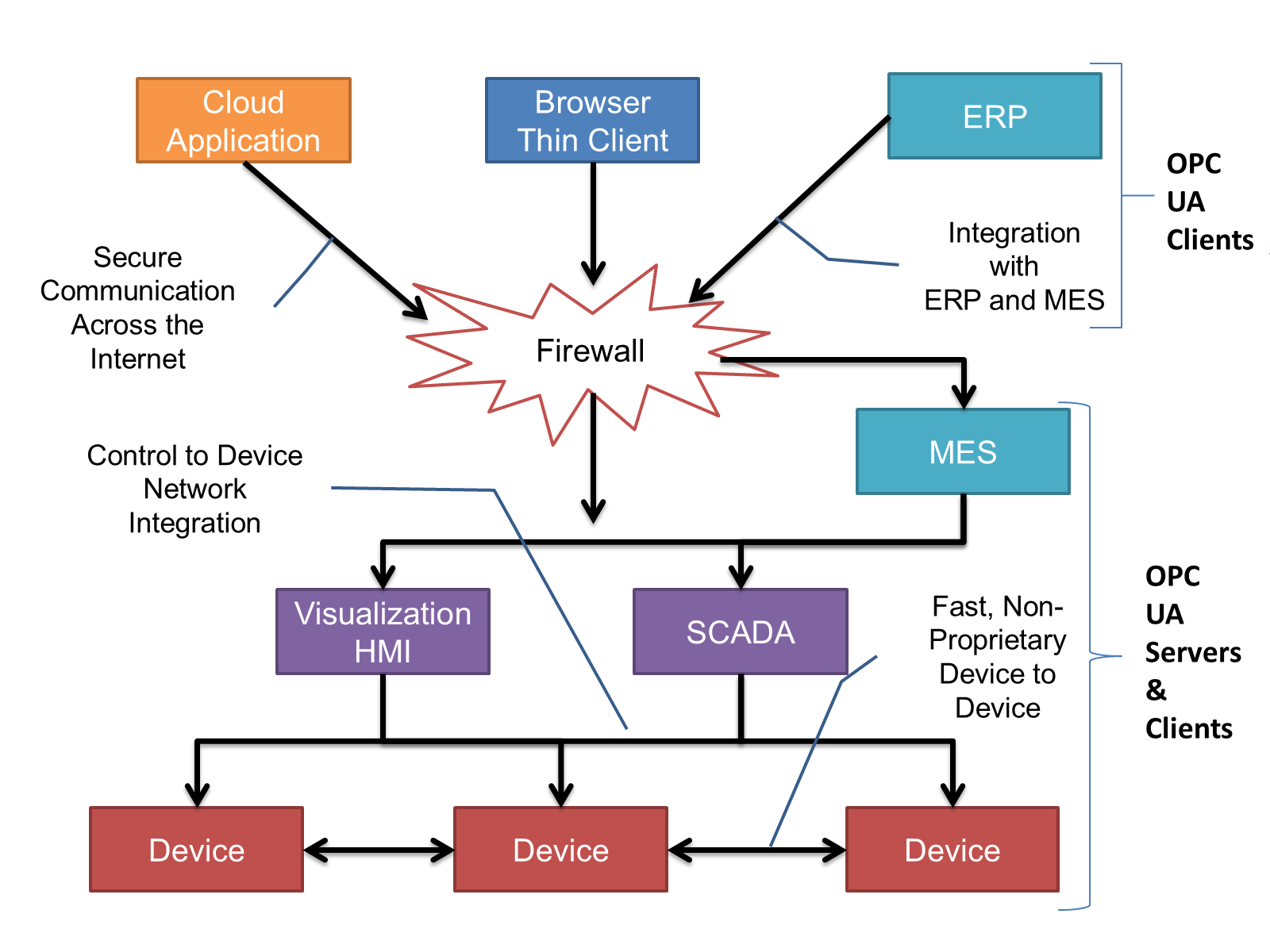
OPC UA provides a robust and reliable communication infrastructure having mechanisms for handling lost messages, failover, heartbeat, etc. With its binary encoded data, it offers a high-performing data exchange solution. Security is built into OPC UA as security requirements become more and more important especially since environments are connected to the office network or the internet and attackers are starting to focus on automation systems.
4.2.3 Information Modelling in OPC UA
4.2.3.1 Concepts
OPC UA provides a framework that can be used to represent complex information as Objects in an AddressSpace which can be accessed with standard services. These Objects consist of Nodes connected by References. Different classes of Nodes convey different semantics. For example, a Variable Node represents a value that can be read or written. The Variable Node has an associated DataType that can define the actual value, such as a string, float, structure etc. It can also describe the Variable value as a variant. A Method Node represents a function that can be called. Every Node has a number of Attributes including a unique identifier called a NodeId and non-localized name called as BrowseName. An Object representing a 'Reservation' is shown in Figure 2.
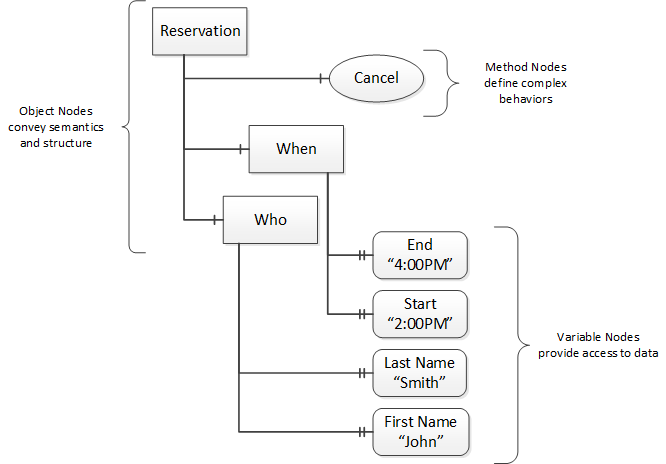
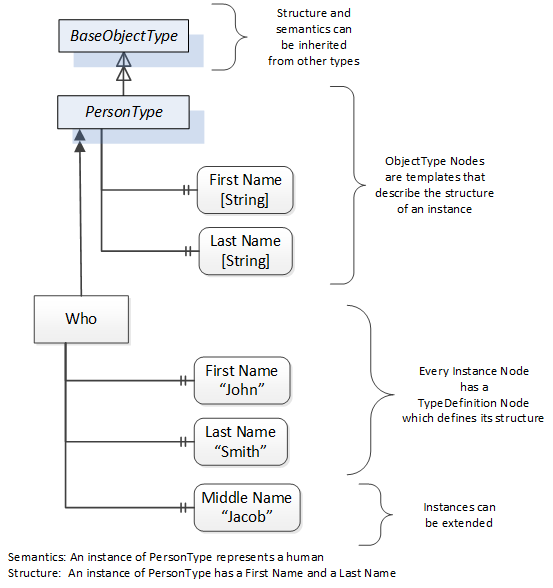
Object and Variable Nodes represent instances and they always reference a TypeDefinition (ObjectType or VariableType) Node which describes their semantics and structure. Figure 3 illustrates the relationship between an instance and its TypeDefinition.
The type Nodes are templates that define all of the children that can be present in an instance of the type. In the example in Figure 3 the PersonType ObjectType defines two children: First Name and Last Name. All instances of PersonType are expected to have the same children with the same BrowseNames. Within a type the BrowseNames uniquely identify the children. This means Client applications can be designed to search for children based on the BrowseNames from the type instead of NodeIds. This eliminates the need for manual reconfiguration of systems if a Client uses types that multiple Servers implement.
OPC UA also supports the concept of subtyping. This allows a modeller to take an existing type and extend it. There are rules regarding subtyping defined in OPC 10000-3, but in general they allow the extension of a given type or the restriction of a DataType. For example, the modeller may decide that the existing ObjectType in some cases needs an additional Variable. The modeller can create a subtype of the ObjectType and add the Variable. A Client that is expecting the parent type can treat the new type as if it was of the parent type. Regarding DataTypes, subtypes can only restrict. If a Variable is defined to have a numeric value, a sub type could restrict it to a float.
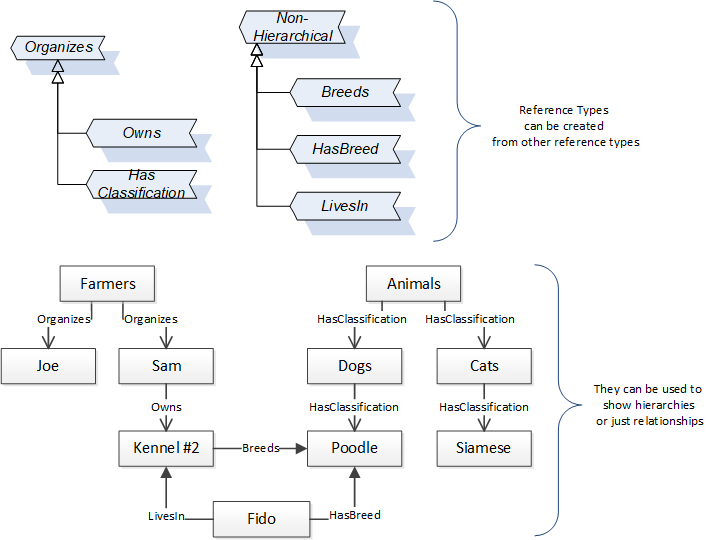
References allow Nodes to be connected in ways that describe their relationships. All References have a ReferenceType that specifies the semantics of the relationship. References can be hierarchical or non-hierarchical. Hierarchical references are used to create the structure of Objects and Variables. Non-hierarchical are used to create arbitrary associations. Applications can define their own ReferenceType by creating subtypes of an existing ReferenceType. Subtypes inherit the semantics of the parent but may add additional restrictions. Figure 4 depicts several References, connecting different Objects.
The figures above use a notation that was developed for the OPC UA specification. The notation is summarized in Figure 5. UML representations can also be used; however, the OPC UA notation is less ambiguous because there is a direct mapping from the elements in the figures to Nodes in the AddressSpace of an OPC UA Server.
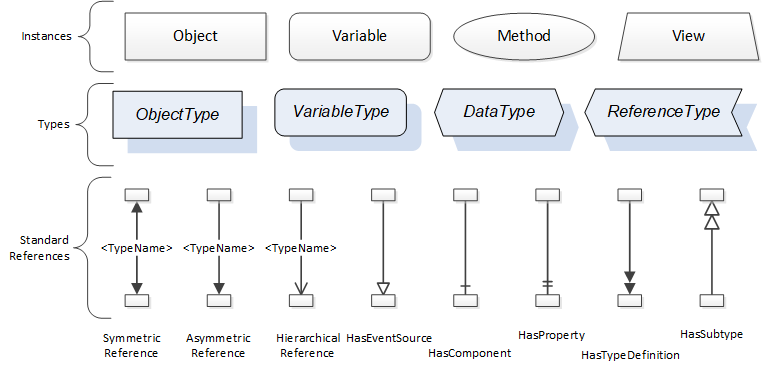
A complete description of the different types of Nodes and References can be found in OPC 10000-3 and the base structure is described in OPC 10000-5.
OPC UA specification defines a very wide range of functionality in its basic information model. It is not required that all Clients or Servers support all functionality in the OPC UA specifications. OPC UA includes the concept of Profiles, which segment the functionality into testable certifiable units. This allows the definition of functional subsets (that are expected to be implemented) within a companion specification. The Profiles do not restrict functionality, but generate requirements for a minimum set of functionality (see OPC 10000-7).
4.2.3.2 Namespaces
OPC UA allows information from many different sources to be combined into a single coherent AddressSpace. Namespaces are used to make this possible by eliminating naming and id conflicts between information from different sources. Each namespace in OPC UA has a globally unique string called a NamespaceUri which identifies a naming authority and a locally unique integer called a NamespaceIndex, which is an index into the Server's table of NamespaceUris. The NamespaceIndex is unique only within the context of a Session between an OPC UA Client and an OPC UA Server- the NamespaceIndex can change between Sessions and still identify the same item even though the NamespaceUri's location in the table has changed. The Services defined for OPC UA use the NamespaceIndex to specify the Namespace for qualified values.
There are two types of structured values in OPC UA that are qualified with NamespaceIndexes: NodeIds and QualifiedNames. NodeIds are locally unique (and sometimes globally unique) identifiers for Nodes. The same globally unique NodeId can be used as the identifier in a node in many Servers - the node's instance data may vary but its semantic meaning is the same regardless of the Server it appears in. This means Clients can have built-in knowledge of what the data means in these Nodes. OPC UA Information Models generally define globally unique NodeIds for the TypeDefinitions defined by the Information Model.
QualifiedNames are non-localized names qualified with a Namespace. They are used for the BrowseNames of Nodes and allow the same names to be used by different information models without conflict. TypeDefinitions are not allowed to have children with duplicate BrowseNames; however, instances do not have that restriction.
4.2.3.3 Companion Specifications
An OPC UA companion specification for an industry specific vertical market describes an Information Model by defining ObjectTypes, VariableTypes, DataTypes and ReferenceTypes that represent the concepts used in the vertical market, and potentially also well-defined Objects as entry points into the AddressSpace.
5 Use Cases
This specification provides building blocks for various use cases. Other specifications or vendor-specific information models can pick the building blocks for specific use cases they want to support.
5.1 Machine Identification and Nameplate
The user would like to uniquely identify machines, potentially across various OPC UA Servers or aggregating OPC UA Servers. The user wants to get standardized information about the machine, like manufacturer or serial number, and set user-specific information in order to simplify the usage of the machine.
That leads to the requirements:
A machine shall be globally uniquely identified (see section 8, ProductInstanceUri).
Information about the machine, like manufacturer or serial number, can be accessed (see section 8, IMachineVendorNameplateType).
Application-specific information about a machine can be set by an OPC UA Client (see section 8, IMachineTagNameplateType).
5.2 Finding all Machines in a Server
The user would like to easily find all machines managed by an OPC UA server.
That leads to the requirement:
All machines shall be easy to find in an OPC UA Server (see section 9, Machines Object).
5.3 Component Identification and Nameplate
The user would like to identify components of a machine. The user wants to get standardized information about the component, like manufacturer or serial number, and set user-specific information in order to simplify the usage of the component.
That leads to the requirements:
Information about the component, like manufacturer or serial number, can be accessed (see section 10.2, MachineryComponentIdentificationType).
Application-specific information about a component can be set by an OPC UA Client (see section 10.2, MachineryComponentIdentificationType).
5.4 Finding all Components of a Machine
The user would like to easily find all components related to a specific machine.
That leads to the requirement:
All components of a machine shall be easy to find in an OPC UA Server (see section 11.2, MachineComponentsType).
5.5 Monitoring
The user would like to monitor information about a specific MachineryItem, like the state or operation mode, for example to get a quick overview over the current state and bottlenecks (localization of errors), to recognize trends or to determine the relevant times (productive time, standby time, etc.) for subsequent KPI calculations (e.g., for calculating reliability and availability). Further information for the KPI calculation might be necessary.
The user would like to monitor different aspects of a MachineryItem like its status, health, process and consumption.
That leads to the requirements:
The state of a MachineryItem can be accessed (see section 12).
The operation mode of a MachineryItem can be accessed (see section 13).
All monitoring information of a MachineryItem shall be easily accessible (see section 16).
All status information of a MachineryItem shall be easily accessible (see section 16).
All health information of a MachineryItem shall be easily accessible (see section 16).
All process information of a MachineryItem shall be easily accessible (see section 16).
All consumption information of a MachineryItem shall be easily accessible (see section 16).
In Annex C an example is given, on how the state and operation mode can be used as base for KPI calculations.
5.6 Preventive Maintenance
The user would like to monitor how long a MachineryItem is powered on and doing an activity and wants to monitor the expected remaining lifetime of a MachineryItem or other aspects of a machine (like the remaining time a software licence is valid).
That leads to the requirements:
The total time a MachineryItem is turned on and the total time an activity is done can be accessed (see section 14).
The remaining estimated lifetime of a MachineryItem or other aspects of a machine can be accessed (see section 15).
5.7 Equipment Information
The user would like to access MachineryEquipment information used by a MachineryItem. The user would like to get some base information about each MachineryEquipment in a standardized way.
That leads to the requirements:
All MachineryEquipment information provided shall be easily accessible (see section 17.2).
All MachineryEquipment information shall contain some base information (see section 17.2).
5.8 Notifications
The user would like to access notifications of a MachineryItem. Those notifications may include prognosis information, noteworthy or abnormal conditions.
That leads to the requirement:
All notifications of a MachineryItem shall be easily accessible (see section 18).
6 Machinery Information Model overview
6.1 General Idea - Definition of Building Blocks
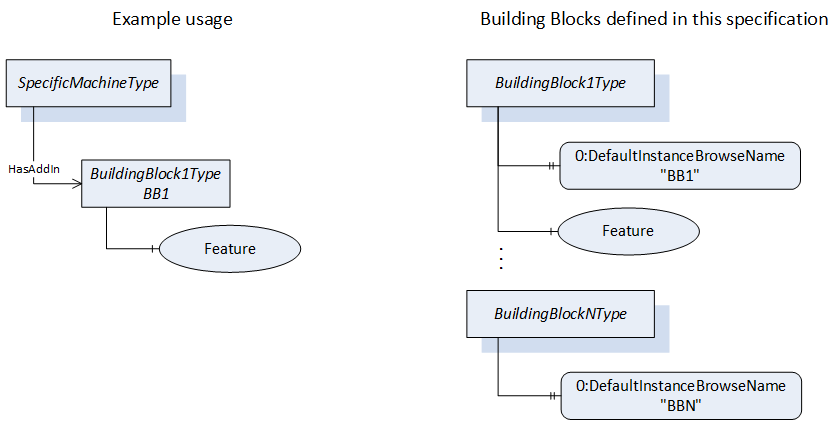
This specification defines several building blocks for various use cases in the context of machinery. The specification uses the AddIn concept defined in OPC 10000-3, in order to allow companion specifications and vendors to easily apply individual building blocks.
This is exemplified in Figure 6. On the right side of the figure, you can see ObjectTypes defining specific functionality like Identification. This includes the definition of a default BrowseName. On the left side you see an example of how such a building block is used. This type could use other building blocks as well.
6.2 Overview of the Building Blocks
This version of the specification defines
a building block for Machine Identification and Nameplate (see section 8) defined as AddIn
capabilities to find all Machines in a Server (see section 9) by defining a standardized entry point
a building block for component Identification and Nameplate (see section 10) defined as AddIn
a building block to find all identifiable components of a Machine (see section 11) defined as AddIn
a building block to represent the state of a MachineryItem (see section 12) defined as AddIn
a building block to represent the operation mode of a MachineryItem (see section 13) defined as AddIn
a building block for operation counters (see section 14) defined as AddIn
a building block for lifetime counters (see section 15) defined as AddIn
6.3 Organization of Building Blocks
6.3.1 Overview
The building blocks defined in this specification are typically AddIns that can be applied to Objects or ObjectTypes representing Machines or components of Machines.
The specification intentionally does not define an ObjectType representing a MachineryItem and intentionally leaves it open how the information for the MachineryItem is further structured in addition to the AddIns. This allows a domain-specific organization of the MachineryItem, for example defined in a domain-specific companion specification.
It is to avoid that the Objects and ObjectTypes representing a MachineryItem become a large, hard to understand substructure and it is also to avoid having flat list of all the building blocks. Therefore, this specification defines an organization Object containing the building blocks defined in this specification. This reduces the Nodes on the top-level and thus simplifies accessing the information.
Each Object or ObjectType representing a MachineryItem supporting the AddIns should have an Object of type FolderType or a subtype with the BrowseName "MachineryBuildingBlocks" (using the Namespace of OPC 40001-1), referenced with HasComponent or a subtype. All AddIns defined in this specification should be applied to this Object, i.e. being referenced with a HasAddIn Reference or a subtype from this Object. Because of the base characteristics of the identification and the relation to its subcomponents, those AddIns should be referenced directly from the Object or ObjectType representing the MachineryItem, and should be referenced in addition by the MachineryBuildingBlocks Object.
In Figure 7, an example is given. The SpecificComponentType supports the Identification AddIn as well as the BuildingBlock1 and BuildingBlock2. All three are referenced from the MachineryBuildingBlocks Object. The Identification AddIn is also referenced directly from the ObjectType, and the other AddIns from some domain-specific Objects to structure the component. The SpecificMachineType supports Identification and those two additional building blocks as well, and contains a Component1 of SpecificComponentType. Thus, the Components AddIn is referenced from the ObjectType directly, as well as from the MachineryBuildingBlocks Object.
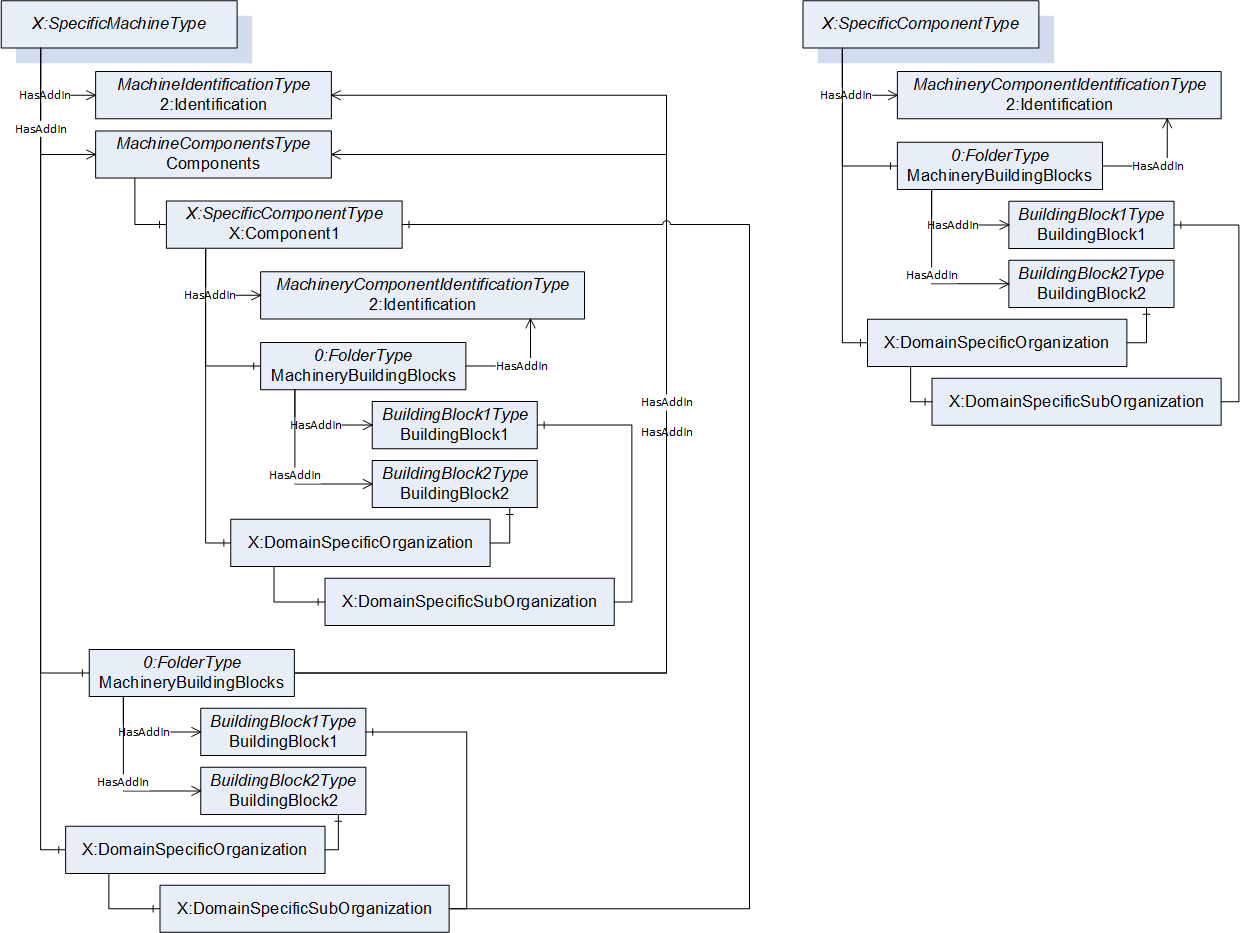
Table 12 defines, which building blocks shall or may be referenced by the MachineryBuildingBlocks folder.
| Building Block | Shall be referenced by the MachineryBuildingBlocks folder | May be referenced by the MachineryBuildingBlocks folder |
| Machine Identification and Nameplate (see 8) | - | X |
| Finding all Machines in a Server (see 9) | - | - |
| Component Identification and Nameplate (see10) | - | X |
| Finding all Identifiable Components of a Machine (see 11) | - | X |
| MachineryItemState (see 12) | X | - |
| MachineryOperationMode (see 13) | X | - |
| OperationCounters (see 14) | X | - |
| LifetimeCounters (see 15) | X | - |
| Monitoring (see 16) | X | - |
| MachineryEquipment (see 17) | X | - |
| Notifications (see 18) | X | - |
6.3.2 Well-Known FolderType BrowseNames
The FolderType BrowseNames are formally defined in Table 13.
| BrowseName | Purpose |
|---|---|
| MachineryBuildingBlocks | Folder as entry point to access machinery building blocks |
7 General Recommendations
7.1 Localization
If the text part of a value of DataType LocalizedText, like the Manufacturer or the Model of a Machine, is language neutral, i.e. it is the same in all languages, the locale of the LocalizedText shall be null or an empty string.
7.2 Optional Nodes
If the information for optional nodes (e.g., Properties) is not available and the access is read-only, the optional Node shall not be provided.
If the content of optional nodes is writable, i.e. it can be provided by end-users, system integrators, etc., it is desirable to provide the Nodes to allow the usage of them.
7.3 No duplicated Nodes
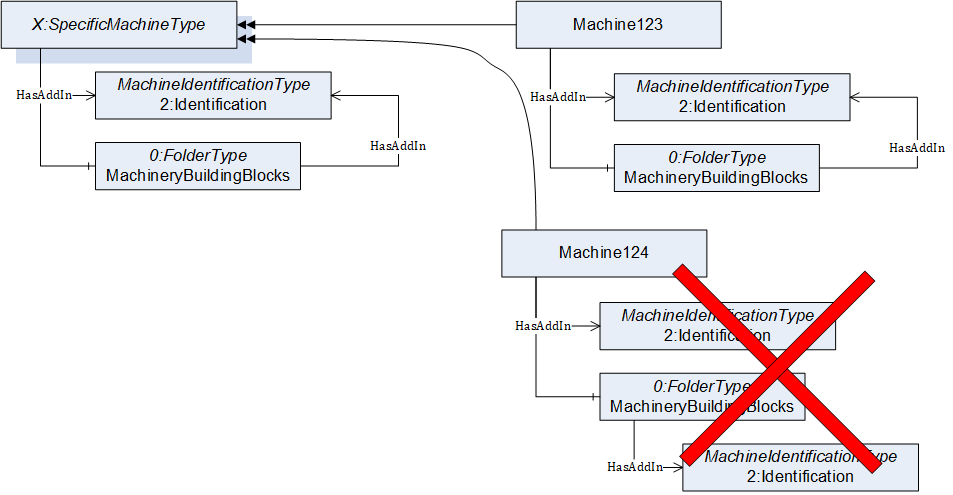
Using the MachineryBuildingBlocks Object may lead to several paths to the same Node in a TypeDefinition (see for example Figure 7). When instantiating such a TypeDefinition it is recommended to keep this approach and let several References lead to the same Node, rather than duplicating the Node. In Figure 8, an example is given. The X:SpecificMachineType is referencing the 2:Identification Object directly and from the MachineryBuildingBlocks Object. The Object Machine123 of X:SpecificMachineType is doing the same, and not duplicating the 2:Identification Object (which would be an allowed instantiation, see OPC 10000-3). This avoids unnecessary Nodes and potentially inconsistent data, like in Object Machine124.
8 Machine Identification and Nameplate
8.1 Overview
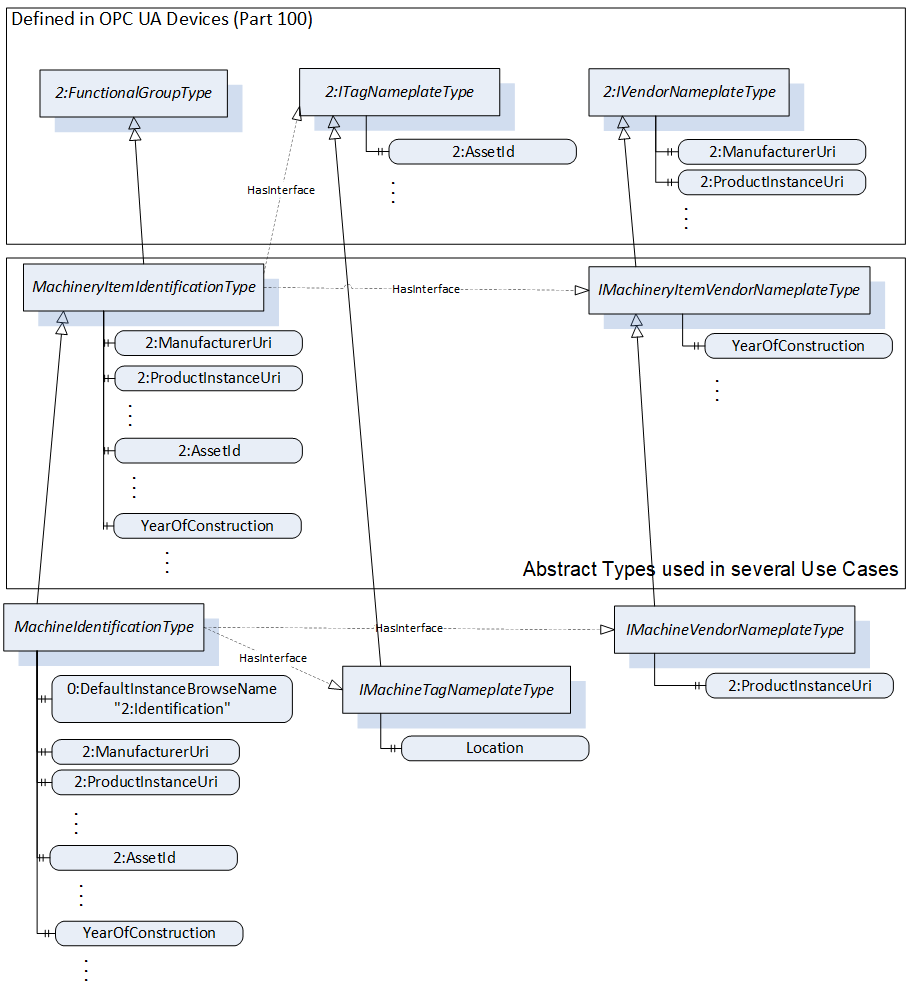
This building block provides the capabilities to globally uniquely identify a Machine and have access to vendor-defined information about the Machine and manage user-specific information for the identification of the Machine. Figure 9 gives an overview. The Interface IMachineryItemVendorNameplateType and the ObjectType MachineryItemIdentificationType are generic ObjectTypes introduced to be used in other use cases. The AddIn MachineIdentificationType with the default name "2:Identification" (as defined in OPC 10000-100), is derived from the MachineryItemIdentificationType and thus indirectly from the 2:FunctionalGroupType and implements the interfaces IMachineVendorNameplateType and IMachineTagNameplateType. IMachineVendorNameplateType is a subtype of IMachineryItemVendorNameplateType and thus indirectly from the 2:IVendorNameplateType defined in OPC 10000-100. IMachineryItemVendorNameplateType refines the usage of the Properties defined in 2:IVendorNameplateType, changes some to Mandatory and defines additional Properties. IMachineVendorNameplateType uses those definitions and makes another Property mandatory. IMachineTagNameplateType is a subtype of the 2:ITagNameplateType defined in OPC 10000-100 and refines the usage of the Properties defined in that interface, and defines an additional Property.
8.2 IMachineryItemVendorNameplateType
The IMachineryItemVendorNameplateType is a subtype of the 2:IVendorNameplateType defined in OPC 10000-100. It refines the semantics of the Properties defined in 2:IVendorNameplateType, makes some Properties mandatory and adds additional Properties. It is formally defined in Table 14.
| Attribute | Value | ||||
| BrowseName | IMachineryItemVendorNameplateType | ||||
| IsAbstract | True | ||||
| Description | Interface containing identification and nameplate information for a MachineryItem provided by the vendor | ||||
| References | Node Class | BrowseName | DataType | TypeDefinition | Other |
|---|---|---|---|---|---|
| Subtype of the 2:IVendorNameplateType defined in OPC 10000-100, i.e. inheriting the InstanceDeclarations of that Node. | |||||
| Properties of the 2:IVendorNameplateType | |||||
| 0:HasProperty | Variable | 2:Manufacturer | 0:LocalizedText | 0:PropertyType | M, RO |
| 0:HasProperty | Variable | 2:SerialNumber | 0:String | 0:PropertyType | M, RO |
| 0:HasProperty | Variable | YearOfConstruction | 0:UInt16 | 0:PropertyType | O, RO |
| 0:HasProperty | Variable | MonthOfConstruction | 0:Byte | 0:PropertyType | O, RO |
| 0:HasProperty | Variable | InitialOperationDate | 0:DateTime | 0:PropertyType | O, RO |
| Conformance Units | |||||
|---|---|---|---|---|---|
| Machinery Machine Identification | |||||
| Machinery Component Identification |
The mandatory 2:Manufacturer provides a human-readable, localized name of the manufacturer. It is defined by the 2:IVendorNameplateType. It is recommended to provide a language neutral LocalizedText. Clients shall not assume the uniqueness of the manufacturer based on this information, i.e. potentially several manufacturers use the same name. The value of this Property might change during the life-cycle of a MachineryItem, for example, when the name of the manufacturer changes due to an acquisition. The manufacturer might change this information, for example, within the next firmware update. Examples are "{"","TRUMPF"}" "{"","KUKA Deutschland GmbH"}", "{"", "ENGEL AUSTRIA GMBH"}".
The mandatory 2:SerialNumber is a string containing a unique production number of the manufacturer of the MachineryItem. It is defined by the 2:IVendorNameplateType. The global uniqueness of the serial number is only given in the context of the manufacturer, and potentially the model. The value of this Property shall not change during the life-cycle of the MachineryItem. If a manufacturer internally does not manage serial numbers, as for example for special purpose machinery manufacturers, they could use for example the order number as serial number. Examples are: "A3231E001", "643872", "235223".
The optional YearOfConstruction provides the year (Gregorian calendar) in which the manufacturing process of the MachineryItem has been completed. It shall be a four-digit number and never change during the life-cycle of a MachineryItem. For example: "2019", "2020".
The optional MonthOfConstruction provides the month in which the manufacturing process of the MachineryItem has been completed. It shall be a number between 1 and 12, representing the month from January to December. The MonthOfConstruction shall only be provided, if the YearOfConstruction is provided as well. For example, "1", "2", "3".
The optional InitialOperationDate provides the date, when the MachineryItem was switched on the first time after it has left the manufacturer plant. The value of InitialOperationDate is not meant to provide any information about the state of warranty. If the date is not provided by the MachineryItem, the InitialOperationDate should not be added. The InitialOperationDate should be provided as UTC time. For example: "2020-01-29T18:59:59Z", "2022-11-1712:00:00Z".
How the InitialOperationDate is set is vendor-specific. This might be done by some manual configuration or can be done automatically. If the InitialOperationDate is set automatically, the vendor needs to ensure, that it uses a coordinated system time.
The optional 2:ProductInstanceUri is a globally unique resource identifier provided by the manufacturer of the MachineryItem. It is defined by the 2:IVendorNameplateType. It is intended to uniquely identify the MachineryItem and shall not change during the life-cycle of the MachineryItem. The length is restricted to 255 characters and it is the responsibility of the manufacturer that the 2:ProductInstanceUri is globally unique. The recommended syntax of the 2:ProductInstanceUri is: <ManufacturerUri>/<any string>. The manufacturer might choose the serial number of the MachineryItem as <any string>, if the serial number is unique within the manufacturer's scope, or a combination of model and serial number, if the serial number is only unique within a model. Examples are: "http://www.trumpf.com/A3231E001", "http://www.kuka.com/KR210R2700_EXTRA_C4_FLR/667659", "http://www.engelglobal.com/Viper06/235223".
The optional 2:ManufacturerUri is a globally unique identifier of the manufacturer of the MachineryItem. It is defined by the 2:IVendorNameplateType. It is intended to uniquely identify the manufacturer. It is the manufacturers responsibility to use the same identifier across its products. If the 2:ManufacturerUri is provided, it is recommended to be used as Prefix in the 2:ProductInstanceUri. As 2:ManufacturerUri is recommended to be used inside the 2:ProductInstanceUri, it shall not change during the life-cycle of the MachineryItem, even if the manufacturer changes its name, e.g., due to an acquisition. Examples are: "http://www.trumpf.com", "http://www.kuka.com", "http://www.engelglobal.com".
The optional 2:Model provides a human-readable, localized name of the model of the MachineryItem. It is defined by the 2:IVendorNameplateInterfaceType. If there is no specific model, this Property should not be provided. If the physical nameplate on the MachineryItem provides a model, the Property shall be provided. It is recommended to provide a language neutral LocalizedText. Examples are "{"","TruLaser 5030 (L76)"}", "{"","VC 200/50"}", "{"","KR210R2700EXTRAC4FLR"}", "{"","Viper 6"}".
The optional 2:ProductCode provides a machine-readable string of the model of the MachineryItem, that might include options like the hardware configuration of the model. This information might be provided by the ERP system of the vendor. For example, it can be used as order information. It is defined by the 2:IVendorNameplateType. If no specific information is available, the Property should not be provided. The value of this Property shall not change during the life-cycle of the MachineryItem. Examples are "11182372", "2377636".
The optional 2:HardwareRevision provides a string representation of the revision level of the hardware of a MachineryItem. Hardware is physical equipment, as opposed to programs, procedures, rules and associated documentation (see IEC 61499-1, [2]). The Property is defined by the 2:IVendorNameplateType. Many Machines will not provide such information due to the modular and configurable nature of the Machine. The value of this Property might change during the life-cycle of a MachineryItem. Examples are: "01.33", "A2", "014/15120129-2018".
The optional 2:SoftwareRevision provides a string representation of the overall software revision level of a MachineryItem. It is defined by the 2:IVendorNameplateType. In most cases, MachineryItems consist of several software components. In that case, information about the software components might be provided as additional information in the AddressSpace, including individual revision information. The 2:SoftwareRevision is either not provided or provides an overall software revision level. The value of this Property might change during the life-cycle of a MachineryItem. Examples are: "PLL01 1.10.0.3" "V05.01.01.15", "3.1 R1293", "70.0.1", "4.60.03".
The optional Properties 2:DeviceRevision, 2:RevisionCounter and 2:DeviceManual defined by the 2:IVendorNameplateType are not further defined in this Interface.
The optional 2:DeviceClass, defined by the 2:IVendorNameplateType, should only be used, when a companion specification defines concrete values for specific MachineryItem classes. This specification does not define any values for this Property. Examples are: "Injection Moulding Machine", "Drilling Machine".
The InstanceDeclarations of the IMachineryItemVendorNameplateType have additional Attribute values defined in Table 15.
| BrowsePath | Value Attribute | Description Attribute |
| 2:Manufacturer | - | A human-readable, localized name of the manufacturer of the MachineryItem. |
| 2:SerialNumber | - | A string containing a unique production number of the manufacturer of the MachineryItem. The global uniqueness of the serial number is only given in the context of the manufacturer, and potentially the model. The value shall not change during the life-cycle of the MachineryItem. |
| YearOfConstruction | - | The year (Gregorian calendar) in which the manufacturing process of the MachineryItem has been completed. It shall be a four-digit number and never change during the life-cycle of a MachineryItem. |
| MonthOfConstruction | - | The month in which the manufacturing process of the MachineryItem has been completed. It shall be a number between 1 and 12, representing the month from January to December. |
| InitialOperationDate | - | The date, when the MachineryItem was switched on the first time after it has left the manufacturer plant. |
8.3 MachineryItemIdentificationType ObjectType Definition
The MachineryItemIdentificationType is an abstract ObjectType and cannot be used directly. It provides identification and other identification information of a MachineryItem and is formally defined in Table 22.
| Attribute | Value | ||||
| BrowseName | MachineryItemIdentificationType | ||||
| IsAbstract | True | ||||
| Description | Contains information about the identification and nameplate of a MachineryItem | ||||
| References | Node Class | BrowseName | DataType | TypeDefinition | Other |
|---|---|---|---|---|---|
| Subtype of the 2:FunctionalGroupType defined in OPC 10000-100, i.e. inheriting the InstanceDeclarations of that Node. | |||||
| 0:HasInterface | ObjectType | IMachineryItemVendorNameplateType | |||
| 0:HasInterface | ObjectType | 2:ITagNameplateType | |||
| 0:HasProperty | Variable | 0:DefaultInstanceBrowseName | 0:QualifiedName | 0:PropertyType | |
| Applied from IMachineryItemVendorNameplateType | |||||
| 0:HasProperty | Variable | 2:ProductInstanceUri | 0:String | 0:PropertyType | O, RO |
| 0:HasProperty | Variable | 2:Manufacturer | 0:LocalizedText | 0:PropertyType | M, RO |
| 0:HasProperty | Variable | 2:ManufacturerUri | 0:String | 0:PropertyType | O, RO |
| 0:HasProperty | Variable | 2:Model | 0:LocalizedText | 0:PropertyType | O, RO |
| 0:HasProperty | Variable | 2:ProductCode | 0:String | 0:PropertyType | O, RO |
| 0:HasProperty | Variable | 2:HardwareRevision | 0:String | 0:PropertyType | O, RO |
| 0:HasProperty | Variable | 2:SoftwareRevision | 0:String | 0:PropertyType | O, RO |
| 0:HasProperty | Variable | 2:DeviceClass | 0:String | 0:PropertyType | O, RO |
| 0:HasProperty | Variable | 2:SerialNumber | 0:String | 0:PropertyType | M, RO |
| 0:HasProperty | Variable | YearOfConstruction | 0:UInt16 | 0:PropertyType | O, RO |
| 0:HasProperty | Variable | MonthOfConstruction | 0:Byte | 0:PropertyType | O, RO |
| 0:HasProperty | Variable | InitialOperationDate | 0:DateTime | 0:PropertyType | O, RO |
| Applied from 2:ITagNameplateType | |||||
| 0:HasProperty | Variable | 2:AssetId | 0:String | 0:PropertyType | O, RW |
| 0:HasProperty | Variable | 2:ComponentName | 0:LocalizedText | 0:PropertyType | O, RW |
| Conformance Units | |||||
|---|---|---|---|---|---|
| Machinery Machine Identification | |||||
| Machinery Component Identification |
The Properties 2:ProductInstanceUri, 2:Manufacturer, 2:ManufacturerUri, 2:Model, 2:ProductCode, 2:HardwareRevision, 2:SoftwareRevision, 2:DeviceClass, 2:SerialNumber, YearOfConstruction, and InitialOperationDate are defined by the IMachineryItemVendorNameplateType and shall be used as defined by the Interface.
In some subtypes it is not recommended to use the Properties 2:DeviceRevision, 2:RevisionCounter and 2:DeviceManual defined by the 2:IVendorNameplateType and inherited by the IMachineVendorNameplateType. Therefore, those optional Properties are not applied on the ObjectType. Subtypes of this ObjectType might add those Properties.
The Properties 2:AssetId and 2:ComponentName are defined by the 2:ITagNameplateType and shall be used as defined by the Interface.
The InstanceDeclarations of the MachineryItemIdentificationType have additional Attribute values defined in Table 23.
| BrowsePath | Value Attribute | Description Attribute |
| 0:DefaultInstanceBrowseName | 2:Identification | The default BrowseName for instances of the type. |
| 2:ProductInstanceUri | - | A globally unique resource identifier provided by the manufacturer of the MachineryItem. |
| 2:Manufacturer | - | A human-readable, localized name of the manufacturer of the MachineryItem. |
| 2:ManufacturerUri | - | A globally unique identifier of the manufacturer of the MachineryItem. |
| 2:Model | - | A human-readable, localized name of the model of the MachineryItem. |
| 2:ProductCode | - | A machine-readable string of the model of the MachineryItem, that might include options like the hardware configuration of the model. This information might be provided by the ERP system of the vendor. For example, it can be used as order information. |
| 2:HardwareRevision | - | A string representation of the revision level of the hardware of a MachineryItem. Hardware is physical equipment, as opposed to programs, procedures, rules and associated documentation. Many machines will not provide such information due to the modular and configurable nature of the machine. |
| 2:SoftwareRevision | - | A string representation of the revision level of a MachineryItem. In most cases, MachineryItems consist of several software components. In that case, information about the software components might be provided as additional information in the address space, including individual revision information. In that case, this property is either not provided or provides an overall software revision level. The value might change during the life-cycle of a MachineryItem. |
| 2:DeviceClass | - | Indicates in which domain or for what purpose the MachineryItem is used. |
| 2:SerialNumber | - | A string containing a unique production number of the manufacturer of the MachineryItem. The global uniqueness of the serial number is only given in the context of the manufacturer, and potentially the model. The value shall not change during the life-cycle of the MachineryItem. |
| YearOfConstruction | - | The year (Gregorian calendar) in which the manufacturing process of the MachineryItem has been completed. It shall be a four-digit number and never change during the life-cycle of a MachineryItem. |
| MonthOfConstruction | - | The month in which the manufacturing process of the MachineryItem has been completed. It shall be a number between 1 and 12, representing the month from January to December. |
| InitialOperationDate | - | The date, when the MachineryItem was switched on the first time after it has left the manufacturer plant. |
| 2:AssetId | "" | To be used by end users to store a unique identification in the context of their overall application. Servers shall support at least 40 Unicode characters for the clients writing this value, this means clients can expect to be able to write strings with a length of 40 Unicode characters into that field. |
| 2:ComponentName | "" | To be used by end users to store a human-readable localized text for the MachineryItem. The minimum number of locales supported for this property shall be two. Servers shall support at least 40 Unicode characters for the clients writing the text part of each locale, this means clients can expect to be able to write texts with a length of 40 Unicode characters into that field. |
8.4 IMachineVendorNameplateType
The IMachineVendorNameplateType is a subtype of the IMachineryItemVendorNameplateType. It makes one Property mandatory. It is formally defined in Table 18.
| Attribute | Value | ||||
| BrowseName | IMachineVendorNameplateType | ||||
| IsAbstract | True | ||||
| Description | Interface containing identification and nameplate information for a machine provided by the machine vendor | ||||
| References | Node Class | BrowseName | DataType | TypeDefinition | Other |
|---|---|---|---|---|---|
| Subtype of the IMachineryItemVendorNameplateType defined in 8.2, i.e. inheriting the InstanceDeclarations of that Node. | |||||
| Properties of the 2:IVendorNameplateType | |||||
| 0:HasProperty | Variable | 2:ProductInstanceUri | 0:String | 0:PropertyType | M, RO |
| Conformance Units | |||||
|---|---|---|---|---|---|
| Machinery Machine Identification |
The Properties defined by the IMachineryItemVendorNameplateType shall be used as defined by that Interface.
It is not recommended to use the optional Properties 2:DeviceRevision, 2:RevisionCounter and 2:DeviceManual defined by the 2:IVendorNameplateType.
The InstanceDeclarations of the IMachineVendorNameplateType have additional Attribute values defined in Table 19.
| BrowsePath | Value Attribute | Description Attribute |
| 2:ProductInstanceUri | - | A globally unique resource identifier provided by the manufacturer of the machine |
8.5 IMachineTagNameplateType
The IMachineTagNameplateType is a subtype of the 2:ITagNameplateType defined in OPC 10000-100. It refines the semantics of the Properties defined in 2:ITagNameplateType, and adds an additional Property. It is formally defined in Table 20.
| Attribute | Value | ||||
| BrowseName | IMachineTagNameplateType | ||||
| IsAbstract | True | ||||
| Description | Interface containing information of the identification of a machine set by the customer | ||||
| References | Node Class | BrowseName | DataType | TypeDefinition | Other |
|---|---|---|---|---|---|
| Subtype of the 2:ITagNameplateType defined in OPC 10000-100, i.e. inheriting the InstanceDeclarations of that Node. | |||||
| 0:HasProperty | Variable | Location | 0:String | 0:PropertyType | O, RW |
| Conformance Units | |||||
|---|---|---|---|---|---|
| Machinery Machine Identification |
The optional 2:AssetId is a writable string. It is defined by the 2:ITagNameplateType. The default value shall be an empty string. The Property is intended to be used by end users to store a unique identification in the context of their overall application. Servers shall support at least 40 Unicode characters for the clients writing this value, this means clients can expect to be able to write strings with a length of 40 Unicode characters into that field.
The optional 2:ComponentName is a writable localized text. It is defined by the 2:ITagNameplateType. The default value shall be an empty string for locale and text. The Property is intended to be used by end users to store a human-readable localized text for the Machine. The minimum number of locales supported for this Property shall be two. Servers shall support at least 40 Unicode characters for the clients writing the text part of each locale, this means clients can expect to be able to write texts with a length of 40 Unicode characters into that field.
The optional Location is a writable string. The Property is intended to be used by end users to store the location of the Machine in a scheme specific to the end user. Servers shall support at least 60 Unicode characters for the clients writing this value, this means clients can expect to be able to write strings with a length of 60 Unicode characters into that field. Examples are "Munich/A2/217", "Area 51".
The InstanceDeclarations of the IMachineTagNameplateType have additional Attribute values defined in Table 21.
| BrowsePath | Value Attribute | Description Attribute |
| Location | - | To be used by end users to store the location of the machine in a scheme specific to the end user Servers shall support at least 60 Unicode characters for the clients writing this value, this means clients can expect to be able to write strings with a length of 60 Unicode characters into that field. |
8.6 MachineIdentificationType ObjectType Definition
The MachineIdentificationType provides a globally unique identification of a Machine and other identification information of a Machine and is formally defined in Table 22.
| Attribute | Value | ||||
| BrowseName | MachineIdentificationType | ||||
| IsAbstract | False | ||||
| Description | Contains information about the identification and nameplate of a machine | ||||
| References | Node Class | BrowseName | DataType | TypeDefinition | Other |
|---|---|---|---|---|---|
| Subtype of the MachineryItemIdentificationType defined in 8.3, i.e. inheriting the InstanceDeclarations of that Node. | |||||
| 0:HasProperty | Variable | 0:DefaultInstanceBrowseName | 0:QualifiedName | 0:PropertyType | - |
| 0:HasInterface | ObjectType | IMachineVendorNameplateType | |||
| 0:HasInterface | ObjectType | IMachineTagNameplateType | |||
| Applied from IMachineVendorNameplateType | |||||
| 0:HasProperty | Variable | 2:ProductInstanceUri | 0:String | 0:PropertyType | M, RO |
| Applied from IMachineTagNameplateType | |||||
| 0:HasProperty | Variable | Location | 0:String | 0:PropertyType | O, RW |
| Conformance Units | |||||
|---|---|---|---|---|---|
| Machinery Machine Identification |
The Properties 2:ProductInstanceUri, 2:Manufacturer, 2:ManufacturerUri, 2:Model, 2:ProductCode, 2:HardwareRevision, 2:SoftwareRevision, 2:DeviceClass, 2:SerialNumber, YearOfConstruction and InitialOperationDate are defined by the IMachineVendorNameplateType and already inherited from the MachineryItemIdentificationType and shall be used as defined by both. The 2:ProductInstanceUri is mandatory.
It is not recommended to use the optional Properties 2:DeviceRevision, 2:RevisionCounter and 2:DeviceManual defined by the 2:IVendorNameplateType and inherited by the IMachineVendorNameplateType. Therefore, those optional Properties are not applied on the ObjectType.
The Properties 2:AssetId, 2:ComponentName, and Location are defined by the IMachineTagNameplateType and shall be used as defined by the Interface. 2:AssetId and 2:ComponentName are also inherited from the MachineryItemIdentificationType.
The InstanceDeclarations of the MachineIdentificationType have additional Attribute values defined in Table 23.
| BrowsePath | Value Attribute | Description Attribute |
| 0:DefaultInstanceBrowseName | 2:Identification | The default BrowseName for instances of the type. |
| 2:ProductInstanceUri | - | A globally unique resource identifier provided by the manufacturer of the machine |
| Location | - | To be used by end users to store the location of the machine in a scheme specific to the end user. Servers shall support at least 60 Unicode characters for the clients writing this value, this means clients can expect to be able to write strings with a length of 60 Unicode characters into that field. |
9 Finding all Machines in a Server
9.1 Overview
An OPC UA Server may contain many Nodes, organized in vendor-specific ways. The OPC UA specification already defines entry points to start browsing instances or types. However, finding specific Nodes might be challenging since they may be managed somewhere inside the hierarchies of Nodes of the OPC UA Server.
This building block provides the capability to easily find all Machines managed in a Server. Figure 10 gives an overview. There is a well-defined Object in the AddressSpace as entry point to browse to Objects representing a Machine.
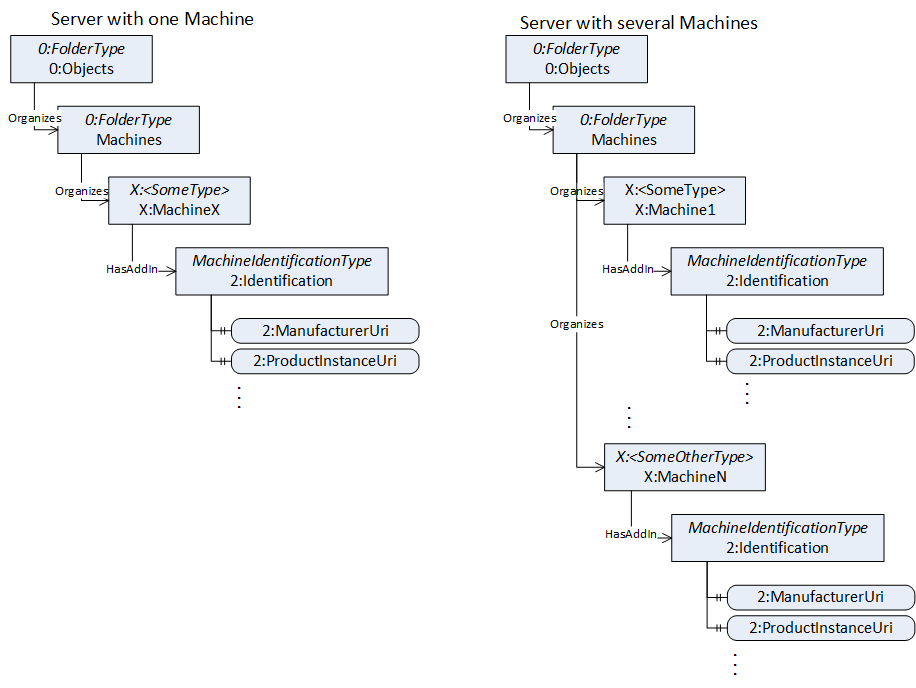
In many cases, Servers will only manage one Machine. For example, if the Server runs on the PLC of a particular Machine. However, Servers can also manage several Machines, for example, in a cell or production line, or a robot system consisting of a controller and a robot, or when aggregating Machines of a factory floor, a factory, or company-wide.
9.2 Machines Object Definition
The Machines Object is a standardized entry point to access all Machines managed in the Server and formally defined in Table 24. All Objects representing Machines, that are managed in the Server, shall be referenced directly from this Object with a Reference of ReferenceType Organizes or a subtype of Organizes.
| Attribute | Value | |||
| BrowseName | Machines | |||
| Description | This object is the entry point to machines managed in the server. All machines are directly referenced by this object. | |||
| References | NodeClass | BrowseName | DataType | TypeDefinition |
|---|---|---|---|---|
| OrganizedBy by the 0:Objects defined in OPC 10000-5 | ||||
| 0:HasTypeDefinition | ObjectType | 0:FolderType | Defined in OPC 10000-5 | |
| Conformance Units | ||||
|---|---|---|---|---|
| Machinery Find Machines |
In order to identify the referenced Objects as representations of Machines, each of those Objects shall provide the MachineIdentificationType AddIn using the 0:DefaultInstanceBrowseName as a direct sub-component of the Object (referenced with a Reference of ReferenceType 0:HasAddIn or a subtype of it).
The Machines Object shall be referenced from the 0:Objects Object defined in OPC 10000-5 with an Organizes Reference.
Since later versions of this specification might change the parent of this Object, Clients aware of this standardized Object shall not access it via its parent but directly via its standardized NodeId.
10 Component Identification and Nameplate
10.1 Overview
This building block provides the capabilities to identify components of a Machine and have access to vendor-defined information about the components and manage user-specific information for the identification of the component.
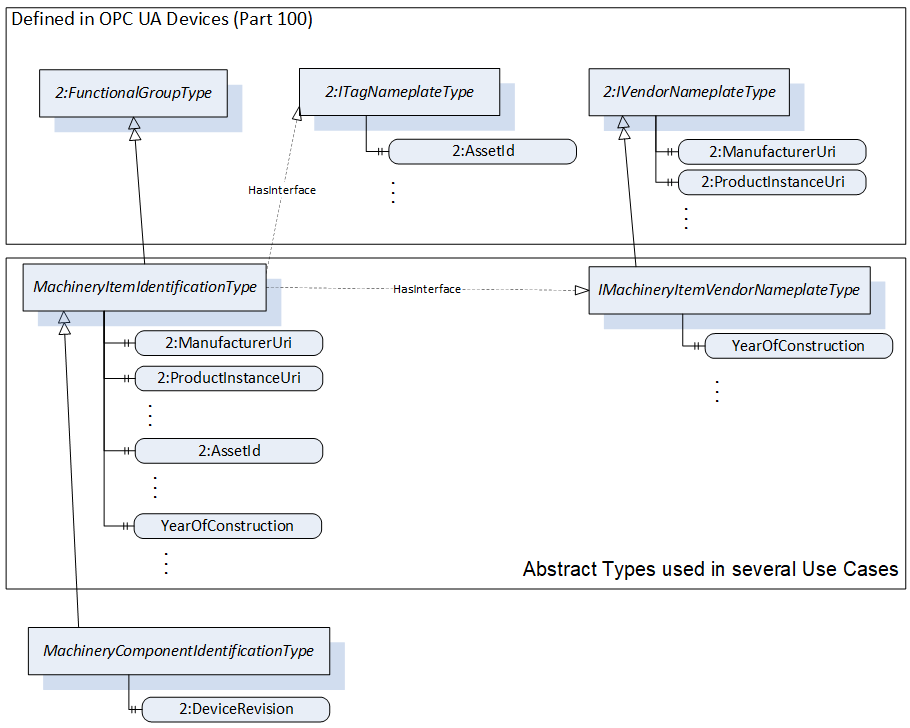
Figure 11 gives an overview. The AddIn MachineryComponentIdentificationType with the default name "2:Identification" (as defined in OPC 10000-100) is derived from the MachineryItemIdentificationType and thus indirectly from the 2:FunctionalGroupType. It adds Properties and refines the semantics of the inherited Properties.
10.2 MachineryComponentIdentificationType ObjectType Definition
The MachineryComponentIdentificationType provides identification information about a component, like manufacturer or serial number, and allows setting user-specific information like 2:ComponentName and is formally defined in Table 22.
| Attribute | Value | ||||
| BrowseName | MachineryComponentIdentificationType | ||||
| IsAbstract | False | ||||
| Description | Contains information about the identification and nameplate of a component | ||||
| References | Node Class | BrowseName | DataType | TypeDefinition | Other |
|---|---|---|---|---|---|
| Subtype of the MachineryItemIdentificationType defined in 8.3, i.e. inheriting the InstanceDeclarations of that Node. | |||||
| 0:HasProperty | Variable | 0:DefaultInstanceBrowseName | 0:QualifiedName | 0:PropertyType | - |
| 0:HasProperty | Variable | 2:DeviceRevision | 0:String | 0:PropertyType | O, RO |
| Conformance Units | |||||
|---|---|---|---|---|---|
| Machinery Component Identification |
The optional 2:DeviceRevision is defined by the 2:IVendorNameplateType, but not included in the MachineryItemIdentificationType. Therefore, it is added to the MachineryComponentIdentificationType. It provides the overall revision level of the component. Often, it is increased when either the SoftwareRevision and / or the 2:HardwareRevision of the component is increased. As an example, this Property can be used in ERP systems together with the 2:ProductCode Property. Examples are: "PLL01 1.10.0.3" "V05.01.01.15", "3.1 R1293", "70.0.1", "4.60.03".
It is not recommended to use the optional Properties 2:RevisionCounter and 2:DeviceManual defined by the 2:IVendorNameplateType and inherited by the IMachineVendorNameplateType.
A Machine vendor should not generate a 2:ProductInstanceUri for components of its Machine, but take the one provided by the component manufacturer. If the component manufacturer does not provide such a 2:ProductInstanceUri, the Property shall be omitted. Clients can use the 2:ProductInstanceUri of the Machine in combination with the NodeId of the component to generate a globally unique identification, which is only valid in the context of the Machine. Examples are: http://www.example.com/A3231E001.
A Machine vendor should not change the InitialOperationDate for components of its Machine, but take the one provided by the component manufacturer.
Machine vendors might use the 2:AssetId to provide their internal machine-readable identification of the component. In that case, the Property might be provided as read-only.
Machine vendors shall not use the 2:ComponentName Property to manage its identification of the component. Instead of, the BrowseName and DisplayName Attributes of the Object representing the component shall be used for that purpose.
The InstanceDeclarations of the MachineryComponentIdentificationType have additional Attribute values defined in Table 26.
| BrowsePath | Value Attribute | Description Attribute |
| 0:DefaultInstanceBrowseName | 2:Identification | The default BrowseName for instances of the type. |
| 2:DeviceRevision | - | A string representation of the overall revision level of the component. Often, it is increased when either the SoftwareRevision and / or the HardwareRevision of the component is increased. As an example, it can be used in ERP systems together with the ProductCode. |
11 Finding all identifiable Components of a Machine
11.1 Overview
Machines may organize their components in many different ways. Therefore, it might be challenging to find all components that are part of a Machine.
This building block provides the capability to easily find all identifiable components (providing the Identification Object) of a Machine. Figure 12 gives an overview. Each Machine providing this building block provides the Components Object, which directly references all identifiable components of a Machine.
Note: That does not preclude that a Machine is organizing its components in various other hierarchies as well.
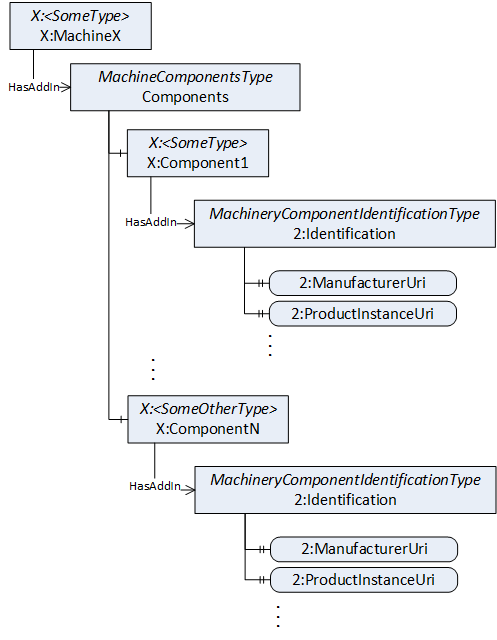
As a special case, a Machine might contain other Machines as components. In that case, the contained Machine is referenced from the Components Object like any other component, as shown in Figure 13. In addition, the contained Machine is also referenced from the Machines Object directly, as also shown in the Figure.
Note: Consider the example of a Machine MachineA containing a Machine MachineB. Components of the contained MachineB are typically only considered to be components of MachineB, that is, they are typically not directly referenced from the Components Object of the containing MachineA.
Note: It is expected that domain-specific companion specifications using this specification will define what assets of the domain in what usage are considered to be Machines or components of Machines.
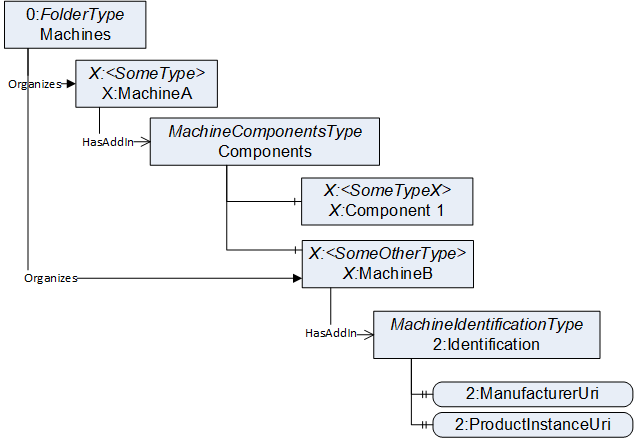
11.2 MachineComponentsType ObjectType Definition
The MachineComponentsType provides HasComponent References to all identifiable components of a Machine and is formally defined in Table 27.
| Attribute | Value | ||||
| BrowseName | MachineComponentsType | ||||
| IsAbstract | False | ||||
| Description | Contains all identifiable components of a machine | ||||
| References | Node Class | BrowseName | DataType | TypeDefinition | Other |
|---|---|---|---|---|---|
| Subtype of the 0:BaseObjectType defined in OPC 10000-5, i.e. inheriting the InstanceDeclarations of that Node. | |||||
| 0:HasProperty | Variable | 0:DefaultInstanceBrowseName | 0:QualifiedName | 0:PropertyType | - |
| 0:HasComponent | Object | <Component> | 0:BaseObjectType | OP | |
| Conformance Units | |||||
|---|---|---|---|---|---|
| Machinery Find Components of Machines |
The <Component> Object has the ModellingRule OptionalPlaceholder and represents the identifiable components of a Machine. As any ObjectType can be used for components, it is of BaseObjectType. As all identifiable components shall contain the Identification Object, <Component> references to that AddIn as defined in Table 28. As a Machine can contain other Machines, it does not reference to the MachineryComponentIdentificationType, but the MachineryItemIdentificationType, which is the abstract supertype of MachineryComponentIdentificationType and MachineIdentificationType.
| SourceBrowsePath | References | NodeClass | BrowseName | DataType | TypeDefinition | Others |
| <Component> | 0:HasAddIn | Object | 2:Identification | MachineryItemIdentificationType | M |
The InstanceDeclarations of the MachineComponentsType have additional Attribute values defined in Table 29.
| BrowsePath | Value Attribute | Description Attribute |
| 0:DefaultInstanceBrowseName | Components | The default BrowseName for instances of the type. |
| <Component> | - | Represents the identifiable components of a machine. |
12 MachineryItemState
12.1 Overview
This building block provides information about the state of a MachineryItem. It defines some common top-level states. Companion specifications or vendors might extend those states with substates, but cannot add additional top-level states. In order to have a modelling mechanism that allows the creation of substate, but also to define causes and effects on specific transitions, the concept of a FiniteStateMachine defined in OPC 10000-16 is used. Since the intention of this base specification is not to restrict the Transitions between the States, the StateMachine defines Transitions between all States. Instances might restrict the usage of the defined States and Transitions. That might be used by domain-specific companion specifications to restrict the usage of the StateMachine. An overview of the StateMachine is given in Figure 14. The States are further described in 12.2.
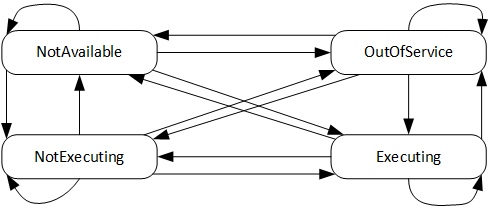
The overview of the building block is shown in Figure 15. The MachineryItemState_StateMachineType is a subtype of the FiniteStateMachineType defining the States and Transitions of that StateMachine. The usage of the building block is also shown in that figure. An instance of the MachineryItemState_StateMachineType is added to the Object MyMachine representing a Machine using the AddIn concept. The MachineryItemState_StateMachineType is defined in 12.2.
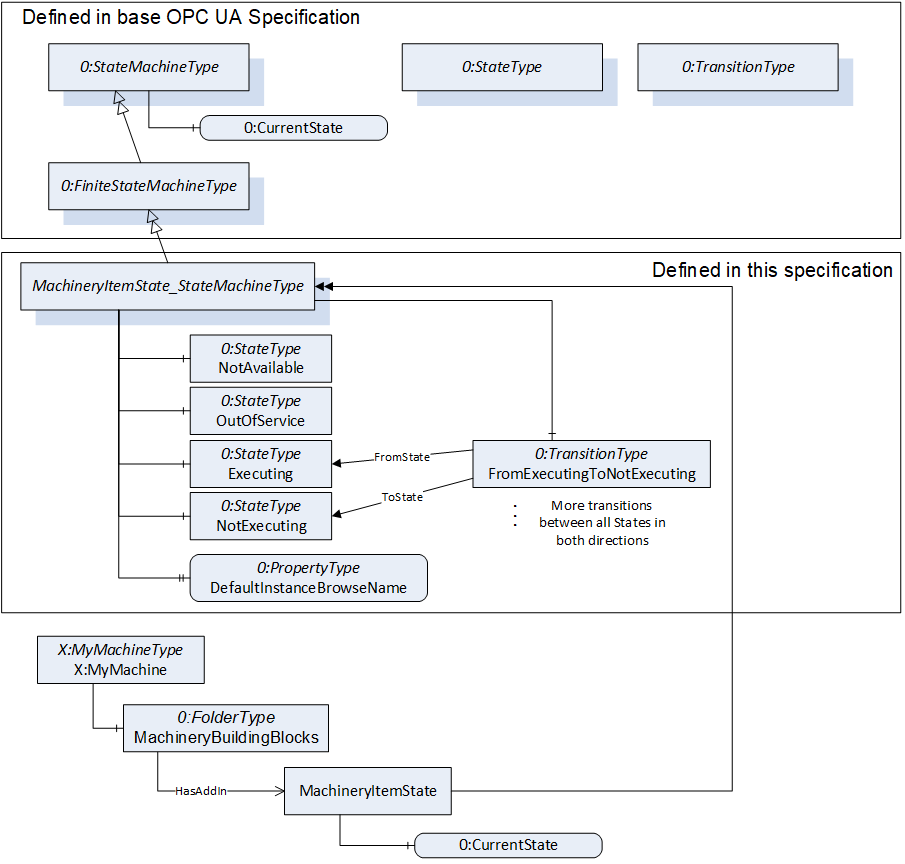
In Figure 16, a more complex example is shown, where the Machine also contains a component having the MachineryItemState.
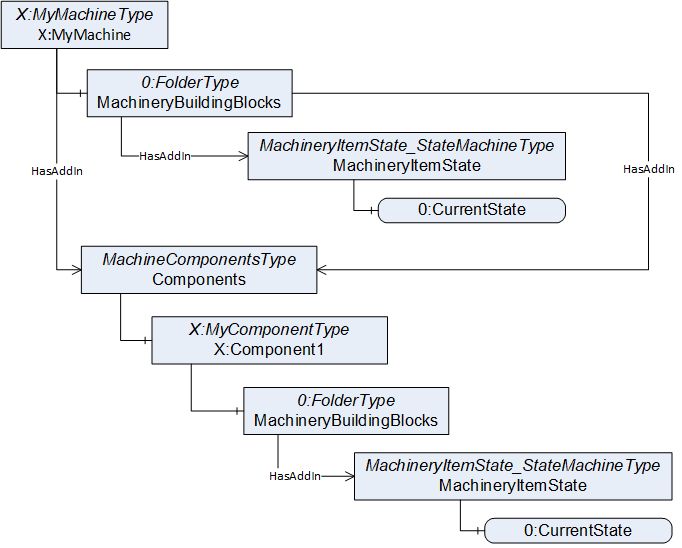
12.2 MachineryItemState_StateMachineType
The MachineryItemState_StateMachineType is a subtype of FiniteStateMachineType defined in OPC 10000-16. The semantic of this AddIn is to provide the state of a MachineryItem. It is formally defined in Table 30.
| Attribute | Value | ||||
| BrowseName | MachineryItemState_StateMachineType | ||||
| IsAbstract | False | ||||
| Description | State machine representing the state of a machinery item | ||||
| References | Node Class | BrowseName | DataType | TypeDefinition | Other |
|---|---|---|---|---|---|
| Subtype of the 0:FiniteStateMachineType defined in OPC 10000-16, i.e. inheriting the InstanceDeclarations of that Node. | |||||
| 0:HasProperty | Variable | 0:DefaultInstanceBrowseName | 0:QualifiedName | 0:PropertyType | - |
| 0:HasComponent | Object | NotAvailable | - | 0:StateType | - |
| 0:HasComponent | Object | OutOfService | - | 0:StateType | - |
| 0:HasComponent | Object | Executing | - | 0:StateType | - |
| 0:HasComponent | Object | NotExecuting | - | 0:StateType | - |
| 0:HasComponent | Object | FromNotAvailableToOutOfService | - | 0:TransitionType | - |
| 0:HasComponent | Object | FromNotAvailableToNotExecuting | - | 0:TransitionType | - |
| 0:HasComponent | Object | FromNotAvailableToExecuting | - | 0:TransitionType | - |
| 0:HasComponent | Object | FromNotAvailableToNotAvailable | - | 0:TransitionType | - |
| 0:HasComponent | Object | FromOutOfServiceToNotAvailable | - | 0:TransitionType | - |
| 0:HasComponent | Object | FromOutOfServiceToNotExecuting | - | 0:TransitionType | - |
| 0:HasComponent | Object | FromOutOfServiceToExecuting | - | 0:TransitionType | - |
| 0:HasComponent | Object | FromOutOfServiceToOutOfService | - | 0:TransitionType | - |
| 0:HasComponent | Object | FromNotExecutingToNotAvailable | - | 0:TransitionType | - |
| 0:HasComponent | Object | FromNotExecutingToOutOfService | - | 0:TransitionType | - |
| 0:HasComponent | Object | FromNotExecutingToExecuting | - | 0:TransitionType | - |
| 0:HasComponent | Object | FromNotExecutingToNotExecuting | - | 0:TransitionType | - |
| 0:HasComponent | Object | FromExecutingToNotAvailable | - | 0:TransitionType | - |
| 0:HasComponent | Object | FromExecutingToOutOfService | - | 0:TransitionType | - |
| 0:HasComponent | Object | FromExecutingToNotExecuting | - | 0:TransitionType | - |
| 0:HasComponent | Object | FromExecutingToExecuting | - | 0:TransitionType | - |
| Conformance Units | |||||
|---|---|---|---|---|---|
| Machinery MachineryItem State |
The States and Transitions define a StateMachine as shown in Figure 14. It does not define an initial State, i.e., the initial State is vendor-specific.
Note: None of the States or Transitions have a ModellingRule, i.e., they are only provided in the TypeDefinition, not on the instance. The CurrentState Variable (inherited from StateMachineType) contains the information of the current State of the instance.
The NotAvailable State represents that the MachineryItem is not available and does not perform any activity.
Examples for this State are that the Machine is switched off or is in energy saving mode.
Note: Activity can be part of the production, preparation or maintenance process.
Note: The NotAvailable State should only be used, when the State of the Machine is known. If the OPC UA Server is for example deployed outside the Machine and just lost the connection to the Machine, it should rather use a Bad StatusCode for the CurrentState than the NotAvailable State.
Note: Depending on the deployment of the OPC UA Server, the NotAvailable State might never be provided by the OPC UA Server, since the Server might not be available when the Machine is not available, e.g., if the OPC UA Server is deployed on a PLC of the Machine.
The OutOfService State represents that the MachineryItem is available, but unable to perform any activity. This is caused by a technical reason originating from within the MachineryItem.
Examples include situations where the Machine is in an error condition or requires a maintenance action (repair/de-stressing, maintenance/cleaning).
The NotExecuting State represents that the MachineryItem is available & functional and does not perform any activity. This is caused by an organizational reason originating from outside the MachineryItem.
Examples for this State are that the Machine is waiting for a new order to be produced, a loading process or an automatic or manual activation to be executed.
The Executing State represents that the Machine is available & functional and is actively performing an activity (pursues a purpose).
Examples for this State are that the Machine is producing, transporting or processing something or executing a maintenance process.
The meaning of the Transitions is defined in the Description of Table 31.
The InstanceDeclarations of the MachineryItemState_StateMachineType have additional Attribute values defined in Table 31.
| BrowsePath | Value Attribute | Description Attribute | ||
| 0:DefaultInstanceBrowseName | MachineryItemState | The default BrowseName for instances of the type | ||
| NotAvailable | - | The machine is not available and does not perform any activity (e.g., switched off, in energy saving mode) | ||
| OutOfService | - | The machine is available but unable to perform any activity (e.g., error). This is caused by a technical reason originating from within the MachineryItem | ||
| NotExecuting | - | The machine is available & functional and does not perform any activity (e.g., waits for an order). This is caused by an organizational reason originating from outside the MachineryItem | ||
| Executing | - | The machine is available & functional and is actively performing an activity (pursues a purpose) | ||
| FromNotAvailableToOutOfService | - | Transition from state NotAvailable to state OutOfService | ||
| FromNotAvailableToNotExecuting | - | Transition from state NotAvailable to state NotExecuting | ||
| FromNotAvailableToExecuting | - | Transition from state NotAvailable to state Executing | ||
| FromNotAvailableToNotAvailable | - | Transition from state NotAvailable to state NotAvailable | ||
| FromOutOfServiceToNotAvailable | - | Transition from state OutOfService to state NotAvailable | ||
| FromOutOfServiceToNotExecuting | - | Transition from state OutOfService to state NotExecuting | ||
| FromOutOfServiceToExecuting | - | Transition from state OutOfService to state Executing | ||
| FromOutOfServiceToOutOfService | - | Transition from state OutOfService to state OutOfService | ||
| FromNotExecutingToNotAvailable | - | Transition from state NotExecuting to state NotAvailable | ||
| FromNotExecutingToOutOfService | - | Transition from state NotExecuting to state OutOfService | ||
| FromNotExecutingToExecuting | - | Transition from state NotExecuting to state Executing | ||
| FromNotExecutingToNotExecuting | - | Transition from state NotExecuting to state NotExecuting | ||
| FromExecutingToNotAvailable | - | Transition from state Executing to state NotAvailable | ||
| FromExecutingToOutOfService | - | Transition from state Executing to state OutOfService | ||
| FromExecutingToNotExecuting | - | Transition from state Executing to state NotExecuting | ||
| FromExecutingToExecuting | - | Transition from state Executing to state Executing | ||
| 0 | - | ||
| 1 | - | ||
| 2 | - | ||
| 3 | - | ||
| 0 | - | ||
| 1 | - | ||
| 2 | - | ||
| 3 | - | ||
| 4 | - | ||
| 5 | - | ||
| 6 | - | ||
| 7 | - | ||
| 8 | - | ||
| 9 | - | ||
| 10 | - | ||
| 11 | - | ||
| 12 | - | ||
| 13 | - | ||
| 14 | - | ||
| 15 | - |
The components of the MachineryItemState_StateMachineType have additional References which are defined in Table 32.
| SourceBrowsePath | Reference Type | Is Forward | TargetBrowsePath |
| FromNotAvailableToOutOfService | 0:FromState | True | NotAvailable |
| 0:ToState | True | OutOfService | |
| FromNotAvailableToExecuting | 0:FromState | True | NotAvailable |
| 0:ToState | True | Executing | |
| FromNotAvailableToNotExecuting | 0:FromState | True | NotAvailable |
| 0:ToState | True | NotExecuting | |
| FromOutOfServiceToNotAvailable | 0:FromState | True | OutOfService |
| 0:ToState | True | NotAvailable | |
| FromOutOfServiceToExecuting | 0:FromState | True | OutOfService |
| 0:ToState | True | Executing | |
| FromOutOfServiceToNotExecuting | 0:FromState | True | OutOfService |
| 0:ToState | True | NotExecuting | |
| FromExecutingToNotAvailable | 0:FromState | True | Executing |
| 0:ToState | True | NotAvailable | |
| FromExecutingToOutOfService | 0:FromState | True | Executing |
| 0:ToState | True | OutOfService | |
| FromExecutingToNotExecuting | 0:FromState | True | Executing |
| 0:ToState | True | NotExecuting | |
| FromNotExecutingToNotAvailable | 0:FromState | True | NotExecuting |
| 0:ToState | True | NotAvailable | |
| FromNotExecutingToOutOfService | 0:FromState | True | NotExecuting |
| 0:ToState | True | OutOfService | |
| FromNotExecutingToExecuting | 0:FromState | True | NotExecuting |
| 0:ToState | True | Executing | |
| FromNotAvailableToNotAvailable | 0:FromState | True | NotAvailable |
| 0:ToState | True | NotAvailable | |
| FromOutOfServiceToOutOfService | 0:FromState | True | OutOfService |
| 0:ToState | True | OutOfService | |
| FromExecutingToExecuting | 0:FromState | True | Executing |
| 0:ToState | True | Executing | |
| FromNotExecutingToNotExecuting | 0:FromState | True | NotExecuting |
| 0:ToState | True | NotExecuting |
13 MachineryOperationMode
13.1 Overview
This building block provides information about the MachineryOperationMode of a MachineryItem. It defines some common top-level modes. Companion specifications or vendors might extend those modes with submodes, but cannot add additional top-level modes. In order to have a modelling mechanism that allows the creation of submodes, but also to define causes and effects on specific transitions, the concept of a FiniteStateMachine defined in OPC 10000-16 is used. Since the intention of this base specification is not to restrict the Transitions between the States, the StateMachine defines Transitions between all States. Instances might restrict the usage of the defined States and Transitions. That might be used by domain-specific companion specifications to restrict the usage of the StateMachine. An overview of the StateMachine is given in Figure 17. The States are further described in 13.2.
Note that the MachineryOperationMode may not be known by the MachineryItem itself. In this case, the information needs to be provided by an external source like an MES system or the operator.
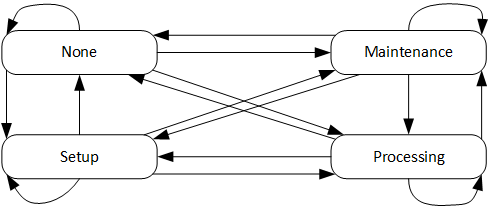
The overview of the building block is shown in Figure 18. The MachineryOperationModeStateMachineType is a subtype of the FiniteStateMachineType defining the States and Transitions of that StateMachine. The usage of the building block is also shown in that figure. An instance of the MachineryOperationModeStateMachineType is added to the Object MyMachine representing a Machine using the AddIn concept. The MachineryOperationModeStateMachineType is defined in 13.2.
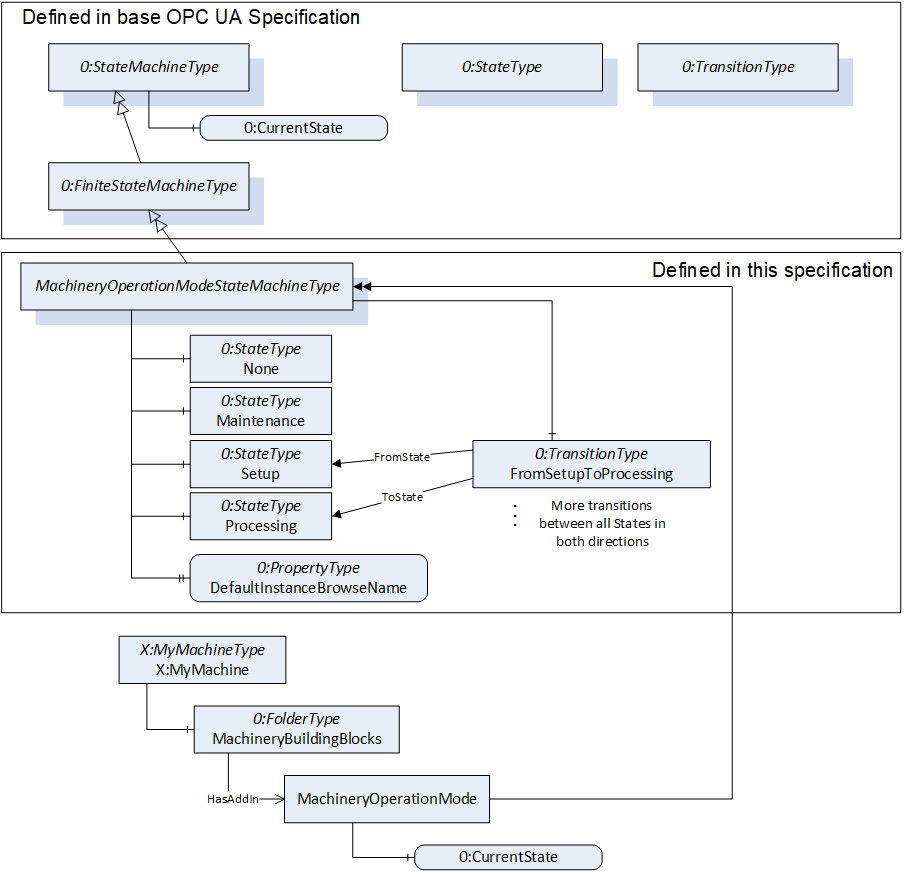
In Figure 19, a more complex example is shown, where the Machine also contains a component having the MachineryItemState.
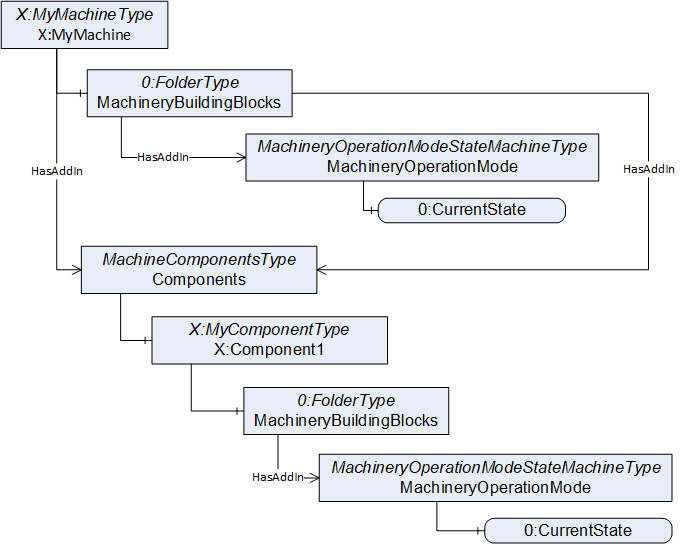
13.2 MachineryOperationModeStateMachineType
The MachineryOperationModeStateMachineType is a subtype of FiniteStateMachineType defined in OPC 10000-16. The semantic of this AddIn is to provide the MachineryOperationMode of a MachineryItem. It is formally defined in Table 33.
| Attribute | Value | ||||
| BrowseName | MachineryOperationModeStateMachineType | ||||
| IsAbstract | False | ||||
| Description | State machine representing the operation mode of a MachineryItem | ||||
| References | Node Class | BrowseName | DataType | TypeDefinition | Other |
|---|---|---|---|---|---|
| Subtype of the 0:FiniteStateMachineType defined in OPC 10000-16, i.e. inheriting the InstanceDeclarations of that Node. | |||||
| 0:HasProperty | Variable | 0:DefaultInstanceBrowseName | 0:QualifiedName | 0:PropertyType | - |
| 0:HasComponent | Object | None | - | 0:StateType | - |
| 0:HasComponent | Object | Maintenance | - | 0:StateType | - |
| 0:HasComponent | Object | Processing | - | 0:StateType | - |
| 0:HasComponent | Object | Setup | - | 0:StateType | - |
| 0:HasComponent | Object | FromNoneToMaintenance | - | 0:TransitionType | - |
| 0:HasComponent | Object | FromNoneToSetup | - | 0:TransitionType | - |
| 0:HasComponent | Object | FromNoneToProcessing | - | 0:TransitionType | - |
| 0:HasComponent | Object | FromNoneToNone | - | 0:TransitionType | - |
| 0:HasComponent | Object | FromMaintenanceToNone | - | 0:TransitionType | - |
| 0:HasComponent | Object | FromMaintenanceToSetup | - | 0:TransitionType | - |
| 0:HasComponent | Object | FromMaintenanceToProcessing | - | 0:TransitionType | - |
| 0:HasComponent | Object | FromMaintenanceToMaintenance | - | 0:TransitionType | - |
| 0:HasComponent | Object | FromSetupToNone | - | 0:TransitionType | - |
| 0:HasComponent | Object | FromSetupToMaintenance | - | 0:TransitionType | - |
| 0:HasComponent | Object | FromSetupToProcessing | - | 0:TransitionType | - |
| 0:HasComponent | Object | FromSetupToSetup | - | 0:TransitionType | - |
| 0:HasComponent | Object | FromProcessingToNone | - | 0:TransitionType | - |
| 0:HasComponent | Object | FromProcessingToMaintenance | - | 0:TransitionType | - |
| 0:HasComponent | Object | FromProcessingToSetup | - | 0:TransitionType | - |
| 0:HasComponent | Object | FromProcessingToProcessing | - | 0:TransitionType | - |
| Conformance Units | |||||
|---|---|---|---|---|---|
| Machinery Operation Mode |
The States and Transitions define a StateMachine as shown in Figure 17. It does not define an initial State, i.e., the initial State is vendor-specific.
Note: None of the States or Transitions have a ModellingRule, i.e., they are only provided in the TypeDefinition, not on the instance. The CurrentState Variable (inherited from StateMachineType) contains the information of the current State of the instance.
The None State represents that there is currently no MachineryOperationMode available for the MachineryItem.
The Maintenance State represents that the MachineryItem is set into maintenance mode with the intention to carry out maintenance or servicing activities of the MachineryItem.
The Setup State represents that the MachineryItem is set into setup mode with the intention to carry out setup, preparation or postprocessing activities of a production process.
The Processing State represents that the MachineryItem is set into processing mode with the intention to carry out the value adding activities.
The meaning of the Transitions is defined in the Description of Table 34.
The InstanceDeclarations of the MachineryOperationModeStateMachineType have additional Attribute values defined in Table 34.
| BrowsePath | Value Attribute | Description Attribute | ||
| 0:DefaultInstanceBrowseName | MachineryOperationMode | The default BrowseName for instances of the type | ||
| None | - | There is currently no operation mode available | ||
| Maintenance | - | MachineryItem is set into maintenance mode with the intention to carry out maintenance or servicing activities | ||
| Setup | - | MachineryItem is set into setup mode with the intention to carry out setup, preparation or postprocessing activities of a production process | ||
| Processing | - | MachineryItem is set into processing mode with the intention to carry out the value adding activities | ||
| FromNoneToMaintenance | - | Transition from state None to state Maintenance | ||
| FromNoneToSetup | - | Transition from state None to state Setup | ||
| FromNoneToProcessing | - | Transition from state None to state Processing | ||
| FromNoneToNone | - | Transition from state None to state None | ||
| FromMaintenanceToNone | - | Transition from state Maintenance to state None | ||
| FromMaintenanceToSetup | - | Transition from state Maintenance to state Setup | ||
| FromMaintenanceToProcessing | - | Transition from state Maintenance to state Processing | ||
| FromMaintenanceToMaintenance | - | Transition from state Maintenance to state Maintenance | ||
| FromSetupToNone | - | Transition from state Setup to state None | ||
| FromSetupToMaintenance | - | Transition from state Setup to state Maintenance | ||
| FromSetupToProcessing | - | Transition from state Setup to state Processing | ||
| FromSetupToSetup | - | Transition from state Setup to state Setup | ||
| FromProcessingToNone | - | Transition from state Processing to state None | ||
| FromProcessingToMaintenance | - | Transition from state Processing to state Maintenance | ||
| FromProcessingToSetup | - | Transition from state Processing to state Setup | ||
| FromProcessingToProcessing | - | Transition from state Processing to state Processing | ||
| 0 | - | ||
| 1 | - | ||
| 2 | - | ||
| 3 | - | ||
| 0 | - | ||
| 1 | - | ||
| 2 | - | ||
| 3 | - | ||
| 4 | - | ||
| 5 | - | ||
| 6 | - | ||
| 7 | - | ||
| 8 | - | ||
| 9 | - | ||
| 10 | - | ||
| 11 | - | ||
| 12 | - | ||
| 13 | - | ||
| 14 | - | ||
| 15 | - |
The components of the MachineryOperationModeStateMachineType have additional References which are defined in Table 35.
| SourceBrowsePath | Reference Type | Is Forward | TargetBrowsePath |
| FromNoneToMaintenance | 0:FromState | True | None |
| 0:ToState | True | Maintenance | |
| FromNoneToProcessing | 0:FromState | True | None |
| 0:ToState | True | Processing | |
| FromNoneToSetup | 0:FromState | True | None |
| 0:ToState | True | Setup | |
| FromMaintenanceToNone | 0:FromState | True | Maintenance |
| 0:ToState | True | None | |
| FromMaintenanceToProcessing | 0:FromState | True | Maintenance |
| 0:ToState | True | Processing | |
| FromMaintenanceToSetup | 0:FromState | True | Maintenance |
| 0:ToState | True | Setup | |
| FromProcessingToNone | 0:FromState | True | Processing |
| 0:ToState | True | None | |
| FromProcessingToMaintenance | 0:FromState | True | Processing |
| 0:ToState | True | Maintenance | |
| FromProcessingToSetup | 0:FromState | True | Processing |
| 0:ToState | True | Setup | |
| FromSetupToNone | 0:FromState | True | Setup |
| 0:ToState | True | None | |
| FromSetupToMaintenance | 0:FromState | True | Setup |
| 0:ToState | True | Maintenance | |
| FromSetupToProcessing | 0:FromState | True | Setup |
| 0:ToState | True | Processing | |
| FromNoneToNone | 0:FromState | True | None |
| 0:ToState | True | None | |
| FromMaintenanceToMaintenance | 0:FromState | True | Maintenance |
| 0:ToState | True | Maintenance | |
| FromProcessingToProcessing | 0:FromState | True | Processing |
| 0:ToState | True | Processing | |
| FromSetupToSetup | 0:FromState | True | Setup |
| 0:ToState | True | Setup |
14 Operation Counter
14.1 Overview
This building block provides the information, how long a MachineryItem is turned on and how long it performed an activity. It uses the 2:IOperationCounterType interface and the predefined functional group 2:OperationCounters defined in OPC 10000-100.
In Figure 20, an example of a machine providing that information is given. The MachineryOperationCounterType defined in 14.2 implements the 2:IOperationCounterType interface and provides the 2:PowerOnDuration and 2:OperationDuration Properties. The X:SpecificMachineType provides the building block in its MachineryBuildingBlocks folder using the default name 2:OperationCounters. In this case, the X:SpecificMachineType also references the building block directly (like 2:Identification), in order to simplify the usage for Clients purely developed based on OPC 10000-100. It is recommended to provide this reference, but not required from perspective of this specification.
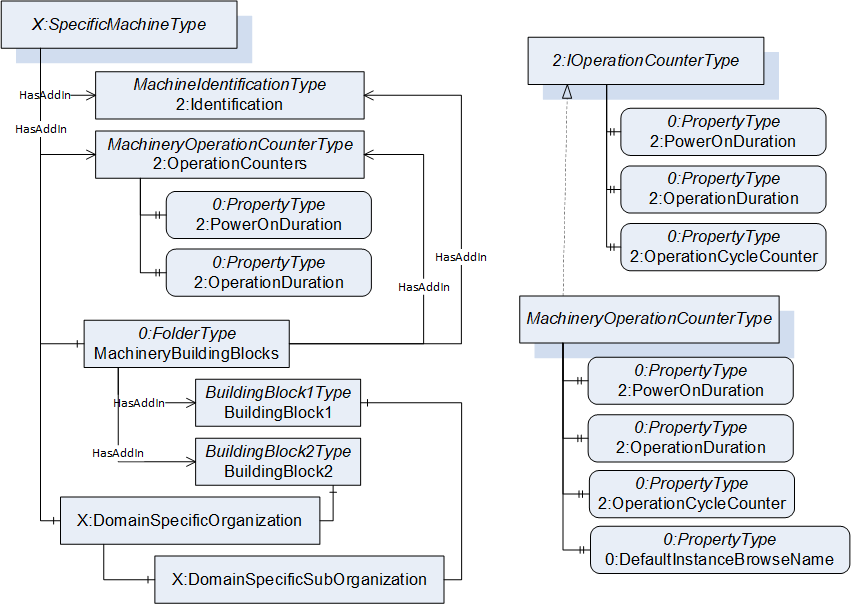
In Figure 21, an example of a machine and a component of the machine, both providing operation counters, is given. This example leaves out any other building blocks like identification or domain-specific organizations. Like the machine, also the component provides the operation counters.
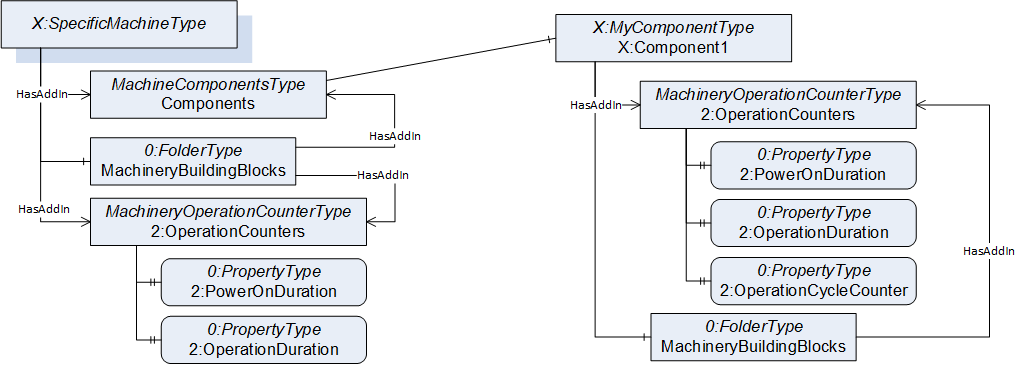
14.2 MachineryOperationCounterType
The MachineryOperationCounterType provides information about the duration something is turned on and how long it performs an activity. It is formally defined in Table 36.
| Attribute | Value | ||||
| BrowseName | MachineryOperationCounterType | ||||
| IsAbstract | False | ||||
| References | Node Class | BrowseName | DataType | TypeDefinition | Other |
|---|---|---|---|---|---|
| Subtype of the 2:FunctionalGroupType defined in OPC 10000-100 | |||||
| 0:HasProperty | Variable | 2:PowerOnDuration | 0:Duration | 0:PropertyType | O |
| 0:HasProperty | Variable | 2:OperationDuration | 0:Duration | 0:PropertyType | O |
| 0:HasProperty | Variable | 2:OperationCycleCounter | 0:UInteger | 0:PropertyType | O |
| 0:HasProperty | Variable | 0:DefaultInstanceBrowseName | 0:QualifiedName | 0:PropertyType | |
| 0:HasInterface | ObjectType | 2:IOperationCounterType | |||
| Conformance Units | |||||
|---|---|---|---|---|---|
| Machinery Operation Counter |
The optional 2:PowerOnDuration, 2:OperationDuration and 2:OperationCycleCounter shall be used as defined in OPC 10000-100. Typically, a machine only provides the 2:PowerOnDuration to indicate how long the machine is powered on, and the 2:OperationDuration to indicate how long the machine is performing an activity. Components of a machine may also provide the 2:OperationCycleCounter to identify how often the component was switching.
The child Nodes of the MachineryOperationCounterType have additional Attribute values defined in Table 37.
| BrowsePath | Value Attribute | Description Attribute |
| 0:DefaultInstanceBrowseName | 2:OperationCounters | The default BrowseName for instances of the type |
| 2:PowerOnDuration | - | PowerOnDuration is the duration the MachineryItem has been powered. The main purpose is to determine the time in which degradation of the MachineryItem occurred. The details, when the time is counted, is implementation-specific. Companion specifications might define specific rules. Typically, when the MachineryItem has supply voltage and the main CPU is running, the time is counted. This may include any kind of sleep mode, but may not include pure Wake on LAN. This value shall only increase during the lifetime of the MachineryItem and shall not be reset when it is restarted. The PowerOnDuration is provided as Duration, i.e., in milliseconds or even fractions of a millisecond. However, the Server is not expected to update the value in such a high frequency, but maybe once a minute or once an hour, depending on the application. |
| 2:OperationDuration | - | OperationDuration is the duration the MachineryItem has been powered and performing an activity. This counter is intended for machines and components where a distinction is made between switched on and in operation. For example, a drive might be powered on but not operating. It is not intended for machines or components always performing an activity like sensors always measuring data. This value shall only increase during the lifetime of the MachineryItem and shall not be reset when it is restarted. The OperationDuration is provided as Duration, i.e., in milliseconds or even fractions of a millisecond. However, the Server is not expected to update the value in such a high frequency, but maybe once a minute or once an hour, depending on the application. |
| 2:OperationCycleCounter | - | OperationCycleCounter is counting the times the component switches from not performing an activity to performing an activity. For example, each time a valve starts moving, is counted. This value shall only increase during the lifetime of the component and shall not be reset when the component is restarted. |
15 Lifetime Counter
15.1 Overview
This building block provides the information about the past and estimated remaining lifetime of a MachineryItem or other aspects of a MachineryItem like a software license. It uses the 2:LifetimeVariableType defined in OPC 10000-100 as base.
In Figure 22, an example of a machine providing such information is given. The MachineryLifetimeCounterType, defined in 15.2, contains one or many Variables of 2:LifetimeVariableType. The X:SpecificMachineType provides the building block in its MachineryBuildingBlocks folder using the default name LifetimeCounters. In the example, there is only one lifetime counter for the validity of a software license, which is also represented as Object in the AddressSpace.
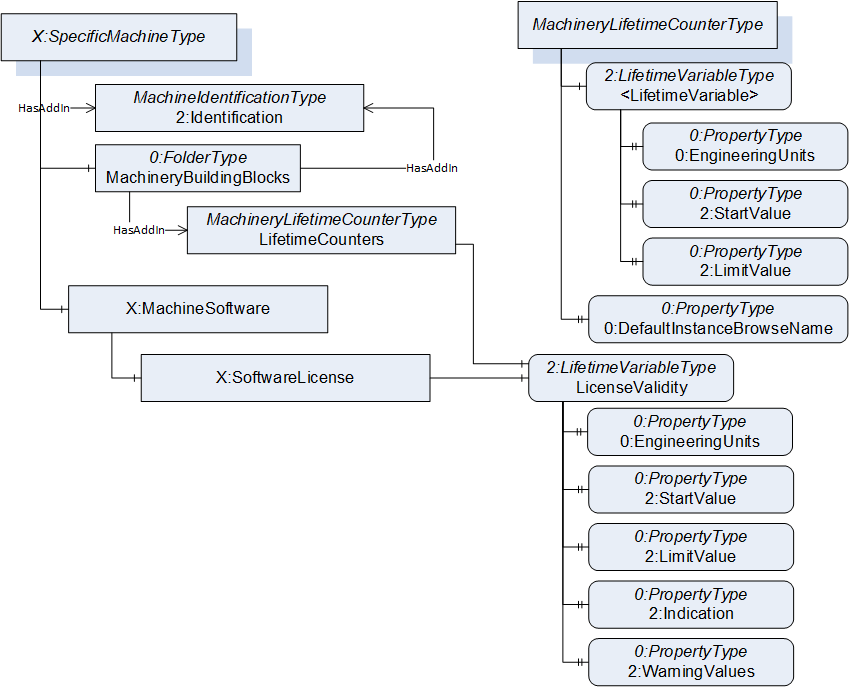
In Figure 23, an example of a machine and a component of the machine, both providing lifetime counters, is given. This example leaves out any other building blocks like identification. Like the Figure 22, the machine provides a lifetime counter for its software. In addition, the component provides a lifetime counter on how many parts it has and can produce. In this case, machine and component provide the LifetimeCounters building block and both reference the PartsProduced lifetime counter, as it is important for both. This is not required, and it is also allowed that the LifetimeCounters of the machine does not reference the PartsProduced or the component does not provide the LifetimeCounters building block.
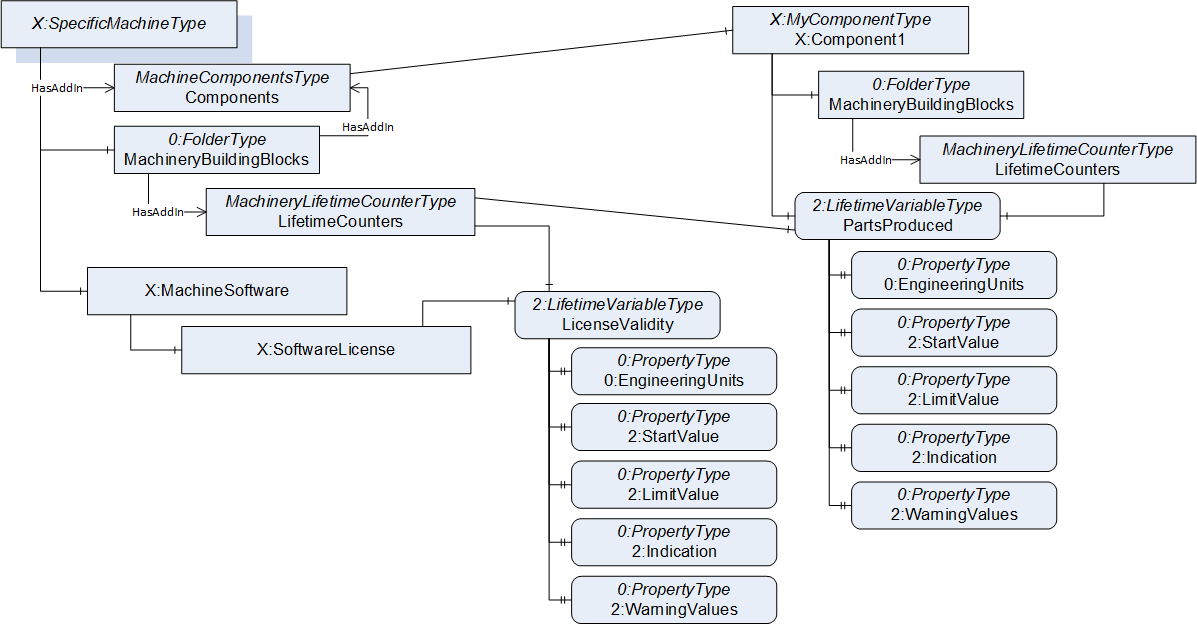
In Table 38, some values are shown that could be the current state of values of the example. The software license has a validity of 365 days, where 200 days are remaining. The parts that can be produced by the component are 1000, where 553 have already been produced.
| Node | LicenseValidity | PartsProduced |
| LifetimeVariable | 200 | 553 |
| EngineeringUnits (Mandatory) | day | number of parts |
| StartValue (Mandatory) | 365 | 0 |
| WarningValues (Optional) | 10 | 950 |
| LimitValue (Mandatory) | 0 | 1000 |
| Indication (Optional) | TimeIndicationType | NumberOfPartsIndicationType |
As shown in the examples, it is expected that the lifetime counters can also be accessed by different paths than the building block. The building block allows an optimized access to all relevant counters and thus clients can supervise all those counters and indicate when a warning value or the limit value is reached.
15.2 MachineryLifetimeCounterType
The MachineryLifetimeCounterType serves as AddIn and provides an entry point to various lifetime variables. It is formally defined in Table 39.
| Attribute | Value | ||||
| BrowseName | MachineryLifetimeCounterType | ||||
| IsAbstract | False | ||||
| References | Node Class | BrowseName | DataType | TypeDefinition | Other |
|---|---|---|---|---|---|
| Subtype of the 0:FolderType defined in OPC 10000-5 | |||||
| 0:HasComponent | Variable | <LifetimeVariable> | 0:Number | 2:LifetimeVariableType | MP |
| 0:HasProperty | Variable | 0:DefaultInstanceBrowseName | 0:QualifiedName | 0:PropertyType | |
| Conformance Units | |||||
|---|---|---|---|---|---|
| Machinery Lifetime Counter |
The <LifetimeVariable> can be used for any kind of lifetime variables. There shall be at least one lifetime variable. In situations, where there may be no lifetime variable available, the AddIn should be defined as optional on the TypeDefinition and should not be provided on the instance if there is no lifetime variable.
The child Nodes of the MachineryLifetimeCounterType have additional Attribute values defined in Table 40.
| BrowsePath | Value Attribute | Description Attribute |
| 0:DefaultInstanceBrowseName | LifetimeCounters | The default BrowseName for instances of the type |
16 Monitoring
16.1 Overview
This building block provides a base structure for monitoring information of a MachineryItem. In Figure 24, the MonitoringType is shown. It provides some sub-structures for grouping different monitoring information. Vendors or companion specifications may add additional sub-structures on the different levels of this building block. The Status Object shall reference the MachineryItemState and MachineryOperationMode AddIns, if they are provided by the MachineryItem. The Health of the MachineryItem may be represented by the 2:IDeviceHealthType Interface defined in OPC 10000-100.
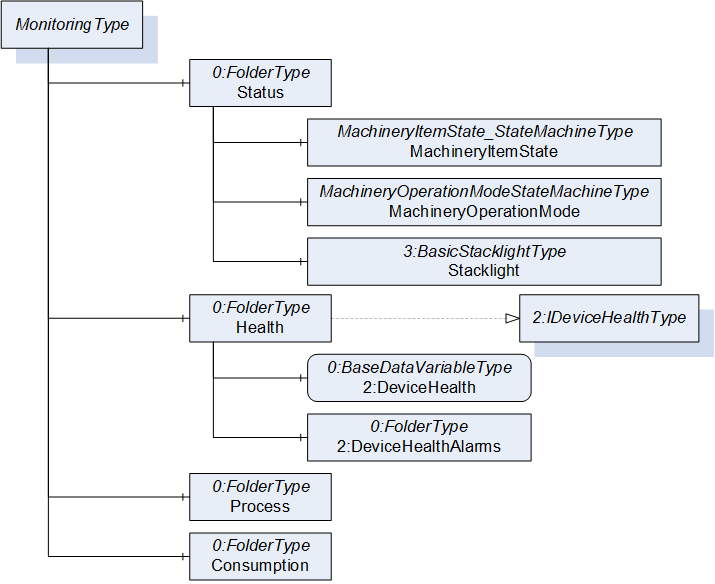
The building block can be used in parallel to other structures of the MachineryItem or as the main structure of the MachineryItem. In Figure 25 three different examples are shown. X:Machine1 only reference the Monitoring Object under MachineryBuildingBlocks, X:Machine2 has some additional structuring referencing the Monitoring Object in addition, and X:Machine3 references the Monitoring Object also directly to provide it as additional top-level entry point. It is recommended to provide this top-level entry point.

When the building block is used in combination with the MachineryItemState (see section 12) or MachineryOperationMode (see section 13), they should be combined as shown in Figure 26. The MachineryItemState and MachineryOperationMode should be referenced as building block from the MachineryBuildingBlocks Object, and in addition, from the Status Object of the Monitoring building block.
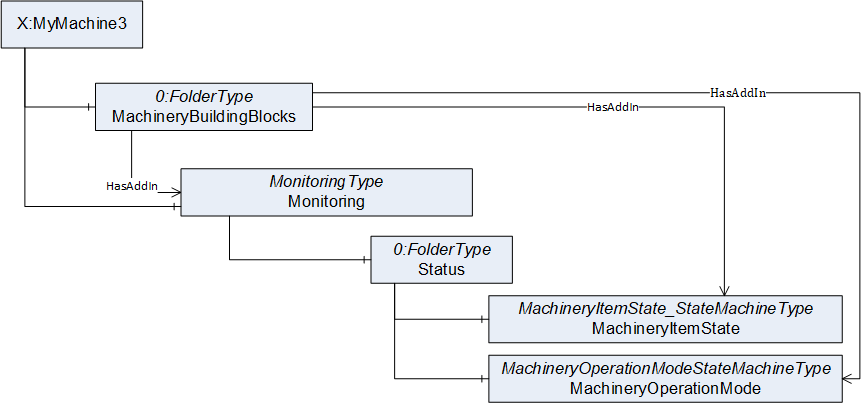
In B.4, some more detailed examples are given on how to use this building block.
16.2 MonitoringType
The MonitoringType provides entry points for monitoring a MachineryItem and is formally defined in Table 41.
| Attribute | Value | ||||
| BrowseName | MonitoringType | ||||
| IsAbstract | False | ||||
| Description | Entry point for monitoring information of a MachineryItem. | ||||
| References | Node Class | BrowseName | DataType | TypeDefinition | Other |
|---|---|---|---|---|---|
| Subtype of the 0:FolderType | |||||
| 0:HasProperty | Variable | 0:DefaultInstanceBrowseName | 0:QualifiedName | 0:PropertyType | - |
| HasComponent | Object | Status | FolderType | O | |
| HasComponent | Object | Health | FolderType | O | |
| HasComponent | Object | Process | FolderType | O | |
| HasComponent | Object | Consumption | FolderType | O | |
| Conformance Units | |||||
|---|---|---|---|---|---|
| Machinery Monitoring |
The child Nodes of the MonitoringType have additional Attribute values defined in Table 42.
| BrowsePath | Value Attribute | Description Attribute |
| 0:DefaultInstanceBrowseName | Monitoring | The default BrowseName for instances of the type. |
| Status | - | Entry point for status information of the MachineryItem. If this Object is provided, and the MachineryItemState is provided, it shall be referenced. If this Object is provided and the MachineryOperationMode is provided, it shall be referenced. |
| Health | - | Entry point of health information of the MachineryItem. |
| Process | - | Entry point for process information of the MachineryItem. |
| Consumption | Entry point for consumption information of the MachineryItem. |
The components of the MonitoringType have additional subcomponents which are defined in Table 43.
| Source Path | Reference | Node Class | BrowseName | DataType | TypeDefinition | Others |
| Status | 0:HasComponent | Object | MachineryItemState | MachineryItemState_StateMachineType | O | |
| Status | 0:HasComponent | Object | MachineryOperationMode | MachineryOperationModeStateMachineType | O | |
| Status | 0:HasComponent | Object | Stacklight | 3:BasicStacklightType | O | |
| Health | 0:HasComponent | Object | 2:DeviceHealthAlarms | 0:FolderType | O | |
| Health | 0:HasComponent | Variable | 2:DeviceHealth | 2:DeviceHealthEnumeration | 0:BaseDataVariableType | O |
The components of the MonitoringType have additional References which are defined in Table 44.
| SourceBrowsePath | Reference Type | Is Forward | TargetBrowsePath |
| Health | 0:HasInterface | True | 2:IDeviceHealthType |
17 MachineryEquipment
17.1 Overview
This building block provides an entry point to MachineryEquipment information. The MachineryEquipment should be represented by Objects implementing the IMachineryEquipmentType interface and (parts of) the 2:IVendorNameplateType. Those Objects may be put directly under the MachineryEquipment folder, or may be further grouped by different types of MachineryEquipment. This grouping should be done by additional Objects defined by vendors or other companion specifications.
In Figure 27, the EquipmentFolderType is shown, and in addition the IMachineryEquipmentType and parts of the 2:IVendorNameplateType defined in OPC 10000-100. The <MachineryEquipment> Object implements both Interfaces and provides the Properties expected to be used. The IMachineryEquipmentType is derived from the IMachineTagNameplateType and adds the MachineryEquipmentTypeId and Description.
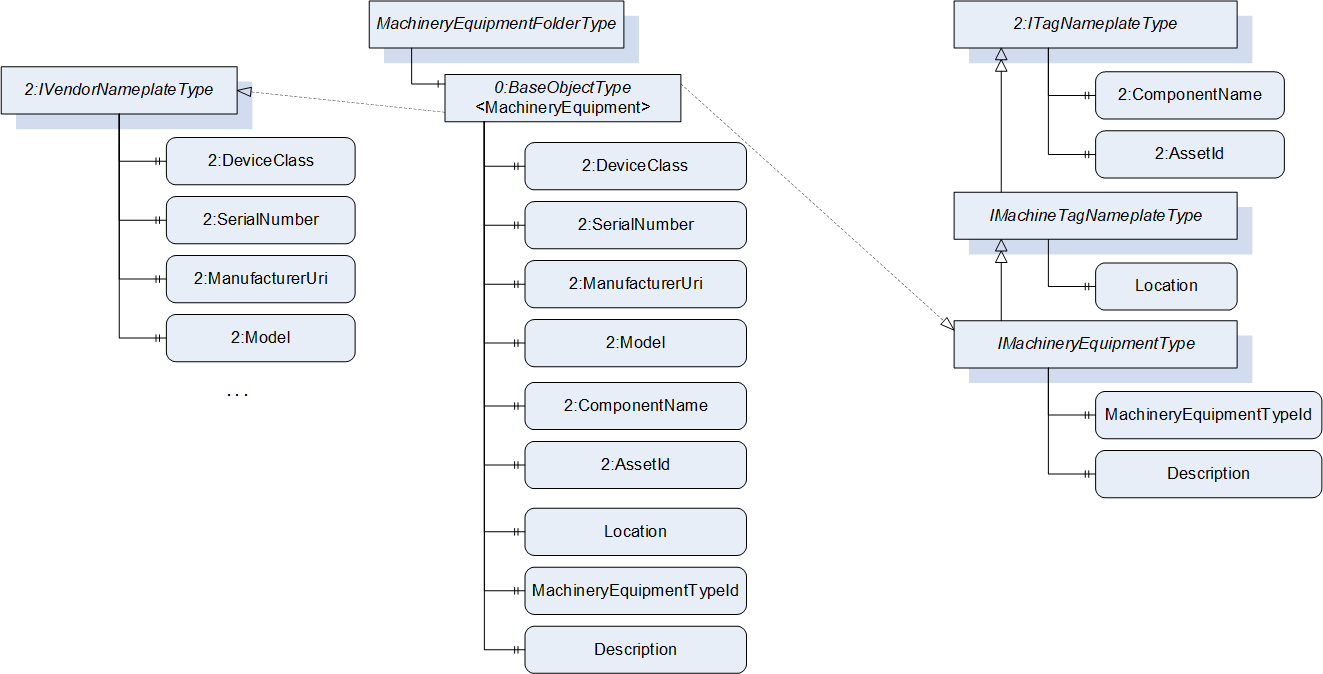
Figure 28 shows an example where the MachineryEquipment is directly put under such an MachineryEquipment Object on the left, and on the right an example, where there is a grouping of MachineryEquipment. In both cases, a specific type representing the MachineryEquipment (X:MyEquipmentType) is used.
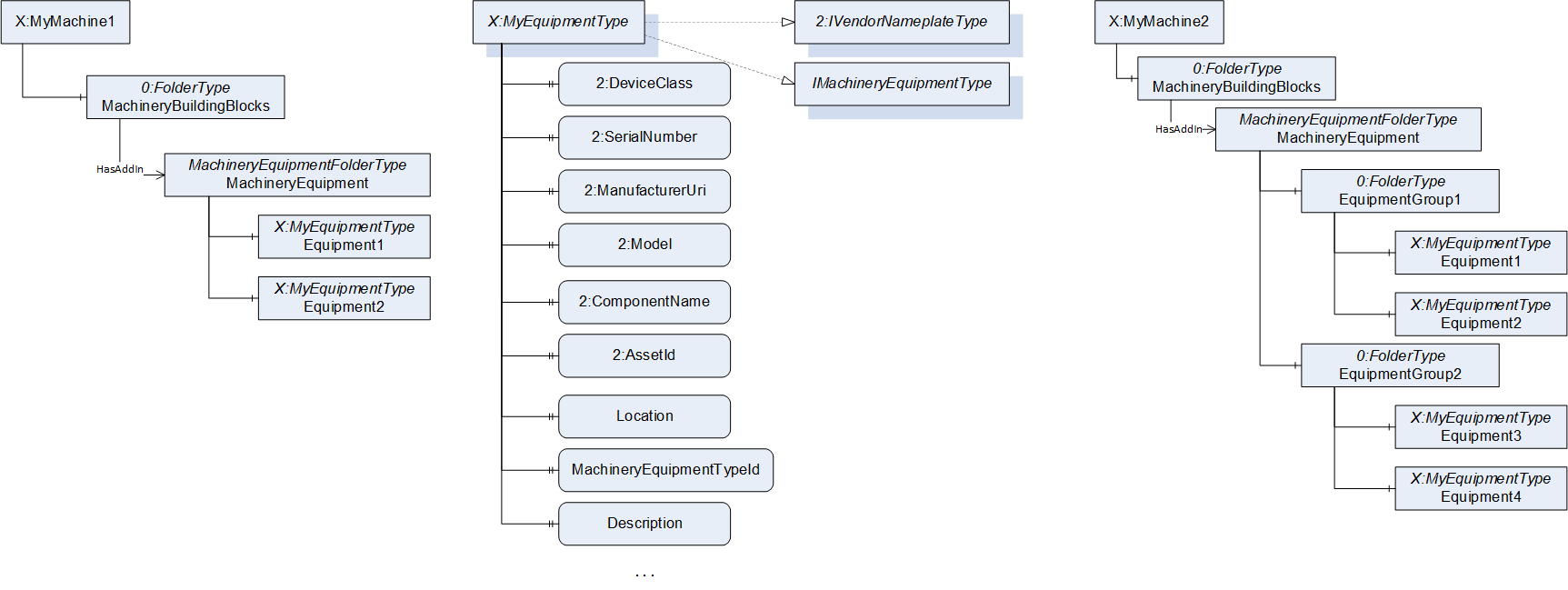
The building block can be used in parallel to other structures of the MachineryItem or as the main structure of the MachineryItem. In Figure 29 three different examples are shown. X:Machine1 only reference the MachineryEquipment Object under MachineryBuildingBlocks, X:Machine2 has some additional structuring referencing the MachineryEquipment Object in addition, and X:Machine3 references the MachineryEquipment Object also directly to provide it as additional top-level entry point. It is recommended to provide this top-level entry point.

17.2 MachineryEquipmentFolderType
The MachineryEquipmentFolderType provides the entry point for MachineryEquipment of a MachineryItem and is formally defined in Table 45.
| Attribute | Value | ||||
| BrowseName | MachineryEquipmentFolderType | ||||
| IsAbstract | False | ||||
| Description | Defines an entry point for MachineryEquipment of a MachineryItem. | ||||
| References | Node Class | BrowseName | DataType | TypeDefinition | Other |
|---|---|---|---|---|---|
| Subtype of the 0:FolderType | |||||
| 0:HasProperty | Variable | 0:DefaultInstanceBrowseName | 0:QualifiedName | 0:PropertyType | - |
| 0:HasComponent | Object | <MachineryEquipment> | - | 0:BaseObjectType | OP |
| Conformance Units | |||||
|---|---|---|---|---|---|
| Machinery MachineryEquipment |
The child Nodes of the MachineryEquipmentFolderType have additional Attributes defined in Table 46.
| BrowsePath | Value Attribute | Description Attribute | ||
| 0:DefaultInstanceBrowseName | MachineryEquipment | The default BrowseName for instances of the type. | ||
| <MachineryEquipment> | - | Placeholder for MachineryEquipment that implements the IMachineryEquipmentType. | ||
| - | Identification of a generic MachineryEquipment. Defined by each company (e.g., company has an MachineryEquipmentTypeId for all 8 mm drills). | ||
| - | Additional information and description about the MachineryEquipment. Should be used if Description Attribute cannot be written via OPC UA and should be ideally identical to Description Attribute. | ||
| - | Class of the MachineryEquipment (e.g.: Each drill of a company has the DeviceClass "drill"). | ||
| - | Serial Number of the MachineryEquipment. | ||
| - | Manufacturer of the MachineryEquipment. | ||
| - | Model of the MachineryEquipment. | ||
| - | Used name for the MachineryEquipment. | ||
| - | Companywide unique ID for a specific asset (Each 8 mm drill of a company has the same MachineryEquipmentTypeId and a unique AssetId). | ||
| - | Location of the MachineryEquipment (e.g.: Storage Location; Position in the Tool Changer; Position on the machine). |
The components of the MachineryEquipmentFolderType have additional subcomponents which are defined in Table 47.
| Source Path | Reference | NodeClass | BrowseName | DataType | TypeDefinition | Others |
| <MachineryEquipment> | 0:HasProperty | Variable | MachineryEquipmentTypeId | 0:String | 0:PropertyType | M, RW |
| <MachineryEquipment> | 0:HasProperty | Variable | 2:DeviceClass | 0:String | 0:PropertyType | O, RO |
| <MachineryEquipment> | 0:HasProperty | Variable | 2:SerialNumber | 0:String | 0:PropertyType | O, RO |
| <MachineryEquipment> | 0:HasProperty | Variable | 2:ManufacturerUri | 0:String | 0:PropertyType | O, RO |
| <MachineryEquipment> | 0:HasProperty | Variable | 2:Model | 0:LocalizedText | 0:PropertyType | O, RO |
| <MachineryEquipment> | 0:HasProperty | Variable | 2:ComponentName | 0:LocalizedText | 0:PropertyType | O, RW |
| <MachineryEquipment> | 0:HasProperty | Variable | 2:AssetId | 0:String | 0:PropertyType | O, RW |
| <MachineryEquipment> | 0:HasProperty | Variable | Location | 0:String | 0:PropertyType | O, RW |
| <MachineryEquipment> | 0:HasProperty | Variable | Description | 0:LocalizedText | 0:PropertyType | O, RW |
The components of the MachineryEquipmentFolderType have additional references which are defined in Table 48.
| SourceBrowsePath | Reference Type | Is Forward | TargetBrowsePath |
| <MachineryEquipment> | 0:HasInterface | TRUE | IMachineryEquipmentType |
| <MachineryEquipment> | 0:HasInterface | TRUE | 2:IVendorNameplateType |
17.3 IMachineryEquipmentType
The IMachineryEquipmentType provides base information about MachineryEquipment and is formally defined in Table 49.
| Attribute | Value | ||||
| BrowseName | IMachineryEquipmentType | ||||
| IsAbstract | True | ||||
| Description | Provides base identification information of MachineryEquipment that can be set by the user. | ||||
| References | Node Class | BrowseName | DataType | TypeDefinition | Other |
|---|---|---|---|---|---|
| Subtype of the IMachineTagNameplateType | |||||
| 0:HasProperty | Variable | MachineryEquipmentTypeId | 0:String | 0:PropertyType | M, RW |
| 0:HasProperty | Variable | Description | 0:LocalizedText | 0:PropertyType | O, RW |
| 0:HasComponent | Variable | EquipmentLife | 0:Number | 2:LifetimeVariableType | O, RO |
| Conformance Units | |||||
|---|---|---|---|---|---|
| Machinery MachineryEquipment |
The component Variables of the IMachineryEquipmentType have additional Attributes defined in Table 50.
| BrowsePath | Value Attribute | Description Attribute |
| MachineryEquipmentTypeId | - | Identification of a generic MachineryEquipment. Defined by each company (e.g., company has an MachineryEquipmentTypeId for all 8 mm drills). |
| Description | - | Additional information and description about the MachineryEquipment. Should be used if Description Attribute cannot be written via OPC UA and should be ideally identical to Description Attribute. |
| EquipmentLife | - | Lifetime indication of the MachineryEquipment. |
18 Notifications
18.1 Overview
This building block provides the entry point into notifications of a MachineryItem. It allows to provide such notifications as Events by becoming an EventNotifier or providing specific Objects for notifications. This specification does not define any specific EventTypes or other ObjectTypes for notifications but just the base infrastructure. Vendors or other companion specifications may define those and reference the EventTypes with 0:GeneratesEvent References or add specific Objects. In Figure 30, an example is shown, where the Notifications Object provides Events of X:MyEventType and Objects of X:MyMessageType. In B.5, some more detailed examples are given on how to use this building block.
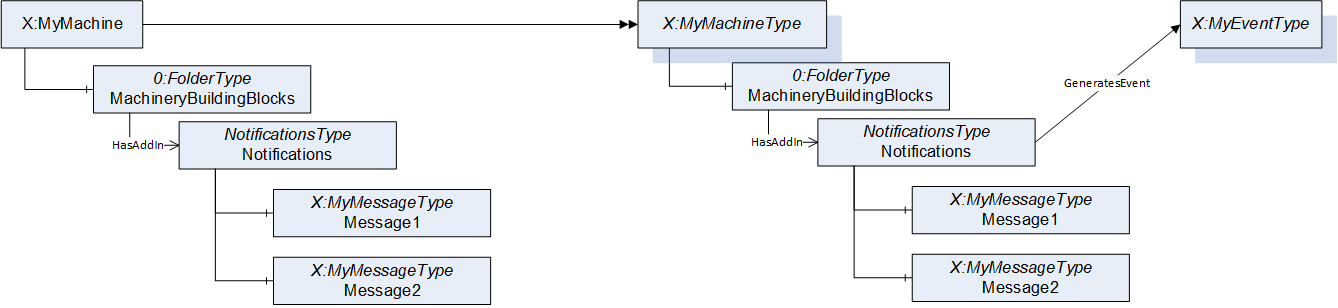
The building block can be used in parallel to other structures of the MachineryItem or as the main structure of the MachineryItem. In Figure 31 three different examples are shown. X:Machine1 only reference the Notifications Object under MachineryBuildingBlocks, X:Machine2 has some additional structuring referencing the Notifications Object in addition, and X:Machine3 references the Notifications Object also directly to provide it as additional top-level entry point. It is recommended to provide this top-level entry point.

18.2 NotificationsType
The NotificationsType provides notifications of a MachineryItem and is formally defined in Table 51.
| Attribute | Value | ||||
| BrowseName | NotificationsType | ||||
| IsAbstract | False | ||||
| Description | Provides notifications as events or objects. | ||||
| References | Node Class | BrowseName | DataType | TypeDefinition | Other |
|---|---|---|---|---|---|
| Subtype of the 0:FolderType | |||||
| 0:HasProperty | Variable | 0:DefaultInstanceBrowseName | 0:QualifiedName | 0:PropertyType | - |
| Conformance Units | |||||
|---|---|---|---|---|---|
| Machinery Notifications |
The component Variables of the NotificationsType have additional Attributes defined in Table 52.
| BrowsePath | Value Attribute | Description Attribute |
| 0:DefaultInstanceBrowseName | Notifications | The default BrowseName for instances of the type. |
19 Profiles and Conformance Units
19.1 Conformance Units
This chapter defines the corresponding Conformance Units for the OPC UA Information Model for Machinery.
| Category | Title | Description |
| Server | Machinery Machine Identification | Supports the MachineIdentificationType with all its mandatory InstanceDeclarations, and optionally the optional InstanceDeclarations with read access. There is at least one instance of the MachineIdentificationType or a subtype using the DefaultInstanceBrowseName and is referenced from an Object representing a Machine with a Reference of HasAddIn or a subtype. |
| Server | Machinery Machine Identification Writable | Supports the MachineIdentificationType with all its mandatory InstanceDeclarations, and optionally the optional InstanceDeclarations, with writable access to all Variables defined as writable in this specification. The optional Properties 2:AssetId, 2:ComponentName and Location shall be provided for all instances of the MachineIdentificationType or its subtypes. |
| Server | Machinery Find Machines | Supports the Machines Object and references all Machines of the Server as defined by the Machines Object. |
| Server | Machinery Component Identification | Supports the MachineryComponentIdentificationType with optionally the optional InstanceDeclarations with read access. There is at least one instance of the MachineryComponentIdentificationType or a subtype using the DefaultInstanceBrowseName and is referenced from an Object representing a component of a Machine with a Reference of HasAddIn or a subtype. |
| Server | Machinery Component Identification Mandatory | Supports the MachineryComponentIdentificationType with the Properties 2:Manufacturer, 2:Model, 2:ProductCode, and 2:SerialNumber as mandatory and optionally the other optional InstanceDeclarations with read access. The Properties 2:Manufacturer, 2:Model, 2:ProductCode, and 2:SerialNumber shall be provided for all instances of the MachineryComponentIdentificationType or a subtype. |
| Server | Machinery Component Identification Writable | Supports the MachineryComponentIdentificationType with optionally the optional InstanceDeclarations, with writable access to all Variables defined as writable in this specification for all instances of the MachineryComponentIdentificationType or its subtypes. The optional Properties 2:AssetId, and 2:ComponentName shall be provided for all instances of the MachineryComponentIdentificationType or its subtypes. |
| Server | Machinery Find Components of Machines | Supports the MachineComponentsType for all Machines managed by the Server, each one referencing the exposed components of the corresponding machine. Each Object representing a Machine shall reference an instance of MachineComponentsType or a subtype using the DefaultInstanceBrowseName with a Reference of HasAddIn or a subtype. |
| Server | Machinery Building Block Organization | Each MachineryItem supporting building blocks defined by this specification using the MachineryBuildingBlocks folder directly references a folder called MachineryBuildingBlocks. This folder directly references all those building blocks supported by the MachineryItem. |
| Server | Machinery MachineryItem State | Supports the MachineryItemState_StateMachineType and has at least one instance of a MachineryItem supporting this as AddIn under its MachineryBuildingBlocks folder. |
| Server | Machinery Operation Mode | Supports the MachineryOperationModeStateMachineType and has at least one instance of a MachineryItem supporting this as AddIn under its MachineryBuildingBlocks folder. |
| Server | Machinery Operation Counter | Supports the MachineryOperationCounterType and has at least one instance of a MachineryItem supporting this as AddIn with at least one counter under its MachineryBuildingBlocks folder. |
| Server | Machinery Lifetime Counter | Supports the MachineryLifetimeCounterType and has at least one instance of a MachineryItem supporting this as AddIn under its MachineryBuildingBlocks folder. |
| Server | Machinery Monitoring | Supports the MonitoringType and has at least one instance of a MachineryItem supporting this AddIn under its MachineryBuildingBlocks folder. |
| Server | Machinery MachineryEquipment | Supports the MachineryEquipmentFolderType and has at least one instance of a MachineryItem supporting this AddIn under its MachineryBuildingBlocks folder. Supports the IMachineryEquipmentType and has at least one instance of MachineryEquipmentFolderType with one instance implementing the IMachineryEquipmentType. |
| Server | Machinery Notifications | Supports the NotificationsType and has at least one instance of a MachineryItem supporting this AddIn under its MachineryBuildingBlocks folder. |
19.2 Profiles
19.2.1 Profile list
Table 54 lists all Profiles defined in this document and defines their URIs.
19.2.2 Server Facets
19.2.2.1 Overview
The following sections specify the Facets available for Servers that implement the OPC UA for Machinery companion specification. Each section defines and describes a Facet or Profile.
19.2.2.2 Machinery Machine Identification Server Facet
Table 55 defines a Facet that provides the identification of Machines managed in an OPC UA Server.
| Group | Conformance Unit / Profile Title | Mandatory / Optional |
| Address Space Model | 0:Address Space Base | M |
| Address Space Model | 0:Address Space Interfaces | M |
| Address Space Model | 0:Address Space AddIn Reference | M |
| Address Space Model | 0:Address Space AddIn DefaultInstanceBrowsename | M |
| View Services | 0:View Basic | M |
| View Services | 0:View TranslateBrowsePath | M |
| View Services | 0:View Minimum Continuation Point 01 | M |
| Attribute Services | 0:Attribute Read | M |
| Machinery | Machinery Machine Identification | M |
| Machinery | Machinery Find Machines | M |
| Machinery | Machinery Building Block Organization | O |
19.2.2.3 Machinery Machine Identification Writable Server Facet
Table 56 defines a Facet that provides the identification of Machines as well as the writing of Machine identification aspects changeable by the user via the OPC UA interface.
| Group | Conformance Unit / Profile Title | Mandatory / Optional |
| Profile | Machinery Machine Identification Server Facet | |
| Attribute Services | 0:Attribute Write Values | M |
| Machinery | Machinery Machine Identification Writable | M |
19.2.2.4 Machinery Component Identification Server Facet
Table 57 defines a Facet that provides the identification of components of Machines managed in an OPC UA Server.
| Group | Conformance Unit / Profile Title | Mandatory / Optional |
| Address Space Model | 0:Address Space Base | M |
| Address Space Model | 0:Address Space Interfaces | M |
| Address Space Model | 0:Address Space AddIn Reference | M |
| Address Space Model | 0:Address Space AddIn DefaultInstanceBrowsename | M |
| View Services | 0:View Basic | M |
| View Services | 0:View TranslateBrowsePath | M |
| View Services | 0:View Minimum Continuation Point 01 | M |
| Attribute Services | 0:Attribute Read | M |
| Machinery | Machinery Component Identification | M |
| Machinery | Machinery Find Components of Machines | M |
| Machinery | Machinery Building Block Organization | O |
19.2.2.5 Machinery Component Identification Mandatory Server Facet
Table 58 defines a Facet that provides the identification of components of Machines with some mandatory Properties via the OPC UA interface.
| Group | Conformance Unit / Profile Title | Mandatory / Optional | |
| Profile | Machinery Component Identification Server Facet | ||
| Machinery | Machinery Component Identification Mandatory | M | |
19.2.2.6 Machinery Component Identification Writable Server Facet
Table 59 defines a Facet that provides the identification of Machines as well as the writing of Machine identification aspects changeable by the user via the OPC UA interface.
| Group | Conformance Unit / Profile Title | Mandatory / Optional |
| Profile | Machinery Component Identification Server Facet | |
| Attribute Services | 0:Attribute Write Values | M |
| Machinery | Machinery Component Identification Writable | M |
19.2.2.7 Machinery State Server Facet
Table 60 defines a Facet that provides the states and modes of MachineryItems managed in an OPC UA Server.
| Group | Conformance Unit / Profile Title | Mandatory / Optional |
| Address Space Model | 0:Address Space Base | M |
| Address Space Model | 0:Address Space AddIn Reference | M |
| Address Space Model | 0:Address Space AddIn DefaultInstanceBrowsename | M |
| View Services | 0:View Basic | M |
| View Services | 0:View TranslateBrowsePath | M |
| View Services | 0:View Minimum Continuation Point 01 | M |
| Attribute Services | 0:Attribute Read | M |
| Machinery | Machinery Building Block Organization | M |
| Machinery | Machinery MachineryItem State | M |
| Machinery | Machinery Operation Mode | O |
19.2.2.8 Machinery Operation Counter Server Facet
Table 61 defines a Facet that provides operation counter of MachineryItems managed in an OPC UA Server.
| Group | Conformance Unit / Profile Title | Mandatory / Optional |
| Address Space Model | 0:Address Space Base | M |
| Address Space Model | 0:Address Space AddIn Reference | M |
| Address Space Model | 0:Address Space AddIn DefaultInstanceBrowsename | M |
| View Services | 0:View Basic | M |
| View Services | 0:View TranslateBrowsePath | M |
| View Services | 0:View Minimum Continuation Point 01 | M |
| Attribute Services | 0:Attribute Read | M |
| Machinery | Machinery Building Block Organization | M |
| Machinery | Machinery Operation Counter | M |
19.2.2.9 Machinery Lifetime Counter Server Facet
Table 62 defines a Facet that provides lifetime counter of MachineryItems managed in an OPC UA Server.
| Group | Conformance Unit / Profile Title | Mandatory / Optional |
| Address Space Model | 0:Address Space Base | M |
| Address Space Model | 0:Address Space AddIn Reference | M |
| Address Space Model | 0:Address Space AddIn DefaultInstanceBrowsename | M |
| View Services | 0:View Basic | M |
| View Services | 0:View TranslateBrowsePath | M |
| View Services | 0:View Minimum Continuation Point 01 | M |
| Attribute Services | 0:Attribute Read | M |
| Machinery | Machinery Building Block Organization | M |
| Machinery | Machinery Lifetime Counter | M |
19.2.2.10 Machinery Monitoring Server Facet
Table 62 defines a Facet that provides a monitoring entry point for MachineryItems managed in an OPC UA Server.
| Group | Conformance Unit / Profile Title | Mandatory / Optional |
| Address Space Model | 0:Address Space Base | M |
| Address Space Model | 0:Address Space AddIn Reference | M |
| Address Space Model | 0:Address Space AddIn DefaultInstanceBrowsename | M |
| View Services | 0:View Basic | M |
| View Services | 0:View TranslateBrowsePath | M |
| View Services | 0:View Minimum Continuation Point 01 | M |
| Attribute Services | 0:Attribute Read | M |
| Machinery | Machinery Building Block Organization | M |
| Machinery | Machinery Monitoring | M |
19.2.2.11 Machinery MachineryEquipment Server Facet
Table 62 defines a Facet that provides a MachineryEquipment entry point for MachineryItems managed in an OPC UA Server.
| Group | Conformance Unit / Profile Title | Mandatory / Optional |
| Address Space Model | 0:Address Space Base | M |
| Address Space Model | 0:Address Space AddIn Reference | M |
| Address Space Model | 0:Address Space AddIn DefaultInstanceBrowsename | M |
| View Services | 0:View Basic | M |
| View Services | 0:View TranslateBrowsePath | M |
| View Services | 0:View Minimum Continuation Point 01 | M |
| Attribute Services | 0:Attribute Read | M |
| Machinery | Machinery Building Block Organization | M |
| Machinery | Machinery MachineryEquipment | M |
19.2.2.12 Machinery Notifications Server Facet
Table 62 defines a Facet that provides a notifications entry point for MachineryItems managed in an OPC UA Server.
| Group | Conformance Unit / Profile Title | Mandatory / Optional |
| Address Space Model | 0:Address Space Base | M |
| Address Space Model | 0:Address Space AddIn Reference | M |
| Address Space Model | 0:Address Space AddIn DefaultInstanceBrowsename | M |
| View Services | 0:View Basic | M |
| View Services | 0:View TranslateBrowsePath | M |
| View Services | 0:View Minimum Continuation Point 01 | M |
| Attribute Services | 0:Attribute Read | M |
| Machinery | Machinery Building Block Organization | M |
| Machinery | Machinery Notifications | M |
19.2.3 Client Facets
This version of the specification does not define any Client Facets.
20 Namespaces
20.1 Namespace Metadata
Table 66 defines the namespace metadata for this document. The Object is used to provide version information for the namespace and an indication about static Nodes. Static Nodes are identical for all Attributes in all Servers, including the Value Attribute. See OPC 10000-5 for more details.
The information is provided as Object of type NamespaceMetadataType. This Object is a component of the Namespaces Object that is part of the Server Object. The NamespaceMetadataType ObjectType and its Properties are defined in OPC 10000-5.
The version information is also provided as part of the ModelTableEntry in the UANodeSet XML file. The UANodeSet XML schema is defined in OPC 10000-6.
| Attribute | Value | ||
| BrowseName | http://opcfoundation.org/UA/Machinery/ | ||
| Property | DataType | Value | |
|---|---|---|---|
| NamespaceUri | String | http://opcfoundation.org/UA/Machinery/ | |
| NamespaceVersion | String | 1.04.2 | |
| NamespacePublicationDate | DateTime | 2026-11-01 | |
| IsNamespaceSubset | Boolean | False | |
| StaticNodeIdTypes | IdType[] | 0 | |
| StaticNumericNodeIdRange | NumericRange [] | - | |
| StaticStringNodeIdPattern | String | - | |
Note: The IsNamespaceSubset Property is set to False as the UANodeSet XML file contains the complete Namespace. Servers only exposing a subset of the Namespace need to change the value to True.
20.2 Handling of OPC UA Namespaces
Namespaces are used by OPC UA to create unique identifiers across different naming authorities. The Attributes NodeId and BrowseName are identifiers. A Node in the UA AddressSpace is unambiguously identified using a NodeId. Unlike NodeIds, the BrowseName cannot be used to unambiguously identify a Node. Different Nodes may have the same BrowseName. They are used to build a browse path between two Nodes or to define a standard Property.
Servers may often choose to use the same namespace for the NodeId and the BrowseName. However, if they want to provide a standard Property, its BrowseName shall have the namespace of the standards body although the namespace of the NodeId reflects something else, for example the EngineeringUnits Property. All NodeIds of Nodes not defined in this document shall not use the standard namespaces.
Table 67 provides a list of mandatory and optional namespaces used in an OPC UA for Machinery OPC UA Server.
| NamespaceURI | Description |
| http://opcfoundation.org/UA/ | Namespace for NodeIds and BrowseNames defined in the OPC UA specification. This namespace shall have namespace index 0. |
| Local Server URI | Namespace for nodes defined in the local server. This namespace shall have namespace index 1. |
| http://opcfoundation.org/UA/DI/ | Namespace for NodeIds and BrowseNames defined in OPC 10000-100. The namespace index is Server specific. |
| http://opcfoundation.org/UA/IA/ | Namespace for NodeIds and BrowseNames defined in OPC 10000-200. The namespace index is Server-specific. |
| http://opcfoundation.org/UA/Machinery/ | Namespace for NodeIds and BrowseNames defined in this document. The namespace index is Server specific. |
| Vendor specific types | A Server may provide vendor-specific types like types derived from ObjectTypes defined in this document in a vendor-specific namespace. |
| Vendor specific instances | A Server provides vendor-specific instances of the standard types or vendor-specific instances of vendor-specific types in a vendor-specific namespace. It is recommended to separate vendor specific types and vendor specific instances into two or more namespaces. |
Table 68 provides a list of namespaces and their index used for BrowseNames in this document. The default namespace of this document is not listed since all BrowseNames without prefix use this default namespace.
| NamespaceURI | Namespace Index | Example |
| http://opcfoundation.org/UA/ | 0 | 0:EngineeringUnits |
| http://opcfoundation.org/UA/DI/ | 2 | 2:DeviceRevision |
| http://opcfoundation.org/UA/IA/ | 3 | 3:BasicStacklightType |
Annex A OPC UA for Machinery Namespace and Mappings (Normative)
A.1 NodeSet and supplementary files for Machinery Information Model
The Machinery Information Model is identified by the following URI:
http://opcfoundation.org/UA/Machinery/
Documentation for the NamespaceUri can be found here.
The NodeSet associated with this version of specification can be found here:
https://reference.opcfoundation.org/nodesets/?u=http://opcfoundation.org/UA/Machinery/&v=1.04.2&i=1
The NodeSet associated with the latest version of the specification can be found here:
https://reference.opcfoundation.org/nodesets/?u=http://opcfoundation.org/UA/Machinery/&i=1
Supplementary files for the Machinery Information Model can be found here:
https://reference.opcfoundation.org/nodesets/?u=http://opcfoundation.org/UA/Machinery/&v=1.04.2&i=2
The files associated with the latest version of the specification can be found here:
https://reference.opcfoundation.org/nodesets/?u=http://opcfoundation.org/UA/Machinery/&i=2
___________
Annex B Examples (Informative)
B.1 Overview
This appendix provides informal examples on how the building blocks defined in this specification can be used.
B.2 Identification and Finding Machines
In Figure 32, an example is given, showing the identification and Nameplate and Finding all Machines in Server use cases. The server provides information about a Robotics system as well as a CNC machine defined by Machine Tools (see OPC 40501, [3]). As the Robotics specification (see OPC 40010-1, [4]) already defines some Properties for identification directly, those are only referenced from the Identification functional group.
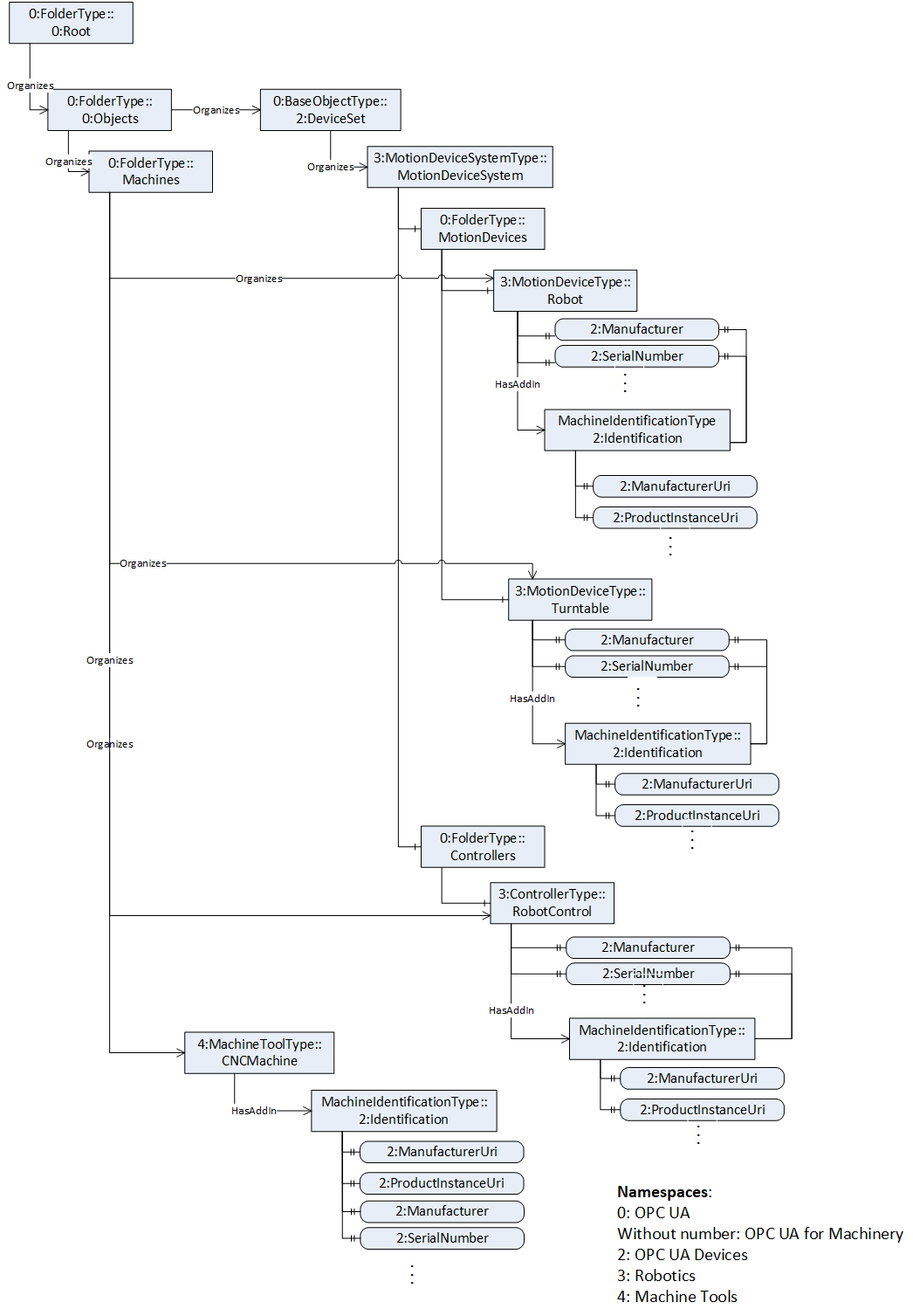
B.3 Component Identification and Finding Components of a Machine
In Figure 33, an example is given, showing the Component Identification and Nameplate and Finding all Components of a Machine use cases. The server provides information about a Robotics system (see OPC 40010-1, [4]). In that system, the components are organized according to the Robotics specification, and in addition according to this specification.
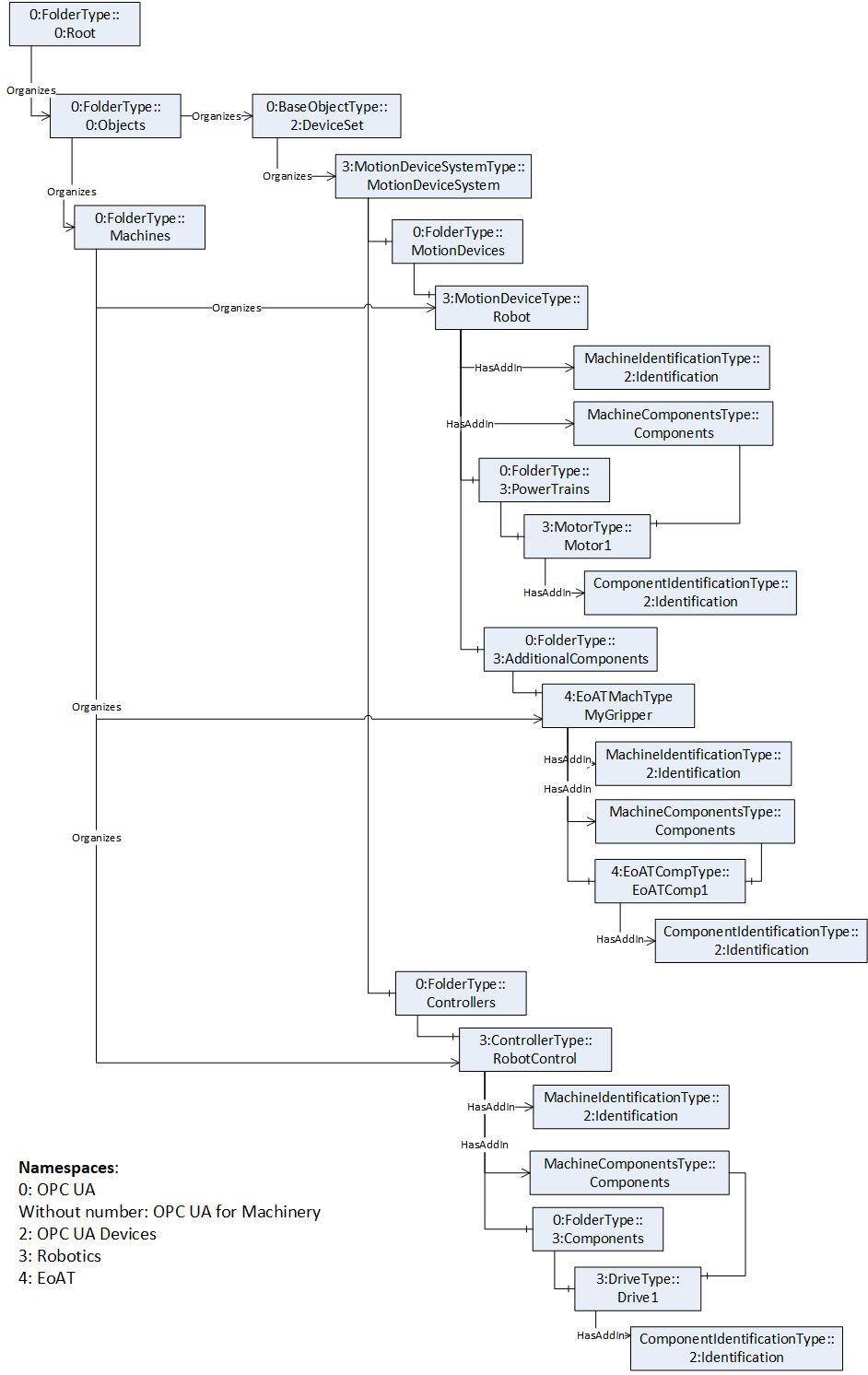
B.4 Monitoring
B.4.1 Overview
The Monitoring building block (see section 16) can be used for a MachineryItem as well as for components of a MachineryItem. There are different ways how to combine this information, as shown in the following sections. Servers can choose which approach to use, Clients should be prepared for all those approaches.
B.4.2 Independent representation
The simplest implementation is, that the MachineryItem represents its monitoring information in its Monitoring building block, and the components provide their monitoring information in their Monitoring building blocks. When a component gets replaced, only this part of the information model needs to be replaced, as well.
An example is shown in Figure 34. The X:MyMachine provides the Monitoring building block with information only in the context of the machine, not considering anything from its subcomponents. It does provide a subcomponent X:MyComponent, also providing a Monitoring building block with information about the subcomponent.
Note: The values of the MachineryItem may be aggregated out of the values of subcomponents. Considering the example of Figure 34, the overall MachineryItemState may consider the MachineryItemState of subcomponent X:MyComponent as well. Same is true for the DeviceHealth. Depending on the functionality of the X:MyMachine, this may actually be required if the X:MyComponent is an integral part of the X:MyMachine, and the X:MyMachine would not be functional without X:MyComponent.
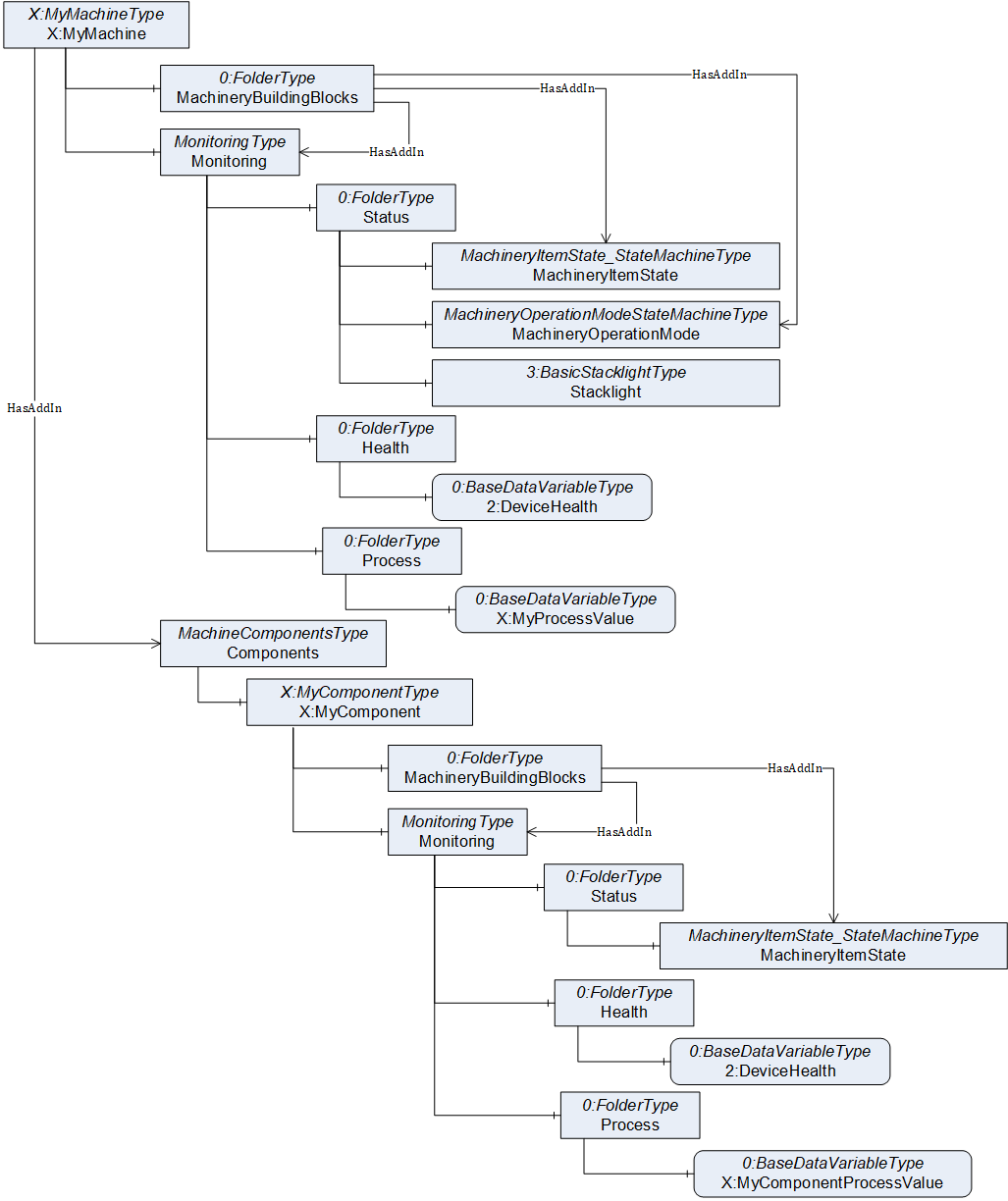
B.4.3 References
When some information of subcomponents is considered to be essential for the machine, the Monitoring building block may reference the information of the subcomponents directly. This is shown in Figure 35. The X:MyComponentProcessValue, provided by the X:MyComponent, is referenced from the Process folder of X:MyMachine. This approach only works, if the referenced Node has a unique (in the context of the machine) and self-explaining name and description in order to be interpretable. If this is not the case, the context needs to be provided by some proxy object, like used for the health of the subcomponent. Just referencing the Health folder or the DeviceHealth Variable would not provide the context of the subcomponent (assuming there would be several subcomponents), therefore a proxy object X:MyComponent was added. Note that this approach may lead to duplicating the components information in various places under Monitoring, It should be used rarely for important information that should be accessible from the Monitoring of the machine, directly. For the example of the health of the subcomponent, this may be unnecessary and better accessed by accessing the general information about the component.
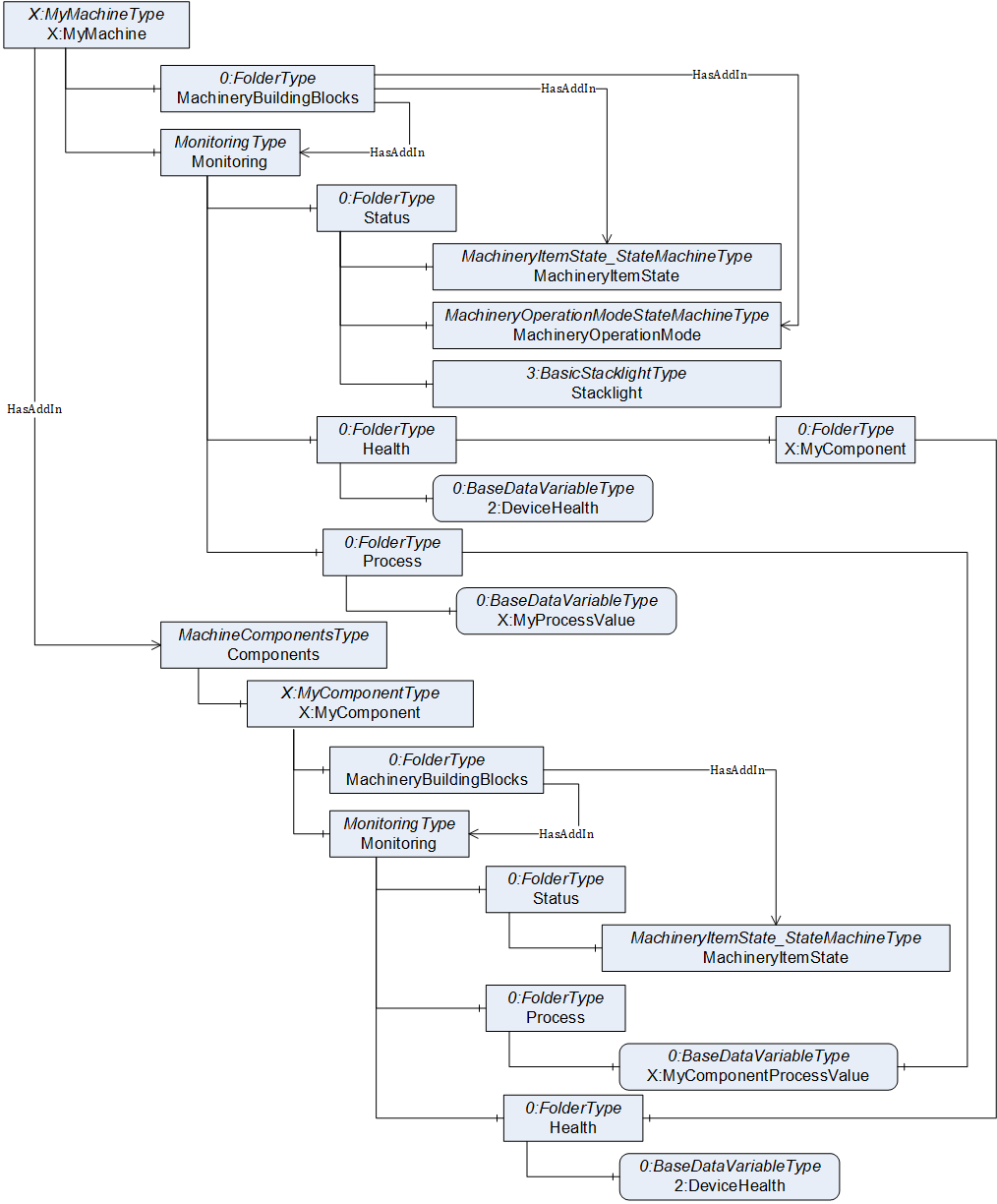
B.5 Notifications
B.5.1 Overview
As stated in 18.1, Notifications Objects expose Notifications either as Objects or as Events. In B.5.2, an example is given, where Objects are used. In B.5.3, an example is given, where Events are used. In Figure 30 in 18.1 a small example is shown, where both approaches are combined.
B.5.2 Notifications as Objects
In Figure 36, an example is given, where Objects are used as Notifications. The ObjectType X:ManualActivityType provides a notification that some manual activity (like the change of a tool in a machine tool) is needed. It provides information about the activity and when it is expected to be done. Whenever the machine predicts the need for such an activity, such an Object is created on the Notifications Object. The 0:NodeVersion Property can be used to identify such new Objects as a Client. After the action has been executed, the Notification Object will be removed.
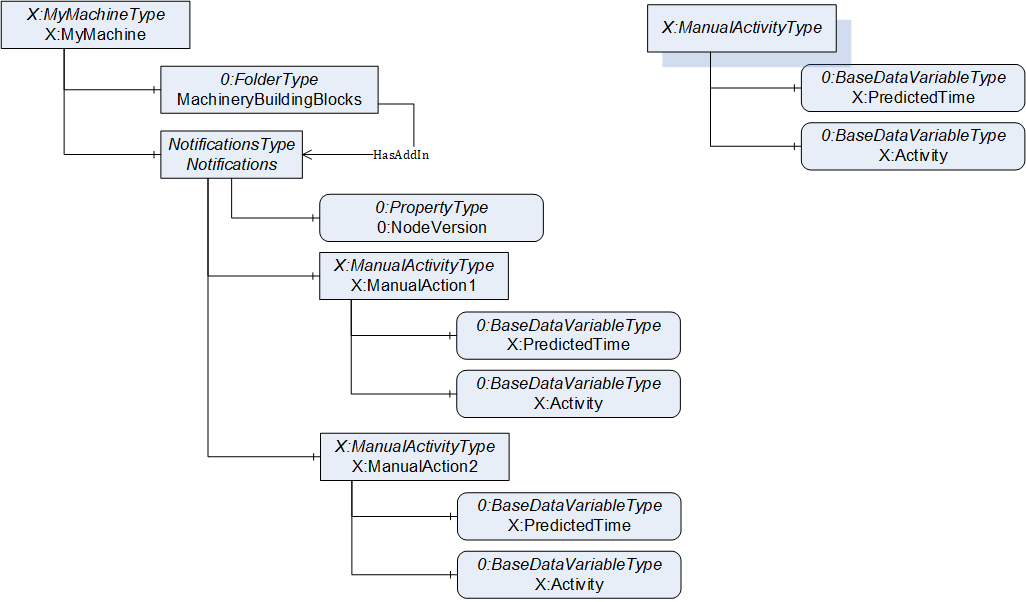
B.5.3 Notifications as Events
In Figure 37, an example is given, where Events are used as Notifications. In this case, the log of maintenance activities as defined by Asset Management Basics [8] is used. The EventType X:MaintenanceEventType implements the IMaintenanceEventType defined by Asset Management Basics. The X:MyMachineType provides a GeneratesEvent Reference from its Notifications Object to the X:MaintenanceEventType. For each new maintenance event, or if the status is changing, such an Event is generated.
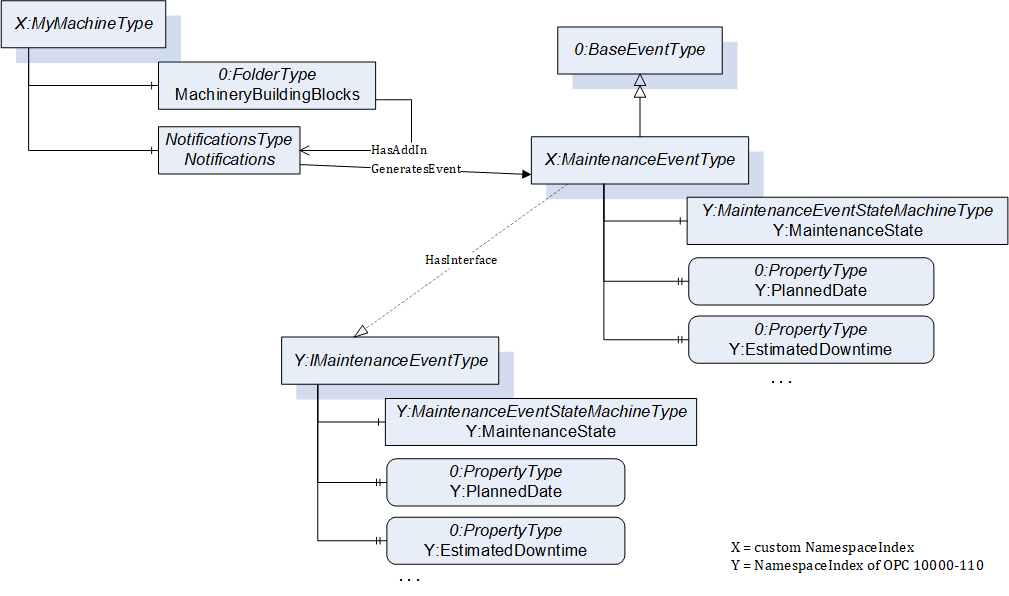
Annex C Examples how to use MachineryItemState and MachineryOperationMode to calculate KPIs (Informative)
C.1 Overview
To calculate KPIs such as the availability or efficiency of a machine or plant, the respective times must be used. These can be derived from the MachineryItemState and the MachineryOperationMode. This annex does not define any KPI values. The assumption is, that the KPIs will be calculated application specific, but can be based on those two states. Potentially, more information is needed for calculating specific KPIs.
To calculate KPI often information about the planning of production is required. This information usually comes from a higher level system such as MES or ERP and not from the machine, so it has not been included in this specification.
The following table in C.2 is used to explain how the required KPI time elements can be derived conform to ISO 22400-2 using the combination of MachineryItemState, MachineryOperationMode and HLS-ConditionState of the higher level system such as MES or ERP on level 3 (see IEC 62264-1). The KPI element definitions used are taken from the ISO 22400-2:2022 called Automation systems and integration - Key performance indicators (KPIs) for manufacturing operations management for KPI calculation.
The following section C.3 provides an example interpretation, of how the MachineryOperationMode and MachineryItemState can be used to determine SEMI E10 [5] times. Typically, MachineryItems are scheduled by higher level systems and are not aware how they are scheduled. So, interpretations of SEMI E10 times are typically "Operations time".
C.2 Example interpretation for ISO 22400
Table 69 proposes how KPI time elements according to ISO 22400-2 can be set using the combinations of MachineryItemState, MachineryOperationMode and HLS-ConditionState. These ISO 22400-2 KPI time elements can be used to do KPI calculations.
ISO 22400-2 KPI time elements | ISO 22400-2 Interpretation | Machinery Item State | Machinery Operation Mode | Higher Level System Condition State |
ADET | Delay time | OutOfService | Processing | System state is order registered but no maintenance |
ADET | Delay time | NotAvailable | Processing (last sent) | System state is order registered but no maintenance |
ADET | Delay time | NotExecuting | None | System state is order registered |
ADET | Delay time | NotExecuting | Processing | System state is order registered but no maintenance and time is just out of cycle time |
| ADOT (Actual Down Time) | Down time | OutOfService | None | System state is planned busy time based on operation calendar |
| ADOT (Actual Down Time) | Down time | NotAvailable | None (last sent) | System state is planned busy time based on operation calendar but no order registered |
| ADOT (Actual Down Time) | Down time | NotExecuting | None | System state is planned busy time based on operation calendar but no order registered |
APMT | preventive maintenance as service | OutOfService | Maintenance | System state is planned operation time based on operation calendar but no order registered |
APMT | Setup time as service | OutOfService | Setup | System state is planned operation time based on operation calendar but no order registered |
APMT | Setup time as service | NotAvailable | Setup (last sent) | System state is planned operation time based on operation calendar but no order registered |
APMT | preventive maintenance as service | NotAvailable | Maintenance (last sent) | System state is planned operation time based on operation calendar but no order registered |
APMT | preventive maintenance as service | NotExecuting | Maintenance | System state is planned operation time based on operation calendar but no order registered |
APMT | Setup time as service | NotExecuting | Setup | System state is planned operation time based on operation calendar but no order registered |
APMT | preventive maintenance as service | Executing | Maintenance | System state is planned operation time based on operation calendar but no order registered |
| APT (Actual production time) | Production time | Executing | None | System state is order registered |
| APT (Actual production time) | Production time | Executing | Processing | System state is order registered |
| APT (Actual production time) | Production time | NotExecuting | Processing | System state is order registered |
| APT (Actual production time) | Production time | Executing | Setup | SPLIT in setup time (AUST) and value added production time (APT=PQ*PRI) as retrograde confirmation (backflush) |
| ASDT (Actual Shut Down Time) | Shut down time | OutOfService | None | System state is shut down time based on operation calendar |
| ASDT (Actual Shut Down Time) | Shut down time | NotAvailable | None (last sent) | System state is shut down time based on operation calendar |
| ASDT (Actual Shut Down Time) | Shut down time | NotExecuting | None | System state is shut down time based on operation calendar |
AUST | Setup time | OutOfService | Setup | System state is order registered |
AUST | Setup time | NotAvailable | Setup (last sent) | System state is order registered |
AUST | Setup time | NotExecuting | Setup | System state is order registered |
AUST | Setup time | Executing | Setup | SPLIT in setup time (AUST) and value added production time (APT=PQ*PRI) as retrograde confirmation (backflush) |
TTR (Time to Repair) | Delay time but maintenance | OutOfService | Maintenance | System state is order registered but maintenance activities |
TTR (Time to Repair) | Delay time but maintenance | OutOfService | Processing | System state is order registered but maintenance activities |
TTR (Time to Repair) | Delay time but maintenance | NotAvailable | Processing (last sent) | System state is order registered but maintenance activities |
TTR (Time to Repair) | Delay time but maintenance | NotAvailable | Maintenance (last sent) | System state is order registered but maintenance activities |
TTR (Time to Repair) | Delay time but maintenance | NotExecuting | Maintenance | System state is order registered but maintenance activities |
TTR (Time to Repair) | Delay time but maintenance | NotExecuting | Processing | System state is order registered but maintenance activities and time is out of cycle time |
TTR (Time to Repair) | Delay time but maintenance | Executing | Maintenance | System state is order registered but maintenance activities |
Note 1: If condition state is order registered but in planned break down time period based on operation calendar then KPI time element has to be actual break down time (ABRT).
Note 2: Technological effects e.g., speed losses based on wait for feeds or wait for drains have to be analysed on SCADA or machinery level.
Note 3: If an added value activity is included in setup mode period, then the added value time has to be calculated as APT (APT=PQ*PRI) based on produced quantities and AUST has to be reduced based on this calculated APT.
C.3 Example interpretation for SEMI E10
The MachineryItemState OutOfService and the MachineryOperationMode Processing can be interpreted as SEMI E10 "Unscheduled Downtime".
The MachineryItemState NotExecuting and the MachineryOperationMode Setup can be interpreted as SEMI E10 "Engineering time".
The MachineryItemState NotExecuting and the MachineryOperationMode Processing can be interpreted as SEMI E10 "Standby time".
The MachineryItemState Executing and the MachineryOperationMode Processing can be interpreted as SEMI E10 "Productive time".
In this example, the availability of the Machine is calculated according to ISO 22400. For this purpose, the Actual Production Time (APT) and Planned Busy Time (PBT) are required. The APT can be derived from the combination of the MachineryItemState "Executing" and the MachineryOperationMode "Processing". Alternatively, the APT can also be derived from the Semi E10 time "Productive time". The PBT is usually not known to the Machine and is accordingly not provided by this specification.
___________
Bibliography
Agreement of Use
COPYRIGHT RESTRICTIONS
This document is provided "as is" by the OPC Foundation and VDMA.
Right of use for this specification is restricted to this specification and does not grant rights of use for referred documents.
Right of use for this specification will be granted without cost.
This document may be distributed through computer systems, printed or copied as long as the content remains unchanged and the document is not modified.
OPC Foundation and VDMA do not guarantee usability for any purpose and shall not be made liable for any case using the content of this document.
The user of the document agrees to indemnify OPC Foundation and VDMA and their officers, directors and agents harmless from all demands, claims, actions, losses, damages (including damages from personal injuries), costs and expenses (including attorneys' fees) which are in any way related to activities associated with its use of content from this specification.
The document shall not be used in conjunction with company advertising, shall not be sold or licensed to any party.
The intellectual property and copyright is solely owned by the OPC Foundation and VDMA.
PATENTS
The attention of adopters is directed to the possibility that compliance with or adoption of OPC or VDMA specifications may require use of an invention covered by patent rights. OPC Foundation or VDMA shall not be responsible for identifying patents for which a license may be required by any OPC or VDMA specification, or for conducting legal inquiries into the legal validity or scope of those patents that are brought to its attention. OPC or VDMA specifications are prospective and advisory only. Prospective users are responsible for protecting themselves against liability for infringement of patents.
WARRANTY AND LIABILITY DISCLAIMERS
WHILE THIS PUBLICATION IS BELIEVED TO BE ACCURATE, IT IS PROVIDED "AS IS" AND MAY CONTAIN ERRORS OR MISPRINTS. THE OPC FOUDATION NOR VDMA MAKES NO WARRANTY OF ANY KIND, EXPRESSED OR IMPLIED, WITH REGARD TO THIS PUBLICATION, INCLUDING BUT NOT LIMITED TO ANY WARRANTY OF TITLE OR OWNERSHIP, IMPLIED WARRANTY OF MERCHANTABILITY OR WARRANTY OF FITNESS FOR A PARTICULAR PURPOSE OR USE. IN NO EVENT SHALL THE OPC FOUNDATION NOR VDMA BE LIABLE FOR ERRORS CONTAINED HEREIN OR FOR DIRECT, INDIRECT, INCIDENTAL, SPECIAL, CONSEQUENTIAL, RELIANCE OR COVER DAMAGES, INCLUDING LOSS OF PROFITS, REVENUE, DATA OR USE, INCURRED BY ANY USER OR ANY THIRD PARTY IN CONNECTION WITH THE FURNISHING, PERFORMANCE, OR USE OF THIS MATERIAL, EVEN IF ADVISED OF THE POSSIBILITY OF SUCH DAMAGES.
The entire risk as to the quality and performance of software developed using this specification is borne by you.
RESTRICTED RIGHTS LEGEND
This Specification is provided with Restricted Rights. Use, duplication or disclosure by the U.S. government is subject to restrictions as set forth in (a) this Agreement pursuant to DFARs 227.7202-3(a); (b) subparagraph (c)(1)(i) of the Rights in Technical Data and Computer Software clause at DFARs 252.227-7013; or (c) the Commercial Computer Software Restricted Rights clause at FAR 52.227-19 subdivision (c)(1) and (2), as applicable. Contractor / manufacturer are the OPC Foundation, 16101 N. 82nd Street, Suite 3B, Scottsdale, AZ, 85260-1830.
COMPLIANCE
The combination of VDMA and OPC Foundation shall at all times be the sole entities that may authorize developers, suppliers and sellers of hardware and software to use certification marks, trademarks or other special designations to indicate compliance with these materials as specified within this document. Products developed using this specification may claim compliance or conformance with this specification if and only if the software satisfactorily meets the certification requirements set by VDMA or the OPC Foundation. Products that do not meet these requirements may claim only that the product was based on this specification and must not claim compliance or conformance with this specification.
TRADEMARKS
Most computer and software brand names have trademarks or registered trademarks. The individual trademarks have not been listed here.
GENERAL PROVISIONS
Should any provision of this Agreement be held to be void, invalid, unenforceable or illegal by a court, the validity and enforceability of the other provisions shall not be affected thereby.
This Agreement shall be governed by and construed under the laws of Germany.
This Agreement embodies the entire understanding between the parties with respect to, and supersedes any prior understanding or agreement (oral or written) relating to, this specification.
ISSUE REPORTING
If an error or problem is found in this specification, the UaNodeSet, or any associated supplementary files, it should be reported as an issue.
The reporting process can be found here: https://opcfoundation.org/resources/issue-tracking/
The Link to the issue tracking project for this document is here:
https://mantis.opcfoundation.org/set_project.php?project_id=142&make_default=no