5.1.6.5 Structured value
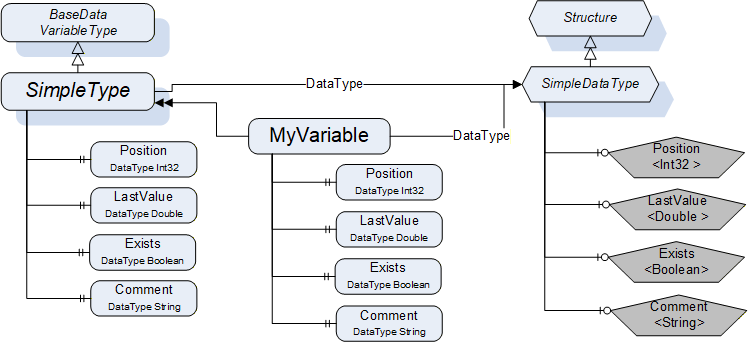
Structured data element is defined in custom DataType derived from Structure DataType or is represented by nested VariableType that has Variables as children.
A structured data element represented as flattened Property Name
Struct Simple {
Integer Position;
Float LastValue;
Boolean Exists;
String Comment;}
ISA-95: Simple.Position, Simple.LastValue, Simple.Exists, Simple.Comment
| OPC UA: | ABC DataType (custom DataType) derived from Structure DataType is defined, with the given structure. |
A structured data element represented by creating an ISA95Property with no data value with nested child ISA95Properties and identification of element.
Struct Simple {
public int Position;
public double LastValue;
public bool Exists;
public string Comment;}
ISA-95: Property [ID=”Simple”]
Property [ID=”Simple”]\ Property [ID=”Position”]
Property [ID=”Simple”]\ Property [ID=”LastValue”]
Property [ID=”Simple”]\ Property [ID=”Exists”]
Property [ID=”Simple”]\ Property [ID=”Comment”]
| OPC UA: | All ISA95Properties are represented as Variables and Simple property points to Position, LastValue, Exists, and Comment properties by HasComponent or subtypes of HasComponent ReferenceType. (See clause 4.3.8.6) |
A combination of a) and b) where a structured data element represented by creating a ISA95 Property with a data value that is a structured data element and with nested child properties and identification of element (see Figure 14). This is the preferred method for modelling complex information. [Note: the figure flow the template defined in OPC 10000-3 with some extensions defined in Annex F]