
Agreement of Use
COPYRIGHT RESTRICTIONS
Any unauthorized use of this specification may violate copyright laws, trademark laws, and communications regulations and statutes. This document contains information which is protected by copyright. All Rights Reserved. No part of this work covered by copyright herein may be reproduced or used in any form or by any means--graphic, electronic, or mechanical, including photocopying, recording, taping, or information storage and retrieval systems--without permission of the copyright owner.
OPC Foundation members and non-members are prohibited from copying and redistributing this specification. All copies must be obtained on an individual basis, directly from the OPC Foundation Web site http://www.opcfoundation.org.
PATENTS
The attention of adopters is directed to the possibility that compliance with or adoption of OPC specifications may require use of an invention covered by patent rights. OPC shall not be responsible for identifying patents for which a license may be required by any OPC specification, or for conducting legal inquiries into the legal validity or scope of those patents that are brought to its attention. OPC specifications are prospective and advisory only. Prospective users are responsible for protecting themselves against liability for infringement of patents.
WARRANTY AND LIABILITY DISCLAIMERS
WHILE THIS PUBLICATION IS BELIEVED TO BE ACCURATE, IT IS PROVIDED "AS IS" AND MAY CONTAIN ERRORS OR MISPRINTS. THE OPC FOUDATION MAKES NO WARRANTY OF ANY KIND, EXPRESSED OR IMPLIED, WITH REGARD TO THIS PUBLICATION, INCLUDING BUT NOT LIMITED TO ANY WARRANTY OF TITLE OR OWNERSHIP, IMPLIED WARRANTY OF MERCHANTABILITY OR WARRANTY OF FITNESS FOR A PARTICULAR PURPOSE OR USE. IN NO EVENT SHALL THE OPC FOUNDATION BE LIABLE FOR ERRORS CONTAINED HEREIN OR FOR DIRECT, INDIRECT, INCIDENTAL, SPECIAL, CONSEQUENTIAL, RELIANCE OR COVER DAMAGES, INCLUDING LOSS OF PROFITS, REVENUE, DATA OR USE, INCURRED BY ANY USER OR ANY THIRD PARTY IN CONNECTION WITH THE FURNISHING, PERFORMANCE, OR USE OF THIS MATERIAL, EVEN IF ADVISED OF THE POSSIBILITY OF SUCH DAMAGES.
The entire risk as to the quality and performance of software developed using this specification is borne by you.
RESTRICTED RIGHTS LEGEND
This Specification is provided with Restricted Rights. Use, duplication or disclosure by the U.S. government is subject to restrictions as set forth in (a) this Agreement pursuant to DFARs 227.7202-3(a); (b) subparagraph (c)(1)(i) of the Rights in Technical Data and Computer Software clause at DFARs 252.227-7013; or (c) the Commercial Computer Software Restricted Rights clause at FAR 52.227-19 subdivision (c)(1) and (2), as applicable. Contractor / manufacturer are the OPC Foundation, 16101 N. 82nd Street, Suite 3B, Scottsdale, AZ, 85260-1830.
COMPLIANCE
The OPC Foundation shall at all times be the sole entity that may authorize developers, suppliers and sellers of hardware and software to use certification marks, trademarks or other special designations to indicate compliance with these materials. Products developed using this specification may claim compliance or conformance with this specification if and only if the software satisfactorily meets the certification requirements set by the OPC Foundation. Products that do not meet these requirements may claim only that the product was based on this specification and must not claim compliance or conformance with this specification.
Trademarks
Most computer and software brand names have trademarks or registered trademarks. The individual trademarks have not been listed here.
GENERAL PROVISIONS
Should any provision of this Agreement be held to be void, invalid, unenforceable or illegal by a court, the validity and enforceability of the other provisions shall not be affected thereby.
This Agreement shall be governed by and construed under the laws of the State of Minnesota, excluding its choice or law rules.
This Agreement embodies the entire understanding between the parties with respect to, and supersedes any prior understanding or agreement (oral or written) relating to, this specification.
ISSUE REPORTING
The OPC Foundation strives to maintain the highest quality standards for its published specifications; hence they undergo constant review and refinement. Readers are encouraged to report any issues and view any existing errata here: http://www.opcfoundation.org/errata.
Revision 1.05.04 Highlights
The following table includes the issues resolved with this revision.
| Mantis ID | Scope | Summary | Resolution |
| 9248 | Errata | Missing Documentation About Duration of Demand | Added new Subclause 7.2.2.3 "Duration of demand". Removed obsolete item 7 from Table 40. |
| 9249 | Clarification | Clarify Byte Order of SafetyBaseID in Calculation of the SPDU_ID | Added new Subclause 7.2.3.3 "Example for the calculation of SPDU_ID_1, SPDU_ID_2 and SPDU_ID_3 (informative)". Adapted Figure 21 wording to IEC "octet(s)". |
| 9466 | Clarification | Merge Changes from IEC Standardization Document Stream | Minor technical rewordings and editorial changes were backported from the IEC CD stage. |
| 9323 | Errata | Misleading Wording in Requirement RQ7.15 About Order of Constructing ResponseSPDU | In RQ7.15, replaced "after that" with "in addition". |
| 9680 | Clarification | Requirement 5.6 "Ignore All-Zero SPDUs" Needs Detailing | Detailing of requirement RQ5.6 regarding actual Client/Server behavior. |
| 9681 | Clarification | Section about "Duration of Demand" misses explanations about timeout-based and bidirectional approaches | Add respective explanations to 7.2.2.3. |
| 9621 | Errata | Nodeset changes concerning missing HasComponent relations | Added HasComponent relations to SafetyPDUs Objects' RequestSPDU and ResponseSPDU. |
| 9552 | Errata | Editorial Issues in 1.05.04 RC | Removed unexplained bold red highlighting of method arguments OutSafetyData and OutNonSafetyData in signature descriptions for methods ReadSafetyData and ReadSafetyDiagnostics and added explanations that these are abstract types that have to be concretized for specific applications. Table 23: added missing blank after "document" in entry for SafetyConsumerID. Figure 9: corrected misalignment of SafetyConsumer in F-PLC. Table 24 - SPI of the SafetyProvider: adapted to consistent usage of range "0x0 - 0xFFFFFFFF" (vs. "0 - 0xFFFFFFFF"). Table 25 - SAPI of the SafetyConsumer: uniformly formatted terms in first column in italics. Table 26 - SPI of the SafetyConsumer: Harmonized the wording explaining the SafetyProviderIDConfigured parameter (using the wording from the SafetyBaseIDConfigured parameter). 6.3.4.3 - Motivation for SAPI Operator Acknowledge (OperatorAckConsumer): added link to 6.3.4.5 - Motivation for SPI SafetyOperatorAckNecessary to last paragraph. Figure 16: noted availability of demand value "C" at occurrence of second new MNR. |
OPC UA Safety extends OPC UA to fulfill the requirements of functional safety as defined in the IEC 61508 series and IEC 61784-3 series of standards.
Figure 1 shows the relationship between this document and the relevant safety and OPC UA standards in an industrial environment. An arrow from Document A to Document B means "Document A is referenced in Document B". This reference can be either normative or informative. Not all of these standards are applicable or required for a given product.
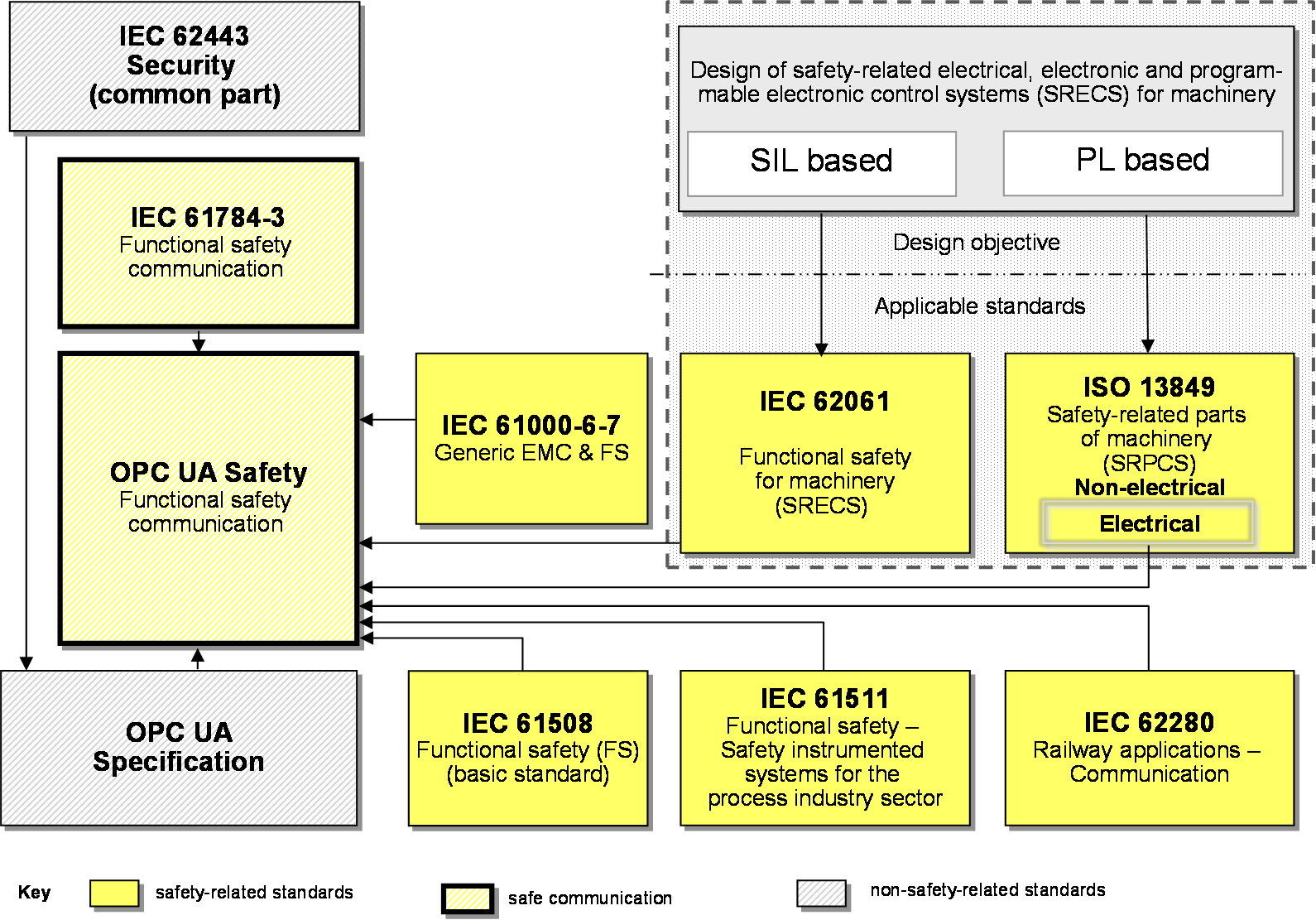
Implementing this document allows for detecting all types of communication errors encountered in the lower network layers. In case an error is detected, this information is shared with the safety applications in the User Layer which can then act in an appropriate way, e.g. by switching to a safe state.
The document describes the behaviour of the individual endpoints for safe communication, as well as the OPC UA Information Model which is used to access these endpoints.
This document is application-independent and does not pose requirements on the structure and length of the application data. Application-specific requirements are expected to be described in appropriate companion specifications.
This document can be used for applications requiring functional safety up to the safety integrity level (SIL) 4.