
6.2.2.6 Objects SafetyProviderParameters and SafetyConsumerParameters
Figure 6 shows the safety parameters for the SafetyProvider and the SafetyConsumer.
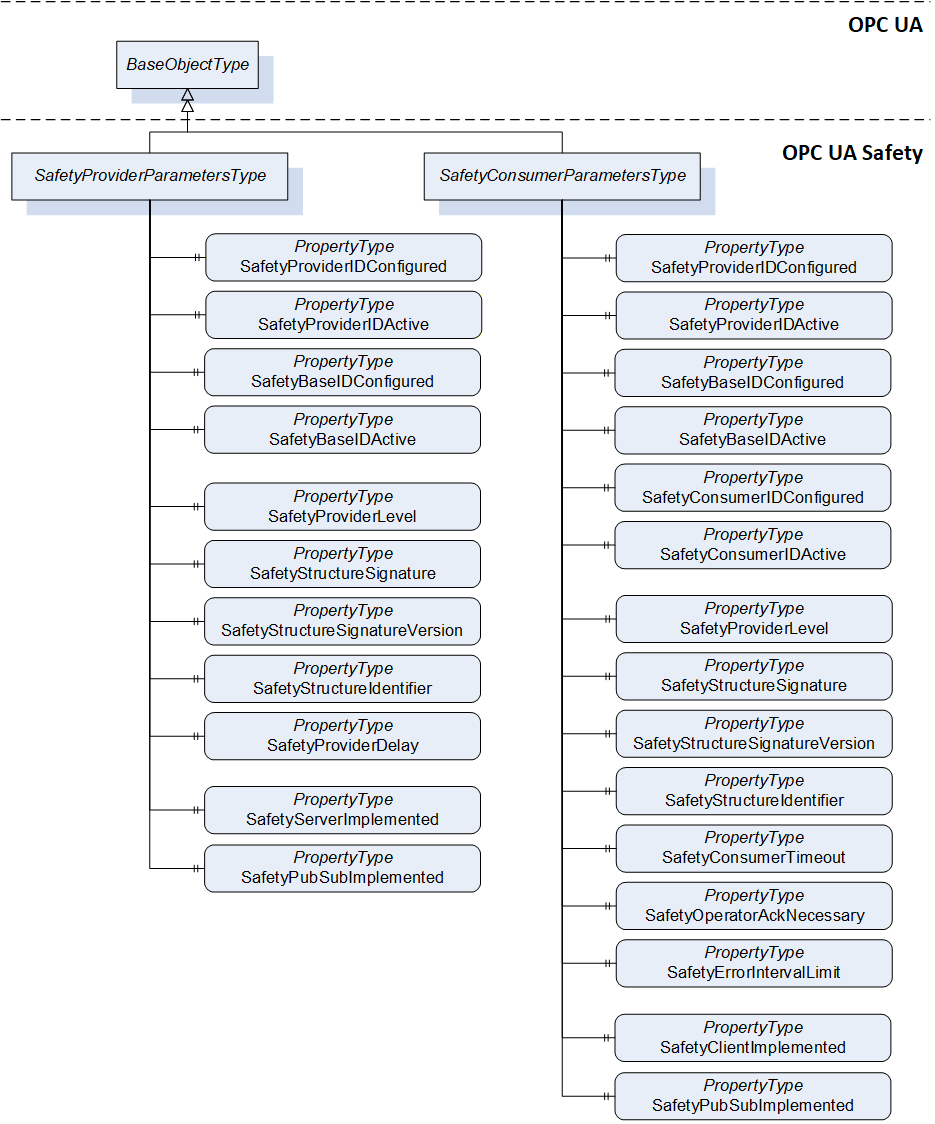
Table 12 shows the definition for the SafetyProviderParametersType. Refer to 6.3.3.3 for more details on the Safety Parameter Interface (SPI) of the SafetyProvider.
| Attribute | Value | ||||
|---|---|---|---|---|---|
| BrowseName | SafetyProviderParametersType | ||||
| IsAbstract | False | ||||
| References | Node class | BrowseName | DataType | TypeDefinition | Modelling rule |
| Subtype of BaseObjectType | |||||
| HasProperty | Variable | SafetyProviderIDConfigured | UInt32 | PropertyType | Mandatory |
| HasProperty | Variable | SafetyProviderIDActive | UInt32 | PropertyType | Mandatory |
| HasProperty | Variable | SafetyBaseIDConfigured | Guid | PropertyType | Mandatory |
| HasProperty | Variable | SafetyBaseIDActive | Guid | PropertyType | Mandatory |
| HasProperty | Variable | SafetyProviderLevel | Byte | PropertyType | Mandatory |
| HasProperty | Variable | SafetyStructureSignature | UInt32 | PropertyType | Mandatory |
| HasProperty | Variable | SafetyStructureSignatureVersion | UInt16 | PropertyType | Mandatory |
| HasProperty | Variable | SafetyStructureIdentifier | String | PropertyType | Mandatory |
| HasProperty | Variable | SafetyProviderDelay | UInt32 | PropertyType | Mandatory |
| HasProperty | Variable | SafetyServerImplemented | Boolean | PropertyType | Mandatory |
| HasProperty | Variable | SafetyPubSubImplemented | Boolean | PropertyType | Mandatory |
| Conformance units | |||||
| SafetyProviderParameters | |||||
The parameters for SafetyProviderID and SafetyBaseID exist in pairs for “Configured” and “Active” states:
SafetyProviderIDConfigured and SafetyProviderIDActive,
SafetyBaseIDConfigured and SafetyBaseIDActive.
The “[...]Configured” parameters shall always deliver the values as configured via the SPI. The “[...]Active” parameters shall deliver:
the corresponding “[...]Configured” values if the system is still offline;
the values which have been set during runtime via the SAPI parameters (SafetyProviderID, SafetyBaseID);
the corresponding “[...]Configured” values if the active values have been set to zero via the SAPI parameters (SafetyProviderID, SafetyBaseID).
The Property SafetyBaseIDConfigured is shared for all SafetyProviders with the same SafetyBaseIDConfigured value. If multiple instances of SafetyObjectsType are running on the same Node, it is a viable optimization that a Property SafetyBaseIDConfigured is referenced by either multiple SafetyProviders or SafetyConsumers, or both.
For releases up to Release 2.0 of the document, the value for the SafetyStructureSignatureVersion shall be 0x0001 (see RQ7.21 in 7.2.3.5).
Table 13 shows the definition of the SafetyConsumerParametersType. The Properties SafetyStructureIdentifier and SafetyStructureSignatureVersion are optional, because SafetyStructureSignature is typically calculated in an offline engineering tool. For small devices, it could be beneficial to only upload the SafetyStructureSignature to the device, but not SafetyStructureIdentifier and SafetyStructureSignatureVersion in order to save either bandwidth or memory, or both. Refer to 6.3.4.4 for more details on the Safety Parameter Interface (SPI) of the SafetyConsumer.
| Attribute | Value | ||||
|---|---|---|---|---|---|
| BrowseName | SafetyConsumerParametersType | ||||
| IsAbstract | False | ||||
| References | Node class | BrowseName | DataType | TypeDefinition | Modelling rule |
| Subtype of BaseObjectType | |||||
| HasProperty | Variable | SafetyProviderIDConfigured | UInt32 | PropertyType | Mandatory |
| HasProperty | Variable | SafetyProviderIDActive | UInt32 | PropertyType | Mandatory |
| HasProperty | Variable | SafetyBaseIDConfigured | Guid | PropertyType | Mandatory |
| HasProperty | Variable | SafetyBaseIDActive | Guid | PropertyType | Mandatory |
| HasProperty | Variable | SafetyConsumerIDConfigured | UInt32 | PropertyType | Mandatory |
| HasProperty | Variable | SafetyConsumerIDActive | UInt32 | PropertyType | Mandatory |
| HasProperty | Variable | SafetyProviderLevel | Byte | PropertyType | Mandatory |
| HasProperty | Variable | SafetyStructureSignature | UInt32 | PropertyType | Mandatory |
| HasProperty | Variable | SafetyStructureSignatureVersion | UInt16 | PropertyType | Optional |
| HasProperty | Variable | SafetyStructureIdentifier | String | PropertyType | Optional |
| HasProperty | Variable | SafetyConsumerTimeout | UInt32 | PropertyType | Mandatory |
| HasProperty | Variable | SafetyOperatorAckNecessary | Boolean | PropertyType | Mandatory |
| HasProperty | Variable | SafetyErrorIntervalLimit | UInt16 | PropertyType | Mandatory |
| HasProperty | Variable | SafetyClientImplemented | Boolean | PropertyType | Mandatory |
| HasProperty | Variable | SafetyPubSubImplemented | Boolean | PropertyType | Mandatory |
| Conformance units | |||||
| SafetyConsumerParameters | |||||
The parameters for SafetyProviderID, SafetyBaseID and SafetyConsumerID exist in pairs for “Configured” and “Active” states: SafetyProviderIDConfigured and SafetyProviderIDActive, SafetyBaseIDConfigured and SafetyBaseIDActive, and SafetyConsumerIDConfigured and SafetyConsumerIDActive.
The “[...]Configured” parameters shall always deliver the values as configured via the SPI. The “[...]Active” parameters shall deliver:
the corresponding “[...]Configured” values if the system is still offline;
the values which have been set during runtime via the SAPI parameters (SafetyProviderID, SafetyBaseID, SafetyConsumerID);
the corresponding “[...]Configured” values if the active values have been set to zero via the SAPI parameters (SafetyProviderID, SafetyBaseID, SafetyConsumerID).