
4.1.4 Serial Number State and Event Model
The state and event model for a Serial Number shall follow the model displayed in Figure 4.
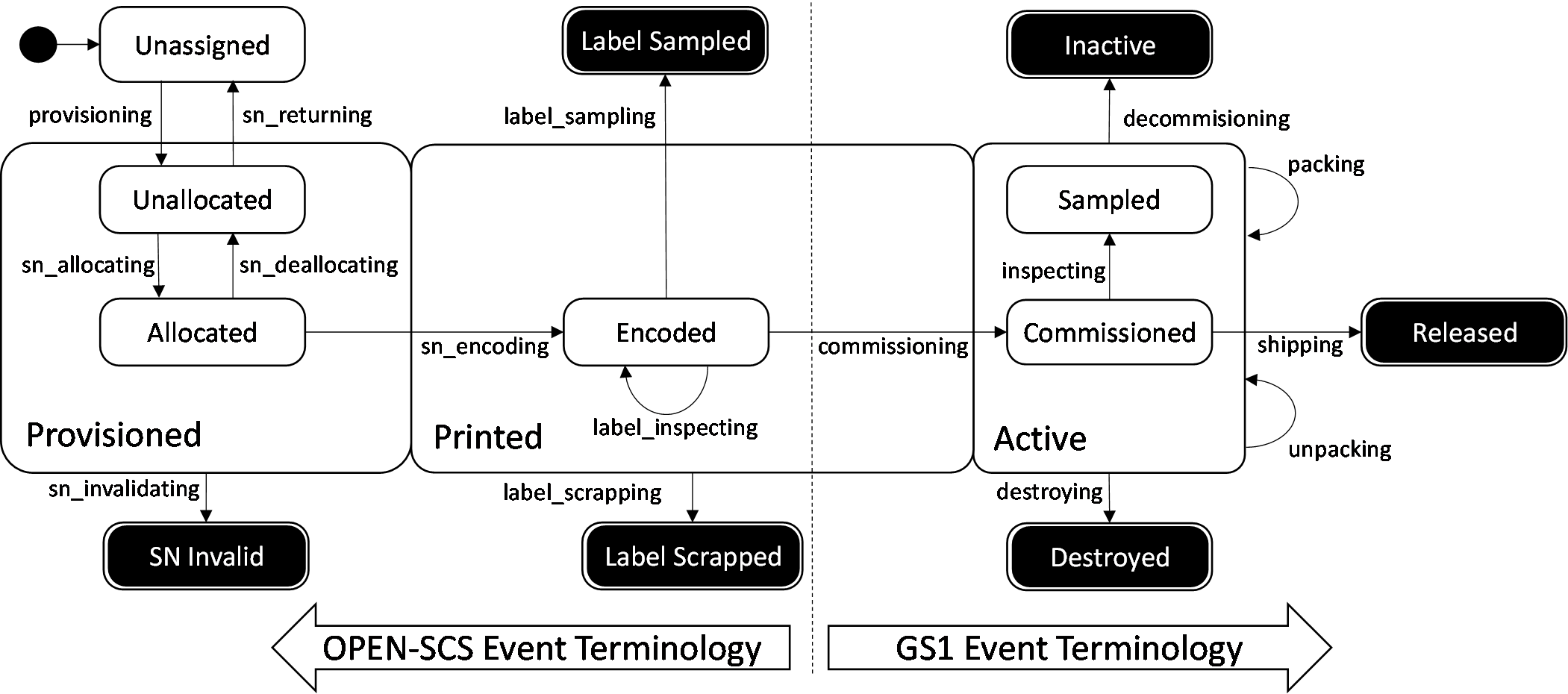
Each Serial Number state is defined in Table 1.
| SID State | Description | Examples |
| Unassigned | The Serial Number has not been assigned to production or a packaging run. The unassigned state is used for communication to systems that assign serial numbers. | A request is sent to an agent or serial number management system that creates serial numbers, along with possible information such as product codes. |
| Unallocated | As Serial Number has been assigned to production or a packaging run, but it has not yet been allocated for use a specific production run of a product or aggregation. | A local serial number management system maintains a set of unallocated serial numbers. |
| Allocated | The Serial Number has been assigned to a specific product or aggregation production run. | Serial Numbers are available and maintained in a local printer for printing on a label. |
| SN Invalid | The Serial Number is no longer viable, and the related serial number is no longer defined. The Serial Number will not be the subject of subsequent events. | A process order using the Serial Numbers was cancelled, the provisioned Serial Number are not associated with a physical product and will not be further used. |
| Encoded | The Serial Number has been written to a barcode or RFID tag, but not yet commissioned. | An industrial printer prints a label. |
| Label Sampled | The printed label has been retained and is not associated with a physical product or aggregation. | A printed label is attached to a batch record. |
| Label Scrapped | A label was encoded with a Serial Number but was made unusable before being applied to a product or aggregation. | A vision system detects that a label was misapplied or ripped on a product or aggregation and the label was removed from the product or aggregation. |
| Commissioned | The Serial Number has been associated with a physical product or aggregation but has not yet left the responsibility of production. The Serial Number can now be identified as a SID. | A label is attached to a package, and the package is being placed into a case, and the case is being placed on a pallet. |
| Sampled | The product or aggregation is to be used as a sample for testing or other use, not to be made active. | Product was pulled from the end of the packaging line and stored in a facility for later stability testing. |
| Inactive | The product or aggregation is no longer active but may not have been destroyed. GS1 defines this disposition as a decommissioned object that may be reintroduced to the supply chain, however any status change after decommissioning is not in scope of the PSS. | Product over its expiration date is send to a facility for destruction or for testing to determine its viability. |
| Destroyed | The product or aggregation has been fully rendered non-usable. | A production error was detected, and all packaged product was pulled from the line and destroyed. |
| Released | The Serial Number has been associated with a physical product or aggregation and has left the responsibility of production. | A pallet of products/packages is delivered to the warehouse and the transfer of control is sent to the ERP system. |
Each Serial Number event is defined in Table 2. The events occur as a result of a business or process step.
| Event | Description |
| provisioning | Unassigned Serial Numbers were made available for use in eventual encoding and commissioning. |
| sn_returning | Unallocated Serial Numbers may be returned to the Unassigned state |
| sn_allocating | Unallocated Serial Numbers are to be assigned for use in a packaging run |
| sn_deallocating | Unused allocated Serial Numbers may be returned to the unallocated state. |
| sn_invalidating | Provisioned Serial Numbers are no longer available for use |
| sn_encoding | Serial Numbers and other associated information are written to a barcode or RFID tag but are not yet associated with a product or aggregation. (Derived from the GS1 “encoding” business step.) |
| label_inspecting | Written barcode or RFID was read to address potential physical or documentation defects. |
| label_sampling | Written barcode or RFID is pulled from production and retained as a sample for later testing or inspection. |
| label_scrapping | Written barcode or RFID was made unusable in production and the serial number if no longer associated with a packaging run |
| commissioning | A Serial Numbers is associated with a specific product or aggregation. (Derived from the GS1 “commissioning” business step.) |
| inspecting | Product or aggregation is pulled from production and retained as a sample for later testing or inspection. |
| shipping | Indicates the overall process of staging, outbound, loading and departing the responsibility of production. (Derived from the GS1 “shipping” business step.) |
| decommissioning | Process of disassociating an instance-level identifier (Serial Number) with an object. For example, either time or an event has caused to the serial number to be disassociated with a product or aggregation. (Derived from the GS1 “decommissioning” business step.) |
| destroying | Process of terminating a physical object. For an instance-level identifier, the object will not be the subject of subsequent events; subsequent events are likely indicative of error (such as a stray read of a tag inside an incinerator). (Derived from the GS1 “destroying” business step.) |
| packing | Denotes a specific activity within a business process that includes putting objects into a larger container. For example, adding labeled bottles into a case or adding cases into a pallet. (Derived from the GS1 “packing” business step.) |
| unpacking | Denotes a specific activity within a business process that includes removing products (individuals, inners, cases, pallets) from a larger container. For example, removing labeled bottles from a case or removing cases from a pallet. (Derived from the GS1 “unpacking” business step.) |