
1 Scope
This document defines basic concepts for asset management used in an OPC UA Information Model. It considers different aspects of asset management. Applications do not have to use all or nothing of this specification, but can chose which concepts they want to support. In some cases, this specification just defines how to use concepts of the base OPC UA specifications, in other cases it does define additional OPC UA Nodes (types or standardized instances).
The intention of this specification is to define commonalities on asset management, that can be used as base from other companion specifications which might further refine those concepts for their domain specific needs. However, it is also possible to use this specification directly, without additional companion specifications.
OPC Foundation
OPC is the interoperability standard for the secure and reliable exchange of data and information in the industrial automation space and in other industries. It is platform independent and ensures the seamless flow of information among devices from multiple vendors. The OPC Foundation is responsible for the development and maintenance of this standard.
OPC UA is a platform independent service-oriented architecture that integrates all the functionality of the individual OPC Classic specifications into one extensible framework. This multi-layered approach accomplishes the original design specification goals of:
Platform independence: from an embedded microcontroller to cloud-based infrastructure
Secure: encryption, authentication, authorisation and auditing
Extensible: ability to add new features including transports without affecting existing applications
Comprehensive information modelling capabilities: for defining any model from simple to complex
2 Normative references
The following referenced documents are indispensable for the application of this document. For dated references, only the edition cited applies. For undated references, the latest edition of the referenced document (including any amendments and errata) applies.
OPC 10000-1, OPC Unified Architecture - Part 1: Overview and Concepts
OPC 10000-1
OPC 10000-2, OPC Unified Architecture - Part 2: Security Model
OPC 10000-2
OPC 10000-3, OPC Unified Architecture - Part 3: Address Space Model
OPC 10000-3
OPC 10000-4, OPC Unified Architecture - Part 4: Services
OPC 10000-4
OPC 10000-5, OPC Unified Architecture - Part 5: Information Model
OPC 10000-5
OPC 10000-6, OPC Unified Architecture - Part 6: Mappings
OPC 10000-6
OPC 10000-7, OPC Unified Architecture - Part 7: Profiles
OPC 10000-7
OPC 10000-9, OPC Unified Architecture - Part 9: Alarms and Conditions
OPC 10000-9
OPC 10000-11, OPC Unified Architecture - Part 11: Historical Access
OPC 10000-11
OPC 10000-16, OPC Unified Architecture - Part 16: State Machines
OPC 10000-16
OPC 10000-17, OPC Unified Architecture - Part 17: Alias Names
OPC 10000-17
OPC 10000-19, OPC Unified Architecture - Part 19: Dictionary Reference
OPC 10000-19
OPC 10000-23, OPC Unified Architecture - Part 23: Common ReferenceTypes
http://www.opcfoundation.org/UA/Part23/
OPC 10000-100, OPC Unified Architecture - Part 100: Devices
OPC 10000-100
3 Terms, abbreviated terms and conventions
3.1 Overview
It is assumed that basic concepts of OPC UA information modelling and asset management are understood in this document. This document will use these concepts to describe the Asset Management Basics Information Model. For the purposes of this document, the terms and definitions given in OPC 10000-1, OPC 10000-2, OPC 10000-3, OPC 10000-4, OPC 10000-5, OPC 10000-6, OPC 10000-7, OPC 10000-9, OPC 10000-11, OPC 10000-16, OPC 10000-17, OPC 10000-19, OPC 10000-23 and OPC 10000-100 apply.
Note that OPC UA terms and terms defined in this document are italicized in the document.
3.2 Abbreviated terms
| PLC | Programmable Logical Controller |
| URI | Uniform Resource Identifier |
| XML | Extensible Markup Language |
3.3 Conventions used in this document
3.3.1 Conventions for Node descriptions
3.3.1.1 Node definitions
Node definitions are specified using tables (see Table 2).
Attributes are defined by providing the Attribute name and a value, or a description of the value.
References are defined by providing the ReferenceType name, the BrowseName of the TargetNode and its NodeClass.
If the TargetNode is a component of the Node being defined in the table the Attributes of the composed Node are defined in the same row of the table.
The DataType is only specified for Variables; "[<number>]" indicates a single-dimensional array, for multi-dimensional arrays the expression is repeated for each dimension (e.g. [2][3] for a two-dimensional array). For all arrays the ArrayDimensions is set as identified by <number> values. If no <number> is set, the corresponding dimension is set to 0, indicating an unknown size. If no number is provided at all the ArrayDimensions can be omitted. If no brackets are provided, it identifies a scalar DataType and the ValueRank is set to the corresponding value (see OPC 10000-3). In addition, ArrayDimensions is set to null or is omitted. If it can be Any or ScalarOrOneDimension, the value is put into "{<value>}", so either "{Any}" or "{ScalarOrOneDimension}" and the ValueRank is set to the corresponding value (see OPC 10000-3) and the ArrayDimensions is set to null or is omitted. Examples are given in Table 1.
| Notation | DataType | ValueRank | ArrayDimensions | Description |
| 0:Int32 | 0:Int32 | -1 | omitted or null | A scalar Int32. |
| 0:Int32[] | 0:Int32 | 1 | omitted or {0} | Single-dimensional array of Int32 with an unknown size. |
| 0:Int32[][] | 0:Int32 | 2 | omitted or {0,0} | Two-dimensional array of Int32 with unknown sizes for both dimensions. |
| 0:Int32[3][] | 0:Int32 | 2 | {3,0} | Two-dimensional array of Int32 with a size of 3 for the first dimension and an unknown size for the second dimension. |
| 0:Int32[5][3] | 0:Int32 | 2 | {5,3} | Two-dimensional array of Int32 with a size of 5 for the first dimension and a size of 3 for the second dimension. |
| 0:Int32{Any} | 0:Int32 | -2 | omitted or null | An Int32 where it is unknown if it is scalar or array with any number of dimensions. |
| 0:Int32{ScalarOrOneDimension} | 0:Int32 | -3 | omitted or null | An Int32 where it is either a single-dimensional array or a scalar. |
The TypeDefinition is specified for Objects and Variables.
The TypeDefinition column specifies a symbolic name for a NodeId, i.e. the specified Node points with a HasTypeDefinition Reference to the corresponding Node.
The ModellingRule of the referenced component is provided by specifying the symbolic name of the rule in the ModellingRule column. In the AddressSpace, the Node shall use a HasModellingRule Reference to point to the corresponding ModellingRule Object.
If the NodeId of a DataType is provided, the symbolic name of the Node representing the DataType shall be used.
Note that if a symbolic name of a different namespace is used, it is prefixed by the NamespaceIndex (see 3.3.2.2).
Nodes of all other NodeClasses cannot be defined in the same table; therefore, only the used ReferenceType, their NodeClass and their BrowseName are specified. A reference to another part of this document points to their definition.
Table 2 illustrates the table. If no components are provided, the DataType, TypeDefinition and Other columns may be omitted and only a Comment column is introduced to point to the Node definition.
| Attribute | Value | ||||
| Attribute name | Attribute value. If it is an optional Attribute that is not set "--" is used. | ||||
| References | NodeClass | BrowseName | DataType | TypeDefinition | Other |
|---|---|---|---|---|---|
| ReferenceType name | NodeClass of the target Node. | BrowseName of the target Node. | DataType of the referenced Node, only applicable for Variables. | TypeDefinition of the referenced Node, only applicable for Variables and Objects. | Additional characteristics of the TargetNode such as the ModellingRule or AccessLevel. |
| NOTE Notes referencing footnotes of the table content. | |||||
Components of Nodes can be complex that is containing components by themselves. The TypeDefinition, NodeClass and DataType can be derived from the type definitions, and the symbolic name can be created as defined in 3.3.3.1. Therefore, those containing components are not explicitly specified; they are implicitly specified by the type definitions.
The Other column defines additional characteristics of the Node. Examples of characteristics that can appear in this column are show in Table 3.
| Name | Short Name | Description |
| 0:Mandatory | M | The Node has the Mandatory ModellingRule. |
| 0:Optional | O | The Node has the Optional ModellingRule. |
| 0:MandatoryPlaceholder | MP | The Node has the MandatoryPlaceholder ModellingRule. |
| 0:OptionalPlaceholder | OP | The Node has the OptionalPlaceholder ModellingRule. |
| ReadOnly | RO | The Node AccessLevel has the CurrentRead bit set but not the CurrentWrite bit. |
| ReadWrite | RW | The Node AccessLevel has the CurrentRead and CurrentWrite bits set. |
| WriteOnly | WO | The Node AccessLevel has the CurrentWrite bit set but not the CurrentRead bit. |
If multiple characteristics are defined they are separated by commas. The name or the short name may be used.
3.3.1.2 Additional References
To provide information about additional References, the format as shown in Table 4 is used.
| SourceBrowsePath | Reference Type | Is Forward | TargetBrowsePath |
| SourceBrowsePath is always relative to the TypeDefinition. Multiple elements are defined as separate rows of a nested table. | ReferenceType name | True = forward Reference. | TargetBrowsePath points to another Node, which can be a well-known instance or a TypeDefinition. You can use BrowsePaths here as well, which is either relative to the TypeDefinition or absolute. If absolute, the first entry needs to refer to a type or well-known instance, uniquely identified within a namespace by the BrowseName. |
References can be to any other Node.
3.3.1.3 Additional sub-components
To provide information about sub-components, the format as shown in Table 5 is used.
| BrowsePath | References | NodeClass | BrowseName | DataType | TypeDefinition | Others |
| BrowsePath is always relative to the TypeDefinition. Multiple elements are defined as separate rows of a nested table | NOTE Same as for Table 2 | |||||
3.3.1.4 Additional Attribute values
The type definition table provides columns to specify the values for required Node Attributes for InstanceDeclarations. To provide information about additional Attributes, the format as shown in Table 6 is used.
| BrowsePath | <Attribute name> Attribute |
| BrowsePath is always relative to the TypeDefinition. Multiple elements are defined as separate rows of a nested table | The values of attributes are converted to text by adapting the reversible JSON encoding rules defined in OPC 10000-6. If the JSON encoding of a value is a JSON string or a JSON number then that value is entered in the value field. Double quotes are not included. If the DataType includes a NamespaceIndex (QualifiedNames, NodeIds or ExpandedNodeIds) then the notation used for BrowseNames is used. If the value is an Enumeration the name of the enumeration value is entered. If the value is a Structure then a sequence of name and value pairs is entered. Each pair is followed by a newline. The name is followed by a colon. The names are the names of the fields in the DataTypeDefinition. If the value is an array of non-structures then a sequence of values is entered where each value is followed by a newline. If the value is an array of Structures or a Structure with fields that are arrays or with nested Structures then the complete JSON array or JSON object is entered. Double quotes are not included. |
There can be multiple columns to define more than one Attribute.
3.3.2 NodeIds and BrowseNames
3.3.2.1 NodeIds
The NodeIds of all Nodes described in this standard are only symbolic names. Annex A defines the actual NodeIds.
The symbolic name of each Node defined in this document is its BrowseName, or, when it is part of another Node, the BrowseName of the other Node, a ".", and the BrowseName of itself. In this case "part of" means that the whole has a HasProperty or HasComponent Reference to its part. Since all Nodes not being part of another Node have a unique name in this document, the symbolic name is unique.
The NamespaceUri for all NodeIds defined in this document is defined in Annex A. The NamespaceIndex for this NamespaceUri is vendor-specific and depends on the position of the NamespaceUri in the server namespace table.
Note that this document not only defines concrete Nodes, but also requires that some Nodes shall be generated, for example one for each Session running on the Server. The NodeIds of those Nodes are Server-specific, including the namespace. But the NamespaceIndex of those Nodes cannot be the NamespaceIndex used for the Nodes defined in this document, because they are not defined by this document but generated by the Server.
3.3.2.2 BrowseNames
The text part of the BrowseNames for all Nodes defined in this document is specified in the tables defining the Nodes. The NamespaceUri for all BrowseNames defined in this document is defined in 16.2.
For InstanceDeclarations of NodeClass Object and Variable that are placeholders (OptionalPlaceholder and MandatoryPlaceholder ModellingRule), the BrowseName and the DisplayName are enclosed in angle brackets (<>) as recommended in OPC 10000-3. If the BrowseName is not defined by this document, a namespace index prefix is added to the BrowseName (e.g., prefix '0' leading to '0:EngineeringUnits' or prefix '2' leading to '2:DeviceRevision'). This is typically necessary if a Property of another specification is overwritten or used in the OPC UA types defined in this document. Table 60 provides a list of namespaces and their indexes as used in this document.
3.3.3 Common Attributes
3.3.3.1 General
The Attributes of Nodes, their DataTypes and descriptions are defined in OPC 10000-3. Attributes not marked as optional are mandatory and shall be provided by a Server. The following tables define if the Attribute value is defined by this document or if it is server-specific.
For all Nodes specified in this document, the Attributes named in Table 7 shall be set as specified in the table.
| Attribute | Value |
| DisplayName | The DisplayName is a LocalizedText. Each Server shall provide the DisplayName identical to the BrowseName of the Node for the LocaleId "en". Whether the server provides translated names for other LocaleIds are server-specific. |
| Description | Optionally a server-specific description is provided. |
| NodeClass | Shall reflect the NodeClass of the Node. |
| NodeId | The NodeId is described by BrowseNames as defined in 3.3.2.1. |
| WriteMask | Optionally the WriteMask Attribute can be provided. If the WriteMask Attribute is provided, it shall set all non-server-specific Attributes to not writable. For example, the Description Attribute may be set to writable since a Server may provide a server-specific description for the Node. The NodeId shall not be writable, because it is defined for each Node in this document. |
| UserWriteMask | Optionally the UserWriteMask Attribute can be provided. The same rules as for the WriteMask Attribute apply. |
| RolePermissions | Optionally server-specific role permissions can be provided. |
| UserRolePermissions | Optionally the role permissions of the current Session can be provided. The value is server-specific and depends on the RolePermissions Attribute (if provided) and the current Session. |
| AccessRestrictions | Optionally server-specific access restrictions can be provided. |
3.3.3.2 Objects
For all Objects specified in this document, the Attributes named in Table 8 shall be set as specified in the Table 8. The definitions for the Attributes can be found in OPC 10000-3.
| Attribute | Value |
| EventNotifier | Whether the Node can be used to subscribe to Events or not is server-specific. |
3.3.3.3 Variables
For all Variables specified in this document, the Attributes named in Table 9 shall be set as specified in the table. The definitions for the Attributes can be found in OPC 10000-3.
| Attribute | Value |
| MinimumSamplingInterval | Optionally, a server-specific minimum sampling interval is provided. |
| AccessLevel | The access level for Variables used for type definitions is server-specific, for all other Variables defined in this document, the access level shall allow reading; other settings are server-specific. |
| UserAccessLevel | The value for the UserAccessLevel Attribute is server-specific. It is assumed that all Variables can be accessed by at least one user. |
| Value | For Variables used as InstanceDeclarations, the value is server-specific; otherwise it shall represent the value described in the text. |
| ArrayDimensions | If the ValueRank does not identify an array of a specific dimension (i.e. ValueRank <= 0) the ArrayDimensions can either be set to null or the Attribute is missing. This behaviour is server-specific. If the ValueRank specifies an array of a specific dimension (i.e. ValueRank > 0) then the ArrayDimensions Attribute shall be specified in the table defining the Variable. |
| Historizing | The value for the Historizing Attribute is server-specific. |
| AccessLevelEx | If the AccessLevelEx Attribute is provided, it shall have the bits 8, 9, and 10 set to 0, meaning that read and write operations on an individual Variable are atomic, and arrays can be partly written. |
3.3.3.4 VariableTypes
For all VariableTypes specified in this document, the Attributes named in Table 10 shall be set as specified in the table. The definitions for the Attributes can be found in OPC 10000-3.
| Attributes | Value |
| Value | Optionally a server-specific default value can be provided. |
| ArrayDimensions | If the ValueRank does not identify an array of a specific dimension (i.e. ValueRank <= 0) the ArrayDimensions can either be set to null or the Attribute is missing. This behaviour is server-specific. If the ValueRank specifies an array of a specific dimension (i.e. ValueRank > 0) then the ArrayDimensions Attribute shall be specified in the table defining the VariableType. |
3.3.3.5 Methods
For all Methods specified in this document, the Attributes named in Table 11 shall be set as specified in the table. The definitions for the Attributes can be found in OPC 10000-3.
| Attributes | Value |
| Executable | All Methods defined in this document shall be executable (Executable Attribute set to "True"), unless it is defined differently in the Method definition. |
| UserExecutable | The value of the UserExecutable Attribute is server-specific. It is assumed that all Methods can be executed by at least one user. |
4 Introduction to Asset Management
Asset management is a huge topic with many different facets. In this specification, the topic is intentionally rather left open, and for example, this specification does not define what is considered to be an asset. The intention of this specification is to define basic information modelling constructs that can be used and refined by companion specifications to domain-specific needs.
The specification does define specific use cases like the identification and discovery of assets, the access of the health status of assets, and the classification of assets. Section 5 describes those use cases addressed by this specification in more detail.
5 Use cases
5.1 Overview
The following sections describe use cases addressed in this version of the specification.
5.2 Identification of Asset (UC001)
| ID | UC001 |
| Name | Identification of Asset |
| Objective | The user wants to identify the assets managed by an OPC UA Server in a globally unique manner, receive standardized identification information about the asset and set user-specific information in order to simplify its usage. |
| Description | For each asset managed by an OPC UA Server the user wants to Receive a globally unique identification of the asset that should be identical, even if the asset is managed by various OPC UA servers. Receive standardized base identification information of the asset like serial number, manufacturer, and revision information. Set and receive user-specific identification information that is tailored to the needs of the user, like a user-specific name or identification. This allows the user to receive and manage asset information as base for various asset management use cases. The assets can be uniquely identified, even if managed by different applications, and the user gets information about the manufacturer of the asset etc. The user can set its own information into the identification information in order to follow a user-specific identification and naming schema. |
| Addressed in section | 7 |
5.3 Discovery of Assets (UC002)
| ID | UC002 |
| Name | Discovery of Assets |
| Objective | The user wants to easily access all assets managed in an OPC UA Server. |
| Description | The user wants to have a mechanism that allows access to information about all assets in an OPC UA Server with a minimum set of roundtrips (service calls). The user wants to identify if new assets have been added to the OPC UA Server or assets have been removed. This requires a unique identification of the asset (see UC001). |
| Required Use Cases | UC001 |
| Addressed in section | 8 |
5.4 Technical Specification: Skills / Capabilities (UC003-1)
| ID | UC0003-1 |
| Name | Skills / Capabilities |
| Objective | The user wants to plan the usage of an asset managed by an OPC UA Server. |
| Description | For planning the usage of each asset, the user wants to receive information about: general skills of an asset such as supported manufacturing processes, supported tools, … products an asset can produce or transform |
| Required Use Cases | UC001 |
| Addressed in section | 10.7 |
5.5 Technical Specification: Requirements (UC003-2)
| ID | UC003-2 |
| Name | Requirements |
| Objective | The user wants to use, position or reposition assets managed by an OPC UA Server. |
| Description | To use, position or reposition an asset managed by an OPC UA Server the user wants to get information about: Connection Values such as electricity requirements (voltage, current, …) and media connection pressure if required Connection and plug types Required environmental conditions such as temperature and air pressure Dimension and weight |
| Required Use Cases | UC001 |
| Addressed in section | 10.6 |
5.6 Technical Specification: Version information (UC003-3)
| ID | UC003-3 |
| Name | Version information |
| Objective | The user wants to get Version information of an asset managed by an OPC UA Server. |
| Description | The user wants to get version information of an asset. This information is needed for maintenance purposes and so on. Required are the following information: Type or Hardware-Version Firmware Version (if applicable) Integrated Software and version of it Current Patch Version (History) Revision Counter Supported OPC UA functionality Operating time counter Link to digital record (handbook / delivery status /usable skills and skill changes by upgrades) Counter about using (e.g. Relay: Counter switching operation switch operations under load) Standard Basic Error messages |
| Required Use Cases | UC001 |
| Addressed in section | 10.2, 10.3, 10.4, 10.5 |
5.7 Health Status (UC004)
| ID | UC004 |
| Name | Health Status |
| Objective | The user wants to get information about the current health status of an asset managed by an OPC UA Server. This includes a simple, common overview on each asset as well as detailed information on failure conditions. |
| Description | For each asset managed by an OPC UA Server the user wants to Receive a simple, common health status. This includes (from Devices spec and NAMUR NE 107): Normal - Asset functions normally Failure - Malfunction of the asset Check Function - Function checks are performed, like configuration checks, local operation, etc. Off Spec - The asset is operating outside its specification (e.g. measuring or temperature range) or internal diagnoses indicate deviations Maintenance required - Asset operates normally, the wear reserve is nearly exhausted or a function will soon be restricted due to operational conditions, e.g. build-up of deposits Note: If an asset contains sub-assets, the health status of the sub-assets are of importance for the asset, however, how this is considered is an implementation detail (e.g. if you have redundant sub-assets, one might fail without the overall asset failing). Receive asset specific information on failure or maintenance conditions. This information should include Time of failure Severity A description, ideally containing cause of a failure and a proposed action, how to solve the failure (e.g. restarting the asset, changing the configuration, replacing asset, doing maintenance operations, etc.) Once the user has investigated the cause, she wants the ability to mask and filter issues. Information details about maintenance is covered in UC005-1. The user wants to find the root cause of why the asset is not operating as expected. Ideally the user may want to know how long the asset has been in its current common health status. The user wants to get notified if an asset changes its health status. |
| Required Use Cases | UC001 |
| Addressed in section | 9 |
5.8 Health Status: Health Categories (UC004-1)
| ID | UC004-1 |
| Name | Health Categories |
| Objective | Users want health indications of assets managed by an OPC UA Server to be categorized by importance. |
| Description | Users want assets managed by an OPC UA Sever to have classified health indications. Proposed indications: Critical Fault - Something has permanently failed. Major Recoverable Fault - An asset can no longer perform its function. Intervention is required. Minor Recoverable Fault - An asset has experienced a problem but is able to continue operation until intervention occurs. Maintenance Needed - Service is required to keep the asset operating within its designed tolerances. Limited Resource Capacity Near Limit - A limited resource met a threshold beyond which a more serious fault would occur. Ideally users may want the ability to reassign indications to other categories based on their application. |
| Required Use Cases | UC001, UC004 |
| Addressed in section | 9.3 |
5.9 Health Status: Specific Health Conditions (UC004-2)
| ID | UC004-2 |
| Name | Specific Health Conditions |
| Objective | Users want health indications of assets managed by an OPC UA Server to be reported in a harmonized way. |
| Description | Not all assets have the same capabilities, however if an asset can detect the following health conditions, users want them reported in a standardized way. Standard Health Conditions: One or more connections have failed Over temperature Calibration due Self-Test has failed Flash update in progress Flash update has failed Configuration is bad OutOfResources issues and as specialisation OutOfMemory |
| Required Use Cases | UC001, UC004, UC004-1 |
| Addressed in section | 9.5 |
5.10 Health Status: Tracking of Health Information (UC004-3)
| ID | UC004-3 |
| Name | Tracking of Health Information |
| Objective | Users want to get information on the health information of an asset managed by an OPC UA Server over time. |
| Description | For each asset managed by an OPC UA Server the user wants to determine how long an asset has been in a specific health status and how often it changed over time. get the information about asset specific information on failure or maintenance conditions over time. be able to reset the tracked data (starting new from that point in time). get the information when the tracked data have been reset / started to be tracked |
| Required Use Cases | UC001, UC004, UC004-1, UC004-2 |
| Addressed in section | 9.6 |
5.11 Maintenance: Log of maintenance activities (UC005-2)
| ID | UC005-2 |
| Name | Log of maintenance records |
| Objective | The user wants to access the information concerning the maintenance activities of an asset managed by an OPC UA Server. |
| Description | The user wants to have access to the information regarding the maintenance activities of an asset. Through this information the user should be able to identify past and planned maintenance activities. This information should contain (if available): Maintenance activity date Estimated downtime (for planned events) Actual downtime (for past events) Notification for planned event (inactive/ days before / hours before) Maintenance activity type (inspection, external check, servicing, repair, improvement) Description of the maintenance activity Maintenance supplier Qualification of the personnel Parts of the asset replaced Parts of the asset serviced Maintenance method (remote/local) Configuration change (indicates whether the configuration has changed) |
| Required Use Cases | CU001 |
| Addressed in section | 12 |
5.12 Location/Contextualisation: Hierarchical Location (UC007-3)
| ID | UC007-3 |
| Name | Hierarchical Location |
| Objective | The user needs knowledge about the hierarchical location of assets managed by an OPC UA Server. |
| Description | The user needs detailed information concerning the hierarchical location of each asset to be able to apply actions or receive information only from a specific part inside his plant, e.g. all assets within a specific line or emergency area. Examples for standardized hierarchies can be IEC 62264 (ISA 95), IEC 61512 (ISA 88), or IEC PAS 63088:2017 (Smart Manufacturing/Industry 4.0). |
| Required Use Cases | UC001 |
| Addressed in section | 13.3 |
5.13 Location/Contextualisation: Time/Local Time Location (UC007-4)
| ID | UC007-4 |
| Name | Time / Local Time Location |
| Objective | The user needs knowledge about the time/local-time location of assets managed by an OPC UA Server. |
| Description | The user needs detailed information concerning the time/local-time location of each asset to be able to apply configuration changes related to a time zone, e.g. reconfiguration of an NTP server or applying a specific maintenance plan. |
| Required Use Cases | UC001 |
| Addressed in section | 13.2 |
5.14 Location/Contextualisation: Digital Location (UC007-6)
| ID | UC007-6 |
| Name | Digital Location |
| Objective | The user needs knowledge about the digital location of digital assets managed in an OPC UA Server. |
| Description | The user needs detailed information concerning the digital location of each digital asset. The digital location can be a URI e.g. in case of a file asset. |
| Required Use Cases | UC001 |
| Addressed in section | 13.5 |
5.15 Location/Contextualisation: Operational Location (UC007-7)
| ID | UC007-7 |
| Name | Operational Location |
| Objective | The user needs knowledge about the operational location of assets managed in an OPC UA Server. |
| Description | The user needs information about the operational location of each asset. An operational location represents a logical or physical location in which assets are located for operation. An operational location can for example be a stainless-steel tote, maintenance shed, work bench shelf and warehouse. Operational locations may be made up of smaller operational locations. |
| Required Use Cases | UC001 |
| Addressed in section | 13.4 |
5.16 Structure of Assets: Identifying the Structure of Assets (UC008-1)
| ID | UC008-1 |
| Name | Identifying the Structure of Assets |
| Objective | The user wants to identify the internal structure of an asset managed by an OPC UA Server, based on its sub-assets. |
| Description | For any selected asset, the user shall be able to identify and browse the internal structure based on the hierarchy of sub-assets. The user shall be able to identify 1) all the exposed sub-assets directly linked to the asset in a parent-child-like relation and 2) other relations between sub-assets that are exposed to the asset. |
| Required Use Cases | UC001 |
| Addressed in section | 14 |
5.17 Asset Classification (UC009)
| ID | UC009 |
| Name | Asset Classification |
| Objective | The user wants to access classification information of assets managed in an OPC UA Server. |
| Description | Assets can be classified in many different ways, for example by the manufacturing process (see DIN 8580), by the type of physical asset (see ISA 95), ECLASS, IEC 61360, etc. The user wants to access the classification information of each asset. An asset may be classified by different classification schemas. The user wants to access that information, including the used classification schema per classification. |
| Required Use Cases | CU001 |
| Addressed in section | 10.6 |
6 Asset Management Basics Information Model overview
6.1 General
This specification defines base functionality for asset management to fulfil the use cases described in section 5. It is intended to be a base specification, that can be extended by domain-specific companion specifications and vendor-specific information models. Therefore, this specification does not define, what an asset is. It can be, for example, a piece of hardware like actuators, sensors, PLCs, network equipment, or software, like a PLC program or firmware. It can contain an OPC UA Server providing the information model, like on a field device or PLC, or it can be some passive component like a calibration target, gear, or pipe. In general, it can be anything that is worth to be manged by an asset management system.
This specification defines general concepts how to manage the assets, so that a Client can manage those assets, independent of the type of asset. The information model is built in a modular way, defining concepts for the different use cases, that can be used independent of each other. The ConformanceUnits defined in section 15.1 reflect those individual functionalities. As not all concepts are independent of each other, for example the identification of an asset is needed in most cases, the Profiles defined in section 15.2 combine the ConformanceUnits to functionality that is required to be provided together.
6.2 Where to apply the Asset Management Basics Information Model?
This specification defines an Information Model to represent one or several assets. It does not define, where the Information Model should be deployed. In some cases, the asset itself might provide a Server, and this Server might provide asset management related information about the asset as defined in this specification. Other assets might not have any electronics and no capability to even run a Server, and any Server providing information about the asset is running outside the asset.
Independent of that, even if the asset provides a Server, not all asset management related information has to be provided by that Server, and some information might be provided by some higher-level system potentially aggregating the information of many assets. For example, the information when the next maintenance activity is planned might not be known by the asset but only by some higher-level asset management systems.
7 Identification of Asset
For the identification of an asset, this specification mainly uses Properties defined in OPC 10000-100. In order to support already released companion specifications and products as well as the different options provided by OPC 10000-100, this specification does not define or require a specific ObjectType or Interface, but ConformanceUnits and Profiles referencing mandatory and optional Properties as defined in OPC 10000-100.
The Properties defined in OPC 10000-100 for identification can either be implemented directly on the Object representing the asset, or in a grouping Object called 2:Identification, also defined in OPC 10000-100.
This leads to the following options, as shown in Figure 1:
Usage of 2:ComponentType or 2:DeviceType. An Object representing an asset can have the TypeDefinition 2:ComponentType, 2:DeviceType, or a subtype of one of those ObjectTypes and thus containing the identification Properties defined in OPC 10000-100.
Usage of 2:IVendorNameplateType and 2:ITagNameplateType. An Object representing an asset can either directly implement those interfaces, or has a TypeDefinition directly or indirectly implementing the interfaces.
Usage of 2:Identification Object. An Object representing an asset provides the 2:Identification Object, and the 2:Identification Object provides the Properties, either by implementing the 2:IVendorNameplateType and 2:ITagNameplateType or by just providing the Properties.
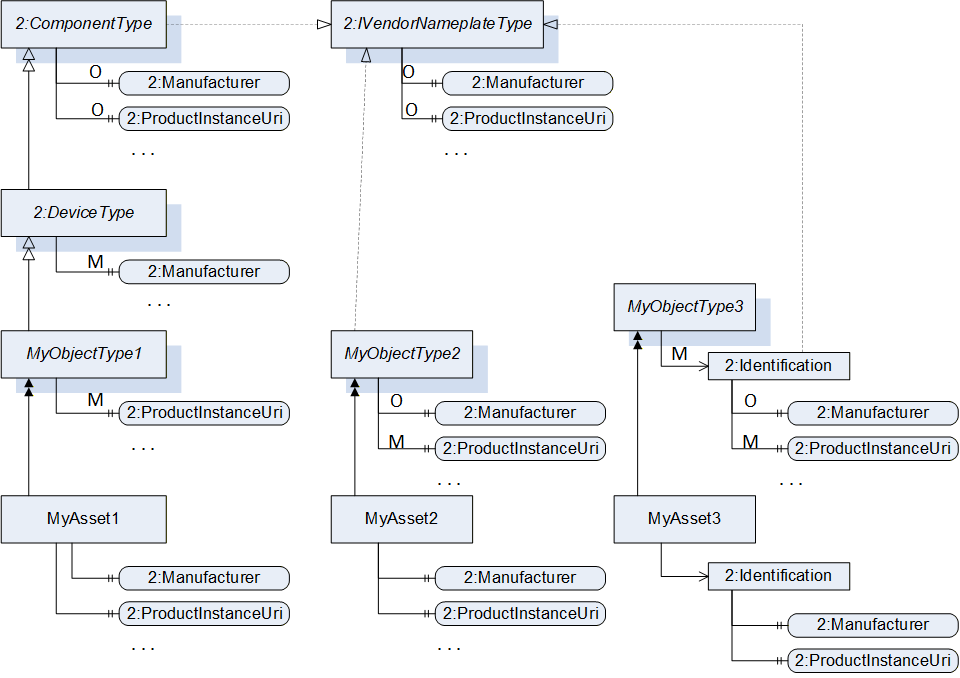
The 2:Identification Object shall have the BrowseName 2:Identification and shall be referenced with a hierarchical Reference from the Object representing an asset. The ObjectType of the 2:Identification Object shall be 2:FunctionalGroupType or a subtype of 2:FunctionalGroupType.
The preferred and recommended approach is to use the 2:Identification Object. However, Clients shall be aware of the other approaches and consider those for the identification of an asset as well.
OPC 10000-100 defines most of the Properties as mandatory on the 2:DeviceType, with default values when the value cannot be provided. The 2:ComponentType and the Interfaces define the Properties as optional, i.e., they should be omitted when the information cannot be provided. The preferred and recommended approach is to omit Properties if the information is not available. However, Clients shall be aware that there are default values and shall consider those.
In order to allow a globally unique identification of an asset, the 2:ProductInstanceUri shall be provided (see ConformanceUnit AMB Asset Identification in 15.1). It shall be either a Property of the Object representing the asset or referenced with a hierarchical Reference from the 2:Identification Object. The Property value shall not be an empty String.
All other Properties of 2:IVendorNameplateType should be provided if the information is available. Other companion specifications will define additional, domain-specific identification information and vendors may add information as well. This additional information should preferably be put on the 2:Identification Object. A specialisation of 2:IVendorNameplateType can also be used to identify this additional information is identification information.
If the 2:AssetId of the 2:ITagNameplateType is provided it shall be writable to allow a configurable identification of the asset (see ConformanceUnit AMB Configurable Asset Identification in 15.1). Other Properties of 2:ITagNameplateType and additional configurable Properties may be provided as well.
Older versions of OPC 10000-100 did not define the 2:IVendorNameplateType and 2:ITagNameplateType and thus Clients shall not expect that the 2:IVendorNameplateType and 2:ITagNameplateType are explicitly implemented on the TypeDefinition.
8 Discovery of Assets
8.1 Overview
For the discovery of assets, this specification uses the concept of AliasNames, as defined in OPC 10000-17. AliasNames define an additional name for any Node of a Server and can be used to categorize AliasNames and provide filter functionality on the AliasNames. The same AliasName can be represented by several Nodes, for example, if managed in different Servers. Using AliasNames simplifies managing information from various Servers, where some Servers potentially are not aware of AliasNames. AliasNames defines a concept how to integrate AliasNames into a Global Discovery Server (GDS). AliasNames already define the usage of NodeVersion and ModelChangeEvents to get notification on changes, which is used in this specification as well.
Unlike other usages of AliasNames, in this specification the purpose is not to define additional names for a Node / asset, but use the provided information of the assets.
That is, this specification defines two standardized categories for AliasNames, one using the mandatory 2:ProductInstanceUri as AliasName, and another one using the writable 2:AssetId, which can be set by the user.
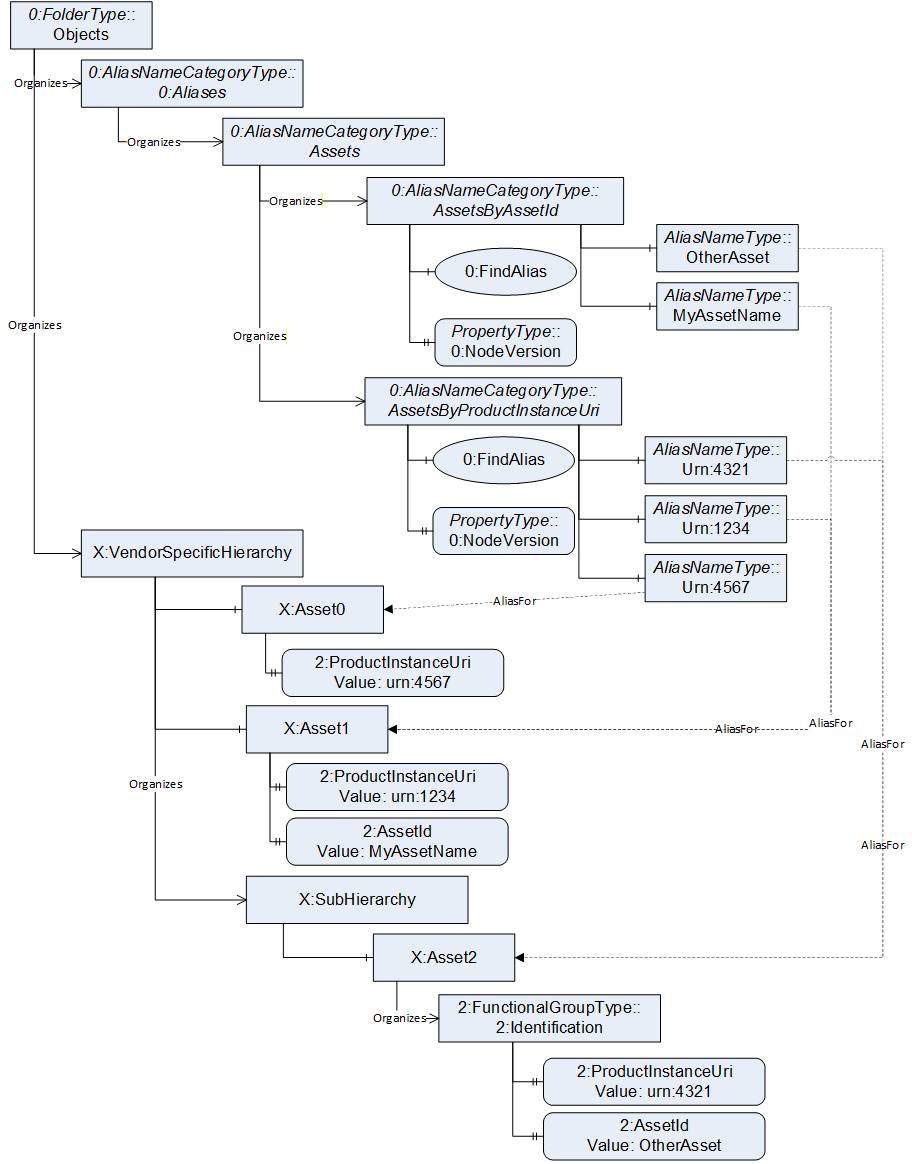
In Figure 2, an example of the usage of AliasNames is given, to discover assets in a Server. This specification defines the standardized Nodes Assets, AssetsByProductInstanceUri and AssetsByAssetId (see 8.2). In order to discover the assets, a Client would either browse AssetsByProductInstanceUri or AssetsByAssetId to receive the AliasNames representing the assets, and from there with another browse access the Nodes representing the assets. Or it would call the Method 0:FindAlias on one of the Objects, allowing potentially to filter for the 2:ProductInstanceUri or the 2:AssetId. To get notified if assets have been added or removed, the Client subscribes to the 0:NodeVersion Property or subscribes to ModelChangeEvents.
As shown in the example in Figure 2, the Server manages three assets, X:Asset0, X:Asset1 and X:Asset2, somehow arranged in the vendor-specific hierarchy of the Servers AddressSpace. For all three assets, an AliasName Object for the 2:ProductInstanceUri exists. As X:Asset0 does not support the 2:AssetId, AliasName Objects for the 2:AssetId only exist for X:Asset1 and X:Asset2. Each AliasName is based on the identification information of the asset.
Note that a Server might not provide both entry points, depending on the supported ConformanceUnits.
Note that an AliasName could point to several Nodes representing the same asset (not shown in the example). The returned structure of 0:FindAlias allows to return several Nodes for one AliasName (see OPC 10000-17).
Note that the concept also allows for Off-Server References, for the 0:AliasFor References as well as for the 0:FindAlias Method (not shown in the example).
8.2 Instances
8.2.1 Assets
The Assets Object is formally defined in Table 12.
| Attribute | Value | |||
| BrowseName | Assets | |||
| Description | Entry point to discover assets | |||
| References | NodeClass | BrowseName | DataType | TypeDefinition |
|---|---|---|---|---|
| OrganizedBy by the 0:Aliases Object defined in OPC 10000-17 | ||||
| 0:HasTypeDefinition | ObjectType | 0:AliasNameCategoryType | Defined in OPC 10000-17 | |
| Conformance Units | ||||
|---|---|---|---|---|
| AMB Asset Discovery by ProductInstanceUri | ||||
| AMB Asset Discovery by AssetId |
8.2.2 AssetsByProductInstanceUri
The AssetsByProductInstanceUri Object is formally defined in Table 12. All AliasNames organized by this category shall be assets having a 2:ProductInstanceUri (see section 7). The string part of the AliasName shall be identical to the value of the 2:ProductInstanceUri, the namespace of the AliasName shall be the one defined by this specification in section 16.
| Attribute | Value | |||
| BrowseName | AssetsByProductInstanceUri | |||
| Description | Entry point to discover assets by ProductInstanceUri | |||
| References | NodeClass | BrowseName | DataType | TypeDefinition |
|---|---|---|---|---|
| OrganizedBy by the Assets Object defined in 8.2.1 | ||||
| 0:HasTypeDefinition | ObjectType | 0:AliasNameCategoryType | Defined in OPC 10000-17 | |
| 0:HasProperty | Variable | 0:NodeVersion | 0:String | PropertyType |
| Conformance Units | ||||
|---|---|---|---|---|
| AMB Asset Discovery by ProductInstanceUri |
8.2.3 AssetsByAssetId
The AssetsByAssetId Object is formally defined in Table 12. All AliasNames organized by this category shall be assets having a 2:AssetId (see section 7). The string part of the AliasName shall be identical to the value of the 2:AssetId, if the value of 2:AssetId is not an empty or null String. The namespace of the AliasName shall be the one defined by this specification in section 16.
As the default value of the 2:AssetId is an empty String, in a system where the 2:AssetId is not configured, many assets will have the identical 2:AssetId (empty String). In this case, each individual asset should have its own AliasName Object and all of those assets should not use the same AliasName Object. Same assets shall be, in this case, identified by the 2:ProductInstanceUri. In this case, the string part of the AliasName shall be "NoAssetIdAssigned" and the namespace of the AliasName shall be the one defined by this specification in section 16.
Note: Ideally, 2:AssetIds should be unique and two assets with different 2:ProductInstanceUris should have different 2:AssetIds. Also, if an asset is represented by more than one asset Node, meaning several asset Nodes have the same 2:ProductInstanceUri, the same 2:AssetId should be used. As the 2:AssetId is set by the user, this might not be the case. Assigning AliasNames in the context of this Object is done by 2:AssetId. The 2:ProductInstanceUri should only be considered when the 2:AssetId is empty (default value). Therefore, browsing and filtering is also done based on the 2:AssetId, not the 2:ProductInstanceUri.
| Attribute | Value | ||||
| BrowseName | AssetsByAssetId | ||||
| Description | Entry point to discover assets by AssetId | ||||
| References | NodeClass | BrowseName | DataType | TypeDefinition | |
|---|---|---|---|---|---|
| OrganizedBy by the Assets Object defined in 8.2.1 | |||||
| 0:HasTypeDefinition | ObjectType | 0:AliasNameCategoryType | Defined in OPC 10000-17 | ||
| 0:HasProperty | Variable | 0:NodeVersion | 0:String | PropertyType | |
| Conformance Units | |||||
|---|---|---|---|---|---|
| AMB Asset Discovery by AssetId |
9 Health Status
9.1 Overview
In order to provide the health status of assets, this specification mainly uses the concepts defined in OPC 10000-100.
9.2 Overall health status of an asset
The Variable 2:DeviceHealth defined in OPC 10000-100 is used to provide the overall health status of an asset. It uses an enumeration having the values NORMAL, FAILURE, CHECK_FUNCTION, OFF_SPEC and MAINTENANCE_REQUIRED (see OPC 10000-100 for details).
Note that this Variable should be used for all assets, independent of what type of asset it is, for example also for software components. For some types of assets, not all values of the enumeration can reasonably be applied.
OPC 10000-100 defines the interface 2:IDeviceHealthType containing optionally the Variable 2:DeviceHealth. In older versions of OPC 10000-100 the Variable was only defined on the 2:DeviceType.
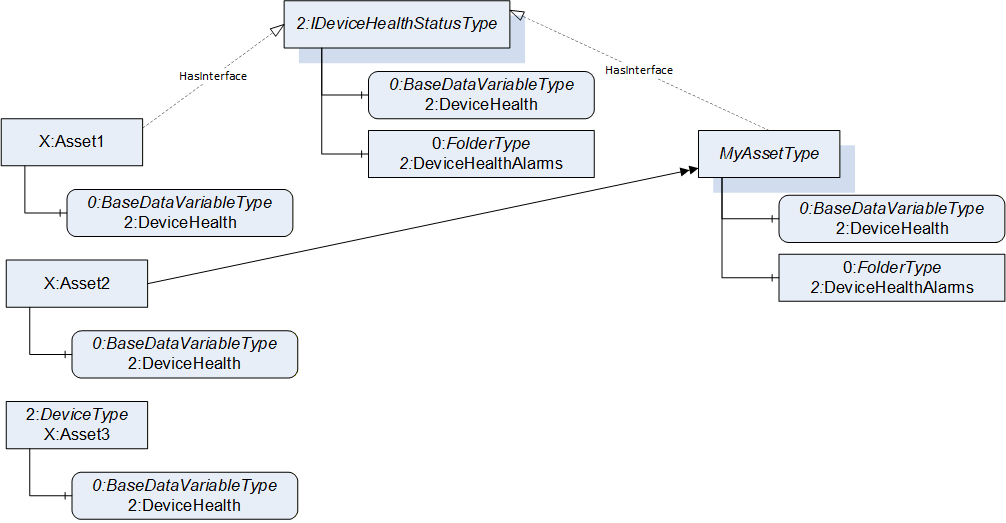
In order to support older versions of OPC 10000-100, Objects representing an asset and providing health status information shall provide the 2:DeviceHealth Variable. This should be achieved by implementing the 2:IDeviceHealthType interface providing optionally the 2:DeviceHealth Variable. This can be done either directly on the instance (X:Asset1) or via the TypeDefinition (X:Asset2), as shown in Figure 3. However, it is also allowed to just provide the 2:DeviceHealth Variable as done by X:Asset3 by using the 2:DeviceType. Note that in the current version of OPC 10000-100 2:DeviceType does implement 2:IDeviceHealthType.
The SourceTimestamp of the 2:DeviceHealth Variable provides the time when the asset entered that health status. In order to provide an accurate time, Servers should preserve the time, also when restarting the Server. As this might not always be possible, a Client shall be aware that the SourceTimestamp is not always the time when the asset switched the health status.
9.3 Asset specific information on health status
To provide asset specific information on failure or maintenance conditions the alarming mechanism of OPC UA is used. The 2:IDeviceHealthType already defines the optional 2:DeviceHealthAlarms folder, where such alarm Objects can be provided. However, it is not required to provide the folder and the alarm Objects in the AddressSpace. Servers should use the AlarmTypes defined in OPC 10000-100 (2:DeviceHealthDiagnosticsAlarmType and subtypes) to expose the asset specific information. The event fields shall be used as defined in OPC 10000-5 and OPC 10000-9. The 0:SourceNode and 0:SourceName shall identify the asset. The 0:Severity should be used as defined in Table 15. Applications may refine those categories to a more detailed categorisation.
| Severity | Classification | Description |
| 801-1000 | Critical Fault | The asset has permanently failed. |
| 601-800 | Major Recoverable Fault | The asset can no longer perform its function. Intervention is required. |
| 401-600 | Minor Recoverable Fault | The asset has experienced a problem but is able to continue operation until intervention occurs. |
| 301-400 | Maintenance Needed | Service is required to keep the asset operating within its designed tolerances. |
| 201-300 | Limited Resource Capacity Near Limit | A limited resource met a threshold beyond which a more serious fault would occur. |
| 1-200 | - | Used when the alarm is not active. |
9.4 Root cause of asset specific information on health status
9.4.1 Overview
An asset might have several reasons why it's not operating as expected, which often are dependent on each other. For example, the asset MyMachine might indicate the faults that a pump is not working and the oil pressure is too low. The second fault is caused by the first fault. To manage assets, it is desirable to identify the root causes of failures. In order to provide the root cause of why an asset is not operating as expected, the interface IRootCauseIndicationType is defined (see 9.4.2). Servers providing this information shall use AlarmTypes implementing this interface for alarms indicating asset specific information on failures.
9.4.2 IRootCauseIndicationType
The IRootCauseIndicationType is an interface and should be applied to AlarmTypes. It is formally defined in Table 16.
Note: The IRootCauseIndicationType cannot only be applied to AlarmTypes, but in general to subtypes of 0:ConditionType.
| Attribute | Value | ||||
| BrowseName | IRootCauseIndicationType | ||||
| IsAbstract | True | ||||
| Description | Information on the root cause of conditions, should be applied to alarms (AlarmType or subtypes) | ||||
| References | NodeClass | BrowseName | DataType | TypeDefinition | Other |
|---|---|---|---|---|---|
| Subtype of the 0:BaseInterfaceType Type defined in OPC 10000-5 | |||||
| 0:HasProperty | Variable | PotentialRootCauses | RootCauseDataType[] | PropertyType | M |
| Conformance Units | |||||
|---|---|---|---|---|---|
| AMB Asset Health Status Root Causes |
The mandatory Property PotentialRootCauses contains an array of potential root causes of the alarm. This is intended to be a hint to the client and might be a local view on the potential root causes of the alarm. The list might not contain all potential root causes, that is, other potential root causes might exist as well. If the alarm itself is considered to be the root cause, the array shall be empty. If no potential root causes have been identified, there shall be at least one entry in the array indicating that the root cause is unknown.
The child Nodes of the IRootCauseIndicationType have additional Attribute values defined in Table 17.
| BrowsePath | Value Attribute | Description Attribute |
| PotentialRootCauses | - | An array of potential root causes of the alarm. This is intended to be a hint to the client and might be a local view on the potential root causes of the alarm. The list might not contain all potential root causes, that is, other potential root causes might exist as well. If the alarm itself is considered to be the root cause, the array shall be empty. If no potential root causes have been identified, there shall be at least one entry in the array indicating that the root cause is unknown. |
9.4.3 RootCauseDataType
This structure contains information about the root cause of an alarm. The structure is defined in Table 18.
| Name | Type | Description |
|---|---|---|
| RootCauseDataType | structure | |
RootCauseId | 0:NodeId | The NodeId of the root cause of an alarm. This can point to another Node in the AddressSpace or a ConditionId, that is not necessarily represented as Object in the AddressSpace. Ideally, this points directly to the root cause. Potentially, it points to an alarm that has an additional root cause. Clients shall expect that they need to follow a path to find the root cause. If the root cause is unknown, the NodeId shall be set to NULL. |
RootCause | 0:LocalizedText | Localized description of the root cause of an alarm. This can be the DisplayName of the Node referenced by RootCauseId or a more descriptive text. If the root cause is unknown, this should be described in the text. |
Its representation in the AddressSpace is defined in Table 19.
| Attribute | Value | |||||
| BrowseName | RootCauseDataType | |||||
| IsAbstract | False | |||||
| Description | Root cause of an alarm | |||||
| References | NodeClass | BrowseName | DataType | TypeDefinition | Other | |
|---|---|---|---|---|---|---|
| Subtype of the Structure DataType defined in OPC 10000-5 | ||||||
| Conformance Units | ||||||
|---|---|---|---|---|---|---|
| AMB Asset Health Status Root Causes |
9.5 Standardized categories of asset specific information on health status
9.5.1 Overview
Although the alarming mechanism of OPC UA is used to indicate asset specific information on the health status, there are common indications of alarms across assets. To standardize the common indications, and leave options for extensibility by companion specifications and vendors, this specification uses the mechanism of the ConditionClassId defined for conditions in OPC 10000-9. In the following, specific subtypes of BaseConditionClassType are defined that should be used as ConditionClassId for specific alarms. Other companion specifications and vendors might add additional subtypes of BaseConditionClassType and might inherit from the types defined in this specification.
9.5.2 ConnectionFailureConditionClassType
The ConnectionFailureConditionClassType is used to classify conditions related to connection failures. It is formally defined in Table 20.
| Attribute | Value | ||||
| BrowseName | ConnectionFailureConditionClassType | ||||
| IsAbstract | True | ||||
| Description | One or more connections have failed | ||||
| References | NodeClass | BrowseName | DataType | TypeDefinition | Other |
|---|---|---|---|---|---|
| Subtype of the 0:SystemConditionClassType defined in OPC 10000-9 | |||||
| Conformance Units | |||||
|---|---|---|---|---|---|
| AMB Asset Health Status Alarm Categories |
9.5.3 OverTemperatureConditionClassType
The OverTemperatureConditionClassType is used to classify conditions related to over temperature. It is formally defined in Table 21.
| Attribute | Value | ||||
| BrowseName | OverTemperatureConditionClassType | ||||
| IsAbstract | True | ||||
| Description | Over temperature | ||||
| References | NodeClass | BrowseName | DataType | TypeDefinition | Other |
|---|---|---|---|---|---|
| Subtype of the 0:SystemConditionClassType defined in OPC 10000-9 | |||||
| Conformance Units | |||||
|---|---|---|---|---|---|
| AMB Asset Health Status Alarm Categories |
9.5.4 CalibrationDueConditionClassType
The CalibrationDueConditionClassType is used to classify conditions related to calibration being due. It is formally defined in Table 22.
| Attribute | Value | ||||
| BrowseName | CalibrationDueConditionClassType | ||||
| IsAbstract | True | ||||
| Description | Calibration is due | ||||
| References | NodeClass | BrowseName | DataType | TypeDefinition | Other |
|---|---|---|---|---|---|
| Subtype of the 0:MaintenanceConditionClassType defined in OPC 10000-9 | |||||
| Conformance Units | |||||
|---|---|---|---|---|---|
| AMB Asset Health Status Alarm Categories |
9.5.5 SelfTestFailureConditionClassType
The SelfTestFailureConditionClassType is used to classify conditions related to self-test failures. It is formally defined in Table 23.
| Attribute | Value | ||||
| BrowseName | SelfTestFailureConditionClassType | ||||
| IsAbstract | True | ||||
| Description | Self-Test failure | ||||
| References | NodeClass | BrowseName | DataType | TypeDefinition | Other |
|---|---|---|---|---|---|
| Subtype of the 0:SystemConditionClassType defined in OPC 10000-9 | |||||
| Conformance Units | |||||
|---|---|---|---|---|---|
| AMB Asset Health Status Alarm Categories |
9.5.6 FlashUpdateInProgressConditionClassType
The FlashUpdateInProgressConditionClassType is used to classify conditions related to flash updates being in progress. It is formally defined in Table 24.
| Attribute | Value | ||||
| BrowseName | FlashUpdateInProgressConditionClassType | ||||
| IsAbstract | True | ||||
| Description | Flash update in progress | ||||
| References | NodeClass | BrowseName | DataType | TypeDefinition | Other |
|---|---|---|---|---|---|
| Subtype of the 0:MaintenanceConditionClassType defined in OPC 10000-9 | |||||
| Conformance Units | |||||
|---|---|---|---|---|---|
| AMB Asset Health Status Alarm Categories |
9.5.7 FlashUpdateFailedConditionClassType
The FlashUpdateFailedConditionClassType is used to classify conditions related to flash update failures. It is formally defined in Table 25.
| Attribute | Value | ||||
| BrowseName | FlashUpdateFailedConditionClassType | ||||
| IsAbstract | True | ||||
| Description | Flash update has failed | ||||
| References | NodeClass | BrowseName | DataType | TypeDefinition | Other |
|---|---|---|---|---|---|
| Subtype of the 0:SystemConditionClassType defined in OPC 10000-9 | |||||
| Conformance Units | |||||
|---|---|---|---|---|---|
| AMB Asset Health Status Alarm Categories |
9.5.8 BadConfigurationConditionClassType
The ConfigurationIsBadConditionClassType is used to classify conditions related to configurations being bad. It is formally defined in Table 26.
| Attribute | Value | ||||
| BrowseName | BadConfigurationConditionClassType | ||||
| IsAbstract | True | ||||
| Description | Configuration is bad | ||||
| References | NodeClass | BrowseName | DataType | TypeDefinition | Other |
|---|---|---|---|---|---|
| Subtype of the 0:SystemConditionClassType defined in OPC 10000-9 | |||||
| Conformance Units | |||||
|---|---|---|---|---|---|
| AMB Asset Health Status Alarm Categories |
9.5.9 OutOfResourcesConditionClassType
The OutOfResourcesConditionClassType is used to classify conditions related to running out of resources. It is formally defined in Table 27.
| Attribute | Value | ||||
| BrowseName | OutOfResourcesConditionClassType | ||||
| IsAbstract | True | ||||
| Description | Out of resources issues | ||||
| References | NodeClass | BrowseName | DataType | TypeDefinition | Other |
|---|---|---|---|---|---|
| Subtype of the 0:SystemConditionClassType defined in OPC 10000-9 | |||||
| Conformance Units | |||||
|---|---|---|---|---|---|
| AMB Asset Health Status Alarm Categories |
9.5.10 OutOfMemoryConditionClassType
The OutOfMemoryConditionClassType is used to classify conditions related to running out of memory. It is formally defined in Table 28.
| Attribute | Value | ||||
| BrowseName | OutOfMemoryConditionClassType | ||||
| IsAbstract | True | ||||
| Description | Out of memory issues | ||||
| References | NodeClass | BrowseName | DataType | TypeDefinition | Other |
|---|---|---|---|---|---|
| Subtype of the OutOfResourcesConditionClassType defined in 9.5.9 | |||||
| Conformance Units | |||||
|---|---|---|---|---|---|
| AMB Asset Health Status Alarm Categories |
9.6 Tracking of health information
When the Server wants to provide the overall health status of an asset over time, the history of the 2:DeviceHealth Variable shall be used. For each 2:DeviceHealth Variable, where the history is currently tracked, the Historizing Attribute is set to True and the AccessLevel is set to HistoryRead. In order to provide the information, when history tracking started, a HistoryDataConfiguration is referenced with a HasHistoricalConfiguration Reference (see OPC 10000-11 for details).
When the Server wants to provide information for tracking the alarms with detailed health information of an asset over time, the history of the events based on the alarms shall be used. . This specification does not define which Objects are used as EventNotifier. As defined in the base specification, the Server Object shall be an EventNotifier when events are supported, which can be used to subscribe to all events of the Server. It is, therefore, server-specific where the history of events can be accessed and what details of the events are stored. The general concepts are defined in OPC 10000-11. The server should provide for each asset the history of events for the same amount of time as the history of the 2:DeviceHealth.
10 Technical Specification
10.1 Overview
The use cases for technical specifications consider different information on the assets. Some, like standard error messages, are already defined in other sections of this document and not considered further. This section is divided into subsections addressing the different information aspects.
10.2 Version Information
The version information of an asset can consist of different information like the hardware version, potentially a software version when the asset is or contains software, and a revision counter. Those Properties are already defined in OPC 10000-100, at the same level where the identification is defined. Therefore, this specification uses those Properties as defined in OPC 10000-100. They can be deployed in the same way as the identification information as defined in section 7.
Those Properties include:
HardwareRevision providing the revision level of the hardware
SoftwareRevision providing the revision level of the software
RevisionCounter providing an incremental counter when the configuration of the asset has changed
For the usage of those Properties, different cases need to be distinguished.
The asset is software without hardware. In this case, only the SoftwareRevision is provided, and the HardwareRevision is omitted.
The asset is hardware without software. In this case, only the HardwareRevision is provided, and the SoftwareRevision is omitted.
The asset is a combination of hard- and software. In this case, the following model approaches can be done
Represent asset as one Object: The asset provides the HardwareRevision and SoftwareRevision
Represent software as sub-assets of hardware Object. This modelling approach makes specifically sense, if the software of the asset is not considered as one monolithic piece of software, but consists for example of firmware, drivers, applications, etc. In this case, the hardware is the main asset and the software components sub-assets. The main asset might contain a SoftwareRevision which contains the overall revision of all software assets.
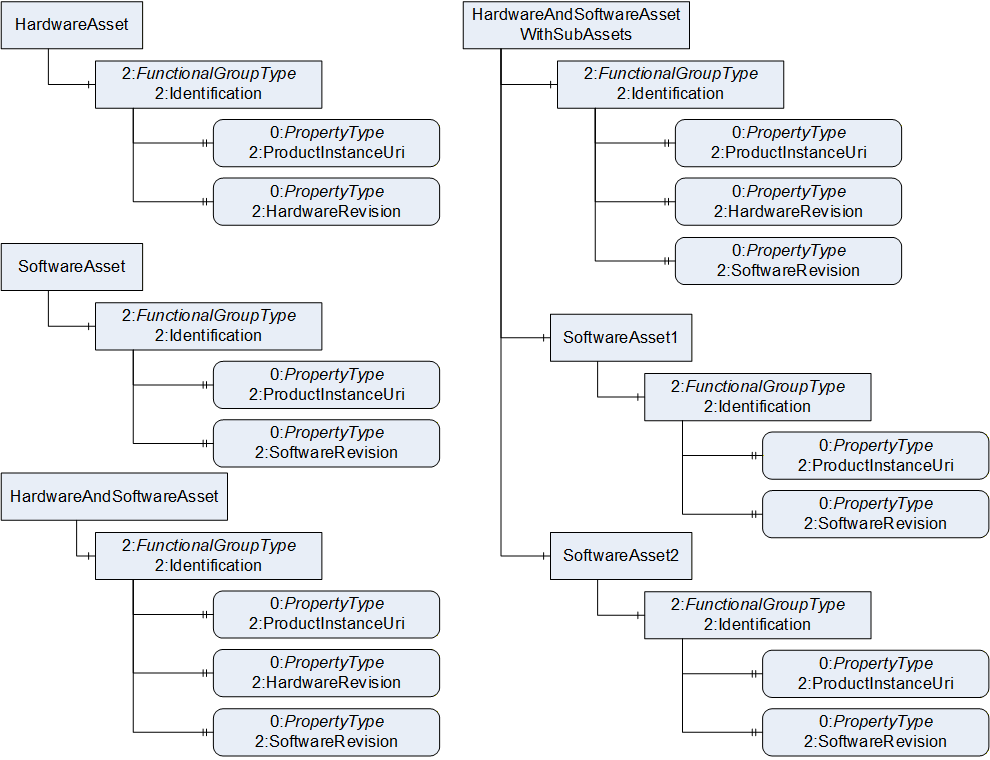
In Figure 4, examples for the different cases are shown. In the example, always the Identification Object is used for grouping. The HardwareAsset only provides the HardwareRevision, the SoftwareAsset only the SoftwareRevision. The HardwareAndSoftwareAsset combines both and provides HardwareRevision and SoftwareRevision. The HardwareAndSoftwareAssetWithSubAssets does provide a HardwareRevision and an overall SoftwareRevision, and two sub-assets representing software assets, each containing a SoftwareRevision.
In order to provide patch information about the software components, OPC 10000-100 defines the SoftwareVersionType. This is used for updating software via the OPC UA interface, using the SoftwareUpdate AddIn. In case the Server supports the AddIn for the asset, the SoftwareVersionType shall be used as defined in OPC 10000-100 to provide the patch information. In case, the Server does not support the AddIn for the asset, the Property 2:PatchIdentifiers should be provided on the same level as SoftwareRevision with the same semantic as defined on the SoftwareVersionType.
10.3 Operation Counters
When an asset is operating, several numbers might be of interest when managing the asset, like the hours of operation, hours in standby, etc. Those are often the base to calculate KPIs (key performance indicators) like the OEE (overall equipment efficiency). As this specification is just a base specification for asset management, and the counters are domain specific, this specification does not define any of those counters. It just defines a standardized way to find those counters. Other companion specifications or vendors might define those counters.
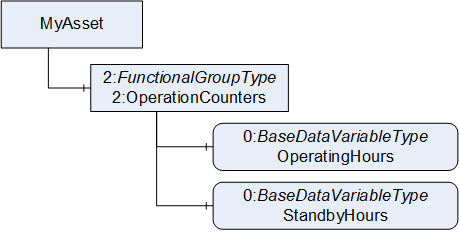
In order to provide access to the counters, the concept of a FunctionalGroup as defined in OPC 10000-100 is used. This specification just defines to use the standardized name "2:OperationCounters". Servers might provide the counters using different access paths, but they should provide the 2:OperationCounters FunctionalGroup as well. This FunctionalGroup might be organized into other FunctionalGroups, so Clients shall expect that they need to browse several hops to get to all counters. In Figure 5, an example is given.
10.4 Supported OPC UA Functionality
If an asset supports Server functionality directly, it means that it does support the standardized Server Object defined in OPC 10000-5. This Object can contain information about the supported OPC UA functionality in the ServerCapabilites Object, like the supported OPC UA Profiles in the ServerProfileArray. The corresponding ConformanceUnit is already defined in OPC 10000-7. Therefore, this specification does not further address this topic.
10.5 Link to Digital Records
10.5.1 Overview
To provide links to digital records, the ObjectType DocumentationLinksType is introduced, which is deployed as AddIn on Objects representing assets. The AddIn serves as entry point to Variables linking to digital records managed outside the Server. The Variable contains a URI, which is typically a URL. Vendors might add additional Properties defining meta data of the linked document, e.g. type of file or size. In addition, it optionally provides the capabilities to add and remove editable links to user-defined documents like operator's handbooks.
In Figure 6, an example of using the DocumentationLinks AddIn is given.
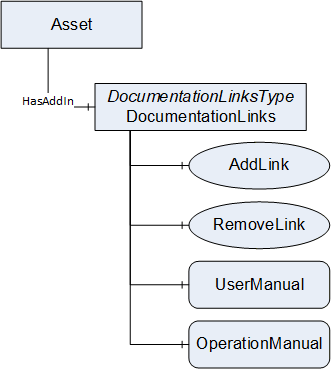
Instead of providing the optional Methods to add and remove links, a server not capable of the dynamics in its AddressSpace might also just provide some writable Variables that the user can edit and thus manage its links.
10.5.2 DocumentationLinksType
The DocumentationLinksType is an AddIn and should be applied to Objects or ObjectTypes representing Assets. It is formally defined in Table 29.
| Attribute | Value | ||||
| BrowseName | DocumentationLinksType | ||||
| IsAbstract | False | ||||
| Description | AddIn to link documentation provided by the manufacturer and / or end-user. | ||||
| References | NodeClass | BrowseName | DataType | TypeDefinition | Other |
|---|---|---|---|---|---|
| Subtype of the 0:BaseObjectType Type defined in OPC 10000-5 | |||||
| 0:HasProperty | Variable | 0:DefaultInstanceBrowseName | 0:QualifiedName | PropertyType | |
| 0:HasComponent | Variable | <Link> | 0:UriString | BaseDataVariableType | OP |
| 0:HasComponent | Method | AddLink | O | ||
| 0:HasComponent | Method | RemoveLink | O | ||
| Conformance Units | |||||
|---|---|---|---|---|---|
| AMB DocumentationLinks Base |
The Property 0:DefaultInstanceBrowseName defines the default BrowseName of instances of this ObjectType.
The <Link> Variable represents links provided by instances of this type.
The components of the DocumentationLinksType have additional Attributes defined in Table 30.
| BrowsePath | Value Attribute | Description Attribute |
| 0:DefaultInstanceBrowseName | DocumentationLinks | |
| <Link> | Represents links to externally managed documentation, typically URLs. | |
| AddLink | Method to add an end-user specific link that is stored persistently in the server. | |
| RemoveLink | Method to remove an end-user specific link that is managed in the server. |
10.5.3 AddLink Method
This Method provides the capability to persistently add a link to an externally managed resource by adding a Variable according to the input arguments with a HasComponent Reference to the Object the Method is called on. The server shall manage the added link persistently, i.e., if the Method was executed successful, the Variable representing the link shall be persistent and available after restart of the Server. It might disappear after resetting or reconfiguring the Server or after calling the RemoveLink Method. The Value Attribute of the created Node should be writable, so the end-user can change the URI. In addition, the BrowseName, DisplayName, and Description might be writable. Servers might restrict the execution of this Method as well as writing the Attributes to specific users / roles.
The signature of this Method is specified below. Table 31 and Table 32 specify the Arguments and AddressSpace representation, respectively.
Signature
	AddLink (
	  [in]  0:UriString       LinkToExternalSource,
	  [in]  0:QualifiedName   BrowseName,
	  [in]  0:LocalizedText   DisplayName,
	  [in]  0:LocalizedText   Description,
[out] 0:NodeId LinkVariable);| Argument | Description |
| LinkToExternalSource | Link to an external source. The server might or might not check if a correct URI is provided, or if the URI is available/reachable. |
| BrowseName | The BrowseName of the new created Node. Method fails if a Variable with the same BrowseName already exists. |
| DisplayName | The DisplayName of the new created Node. If the server supports multiple locales, and the Client wants to provide more than one locale, the Write operation on the Variable shall be used. |
| Description | The Description of the new created Node. If the server supports multiple locales, and the Client wants to provide more than one locale, the Write operation on the Variable shall be used. |
| LinkVariable | The NodeId of the newly created Variable. |
Method Result Codes (defined in Call Service)
| Result Code | Description |
| Bad_UserAccessDenied | See OPC 10000-4 for a general description. |
| Bad_InvalidArgument | See OPC 10000-4 for a general description. |
| Attribute | Value | ||||
| BrowseName | AddLink | ||||
| References | NodeClass | BrowseName | DataType | TypeDefinition | ModellingRule |
|---|---|---|---|---|---|
| 0:HasProperty | Variable | 0:InputArguments | 0:Argument[] | 0:PropertyType | 0:Mandatory |
| 0:HasProperty | Variable | 0:OutputArguments | 0:Argument[] | 0:PropertyType | 0:Mandatory |
| Conformance Units | |||||
|---|---|---|---|---|---|
| AMB DocumentationLinks Base |
10.5.4 RemoveLink Method
This Method provides the capability to remove a Variable representing a link. The Method shall only succeed when the Variable to be deleted is referenced from the Object the Method is called on. Servers might restrict the execution of this Method to specific users / roles. Servers will typically reject the deletion of Nodes not added with the AddLink Method.
The signature of this Method is specified below. Table 33 and Table 34 specify the Arguments and AddressSpace representation, respectively.
Signature
	RemoveLink (
	  [in]  0:NodeId       VariableToBeDeleted
);| Argument | Description |
| VariableToBeDeleted | NodeId of the Variable containing a link, that should be deleted. Variable shall be referenced from the Object with a HasComponent Reference where the Method is called on. |
Method Result Codes (defined in Call Service)
| Result Code | Description |
| Bad_UserAccessDenied | See OPC 10000-4 for a general description. |
| Bad_InvalidArgument | See OPC 10000-4 for a general description. |
| Attribute | Value | ||||
| BrowseName | RemoveLink | ||||
| References | NodeClass | BrowseName | DataType | TypeDefinition | ModellingRule |
|---|---|---|---|---|---|
| 0:HasProperty | Variable | 0:InputArguments | 0:Argument[] | 0:PropertyType | 0:Mandatory |
| Conformance Units | |||||
|---|---|---|---|---|---|
| AMB DocumentationLinks Base |
10.6 Requirements
When operating an asset, certain requirements need to be fulfilled. This may include, that certain things need to be provided to the asset like pressure or electricity with a specific voltage and current. This may also include specific environmental conditions like a minimum and maximum temperature, air pressure and humidity and the weight and dimensions of the asset the environment need to support.
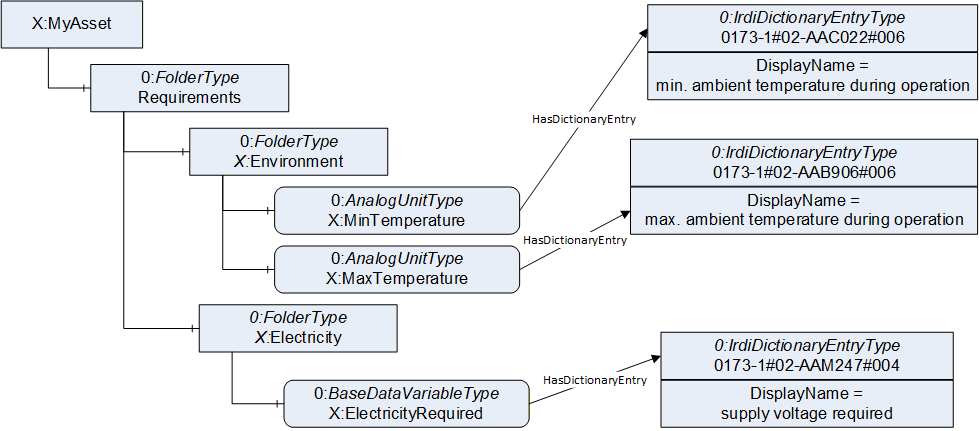
This specification does not define specific types of requirements. Other specifications, like IEC Common Data Dictionary or ECLASS do define those. This specification defines a standardized place to expose the requirements. It is recommended to use dictionary references, as defined in OPC 10000-19, to reference external dictionaries like IEC Common Data Dictionary or ECLASS to define the semantic of the specific requirements.
In order to provide access to the requirements, the concept of a Folder as defined in OPC 10000-5 is used. This specification just defines the use of the standardized BrowseName "Requirements" (defined in the Namespace of this specification). Servers might provide the requirements using different access paths, but they should provide the Requirements Folder as well. This Folder might be organized into other Folders, so Clients shall expect that they need to browse several hops to get to all requirements. In Figure 7, an example is given, also pointing with dictionary references to an external dictionary (ECLASS).
10.7 Capabilities
Assets provide skills / capabilities. It is desirable to describe, what capabilities the asset supports to select the right asset for the right purpose. Depending on the asset, the capabilities can be very different. A temperature sensor has the capability to measure the temperature, whereas an injection moulding machine can produce parts, and the parts depend on the configuration of the machine.
This specification does not define specific types of capabilities. Other specifications, like IEC Common Data Dictionary or ECLASS define common capabilities. Application-specific capabilities, like producing application-specific parts, are related to describing those parts in recipes, jobs or programs. It is expected, that other specifications, dealing with those, may define concepts for those application-specific capabilities.
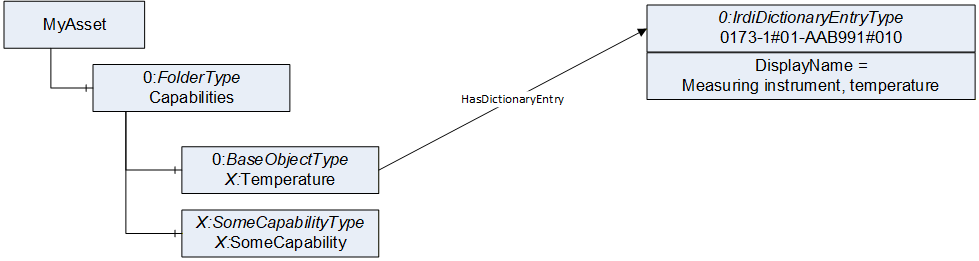
This specification defines a standardized place where to expose the capabilities. For common capabilities, it is recommended to use dictionary references, as defined in OPC 10000-19, to reference external dictionaries like IEC Common Data Dictionary or ECLASS.
In order to provide access to the capabilities, the concept of a Folder as defined in OPC 10000-5 is used. This specification just defines the use of the standardized BrowseName "Capabilities" (defined in the Namespace of this specification). Servers might provide the capabilities using different access paths, but they should provide the Capabilities Folder as well. This Folder might be organized into other Folders, so Clients shall expect that they need to browse several hops to get to all capabilities. In Figure 8, an example is given, also pointing with dictionary references to an external dictionary (ECLASS).
11 Asset Classification
For the classification of assets, this specification uses dictionary references, as defined in OPC 10000-19. Dictionary references allow to reference external dictionaries like IEC Common Data Dictionary or ECLASS. This can be used to classify the assets according to those external dictionaries. In Figure 9, an example is given. There are two different classification schemas: "SomeClassification" and "OtherClassification", the first one using IRDIs and the second URIs. In the example, two of the assets, Asset1 and Asset2, use both classification schemas, one classifying as flow transmitter, and the other as field device. The third asset, Asset3, only uses the second classification schema and classifies as machine. The concept of dictionary references allows to expose many classification schemes, all managed under the standardized Dictionaries Object of the Server Object.
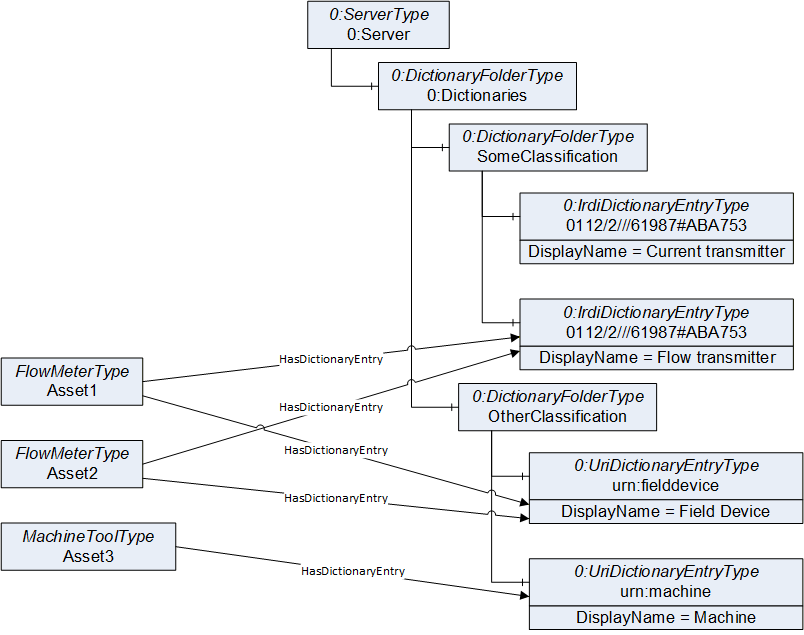
This specification does not further define what external dictionaries should be used for classification. Companion specifications may suggest or mandate specific external dictionaries for specific types of assets.
12 Log of Maintenance Activities
12.1 Overview
To provide information about the maintenance of an asset, the alarming mechanism of OPC UA is used. This allows providing information on upcoming or not executed maintenance activities by making the conditions representing the upcoming maintenance activity active. Even if the maintenance activity has not been executed (planned or in execution), the information can already be provided to the Client. In this case, the 0:Retain Property of the condition shall be set to true, allowing Clients to access the information.
Using the alarming mechanism of OPC UA also allows providing information about past maintenance activities by providing access to the history of Events for those maintenance activities.
The conditions representing maintenance activities might be represented as Objects in the AddressSpace, however, this is not required. If they are provided, it is recommended to use the 2:DeviceHealthAlarms folder defined in 2:IDeviceHealthType as container for those Objects.
This specification does not define a specific 0:ConditionType for maintenance activities. Companion specifications or vendors might define their own 0:ConditionTypes for specific types of maintenance activities. It is recommended to create those as subtypes of 2:MaintenanceRequiredAlarmType defined in OPC 10000-100.
To allow clients to easily identify or filter for maintenance activities, the 0:ConditionClassId is used as defined for conditions in OPC 10000-9. Maintenance activities shall use the 0:MaintenanceConditionClassType or a subtype as 0:ConditionClassId. In 12.4, specific 0:ConditionClassIds are defined. Companion specifications or vendors might create subtypes of 0:MaintenanceConditionClassType or its subtypes for a more detailed classification.
The maintenance activities should provide specific information. This specification defines an interface (see 12.2) that should be implemented by all ConditionTypes used as maintenance activities.
For a recurring maintenance activity it is recommended to use one condition and change the state of the condition to the next planned occurrence of the maintenance activity once the maintenance activity has taken place.
When the execution of a maintenance activity fails (e.g., the correct part to exchange is not available) the message field of the event should be used to indicate the failure. The event may be extended with additional event fields for more specific information. However, this specification does not define more specific event fields for this case.
12.2 IMaintenanceEventType
The IMaintenanceEventType is an interface and should be applied to 0:ConditionTypes. It is formally defined in Table 35.
| Attribute | Value | ||||
| BrowseName | IMaintenanceEventType | ||||
| IsAbstract | True | ||||
| Description | Information on maintenance activities, should by applied to conditions (ConditionType or subtypes) | ||||
| References | NodeClass | BrowseName | DataType | TypeDefinition | Other |
|---|---|---|---|---|---|
| Subtype of the 0:BaseInterfaceType Type defined in OPC 10000-5 | |||||
| 0:HasComponent | Object | MaintenanceState | MaintenanceEvent StateMachineType | M | |
| 0:HasProperty | Variable | PlannedDate | 0:UtcTime | PropertyType | O |
| 0:HasProperty | Variable | EstimatedDowntime | 0:Duration | PropertyType | O |
| 0:HasProperty | Variable | MaintenanceSupplier | NameNodeIdDataType | PropertyType | O |
| 0:HasProperty | Variable | QualificationOfPersonnel | NameNodeIdDataType | PropertyType | O |
| 0:HasProperty | Variable | PartsOfAssetReplaced | NameNodeIdDataType[] | PropertyType | O |
| 0:HasProperty | Variable | PartsOfAssetServiced | NameNodeIdDataType[] | PropertyType | O |
| 0:HasProperty | Variable | MaintenanceMethod | MaintenanceMethodEnum | PropertyType | O |
| 0:HasProperty | Variable | ConfigurationChanged | 0:Boolean | PropertyType | O |
| Conformance Units | |||||
|---|---|---|---|---|---|
| AMB Current and Future Maintenance Activities |
The MaintenanceState provides the information if the maintenance activity is still planned, currently in execution, or has already been executed.
The PlannedDate provides the date for which the maintenance activity has been scheduled. In case of replanning, it is allowed to change the PlannedDate. However, it is not the intention that the PlannedDate is modified because the maintenance activity starts to get executed. If the PlannedDate depends for example on the operation hours of the asset, it might get adapted depending on the passed operation hours.
The EstimatedDowntime provides the estimated time the execution of the maintenance activity will take. In case of replanning, it is allowed to change the EstimatedDowntime. If during the execution of the maintenance activity the EstimatedDowntime can be adjusted (e.g., the asset needs to be repaired because an inspection found some issues) this should be done. Clients can access the history of Events to receive the information on the original estimates when the maintenance activity started.
The MaintenanceSupplier provides information on the supplier that is planned to execute, currently executing or has executed the maintenance activity. The content may change during the different MaintenanceStates. By accessing the history of Events a Client can distinguish between the planned and actual supplier that executed the maintenance activity. The value contains always a human-readable name of the supplier and optionally references a Node representing the supplier in the AddressSpace.
The QualificationOfPersonnel provides information on the qualification of the personnel that is planned to execute, currently executing or has executed the maintenance activity. The content may change during the different MaintenanceStates. By accessing the history of Events a Client can distinguish between the planned and actual qualification of the personnel that executed the maintenance activity. The value contains always a human-readable name of the qualification of the personnel and optionally references a Node representing the qualification of the personnel in the AddressSpace.
The PartsOfAssetReplaced provides information on the parts of the assets that are planned to be replaced during the maintenance activity, currently in replacement or have been replaced, depending on the different MaintenanceStates. The content may change during the different MaintenanceStates. By accessing the history of Events a Client can distinguish between the planned and actual parts of the assets replaced during the maintenance activity. The value contains always an array of a human-readable name of the qualification of the parts of the asset to be replaced and optionally references a Node representing each part of the asset in the AddressSpace.
The PartsOfAssetServiced provides information on the parts of the assets that are planned to be serviced during the maintenance activity, currently serviced or have been serviced, depending on the different MaintenanceStates. The content may change during the different MaintenanceStates. By accessing the history of Events a Client can distinguish between the planned and actual parts of the assets serviced during the maintenance activity. The value contains always an array of a human-readable name of the qualification of the parts of the asset to be serviced and optionally references a Node representing the part of the asset in the AddressSpace.
The MaintenanceMethod provides information about the planned or used maintenance method. The content may change during the different MaintenanceStates. By accessing the history of Events a Client can distinguish between the planned and actual used maintenance method during the maintenance activity.
The ConfigurationChanged provides information if the configuration of the asset is planned to be changed or has changed during the maintenance activity. FALSE indicates no change, and TRUE indicates a change. The content may change during the different MaintenanceStates. By accessing the history of Events a Client can distinguish between the planned and actual configuration changes during the maintenance activity.
The description of the maintenance activity should be put into the Message field defined for the BaseEventType in OPC 10000-5.
The maintenance activity starts, when the MaintenanceState changes to Execution, and finished, when it changes to Finished. Clients can use this information to identify the overall duration the maintenance took place.
Servers might change the Severity or other Event Fields as well as the state of the conditions when a maintenance activity becomes nearer to its due date in order notify Clients with an Event notification.
The child Nodes of the IMaintenanceEventType have additional Attribute values defined in Table 36.
| BrowsePath | Description Attribute |
| MaintenanceState | Information if the maintenance activity is still planned, currently in execution, or has already been executed. |
| PlannedDate | Date for which the maintenance activity has been scheduled. In case of replanning, it is allowed to change the PlannedDate. However, it is not the intention that the PlannedDate is modified because the maintenance activity starts to get executed. If the PlannedDate depends for example on the operation hours of the asset, it might get adapted depending on the passed operation hours. |
| EstimatedDowntime | The estimated time the execution of the maintenance activity will take. In case of replanning, it is allowed to change the EstimatedDowntime. If during the execution of the maintenance activity the EstimatedDowntime can be adjusted (e.g., the asset needs to be repaired because an inspection found some issues) this should be done. Clients can access the history of Events to receive the information on the original estimates when the maintenance activity started. |
| MaintenanceSupplier | Information on the supplier that is planned to execute, currently executing or has executed the maintenance activity. The content may change during the different MaintenanceStates. By accessing the history of Events a Client can distinguish between the planned and actual supplier that executed the maintenance activity. The value contains always a human-readable name of the supplier and optionally references a Node representing the supplier in the AddressSpace. |
| QualificationOfPersonnel | Information on the qualification of the personnel that is planned to execute, currently executing or has executed the maintenance activity. The content may change during the different MaintenanceStates. By accessing the history of Events a Client can distinguish between the planned and actual qualification of the personnel that executed the maintenance activity. The value contains always a human-readable name of the qualification of the personnel and optionally references a Node representing the qualification of the personnel in the AddressSpace. |
| PartsOfAssetReplaced | Information on the parts of the assets that are planned to be serviced during the maintenance activity, currently serviced or have been serviced, depending on the different MaintenanceStates. The content may change during the different MaintenanceStates. By accessing the history of Events a Client can distinguish between the planned and actual parts of the assets serviced during the maintenance activity. The value contains always an array of a human-readable name of the qualification of the parts of the asset to be serviced and optionally references a Node representing the part of the asset in the AddressSpace. |
| PartsOfAssetServiced | Information on the parts of the assets that are planned to be serviced during the maintenance activity, currently serviced or have been serviced, depending on the different MaintenanceStates. The content may change during the different MaintenanceStates. By accessing the history of Events a Client can distinguish between the planned and actual parts of the assets serviced during the maintenance activity. The value contains always an array of a human-readable name of the qualification of the parts of the asset to be serviced and optionally references a Node representing the part of the asset in the AddressSpace. |
| MaintenanceMethod | Information about the planned or used maintenance method. The content may change during the different MaintenanceStates. By accessing the history of Events a Client can distinguish between the planned and actual used maintenance method during the maintenance activity. |
| ConfigurationChanged | Information if the configuration of the asset is planned to be changed or has changed during the maintenance activity. FALSE indicates no change, and TRUE indicates a change. The content may change during the different MaintenanceStates. By accessing the history of Events a Client can distinguish between the planned and actual configuration changes during the maintenance activity. |
12.3 MaintenanceEventStateMachineType
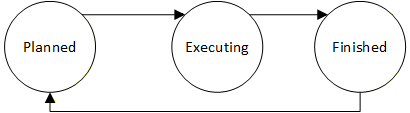
The MaintenanceEventStateMachineType provides information, whether a maintenance activity is planned, currently in execution, or has been executed. A state machine diagram is shown in Figure 10. This specification does not define any effects or actions of the MaintenanceEventStateMachineType, the execution of the StateMachine is server-specific. The Transitions go from Planned to Executing to Finished. In case or repeating maintenance activities, the StateMachine might go back from Finished to Planned for another cycle. The ObjectType and is formally defined in Table 37.
| Attribute | Value | ||||
| BrowseName | MaintenanceEventStateMachineType | ||||
| IsAbstract | False | ||||
| Description | Information, whether a maintenance activity is planned, currently in execution, or has been executed | ||||
| References | Node Class | BrowseName | DataType | TypeDefinition | Other |
|---|---|---|---|---|---|
| Subtype of the FiniteStateMachineType defined in OPC 10000-16, i.e. inheriting the InstanceDeclarations of that Node. | |||||
| 0:HasComponent | Object | Planned | 0:InitialStateType | ||
| 0:HasComponent | Object | Executing | 0:StateType | ||
| 0:HasComponent | Object | Finished | 0:StateType | ||
| 0:HasComponent | Object | FromPlannedToExecuting | 0:TransitionType | ||
| 0:HasComponent | Object | FromExecutingToFinished | 0:TransitionType | ||
| 0:HasComponent | Object | FromFinishedToPlanned | 0:TransitionType | ||
| Conformance Units | |||||
|---|---|---|---|---|---|
| AMB Current and Future Maintenance Activities |
The components of the MaintenanceEventStateMachineType have additional References which are defined in Table 38.
| SourceBrowsePath | Reference Type | Is Forward | TargetBrowsePath |
| FromPlannedToExecuting | 0:FromState | True | Planned |
| 0:ToState | True | Executing | |
| FromExecutingToFinished | 0:FromState | True | Executing |
| 0:ToState | True | Finished | |
| FromFinishedToPlanned | 0:FromState | True | Finished |
| 0:ToState | True | Planned |
The components of the MaintenanceEventStateMachineType have additional Attributes defined in Table 39.
| BrowsePath | Value Attribute | ||
| 1 | ||
| 2 | ||
| 3 | ||
| 1 | ||
| 2 | ||
| 3 |
12.4 Standardized categories of Maintenance Activities
12.4.1 Overview
Maintenance activities can be classified into different categories. This specification uses the mechanism of the ConditionClassId defined for conditions in OPC 10000-9, for such a classification of maintenance activities. In the following, specific subtypes of MaintenanceConditionClassType are defined, that should be used as ConditionClassId for specific maintenance activities. Other companion specifications and vendors might add additional subtypes of MaintenanceConditionClassType and might inherit from the types defined in this specification.
12.4.2 InspectionConditionClassType
The InspectionConditionClassType is used to classify conditions related to inspection maintenance activities. It is formally defined in Table 40.
| Attribute | Value | ||||
| BrowseName | InspectionConditionClassType | ||||
| IsAbstract | True | ||||
| Description | An inspection maintenance activity | ||||
| References | NodeClass | BrowseName | DataType | TypeDefinition | Other |
|---|---|---|---|---|---|
| Subtype of the 0:MaintenanceConditionClassType defined in OPC 10000-9 | |||||
| Conformance Units | |||||
|---|---|---|---|---|---|
| AMB Current and Future Maintenance Activities |
12.4.3 ExternalCheckConditionClassType
The ExternalCheckConditionClassType is used to classify conditions related to external check maintenance activities. It is formally defined in Table 41.
| Attribute | Value | ||||
| BrowseName | ExternalCheckConditionClassType | ||||
| IsAbstract | True | ||||
| Description | An external check maintenance activity | ||||
| References | NodeClass | BrowseName | DataType | TypeDefinition | Other |
|---|---|---|---|---|---|
| Subtype of the 0:MaintenanceConditionClassType defined in OPC 10000-9 | |||||
| Conformance Units | |||||
|---|---|---|---|---|---|
| AMB Current and Future Maintenance Activities |
12.4.4 ServicingConditionClassType
The ServicingConditionClassType is used to classify conditions related to servicing maintenance activities. It is formally defined in Table 42.
| Attribute | Value | ||||
| BrowseName | ServicingConditionClassType | ||||
| IsAbstract | True | ||||
| Description | A servicing maintenance activity | ||||
| References | NodeClass | BrowseName | DataType | TypeDefinition | Other |
|---|---|---|---|---|---|
| Subtype of the 0:MaintenanceConditionClassType defined in OPC 10000-9 | |||||
| Conformance Units | |||||
|---|---|---|---|---|---|
| AMB Current and Future Maintenance Activities |
12.4.5 RepairConditionClassType
The RepairConditionClassType is used to classify conditions related to repair maintenance activities. It is formally defined in Table 43.
| Attribute | Value | ||||
| BrowseName | RepairConditionClassType | ||||
| IsAbstract | True | ||||
| Description | A repair maintenance activity | ||||
| References | NodeClass | BrowseName | DataType | TypeDefinition | Other |
|---|---|---|---|---|---|
| Subtype of the 0:MaintenanceConditionClassType defined in OPC 10000-9 | |||||
| Conformance Units | |||||
|---|---|---|---|---|---|
| AMB Current and Future Maintenance Activities |
12.4.6 ImprovementConditionClassType
The ImprovementConditionClassType is used to classify conditions related to improvement maintenance activities. It is formally defined in Table 44.
| Attribute | Value | ||||
| BrowseName | ImprovementConditionClassType | ||||
| IsAbstract | True | ||||
| Description | An improvement maintenance activity | ||||
| References | NodeClass | BrowseName | DataType | TypeDefinition | Other |
|---|---|---|---|---|---|
| Subtype of the 0:MaintenanceConditionClassType defined in OPC 10000-9 | |||||
| Conformance Units | |||||
|---|---|---|---|---|---|
| AMB Current and Future Maintenance Activities |
12.5 NameNodeIdDataType
This structure contains the name and optionally a NodeId. It is used to provide a human-readable name of something plus optionally the NodeId in case the something is represented in the AddressSpace. The structure is defined in Table 18.
| Name | Type | Description |
|---|---|---|
| NameNodeIdDataType | structure | |
Name | 0:LocalizedText | The human-readable name. Shall be the DisplayName of the NodeId field, in case the NodeId is provided |
NodeId | 0:NodeId | Optionally provided NodeId, in case the referenced thing is represented as Node in the AddressSpace. |
Its representation in the AddressSpace is defined in Table 46.
| Attribute | Value | |||||
| BrowseName | NameNodeIdDataType | |||||
| IsAbstract | False | |||||
| Description | A human-readable name of something plus optionally the NodeId in case the something is represented in the AddressSpace | |||||
| References | NodeClass | BrowseName | DataType | TypeDefinition | Other | |
|---|---|---|---|---|---|---|
| Subtype of Structure defined in OPC 10000-5 | ||||||
| Conformance Units | ||||||
|---|---|---|---|---|---|---|
| AMB Current and Future Maintenance Activities |
12.6 MaintenanceMethodEnum
This enumeration provides information on the maintenance method. The enumeration is defined in Table 47.
| Name | Value | Description |
|---|---|---|
| Local | 0 | Maintenance close to the asset |
| Remote | 1 | Maintenance from another location |
Its representation in the AddressSpace is defined in Table 48.
| Attribute | Value | |||||
| BrowseName | MaintenanceMethodEnum | |||||
| IsAbstract | False | |||||
| References | NodeClass | BrowseName | DataType | TypeDefinition | Other | |
|---|---|---|---|---|---|---|
| Subtype of the Enumeration type defined in OPC 10000-5 | ||||||
| 0:HasProperty | Variable | 0:EnumValues | 0:EnumValueType[] | 0:PropertyType | ||
| Conformance Units | ||||||
|---|---|---|---|---|---|---|
| AMB Current and Future Maintenance Activities |
13 Localisation / Contextualisation
13.1 General
13.1.1 Overview
This section provides some general infrastructure used for various types of location / contextualization information.
13.1.2 Contains ReferenceType
Contains is an abstract ReferenceType as base to point to various types of locations. It is a subtype of 0:HierarchicalReferences.
The semantic of this ReferenceType is to link an Object representing some type of location to Objects (like assets) located in that location.
The SourceNode of References of this type shall be an Object representing a location. This Object should be part of a hierarchy referenced by the 0:Locations Object, directly or indirectly.
The TargetNode of this ReferenceType shall be an Object contained in the location of the SourceNode.
References of this ReferenceType shall always be exposed bidirectional, i.e. navigating from the location and to the location shall be supported.
The Contains is formally defined in Table 51.
| Attributes | Value | ||
| BrowseName | Contains | ||
| InverseName | LocatedIn | ||
| Symmetric | False | ||
| IsAbstract | True | ||
| Description | Links an Object representing some type of location to Objects (like assets) located in that location | ||
| References | NodeClass | BrowseName | Comment |
|---|---|---|---|
| Subtype of 0:HierarchicalReferences defined in OPC 10000-5 | |||
| Conformance Units | |||
|---|---|---|---|
| AMB Hierarchical Location Objects | |||
| AMB Operational Location Objects |
13.2 Local Time
OPC UA provides an mechanism to expose the local time of a Server, by the optional Property 0:LocalTime on the 0:Server Object (defined on the 0:ServerType in OPC 10000-5). This Property is also used as optional Event field.
Assets managed by a Server may be in a different time zone than the Server. Therefore, the same Property as on the Server Object should be used to expose the local time of the asset, i.e. a Property with BrowseName 0:LocalTime having the DataType 0:TimeZoneDataType or a subtype.
Servers may set the 0:LocalTime Property to be writable to allow Clients to set the local time of an asset. Servers may provide the 0:LocalTime with a Null Value in case the local time is unknown to the Server and not set by any Client.
13.3 Hierarchical Location
13.3.1 Overview
In order to provide hierarchical location information, this specification defines two mechanisms, that can be used individual or in combination.
The hierarchical location Property provides a simple string providing the hierarchical location of an asset. The structure inside the string may expose several levels. How this is exposed, what delimiters are used, etc. is vendor-specific. Examples of such strings are "FactoryA/BuildingC/Floor1" or "Area1-ProcessCell17-Unit4"
The hierarchical location Objects provide a browsable structure of the hierarchy and simplifies access like getting all assets of one hierarchical location.
In Figure 11, an example is given exposing the hierarchical location by Properties.
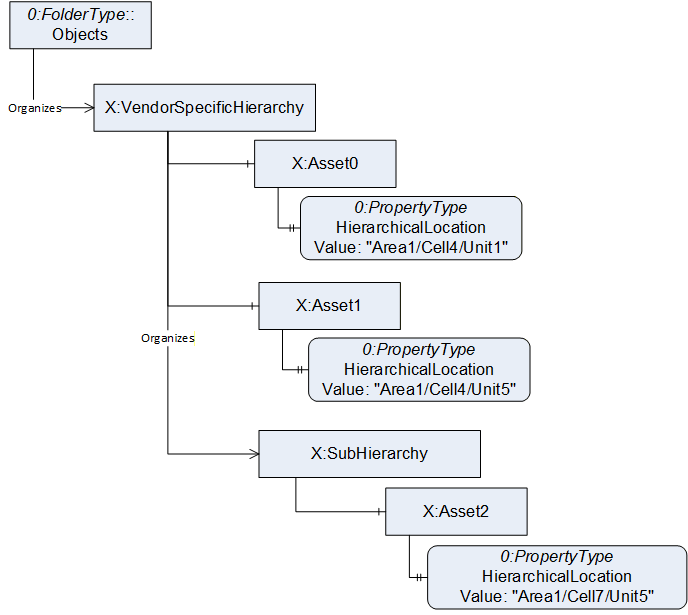
In Figure 12, an example is given exposing the hierarchical location by Objects. The standardized 0:Locations Object (see 13.3.3.2) is used as entry point.
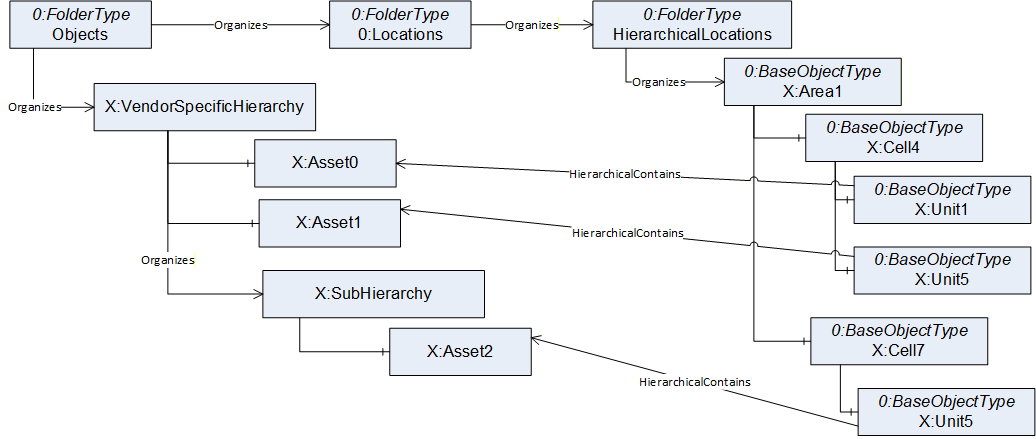
In Figure 13, an example is given combining both approaches.
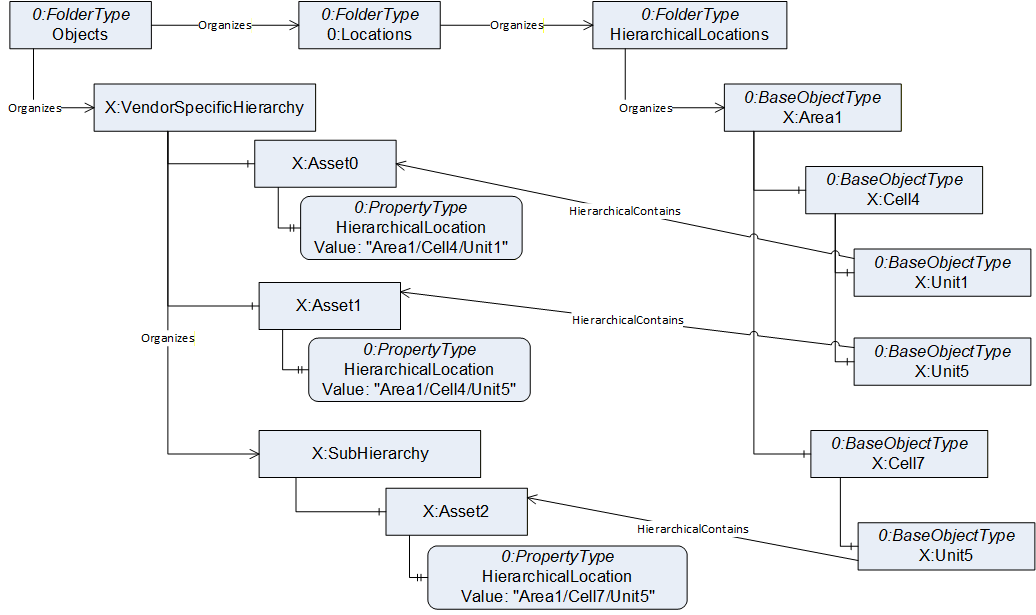
As shown in the figure, X:Asset0 is referenced by the X:Unit1 of X:Cell4 of X:Area1. The Property HierarchicalLocation provides the same information. As the format of the string is not further defined, it is vendor-specific how to keep both information sources in sync, especially when the Property is writable. Servers may reject Values not represented by Objects or may extend the Locations hierarchy.
13.3.2 HierarchicalLocation Property
Each asset exposing the hierarchical location as Property has a Property with the BrowseName "HierarchicalLocation" (defined in the Namespace of this specification) and the DataType String or a subtype. The structure of the String (e.g. delimiters for different hierarchies) is not further defined in this specification.
Servers may set the HierarchicalLocation Property to be writable to allow Clients to set the hierarchical location of an asset. Servers may provide the HierarchicalLocation with a Null Value or empty string in case the HierarchicalLocation is unknown to the Server and not set by any Client.
13.3.3 Hierarchical Location Objects
13.3.3.1 General
In order to expose the hierarchical location as Objects, there is a standardized entry point HierarchicalLocations (see 13.3.3.2). Each Object referenced from the HierarchicalLocations Object with an Organizes Reference or a subtype represents the highest level of a location hierarchy. The ObjectType for those Objects is not further defined, it can be of any ObjectType. Companion specifications might further refine the ObjectType. These Objects may reference other Objects with hierarchical References, exposing deeper level of the hierarchy. The ReferenceType is not further restricted, it is recommended to use the HasComponent ReferenceType. The hierarchy spanned should not contain loops, however, Clients shall not rely on this.
The HierarchicalContains ReferenceType (see 13.3.3.3) is used to relate the contained assets in the corresponding hierarchical location and is excluded from spanning the location hierarchy.
Since the Objects under the HierarchicalLocations Object span a location hierarchy, each asset is only referenced from the deepest level in the hierarchy it belongs to. Implicitly, those assets are also contained from the higher levels in the hierarchy.
13.3.3.2 HierarchicalLocations Object
The HierarchicalLocations Object is formally defined in Table 50.
| Attribute | Value | |||
| BrowseName | HierarchicalLocations | |||
| Description | Entry point for objects representing the root of a location hierarchy | |||
| References | NodeClass | BrowseName | DataType | TypeDefinition |
|---|---|---|---|---|
| OrganizedBy by the 0:Locations Object defined in OPC 10000-5 | ||||
| 0:HasTypeDefinition | ObjectType | 0:FolderType | ||
| Conformance Units | ||||
|---|---|---|---|---|
| AMB Hierarchical Location Objects |
Objects referenced with an Organizes Reference or a subtype are considered to be the root of a location hierarchy. The HierarchicalLocations Object is the entry point to those root Objects.
13.3.3.3 HierarchicalContains ReferenceType
HierarchicalContains is a concrete ReferenceType and can be used directly. It is a subtype of Contains.
The semantic of this ReferenceType is to link an Object representing part in a hierarchical location to Objects (like assets) located in that hierarchical location.
The SourceNode of References of this type shall be an Object representing a location. This Object should be part of a hierarchy referenced by the HierarchicalLocations Object, directly or indirectly.
The TargetNode of this ReferenceType shall be an Object contained in the location of the SourceNode.
References of this ReferenceType shall always be exposed bidirectional, i.e. navigating from the location and to the location shall be supported.
The HierarchicalContains is formally defined in Table 51.
| Attributes | Value | ||
| BrowseName | HierarchicalContains | ||
| InverseName | HierarchicalLocatedIn | ||
| Symmetric | False | ||
| IsAbstract | False | ||
| Description | Links an Object representing part in a hierarchical location to Objects (like assets) located in that hierarchical location | ||
| References | NodeClass | BrowseName | Comment |
|---|---|---|---|
| Subtype of Contains | |||
| Conformance Units | |||
|---|---|---|---|
| AMB Hierarchical Location Objects |
13.4 Operational Location
13.4.1 Overview
In order to provide operational location information, this specification defines two mechanisms, that can be used individual or in combination. Those are the same as for hierarchical locations.
The operational location Property provides a simple string providing the operational location of an asset. The structure inside the string may expose several levels. How this is exposed, what delimiters are used, etc. is vendor-specific. Examples of such strings are "Warehouse1/Sheet3" or "StainlessSteelTote3"
The operational location Objects provide a browsable structure of the operational location and simplifies access like getting all assets of one operational location.
In Figure 14, an example is given exposing the operational location by Properties.
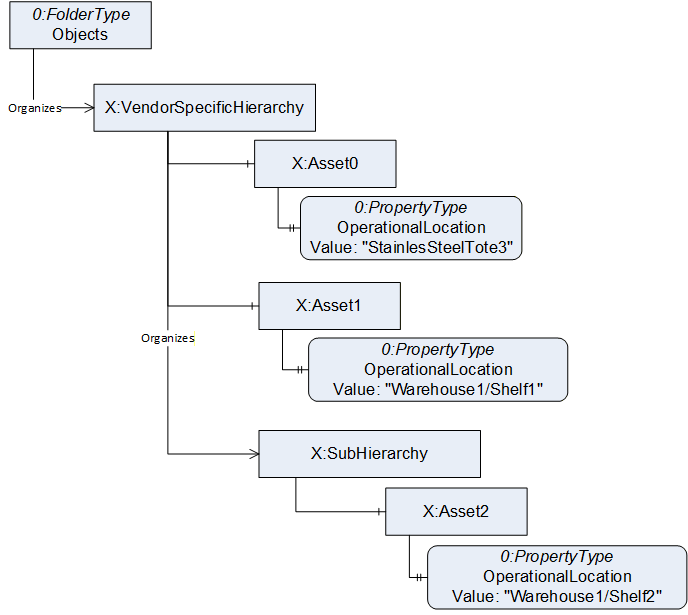
In Figure 15, an example is given exposing the operational location by Objects. The standardized OperationalLocations Object (see 13.4.3.2) is used as entry point.
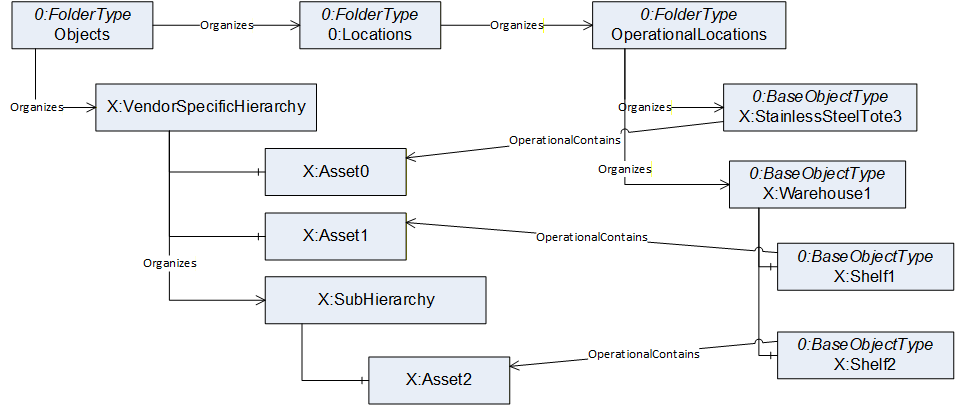
In Figure 16, an example is given combining both approaches.
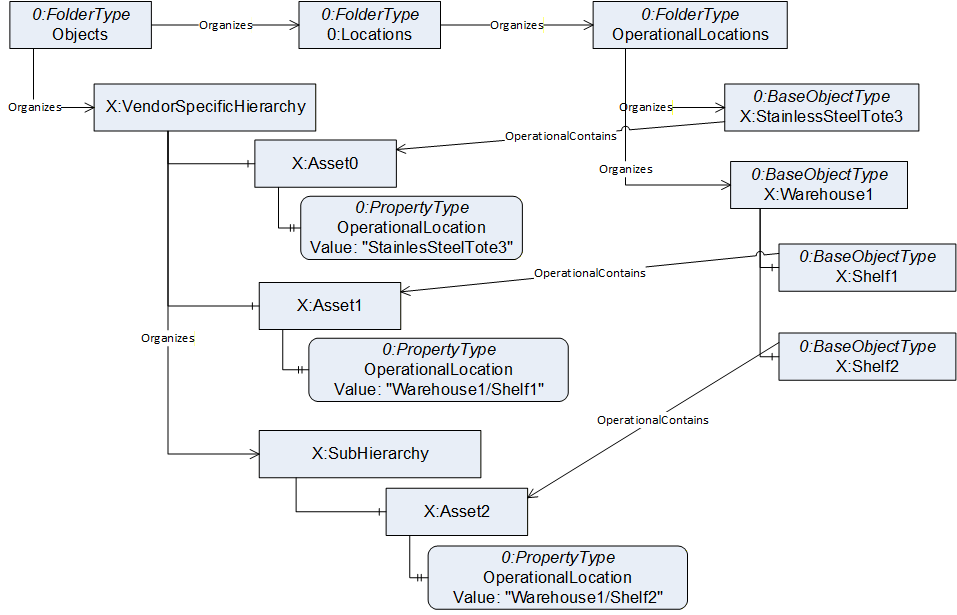
As shown in the figure, X:Asset1 is referenced by the X:Shelf1 of X:Warehouse1. The Property OperationalLocation provides the same information. As the format of the string is not further defined, it is vendor-specific how to keep both information sources in sync, especially when the Property is writable. Servers may reject Values not represented by Objects or may extend the hierarchy or operational locations.
13.4.2 OperationalLocation Property
Each asset exposing the operational location as Property has a Property with the BrowseName "OperationalLocation" (defined in the Namespace of this specification) and the DataType String or a subtype. The structure of the String (e.g. delimiters for different levels of operational locations) is not further defined in this specification.
Servers may set the OperationalLocation Property to be writable to allow Clients to set the operational location of an asset. Servers may provide the OperationalLocation with a Null Value or empty string in case the OperationalLocation is unknown to the Server and not set by any Client.
13.4.3 Operational Location Objects
13.4.3.1 General
In order to expose the hierarchical of operational locations as Objects, there is a standardized entry point OperationalLocations (see 13.4.3.2). Each Object referenced from the OperationalLocations Object with an Organizes Reference or a subtype represents the highest level of a hierarchy of operational locations. The ObjectType for those Objects is not further defined, it can be of any ObjectType. Companion specifications might further refine the ObjectType. These Objects may reference other Objects with hierarchical References, exposing deeper level of the hierarchy. The ReferenceType is not further restricted, it is recommended to use the HasComponent ReferenceType. The hierarchy spanned should not contain loops, however, Clients shall not rely on this.
The OperationalContains ReferenceType (see 13.4.3.3) is used to relate the contained assets in the corresponding location and is excluded from spanning the location hierarchy.
Since the Objects under the OperationalLocations Object span a hierarchy of operational locations, each asset is only referenced from the deepest level in the hierarchy it belongs to. Implicitly, those assets are also contained from the higher levels in the hierarchy.
13.4.3.2 OperationalLocations Object
The OperationalLocations Object is formally defined in Table 52.
| Attribute | Value | |||
| BrowseName | OperationalLocations | |||
| Description | Entry point for objects representing the root of a hierarchy of operational locations | |||
| References | NodeClass | BrowseName | DataType | TypeDefinition |
|---|---|---|---|---|
| OrganizedBy by the 0:Locations Object defined in OPC 10000-5 | ||||
| 0:HasTypeDefinition | ObjectType | 0:FolderType | ||
| Conformance Units | ||||
|---|---|---|---|---|
| AMB Operational Location Objects |
Objects referenced with an Organizes Reference or a subtype are considered to be the root of a hierarchy of operational locations. The OperationalLocations Object is the entry point to those root Objects.
13.4.3.3 OperationalContains ReferenceType
OperationalContains is a concrete ReferenceType and can be used directly. It is a subtype of Contains.
The semantic of this ReferenceType is to link an Object representing an operational location to Objects (like assets) located in that operational location.
The SourceNode of References of this type shall be an Object representing a location. This Object should be part of a hierarchy referenced by the OperationalLocations Object, directly or indirectly.
The TargetNode of this ReferenceType shall be an Object contained in the location of the SourceNode.
References of this ReferenceType shall always be exposed bidirectional, i.e. navigating from the location and to the location shall be supported.
The OperationalContains is formally defined in Table 53.
| Attributes | Value | ||
| BrowseName | OperationalContains | ||
| InverseName | OperationalLocatedIn | ||
| Symmetric | False | ||
| IsAbstract | False | ||
| Description | Links an Object representing an operational location to Objects (like assets) located in that operational location | ||
| References | NodeClass | BrowseName | Comment |
|---|---|---|---|
| Subtype of Contains | |||
| Conformance Units | |||
|---|---|---|---|
| AMB Operational Location Objects |
13.5 Digital Location
For digital assets like files, it may be desirable to provide the digital location of such assets in form of a reference like a URI.
Each digital asset exposing the digital location has a Property with the BrowseName "DigitalLocation" (defined in the Namespace of this specification) and the DataType String or a subtype. The structure of the String is not further defined in this specification. Servers should use the 0:UriString or a subtype if they expose a URI in order to provide this additional information to the Client.
Servers may set the DigitalLocation Property to be writable to allow Clients to set the digital location of an asset. Servers may provide the DigitalLocation with a Null Value or an empty string in case the digital location is unknown to the Server and not set by any Client.
14 Structure of Assets
14.1 Sub-Assets
An asset may consist of several sub-assets, and those may have sub-assets as well. In order to expose such a hierarchy, the concept of References is used. Sub-assets shall be referenced from the asset with a hierarchical Reference, preferable 0:HasComponent or a subtype of it. Assets may reference their sub-assets directly, or have additional grouping Objects in between, potentially several layers of grouping Objects. In Figure 17, some examples are given. X:Asset1 contains two sub-assets, directly referenced, and the sub-asset X:Subasset1.2 contains additional two sub-assets. For X:Asset2, the sub-assets are not directly referenced, but some grouping Objects are in between.
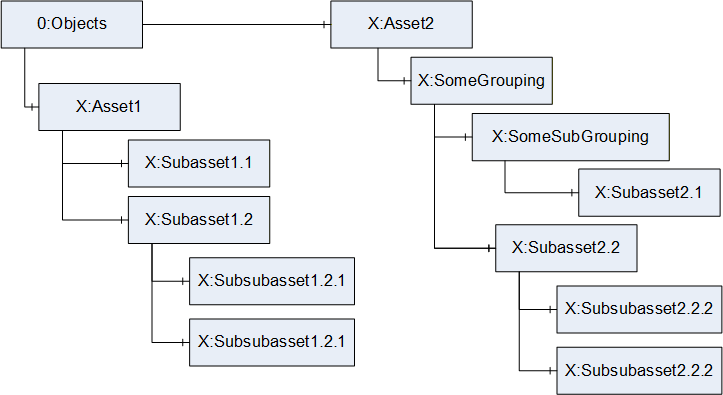
In order to identify all sub-assets of an asset, a Client needs to follow all hierarchical References in forward direction from the asset recursively.
14.2 Relations to other Assets
Assets may be related to other assets to expose different information like being physically connected or one asset utilizes another asset. In that case, References are used to expose such functionality. Typically, those References are non-hierarchical References. OPC 10000-23 defines several of those ReferenceTypes, Companion Specification may define additional ReferenceTypes. In Figure 18, some examples are given. X:Asset1 and X:Asset2 are related with the symmetric 0:PhysicallyConnectTo Reference. X:Subasset1.1 utilizes X:Subsubasset1.2.1 using the 0:Utilizes Reference.
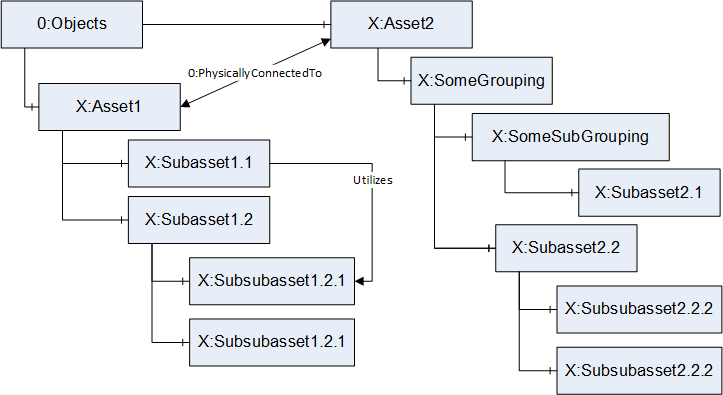
In order to identify all relations to other assets, a Client needs to follow all References from the asset considering forward and backward direction. Clients may filter for specific ReferenceTypes.
15 Profiles and Conformance Units
15.1 Conformance Units
Table 54 defines the corresponding ConformanceUnits for the OPC UA Information Model for Asset Management Basics.
| Category | Title | Description |
| Server | AMB Asset Identification | All manageable assets provided by the server have the "ProductInstanceUri" and optionally additional identification Properties. The Properties are either directly on the Object representing the asset or on the Identification Object grouping the Properties. |
| Server | AMB Configurable Asset Identification | All manageable assets provided by the server have the "AssetId" and optionally additional configurable identification Properties as writable Properties that store the configuration persistently, providing the written values also after a restart of the server. Servers shall support at least 40 Unicode characters for the clients writing this value. This means clients can expect to be able to write strings with a length of 40 Unicode characters into that field. The Properties are either directly on the Object representing the asset or on the Identification Object grouping the Properties. |
| Client | AMB Client Asset Identification | The client can make use of asset identification information and is capable to receive that information independent if it is provided per TypeDefinition, Interface or just as Properties on the instance or under the Identification Object and is able to deal with default values of the Properties. |
| Server | AMB Asset Discovery by ProductInstanceUri | All manageable assets are provided as AliasNames under to AssetsByProductInstanceUri using the ProductInstanceUri as AliasName. The AssetsByProductInstanceUri Object supports NodeVersion and ModelChangeEvents. |
| Server | AMB Asset Discovery by AssetId | All manageable assets supporting the AssetId Property are provided as AliasNames under to AssetsByAssetId using the AssetId as AliasName. The AssetsByProductInstanceUri Object supports NodeVersion and ModelChangeEvents. |
| Client | AMB Client Asset Discovery by ProductInstanceUri | The client can make use of the AssetsByProductInstanceUri discovery mechanism to discover the assets managed by the server or other, referenced servers. Whether the client uses the FindAlias method or browses the AliasNames is client-specific. The client is capable to manage Off-Server references in this discovery mechanism. |
| Client | AMB Client Asset Discovery by AssetId | The client can make use of the AssetsByAssetId discovery mechanism to discover the assets managed by the server or other, referenced servers. Whether the client uses the FindAlias method or browses the AliasNames is client-specific. The client is capable to manage Off-Server references in this discovery mechanism. |
| Server | AMB Asset Health Status Base | All manageable assets provided by the sever have the "DeviceHealth" variable. |
| Server | AMB Asset Health Status Alarms | All manageable assets provided by the server provide alarms with details of their fault indications. Optionally, the alarms are provided as Objects in the DeviceHealthAlarms folder. |
| Server | AMB Asset Health Status Root Causes | All manageable assets provided by the server provide alarms with details of their fault indications. All those alarms implement the "IRootCauseIndicationType". |
| Server | AMB Asset Health Status Alarm Categories | All manageable assets provided by the server provide alarms with a reasonable ConditionClassId. |
| Server | AMB Asset Health Tracking Overall Asset Status | All manageable assets provided by the sever having the "DeviceHealth" variable have the Historizing attribute of that variable set to true and the AccessLevel set to HistoricalRead. |
| Server | AMB Asset Health Tracking Events | The server supports access of the history of all alarms representing the details of fault indications of its assets. |
| Client | AMB Client Asset Health Status | The client can make use of the "DeviceHealth" variable and the alarms providing details on the fault indication. |
| Client | AMB Client Asset Health Tracking Status | The client can make use of the history of the "DeviceHealth" variable and the history of the alarms providing details on the fault indication. |
| Server | AMB Version Information | All manageable assets provided by the server have, depending on their nature, the Software- and or HardwareRevision Property and the RevisionCounter Property. |
| Server | AMB Operation Counters | At least one manageable asset provided by the server provides the OperationCounters Object and at least one operation counter. |
| Server | AMB DocumentationLinks Base | At least one manageable asset provided by the server provides the DocumentationLinks AddIn and have at least one link. |
| Server | AMB DocumentationLinks Edit Base | All manageable assets provided by the server provide the DocumentationLinks AddIn and have at least one link that can be edited by the user to provide user-specific links. The Browse- and DisplayName and the Description might be editable. The server supports links of a length of at least 255 chars. |
| Server | AMB DocumentationLinks Edit Advanced | All manageable assets provided by the server provide the DocumentationLinks AddIn and support the AddLink and RemoveLink methods. The server is capable to manage at least two links added via the AddLink method. The server supports links of a length of at least 255 chars. |
| Server | AMB Requirements | At least one manageable asset provided by the server provides the Requirements Object and at least one requirement. |
| Server | AMB Capabilities | At least one manageable asset provided by the server provides the Capabilities Object and at least one capability. |
| Server | AMB Classification | At least one manageable asset provides at least one HasDictionaryEntry reference to classify the asset. |
| Server | AMB Current and Future Maintenance Activities | All manageable assets provided by the server provide conditions with details of current or upcoming maintenance activities. Optionally, the conditions are provided as Objects in the DeviceHealthAlarms folder. The ConditionTypes used as maintenance activities implement the IMaintenanceEventType. |
| Server | AMB Past Maintenance Activities | The server provides capability to read the history of events and for all manageable assets provided by the server the history of all maintenance activities is provided. The ConditionTypes used as maintenance activities implement the IMaintenanceEventType. |
| Client | AMB Client Current and Future Maintenance Activities | The client can make use of the conditions provided as maintenance activities providing details on current and planned maintenance activities. |
| Client | AMB Client Past Maintenance Activities | The client can make use of the history of the conditions provided as maintenance activities providing details on the past maintenance activities. |
| Server | AMB Local Time | At least one manageable asset provided by the server provides the LocalTime Property. |
| Server | AMB Hierarchical Location Property | At least one manageable asset provided by the server provides the Location Property. |
| Server | AMB Hierarchical Location Objects | The HierarchicalLocations Object is provided with at least one location hierarchy and at least one manageable asset is referenced from that hierarchy with the HierarchicalContains Reference or a subtype. |
| Server | AMB Operational Location Property | At least one manageable asset provided by the server provides the OperationalLocation Property. |
| Server | AMB Operational Location Objects | The OperationalLocations Object is provided with at least one operational location and at least one manageable asset is referenced from that location with the OperationalContains Reference or a subtype. |
| Server | AMB Digital Location | At least one manageable asset provided by the server provides the DigitalLocation Property. |
| Server | AMB Sub-assets | At least one manageable asset provided by the server exposes at least one sub-asset as manageable asset. The sub-assets may be managed in another server. |
| Client | AMB Client sub-assets | The client can make use of the sub-asset hierarchy provided by the server and is capably to identify all sub-assets of an asset managed in the same server. |
| Client | AMB Client sub-assets remote | The client can make use of the sub-asset hierarchy provided by the server and is capably to identify all sub-assets of an asset managed in multiple servers. |
| Server | AMB Asset relations | At least one manageable asset provided by the server exposes a relation to another manageable asset other than containment (sub-asset). The referenced asset may be managed in another server. |
15.2 Profiles
15.2.1 Profile list
Table 55 lists all Profiles defined in this document and defines their URIs.
| Profile | URI |
| AMB Base Asset Management Server Facet | http://opcfoundation.org/UA-Profile/AMB/Server/BaseServer |
| AMB Base Asset Management Client Facet | http://opcfoundation.org/UA-Profile/AMB/Client/BaseClient |
15.2.2 Server Facets
15.2.2.1 Overview
The following sections specify the Facets available for Servers that implement the Asset Management Basics companion specification. Each section defines and describes a Facet or Profile.
15.2.2.2 AMB Base Asset Management Server Facet
Table 56 defines a Profile that describes the base characteristics for all OPC UA Servers that make use of this companion specification.
| Group | Conformance Unit / Profile Title | Mandatory / Optional |
| Server | AMB Asset Identification | M |
| Server | AMB Configurable Asset Identification | O |
| Server | AMB Asset Discovery by ProductInstanceUri | O |
| Server | AMB Asset Discovery by AssetId | O |
| Server | AMB Asset Health Status Base | O |
| Server | AMB Asset Health Status Alarms | O |
| Server | AMB Asset Health Status Root Causes | O |
| Server | AMB Asset Health Status Alarm Categories | O |
| Server | AMB Asset Health Tracking Overall Asset Status | O |
| Server | AMB Asset Health Tracking Events | O |
| Server | AMB Version Information | O |
| Server | AMB Operation Counters | O |
| Server | AMB DocumentationLinks Base | O |
| Server | AMB DocumentationLinks Edit Base | O |
| Server | AMB DocumentationLinks Edit Advanced | O |
| Server | AMB Requirements | O |
| Server | AMB Capabilities | O |
| Server | AMB Classification | O |
| Server | AMB Current and Future Maintenance Activities | O |
| Server | AMB Past Maintenance Activities | O |
| Server | AMB Local Time | O |
| Server | AMB Hierarchical Location Property | O |
| Server | AMB Hierarchical Location Objects | O |
| Server | AMB Operational Location Property | O |
| Server | AMB Operational Location Objects | O |
| Server | AMB Digital Location | O |
| Server | AMB Sub-assets | O |
| Server | AMB Asset relations | O |
15.2.3 Client Facets
15.2.3.1 Overview
The following tables specify the Facets available for Clients that implement the Asset Management Basics companion specification.
15.2.3.2 AMB Base Asset Management Client Facet
Table 57 defines a Facet that describes the base characteristics for all OPC UA Clients that make use of this companion specification.
| Group | Conformance Unit / Profile Title | Mandatory / Optional |
| Client | AMB Client Asset Identification | M |
| Client | AMB Client Asset Discovery by ProductInstanceUri | O |
| Client | AMB Client Asset Discovery by AssetId | O |
| Client | AMB Client Asset Health Status | O |
| Client | AMB Client Asset Health Tracking Status | O |
| Client | AMB Client Current and Future Maintenance Activities | O |
| Client | AMB Client Past Maintenance Activities | O |
| Client | AMB Client sub-assets | O |
| Client | AMB Client sub-assets remote | O |
16 Namespaces
16.1 Namespace Metadata
Table 58 defines the namespace metadata for this document. The Object is used to provide version information for the namespace and an indication about static Nodes. Static Nodes are identical for all Attributes in all Servers, including the Value Attribute. See OPC 10000-5 for more details.
The information is provided as Object of type NamespaceMetadataType. This Object is a component of the Namespaces Object that is part of the Server Object. The NamespaceMetadataType ObjectType and its Properties are defined in OPC 10000-5.
The version information is also provided as part of the ModelTableEntry in the UANodeSet XML file. The UANodeSet XML schema is defined in OPC 10000-6.
| Attribute | Value | ||
| BrowseName | http://opcfoundation.org/UA/AMB/ | ||
| Property | DataType | Value | |
|---|---|---|---|
| NamespaceUri | String | http://opcfoundation.org/UA/AMB/ | |
| NamespaceVersion | String | 1.01.1 | |
| NamespacePublicationDate | DateTime | 2024-02-27 | |
| IsNamespaceSubset | Boolean | False | |
| StaticNodeIdTypes | IdType[] | 0 | |
| StaticNumericNodeIdRange | NumericRange[] | ||
| StaticStringNodeIdPattern | String | ||
Note: The IsNamespaceSubset Property is set to False as the UANodeSet XML file contains the complete Namespace. Servers only exposing a subset of the Namespace need to change the value to True.
16.2 Handling of OPC UA Namespaces
Namespaces are used by OPC UA to create unique identifiers across different naming authorities. The Attributes NodeId and BrowseName are identifiers. A Node in the UA AddressSpace is unambiguously identified using a NodeId. Unlike NodeIds, the BrowseName cannot be used to unambiguously identify a Node. Different Nodes may have the same BrowseName. They are used to build a browse path between two Nodes or to define a standard Property.
Servers may often choose to use the same namespace for the NodeId and the BrowseName. However, if they want to provide a standard Property, its BrowseName shall have the namespace of the standards body although the namespace of the NodeId reflects something else, for example the EngineeringUnits Property. All NodeIds of Nodes not defined in this document shall not use the standard namespaces.
Table 59 provides a list of mandatory and optional namespaces used in an Asset Management Basics OPC UA Server.
| NamespaceURI | Description | Use |
| http://opcfoundation.org/UA/ | Namespace for NodeIds and BrowseNames defined in the OPC UA specification. This namespace shall have namespace index 0. | Mandatory |
| Local Server URI | Namespace for nodes defined in the local server. This namespace shall have namespace index 1. | Mandatory |
| http://opcfoundation.org/UA/DI/ | Namespace for NodeIds and BrowseNames defined in OPC 10000-100. The namespace index is Server specific. | Mandatory |
| http://opcfoundation.org/UA/AMB/ | Namespace for NodeIds and BrowseNames defined in this document. The namespace index is Server specific. | Mandatory |
| Vendor specific types | A Server may provide vendor-specific types like types derived from ObjectTypes defined in this document in a vendor-specific namespace. | Optional |
| Vendor specific instances | A Server provides vendor-specific instances of the standard types or vendor-specific instances of vendor-specific types in a vendor-specific namespace. It is recommended to separate vendor specific types and vendor specific instances into two or more namespaces. | Mandatory |
Table 60 provides a list of namespaces and their index used for BrowseNames in this document. The default namespace of this document is not listed since all BrowseNames without prefix use this default namespace.
| NamespaceURI | Namespace Index | Example |
| http://opcfoundation.org/UA/ | 0 | 0:EngineeringUnits |
| http://opcfoundation.org/UA/DI/ | 2 | 2:DeviceRevision |
Annex A Asset Management Basics Namespace and mappings (Normative)
A.1 NodeSet and supplementary files for Asset Management Basics (AMB) Information Model
The AMB Information Model is identified by the following URI:
http://opcfoundation.org/UA/AMB/
Documentation for the NamespaceUri can be found here.
The NodeSet associated with this version of specification can be found here:
https://reference.opcfoundation.org/nodesets/?u=http://opcfoundation.org/UA/AMB/&v=1.01.1&i=1
The NodeSet associated with the latest version of the specification can be found here:
https://reference.opcfoundation.org/nodesets/?u=http://opcfoundation.org/UA/AMB/&i=1
Supplementary files for the AMB Information Model can be found here:
https://reference.opcfoundation.org/nodesets/?u=http://opcfoundation.org/UA/AMB/&v=1.01.1&i=2
The files associated with the latest version of the specification can be found here:
https://reference.opcfoundation.org/nodesets/?u=http://opcfoundation.org/UA/AMB/&i=2
_____________
Agreement of Use
COPYRIGHT RESTRICTIONS
Any unauthorized use of this specification may violate copyright laws, trademark laws, and communications regulations and statutes. This document contains information which is protected by copyright. All Rights Reserved. No part of this work covered by copyright herein may be reproduced or used in any form or by any means--graphic, electronic, or mechanical, including photocopying, recording, taping, or information storage and retrieval systems--without permission of the copyright owner.
OPC Foundation members and non-members are prohibited from copying and redistributing this specification. All copies must be obtained on an individual basis, directly from the OPC Foundation Web site
http://www.opcfoundation.org.
PATENTS
The attention of adopters is directed to the possibility that compliance with or adoption of OPC specifications may require use of an invention covered by patent rights. OPC shall not be responsible for identifying patents for which a license may be required by any OPC specification, or for conducting legal inquiries into the legal validity or scope of those patents that are brought to its attention. OPC specifications are prospective and advisory only. Prospective users are responsible for protecting themselves against liability for infringement of patents.
WARRANTY AND LIABILITY DISCLAIMERS
WHILE THIS PUBLICATION IS BELIEVED TO BE ACCURATE, IT IS PROVIDED "AS IS" AND MAY CONTAIN ERRORS OR MISPRINTS. THE OPC FOUDATION MAKES NO WARRANTY OF ANY KIND, EXPRESSED OR IMPLIED, WITH REGARD TO THIS PUBLICATION, INCLUDING BUT NOT LIMITED TO ANY WARRANTY OF TITLE OR OWNERSHIP, IMPLIED WARRANTY OF MERCHANTABILITY OR WARRANTY OF FITNESS FOR A PARTICULAR PURPOSE OR USE. IN NO EVENT SHALL THE OPC FOUNDATION BE LIABLE FOR ERRORS CONTAINED HEREIN OR FOR DIRECT, INDIRECT, INCIDENTAL, SPECIAL, CONSEQUENTIAL, RELIANCE OR COVER DAMAGES, INCLUDING LOSS OF PROFITS, REVENUE, DATA OR USE, INCURRED BY ANY USER OR ANY THIRD PARTY IN CONNECTION WITH THE FURNISHING, PERFORMANCE, OR USE OF THIS MATERIAL, EVEN IF ADVISED OF THE POSSIBILITY OF SUCH DAMAGES.
The entire risk as to the quality and performance of software developed using this specification is borne by you.
RESTRICTED RIGHTS LEGEND
This Specification is provided with Restricted Rights. Use, duplication or disclosure by the U.S. government is subject to restrictions as set forth in (a) this Agreement pursuant to DFARs 227.7202-3(a); (b) subparagraph (c)(1)(i) of the Rights in Technical Data and Computer Software clause at DFARs 252.227-7013; or (c) the Commercial Computer Software Restricted Rights clause at FAR 52.227-19 subdivision (c)(1) and (2), as applicable. Contractor / manufacturer are the OPC Foundation, 16101 N. 82nd Street, Suite 3B, Scottsdale, AZ, 85260-1830.
COMPLIANCE
The OPC Foundation shall at all times be the sole entity that may authorize developers, suppliers and sellers of hardware and software to use certification marks, trademarks or other special designations to indicate compliance with these materials. Products developed using this specification may claim compliance or conformance with this specification if and only if the software satisfactorily meets the certification requirements set by the OPC Foundation. Products that do not meet these requirements may claim only that the product was based on this specification and must not claim compliance or conformance with this specification.
Trademarks
Most computer and software brand names have trademarks or registered trademarks. The individual trademarks have not been listed here.
GENERAL PROVISIONS
Should any provision of this Agreement be held to be void, invalid, unenforceable or illegal by a court, the validity and enforceability of the other provisions shall not be affected thereby.
This Agreement shall be governed by and construed under the laws of the State of Minnesota, excluding its choice or law rules.
This Agreement embodies the entire understanding between the parties with respect to, and supersedes any prior understanding or agreement (oral or written) relating to, this specification.
ISSUE REPORTING
The OPC Foundation strives to maintain the highest quality standards for its published specifications; hence they undergo constant review and refinement. Readers are encouraged to report any issues and view any existing errata here: http://www.opcfoundation.org/errata
Revision 1.01.01 Highlights
The following table includes new features and the Mantis issues resolved with this revision.
| Mantis ID | Summary | Resolution |
| 9306 | IMaintenanceEventType.ConfigurationChanged - description of value's semantic is upside down | Fixed description of ConfigurationChanged in 12.2 (switched semantic of TRUE and FALSE, which was described wrong before). |
| Add Descriptions to Nodes in NodeSet and in Tables in Document | Updated NodeSet and added various tables to document |