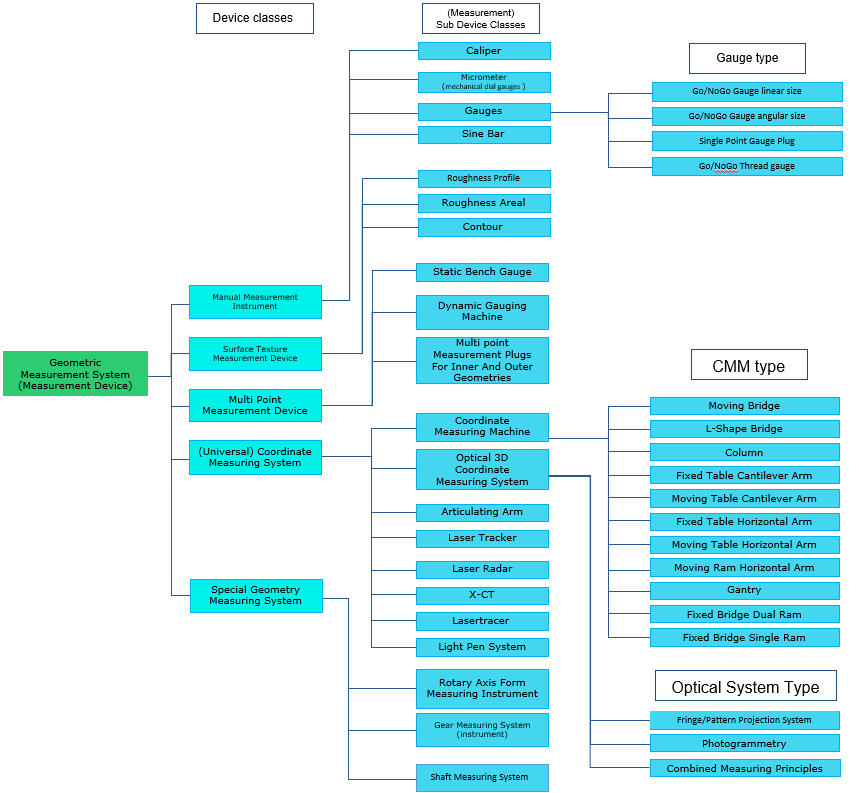
5.1.2 Classification and Structure of Geometric Measurement Systems
The field of Geometric Measurement Systems is very broad. In this section, the components of a GMS, as well as a classification for possible implementations, will be shown. The structures described here are exemplary. There may be further or future classifications for which this Companion Specification can still be used, and a GMS may contain further components or subsystems. Figure 2 contains an overview of the common components. It does not claim to be complete.
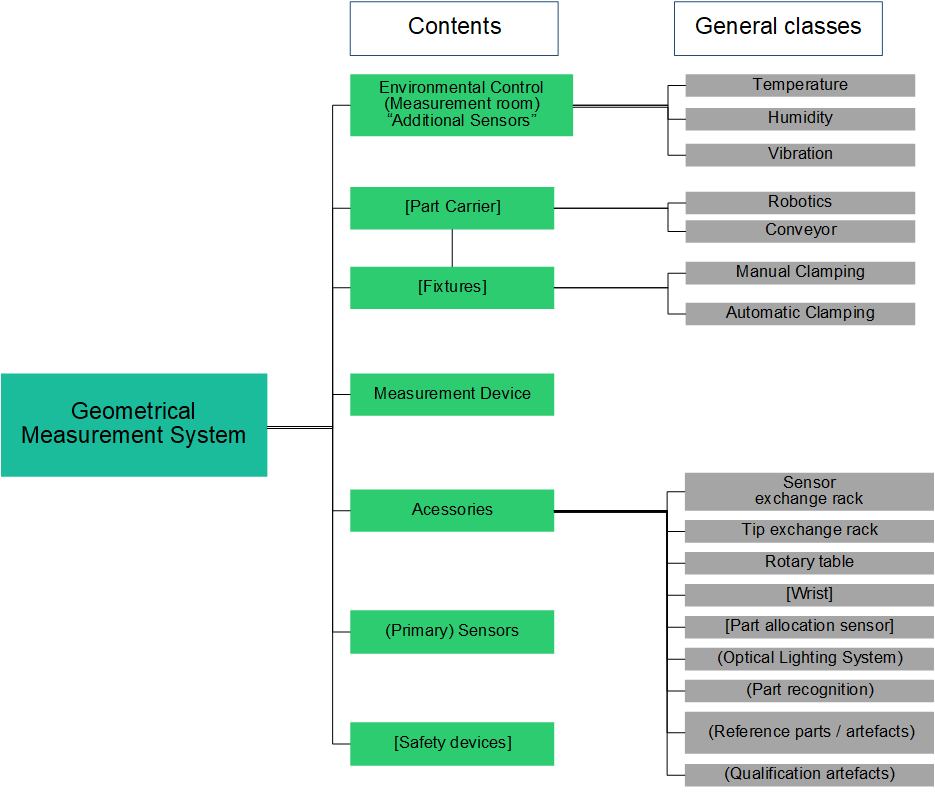
According to Figure 2, there are seven different main types of common components of a GMS (green). They may also be split into different subtypes (grey). The main types are defined as:
The GMS consists of an instrument that comprises one or more sensors (4.2.7).
Environmental control [VDI 2627] requires additional sensors (4.2.8)).
Part carrier & fixtures: enable a strict control and fixed reference in space and time - the coordinate systems - between measured component and measurement system.
Accessories enable the GMS to function according to the production plan.
Safety devices enable the GMS to observe its environment and prevent it from harming the operator or the measured part.
Figure 3 contains the classification of a GMS and divide the GMS into manual measurement instruments [ISO 14978], surface texture measuring instruments [ISO 25178], multi point measuring instruments, coordinate measuring systems [ISO 10360] and special systems. The gauges [ISO 1938] are treated as manual instruments. The list of applicable GMS does not claim to be complete.