
7 OPC UA ObjectTypes
7.1 ObjectTypes for Energy Consumption Measurement
7.1.1 EnergyMeasurementType ObjectType Definition
The EnergyMeasurementType provides various energy measurement values measured at the same point in a system and is formally defined in Table 16.
| Attribute | Value | ||||
| BrowseName | EnergyMeasurementType | ||||
| IsAbstract | False | ||||
| References | Node Class | BrowseName | DataType | TypeDefinition | Other |
|---|---|---|---|---|---|
| Subtype of the 0:BaseObjectType | |||||
| 0:HasProperty | Variable | ApplicationTag | 0:String | 0:PropertyType | M, RW |
| 0:HasComponent | Variable | <MeasurementValue> | 0:BaseDataType{Any} | EnergyMeasurementValueType | MP |
| 0:HasComponent | Method | 2:ResetStatistics | O | ||
| 0:HasProperty | Variable | 2:StartTime | 0:DateTime | 0:PropertyType | O |
| 0:HasInterface | ObjectType | 2:IStatisticsType | |||
| Conformance Units | |||||
|---|---|---|---|---|---|
| ECM Energy Measurement | |||||
The ApplicationTag provides a string that is supposed to uniquely identify the functionality of the energy measurement. It is to be set by an end user or system integrator. Server-provider would typically initially set it to an empty string. It is marked as writable. However, applications may also provide other mechanisms than the OPC UA interface to set the value, e.g. by some proprietary engineering environments.
The <MeasurementValue> Variable is a placeholder for all measurement values provided by the instance of the EnergyMeasurementType. At least one measurement value shall be provided. There are standardized measurement values defined (see 6.2.2).
The ObjectType implements the 2:IStatisticsType Interface as defined in OPC 10000-200 providing the optional 2:ResetStatistics and 2:StartTime.
The optional 2:ResetStatistics Method can be used to reset measurement values used as energy counter, i.e. aggregating the energy consumption over time. Details of its usage are defined in OPC 10000-200. Measurement values that can be reset are identified by being referenced using the 2:HasStatisticComponent (a subtype of 0:HasComponent).
The optional 2:StartTime indicates when the collection of aggregated data has started or was reset. Details of its usage are defined in OPC 10000-200.
7.1.2 AccuracyDomainType
The AccuracyDomainType is used to represent accuracy domains and contains the accuracy classes of the accuracy domain (see 6.2.4). It is formally defined in Table 17.
| Attribute | Value | ||||
| BrowseName | AccuracyDomainType | ||||
| IsAbstract | False | ||||
| References | Node Class | BrowseName | DataType | TypeDefinition | Other |
|---|---|---|---|---|---|
| Subtype of the 0:BaseObjectType | |||||
| 0:HasProperty | Variable | 0:EnumValues | 0:EnumValueType[] | 0:PropertyType | M |
| Conformance Units | |||||
|---|---|---|---|---|---|
| ECM Energy Measurement | |||||
The EnumValues provides the accuracy classes of the accuracy domain.
7.1.3 Interfaces for Energy Consumption Measurement
7.1.3.1 IEnergyProfileE0Type
The IEnergyProfileE0Type contains the References to EnergyMeasurementValueType Variables needed for EnergyProfile E0.
| Attribute | Value | ||||
| BrowseName | IEnergyProfileE0Type | ||||
| IsAbstract | True | ||||
| References | Node Class | BrowseName | DataType | TypeDefinition | Other |
|---|---|---|---|---|---|
| Subtype of the 0:BaseInterfaceType | |||||
| 0:HasComponent | Variable | AcCurrentPe | AcPeDataType | EnergyMeasurementValueType | M |
| Conformance Units | |||||
|---|---|---|---|---|---|
| ECM EnergyProfile E0 | |||||
| Source Path | Value Attribute | ||
| NamespaceUri: http://www.opcfoundation.org/UA/units/un/cefact UnitId: 4279632 DisplayName: A Description: ampere | ||
| 1218 | ||
| 1 |
7.1.3.2 IEnergyProfileE1Type
The IEnergyProfileE1Type contains the References to EnergyMeasurementValueType Variables needed for EnergyProfile E1.
| Attribute | Value | ||||
| BrowseName | IEnergyProfileE1Type | ||||
| IsAbstract | True | ||||
| References | Node Class | BrowseName | DataType | TypeDefinition | Other |
|---|---|---|---|---|---|
| Subtype of the 0:BaseInterfaceType | |||||
| 0:HasComponent | Variable | AcActivePowerTotal | 0:Float | EnergyMeasurementValueType | M |
| Conformance Units | |||||
|---|---|---|---|---|---|
| ECM EnergyProfile E1 | |||||
| Source Path | Value Attribute | ||
| NamespaceUri: http://www.opcfoundation.org/UA/units/un/cefact UnitId: 5723220 DisplayName: W Description: watt | ||
| 1412 | ||
| 1 |
7.1.3.3 IEnergyProfileE2Type
The IEnergyProfileE2Type contains the References to EnergyMeasurementValueType Variables needed for EnergyProfile E2.
| Attribute | Value | ||||
| BrowseName | IEnergyProfileE2Type | ||||
| IsAbstract | True | ||||
| References | Node Class | BrowseName | DataType | TypeDefinition | Other |
|---|---|---|---|---|---|
| Subtype of the 0:BaseInterfaceType | |||||
| 0:HasComponent | Variable | AcActivePowerTotal | 0:Float | EnergyMeasurementValueType | M |
| 2:HasStatisticComponent | Variable | AcActiveEnergyTotalImportLp | 0:Float | EnergyMeasurementValueType | M |
| 2:HasStatisticComponent | Variable | AcActiveEnergyTotalExportLp | 0:Float | EnergyMeasurementValueType | M |
| Conformance Units | |||||
|---|---|---|---|---|---|
| ECM EnergyProfile E2 | |||||
| Source Path | Value Attribute | ||
| NamespaceUri: http://www.opcfoundation.org/UA/units/un/cefact UnitId: 5723220 DisplayName: W Description: watt | ||
| 1412 | ||
| 1 | ||
| NamespaceUri: http://www.opcfoundation.org/UA/units/un/cefact UnitId: 5720146 DisplayName: W·h Description: watt hour | ||
| 1001 | ||
| 1 | ||
| NamespaceUri: http://www.opcfoundation.org/UA/units/un/cefact UnitId: 5720146 DisplayName: W·h Description: watt hour | ||
| 1004 | ||
| 1 |
7.1.3.4 IEnergyProfileE3Type
The IEnergyProfileE3Type contains the References to EnergyMeasurementValueType Variables needed for EnergyProfile E3.
| Attribute | Value | ||||
| BrowseName | IEnergyProfileE3Type | ||||
| IsAbstract | True | ||||
| References | Node Class | BrowseName | DataType | TypeDefinition | |
|---|---|---|---|---|---|
| Subtype of the 0:BaseInterfaceType | |||||
| 0:HasComponent | Variable | AcActivePowerPe | AcPeDataType | EnergyMeasurementValueType | M |
| 0:HasComponent | Variable | AcReactivePowerPe | AcPeDataType | EnergyMeasurementValueType | M |
| 2:HasStatisticComponent | Variable | AcActiveEnergyTotalImportHp | 0:Double | EnergyMeasurementValueType | M |
| 2:HasStatisticComponent | Variable | AcActiveEnergyTotalExportHp | 0:Double | EnergyMeasurementValueType | M |
| 2:HasStatisticComponent | Variable | AcReactiveEnergyTotalImportHp | 0:Double | EnergyMeasurementValueType | M |
| 2:HasStatisticComponent | Variable | AcReactiveEnergyTotalExportHp | 0:Double | EnergyMeasurementValueType | M |
| 0:HasComponent | Variable | AcVoltagePe | AcPeDataType | EnergyMeasurementValueType | M |
| 0:HasComponent | Variable | AcVoltagePp | AcPpDataType | EnergyMeasurementValueType | M |
| 0:HasComponent | Variable | AcCurrentPe | AcPeDataType | EnergyMeasurementValueType | M |
| 0:HasComponent | Variable | AcPowerFactorPe | AcPeDataType | EnergyMeasurementValueType | M |
| Conformance Units | |||||
|---|---|---|---|---|---|
| ECM EnergyProfile E3 | |||||
| Source Path | Value Attribute | ||
| NamespaceUri: http://www.opcfoundation.org/UA/units/un/cefact UnitId: 5723220 DisplayName: W Description: watt | ||
| 1409 | ||
| 1 | ||
| NamespaceUri: http://www.opcfoundation.org/UA/units/un/cefact UnitId: 4469812 DisplayName: var Description: var | ||
| 1618 | ||
| 1 | ||
| NamespaceUri: http://www.opcfoundation.org/UA/units/un/cefact UnitId: 5720146 DisplayName: W·h Description: watt hour | ||
| 1002 | ||
| 1 | ||
| NamespaceUri: http://www.opcfoundation.org/UA/units/un/cefact UnitId: 5720146 DisplayName: W·h Description: watt hour | ||
| 1005 | ||
| 1 | ||
| NamespaceUri: http://opcfoundation.org/UA/ECM/ UnitId: 1 DisplayName: var·h Description: volt ampere reactive hour | ||
| 1011 | ||
| 1 | ||
| NamespaceUri: http://opcfoundation.org/UA/ECM/ UnitId: 1 DisplayName: var·h Description: volt ampere reactive hour | ||
| 1014 | ||
| 1 | ||
| NamespaceUri: http://www.opcfoundation.org/UA/units/un/cefact UnitId: 5655636 DisplayName: V Description: volt | ||
| 1118 | ||
| 1 | ||
| NamespaceUri: http://www.opcfoundation.org/UA/units/un/cefact UnitId: 5655636 DisplayName: V Description: volt | ||
| 1145 | ||
| 1 | ||
| NamespaceUri: http://www.opcfoundation.org/UA/units/un/cefact UnitId: 4279632 DisplayName: A Description: ampere | ||
| 1218 | ||
| 1 | ||
| 1709 | ||
| 1 |
7.1.3.5 IEnergyProfileD0Type
The IEnergyProfileD0Type Interface contains a Reference to a EnergyMeasurementValueType Variable representing direct current (EnergyProfile D0).
| Attribute | Value | ||||
| BrowseName | IEnergyProfileD0Type | ||||
| IsAbstract | True | ||||
| References | Node Class | BrowseName | DataType | TypeDefinition | Other |
|---|---|---|---|---|---|
| Subtype of the 0:BaseInterfaceType | |||||
| 0:HasComponent | Variable | DcCurrent | 0:Float | EnergyMeasurementValueType | M |
| Conformance Units | |||||
|---|---|---|---|---|---|
| ECM EnergyProfile D0 | |||||
| Source Path | Value Attribute | ||
| NamespaceUri: http://www.opcfoundation.org/UA/units/un/cefact UnitId: 4279632 DisplayName: A Description: ampere | ||
| 1033 | ||
| 1 |
7.1.3.6 IEnergyProfileD1Type
The IEnergyProfileD1Type Interface contains the References to EnergyMeasurementValueType Variables representing measurements for equipment that produces or consumes direct current.
| Attribute | Value | ||||
| BrowseName | IEnergyProfileD1Type | ||||
| IsAbstract | True | ||||
| References | Node Class | BrowseName | DataType | TypeDefinition | Other |
|---|---|---|---|---|---|
| Subtype of the 0:BaseInterfaceType | |||||
| 0:HasComponent | Variable | DcCurrent | 0:Float | EnergyMeasurementValueType | M |
| 0:HasComponent | Variable | DcVoltage | 0:Float | EnergyMeasurementValueType | M |
| 0:HasComponent | Variable | DcActivePower | 0:Float | EnergyMeasurementValueType | M |
| 2:HasStatisticComponent | Variable | DcEnergyTotalImportLp | 0:Float | EnergyMeasurementValueType | M |
| 2:HasStatisticComponent | Variable | DcEnergyTotalExportLp | 0:Float | EnergyMeasurementValueType | M |
| 2:HasStatisticComponent | Variable | DcElectricalCharge | 0:Float | EnergyMeasurementValueType | M |
| 2:HasStatisticComponent | Variable | DcRelativeCharge | 0:Float | EnergyMeasurementValueType | M |
| Conformance Units | |||||
|---|---|---|---|---|---|
| ECM EnergyProfile D1 | |||||
| Source Path | Value Attribute | ||
| NamespaceUri: http://www.opcfoundation.org/UA/units/un/cefact UnitId: 4279632 DisplayName: A Description: ampere | ||
| 1033 | ||
| 1 | ||
| NamespaceUri: http://www.opcfoundation.org/UA/units/un/cefact UnitId: 5655636 DisplayName: V Description: volt | ||
| 1034 | ||
| 1 | ||
| NamespaceUri: http://www.opcfoundation.org/UA/units/un/cefact UnitId: 5723220 DisplayName: W Description: watt | ||
| 1032 | ||
| 1 | ||
| NamespaceUri: http://www.opcfoundation.org/UA/units/un/cefact UnitId: 5720146 DisplayName: W·h Description: watt hour | ||
| 1022 | ||
| 1 | ||
| NamespaceUri: http://www.opcfoundation.org/UA/units/un/cefact UnitId: 5720146 DisplayName: W·h Description: watt hour | ||
| 1025 | ||
| 1 | ||
| NamespaceUri: http://www.opcfoundation.org/UA/units/un/cefact UnitId: 4279624 DisplayName: A·h Description: ampere hour | ||
| 1030 | ||
| 1 | ||
| NamespaceUri: http://www.opcfoundation.org/UA/units/un/cefact UnitId: 20529 DisplayName: % Description: percent | ||
| 1031 | ||
| 1 |
7.2 ObjectTypes for Standby Management
7.2.1 EnergyStandbyManagementType
7.2.1.1 Overview
The EnergyStandbyManagementType ObjectType provides access to the Standby Management functionality of one Standby Management Entity. Parallel access of Clients to the read only data shall be possible but write operations and Method invocation can be limited to one Client at a time with the Lock Object.
| Attribute | Value | ||||
| BrowseName | EnergyStandbyManagementType | ||||
| IsAbstract | False | ||||
| References | Node Class | BrowseName | DataType | TypeDefinition | Other |
|---|---|---|---|---|---|
| Subtype of the 0:BaseObjectType | |||||
| 0:HasComponent | Variable | StandbyManagementStatus | 0:Byte | 0:MultiStateDiscreteType | M, RO |
| 0:HasComponent | Object | EnergySavingModeStatus | EnergySavingModeStatusType | M | |
| 0:HasComponent | Object | EnergySavingModes | EnergySavingModesContainerType | O | |
| 0:HasComponent | Variable | PauseTime | 0:Duration | 0:BaseDataVariableType | M, RW |
| 0:HasComponent | Object | 3:Lock | 3:LockingServicesType | O | |
| 0:HasComponent | Method | StartPause | O | ||
| 0:HasComponent | Method | EndPause | O | ||
| 0:HasComponent | Method | SwitchToEnergySavingMode | O | ||
| Conformance Units | |||||
|---|---|---|---|---|---|
| ECM Standby Management | |||||
The StandbyManagementStatus Variable shall contain the current state of the Standby Management. The value of this Variable shall be consistent with the content of the EnergySavingModeStatus Object.
The mode IDs used in the EnergySavingModeStatus and the EnergySavingModes (IDSource and IDDestination) in correlation to the StandbyManagementStatus are described in Figure 15.
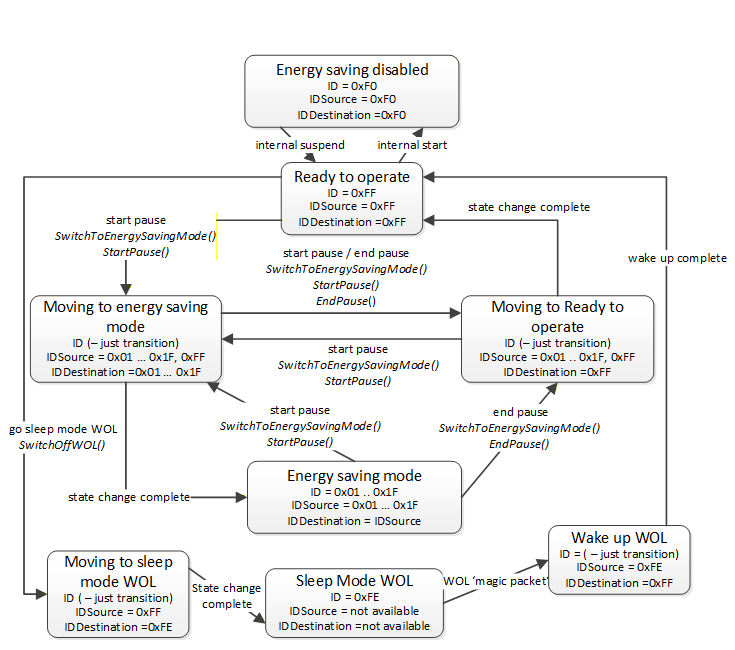
The values of the 0:EnumStrings of the StandbyManagementStatus shall follow the definition of Table 31. Each instance shall have the values 0 to 8. Element numbers 9-15 are reserved for future use. If vendors add specific elements, the range 9-15 shall be filled with 'null'-strings.
| Element number (starting with 0) | Message (for locale "en") |
| 0 | Energy saving disabled |
| 1 | Power Off |
| 2 | Ready to operate |
| 3 | Moving to Energy Saving Mode |
| 4 | Energy saving mode |
| 5 | Moving to ready to operate |
| 6 | Moving to Sleep mode WOL |
| 7 | Sleep mode WOL |
| 8 | Wake up WOL |
| 9-15 | 'null'-String |
| 16-255 | Vendor specific |
The Variables of the EnergyStandbyManagementType have additional Attributes defined in Table 32.
| Source Path | Value Attribute | ||
| Energy saving disabled Power Off Ready to operate Moving to Energy Saving Mode Energy saving mode Moving to ready to operate Moving to Sleep mode WOL Sleep mode WOL Wake up WOL |
The EnergySavingModes container Object contains References to EnergySavingModeType Objects representing the supported Energy Saving Modes.
Writing the PauseTime Variable can be used to update the pause time alternatively to the StartPause Method. Setting the PauseTime Variable with a value not equal to 0 shall have the same effect as invoking the StartPause Method passing the PauseTime value. Setting the PauseTime Variable with a value equal to 0 shall have the same effect as invoking the EndPause Method. An additional benefit is that the Variable PauseTime can be used in a PubSub communication scenario where the PauseTime is distributed by a central time management client using a broadcast telegram to which every Standby Management Entity subscribes.
The Lock Object ensures exclusive write access and Method call for one Client. Write access and Method calls from Clients shall be blocked unless the client has locked the Object by invoking the InitLock Method of the Lock Object. The LockingServicesType is defined in OPC 10000-100.
The StartPause Method starts the transition to an Energy Saving Mode. The SwitchToEnergySavingMode allows the transition into a specific Energy Saving Mode. The EndPause Method ends the Energy Saving Mode.
7.2.1.2 StartPause Method
This Method starts the transition into an Energy Saving Mode.
Signature
	StartPause (
		[in]  0:Duration		PauseTime
		[out] 0:Byte		ModeID
		[out] 0:Duration		CurrentTimeToDestination
		[out] 0:Duration		RegularTimeToOperate
		[out] 0:Duration		TimeMinLengthOfStay
		[out] 0:Byte		ReturnCode
		);
| Argument | Description |
| PauseTime | Requested pause time. |
| ModeID | ID of the destination Energy Saving Mode if successful, otherwise 0. |
| CurrentTimeToDestination | Time needed to reach the Energy Saving Mode if successful, otherwise 0. |
| RegularTimeToOperate | Time needed to reach "Ready to operate" again if the destination Energy Saving Mode will be regularly terminated if successful, otherwise 0. |
| TimeMinLengthOfStay | Time of minimum stay in the destination Energy Saving Mode if successful, otherwise 0. |
| ReturnCode | Return code. |
The Method Result Codes (defined in Call Service) are defined in Table 33.
ReturnCodes are defined in Table 34.
7.2.1.3 SwitchToEnergySavingMode Method
This Method initiates a switch to a certain Energy Saving Mode.
Signature
	SwitchToEnergySavingMode (
	[in]  0:Byte		ModeID
	[out] 0:Byte		EffectiveModeID
	[out] 0:Duration	CurrentTimeToDestination
	[out] 0:Duration	RegularTimeToOperate
	[out] 0:Duration	TimeMinLengthOfStay
	[out] 0:Byte	ReturnCode
		);
| Argument | Description |
| ModeID | ID of the requested Energy Saving Mode. |
| EffectiveModeID | ID of the effectively chosen Energy Saving Mode if successful, otherwise ID of current mode. |
| CurrentTimeToDestination | Time needed to reach the destination Energy Saving Mode if successful, otherwise 0. |
| RegularTimeToOperate | Time needed to reach "Ready to operate" again if the destination Energy Saving Mode will be regularly terminated if successful, otherwise 0. |
| TimeMinLengthOfStay | Time of minimum stay in the destination Energy Saving Mode if successful, otherwise 0. |
| ReturnCode | Return code. |
The Method Result Codes (defined in Call Service) are defined in Table 33.
ReturnCodes are defined in Table 34.
7.2.1.4 EndPause Method
This Method ends the current Energy Saving Mode.
Signature
	EndPause (
		[out] 0:Duration	CurrentTimeToOperate
		[out] 0:Byte	ReturnCode
		);
| Argument | Description |
| CurrentTimeToOperate | Time needed to reach "Ready to operate" if successful, 0. |
| ReturnCode | Return code. |
The Method Result Codes (defined in Call Service) are defined in Table 33.
ReturnCodes are defined in Table 34.
Table 33 shows the possible values for the Method call result codes.
| Result Code | Description |
| Good | The Method execution was successful and the ReturnCode parameter has the value 0x00 ("Success"). |
| Uncertain | The Method execution was successful, but the ReturnCode parameter indicates an error. |
| Bad_UserAccessDenied | The user has not the right to execute the Method. The client shall not evaluate the ReturnCode parameter. |
| Bad_UnexpectedError | The server is not able to execute the function because an unexpected error occurred. The device might be temporarily unavailable or unreachable due to network failure. The client shall not evaluate the ReturnCode parameter. |
Table 34 shows the possible values for the out parameter ReturnCode.
| ReturnCode | Description |
| 0x00 | Success. |
| 0x50 | No suitable energy-saving mode available. |
| 0x52 | No switch to requested energy-saving mode because of invalid mode ID. |
| 0x53 | No switch to Energy Saving Mode because of state operate. |
| 0x54 | Service or function not available due to internal device status. |
7.2.2 EnergySavingModesContainerType
The EnergySavingModesContainerType provides a grouping of different Energy Saving Modes.
| Attribute | Value | ||||
| BrowseName | EnergySavingModesContainerType | ||||
| IsAbstract | False | ||||
| References | Node Class | BrowseName | DataType | TypeDefinition | Other |
|---|---|---|---|---|---|
| Subtype of the 0:BaseObjectType | |||||
| 0:HasComponent | Object | <EnergySavingModes> | EnergySavingModeType | MP | |
| Conformance Units | |||||
|---|---|---|---|---|---|
| ECM Standby Management | |||||
7.2.3 EnergySavingModeStatusType
The EnergySavingModeStatusType provides information about the current status of the Energy Saving Mode.
| Attribute | Value | ||||
| BrowseName | EnergySavingModeStatusType | ||||
| IsAbstract | False | ||||
| References | Node Class | BrowseName | DataType | TypeDefinition | Other |
|---|---|---|---|---|---|
| Subtype of the 0:BaseObjectType | |||||
| 0:HasComponent | Variable | CurrentTransitionData | StandbyModeTransitionDataType | 0:BaseDataVariableType | O, RO |
| 0:HasComponent | Variable | StateInformation | EnergyStateInformationDataType | 0:BaseDataVariableType | M, RO |
| Conformance Units | |||||
|---|---|---|---|---|---|
| ECM Standby Management | |||||
The CurrentTransitionData Variable contains details for the state transition indicated by the StateInformation Variable.
The StateInformation Variable contains details for the actual Energy Saving Mode state.
7.2.4 EnergySavingModeType
The EnergySavingModeType provides detailed information for a specific Energy Saving Mode.
| Attribute | Value | ||||
| BrowseName | EnergySavingModeType | ||||
| IsAbstract | False | ||||
| References | Node Class | BrowseName | DataType | TypeDefinition | Other |
|---|---|---|---|---|---|
| Subtype of the 0:BaseObjectType | |||||
| 0:HasProperty | Variable | ID | 0:Byte | 0:PropertyType | M, RO |
| 0:HasProperty | Variable | DynamicData | 0:Boolean | 0:PropertyType | M, RO |
| 0:HasComponent | Variable | TimeMinPause | 0:Duration | 0:BaseDataVariableType | M, RO |
| 0:HasComponent | Variable | TimeToPause | 0:Duration | 0:BaseDataVariableType | M, RO |
| 0:HasComponent | Variable | TimeMinLengthOfStay | 0:Duration | 0:BaseDataVariableType | M, RO |
| 0:HasComponent | Variable | TimeMaxLengthOfStay | 0:Duration | 0:BaseDataVariableType | M, RO |
| 0:HasComponent | Variable | RegularTimeToOperate | 0:Duration | 0:BaseDataVariableType | M, RO |
| 0:HasComponent | Variable | ModePowerConsumption | 0:Float | 0:AnalogUnitType | M, RO |
| 0:HasComponent | Variable | EnergyConsumptionToPause | 0:Float | 0:AnalogUnitType | M, RO |
| 0:HasComponent | Variable | EnergyConsumptionToOperate | 0:Float | 0:AnalogUnitType | M, RO |
| Conformance Units | |||||
|---|---|---|---|---|---|
| ECM Standby Management | |||||
The BrowseName shall contain a unique name for the Energy Saving Mode.
The ID Variable shall contain a unique mode ID for the Energy Saving Mode. The mode ID's 0x00, 0xF0, 0xFE and 0xFF are reserved for predefined states.
DynamicData shall indicate whether the time, energy consumption and power values can vary (slightly) during runtime.
The TimeMinPause Variable shall contain the minimum pause time for this Energy Saving Mode.
The TimeToPause Variable shall contain the expected time to switch to this Energy Saving Mode.
The TimeMinLengthOfStay Variable shall contain the time of minimum stay in this Energy Saving Mode.
The TimeMaxLengthOfStay Variable shall contain the time of maximum stay in this Energy Saving Mode.
The RegularTimeToOperate Variable shall contain the time value to reach "Ready to operate" (see Figure 14) if this Energy Saving Mode will be regularly terminated.
The ModePowerConsumption Variable shall contain the energy consumption in this Energy Saving Mode. Unit: [kW].
The EnergyConsumptionToPause Variable shall contain the energy consumption from "Ready to operate" to this Energy Saving Mode. Unit: [kWh].
The EnergyConsumptionToOperate Variable shall contain the energy consumption from this Energy Saving Mode to "Ready to operate". Unit: [kWh].
7.3 ObjectTypes for Sleep Mode WOL Functionality
7.3.1 EnergyDevicePowerOffType
7.3.1.1 Overview
The EnergyDevicePowerOffType type provides access to the Sleep Mode WOL functionality of the device if supported.
| Attribute | Value | ||||
| BrowseName | EnergyDevicePowerOffType | ||||
| IsAbstract | False | ||||
| References | Node Class | BrowseName | DataType | TypeDefinition | Other |
|---|---|---|---|---|---|
| Subtype of the 0:BaseObjectType | |||||
| 0:HasComponent | Variable | RegularTimeToOperate | 0:Duration | 0:BaseDataVariableType | M, RO |
| 0:HasComponent | Variable | TimeMinPause | 0:Duration | 0:BaseDataVariableType | M, RO |
| 0:HasComponent | Variable | ModePowerConsumption | 0:UInt32 | 0:BaseDataVariableType | M, RO |
| 0:HasProperty | Variable | WOLMagicPacket | 0:ByteString | 0:PropertyType | M, RO |
| 0:HasComponent | Method | SwitchOffWOL | M | ||
| Conformance Units | |||||
|---|---|---|---|---|---|
| ECM Sleep Mode WOL | |||||
The RegularTimeToOperate Variable shall contain the time value to reach the state "Ready to operate" if the WOL sleep mode is terminated by a wake-up (see below).
The ModePowerConsumption Variable shall contain the energy consumption in the
WOL sleep mode. Unit: [kW].
The WOLMagicPacket Variable shall contain the 6 bytes MAC address to be used with the magic packet sent for wake-up (see PE 3802, chapter 7.3.4.9).
The SwitchOffWOL Method initiates the transition into the WOL sleep mode. In this mode the device is effectively switched off and unavailable for network communication. The device can be awakened using the magic packet (see PE 3802, chapter 7.3.4.9).
7.3.1.2 SwitchOffWOL Method
This Method starts the transition into the special WOL mode.
Signature
	SwitchOffWOL (
		[out] 0:Byte		ModeID
		[out] 0:Duration		CurrentTimeToDestination
		[out] 0:Duration		RegularTimeToOperate
		[out] 0:Duration		TimeMinLengthOfStay
		[out] 0:Byte		ReturnCode
		);
| Argument | Description |
| ModeID | ID of the "Sleep Mode WOL" (0xFE) if successful, otherwise 0. |
| CurrentTimeToDestination | Time needed to reach the Energy Saving Mode if successful, otherwise 0. |
| RegularTimeToOperate | Time needed to reach "Ready to operate" again if the Wake-on-LAN sleep mode will be regularly terminated if successful, otherwise 0. |
| TimeMinLengthOfStay | Time of minimum stay in the Wake-on-LAN sleep mode if successful, otherwise 0. |
| ReturnCode | Return code. |
The Method Result Codes (defined in Call Service) are defined in Table 33.
ReturnCodes are defined in Table 34.