9.1 StandbyModeTransitionDataType
The StandbyModeTransitionDataType holds information which might change when the device is in a transition state to an Energy Saving Mode.
| Name | Type | Description |
|---|---|---|
| StandbyModeTransitionDataType | Structure | |
| IDDestination | 0:Byte | Mode ID of destination Energy Saving Mode. |
| CurrentTimeToDestination | 0:Duration | Time needed to reach the mode IDDestination. Shall be a “Worst case” value if ongoing (dynamic) time value is not supported. Shall be 0 if destination Energy Saving Mode is reached. |
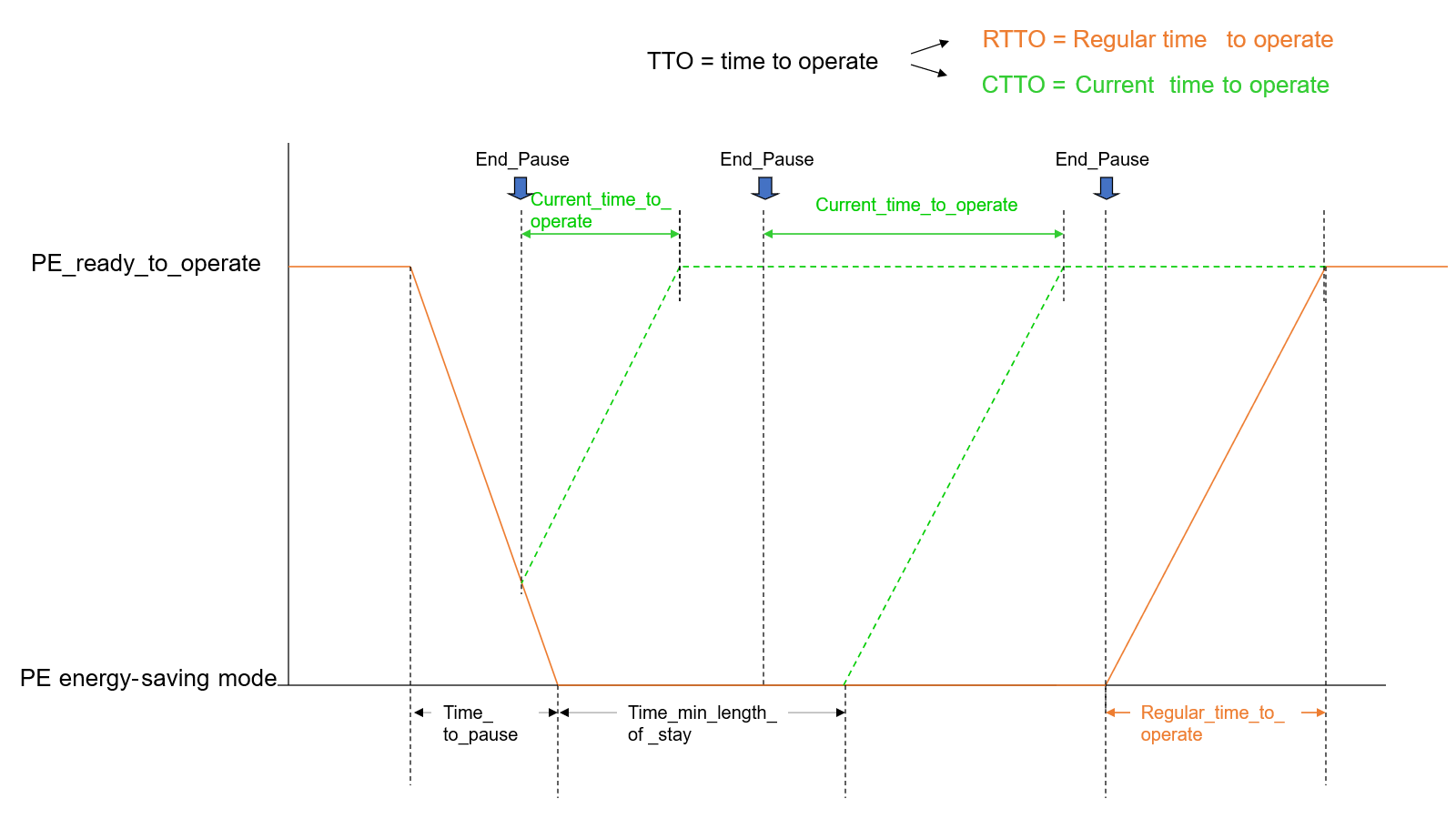
| CurrentTimeToOperate | 0:Duration | Time needed to reach “Ready to operate” if the Energy Saving Mode is not regularly terminated. The server might update the value after reaching the destination state as long as the TimeMinLengthOfStay of the destination state is not reached. |
| EnergyConsumptionToDestination | 0:Float | Energy consumption for actual transition. Shall be 0 if not in a transition state. |
Its representation in the AddressSpace is defined in Table 42.
| Attribute | Value | |||||
| BrowseName | StandbyModeTransitionDataType | |||||
| IsAbstract | False | |||||
| References | NodeClass | BrowseName | DataType | TypeDefinition | Other | |
|---|---|---|---|---|---|---|
| Subtype of the 0:Structure | ||||||
| Conformance Units | ||||||
|---|---|---|---|---|---|---|
| ECM Standby Management | ||||||
Figure 16 shows how CurrentTimeToOperate varies in dependence of TimeToPause and TimeMinLengthOfStay of the destination Energy Saving Mode during and immediately after the transition.
The relationship of RegularTimeToOperate and CurrentTimeToOperate during a mode transition shall follow Figure 16. A more comprehensive explanation may be found in PE 3802.