
C.4 PE State Model
PROFIenergy defines a basic state model. The state model determines the possible modes of a device regarding energy consumption. The state model also determines the possible changes in energy consumption as state transitions. Figure 14 shows the PROFIenergy state model.
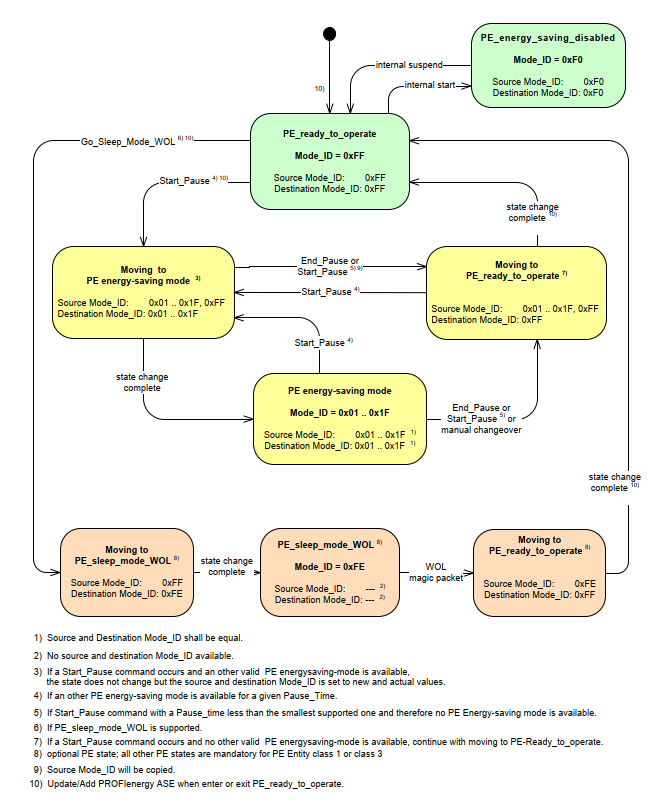
Each PE mode is identified by the PE Mode_ID. Table 71 gives a brief description of the modes defined by the basic state model and their PE Mode_ID. Note the mode PE_power_off is not part of the basic state model. For an in-depth description of the state model, especially the constraints and possible state transitions, refer to [PE CAP].
The state transition modes do not have a distinctive PE Mode_ID, but are identified by differing source Mode_ID and the destination Mode_ID. When in a non-transition state, the source Mode_ID and the destination Mode_ID are identical.
| PE Mode | Source PE Mode_ID | Destination PE Mode_ID | Description |
| PE_power_off | 0x00 | The device is free from voltage and cannot communicate. When in a different mode, the mode properties can be queried. | |
| PE_energy_saving_disabled | 0xF0 | The device is in productive operation and Standby Management is disabled. The device will not execute commands requesting the transition into an energy-saving mode. | |
| PE_ready_to_operate | 0xFF | Standby Management is enabled and the device is able for a transition into an Energy Saving Mode. | |
| Moving to PE energy-saving-mode | 0x1-0x1F, 0xFF | 0x01-0x1F | The device is in transition to one of the supported energy-saving modes. |
| Moving to PE_ready_to_operate | 0x01-0x1F, 0xFF, 0xFE | 0xFF | The device is in transition from an energy-saving mode to PE_ready_to_operate. |
| PE energy-saving-mode | 0x01 - 0x1F | The device is in some standby operation mode saving energy. The supported modes are determined by the manufacturer. | |
| Moving to PE_sleep_mode_WOL | 0xFF | 0xFE | The device is in transition to the PE_sleep_mode_WOL. |
| PE_sleep_mode_WOL | 0xFE | The device is in Wake-on-LAN sleep mode and cannot communicate. | |