
6 OPC UA for Powertrain - Functional Model Information Model overview
6.1 Introduction to OPC UA for Powertrain - Functional Model Information Model
To be able to model all aspects of a Powertrain and to offer high flexibility for combining with other models, the Powertrain model is using the partial modelling approach and not OPC DI.
The comprehensive Information Model describes all aspects of a Powertrain system, containing the asset partial model related to orderable components and the functional partial model related to the application function part of the system (for basic concept see OPC 10000-81). The asset types to be used for the asset partial model are specified in OPC 40400-1 (OPC UA for Powertrain, Part1: Asset Management). This specification document (OPC 40400-2) defines the functional model of the Powertrain. The possible connections (relations) enabling the navigation between related Powertrain Objects representing the same entity in different partial models are modelled by using ReferenceTypes defined in OPC 10000-23 (e.g. 0:IsHostedBy or 0:RepresentsSameEntityAs ReferenceTypes).
Figure 2 shows a simple example of a one axis drive Powertrain composed out of an induction motor and a frequency converter. Here the "0:IsHostedBy" cross-aspect reference is shown for connecting the Powertrain Functional Object with the Powertrain:PtAssetType Object. This ObjectType implements the Machinery:IMachineryItemVendorNameplateType Interface and provides Properties for basic asset information. This 0:IsHostedBy Reference constitutes the relationship between the Asset Model defined in OPC 40400-1 and the Functional Model specified in this document.
The Powertrain:PtAssetMotor Object relates to an additional part of the Asset Model using the UAFX:ConnectedTo (see [OPC 10000-81]) ReferenceType.
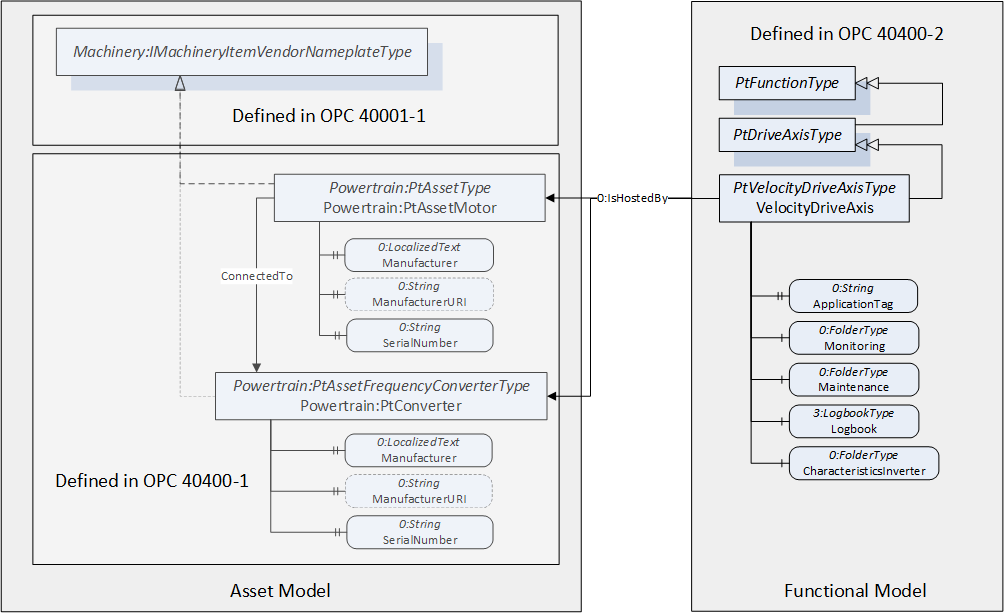
The OPC UA for Powertrain - Functional Model defines all Objects and types provided by an OPC UA Server allowing OPC UA Clients to access online data and services of the Powertrain Functional Objects by providing Powertrain DriveAxis Objects, Powertrain EncoderAxis Objects and Powertrain GearAxis Objects.
The PtFunctionType ObjectType serves as the abstract base for all Powertrain functional ObjectTypes. The components of the PtFunctionType ObjectType belong the sub-aspects of "Fieldbus", "Actual and Command Values", "Diagnosis", "Maintenance" and "Semantic". These sub-aspects combine folder Objects containing Variables matching the designation of this sub-aspect, as shown in Figure 3. Typically, these sub-aspects are dedicated to specific use cases for vertical communication in automation systems.
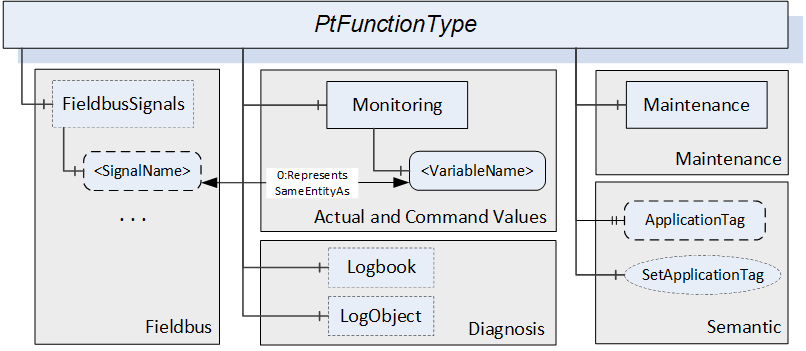
In the optional "Fieldbus" sub-aspect, the "FieldbusSignals" folder Object contains Variables representing signals transmitted over the fieldbus interface. These "Signals" can be used for supervision or debugging of the original values transmitted between the Controller and the Powertrain Object.
The Variable representing a fieldbus signal can relate to a Variable in the "Monitoring" folder using the 0:RepresentsSameEntityAs ReferenceType if the Variables contain the same information. Note, that these two Variables might be encoded in two different ways, e.g. if there is a signal representing the actual velocity the representing Variable may be connected to the VelocityActualValue Variable with the DataType float and an associated unit (via 0:AnalogUnitType) directly usable by Clients. The signal variable might encode the actual velocity as Int32 using a different unit not directly usable by Clients (shift factors, etc.).
Common for all Powertrain Objects, the mandatory "Actual and Command Values" sub-aspect is mainly consisting of Variables which contain the setpoint and measurement values like velocity and acceleration represented as physical values in floating point data types. These Variables are used to address the use case for monitoring on a control panel and the use case for data mining.
The Logbook Object provides access to the Powertrain diagnosis system logbook. Via the Logbook Object access to the current fault situation (faults, warnings, maintenance) and to historical fault situations and diagnosis history is possible.
The "Maintenance" sub-aspect contains Variables yielding maintenance related information, such as operation duration.
The "Semantic" sub-aspect contains information about the overall application context which can be set by an operator.
The Powertrain Axis Objects serve as the root containers for modelling of Devices equipped with one or more motors (also referred to as CDM or Drive). The functional aspect of a Drive contains as many Powertrain Axis Objects as needed. Figure 4 shows the organization of Powertrain Axis Objects. The components of a PtDriveAxisType Object representing a Powertrain Axis Object are part of the sub-aspects "Functional Safety", "Process Supervision" and "Axis Properties".
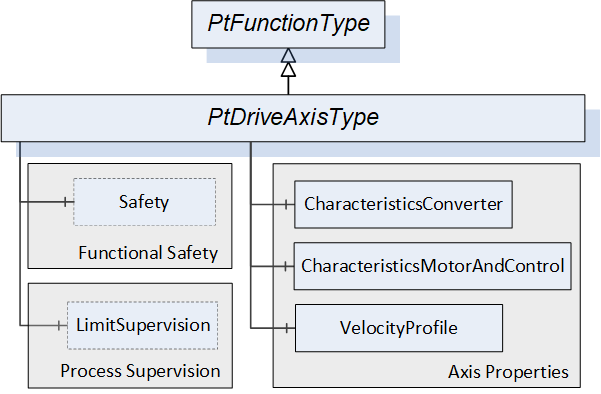
The abstract PtDriveAxisType is derived from the PtFunctionType abstract base ObjectType common to all Powertrain Objects. The concrete ObjectTypes representing Powertrain Axis Objects like PtVelocityDriveAxisType (see section 7.1.1.2) and PtFrequencyDriveAxisType (see section 7.1.1.1) are derived from the abstract PtDriveAxisType base ObjectType (see section 7.1.1).
The "Axis Properties" sub-aspect contains a collection of values which are of special interest for the functional identification and behaviour (configuration) of a Powertrain Axis Object. These values are organized into several containers further structuring the sub-aspects.
The "Safety" sub-aspect contains Objects informing about the status of implemented safety functions.
The "Process Supervision" sub-aspect hosts the optional "LimitSupervision" folder containing Variables with information about limiting values of the PtDriveAxisType Object. Derived ObjectTypes may render the LimitSupervision folder mandatory.
As shown in Figure 5, the PtEncoderAxisType and PtGearAxisType concrete ObjectTypes are derived directly from the abstract PtFunctionType thus not containing a controllable motor or actuator.
6.2 Powertrain Functional Model Security
Servers shall allow Method invocation only for Sessions using user accounts with the right to invoke Methods. There shall exist user accounts with restricted rights (that is, no Method invocation unless explicitly allowed for all users for a specific Method) for Clients performing data acquisition or diagnosis also.
If well-known Roles are supported by the Server, role-based security (see [OPC 10000-18] shall be applied. Method invocation shall only be possible if the well-known "Operator" Role is granted to the Client's Session. This applies to all Methods except for those where the restriction is lifted explicitly.
All Variables are read-only. Modifying the content of Variables shall only be possible by invoking a "Set-" Method.