
Introduction
This section specifies the interesting changes to the previous revisions:
| Version | Date | Description |
| 1.00.00 | March 24, 2010 | Release first specification 1.0 |
| 1.02.00 | June 19, 2019 | Update to use new UA Companion Specification Template v1.01.11 including additional sections Table 27: Adding additional data types from 3rd edition of IEC61131-3 |
1 Scope
This specification was created by a joint working group of the OPC Foundation and PLCopen. It defines an OPC UA Information Model to represent the IEC 61131-3 architectural models.
It is important that the controller as a main component of automation systems is accessible in the vertical information integration which will be strongly influenced by OPC UA. OPC UA servers which represent their underlying manufacturer specific controllers in a similar, IEC 61131-3 based manner provide a substantial advantage for client applications as e.g. visualizations or MES. Controller vendors may reduce costs for the development of these OPC UA servers if an OPC UA Information Model for IEC 61131-3 is used.
OPC Foundation
OPC is the interoperability standard for the secure and reliable exchange of data and information in the industrial automation space and in other industries. It is platform independent and ensures the seamless flow of information among devices from multiple vendors. The OPC Foundation is responsible for the development and maintenance of this standard.
OPC UA is a platform independent service-oriented architecture that integrates all the functionality of the individual OPC Classic specifications into one extensible framework. This multi-layered approach accomplishes the original design specification goals of:
Platform independence: from an embedded microcontroller to cloud-based infrastructure
Secure: encryption, authentication, authorization and auditing
Extensible: ability to add new features including transports without affecting existing applications
Comprehensive information modelling capabilities: for defining any model from simple to complex
PLCopen
PLCopen, as an organization active in industrial control, is creating a higher efficiency in your application software development: in one-off projects as well as in higher volume products. As such it is based on standard available tools to which extensions are and will be defined.
With results like Motion Control Library, Safety, XML specification, Reusability Level and Conformity Level, PLCopen made solid contributions to the community, extending the hardware independence from the software code, as well as reusability of the code and coupling to external software tools. One of the core activities of PLCopen is focused around IEC 61131-3, the only global standard for industrial control programming. It harmonizes the way people design and operate industrial controls by standardizing the programming interface. This allows people with different backgrounds and skills to create different elements of a program during different stages of the software lifecycle: specification, design, implementation, testing, installation and maintenance. Yet all pieces adhere to a common structure and work together harmoniously.
2 Normative references
The following referenced documents are indispensable for the application of this specification. For dated references, only the edition cited applies. For undated references, the latest edition of the referenced document (including any amendments) applies.
IEC 61131-3: 2nd Edition, Subset of 3rd Edition, Programmable Controllers - Part 3: Programming Languages
OPC 10000-1, OPC Unified Architecture - Part 1: Overview and Concepts
3 Terms, definitions and conventions
3.1 Overview
It is assumed that basic concepts of OPC UA information modelling and IEC 61131-3 are understood in this specification. This specification will use these concepts to describe the IEC 61131-3 Information Model. For the purposes of this document, the terms and definitions given in OPC 10000-1, OPC 10000-3, OPC 10000-4, OPC 10000-5, OPC 10000-7, OPC 10000-8, OPC 10000-100, IEC 61131-3 as well as the following apply.
To avoid naming conflicts between IEC 61131-3 and OPC UA terms the prefix Ctrl for controller is used together with IEC 61131-3 terms like Ctrl Variable or Ctrl Program.
Note that OPC UA terms and terms defined in this specification are italicized in the specification.
3.2 OPC UA for IEC 61131-3 terms
3.2.1 Controller
a digitally operating electronic system, designed for use in an industrial environment, which uses a programmable memory for the internal storage of user-oriented instructions for implementing specific functions such as logic, sequencing, timing, counting and arithmetic, to control, through digital or analogue inputs and outputs, various types of machines or processes
3.3 Abbreviations and symbols
| Ctrl | Controller |
| DA | Data Access |
| HDA | Historical Data Access |
| HMI | Human-Machine Interface |
| IEC | International Electrotechnical Commission |
| MES | Manufacturing Execution System |
| PLC | Programmable Logic Controller |
| SCADA | Supervisory Control And Data Acquisition |
| UA | Unified Architecture |
| XML | Extensible Markup Language |
3.4 Conventions used in this document
3.4.1 Conventions for Node descriptions
Node definitions are specified using tables (see Table 2).
Attributes are defined by providing the Attribute name and a value, or a description of the value.
References are defined by providing the ReferenceType name, the BrowseName of the TargetNode and its NodeClass.
If the TargetNode is a component of the Node being defined in the table, the Attributes of the composed Node are defined in the same row of the table.
The DataType is only specified for Variables; "[<number>]" indicates a single-dimensional array, for multi-dimensional arrays the expression is repeated for each dimension (e.g. [2][3] for a two-dimensional array). For all arrays the ArrayDimensions is set as identified by <number> values. If no <number> is set, the corresponding dimension is set to 0, indicating an unknown size. If no number is provided at all the ArrayDimensions can be omitted. If no brackets are provided, it identifies a scalar DataType and the ValueRank is set to the corresponding value (see OPC 10000-3). In addition, ArrayDimensions is set to null or is omitted. If it can be Any or ScalarOrOneDimension, the value is put into "{<value>}", so either "{Any}" or "{ScalarOrOneDimension}" and the ValueRank is set to the corresponding value (see OPC 10000-3) and the ArrayDimensions is set to null or is omitted. Examples are given in Table 1.
| Notation | DataType | ValueRank | ArrayDimensions | Description |
| Int32 | Int32 | -1 | omitted or null | A scalar Int32. |
| Int32[] | Int32 | 1 | omitted or {0} | Single-dimensional array of Int32 with an unknown size. |
| Int32[][] | Int32 | 2 | omitted or {0,0} | Two-dimensional array of Int32 with unknown sizes for both dimensions. |
| Int32[3][] | Int32 | 2 | {3,0} | Two-dimensional array of Int32 with a size of 3 for the first dimension and an unknown size for the second dimension. |
| Int32[5][3] | Int32 | 2 | {5,3} | Two-dimensional array of Int32 with a size of 5 for the first dimension and a size of 3 for the second dimension. |
| Int32{Any} | Int32 | -2 | omitted or null | An Int32 where it is unknown if it is scalar or array with any number of dimensions. |
| Int32{ScalarOrOneDimension} | Int32 | -3 | omitted or null | An Int32 where it is either a single-dimensional array or a scalar. |
The TypeDefinition is specified for Objects and Variables.
The TypeDefinition column specifies a symbolic name for a NodeId, i.e. the specified Node points with a HasTypeDefinition Reference to the corresponding Node.
The ModellingRule of the referenced component is provided by specifying the symbolic name of the rule in the ModellingRule column. In the AddressSpace, the Node shall use a HasModellingRule Reference to point to the corresponding ModellingRule Object.
If the NodeId of a DataType is provided, the symbolic name of the Node representing the DataType shall be used.
Nodes of all other NodeClasses cannot be defined in the same table; therefore, only the used ReferenceType, their NodeClass and their BrowseName are specified. A reference to another part of this document points to their definition.
Table 2 illustrates the table. If no components are provided, the DataType, TypeDefinition and ModellingRule columns may be omitted and only a Comment column is introduced to point to the Node definition.
| Attribute | Value | ||||
| Attribute name | Attribute value. If it is an optional Attribute that is not set "--" will be used. | ||||
| References | NodeClass | BrowseName | DataType | TypeDefinition | ModellingRule |
|---|---|---|---|---|---|
| ReferenceType name | NodeClass of the TargetNode. | BrowseName of the target Node. If the Reference is to be instantiated by the server, then the value of the target Node's BrowseName is "--". | DataType of the referenced Node, only applicable for Variables. | TypeDefinition of the referenced Node, only applicable for Variables and Objects. | Referenced ModellingRule of the referenced Object. |
| NOTE Notes referencing footnotes of the table content. | |||||
Components of Nodes can be complex that is containing components by themselves. The TypeDefinition, NodeClass, DataType and ModellingRule can be derived from the type definitions, and the symbolic name can be created as defined in 3.4.3.1. Therefore, those containing components are not explicitly specified; they are implicitly specified by the type definitions.
3.4.2 NodeIds and BrowseNames
3.4.2.1 NodeIds
The NodeIds of all Nodes described in this standard are only symbolic names. Annex A defines the actual NodeIds.
The symbolic name of each Node defined in this specification is its BrowseName, or, when it is part of another Node, the BrowseName of the other Node, a ".", and the BrowseName of itself. In this case "part of" means that the whole has a HasProperty or HasComponent Reference to its part. Since all Nodes not being part of another Node have a unique name in this specification, the symbolic name is unique.
The NamespaceUri for all NodeIds defined in this specification is defined in Annex A. The NamespaceIndex for this NamespaceUri is vendor-specific and depends on the position of the NamespaceUri in the server namespace table.
Note that this specification not only defines concrete Nodes, but also requires that some Nodes shall be generated, for example one for each Session running on the Server. The NodeIds of those Nodes are Server-specific, including the namespace. But the NamespaceIndex of those Nodes cannot be the NamespaceIndex used for the Nodes defined in this specification, because they are not defined by this specification but generated by the Server.
3.4.2.2 BrowseNames
The text part of the BrowseNames for all Nodes defined in this specification is specified in the tables defining the Nodes. The NamespaceUri for all BrowseNames defined in this specification is defined in Annex A.
If the BrowseName is not defined by this specification, a namespace index prefix like '0:EngineeringUnits' or '2:DeviceRevision' is added to the BrowseName. This is typically necessary if a Property of another specification is overwritten or used in the OPC UA types defined in this specification. Table 42 provides a list of namespaces and their indexes as used in this specification.
3.4.3 Common Attributes
3.4.3.1 General
The Attributes of Nodes, their DataTypes and descriptions are defined in OPC 10000-3. Attributes not marked as optional are mandatory and shall be provided by a Server. The following tables define if the Attribute value is defined by this specification or if it is server-specific.
For all Nodes specified in this specification, the Attributes named in Table 3 shall be set as specified in the table.
| Attribute | Value |
| DisplayName | The DisplayName is a LocalizedText. Each server shall provide the DisplayName identical to the BrowseName of the Node for the LocaleId "en". Whether the server provides translated names for other LocaleIds is server-specific. |
| Description | Optionally a server-specific description is provided. |
| NodeClass | Shall reflect the NodeClass of the Node. |
| NodeId | The NodeId is described by BrowseNames as defined in 3.4.2.1. |
| WriteMask | Optionally the WriteMask Attribute can be provided. If the WriteMask Attribute is provided, it shall set all non-server-specific Attributes to not writable. For example, the Description Attribute may be set to writable since a Server may provide a server-specific description for the Node. The NodeId shall not be writable, because it is defined for each Node in this specification. |
| UserWriteMask | Optionally the UserWriteMask Attribute can be provided. The same rules as for the WriteMask Attribute apply. |
| RolePermissions | Optionally server-specific role permissions can be provided. |
| UserRolePermissions | Optionally the role permissions of the current Session can be provided. The value is server-specific and depend on the RolePermissions Attribute (if provided) and the current Session. |
| AccessRestrictions | Optionally server-specific access restrictions can be provided. |
3.4.3.2 Objects
For all Objects specified in this specification, the Attributes named in Table 4 shall be set as specified in the Table 4. The definitions for the Attributes can be found in OPC 10000-3.
| Attribute | Value |
| EventNotifier | Whether the Node can be used to subscribe to Events or not is server-specific. |
3.4.3.3 Variables
For all Variables specified in this specification, the Attributes named in Table 5 shall be set as specified in the table. The definitions for the Attributes can be found in OPC 10000-3.
| Attribute | Value |
| MinimumSamplingInterval | Optionally, a server-specific minimum sampling interval is provided. |
| AccessLevel | The access level for Variables used for type definitions is server-specific, for all other Variables defined in this specification, the access level shall allow reading; other settings are server-specific. |
| UserAccessLevel | The value for the UserAccessLevel Attribute is server-specific. It is assumed that all Variables can be accessed by at least one user. |
| Value | For Variables used as InstanceDeclarations, the value is server-specific; otherwise it shall represent the value described in the text. |
| ArrayDimensions | If the ValueRank does not identify an array of a specific dimension (i.e. ValueRank <= 0) the ArrayDimensions can either be set to null or the Attribute is missing. This behaviour is server-specific. If the ValueRank specifies an array of a specific dimension (i.e. ValueRank > 0) then the ArrayDimensions Attribute shall be specified in the table defining the Variable. |
| Historizing | The value for the Historizing Attribute is server-specific. |
| AccessLevelEx | If the AccessLevelEx Attribute is provided, it shall have the bits 8, 9, and 10 set to 0, meaning that read and write operations on an individual Variable are atomic, and arrays can be partly written. |
3.4.3.4 VariableTypes
For all VariableTypes specified in this specification, the Attributes named in Table 6 shall be set as specified in the table. The definitions for the Attributes can be found in OPC 10000-3.
| Attributes | Value |
| Value | Optionally a server-specific default value can be provided. |
| ArrayDimensions | If the ValueRank does not identify an array of a specific dimension (i.e. ValueRank <= 0) the ArrayDimensions can either be set to null or the Attribute is missing. This behaviour is server-specific. If the ValueRank specifies an array of a specific dimension (i.e. ValueRank > 0) then the ArrayDimensions Attribute shall be specified in the table defining the VariableType. |
3.4.3.5 Methods
For all Methods specified in this specification, the Attributes named in Table 7 shall be set as specified in the table. The definitions for the Attributes can be found in OPC 10000-3.
| Attributes | Value |
| Executable | All Methods defined in this specification shall be executable (Executable Attribute set to "True"), unless it is defined differently in the Method definition. |
| UserExecutable | The value of the UserExecutable Attribute is server-specific. It is assumed that all Methods can be executed by at least one user. |
3.4.4 Reference to IEC 61131-3 Definitions
Referenced key words in this document like VAR_GLOBAL are defined in the IEC 61131-3 specification. See table delimiters and key words in the IEC 61131-3 for a complete list.
4 General information to IEC 61131-3 and OPC UA
4.1 Introduction to IEC 61131-3
IEC 61131-3 is the first real endeavour to standardize programming languages for industrial automation. With its worldwide support, it is independent of any single company.
IEC 61131-3 is the third part of the IEC 61131 family. This consists of: (1) General information, (2) Equipment requirements and tests, (3) Programming languages, (4) User guidelines, (5) Communications, (6) Safety, (7) Fuzzy control programming, and (8) Guidelines for the application and implementation of programming languages.
IEC 61131-3 basically describes the Common Elements and Programming Languages.
4.1.1 Common Elements
4.1.1.1 Data Typing
Within the common elements, the data types are defined. Data typing prevents errors in an early stage. It is used to define the type of any parameter used. This avoids for instance dividing a Date by an Integer.
Common data types are Boolean, Integer, Real and Byte and Word, but also Date, Time_of_Day and String. Based on these, one can define own personal data types, known as derived data types. In this way one can define an analogue input channel as data type, and re-use this over and over again.
4.1.1.2 Ctrl Variables
Ctrl Variables are only assigned to explicit hardware addresses (e.g. input and outputs) in Ctrl Configurations, Ctrl Resources or Ctrl Programs. In this way a high level of hardware independency is created, supporting the reusability of the software.
The scopes of the Ctrl Variables are normally limited to the organization unit in which they are declared, e.g. local. This means that their names can be reused in other parts without any conflict, eliminating another source of errors. If the Ctrl Variables should have global scope, they have to be declared as such (VAR_GLOBAL). Ctrl Variables can be assigned an initial value at start up and cold restart, in order to have the right setting.
4.1.1.3 Ctrl Configuration, Ctrl Resources and Ctrl Tasks
These elements are integrated within the software model as defined in the standard (see below).
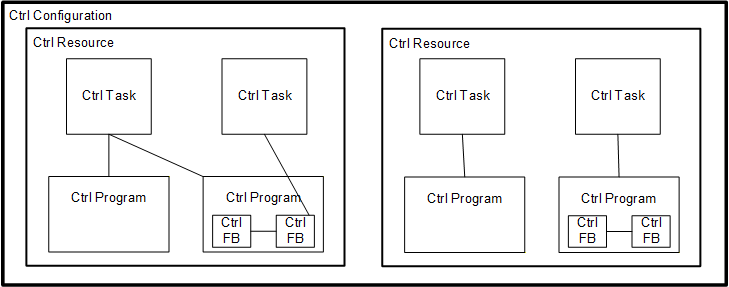
At the highest level, the entire software required to solve a particular control problem can be formulated as a Ctrl Configuration. A Ctrl Configuration is specific to a particular type of control system, including the arrangement of the hardware, i.e. processing resources, memory addresses for I/O channels and system capabilities.
Within a Ctrl Configuration one can define one or more Ctrl Resources. One can look at a Ctrl Resource as a processing facility that is able to execute IEC 61131-3 Ctrl Programs.
Within a Ctrl Resource, one or more Ctrl Tasks can be defined. Ctrl Tasks control the execution of a set of Ctrl Programs and/or Ctrl Function Blocks. These can either be executed periodically or upon the occurrence of a specified trigger, such as the change of a Ctrl Variable.
Ctrl Programs are built from a number of different software elements written in any of the IEC 61131-3 defined programming languages. Typically, a Ctrl Program consists of a network of Ctrl Functions and Ctrl Function Blocks, which are able to exchange data. Ctrl Functions and Ctrl Function Blocks are the basic building blocks, containing a data structure and an algorithm.
4.1.1.4 Ctrl Program Organization Units
Within IEC 61131-3IEC 61131-3, the Ctrl Programs, Ctrl Function Blocks and Ctrl Functions are called Ctrl Program Organization Units, POUs.
4.1.1.5 Ctrl Functions
IEC 61131-3IEC 61131-3 has defined standard Ctrl Functions and user defined Ctrl Functions. Standard Ctrl Functions are for instance ADD(addition), ABS(absolute), SQRT, SIN(sinus) and COS(cosinus). User defined Ctrl Functions, once defined, can be used over and over again.
4.1.1.6 Ctrl Function Blocks
Ctrl Function Blocks are the equivalent to integrated circuits, representing a specialized control function. They contain data as well as the algorithm, so they can keep track of the past (which is one of the differences w.r.t. Ctrl Functions). They have a well-defined interface and hidden internals, like an integrated circuit or black box. In this way they give a clear separation between different levels of programmers, or maintenance people.
A temperature control loop, or PID, is an excellent example of a Ctrl Function Block. Once defined, it can be used over and over again, in the same Ctrl Program, different Ctrl Programs, or even different projects. This makes them highly re-usable.
Ctrl Function Blocks can be written in any of the IEC 61131-3 languages, and in most cases even in "C". This way they can be defined by the user. Derived Ctrl Function Blocks are based on the standard defined Ctrl Function Blocks, but also completely new, customized Ctrl Function Blocks are possible within the standard: it just provides the framework.
The interfaces of Ctrl Functions and Ctrl Function Blocks are described in the same way.
4.1.1.7 Sequential Function Chart
Within the standard Sequential Function Chart (SFC) is defined as a structuring tool. This means that syntax and semantics have been defined, leaving no room for dialects. The language consists of a textual and a graphical version.
4.1.1.8 Ctrl Programs
A Ctrl Program is a network of Ctrl Functions and Ctrl Function Blocks. A Ctrl Program can be written in any of the defined programming languages.
4.1.2 Programming Languages
Within the standard four programming languages are defined. This means that their syntax and semantics have been defined, leaving no room for dialects. The languages consist of textual and graphical versions:
Instruction List, IL (textual)
Structured Text, ST (textual)
Ladder Diagram, LD (graphical)
Function Block Diagram, FBD (graphical)
4.2 Introduction to OPC Unified Architecture
4.2.1 What is OPC UA?
OPC UA is an open and royalty free set of standards designed as a universal communication protocol. While there are numerous communication solutions available, OPC UA has key advantages:
A state of art security model (see OPC 10000-2).
A fault tolerant communication protocol.
An information modelling framework that allows application developers to represent their data in a way that makes sense to them.
OPC UA has a broad scope which delivers for economies of scale for application developers. This means that a larger number of high-quality applications at a reasonable cost are available. When combined with semantic models such as IEC61131-3, OPC UA makes it easier for end users to access data via generic commercial applications.
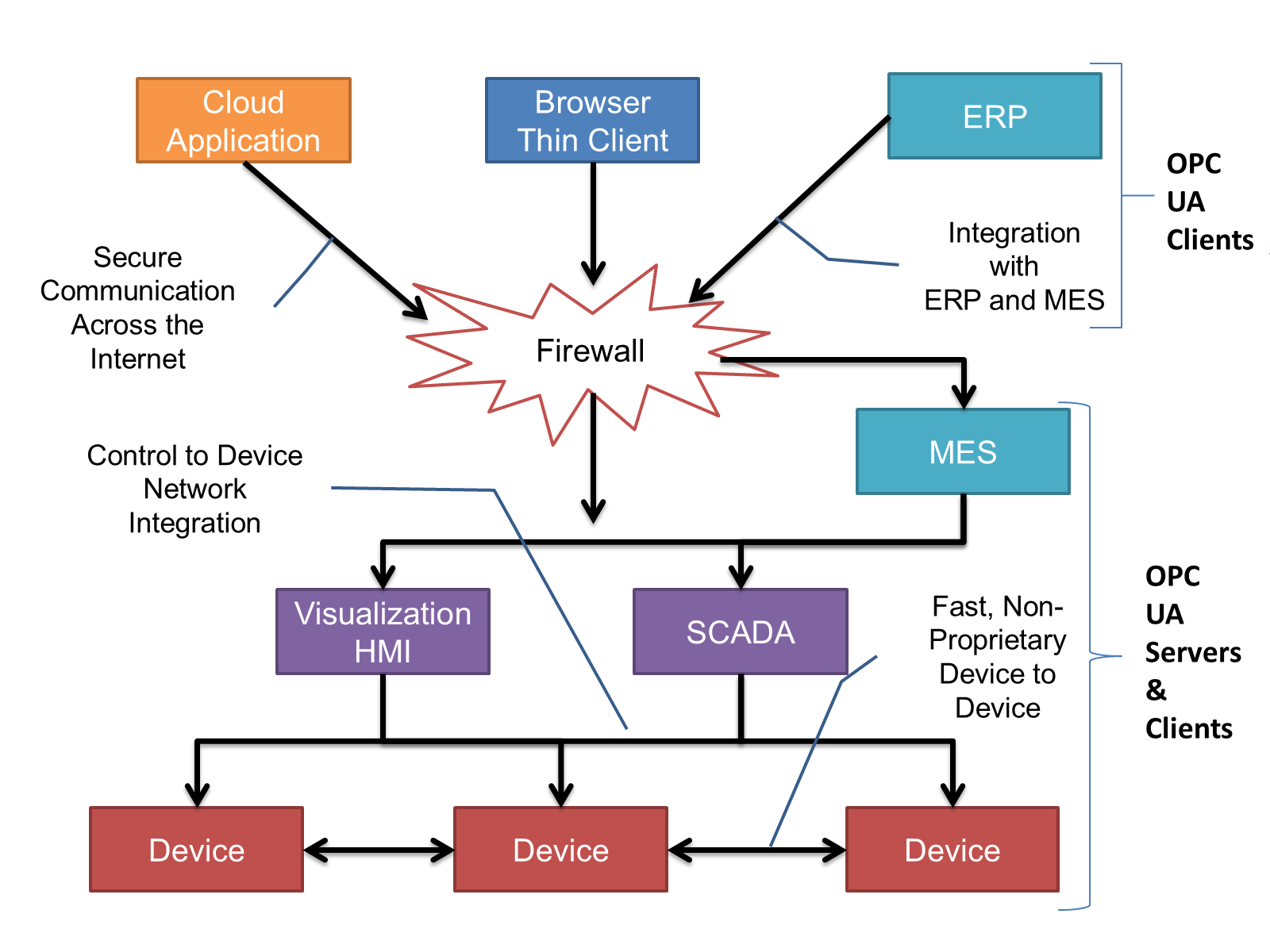
The OPC UA model is scalable from small devices to ERP systems. OPC UA Servers process information locally and then provides that data in a consistent format to any application requesting data - ERP, MES, PMS, Maintenance Systems, HMI, Smartphone or a standard Browser, for examples. For a more complete overview see OPC 10000-1.
4.2.2 Basics of OPC UA
As an open standard, OPC UA is based on standard internet technologies, like TCP/IP, HTTP, Web Sockets.
As an extensible standard, OPC UA provides a set of Services (see OPC 10000-4) and a basic information model framework. This framework provides an easy manner for creating and exposing vendor defined information in a standard way. More importantly all OPC UA Clients are expected to be able to discover and use vendor-defined information. This means OPC UA users can benefit from the economies of scale that come with generic visualization and historian applications. This specification is an example of an OPC UA Information Model designed to meet the needs of developers and users.
OPC UA Clients can be any consumer of data from another device on the network to browser based thin clients and ERP systems. The full scope of OPC UA applications is shown in Figure 2.
OPC UA provides a robust and reliable communication infrastructure having mechanisms for handling lost messages, failover, heartbeat, etc. With its binary encoded data, it offers a high-performing data exchange solution. Security is built into OPC UA as security requirements become more and more important especially since environments are connected to the office network or the internet and attackers are starting to focus on automation systems.
4.2.3 Information modelling in OPC UA
4.2.3.1 Concepts
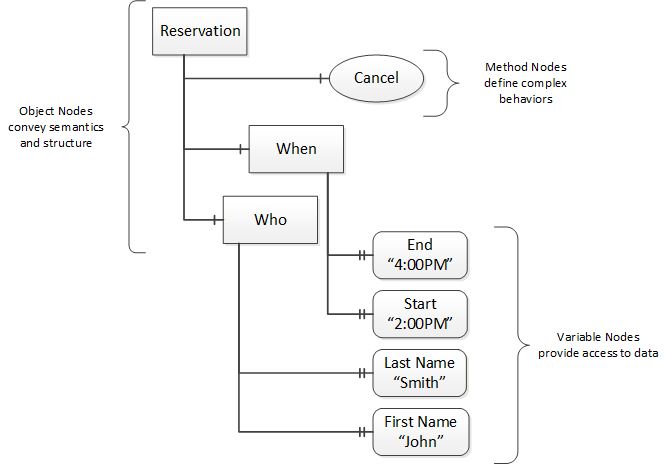
OPC UA provides a framework that can be used to represent complex information as Objects in an AddressSpace which can be accessed with standard services. These Objects consist of Nodes connected by References. Different classes of Nodes convey different semantics. For example, a Variable Node represents a value that can be read or written. The Variable Node has an associated DataType that can define the actual value, such as a string, float, structure etc. It can also describe the Variable value as a variant. A Method Node represents a function that can be called. Every Node has a number of Attributes including a unique identifier called a NodeId and non-localized name called as BrowseName. An Object representing a 'Reservation' is shown in Figure 3.
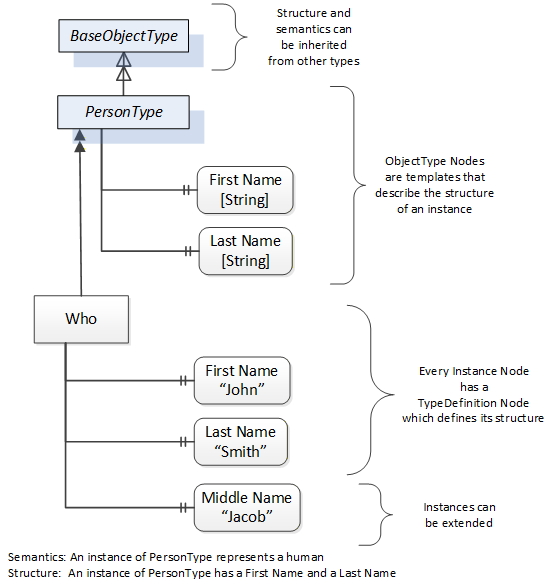
Object and Variable Nodes represent instances and they always reference a TypeDefinition (ObjectType or VariableType) Node which describes their semantics and structure. Figure 4 illustrates the relationship between an instance and its TypeDefinition.
The type Nodes are templates that define all of the children that can be present in an instance of the type. In the example in Figure 4 the PersonType ObjectType defines two children: First Name and Last Name. All instances of PersonType are expected to have the same children with the same BrowseNames. Within a type the BrowseNames uniquely identify the children. This means Client applications can be designed to search for children based on the BrowseNames from the type instead of NodeIds. This eliminates the need for manual reconfiguration of systems if a Client uses types that multiple Servers implement.
OPC UA also supports the concept of sub-typing. This allows a modeller to take an existing type and extend it. There are rules regarding sub-typing defined in OPC 10000-3, but in general they allow the extension of a given type or the restriction of a DataType. For example, the modeller may decide that the existing ObjectType in some cases needs an additional Variable. The modeller can create a subtype of the ObjectType and add the Variable. A Client that is expecting the parent type can treat the new type as if it was of the parent type. Regarding DataTypes, subtypes can only restrict. If a Variable is defined to have a numeric value, a sub type could restrict it to a float.
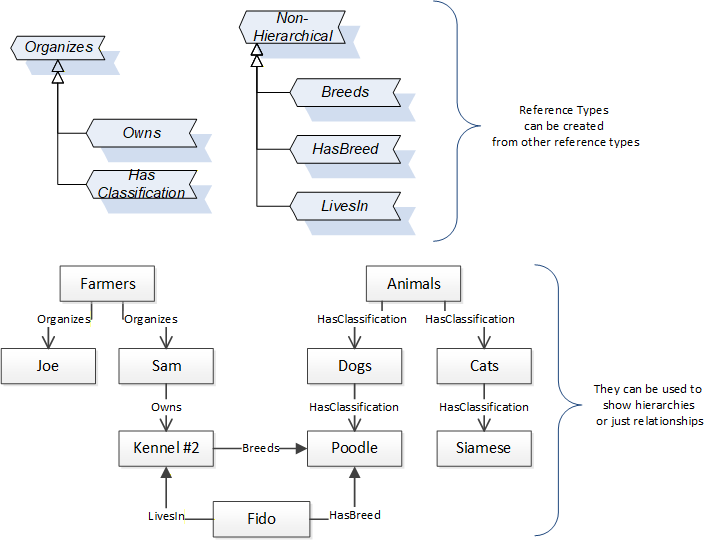
References allow Nodes to be connected in ways that describe their relationships. All References have a ReferenceType that specifies the semantics of the relationship. References can be hierarchical or non-hierarchical. Hierarchical references are used to create the structure of Objects and Variables. Non-hierarchical are used to create arbitrary associations. Applications can define their own ReferenceType by creating subtypes of an existing ReferenceType. Subtypes inherit the semantics of the parent but may add additional restrictions. Figure 5 depicts several References, connecting different Objects.
The figures above use a notation that was developed for the OPC UA specification. The notation is summarized in Figure 6. UML representations can also be used; however, the OPC UA notation is less ambiguous because there is a direct mapping from the elements in the figures to Nodes in the AddressSpace of an OPC UA Server.
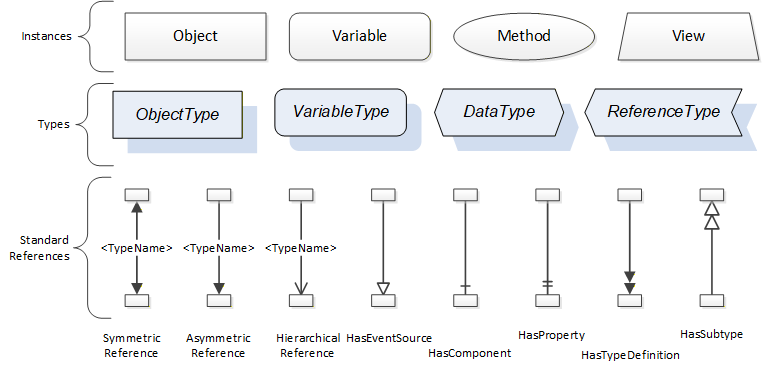
A complete description of the different types of Nodes and References can be found in OPC 10000-3 and the base structure is described in OPC 10000-5.
OPC UA specification defines a very wide range of functionality in its basic information model. It is not expected that all Clients or Servers support all functionality in the OPC UA specifications. OPC UA includes the concept of Profiles, which segment the functionality into testable certifiable units. This allows the definition of functional subsets (that are expected to be implemented) within a companion specification. The Profiles do not restrict functionality, but generate requirements for a minimum set of functionalities (see OPC 10000-7)
4.2.3.2 Namespaces
OPC UA allows information from many different sources to be combined into a single coherent AddressSpace. Namespaces are used to make this possible by eliminating naming and id conflicts between information from different sources. Namespaces in OPC UA have a globally unique string called a NamespaceUri and a locally unique integer called a NamespaceIndex. The NamespaceIndex is only unique within the context of a Session between an OPC UA Client and an OPC UA Server. The Services defined for OPC UA use the NamespaceIndex to specify the Namespace for qualified values.
There are two types of values in OPC UA that are qualified with Namespaces: NodeIds and QualifiedNames. NodeIds are globally unique identifiers for Nodes. This means the same Node with the same NodeId can appear in many Servers. This, in turn, means Clients can have built in knowledge of some Nodes. OPC UA Information Models generally define globally unique NodeIds for the TypeDefinitions defined by the Information Model.
QualifiedNames are non-localized names qualified with a Namespace. They are used for the BrowseNames of Nodes and allow the same names to be used by different information models without conflict. TypeDefinitions are not allowed to have children with duplicate BrowseNames; however, instances do not have that restriction.
4.2.3.3 Companion Specifications
An OPC UA companion specification for an industry specific vertical market describes an Information Model by defining ObjectTypes, VariableTypes, DataTypes and ReferenceTypes that represent the concepts used in the vertical market, and potentially also well-defined Objects as entry points into the AddressSpace.
4.2.3.4 Introduction to OPC UA Devices
The OPC 10000-100 specification is an extension of the overall OPC Unified Architecture specification series and defines the information model associated with Devices. The model is intended to provide a unified view of Devices irrespective of the underlying Device protocols. Controllers are physical or logical Devices and the Devices model is therefore used as base for the IEC 61131-3 information model.
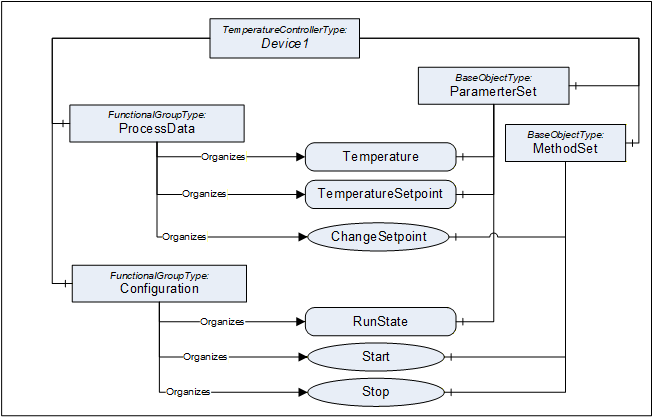
The Devices information model specifies different ObjectTypes and procedures used to represent Devices and related components like the communication infrastructure in an OPC UA Address Space. The main use cases are Device configuration and diagnostic, but it allows a general and standardized way for any kind of application to access Device related information. The following examples illustrate the concepts used in this specification. See OPC 10000-100 for the complete definition of the Devices information model.
Figure 7 shows an example for a temperature controller represented as Device Object. The component ParameterSet contains all Variables describing the Device. The component MethodSet contains all Methods provided by the Device. Both components are inherited from the TopologyElementType which is the root Object type of the Device Object type hierarchy. Objects of the type FunctionalGroupType are used to group the Parameters and Methods of the Device into logical groups. The FunctionalGroupType and the grouping concept are defined in OPC 10000-100 but the groups are Device type specific i.e. the groups ProcessData and Configuration are defined by the TemperatureControllerType in this example.
Another OPC 10000-100 concept used in this specification is described in Figure 8. The ConfigurableObjectType is used to provide a way to group subcomponents of a Device and to indicate which types of subcomponents can be instantiated. The allowed types are referenced from the SupportedTypes folder. This information can be used by configuration clients to allow a user to select the type to instantiate as subcomponent of the Device.
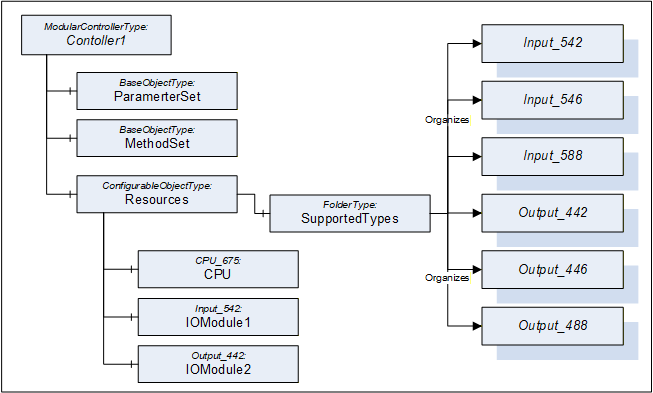
The SupportedTypes Folder can contain different subsets of ObjectTypes for different instances of the ModularControlerType depending on their current configuration since the list contains only types that can be instantiated for the current configuration. The example expects that only one CPU can be used in the ModularControlerType and this CPU is already configured. The SupportedTypes Folder on the ModularControlerType contains all possible types including CPU types that can be used in the ModularControlerType.
4.3 Introductory Example
A simple example shall be used to explain how the above introduced OPC UA concepts are used to represent IEC 61131-3 elements in an OPC UA Server.
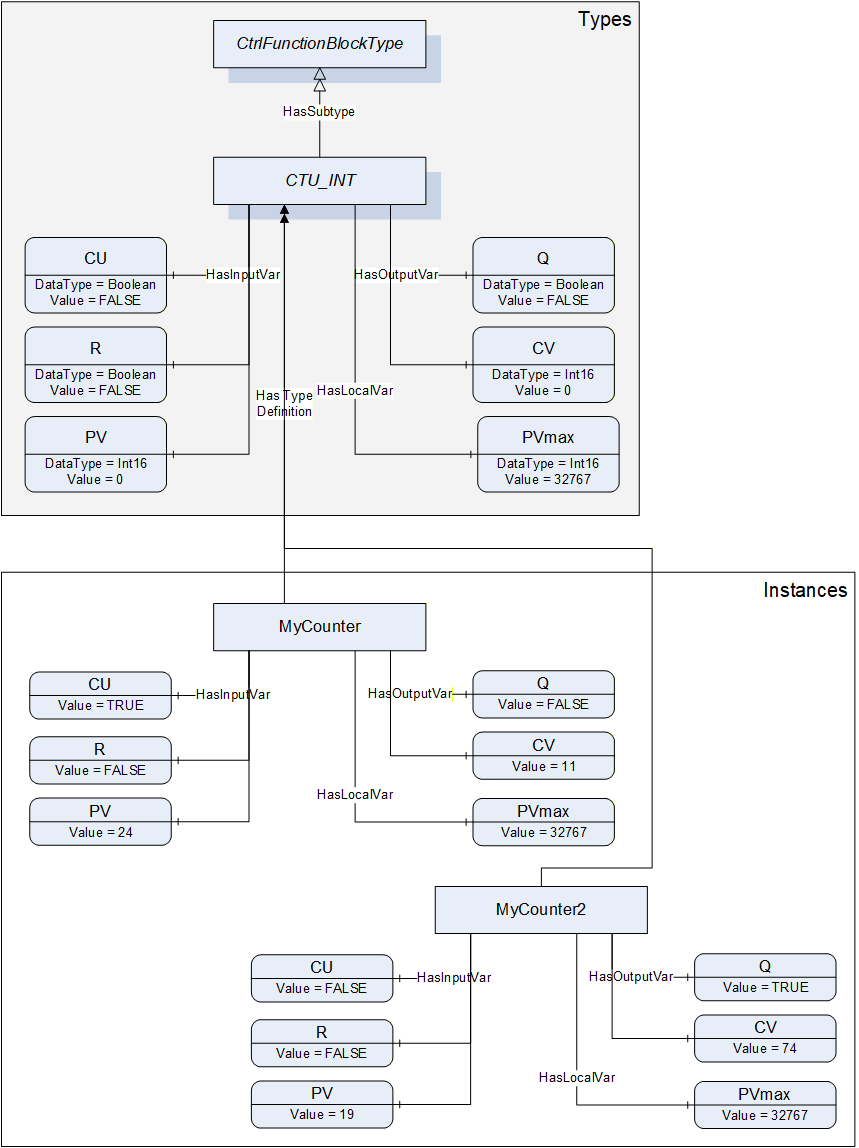
According to IEC 61131-3IEC 61131-3, Ctrl Function Blocks consist of a name, Ctrl Variables with associated data types (input, output, internal), and a body containing the algorithm to be executed. These data are represented by OPC UA ObjectTypes derived from the ObjectType CtrlFunctionBlockType (see Figure 11).
To start, IEC 61131-3IEC 61131-3 requires a Ctrl Function Block type declaration. Here an integer up-counter is used which follows the IEC 61131-3 standard counter Ctrl Function Block. CTU_INT contains three input Ctrl Variables (CU - counter up, R - reset, PV - primary value), one local Ctrl Variable (PVmax) and two output Ctrl Variables (Q, CV - counter value) with their respective data types. Furthermore, CTU_INT has a body containing the algorithm to do the actual counting. The formal declaration of CTU_INT using the Structured Text programming language is shown in Figure 9.
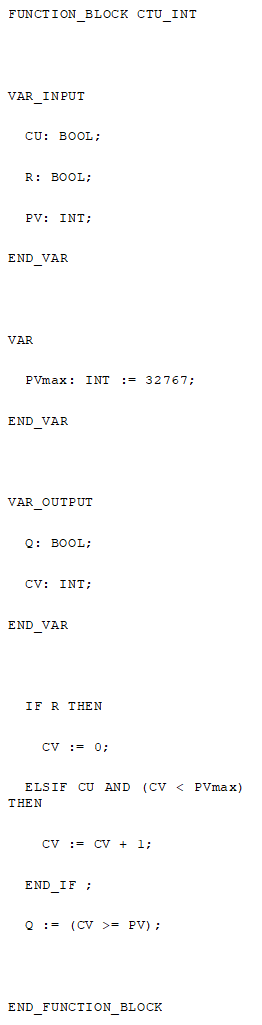
The OPC UA representation of CTU_INT is shown in Figure 11. The ObjectType CTU_INT is a subtype of the ObjectType CtrlFunctionBlockType. Its components are defined by instance declaration and referenced by HasInputVar, HasLocalVar, and HasOutputVar References.
After declaration of CTU_INT it is instantiated twice (MyCounter, MyCounter2) and used within a Ctrl Program MyTestProgram shown in Figure 10. Signal and Signal 2 are counted, the Ctrl Function Block output Ctrl Variables are transferred to some temporary Ctrl Variables but are not further processed in this example.
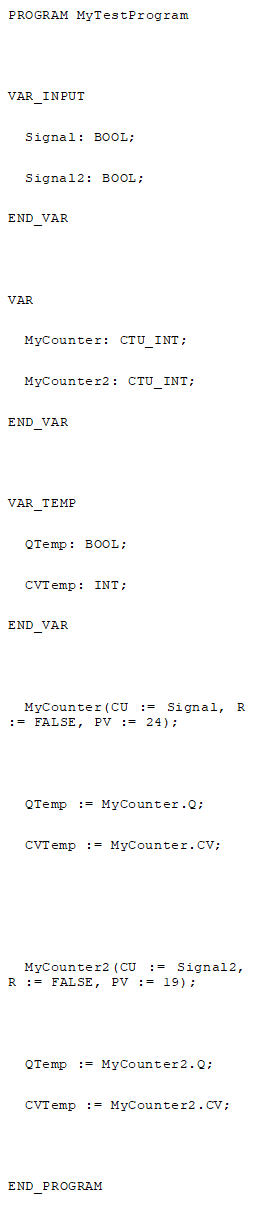
The OPC UA representation of the Objects MyCounter and MyCounter2 is shown in Figure 11. The Objects are instances of the ObjectType CTU_INT which is indicated by the HasTypeDefinition References. The example specific ObjectType CTU_INT is derived from the ObjectType CtrlFunctionBlockType which is indicated by the HasSubType Reference. Current values at a certain point in time are provided by the instances, e. g. the current counter value of MyCounter equals 11. The Ctrl Program MyTestProgram is not represented in the figure.
5 Use cases
The following use cases illustrate the usage of the information model. Not all necessary Objects must be realized within a concrete OPC UA Server.
Observation
Observation comprises reading and monitoring data of Ctrl Configurations, Ctrl Resources, Ctrl Tasks, Ctrl Programs, Ctrl Function Blocks, Ctrl Variables, and their ObjectTypes represented in the OPC UA Server.
Example 1: In a brewery, several tanks of the same type are operated. They are controlled by the same Ctrl Function Block which is instantiated in the Controller once for each tank. For developing the visualization it is useful to create first a template for operating a tank, which is based on the tank CtrlFunctionBlockType provided by the OPC UA server. Then this template can be instantiated and connected to the Ctrl Function Block instances within the OPC UA server as often as required (reuse).
Example 2: In a brewery, the number of bottles produced in the current shift shall be presented on a visualization panel. The bottles are counted by the Controller and the result provided as an output Ctrl Variable of a Ctrl Function Block. The visualization panel subscribes to the corresponding Variable in the OPC UA server, gets the current number of bottles delivered each time it is changing, and presents it to the user.
Operation
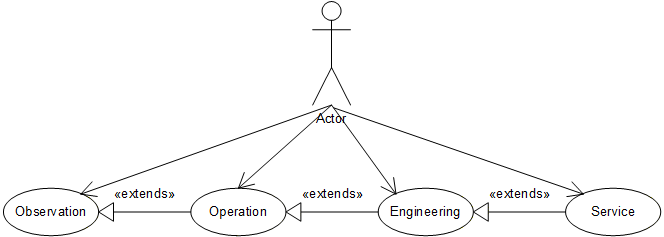
Operation inherits the functionality of observation and extends it.
Operation comprises writing data of Ctrl Variables represented in the OPC UA Server and execution control of Ctrl Programs and Ctrl Function Blocks using Ctrl Tasks represented in the OPC UA Server.
Example: In a brewery, several recipes are used to produce different kinds of beer. To choose the recipe for the next batch, the number of that recipe is written from an HMI to an input Ctrl Variable of a Ctrl Function Block via a corresponding Variable in the OPC UA server. After this, the batch is started using a Ctrl Task in the OPC UA server which triggers the Ctrl Function Block.
Engineering (Programming / Maintenance)
Engineering inherits the functionality of operation and extends it.
Engineering comprises writing of Ctrl Configurations, Ctrl Resources, Ctrl Tasks, Ctrl Programs, Ctrl Function Blocks, Ctrl Functions, Ctrl Variables, and their ObjectTypes into the OPC UA Server.
Example: The Ctrl Program of a machine tool shall be updated via remote access (internet). This download is done using programming software by writing the corresponding Ctrl Program ObjectType into the OPC UA server while observing strict security (and safety) regulations.
Service
Service inherits the functionality of engineering and extends it.
Service comprises the carrying out of service specific functions, e. g. reading / writing of special data and firmware updates.
The following Figure 12 shows the use case diagram.
6 IEC 61131-3 Information Model overview
Figure 13 depicts the main ObjectTypes of this specification and their relationships. The drawing is not intended to be complete. For the sake of simplicity only a few components and relations were captured so as to give a rough idea of the overall structure of the IEC 61131-3 Information Model.
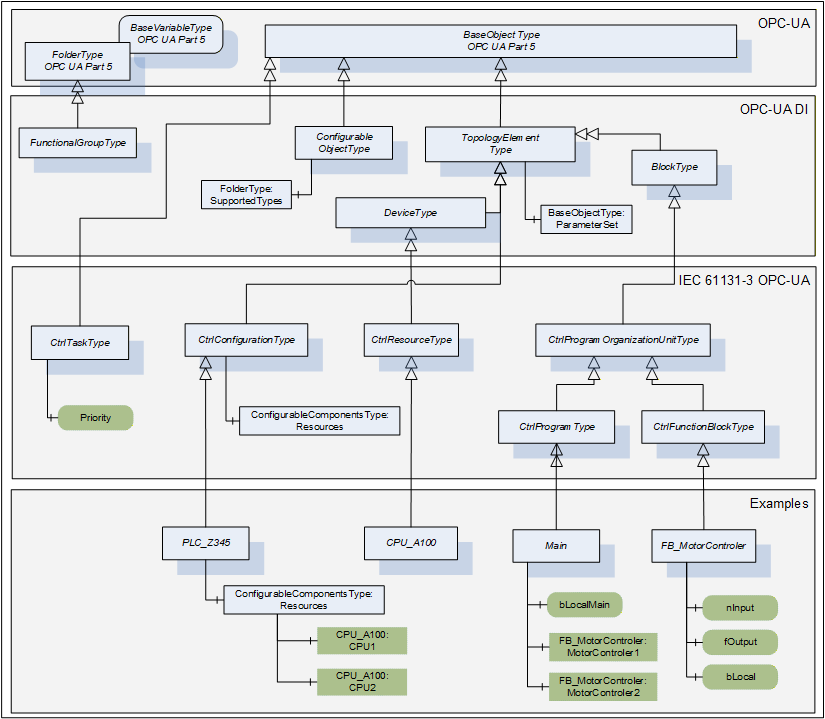
The boxes in this drawing show the ObjectTypes used in this specification as well as some elements from other specifications that help understand the overall context. The upper grey box shows the OPC UA core ObjectTypes from which the OPC UA Device Integration Types are derived. The Device Integration model and its Types in the second level are used as base for the IEC 61131-3 ObjectTypes. The grey box in the third level shows the IEC 61131-3 ObjectTypes that this specification introduces. The components of those ObjectTypes are illustrated only in an abstract way in this overall picture. The grey box in the lowest level represents examples of sub types defined by vendors or Controller programmers.
Typically, the components of an ObjectType are fixed and can be extended by subtyping. However, since each Object of an ObjectType can be extended with additional components, this specification allows extending the standard ObjectTypes defined in this document with additional components. Thereby, it is possible to express the additional information in the type definition that would already be contained in each Object. Some ObjectTypes already provide entry points for server specific extensions. However, it is not allowed to restrict the components of the standard ObjectTypes defined in this specification. An example of extending the ObjectTypes is putting the standard Property NodeVersion defined in OPC 10000-3 into the BaseObjectType, stating that each Object of the server will provide a NodeVersion.
It is not the objective to map all IEC 61131-3 constraints to the OPC UA Information Model, but to define an OPC UA Information Model which is capable to hold at least all possible data of one or more IEC 61131-3 compliant Ctrl Configurations.
A Ctrl Configuration compliant to IEC 61131-3 represents the special case of a complete engineered Controller with an OPC UA server providing access to all data of one or more IEC 61131-3 compliant Ctrl Configurations. In general, an OPC UA server may provide incomplete Ctrl Configurations, e.g. during the engineering process or because not all data shall be accessed from outside.
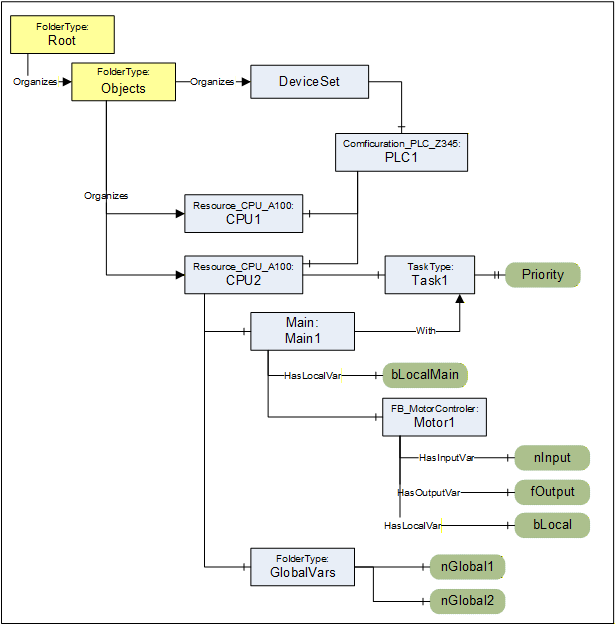
Examples for Object and Variable instances of the vendor or controller programmer specific types are shown in Figure 14. The Root and the Objects Folder are Nodes defined by OPC 10000-5. The Objects Folder is the main entry point for Object instances.
7 OPC UA ObjectTypes
7.1 CtrlConfigurationType ObjectType Definition
7.1.1 Overview
This ObjectType defines the representation of a Ctrl Configuration of a programmable Controller system in an OPC UA Address Space. It introduces Objects to group Ctrl Resources and different types of Ctrl Variables. The CtrlConfigurationType is derived from the TopologyElementType defined in OPC 10000-100. Figure 15 shows the CtrlConfigurationType. It is formally defined in Table 8. The dark grey nodes in the figure are examples and are not part of the ObjectType definition.
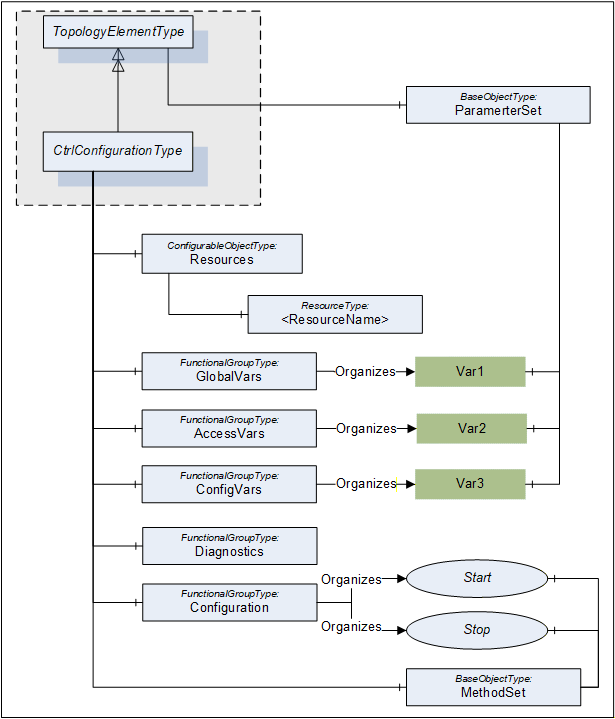
The Ctrl Configuration type is formally defined in Table 8.
| Attribute | Value | ||||
| BrowseName | CtrlConfigurationType | ||||
| IsAbstract | False | ||||
| References |
Node
Class | BrowseName | DataType | TypeDefinition |
Modelling
Rule |
|---|---|---|---|---|---|
| Subtype of the TopologyElementType defined in OPC 10000-100, i.e. inheriting the InstanceDeclarations of that Node. | |||||
| HasComponent | Object | 2:MethodSet | BaseObjectType | Optional | |
| HasComponent | Object | Resources | ConfigurableObjectType | Mandatory | |
| HasComponent | Object | GlobalVars | FunctionalGroupType | Optional | |
| HasComponent | Object | AccessVars | FunctionalGroupType | Optional | |
| HasComponent | Object | ConfigVars | FunctionalGroupType | Optional | |
| HasComponent | Object | Configuration | FunctionalGroupType | Optional | |
| HasComponent | Object | Status | FunctionalGroupType | Optional | |
The CtrlConfigurationType ObjectType is a concrete type and can be used directly. It is recommended to create subtypes for vendor or user specific configurations.
A concrete Ctrl Configuration type or instance may have ParameterSet, Parameters and FunctionalGroups as defined for the TopologyElementType in OPC 10000-100.
The MethodSet Object is defined by the TopologyElementType and is overwritten in the CtrlConfigurationType to add the HasComponent References to the Methods defined for the CtrlConfigurationType.
The Object Resources is used to group Ctrl Resources that are part of the Ctrl Configuration. It uses the concept of configurable Objects defined OPC 10000-100. It contains Objects of the type CtrlResourceType representing a Ctrl Resource and a Folder with possible Ctrl Resource types that can be instantiated in the Ctrl Configuration. For a complete configuration at least one resource is necessary from an IEC 61131-3 point of view but not necessary from an OPC UA point of view. Temporary, incomplete configurations are allowed, e.g. during a configuration process.
The FunctionalGroup GlobalVars contains the corresponding list of Ctrl Variables declared by the key word VAR_GLOBAL.
The FunctionalGroup AccessVars contains the corresponding list of Ctrl Variables declared by the key word VAR_ACCESS.
The FunctionalGroup ConfigVars contains the corresponding list of Ctrl Variables declared by the key word VAR_CONFIG.
The FunctionalGroup Configuration contains configuration Variables and Methods like start and stop.
The FunctionalGroup Status contains diagnostic and status information like system variables, status variables or diagnostic codes.
Starting a Ctrl Configuration causes the initialization of global Ctrl Variables and the start of all Ctrl Resources. Stopping a Ctrl Configuration stops all Ctrl Resources.
7.1.2 Resources components
The configurable Object Resources of the CtrlConfigurationType is formally defined in Table 9.
| Attribute | Value | |||
| BrowseName | Resources | |||
| References | NodeClass | BrowseName | TypeDefinition | ModellingRule |
|---|---|---|---|---|
| HasComponent | Object | <ResourceName> | CtrlResourceType | OptionalPlaceholder |
7.1.3 MethodSet components
The Methods available as parts of the CtrlConfigurationType are formally defined in Table 10.
| Attribute | Value | |||
| BrowseName | MethodSet | |||
| References |
Node
Class | BrowseName | Description |
Modelling
Rule |
|---|---|---|---|---|
Configuration FunctionalGroup The following components are also referenced from the FunctionalGroup Configuration using Organizes References. | ||||
| HasComponent | Method | Start | This Method is used to start a Ctrl Configuration. Only the browse name is defined for this Method. The Method parameters are vendor specific. | Optional |
| HasComponent | Method | Stop | This Method is used to stop a Ctrl Configuration. Only the browse name is defined for this Method. The Method parameters are vendor specific. | Optional |
7.2 CtrlResourceType ObjectType Definition
7.2.1 Overview
This ObjectType defines the representation of a Crtl Resources of a programmable Controller system in an OPC UA Address Space. It introduces Objects to group Configuration and Diagnostic capabilities, GlobalVars and Ctrl Programs executed under the control of Tasks. The CtrlResourceType is derived from the DeviceType defined in OPC 10000-100. Figure 16 shows the CtrlResourceType. It is formally defined in Table 11. The dark grey node in the figure is an example and is not part of the ObjectType definition.
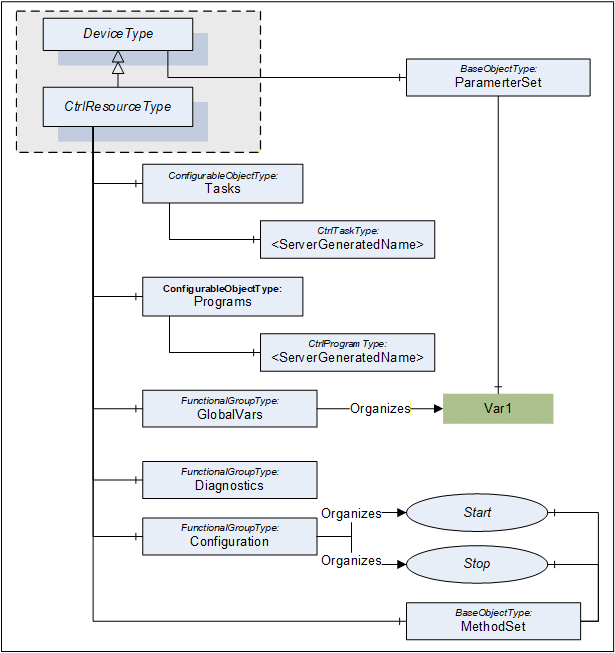
The Ctrl Resource ObjectType is formally defined in Table 11.
| Attribute | Value | ||||
| BrowseName | CtrlResourceType | ||||
| IsAbstract | False | ||||
| References | NodeClass | BrowseName | DataType | TypeDefinition | ModellingRule |
|---|---|---|---|---|---|
| Subtype of the DeviceType defined in OPC 10000-100, i.e. inheriting the InstanceDeclarations of that Node. | |||||
| HasComponent | Object | 2:MethodSet | BaseObjectType | Optional | |
| HasComponent | Object | Tasks | ConfigurableObjectType | Mandatory | |
| HasComponent | Object | Programs | ConfigurableObjectType | Mandatory | |
| HasComponent | Object | GlobalVars | FunctionalGroupType | Optional | |
| HasComponent | Object | Configuration | FunctionalGroupType | Optional | |
| HasComponent | Object | Status | FunctionalGroupType | Optional | |
The CtrlResourceType ObjectType is a concrete type and can be used directly. It is recommended to create subtypes for vendor or user specific resources.
A concrete Ctrl Resource type or instance may have ParameterSet, Parameters and FunctionalGroups as defined for the TopologyElementType in OPC 10000-100.
The MethodSet Object is defined by the TopologyElementType and is overwritten in the CtrlResourceType to add the HasComponent References to the Methods defined for the CtrlResourceType.
The Object Tasks is used to group Ctrl Tasks that are part of the Ctrl Resource. It uses the concept of configurable Objects defined OPC 10000-100. It contains Objects of the type CtrlTaskType representing a Ctrl Resource and a Folder with possible Ctrl Task types that can be instantiated in the Ctrl Resource.
The configurable Object Programms is used to group Ctrl Programs that are part of the Ctrl Resource. It contains Objects of the type CtrlTaskType representing a Ctrl Resource and a Folder with possible Ctrl Program types that can be instantiated in the Ctrl Resource.
The FunctionalGroup GlobalVars contains the corresponding list of GlobalVars that may be accessed in the programmable Controller system within the scope of the Ctrl Resource.
The FunctionalGroup Configuration contains configuration Variables and Methods like start and stop.
The FunctionalGroup Status contains diagnostic and status information like system variables, system events or diagnostic codes.
7.2.2 Tasks components
The configurable Object Tasks of the CtrlResourceType is formally defined in Table 12.
| Attribute | Value | ||||
| BrowseName | Tasks | ||||
| References | NodeClass | BrowseName | TypeDefinition | ModellingRule | |
|---|---|---|---|---|---|
| HasComponent | Object | <TaskName> | CtrlTaskType | OptionalPlaceholder | |
7.2.3 Programs components
The configurable Object Programs of the CtrlResourceType is formally defined in Table 13.
| Attribute | Value | |||
| BrowseName | Programs | |||
| References | NodeClass | BrowseName | TypeDefinition | ModellingRule |
|---|---|---|---|---|
| HasComponent | Object | <ProgramName> | CtrlProgramType | OptionalPlaceholder |
7.2.4 MethodSet components
The Methods available as parts of the CtrlResourceType are formally defined in Table 14.
| Attribute | Value | ||||
| BrowseName | MethodSet | ||||
| References | NodeClass | BrowseName | Description | ModellingRule | |
|---|---|---|---|---|---|
Configuration FunctionalGroup The following components are also referenced from the FunctionalGroup Configuration using Organizes References. | |||||
| HasComponent | Method | Start | This Method is used to start a Ctrl Resource. Only the browse name is defined for this Method. The Method parameters are vendor specific. | Optional | |
| HasComponent | Method | Stop | This Method is used to stop a Ctrl Resource. Only the browse name is defined for this Method. The Method parameters are vendor specific. | Optional | |
7.3 CtrlProgramOrganizationUnitType ObjectType Definition
This ObjectType defines the representation of a Ctrl Program Organization Unit of a programmable Controller system in an OPC UA Address Space. It defines how components of the Ctrl Program Organization Unit like Variables and Ctrl Function Blocks are represented. The CtrlProgramOrganizationUnitType is derived from the BlockType defined in OPC 10000-100. Figure 17 shows the CtrlProgramOrganizationUnitType. It is formally defined in Table 15.
The Ctrl Program Organization Unit ObjectType is formally defined in Table 15.
| Attribute | Value | ||||
| BrowseName | CtrlProgramOrganizationUnitType | ||||
| IsAbstract | True | ||||
| References | NodeClass | BrowseName | DataType | TypeDefinition | ModellingRule |
|---|---|---|---|---|---|
| Subtype of the BlockType defined in OPC 10000-100, i.e. inheriting the InstanceDeclarations of that Node. | |||||
| HasSubtype | ObjectType | CtrlProgramType | Defined in Clause 7.4 | ||
| HasSubtype | ObjectType | CtrlFunctionBlock Type | Defined in Clause 7.5 | ||
| With | Object | <TaskName> | CtrlTaskType | OptionalPlaceholder | |
| HasInputVar | Variable | <VarInputName> | BaseDataType | BaseDataVariableType | OptionalPlaceholder |
| HasOutputVar | Variable | <VarOutputName> | BaseDataType | BaseDataVariableType | OptionalPlaceholder |
| HasInOutVar | Variable | <VarInOutName> | BaseDataType | BaseDataVariableType | OptionalPlaceholder |
| HasLocalVar | Variable | <VarLocalName> | BaseDataType | BaseDataVariableType | OptionalPlaceholder |
| HasExternalVar | Variable | <VarExternalName> | BaseDataType | BaseDataVariableType | OptionalPlaceholder |
| HasLocalVar | Object | <BlockName> | CtrlFunctionBlockType | OptionalPlaceholder | |
| HasComponent | Variable | Body | XmlElement | BaseDataVariableType | Optional |
| HasComponent | Object | <SFCName> | SFCType | OptionalPlaceholder | |
The CtrlProgramOrganizationUnitType ObjectType is abstract. It is the common base type for all Ctrl Program Organization Unit specific types.
The With Reference defined in 8.7 is used to reference the Ctrl Task that is used to execute the Ctrl Program Organization Unit.
Variables declared for a Ctrl Program Organization Unit type are referenced with different subtypes of the HasComponent Reference. The used Reference type depends on the IEC 61131-3 variable declaration keywords. The characteristics of the Variables like data type and access rights and their mapping from IEC 61131-3 information and key words is defined in chapter 9. The name of the Variable depends on the Variable name in the Ctrl Program Organization Unit.
Variables declared with the key word VAR_INPUT are referenced with HasInputVar defined in 8.2.
Variables declared with the key word VAR_OUTPUT are referenced with HasOutputVar defined in 8.3.
Variables declared with the key word VAR_IN_OUT are referenced with HasInOutVar defined in 8.4.
Variables declared with the key word VAR are referenced with HasLocalVar defined in 8.5.
Variables declared with the key word VAR_EXTERNAL are referenced with HasExternalVar defined in 8.6.
Ctrl Function Blocks declared with the key word VAR are referenced with HasLocalVar defined in 8.5. The name of the Object depends on the name of the block in the Ctrl Program Organization Unit.
The Variable Body contains the body of the Ctrl Program Organisation Unit as XmlElement.
Sequential function charts (SFC) declared in the Ctrl Program Organisation Unit are represented as Objects of the type SFCType defined in chapter 7.7.
7.4 CtrlProgramType ObjectType Definition
This ObjectType defines the representation of a Ctrl Program of a programmable Controller system in an OPC UA Address Space. It is derived from CtrlProgramOrganizationUnitType and introduces additional Variables in addition to the components of the base type. Figure 18 shows the CtrlProgramType. It is formally defined in Table 16.
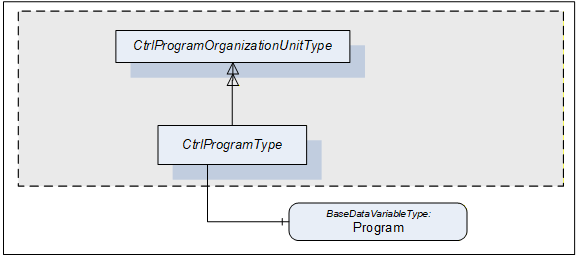
The Ctrl Program ObjectType is formally defined in Table 16.
| Attribute | Value | ||||
| BrowseName | CtrlProgramType | ||||
| IsAbstract | True | ||||
| References |
Node
Class | BrowseName | DataType | TypeDefinition |
Modelling
Rule |
|---|---|---|---|---|---|
| Subtype of the CtrlProgramOrganizationUnitType defined in 7.3, i.e. inheriting the InstanceDeclarations of that Node. | |||||
| HasComponent | Variable | Program | Structure | BaseDataVariableType | Optional |
The CtrlProgramType ObjectType is abstract. There will be no instances of a CtrlProgramType itself, but there will be instances of subtypes of this type like instances of vendor or user specific Ctrl Programs.
The Program Variable component contains the complete Ctrl Program data in a complex Variable.
7.5 CtrlFunctionBlockType ObjectType Definition
This ObjectType defines the representation of a Ctrl Function Blocks of a programmable Controller system in an OPC UA Address Space. It is derived from CtrlProgramOrganizationUnitType and introduces Ctrl Function Block specific components in addition to the components of the base type. Figure 19 shows the CtrlFunctionBlockType. It is formally defined in Table 17.
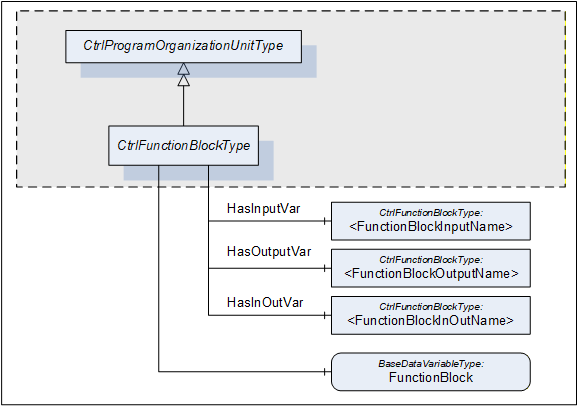
The CtrlFunctionBlock ObjectType is formally defined in Table 17.
| Attribute | Value | |||
| BrowseName | CtrlFunctionBlockType | |||
| IsAbstract | True | |||
| References | NodeClass | BrowseName | TypeDefinition | ModellingRule |
|---|---|---|---|---|
| Inherit the Properties and components of the CtrlProgramOrganizationUnitType | ||||
| HasInputVar | Object | <FunctionBlockInputName> | CtrlFunctionBlockType | OptionalPlaceholder |
| HasOutputVar | Object | <FunctionBlockOutputName> | CtrlFunctionBlockType | OptionalPlaceholder |
| HasInOutVar | Object | <FunctionBlockInOutName> | CtrlFunctionBlockType | OptionalPlaceholder |
| HasComponent | Variable | FunctionBlock | BaseDataVariableType | Optional |
The CtrlFunctionBlockType ObjectType is abstract. There will be no instances of a CtrlFunctionBlockType itself, but there will be instances of subtypes of this type like instances of vendor or user specific Ctrl Function Blocks.
Ctrl Function Block instances declared for a Ctrl Function Block type are referenced with different subtypes of the HasComponent Reference. The used Reference type depends on the IEC 61131-3 declaration keywords. The name of the Object depends on the name of the block in the Ctrl Function Block.
Ctrl Function Block instances declared with the key word VAR_INPUT are referenced with HasInputVar defined in 8.2.
Ctrl Function Block instances declared with the key word VAR_OUTPUT are referenced with HasOutputVar defined in 8.3.
Ctrl Function Block instances declared with the key word VAR_IN_OUT are referenced with HasInOutVar defined in 8.4.
The FunctionBlock Variable component contains the complete Ctrl Function Block data in a complex Variable. The DisplayName for the Variable is FunctionBlock.
7.6 CtrlTaskType ObjectType Definition
This ObjectType defines the representation of a Ctrl Task of a programmable Controller system in an OPC UA Address Space. It introduces Properties providing information about the Ctrl Task. Figure 20 shows the CtrlTaskType. It is formally defined in Table 18.
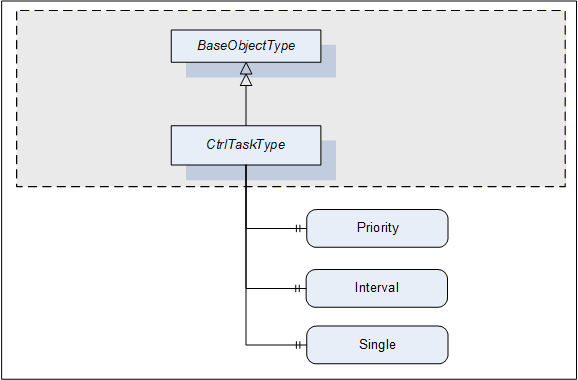
The Ctrl Task ObjectType is formally defined in Table 18.
| Attribute | Value | |||||
| BrowseName | CtrlTaskType | |||||
| IsAbstract | False | |||||
| References |
Node
Class | BrowseName | DataType | TypeDefinition |
Modelling
Rule | |
|---|---|---|---|---|---|---|
| Subtype of the BaseObjectType defined in OPC 10000-5, i.e. inheriting the InstanceDeclarations of that Node. | ||||||
| HasProperty | Variable | Priority | UInt32 | PropertyType | Mandatory | |
| HasProperty | Variable | Interval | String | PropertyType | Optional | |
| HasProperty | Variable | Single | String | PropertyType | Optional | |
The Priority Property indicates the scheduling priority of the associated Ctrl Program Organization Unit.
The Interval Property indicates the periodical scheduling of the associated Ctrl Program Organization Unit at the specified interval.
The Single Property indicates a single scheduling of the associated Ctrl Program Organization Unit at each rising edge.
7.7 SFCType ObjectType Definition
The SFC ObjectType is formally defined in Table 19. This type is a container for Sequential Function Chart (SFC) related information. The representation of this information is vendor specific. Future versions of this specification may define standard representations.
| Attribute | Value | |||||
| BrowseName | SFCType | |||||
| IsAbstract | False | |||||
| References |
Node
Class | BrowseName | DataType | TypeDefinition |
Modelling
Rule | |
|---|---|---|---|---|---|---|
| Subtype of the BaseObjectType defined in OPC 10000-5, i.e. inheriting the InstanceDeclarations of that Node. | ||||||
8 Reference Types
8.1 General
Figure 21 depicts the main ReferenceTypes of this specification and their relationship.
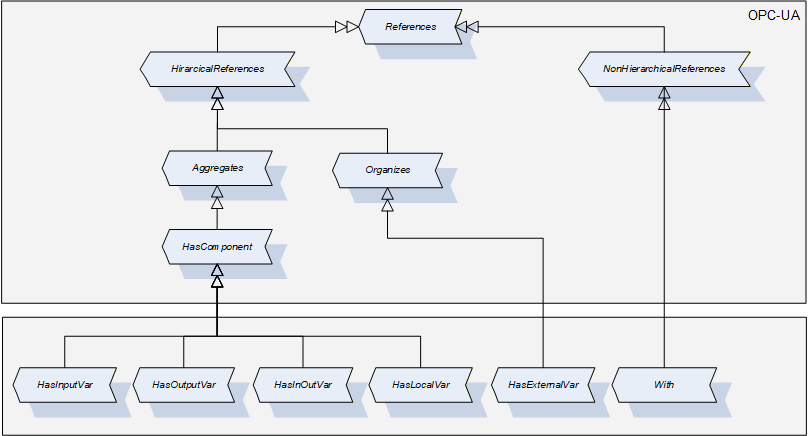
The upper grey box shows the OPC UA core ReferenceTypes from which the IEC 61131-3 ReferenceTypes are derived. The grey box in the second level shows the IEC 61131-3 ReferenceTypes that this specification introduces.
8.2 HasInputVar
This ReferenceType is a subtype of the HasComponent ReferenceType defined in OPC 10000-5. Its representation in the AddressSpace is specified in Table 20.
| Attributes | Value | ||
| BrowseName | HasInputVar | ||
| InverseName | InputVarOf | ||
| Symmetric | False | ||
| IsAbstract | False | ||
| References | NodeClass | BrowseName | Comment |
|---|---|---|---|
| Subtype of HasComponent ReferenceType defined in OPC 10000-5 | |||
The HasInputVar ReferenceType is a concrete ReferenceType and can be used directly.
The semantic of this ReferenceType is to reference components of a Ctrl Program Organization Unit declared with the key word VAR_INPUT.
The SourceNode of References of this type shall be a subtype of CtrlProgramOrganizationUnitType or an instance of one of its subtypes.
The TargetNode of this ReferenceType shall be a Variable or an Object of the ObjectType CtrlFunctionBlockType or one of its subtypes.
8.3 HasOutputVar
This ReferenceType is a subtype of the HasComponent ReferenceType defined in OPC 10000-5. Its representation in the AddressSpace is specified in Table 21.
| Attributes | Value | ||
| BrowseName | HasOutputVar | ||
| InverseName | OutputVarOf | ||
| Symmetric | False | ||
| IsAbstract | False | ||
| References | NodeClass | BrowseName | Comment |
|---|---|---|---|
| Subtype of HasComponent ReferenceType defined in OPC 10000-5 | |||
The HasOutputVar ReferenceType is a concrete ReferenceType and can be used directly.
The semantic of this ReferenceType is to reference components of a Ctrl Program Organization Unit declared with the key word VAR_OUTPUT.
The SourceNode of References of this type shall be a subtype of CtrlProgramOrganizationUnitType or an instance of one of its subtypes.
The TargetNode of this ReferenceType shall be a Variable or an Object of the ObjectType CtrlFunctionBlockType or one of its subtypes.
8.4 HasInOutVar
This ReferenceType is a subtype of the HasComponent ReferenceType defined in OPC 10000-5. Its representation in the AddressSpace is specified in Table 22.
| Attributes | Value | ||
| BrowseName | HasInOutVar | ||
| InverseName | InOutVarOf | ||
| Symmetric | False | ||
| IsAbstract | False | ||
| References | NodeClass | BrowseName | Comment |
|---|---|---|---|
| Subtype of HasComponent ReferenceType defined in OPC 10000-5 | |||
The HasInOutVar ReferenceType is a concrete ReferenceType and can be used directly.
The semantic of this ReferenceType is to reference components of a Ctrl Program Organization Unit declared with the key word VAR_INOUTPUT.
The SourceNode of References of this type shall be a subtype of CtrlProgramOrganizationUnitType or an instance of one of its subtypes.
The TargetNode of this ReferenceType shall be a Variable or an Object of the ObjectType CtrlFunctionBlockType or one of its subtypes.
8.5 HasLocalVar
This ReferenceType is a subtype of the HasComponent ReferenceType defined in OPC 10000-5. Its representation in the AddressSpace is specified in Table 23.
| Attributes | Value | ||
| BrowseName | HasLocalVar | ||
| InverseName | LocalVarOf | ||
| Symmetric | False | ||
| IsAbstract | False | ||
| References | NodeClass | BrowseName | Comment |
|---|---|---|---|
| Subtype of HasComponent ReferenceType defined in OPC 10000-5 | |||
The HasLocalVar ReferenceType is a concrete ReferenceType and can be used directly.
The semantic of this ReferenceType is to reference components of a Ctrl Program Organization Unit declared with the key word VAR.
The SourceNode of References of this type shall be a subtype of CtrlProgramOrganizationUnitType or an instance of one of its subtypes.
The TargetNode of this ReferenceType shall be a Variable or an Object of the ObjectType CtrlFunctionBlockType or one of its subtypes.
8.6 HasExternalVar
This ReferenceType is a subtype of the Organizes ReferenceType defined in OPC 10000-5. Its representation in the AddressSpace is specified in Table 24.
| Attributes | Value | ||
| BrowseName | HasExternalVar | ||
| InverseName | ExternalVarOf | ||
| Symmetric | False | ||
| IsAbstract | False | ||
| References | NodeClass | BrowseName | Comment |
|---|---|---|---|
| Subtype of Organizes ReferenceType defined in OPC 10000-5 | |||
The HasExternalVar ReferenceType is a concrete ReferenceType and can be used directly.
The semantic of this ReferenceType is to reference components of a Ctrl Program Organization Unit declared with the key word VAR_EXTERNAL.
The SourceNode of References of this type shall be a subtype of CtrlProgramOrganizationUnitType or an instance of one of its subtypes.
The TargetNode of this ReferenceType shall be a Variable or an Object of the ObjectType CtrlFunctionBlockType or one of its subtypes.
8.7 With
This ReferenceType is a subtype of the NonHierarchicalReferences ReferenceType defined in OPC 10000-5. Its representation in the AddressSpace is specified in Table 25.
| Attributes | Value | ||
| BrowseName | With | ||
| InverseName | Executes | ||
| Symmetric | False | ||
| IsAbstract | False | ||
| References | NodeClass | BrowseName | Comment |
|---|---|---|---|
| Subtype of NonHierarchicalReferences ReferenceType defined in OPC 10000-5 | |||
The With ReferenceType is a concrete ReferenceType and can be used directly.
The semantic of this ReferenceType is to reference the Ctrl Task that executes a Ctrl Program Organization Unit.
The SourceNode of References of this type shall be an Object of the ObjectType CtrlProgramOrganizationUnitType or an instance of one of its subtypes.
The TargetNode of this ReferenceType shall be an Object of the ObjectType CtrlTaskType or one of its subtypes.
9 Definition of Ctrl Variable Attributes and Properties
9.1 Common Attributes
The common Attributes of OPC UA Address Space Nodes and their mapping from IEC 61131-3 are defined in Table 26.
| Attribute | Use | DataType | Description |
| NodeId | Mandatory | NodeId | The NodeId is a unique identifier for a Node in an OPC UA Address Space. The identifier is server specific and its format is not defined in this specification. |
| NodeClass | Mandatory | NodeClass | The NodeClass is Variable for all Ctrl Variables. |
| BrowseName | Mandatory | QualifiedName | The BrowseName is a QualifiedName composed of a name string and a namespace index. It is used to create paths that can be passed to the TranslateBrowsePathsToNodeIds Service to get the NodeId of a Variable Node. This is typically used to get the NodeId of Variable in an Object instance based on the path known from the Object type. The BrowseName is not used to display the name of the Node. The name part is generated from the Ctrl Variable name. The namespace part depends of the scope where the Variable is defined. Chapter 12.5 describes the handling of namespaces. |
| DisplayName | Mandatory | LocalizedText | The DisplayName is a LocalizedText used by clients to display the name of a Node. It is composed of a localized text part and a LocaleId identifying the language of the text. The DisplayName is server specific if the server supports localization of Variable names. The DisplayName is composed of the Ctrl Variable name and an empty LocaleId string if the server does not support localization. |
| Description | Optional | LocalizedText | The optional Description shall describe the meaning of the Node using a localized text. The Description may correspond to the element Documentation of the element Variable in PLCopen XML. |
| WriteMask | Optional | UInt32 | The WriteMask provides the optional information which attributes of the Node can be written by a client. This excludes the Value Attribute where the access is described by the AccessLevel Attribute. The value of this Attribute is server specific. Servers only supporting the use cases Observation and Operation are typically setting this Attribute to 0 or are not providing this optional Attribute. Servers supporting also the use cases Engineering and Service may allow clients to change Node Attributes. |
| UserWriteMask | Optional | UInt32 | The user specific settings for the WriteMask. |
9.2 DataType
9.2.1 Mapping of elementary data types
The mapping of IEC 61131-3 elementary data types to OPC UA data types is formally defined in Table 27. The OPC UA built in data types are used for the wire representation of the data type. Additional PLCopen specific OPC UA data type definitions are used to provide the special semantic if necessary.
| No. | IEC 61131-3 elementary data types (Keyword / Description) |
DataType
NodeID | OPC UA built in data types | PLCopen specific OPC UA simple data type definitions | Comment |
| 1 | BOOL / Boolean | --- | Boolean (UA:1) | - | A one bit value (true or false). |
| 2 | SINT / Short integer | --- | SByte (UA:2) | - | An 8 bit signed integer value. |
| 3 | INT / Integer | --- | Int16 (UA:4) | - | A 16 bit signed integer value. |
| 4 | DINT | --- | Int32 (UA:6) | - | A 32 bit signed integer value. |
| 5 | LINT / Long integer | --- | Int64 (UA:8) | - | A 64 bit signed integer value. |
| 6 | USINT / Unsigned short integer | --- | Byte (UA:3) | - | An 8 bit unsigned integer value. |
| 7 | UINT / Unsinged integer | --- | UInt16 (UA:5) | - | A 16 bit unsigned integer value. |
| 8 | UDINT / Unsigned double integer | --- | UInt32 (UA:7) | - | A 32 bit unsigned integer value. |
| 9 | ULINT / Unsigned long integer | --- | UInt64 (UA:9) | - | A 64 bit unsigned integer value. |
| 10 | REAL / Real numbers | --- | Float (UA:10) | - | OPC UA definition: An IEEE-754 single precision (32 bit) floating point value. IEC 61131-3 definition: Real (32 bit) with a range of values as defined in IEC 60559 for the basic single width floating-point format. Both standards are identical. |
| 11 | LREAL / Long reals | --- | Double (UA:11) | - | OPC UA definition: An IEEE-754 double precision (64 bit) floating point value. IEC 61131-3 definition: Long real (64 bit) with a range of values as defined in IEC 60559 for the basic double width floating-point format. Both standards are identical. |
| 12a | TIME / Duration | x:3005 | Int64 (UA:8) | TIME | The OPC UA simple data type TIME/Duration is derived from the built-in data type Int64. It describes that the type is used as interval of time in milliseconds. The range of valid values is vendor specific. |
| 12b | LTIME / Duration | x:3006 | Int64 (UA:8) | LTIME | The PLCopen simple data type LTIME is derived from the build in data type Int64. It describes that the type is used as interval of time in nanoseconds. The valid range is LT#-106751d23h47m16s854ms775us808ns to LT#+106751d23h47m16s854ms775us807ns. The representation contains information for days (d), hours (h), minutes (m), seconds (s) milliseconds (ms), microseconds (us) and nanoseconds (ns). |
| 13a | DATE / Date (only) | x:3007 | DateTime (UA:13) | DATE | The PLC open specific OPC UA simple data type DATE is derived from the built-in data type DateTime. It describes that the type is used as a date only. |
| 13b | LDATE / Long date (only) | X:3014 | Int64 (UA:8) | LDATE | The PLCopen specific OPC UA simple data type LDATE is derived from the built-in data type Int64. It describes that the type is used as date only. The interval is nanoseconds since 1970-01-01. |
| 14a | TOD Time of day (only) | x:3008 | UInt32 (UA:7) | TOD | TOD (TIME_OF_DAY) stores number of milliseconds since the beginning of the day: TOD#00:00:00.000 to TOD#23:59:59.999. |
| 14b | LTOD (Time of day) | x:3009 | Int64 (UA:8) | LTOD | LTOD (LTIME_OF_DAY) stores the number of nanoseconds since the beginning of the day: LTOD#00:00:00.000000000 to LTOD#23:59:59.999999999. |
| 15a | DT Date and time of day | x:3010 | DateTime (UA:13) | DT | The range and resolution of this type is vendor specific. |
| 15b | LDT Date and time of day | x:3015 | Int64 (UA:8) | LDT | The PLCopen specific OPC UA Simple datatype LDT is derived from the build in data type Int64. It describes the number of nanoseconds elapsed since 1970-01-01-00:00:00 |
| 16a | STRING variable-length single-byte character string | x:3013 | String (UA:12) | STRING | The PLC open specific OPC UA simple data type STRING is derived from the built-in data type String. It describes that the type is used as a variable-length single-byte character string. |
| 16b | WSTRING variable-length double-byte character string | --- | String (UA:12) | - | OPC UA definition: A sequence of UTF8 characters. IEC 61131-3 definition: Variable-length double-byte character string |
| 17a | CHAR single-byte character | x:3011 | Byte (UA:3) | CHAR | The PLC open specific OPC UA simple data type CHAR is derived from the built-in data type Byte. It describes that the type is used as single-byte character |
| 17b | WCHAR double-byte character | x:3012 | UInt16 | WCHAR | The PLC open specific OPC UA simple data type WCHAR is derived from the built-in data type UInt16. It describes that the type is used as double-byte character. |
| 18 | BYTE Bit string of length 8 | x:3001 | Byte | BYTE | The PLC open specific OPC UA simple data type BYTE is derived from the built-in data type Byte. It describes that the type is used as bit string of length 8. |
| 19 | WORD Bit string of length 16 | x:3002 | UInt16 | WORD | The PLC open specific OPC UA simple data type WORD is derived from the built-in data type UInt16. It describes that the type is used as bit string of length 16 |
| 20 | DWORD Bit string of length 32 | x:3003
| UInt32 | DWORD | The PLC open specific OPC UA simple data type DWORD is derived from the built-in data type UInt32. It describes that the type is used as bit string of length 32 |
| 21 | LWORD Bit string of length 64 | x:3004 | UInt64 | LWORD | The PLC open specific OPC UA simple data type LWORD is derived from the built-in data type UInt64. It describes that the type is used as bit string of length 64 |
9.2.2 Mapping of generic data types
The mapping of IEC 61131-3 generic data types to OPC UA data types is formally defined in Table 28. Since the generic data type should not be used in user-declared Ctrl Program Organization Units, this mapping definition is defined for completeness but is normally not used in an OPC UA AddressSpace.
| IEC 61131-3 generic data types | OPC UA data types | Description |
| ANY | BaseDataType | This abstract OPC UA DataType defines a value that can have any valid OPC UA DataType. |
ANY_DERIVED | BaseDataType | |
ANY_ELEMENTARY | BaseDataType | |
ANY_MAGNITUDE | BaseDataType | |
ANY_NUM | Number | This abstract OPC UA DataType defines a number value that can have any of the OPC UA Number subtypes. |
ANY_REAL | Number | |
ANY_INT | Number | |
ANY_BIT | Number | |
ANY_STRING | String | This OPC UA Built-in DataType defines a Unicode character string that should exclude control characters that are not whitespaces (0x00 - 0x08, 0x0E-0x1F or 0x7F). |
ANY_DATE | DateTime | This OPC UA Built-in DataType defines a Gregorian calendar date. It is a 64-bit signed integer which represents the number of 100 nanosecond intervals since January 1, 1601. |
9.2.3 Mapping of derived data types
9.2.3.1 Mapping of enumerated data types
Both OPC UA and IEC 61131-3 allow the definition of enumerations on a data type or on a variable instance.
In OPC UA the enumerated data types are defined as subtypes of Enumeration. The data has an EnumStrings Property that contains the possible string values. The value is transferred as integer on the wire where the integer defines the index into the EnumStrings array. The index is zero based and has no gaps. Another option is to provide the possible string values in the Property EnumValues. This option is used if individual integer values are assigned to the string. The used option depends on the way the string enumeration is defined in the Controller program. If integer values are assigned to the string values the Property EnumValues is used to represent the enumeration values. If the integer value is zero based and has no gaps the EnumStrings Property should be used since the processing on the client side is more efficient.
The definition on a variable instance is using the MultiStateDiscreteType Variable Type which defines also the EnumStrings or the EnumValues Property containing the enumeration values as string array.
Example for an enumerated data type declaration in IEC 61131-3:
TYPE
  ANALOG_SIGNAL_TYPE : (SINGLE_ENDED, DIFFERENTIAL) ;
END_TYPE
Example for use of an enumeration in a Ctrl Variable instantiation in IEC 61131-3:
VAR
  Y : (Red, Yellow, Green) ;
END_VAR
The IEC 61131-3 enumeration data type declaration is mapped to an OPC UA Enumeration data type. The representation in the address space is formally defined in Table 29.
| References |
Node
Class | BrowseName | DataType | TypeDefinition |
Modelling
Rule |
| Subtype of the Enumeration defined in OPC 10000-5 i.e. inheriting the InstanceDeclarations of that Node. | |||||
| HasProperty | Variable | EnumString | String [ ] | PropertyType | Optional |
| HasProperty | Variable | EnumValues | EnumValueDataType [ ] | PropertyType | Optional |
The Property EnumString is defined in OPC 10000-5
The Property EnumValues is defined in OPC 10000-5.
The IEC 61131-3 enumeration in a Ctrl Variable declaration is mapped to a MultiStateDiscreteType Variable Type defined in OPC 10000-8.
9.2.3.2 Mapping of subrange data types
IEC 61131-3 defines the subrange for all integer data types (ANY_INT) which excludes real values.
OPC UA has no standard concept to limit the range on the data type.
Example for a subrange data type declaration in IEC 61131-3:
TYPE
  ANALOG_DATA : INT (-4095..4095) ;
END_TYPE
Example for use of a subrange in a Ctrl Variable instantiation in IEC 61131-3:
VAR
  Z : SINT (5..95) ;
END_VAR
The IEC 61131-3 subrange is mapped to two OPC UA properties defined in Table 30.
| References |
Node
Class | BrowseName | DataType | TypeDefinition |
Modelling
Rule |
| Instance of any Variable Type or a Data Type Node. | |||||
| HasProperty | Variable | SubrangeMin | Number | PropertyType | Mandatory |
| HasProperty | Variable | SubrangeMax | Number | PropertyType | Mandatory |
The Property SubrangeMin contains the lower bound of the subrange. The data type depends on the elementary data type used for the subrange.
The Property SubrangeMax contains the upper bound of the subrange. The data type depends on the elementary data type used for the subrange.
The IEC 61131-3 subrange data type is mapped to an OPC UA number data type derived from the corresponding elementary data types defined in Table 27. The data type has the two Properties defined in Table 30. The IEC example in this chapter is mapped to an OPC UA data type with the name ANALOG_DATA which is a subtype of Int16.
The IEC 61131-3 subrange in a Ctrl Variable declaration is mapped to the two Properties defined in Table 30. The Properties are children of the OPC UA Variable representing the Ctrl Variable.
9.2.3.3 Mapping of array data types
OPC UA provides the information if a value is an array in the Variable Attributes ValueRank and ArrayDimensions. Every data type can be exposed as array. Arrays can have multiple dimensions. The dimension is defined through the Attribute ValueRank. Arrays can have variable or fixed lengths. The length of each dimension is defined by the Attribute ArrayDimensions. The array index starts with zero.
IEC 61131-3 allows the declaration of array data types with one or multiple dimensions and an index range instead of a length.
OPC UA has no standard concept for defining special array data types or exposing index ranges.
Example for an array data type declaration in IEC 61131-3:
TYPE
  ANALOG_16_INPUT_DATA : ARRAY [1..16] OF INT ;
END_TYPE
Example for use of an array in a Ctrl Variable instantiation in IEC 61131-3:
VAR
  MyArray : ARRAY [1..16] OF INT;
END_VAR
The IEC 61131-3 array data type is mapped to three OPC UA properties defined in Table 31.
| References | NodeClass | BrowseName | DataType | TypeDefinition | ModellingRule | |
| Instance of any VariableType or a DataType Node. | ||||||
| HasProperty | Variable | Dimensions | UInt32 | PropertyType | Mandatory | |
| HasProperty | Variable | IndexMin | Int32 [ ] | PropertyType | Mandatory | |
| HasProperty | Variable | IndexMax | Int32 [ ] | PropertyType | Mandatory | |
The Property Dimensions contains the number of dimensions of the array.
The Property IndexMin contains an array of lower bounds, one for each array dimension.
The Property IndexMax contains an array of upper bounds, one for each array dimension.
The IEC 61131-3 array data type is mapped to an OPC UA data type derived from the corresponding elementary data types defined in Table 27. The data type has the two Properties defined in Table 31. The IEC example in this chapter is mapped to an OPC UA data type with the name ANALOG_16_INPUT_DATA which is a subtype of Int16.
The IEC 61131-3 array in a Ctrl Variable declaration is mapped to the two Properties defined in Table 31. The Properties are children of the OPC UA Variable representing the Ctrl Variable.
9.2.3.4 Mapping of structure data types
IEC 61131-3 structure data types are mapped as subtypes of the OPC UA DataType Structure. OPC UA servers must explicitly describe how structured DataTypes are encoded / decoded and provide this information to the client which is using it while reading / writing structure data.
The following example of an IEC 61131-3 structure data type declaration (using Structured Text) will be used for further illustrations. This structure data type comprises three structure elements of different elementary data types.
TYPE ExampleIEC611313Structure:
  STRUCT
    IntStructureElement: INT;
    RealStructureElement: REAL;
    BoolStructureElement: BOOL;
  END_STRUCT;
END_TYPE
9.2.3.4.1 Deprecated Mapping of structure data types
The following Figure 22 shows the deprecated mapping of the above example. This mapping is deprecated since it is deprecated in OPC UA V1.04.
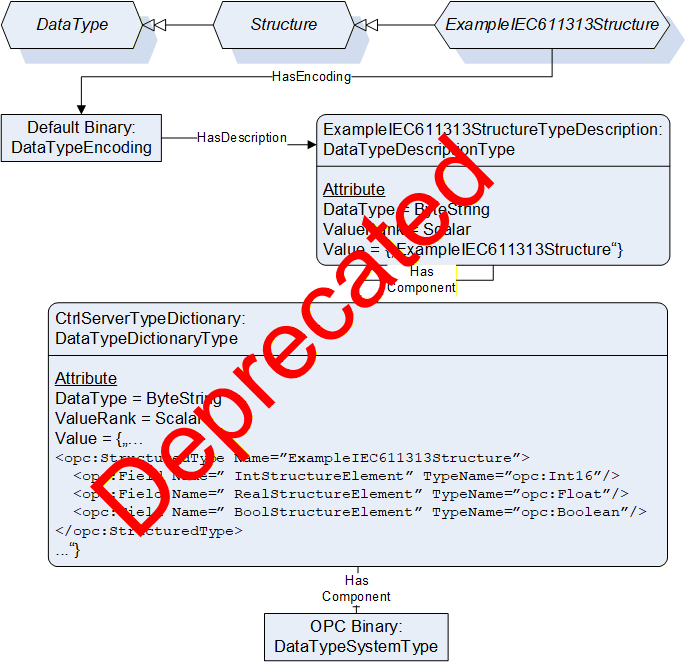
Ctrl servers must support the binary encoding ("Default Binary"). Additionally, other encodings may be provided (not shown in above figure). A Server may provide, for backward compatibility, the deprecated DataTypeDictionary Variable describing all necessary DataTypes. Each DataType is represented by a DataTypeDescription Variable. Optionally, a Property DictionaryFragment may be available, allowing clients not to read the complete DataTypeDictionary in order to get the information about only a single DataType (not shown in above figure).
9.2.3.4.2 Mapping of structure data types
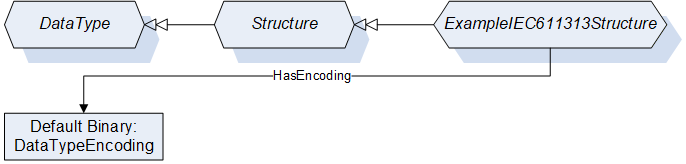
Ctrl servers shall support the binary encoding ("Default Binary"). Additionally, other encodings may be provided (not shown in above figure). Since OPC UA V1.04 a structured DataType provides the new attribute DataTypeDefinition. This attribute is defined in OPC 10000-6 - F.12. Implementations shall use this new attribute instead of the deprecated DataTypeDictionary.
A Server provides on a structured DataType Node the DataTypeDefinition attribute describing all elements and their order in this structure.
The Value of the DataTypeDefinition Attribute for a DataType Node describing ExampleIEC611313Structure is shown in Table 32.
| Name | Type | Description |
| defaultEncodingId | NodeId | NodeId of the "ExampleIEC611313Structure_Encoding_DefaultBinary" Node. |
| baseDataType | NodeId | "i=22" [Structure] |
| structureType | StructureType | Structure_0 [Structure without optional fields] |
| fields [0] | StructureField | |
| name | String | "IntStructureElement" |
| description | LocalizedText | Description of IntStructureElement |
| dataType | NodeId | "i=4" [Int16] |
| valueRank | Int32 | -1 (Scalar) |
| isOptional | Boolean | False |
| fields [1] | StructureField | |
| Name | String | "RealStructureElement" |
| Description | LocalizedText | Description of RealStructureElement |
| dataType | NodeId | "i=10" [Float] |
| valueRank | Int32 | -1 (Scalar) |
| isOptional | Boolean | false |
| fields [2] | StructureField | |
| name | String | "BoolStructureElement" |
| description | LocalizedText | Description of BoolStructureElement |
| dataType | NodeId | "i=1" [Boolean] |
| valueRank | Int32 | -1 (Scalar) |
| isOptional | Boolean | false |
9.2.3.4.3 Structure and VariableType
It is strongly recommended for Ctrl servers to provide additionally the structured data as a set of sub variables (components of the variable) providing the structure as several separated values. This allows clients that do not support complex data to access the scalar values. The following Figure 24 shows an example (instances based on the above type descriptions).
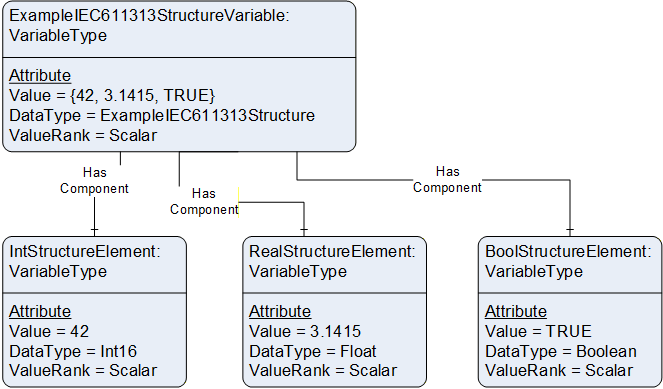
If a structure element is not an elementary data type, it has to be divided again into sub variables.
It is recommended that Ctrl servers do support complex data. If a server does not support complex data it provides only sub variables for structure variables. The structured variable would be a Folder object in this case.
9.3 Variable specific Node Attributes
9.3.1 General
The Variable specific Attributes of OPC UA Address Space Nodes and their mapping from IEC 61131-3 are defined in Table 33.
| Attribute | Use | DataType | Description |
| Value | Mandatory | Defined by DataType | The most recent value of the Variable that the server has. Its data type is defined by the DataType, ValueRank and ArrayDimension Attribute. |
| DataType | Mandatory | NodeId | The DataType of the Variable Value. It defines the type specific content of the Value together with the ValueRank and the ArrayDimension Attributes, The mapping is defined in 9.2. |
| ValueRank | Mandatory | Int32 | This Attribute indicates whether the Value of the Variable is an array and how many dimensions the array has. Ctrl Variables declared as scalar type have the ValueRank -1. Ctrl Variables declared with the key word ARRAY…OF have a ValueRank that indicates the number of dimension of the array declared for the Ctrl Variable. |
| ArrayDimensions | Optional | UInt32[] | This Attribute specifies the length of each dimension for an array value. The Attribute is intended to describe the capability of the Variable, not the current size. The dimension entries have the length defined with the key word ARRAY…OF. |
| AccessLevel | Mandatory | Byte | The AccessLevel Attribute is used to indicate how the Value of a Variable can be accessed (read/write) and if it contains current and/or historic data. The handling of access to historic data is server specific and is not part of this specification. The mapping of the read and write access part of the AccessLevel is defined in 9.3.2 |
| UserAccessLevel | Mandatory | Byte | The user specific settings for the AccessLevel. |
| MinimumSamplingInterval | Optional | Duration | The MinimumSamplingInterval Attribute indicates how "current" the Value of the Variable will be kept. It specifies (in milliseconds) how fast the server can reasonably sample the value for changes. A MinimumSamplingInterval of 0 indicates that the server is to monitor the item continuously. A MinimumSamplingInterval of -1 means indeterminate. The value of this Attribute is server specific. |
| Historizing | Mandatory | Boolean | Indicates if the server is currently collecting history for the Variable Value. The support of value history is server specific. |
9.3.2 Access Level
If the IEC attribute CONSTANT is set, the Access Level shall be read only.
The IEC standard does not define a key word to set the Access Level for a Ctrl Variable. The configuration in a programming system is vendor specific but it is recommended to provide a configuration option for the OPC UA Access Level.
When using the PLCopen XML format the AccessLevel shall be provided in PLCopen XML Additional Data in the XML element addData using the XML element UaAccessLevel as part of the XML element representing the variable. The value is a bit mask where the first bit indicates the read access and the second bit indicates the write access.
9.4 Variable Properties
9.4.1 IEC Ctrl Variable Keywords
The IEC 61131-3 key word mapping to OPC UA Properties is formally defined in Table 34.
| References | NodeClass | BrowseName | DataType | TypeDefinition | ModellingRule |
| Instance of any Variable Type. | |||||
| HasProperty | Variable | RETAIN | Boolean | PropertyType | Optional |
| HasProperty | Variable | NON_RETAIN | Boolean | PropertyType | Optional |
| HasProperty | Variable | CONSTANT | Boolean | PropertyType | Optional |
| HasProperty | Variable | AT | String | PropertyType | Optional |
The Property RETAIN indicates if the RETAIN key word is set for the Ctrl Variable. It provides an explicit declaration of "warm start" behaviour of the Ctrl Variable (and Ctrl Function Blocks and Ctrl Programs).
The Property NON_RETAIN indicates if the NON_RETAIN key word is set for the Ctrl Variable. It provides an explicit declaration of "warm start" behaviour of the Ctrl Variable (and Ctrl Function Blocks and Ctrl Programs).
The Property CONSTANT indicates if the CONSTANT key word is set for the Ctrl Variable. It provides a declaration of a fixed value for the Ctrl Variable. The Ctrl Variable cannot be modified.
The Property AT contains the location assignment to the Ctrl Variable as string if the AT key word is set for the Ctrl Variable.
9.4.2 Configuration of OPC UA defined Properties
The IEC standard does not define key words to configure information like the value range or the engineering unit for a Ctrl Variable. The configuration in a programming system is vendor specific but this specification defines the export format in the PLCopen XML Additional Data in the XML element addData.
The InstrumentRange Property defined in OPC 10000-8 shall be provided in the XML element UaInstrumentRange as part of the XML element representing the Ctrl Variable. The attributes of the XML element are formally defined in Table 35.
| Name | Type | Use | Default | |
| Low | double | required | ||
| High | double | required | ||
The EURange Property defined in OPC 10000-8 shall be provided in the XML element UaEURange as part of the XML element representing the Ctrl Variable. The attributes of the XML element are formally defined in Table 35.
The EngineeringUnits Property defined in OPC 10000-8 shall be provided in the XML element UaEngineeringUnits as part of the XML element representing the Ctrl Variable.
10 Objects used to organise the AddressSpace structure
10.1 DeviceSet as entry point for engineering applications (Mandatory)
The full object component hierarchy based on Object Types defined in this specification shall be provided as components of the DeviceSet Object defined in OPC 10000-100. Figure 25 provides an example for such a component hierarchy.
The DeviceSet Object is typically used as entry point by a UA client in the use cases Engineering and Service.
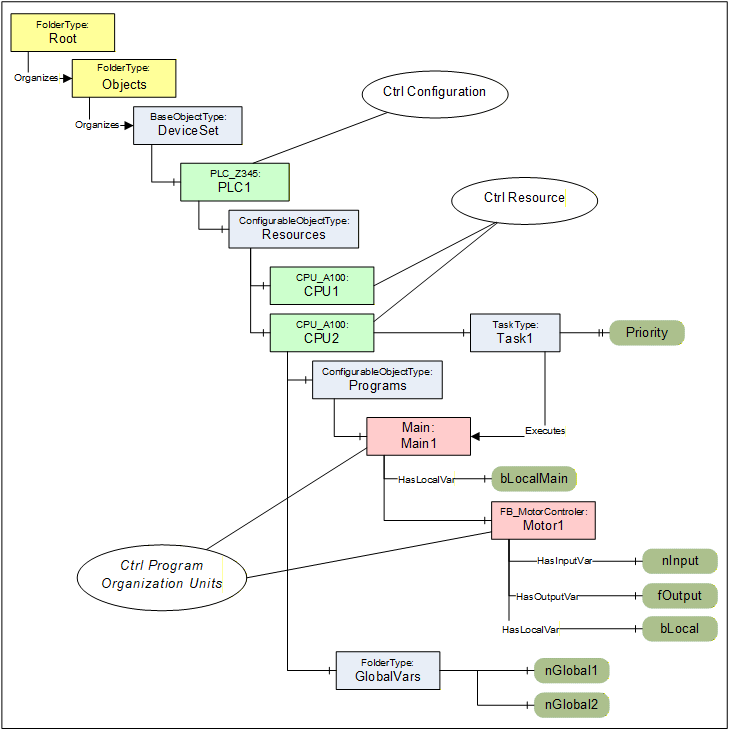
10.2 CtrlTypes Folder for server specific Object Types (Mandatory)
The server specific ObjectTypes like vendor specific Ctrl Configuration types or user specific Ctrl Function Block types can be found by a UA client by following the type hierarchy.
To provide UA clients all relevant server specific types in one place, the Ctrl Function Block types shall be referenced directly or indirectly from the CtrlTypes Folder Object using Organizes References. Other types like Ctrl Resources or Ctrl Program types may be included in addition. The CtrlTypes node is formally defined in Table 36
| References |
Node
Class | BrowseName | TypeDefinition | Description |
| Organized by the ObjectType Folder defined in OPC 10000-5 | ||||
| HasTypeDefinition | ObjectType | Folder | ||
| Organizes | Object | <Server specific> | FolderType | Optional server specific additional structuring of the type information building to a type catalogue |
| Organizes | ObjectType | <Server specific> | Server specific Object Types | |
The server may provide additional Folder objects below the CtrlTypes Object to organize the types. This can be used to create a library structure like in the example in Figure 26.
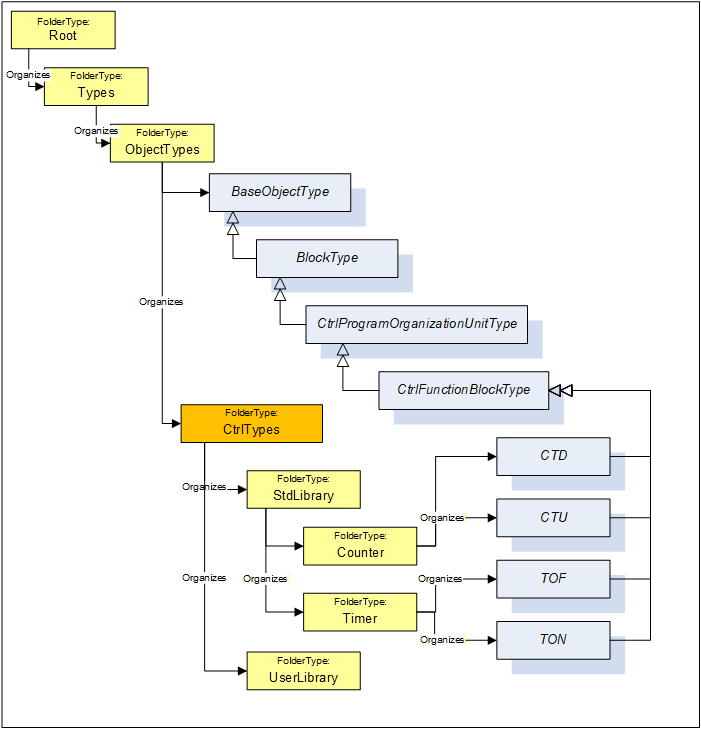
10.3 Entry point for Observation and Operation (Examples)
The entry point for UA client for the use cases Observation and Operation is the Objects Folder. One typical entry point is a list of Objects representing Ctrl Resources. Additional Folders Objects used to structure the Ctrl Resources into a hierarchy are server specific. Such an example is shown in Figure 27.
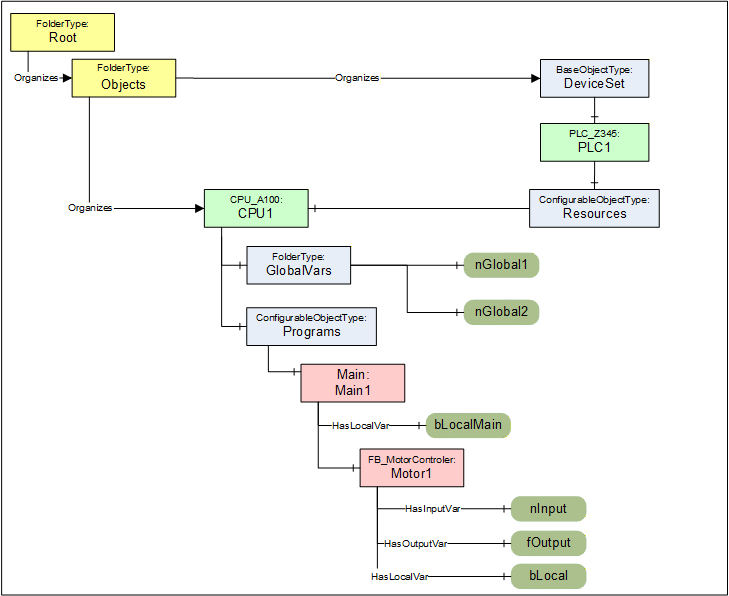
Servers that want to hide some of the components of a Ctrl Resources can create a Folder Object representing the Ctrl Resources and can use Organizes References to reference only the components of the Ctrl Resources that should be visible in this part of the hierarchy. Such an example is shown in Figure 28.
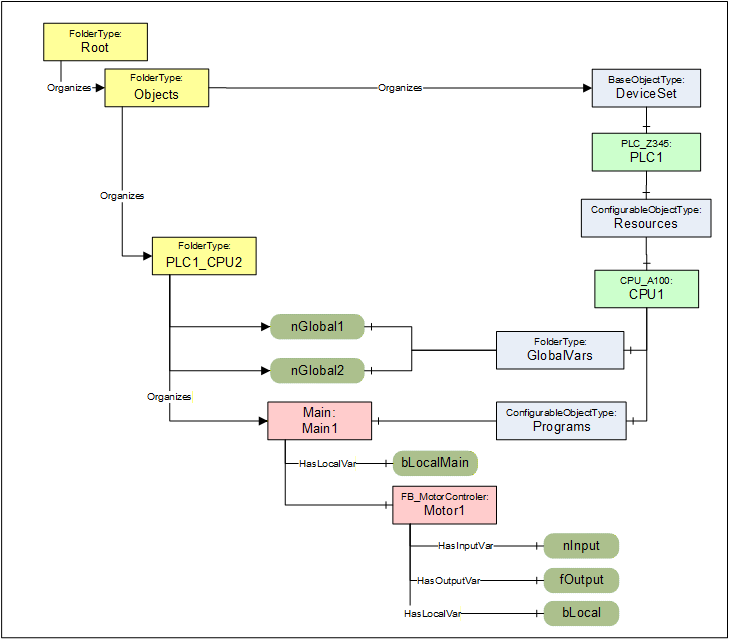
11 System Architecture
11.1 General
This chapter describes typical system architectures where this specification can be applied. Figure 29 shows a possible configuration where OPC UA based interfaces are involved.
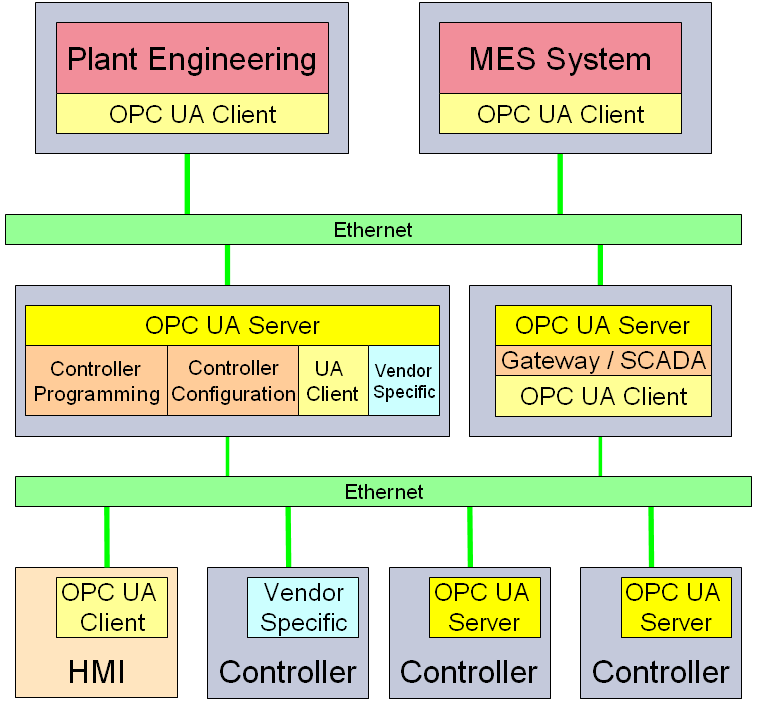
11.2 Embedded OPC UA Server
Embedded OPC UA servers are directly integrated into a Controller providing Ctrl Program and Ctrl Function Block Objects. Such a server allows direct access to information from a Controller using the OPC UA protocol on the wire. Other embedded applications like HMI acting as OPC UA clients can access the information from Controllers directly without the need of a PC.
11.3 PC based OPC UA Server
OPC UA servers running on a PC platform are capable of providing access to multiple Controllers. They are providing full type information for Ctrl Resource, Ctrl Program and Ctrl Function Block Objects. The communication to the Controllers may use OPC UA or a proprietary protocol on the wire.
11.4 PC based OPC UA Server with engineering capabilities
In addition to PC based OPC UA servers, this type of server includes access to the engineering system for the Controllers allowing access to the configuration for the use cases Engineering and Service.
12 Profiles and Namespaces
12.1 Namespace Metadata
Table 37 defines the namespace metadata for this specification. The Object is used to provide version information for the namespace and an indication about static Nodes. Static Nodes are identical for all Attributes in all Servers, including the Value Attribute. See Part5 for more details.
The information is provided as Object of type NamespaceMetadataType. This Object is a component of the Namespaces Object that is part of the Server Object. The NamespaceMetadataType ObjectType and its Properties are defined in OPC 10000-5.
The version information is also provided as part of the ModelTableEntry in the UANodeSet XML file. The UANodeSet XML schema is defined in OPC 10000-6.
| Attribute | Value | |||
| BrowseName | http://PLCopen.org/OpcUa/IEC61131-3/ | |||
| References | BrowseName | DataType | Value | |
|---|---|---|---|---|
| HasProperty | NamespaceUri | String | http://PLCopen.org/OpcUa/IEC61131-3/ | |
| HasProperty | NamespaceVersion | String | 1.02 | |
| HasProperty | NamespacePublicationDate | DateTime | 2020-11-25 | |
| HasProperty | IsNamespaceSubset | Boolean | Vendor-specific | |
| HasProperty | StaticNodeIdTypes | IdType[] | {Numeric} | |
| HasProperty | StaticNumericNodeIdRange | NumericRange[] | ||
| HasProperty | StaticStringNodeIdPattern | String | ||
12.2 Conformance Units and Profiles
This chapter defines the corresponding Profiles and Conformance Units for the OPC UA Information Model for IEC61131-3. Profiles are named groupings of Conformance Units. Facets are Profiles that will be combined with other Profiles to define the complete functionality of an OPC UA Server or Client.
12.3 Server Facets
The following tables specify the Facets available for Servers that implement the IEC 61131-3 Information Model companion specification.
Table 38 defines Conformance Units included in the minimum needed facet. It requires the support for profile BaseDevice Server Facet defined in OPC 10000-100. It is used together with the Embedded 2017 UA Server profile or the Standard 2017 UA Server profile defined in OPC 10000-7.
A server supporting all data types including complex data types must support the ComplexType Server Facet defined in OPC 10000-7.
| Conformance Unit | Description | Optional/ Mandatory |
| Ctrl DeviceSet | Support the full component hirarchy with Ctrl Configuration, Ctrl Resource, Ctrl Program and Ctrl FunctionBlock below the DeviceSet Object defined in OPC 10000-100. | M |
| Ctrl Configuration | Support vendor defined Ctrl Configuration object types and object instances. | M |
| Ctrl Resource | Support vendor defined Ctrl Resource object types and object instances | M |
| Ctrl Program | Support user defined Ctrl Program object types and object instances. | M |
| Ctrl FunctionBlock | Support user defined Ctrl FunctionBlock object types and object instances. | M |
| Ctrl Task | Support of Ctrl Task objects. | O |
| Ctrl References | Support of reference types specified in the IEC 61131-3 Information Model companion standard. | O |
| Profile | ||
|---|---|---|
| BaseDevice_Server_Facet (defined in OPC 10000-100) | M | |
Table 39 defines a facet for the support of the engineering information defined in the IEC 61131-3 Information Model. The Controller Engineering Server Facet requires the Controller Operation Server Facet.
| Conformance Unit | Description | Optional/ Mandatory |
| Ctrl Engineering Data | Support to provide all engineering data defined in this specification like properties describing data types. | M |
| Ctrl Engineering Change | Support of engineering data changes through OPC UA | O |
| Ctrl Type Creation | Support of type node creation through NodeManagement Services to create Ctrl Program Organization Unit declarations. | O |
| Profile | ||
|---|---|---|
| Controller Operation Server Facet | M | |
12.4 Client Facets
The following tables specify the Facets available for Clients that implement the IEC61131-3 Information Model companion specification.
Table 40 defines a facet available for Clients that implement the IEC 61131-3 Information Model standard. Servers implementing the Controller Engineering Server Facet may use this facet to restrict the engineering features to clients supporting this Client facet.
| Conformance Unit | Description | Optional/ Mandatory |
| Ctrl Client Information Model | Consume objects that conform to the types specified in the IEC 61131-3 Information Model companion standard. | M |
| Ctrl Client Engineering Data | Consume engineering data defined in the IEC 61131-3 Information Model companion standard like properties describing data types. | M |
| Ctrl Client Engineering Change | Use engineering data changes through OPC UA | O |
| Ctrl Type Creation | Use type node creation through NodeManagement Services to create Ctrl Program Organization Unit declarations. | O |
| Profile | ||
|---|---|---|
12.5 Handling of OPC UA Namespaces
Namespaces are used by OPC UA to create unique identifiers across different naming authorities. The Attributes NodeId and BrowseName are identifiers. A Node in the UA AddressSpace is unambiguously identified using a NodeId. Unlike NodeIds, the BrowseName cannot be used to unambiguously identify a Node. Different Nodes may have the same BrowseName. They are used to build a browse path between two Nodes or to define a standard Property.
Servers may often choose to use the same namespace for the NodeId and the BrowseName. However, if they want to provide a standard Property, its BrowseName shall have the namespace of the standards body although the namespace of the NodeId reflects something else, for example the EngineeringUnits Property. Another example shown in Figure 30 is the ParameterSet and the GlobalVars object components of a Ctrl Resource instance. The ParameterSet node BrowseName shall use the OPC DI namespace and the GlobalVars node BrowseName shall use the namespace defined by this specification. All NodeIds of Nodes not defined in this specification shall not use the standard namespaces and are typically using the same namespace like the Ctrl Resource object instance, for example local server.
Table 41 provides a list of mandatory and optional namespaces used in a Controller Server.
| NamespaceURI | Description | Use |
| http://opcfoundation.org/UA/ | Namespace for NodeIds and BrowseNames defined in the OPC UA specification. This namespace shall have namespace index 0. | Mandatory |
| Local Server URI | Namespace for nodes defined in the local server. This may include types and instances used in a Ctrl Resource represented by the server. This namespace shall have namespace index 1. | Mandatory |
| http://opcfoundation.org/UA/DI/ | Namespace for NodeIds and BrowseNames defined in OPC 10000-100. The namespace index is server specific. | Mandatory |
| http://PLCopen.org/OpcUa/IEC61131-3/ | Namespace for NodeIds and BrowseNames defined in this specification. The namespace index is server specific. | Mandatory |
| http://PLCopen.org/OpcUa/IEC61131-3/FB/ | A server may provide IEC or PLCopen defined Ctrl Function Block libraries. | Optional |
| User defined types and instances in a Ctrl Resource | A server that provides access to different Ctrl Resources may provide a separate namespace for each Ctrl Resources if it is required to create unique identifiers across Ctrl Resources. | Optional |
| Vendor specific types | A server may provide vendor specific types like types derived from Ctrl Configuration or Ctrl Resource in a vendor specific namespace. | Optional |
| Global user defined library | A server may provide global user defined Ctrl Function Block libraries in a user specific namespace. | Optional |
Figure 30 shows an example for the use of namespaces in NodeIds and BrowseNames.
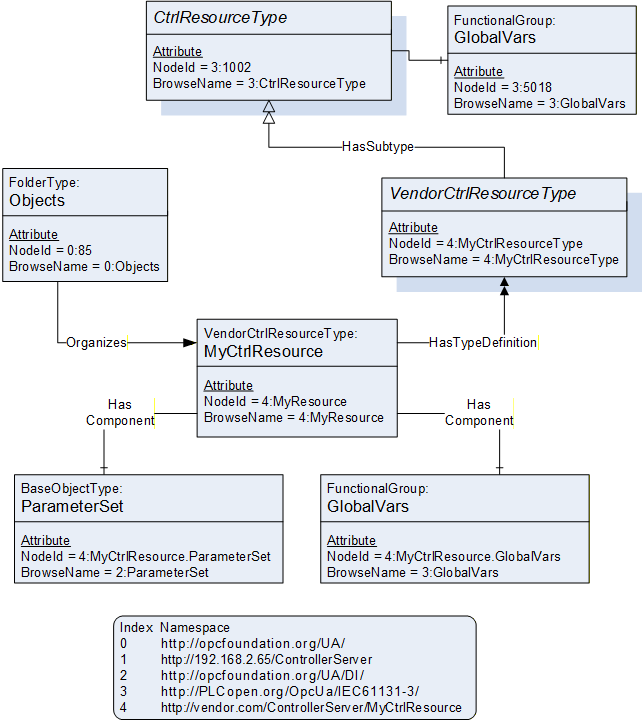
Table 42 provides a list of namespaces and their index used for BrowseNames in this specification. The default namespace of this specification is not listed since all BrowseNames without prefix use this default namespace.
| NamespaceURI | Namespace Index | Example |
| http://opcfoundation.org/UA/ | 0 | 0:EngineeringUnits |
| http://opcfoundation.org/UA/DI/ | 2 | 2:DeviceRevision |
Annex A (normative): IEC 61131-3 Namespace and mappings
A.1 Namespace and identifiers for IEC 61131-3 Information Model
This appendix defines the numeric identifiers for all of the numeric NodeIds defined in this specification. The identifiers are specified in a CSV file with the following syntax:
<SymbolName>, <Identifier>, <NodeClass>Where the SymbolName is either the BrowseName of a Type Node or the BrowsePath for an Instance Node that appears in the specification and the Identifier is the numeric value for the NodeId.
The BrowsePath for an Instance Node is constructed by appending the BrowseName of the instance Node to the BrowseName for the containing instance or type. An underscore character is used to separate each BrowseName in the path. Let's take for example, the CtrlConfigurationType ObjectType Node which has the ParameterSet Object. The Name for the ParameterSet InstanceDeclaration within the CtrlConfigurationType declaration is: CtrlConfigurationType_ParameterSet.
The NamespaceUri for all NodeIds defined here is http://PLCopen.org/OpcUa/IEC61131-3/
A computer processible version of the complete Information Model defined in this specification is also provided. It follows the XML Information Model schema syntax defined in OPC 10000-6.
The Information Model Schema released with this version of the specification can be found here:
http://www.opcfoundation.org/UA/schemas/PLCOpen/1.02/Opc.Ua.PLCopen.NodeSet2_V1.02.xml
A.2 Profile URIs for IEC 61131-3 Information Model
Table 43 defines the Profile URIs for the IEC 61131-3 Information Model companion specification.
| Profile | Profile URI |
| Controller Operation Server Facet | http://PLCopen.org/OpcUa/IEC61131-3/Profile/Server/ControllerOperation |
| Controller Engineering Server Facet | http://PLCopen.org/OpcUa/IEC61131-3/Profile/Server/ControllerEngineering |
| Controller Engineering Client Facet | http://PLCopen.org/OpcUa/IEC61131-3/Profile/Client/ControllerEngineering |
A.3 Namespace for IEC61131-3 Function Blocks
The namespace for all Ctrl Function Block Type nodes defined in other PLCopen documents like Motion Ctrl Function Blocks is "http://PLCopen.org/OpcUa/IEC61131-3/FB/".
The CSV file containing the numeric identifiers for this namespace can be found here:
http://www.PLCopen.org/OpcUa/IEC61131-3/FB/NodeIds.csv
The NodeIds for the defined nodes are composed of this namespace and the numeric identifier for the defined node.
Annex B (informative): PLCopen XML Additional Data Schema
B.1 XML Schema
<?xml version="1.0" encoding="UTF-8"?>
<xsd:schema xmlns:pra="http://www.plcopen.org/xml/tc6_0200/OpcUa"
            xmlns:xsd="http://www.w3.org/2001/XMLSchema"
            targetNamespace="http://www.plcopen.org/xml/tc6_0200/OpcUa">

  <xsd:simpleType name="AccessLevel">
    <xsd:restriction base="xsd:string">
      <xsd:enumeration value="Read" />
      <xsd:enumeration value="Write" />
      <xsd:enumeration value="ReadWrite" />
    </xsd:restriction>
  </xsd:simpleType>

  <xsd:simpleType name="Visible">
    <xsd:restriction base="xsd:string">
      <xsd:enumeration value="Yes" />
      <xsd:enumeration value="No" />
    </xsd:restriction>
  </xsd:simpleType>

  <xsd:complexType name="InstrumentRange">
    <xsd:attribute name="Low" type="xsd:double" use="required" />
    <xsd:attribute name="High" type="xsd:double" use="required" />
  </xsd:complexType>

  <xsd:complexType name="EuRange">
    <xsd:attribute name="Low" type="xsd:double" use="required" />
    <xsd:attribute name="High" type="xsd:double" use="required" />
  </xsd:complexType>

  <xsd:complexType name="EUInformation">
    <xsd:sequence>
      <xsd:element name="DisplayName" type="LocalizedText" minOccurs="1" maxOccurs="1"/>
      <xsd:element name="Description" type="LocalizedText" minOccurs="0" maxOccurs="1"/>
    </xsd:sequence>
    <xsd:attribute name="NamespaceUri" type="xsd:string" use="optional" />
    <xsd:attribute name="UnitId" type="xsd:int" use="optional" />
  </xsd:complexType>

  <xsd:complexType name="InstanceInformation">
    <xsd:sequence>
      <xsd:element name="NodeId" type="xsd:string" minOccurs="1" maxOccurs="1"/>
      <xsd:element name="InstanceNamespaceUri" type="xsd:string" minOccurs="1" maxOccurs="1"/>
      <xsd:element name="Delimiter" type="xsd:string" minOccurs="0" maxOccurs="1"/>
    </xsd:sequence>
  </xsd:complexType>

  <xsd:complexType name="LocalizedText">
    <xsd:simpleContent>
      <xsd:extension base="xsd:string">
        <xsd:attribute name="Key" type="xsd:string" use="optional" default="" />
      </xsd:extension>
    </xsd:simpleContent>
  </xsd:complexType>

  <xsd:complexType name="NodeId">
    <xsd:sequence>
      <xsd:element name="Identifier" type="xsd:string" minOccurs="0"
maxOccurs="1" nillable="true" />
    </xsd:sequence>
  </xsd:complexType>

</xsd:schema>
Agreement of Use
COPYRIGHT RESTRICTIONS
This document is provided "as is" by the OPC Foundation and the PLCopen.
Right of use for this specification is restricted to this specification and does not grant rights of use for referred documents.
Right of use for this specification will be granted without cost.
This document may be distributed through computer systems, printed or copied as long as the content remains unchanged and the document is not modified.
OPC Foundation and PLCopen do not guarantee usability for any purpose and shall not be made liable for any case using the content of this document.
The user of the document agrees to indemnify OPC Foundation and PLCopen and their officers, directors and agents harmless from all demands, claims, actions, losses, damages (including damages from personal injuries), costs and expenses (including attorneys' fees) which are in any way related to activities associated with its use of content from this specification.
The document shall not be used in conjunction with company advertising, shall not be sold or licensed to any party.
The intellectual property and copyright is solely owned by the OPC Foundation and the PLCopen.
PATENTS
The attention of adopters is directed to the possibility that compliance with or adoption of OPC or PLCopen specifications may require use of an invention covered by patent rights. OPC Foundation or PLCopen shall not be responsible for identifying patents for which a license may be required by any OPC or PLCopen specification, or for conducting legal inquiries into the legal validity or scope of those patents that are brought to its attention. OPC or PLCopen specifications are prospective and advisory only. Prospective users are responsible for protecting themselves against liability for infringement of patents.
WARRANTY AND LIABILITY DISCLAIMERS
WHILE THIS PUBLICATION IS BELIEVED TO BE ACCURATE, IT IS PROVIDED "AS IS" AND MAY CONTAIN ERRORS OR MISPRINTS. THE OPC FOUDATION NOR PLCOPEN MAKES NO WARRANTY OF ANY KIND, EXPRESSED OR IMPLIED, WITH REGARD TO THIS PUBLICATION, INCLUDING BUT NOT LIMITED TO ANY WARRANTY OF TITLE OR OWNERSHIP, IMPLIED WARRANTY OF MERCHANTABILITY OR WARRANTY OF FITNESS FOR A PARTICULAR PURPOSE OR USE. IN NO EVENT SHALL THE OPC FOUNDATION NOR PLCOPEN BE LIABLE FOR ERRORS CONTAINED HEREIN OR FOR DIRECT, INDIRECT, INCIDENTAL, SPECIAL, CONSEQUENTIAL, RELIANCE OR COVER DAMAGES, INCLUDING LOSS OF PROFITS, REVENUE, DATA OR USE, INCURRED BY ANY USER OR ANY THIRD PARTY IN CONNECTION WITH THE FURNISHING, PERFORMANCE, OR USE OF THIS MATERIAL, EVEN IF ADVISED OF THE POSSIBILITY OF SUCH DAMAGES.
The entire risk as to the quality and performance of software developed using this specification is borne by you.
RESTRICTED RIGHTS LEGEND
This Specification is provided with Restricted Rights. Use, duplication or disclosure by the U.S. government is subject to restrictions as set forth in (a) this Agreement pursuant to DFARs 227.7202-3(a); (b) subparagraph (c)(1)(i) of the Rights in Technical Data and Computer Software clause at DFARs 252.227-7013; or (c) the Commercial Computer Software Restricted Rights clause at FAR 52.227-19 subdivision (c)(1) and (2), as applicable. Contractor / manufacturer are the OPC Foundation, 16101 N. 82nd Street, Suite 3B, Scottsdale, AZ, 85260-1830
COMPLIANCE
The combination of PLCopen and OPC Foundation shall at all times be the sole entities that may authorize developers, suppliers and sellers of hardware and software to use certification marks, trademarks or other special designations to indicate compliance with these materials as specified within this document. Products developed using this specification may claim compliance or conformance with this specification if and only if the software satisfactorily meets the certification requirements set by PLCopen or the OPC Foundation. Products that do not meet these requirements may claim only that the product was based on this specification and must not claim compliance or conformance with this specification.
Trademarks
Most computer and software brand names have trademarks or registered trademarks. The individual trademarks have not been listed here.
GENERAL PROVISIONS
Should any provision of this Agreement be held to be void, invalid, unenforceable or illegal by a court, the validity and enforceability of the other provisions shall not be affected thereby.
This Agreement shall be governed by and construed under the laws of Germany.
This Agreement embodies the entire understanding between the parties with respect to and supersedes any prior understanding or agreement (oral or written) relating to, this specification.