
1 Scope
The OPC 40301 - 40329 specifications contain OPC UA Companion Specifications of several glass industry sectors and are developed by members of VDMA and/or the OPC Foundation. OPC UA is a machine-to-machine communication technology to transmit characteristics of products (e.g. manufacturer name, device type or components) and process data (e.g. temperatures, pressures, or feed rates). To enable vendor unspecific interoperability the description of product characteristics and process data has to be standardized utilizing technical specifications, the OPC UA companion specifications. Glass industry machinery has a broad range of special application from bottles and tableware to flat glass products for buildings, for window glasses and technology applications such as photovoltaic elements, automotive or display glass (see also chapter 5).
Thus, glass producers as processors are required besides a variety of machinery, a considerable number of specialized manufacturers of such machines. Integrating these machines into an effective production ecosystem requires a considerable amount of interfacing between the machines and equally to production planning and MES software.
Parallel to this challenge the requirements of transparent data transfer between automation layer are a basic demand of the RAMI 4.0 model. In order to allow machinery builders for glass fabricants and processors to evolve into industry 4.0 and simplify integration, a standardization of communication is required. OPC UA is considered to be one of the main languages for standardized communication, however, the variety of possibilities requires confinement to the requirements of the glass industry. A Companion Specification defining information models and exchange methods for the glass industry is an appropriate response to those requirements.
OPC 40301 describes the interface between a flat glass processing/assembling machine and manufacturing execution systems (MES), or enterprise resource planning (ERP) for data exchange.
The target of OPC 40301 is to provide a unique interface for flat glass processing machines, e.g., cutting machines and higher order systems from different manufacturers to ensure compatibility.
The following functionalities are covered:
Machine identification, including machine status, information for job planning and machine capability, information on logged-in users;
Job handling including job management, job status, calls to deal with jobs
OPC Foundation
OPC is the interoperability standard for the secure and reliable exchange of data and information in the industrial automation space and in other industries. It is platform independent and ensures the seamless flow of information among devices from multiple vendors. The OPC Foundation is responsible for the development and maintenance of this standard.
OPC UA is a platform independent service-oriented architecture that integrates all the functionality of the individual OPC Classic specifications into one extensible framework. This multi-layered approach accomplishes the original design specification goals of:
Platform independence: from an embedded microcontroller to cloud-based infrastructure
Secure: encryption, authentication, authorisation, and auditing
Extensible: ability to add new features including transports without affecting existing applications
Comprehensive information modelling capabilities: for defining any model from simple to complex
VDMA Forum Glass Technology
The VDMA represents around 3300 German and European companies in the mechanical engineering industry. The industry represents innovation, export orientation, medium-sized companies and employs around four million people in Europe, with more than one million of them in Germany. The Forum Glass Technology is a network of machine and plant manufacturers along the process chain of the glass industry. It supervises technical working groups, carries out standardization, is active for its members in international markets and represents the interests of companies in the glass industry.
2 Normative references
The following documents are referred to in the text in such a way that some or all of their content constitutes requirements of this document. For dated references, only the edition cited applies. For undated references, the latest edition of the referenced document (including any amendments and errata) applies
OPC 10000-1, OPC Unified Architecture - Part 1: Overview and Concepts
http://www.opcfoundation.org/documents/10000-1/
OPC 10000-2, OPC Unified Architecture - Part 2: Security Model
http://www.opcfoundation.org/documents/10000-2/
OPC 10000-3, OPC Unified Architecture - Part 3: Address Space Model
http://www.opcfoundation.org/documents/10000-3/
OPC 10000-4, OPC Unified Architecture - Part 4: Services
http://www.opcfoundation.org/documents/10000-4/
OPC 10000-5, OPC Unified Architecture - Part 5: Information Model
http://www.opcfoundation.org/documents/10000-5/
OPC 10000-6, OPC Unified Architecture - Part 6: Mappings
http://www.opcfoundation.org/documents/10000-6/
OPC 10000-7, OPC Unified Architecture - Part 7: Profiles
http://www.opcfoundation.org/documents/10000-7/
OPC 10000-8, OPC Unified Architecture - Part 8: Data Access
http://www.opcfoundation.org/documents/10000-8/
OPC 10000-20, OPC Unified Architecture - Part 20: File Transfer
http://www.opcfoundation.org/documents/10000-20/
OPC 10000-100, OPC Unified Architecture - Part 100: Devices
http://www.opcfoundation.org/documents/10000-100/
OPC 40001-1, OPC UA for Machinery - Part 1: Basic Building Blocks
http://www.opcfoundation.org/documents/40001-1/
OPC 10031-4, OPC UA for ISA-95 - Part 4: Job Control
http://www.opcfoundation.org/documents/10031-4/
OPC 40001-3, OPC UA for Machinery - Part 3: Job Management
http://www.opcfoundation.org/documents/40001-3/
RFC 3986
RFC 3986 - Uniform Resource Identifier (URI): Generic Syntax (ietf.org)
3 Terms, definitions and conventions
3.1 Overview
It is assumed that basic concepts of OPC UA information modelling, "OPC UA for Machinery", "OPC UA for ISA-95 - Part 4: Job Control" and "OPC UA for Machinery - Part 3: Job Management" are understood in this document. This document will use these concepts to describe the glass technology Information Model. For the purposes of this document, the terms and definitions given in OPC 10000-1, OPC 10000-3, OPC 10000-4, OPC 10000-5, OPC 10000-7, OPC 10000-100, as well as the following apply.
Note that OPC UA terms and terms defined in this document are italicized in the document.
3.2 OPC UA for glass technology terms (General)
3.2.1 Coating
Layer structure usually applied onto the glass surface by a CVD or PVD process to influence the spectral properties of the component such as transmission and reflection. Such coating is essential for energy conserving glazing where IR radiation may be controlled by this layer. There are several coating classes which are distinguished as follows:
Hard Coated (HC): This describes a type of coating or covering a glass surface in a way that the resulting surface is rather resistant against damage, at least at a similar level as compared to standard Floatglass. In a composite, the surface may be exposed to the environment.
Soft Coated (SC): This describes a type of coating covering a glass surface resulting in a surface that is more vulnerable by environmental conditions such as moist, dirt etc. Soft coated glass panes require more care in processing.
Coated with foil protection (FC): This describes glass panes where the coating (typically a soft coating) is protected against environmental influence by a foil that might have to be removed when the glass is to be processed.
3.2.2 Jumbo sheets, Raw glass panes
Large format glass panes as produced from float tanks at flat glass production plant. The size is typically 6000*3210 mm.
3.2.3 Significant Side
The term "Significant Side" is used if there is a necessity to distinguish which side of a glass pane is "up" or "down" or "front" or "back" while processing the glass pane. Typical examples are:
When producing flat glass, one side is floating on the tin bath, the other is exposed to the gas fire heating the chamber.
If the glass is coated (a thin metallic layer is applied), it is essential to know which side is coated
Glass having patterns or other surface treatments
3.2.4 User Profile
A User Profile contains the meta data of a logged in user.
3.3 OPC UA for glass technology terms (Insulating Glass Units)
3.3.1 Cavity
Space between glass panes, width depends on spacer. Filled with a gas or gas mixture to provide demanded thermal properties.
3.3.2 Gas Filling
The gas filling refers to gas in the space between glass of an Insulating Glass Unit IGU. Typically, the gas used is Argon or Xenon, both gases which allow good thermal resistance.
3.3.3 Perimeter Protection
Used to protect the second sealant of an Insulating Glass Unit. Typically, an aluminum tape is used to wrap the edge of the unit.
3.3.4 Primary Sealing
Applied to the spacer to prevent ingress of moisture and loss of gases between spacer and glass.
3.3.4.1 Untitled
3.3.5 Sealant Depth
The minimum dimension from the spacer to the outer edge of the silicone secondary seal.
3.3.5.1 Untitled
3.3.6 Secondary Sealing
A Sealing applied to IGU after assembling.
3.3.6.1 Untitled
3.3.7 Spacer
Element which is used in IGU's to physically separate the individual glass panes.
3.3.7.1 Untitled
3.3.8 Insulating Glass Unit (IGU)
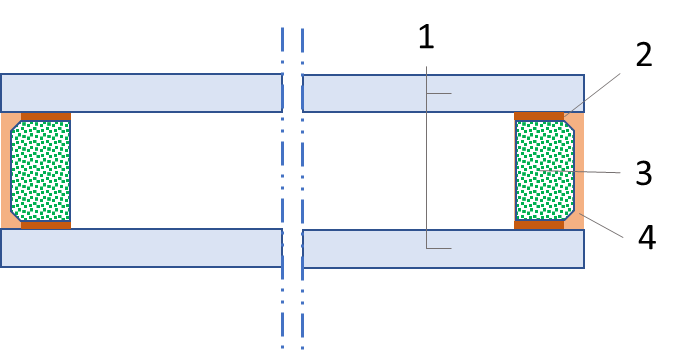
Unit of 2 or more panes of glass. Gas filling is used to set thermal transfer properties. Spacer defines the distance between the panes and also accounts for thermal properties. Sealants prevent loss of gas filling and entrance of humidity. Figure 1 shows a sectional drawing of an IGU with the different elements.
Figure 1 - Sectional drawing of an IGU | Key: 1 glass panes 2 primary sealing 3 spacers with desiccant 4 secondary sealing |
3.3.9 IGU Line
Production line for IGU´s.
3.3.10 Laminated Glass
Type of glass according to prEN12543-1:2020, e.g., glass that is made of two or more panes of glass joined together by a layer of plastic, or polyvinyl butyral (PVB).
3.4 Abbreviated terms
| AC | Alarm and Condition |
| CSV | Character-separated values |
| CVD | Chemical vapor deposition |
| DCS | Distributed Control Systems |
| DI | Device integration |
| ERP | Enterprise resource planning |
| FC | Foil coated |
| HC | Hard coated |
| HLS | Higher level system |
| ID | Identifier |
| IG | Insulating glass |
| IGU | Insulating glass unit |
| M | Mandatory |
| MES | Manufacturing execution system |
| O | Optional |
| OPC | Open platform communications |
| PVB | Polyvinyl butyral |
| PVD | Physical vapor deposition |
| RAMI 4.0 | Reference architecture model industry 4.0 |
| SC | Soft coated |
| SI | International system of units |
| TPS | Thermoplastic spacer |
| UA | Unified architecture |
| UD | User defined |
| URI | Uniform Resource Identifier |
| URL | Uniform resource locator |
| UTC | Coordinated universal time |
3.5 Conventions used in this document
3.5.1 Conventions for Node descriptions
3.5.1.1 Node definitions
Node definitions are specified using tables (see Table 2).
Attributes are defined by providing the Attribute name and a value, or a description of the value.
References are defined by providing the ReferenceType name, the BrowseName of the TargetNode and its NodeClass.
If the TargetNode is a component of the Node being defined in the table the Attributes of the composed Node are defined in the same row of the table.
The DataType is only specified for Variables; "[<number>]" indicates a single-dimensional array, for multi-dimensional arrays the expression is repeated for each dimension (e.g. [2][3] for a two-dimensional array). For all arrays the ArrayDimensions is set as identified by <number> values. If no <number> is set, the corresponding dimension is set to 0, indicating an unknown size. If no number is provided at all the ArrayDimensions can be omitted. If no brackets are provided, it identifies a scalar DataType and the ValueRank is set to the corresponding value (see OPC 10000-3). In addition, ArrayDimensions is set to null or is omitted. If it can be Any or ScalarOrOneDimension, the value is put into "{<value>}", so either "{Any}" or "{ScalarOrOneDimension}" and the ValueRank is set to the corresponding value (see OPC 10000-3) and the ArrayDimensions is set to null or is omitted. Examples are given in Table 1.
| Notation | DataType | ValueRank | ArrayDimensions | Description |
| 0:Int32 | 0:Int32 | -1 | omitted or null | A scalar Int32. |
| 0:Int32[] | 0:Int32 | 1 | omitted or {0} | Single-dimensional array of Int32 with an unknown size. |
| 0:Int32[][] | 0:Int32 | 2 | omitted or {0,0} | Two-dimensional array of Int32 with unknown sizes for both dimensions. |
| 0:Int32[3][] | 0:Int32 | 2 | {3,0} | Two-dimensional array of Int32 with a size of 3 for the first dimension and an unknown size for the second dimension. |
| 0:Int32[5][3] | 0:Int32 | 2 | {5,3} | Two-dimensional array of Int32 with a size of 5 for the first dimension and a size of 3 for the second dimension. |
| 0:Int32{Any} | 0:Int32 | -2 | omitted or null | An Int32 where it is unknown if it is scalar or array with any number of dimensions. |
| 0:Int32{ScalarOrOneDimension} | 0:Int32 | -3 | omitted or null | An Int32 where it is either a single-dimensional array or a scalar. |
The TypeDefinition is specified for Objects and Variables.
The TypeDefinition column specifies a symbolic name for a NodeId, i.e. the specified Node points with a HasTypeDefinition Reference to the corresponding Node.
The ModellingRule of the referenced component is provided by specifying the symbolic name of the rule in the ModellingRule column. In the AddressSpace, the Node shall use a HasModellingRule Reference to point to the corresponding ModellingRule Object.
If the NodeId of a DataType is provided, the symbolic name of the Node representing the DataType shall be used.
Note that if a symbolic name of a different namespace is used, it is prefixed by the NamespaceIndex (see 3.5.2.2).
Nodes of all other NodeClasses cannot be defined in the same table; therefore only the used ReferenceType, their NodeClass and their BrowseName are specified. A reference to another part of this document points to their definition. Table 2 illustrates the table. If no components are provided, the DataType, TypeDefinition and ModellingRule columns may be omitted and only a Comment column is introduced to point to the Node definition.
Each Type Node or well-known Instance Node defined shall have one or more ConformanceUnits defined in 9.2 that require the Node to be in the AddressSpace.
The relations between Nodes and ConformanceUnits are defined at the end of the tables defining Nodes, one row per ConformanceUnit. The ConformanceUnits are reflected in the Category element for the Node definition in the UANodeSet (see OPC 10000-6).
The list of ConformanceUnits in the UANodeSet allows Servers to optimize resource consumption by using a list of supported ConformanceUnits to select a subset of the Nodes in an Information Model.
When a Node is selected in this way, all dependencies implied by the References are also selected.
Dependencies exist if the Node is the source of HasTypeDefinition, HasInterface, HasAddIn or any HierarchicalReference. Dependencies also exist if the Node is the target of a HasSubtype Reference. For Variables and VariableTypes, the value of the DataType Attribute is a dependency. For DataType Nodes, any DataTypes referenced in the DataTypeDefinition Attribute are also dependencies.
For additional details see OPC 10000-5.
| Attribute | Value | ||||
| Attribute name | Attribute value. If it is an optional Attribute that is not set "--" will be used. | ||||
| References | NodeClass | BrowseName | DataType | TypeDefinition | Other |
|---|---|---|---|---|---|
| ReferenceType name | NodeClass of the target Node. | BrowseName of the target Node. | DataType of the referenced Node, only applicable for Variables. | TypeDefinition of the referenced Node, only applicable for Variables and Objects. | Additional characteristics of the TargetNode such as the ModellingRule or AccessLevel. |
| NOTE Notes referencing footnotes of the table content. | |||||
| Conformance Units | |||||
|---|---|---|---|---|---|
| Name of ConformanceUnit, one row per ConformanceUnit |
Components of Nodes can be complex that is containing components by themselves. The TypeDefinition, NodeClass and DataType can be derived from the type definitions, and the symbolic name can be created as defined in 3.5.3.1. Therefore, those containing components are not explicitly specified; they are implicitly specified by the type definitions.
The Other column defines additional characteristics of the Node. Examples of characteristics that can appear in this column are show in Table 3.
| Name | Short Name | Description |
| 0:Mandatory | M | The Node has the Mandatory ModellingRule. |
| 0:Optional | O | The Node has the Optional ModellingRule. |
| 0:MandatoryPlaceholder | MP | The Node has the MandatoryPlaceholder ModellingRule. |
| 0:OptionalPlaceholder | OP | The Node has the OptionalPlaceholder ModellingRule. |
| ReadOnly | RO | The Node AccessLevel has the CurrentRead bit set but not the CurrentWrite bit. |
| ReadWrite | RW | The Node AccessLevel has the CurrentRead and CurrentWrite bits set. |
| WriteOnly | WO | The Node AccessLevel has the CurrentWrite bit set but not the CurrentRead bit. |
If multiple characteristics are defined they are separated by commas. The name or the short name may be used.
3.5.1.2 Additional References
To provide information about additional References, the format as shown in Table 4 is used.
| SourceBrowsePath | Reference Type | Is Forward | TargetBrowsePath |
| SourceBrowsePath is always relative to the TypeDefinition. Multiple elements are defined as separate rows of a nested table. | ReferenceType name | True = forward Reference | TargetBrowsePath points to another Node, which can be a well-known instance or a TypeDefinition. You can use BrowsePaths here as well, which is either relative to the TypeDefinition or absolute. If absolute, the first entry needs to refer to a type or well-known instance, uniquely identified within a namespace by the BrowseName. |
References can be to any other Node.
3.5.1.3 Additional sub-components
To provide information about sub-components, the format as shown in Table 5 is used.
| BrowsePath | Reference | NodeClass | BrowseName | DataType | TypeDefinition | Others |
| BrowsePath is always relative to the TypeDefinition. Multiple elements are defined as separate rows of a nested table | NOTE Same as for Table 2 | |||||
3.5.1.4 Additional Attribute values
The type definition table provides columns to specify the values for required Node Attributes for InstanceDeclarations. To provide information about additional Attributes, the format as shown in Table 6 is used.
| BrowsePath | <Attribute name> Attribute |
| BrowsePath is always relative to the TypeDefinition. Multiple elements are defined as separate rows of a nested table | The values of attributes are converted to text by adapting the reversible JSON encoding rules defined in OPC 10000-6. If the JSON encoding of a value is a JSON string or a JSON number then that value is entered in the value field. Double quotes are not included. If the DataType includes a NamespaceIndex (QualifiedNames, NodeIds or ExpandedNodeIds) then the notation used for BrowseNames is used. If the value is an Enumeration the name of the enumeration value is entered. If the value is a Structure then a sequence of name and value pairs is entered. Each pair is followed by a newline. The name is followed by a colon. The names are the names of the fields in the DataTypeDefinition. If the value is an array of non-structures then a sequence of values is entered where each value is followed by a newline. If the value is an array of Structures or a Structure with fields that are arrays or with nested Structures then the complete JSON array or JSON object is entered. |
There can be multiple columns to define more than one Attribute.
3.5.2 NodeIds and BrowseNames
3.5.2.1 NodeIds
The NodeIds of all Nodes described in this standard are only symbolic names. Annex A defines the actual NodeIds.
The symbolic name of each Node defined in this document is its BrowseName, or, when it is part of another Node, the BrowseName of the other Node, a ".", and the BrowseName of itself. In this case "part of" means that the whole has a HasProperty or HasComponent Reference to its part. Since all Nodes not being part of another Node have a unique name in this document, the symbolic name is unique.
The NamespaceUri for all NodeIds defined in this document is defined in Annex A. The NamespaceIndex for this NamespaceUri is vendor-specific and depends on the position of the NamespaceUri in the server namespace table.
Note that this document not only defines concrete Nodes, but also requires that some Nodes shall be generated, for example one for each Session running on the Server. The NodeIds of those Nodes are Server-specific, including the namespace. But the NamespaceIndex of those Nodes cannot be the NamespaceIndex used for the Nodes defined in this document, because they are not defined by this document but generated by the Server.
3.5.2.2 BrowseNames
The text part of the BrowseNames for all Nodes defined in this document is specified in the tables defining the Nodes. The NamespaceUri for all BrowseNames defined in this document is defined in Annex A.
For InstanceDeclarations of NodeClass Object and Variable that are placeholders (OptionalPlaceholder and MandatoryPlaceholder ModellingRule), the BrowseName and the DisplayName are enclosed in angle brackets (<>) as recommended in OPC 10000-3.
If the BrowseName is not defined by this document, a namespace index prefix is added to the BrowseName (e.g., prefix '0' leading to '0:EngineeringUnits' or prefix '2' leading to '2:DeviceRevision'). This is typically necessary if a Property of another specification is overwritten or used in the OPC UA types defined in this document. Table 45 provides a list of namespaces and their indexes as used in this document.
3.5.3 Common Attributes
3.5.3.1 General
The Attributes of Nodes, their DataTypes and descriptions are defined in OPC 10000-3. Attributes not marked as optional are mandatory and shall be provided by a Server. The following tables define if the Attribute value is defined by this specification or if it is server-specific.
For all Nodes specified in this specification, the Attributes named in Table 7 shall be set as specified in the table.
| Attribute | Value |
| DisplayName | The DisplayName is a LocalizedText. Each server shall provide the DisplayName identical to the BrowseName of the Node for the LocaleId "en". Whether the server provides translated names for other LocaleIds is server-specific. |
| Description | Optionally a server-specific description is provided. |
| NodeClass | Shall reflect the NodeClass of the Node. |
| NodeId | The NodeId is described by BrowseNames as defined in 3.5.2.1. |
| WriteMask | Optionally the WriteMask Attribute can be provided. If the WriteMask Attribute is provided, it shall set all non-server-specific Attributes to not writable. For example, the Description Attribute may be set to writable since a Server may provide a server-specific description for the Node. The NodeId shall not be writable, because it is defined for each Node in this specification. |
| UserWriteMask | Optionally the UserWriteMask Attribute can be provided. The same rules as for the WriteMask Attribute apply. |
| RolePermissions | Optionally server-specific role permissions can be provided. |
| UserRolePermissions | Optionally the role permissions of the current Session can be provided. The value is server-specifc and depend on the RolePermissions Attribute (if provided) and the current Session. |
| AccessRestrictions | Optionally server-specific access restrictions can be provided. |
3.5.3.2 Objects
For all Objects specified in this specification, the Attributes named in Table 8 shall be set as specified in the table. The definitions for the Attributes can be found in OPC 10000-3.
| Attribute | Value |
| EventNotifier | Whether the Node can be used to subscribe to Events or not is server-specific. |
3.5.3.3 Variables
For all Variables specified in this specification, the Attributes named in Table 9 shall be set as specified in the table. The definitions for the Attributes can be found in OPC 10000-3.
| Attribute | Value |
| MinimumSamplingInterval | Optionally, a server-specific minimum sampling interval is provided. |
| AccessLevel | The access level for Variables used for type definitions is server-specific, for all other Variables defined in this specification, the access level shall allow reading; other settings are server-specific. |
| UserAccessLevel | The value for the UserAccessLevel Attribute is server-specific. It is assumed that all Variables can be accessed by at least one user. |
| Value | For Variables used as InstanceDeclarations, the value is server-specific; otherwise it shall represent the value described in the text. |
| ArrayDimensions | If the ValueRank does not identify an array of a specific dimension (i.e. ValueRank <= 0) the ArrayDimensions can either be set to null or the Attribute is missing. This behaviour is server-specific. If the ValueRank specifies an array of a specific dimension (i.e. ValueRank > 0) then the ArrayDimensions Attribute shall be specified in the table defining the Variable. |
| Historizing | The value for the Historizing Attribute is server-specific. |
| AccessLevelEx | If the AccessLevelEx Attribute is provided, it shall have the bits 8, 9, and 10 set to 0, meaning that read and write operations on an individual Variable are atomic, and arrays can be partly written. |
3.5.3.4 VariableTypes
For all VariableTypes specified in this specification, the Attributes named in Table 10 shall be set as specified in the table. The definitions for the Attributes can be found in OPC 10000-3.
| Attributes | Value |
| Value | Optionally a server-specific default value can be provided. |
| ArrayDimensions | If the ValueRank does not identify an array of a specific dimension (i.e. ValueRank <= 0) the ArrayDimensions can either be set to null or the Attribute is missing. This behaviour is server-specific. If the ValueRank specifies an array of a specific dimension (i.e. ValueRank > 0) then the ArrayDimensions Attribute shall be specified in the table defining the VariableType. |
3.5.3.5 Methods
For all Methods specified in this specification, the Attributes named in Table 11 shall be set as specified in the table. The definitions for the Attributes can be found in OPC 10000-3.
| Attributes | Value |
| Executable | All Methods defined in this specification shall be executable (Executable Attribute set to "True"), unless it is defined differently in the Method definition. |
| UserExecutable | The value of the UserExecutable Attribute is server-specific. It is assumed that all Methods can be executed by at least one user. |
3.5.4 Structures
OPC 10000-3 differentiates between different kinds of Structures. The following conventions explain, how these Structures shall be defined.
The first kind are Structures without optional fields where none of the fields allows subtype (except fields with abstract DataTypes). Its definition is in Table 12.
| Name | Type | Description |
| <someStructure> | structure | Subtype of <someParentStructure> defined in … |
SP1 | 0:Byte[] | Setpoint 1 |
SP2 | 0:Byte[] | Setpoint 2 |
The second kind are Structures with optional fields where none of the fields allows subtypes (except fields with abstract DataTypes). Its definition is in Table 13.
Structures with fields that are optional have an "Optional" column. Fields that are optional have True set, otherwise False.
| Name | Type | Description | Optional |
| <someStructure> | structure | Subtype of <someParentStructure> defined in … | |
SP1 | 0:Byte[] | Setpoint 1 | False |
SP2 | 0:Byte[] | Setpoint 2 | True |
The third kind are Structures without optional fields where one or more of the fields allow subtypes. Its definition is in Table 14.
Structures with fields that allow subtypes have an "Allow Subtypes" column. Fields that allow subtypes have True set, otherwise False. Fields with abstract DataTypes can always be subtyped.
| Name | Type | Description | Allow SubTypes |
| <someStructure> | structure | Subtype of <someParentStructure> defined in … | |
SP1 | 0:Byte[] | Setpoint 1 | False |
Allow Subtypes | 0:ByteString | Some Bytestring | True |
4 General information to glass technology and OPC UA
4.1 Introduction to glass technology
4.1.1 Overview
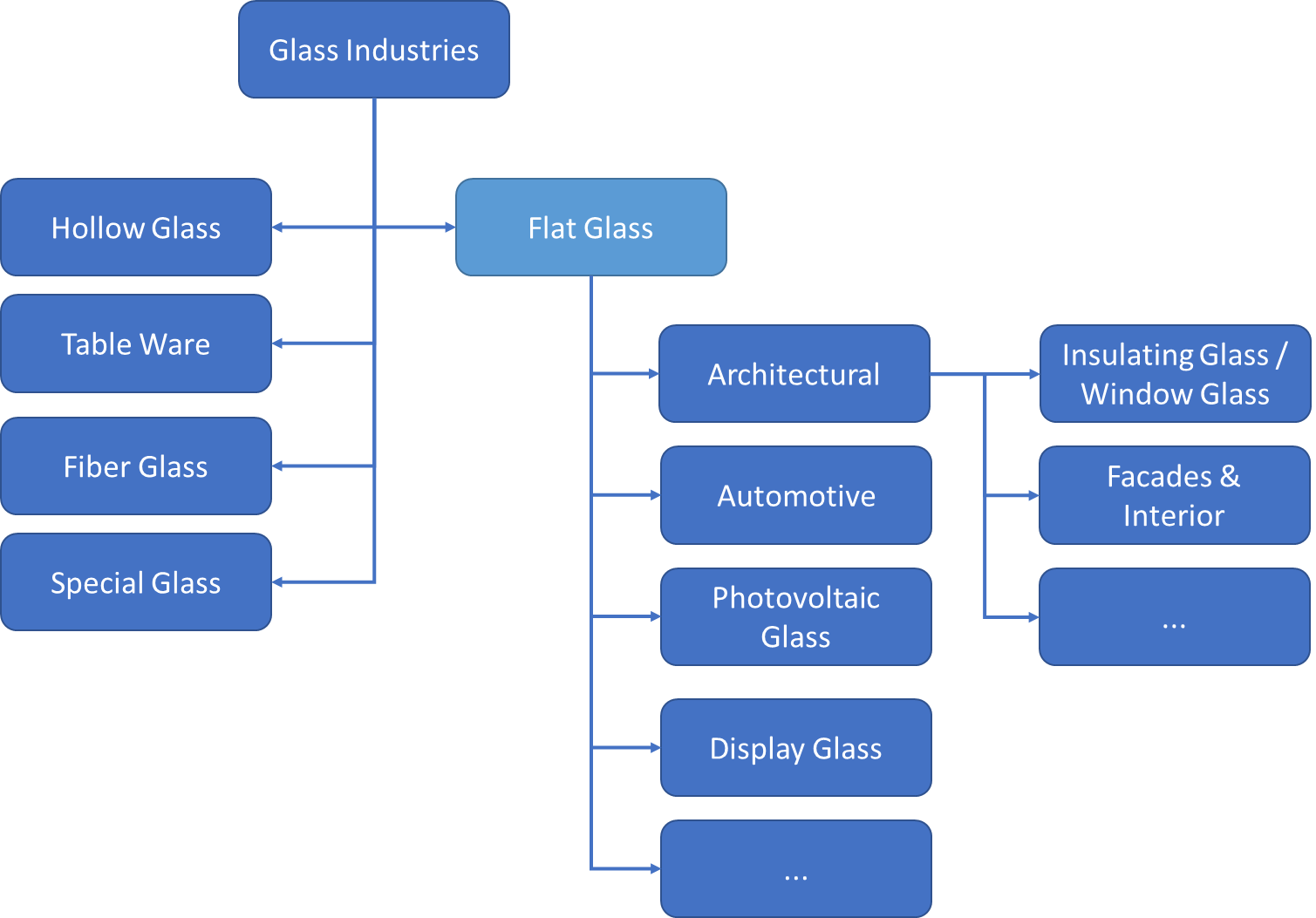
The glass industry is one of the base material industries that, on the one hand has a long tradition, and, on the other hand, is crucial for all modern applications. It ranges from, table ware, bottles for beverages and to perfume up to flat and bended glass for facades, windows, cars and technological applications such as for televisions and mobile devices. Figure 2 gives an overview of the glass domain. This specification only describes the flat glass domain. Other part will be defined OPC UA information models for other domains.
Focusing on flat glass, the principal process steps for flat glass products are shown in simplified form in Figure 3.
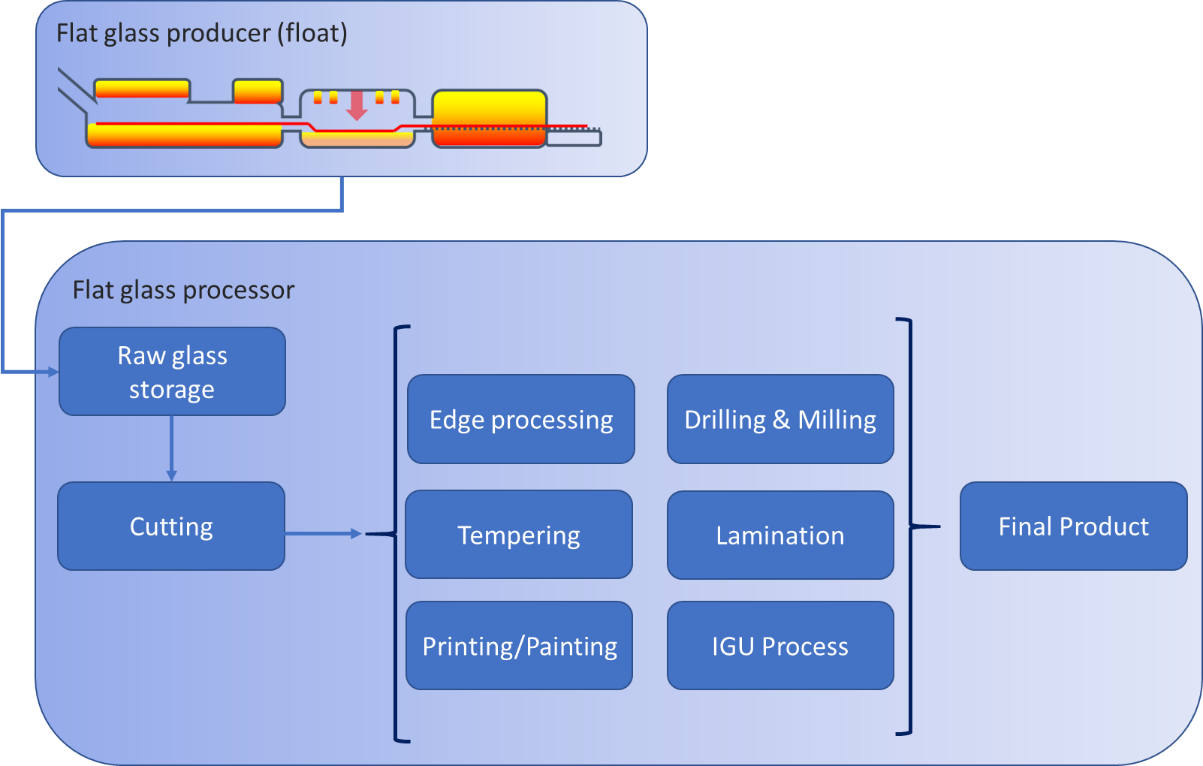
Flat glass can be produced in two ways. The first is by the use of the float process, a second possibility is the rolled glass process. Float glass producers hold large glass tanks to melt and pull glass in the desired thickness and application of required coating. Such glass with a thickness between 2 and 20 mm, typically cut to size of 6000 x 3210 mm and stocked on racks for transport, is typically the raw material for the flat glass processors. The flat glass processor transforms the raw glass into divers glass products of various sizes and shapes such as window glass, splash backs, shopfronts, stairs, tables etc. In any case, the cutting process is the most universal process that is required for basically all raw glass processings and therefore the example of flat glass cutting is used in the subsequent chapters as reference object. The most important processes are described in more detail below:
Cutting: mechanical flat glass cutting is a sequenced process in which:
a raw glass pane is transported from storage to the cutting table
the cutting pattern is inscribed onto the glass surface, e.g., by means of a very small sharpened stainless-steel wheel
the glass is broken along the prescribed lines by applicating a bending force, either manual or automatic
optional, there may be a grinding head mounted, allowing to eliminate existing glass coating on prescribed areas
special cutting for previously laminated glass, where as an additional process after the glass breaking the foil attaching the 2 glass panes is separated mostly by a thermomechanical process.
Processing: Flat glass processing can include :
Edge works, such as edge seaming, grinding and or polishing
Surface works, such as drilling holes or generating cut outs, required e.g. for inserting of hinges and handles as required for shower doors.
Heat treatment, like tempering to change tension and behaviour of glass, as e.g. required for car side windows (tempered glass which in case of break dissipates in small cullets)
Bending (heating plus application of gravity or pressing force) to change the glass shape into curved glass
Assembly: multiple glass panes may be assembled to (semi-) products
Lamination, in which multiple glass panes are glued together by means of interlaying thermoplastic foils. For this process the glass is first cleaned, then stacked with the interlayers and further processed in a thermopressure process to initiate the robustness of the product and the required transparency.
Insulating Glass production: for windows and facade elements in which two or more glass panes are assembled holding glass spacers between the glass elements. The resulting volume is in general filled with inert gas such as Argon to ensure high insulation values.
4.1.2 Relevance to OPC UA Model
For OPC UA modelling it is required to respect main characteristics of flat glass processing:
Glass processing is very individual and a good example of industrial batch size of a production.
As a result, all machinery must be able to receive information on single glass element base in contrast to mass production.
Glass processing is very often based on intensive co-working between machine and human. Thus, processes with non-digitized interfaces shall be possible.
4.1.3 Different kinds of processing
As the OPC UA model shall be universal for flat glass processing, resulting major requirements are deducted.
One of them is that we have different types of transformation processes:
One to many: Cutting, where raw glass panes are cut into multiple glass elements
One to one: Mainly single glass element transformation processes such as edge and surface works, heat treatment, painting
Many to one: Classical assembly processes such as lamination and insulating glass fabrication
4.1.3.1 Processing requirements
In order to establish an OPC UA Model suitable to the different processes, the main requirements of information transport and modelling, established over years in the glass industry, shall be integrated. A job is defined as concrete work order for one or more glass elements. For the transformation, the job may reference to preadjusted work recipes in the respective machines or production lines recipes by means
Jobs can be grouped in a job group (as a set of job in a fix order)
The order of jobs and of job groups may be changed
Each job group and job have a status (see ProductionStateMachine)
Each transformation process is one job, e.g.,
Cutting 100 raw glass panes requires 100 jobs as each pane will be cut in an individual pattern.
IGU Line production of a lot requires an individual setting for each glass element produced.
4.2 Introduction to OPC Unified Architecture
4.2.1 What is OPC UA?
OPC UA is an open and royalty free set of standards designed as a universal communication protocol. While there are numerous communication solutions available, OPC UA has key advantages:
A state of art security model (see OPC 10000-2).
A fault tolerant communication protocol.
An information modelling framework that allows application developers to represent their data in a way that makes sense to them.
OPC UA has a broad scope which delivers for economies of scale for application developers. This means that a larger number of high-quality applications at a reasonable cost are available. When combined with semantic models such as glass technology, OPC UA makes it easier for end users to access data via generic commercial applications.
The OPC UA model is scalable from small devices to ERP systems. OPC UA Servers process information locally and then provide that data in a consistent format to any application requesting data - ERP, MES, PMS, Maintenance Systems, HMI, Smartphone or a standard Browser, for examples. For a more complete overview see OPC 10000-1.
4.2.2 Basics of OPC UA
As an open standard, OPC UA is based on standard internet technologies, like TCP/IP, HTTP, Web Sockets.
As an extensible standard, OPC UA provides a set of Services (see OPC 10000-4) and a basic information model framework. This framework provides an easy manner for creating and exposing vendor defined information in a standard way. More importantly all OPC UA Clients are expected to be able to discover and use vendor-defined information. This means OPC UA users can benefit from the economies of scale that come with generic visualization and historian applications. This specification is an example of an OPC UA Information Model designed to meet the needs of developers and users.
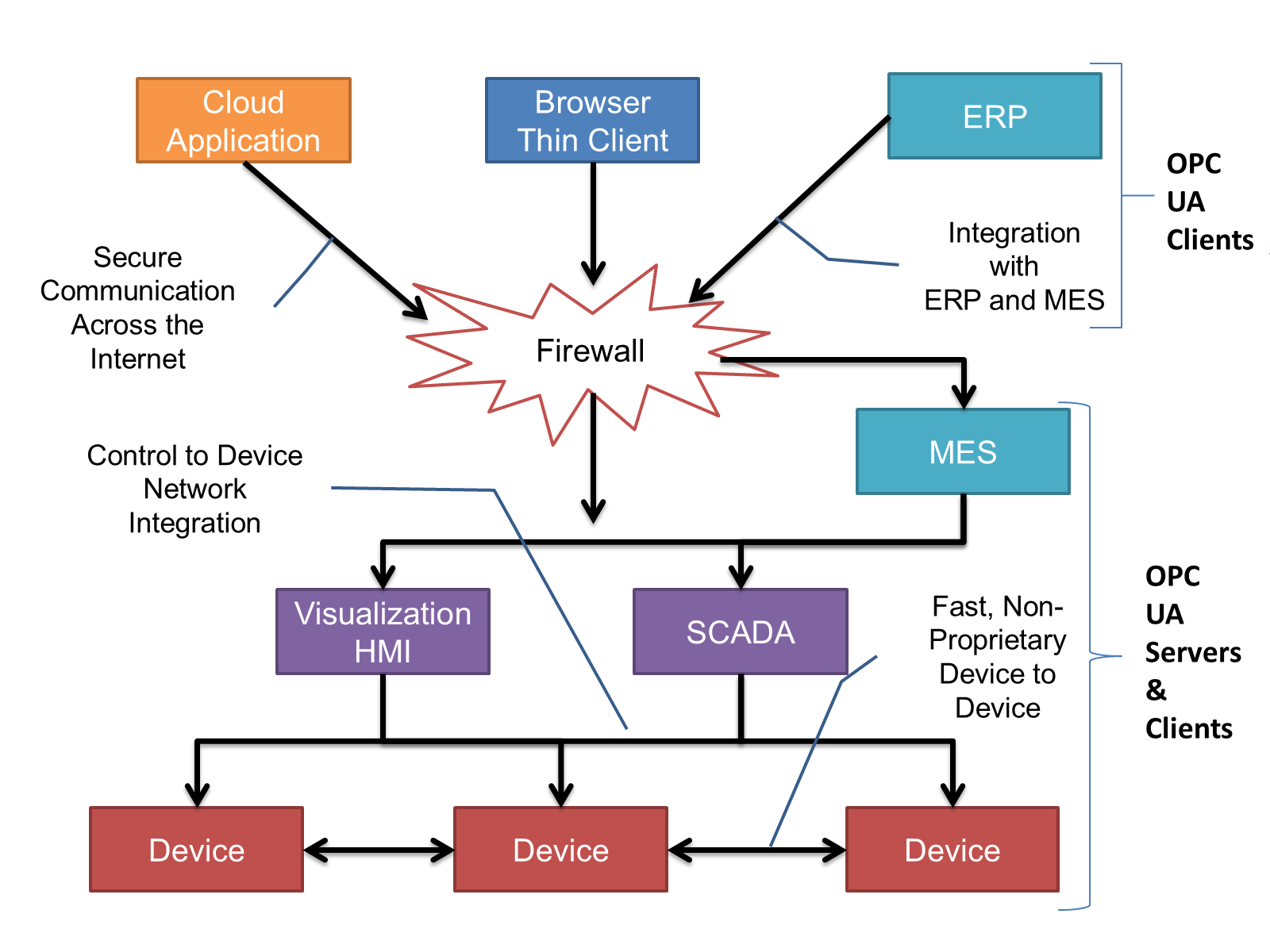
OPC UA Clients can be any consumer of data from another device on the network to browser based thin clients and ERP systems. The full scope of OPC UA applications is shown in Figure 4.
OPC UA provides a robust and reliable communication infrastructure having mechanisms for handling lost messages, failover, heartbeat, etc. With its binary encoded data, it offers a high-performing data exchange solution. Security is built into OPC UA as security requirements become more and more important especially since environments are connected to the office network or the internet and attackers are starting to focus on automation systems.
4.2.3 Information modelling in OPC UA
4.2.3.1 Concepts
OPC UA provides a framework that can be used to represent complex information as Objects in an AddressSpace which can be accessed with standard services. These Objects consist of Nodes connected by References. Different classes of Nodes convey different semantics. For example, a Variable Node represents a value that can be read or written. The Variable Node has an associated DataType that can define the actual value, such as a string, float, structure etc. It can also describe the Variable value as a variant. A Method Node represents a function that can be called. Every Node has a number of Attributes including a unique identifier called a NodeId and non-localized name called as BrowseName. An Object representing a 'Reservation' is shown in Figure 5.
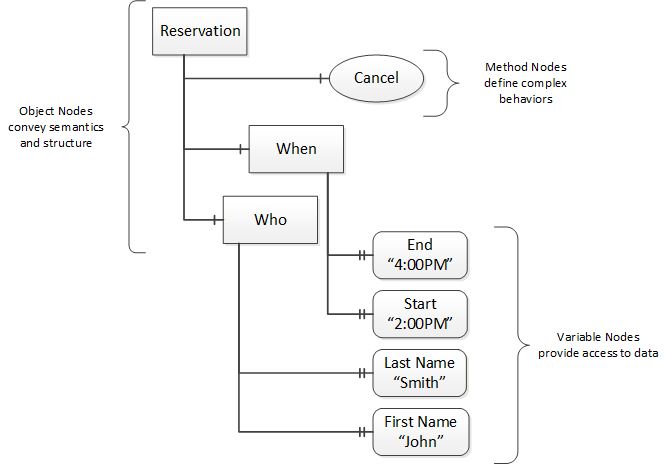
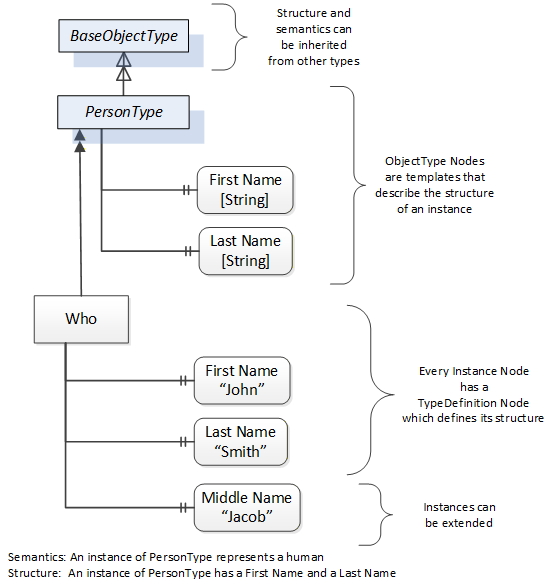
Object and Variable Nodes represent instances and they always reference a TypeDefinition (ObjectType or VariableType) Node which describes their semantics and structure. Figure 6 illustrates the relationship between an instance and its TypeDefinition.
The type Nodes are templates that define all of the children that can be present in an instance of the type. In the example in Figure 6 the PersonType ObjectType defines two children: First Name and Last Name. All instances of PersonType are expected to have the same children with the same BrowseNames. Within a type the BrowseNames uniquely identify the children. This means Client applications can be designed to search for children based on the BrowseNames from the type instead of NodeIds. This eliminates the need for manual reconfiguration of systems if a Client uses types that multiple Servers implement.
OPC UA also supports the concept of sub-typing. This allows a modeller to take an existing type and extend it. There are rules regarding sub-typing defined in OPC 10000-3, but in general they allow the extension of a given type or the restriction of a DataType. For example, the modeller may decide that the existing ObjectType in some cases needs an additional Variable. The modeller can create a subtype of the ObjectType and add the Variable. A Client that is expecting the parent type can treat the new type as if it was of the parent type. Regarding DataTypes, subtypes can only restrict. If a Variable is defined to have a numeric value, a sub type could restrict it to a float.
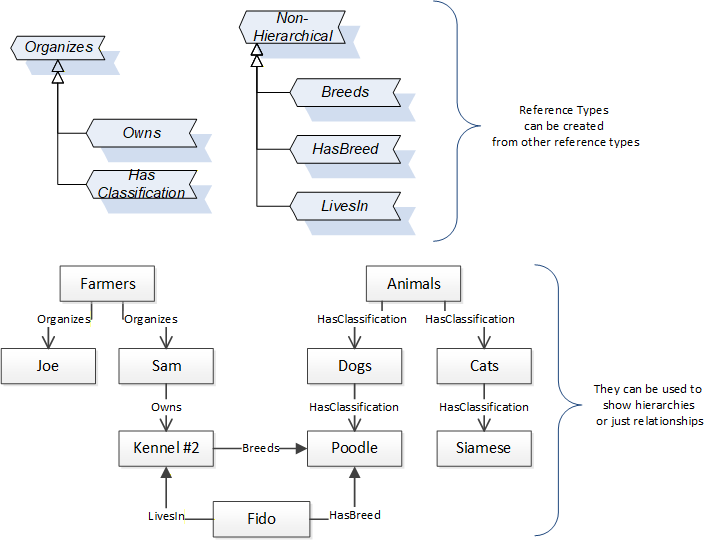
References allow Nodes to be connected in ways that describe their relationships. All References have a ReferenceType that specifies the semantics of the relationship. References can be hierarchical or non-hierarchical. Hierarchical references are used to create the structure of Objects and Variables. Non-hierarchical are used to create arbitrary associations. Applications can define their own ReferenceType by creating subtypes of an existing ReferenceType. Subtypes inherit the semantics of the parent but may add additional restrictions. Figure 7 depicts several References, connecting different Objects.
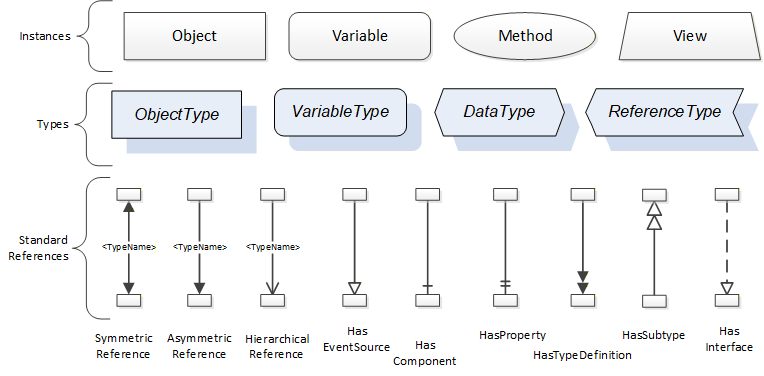
The figures above use a notation that was developed for the OPC UA specification. The notation is summarized in Figure 8. UML representations can also be used; however, the OPC UA notation is less ambiguous because there is a direct mapping from the elements in the figures to Nodes in the AddressSpace of an OPC UA Server.
A complete description of the different types of Nodes and References can be found in OPC 10000-3 and the base structure is described in OPC 10000-5.
OPC UA specification defines a very wide range of functionality in its basic information model. It is not required that all Clients or Servers support all functionality in the OPC UA specifications. OPC UA includes the concept of Profiles, which segment the functionality into testable certifiable units. This allows the definition of functional subsets (that are expected to be implemented) within a companion specification. The Profiles do not restrict functionality, but generate requirements for a minimum set of functionality (see OPC 10000-7)
4.2.3.2 Namespaces
OPC UA allows information from many different sources to be combined into a single coherent AddressSpace. Namespaces are used to make this possible by eliminating naming and id conflicts between information from different sources. Each namespace in OPC UA has a globally unique string called a NamespaceUri which identifies a naming authority and a locally unique integer called a NamespaceIndex, which is an index into the Server's table of NamespaceUris. The NamespaceIndex is unique only within the context of a Session between an OPC UA Client and an OPC UA Server- the NamespaceIndex can change between Sessions and still identify the same item even though the NamespaceUri's location in the table has changed. The Services defined for OPC UA use the NamespaceIndex to specify the Namespace for qualified values.
There are two types of structured values in OPC UA that are qualified with NamespaceIndexes: NodeIds and QualifiedNames. NodeIds are locally unique (and sometimes globally unique) identifiers for Nodes. The same globally unique NodeId can be used as the identifier in a node in many Servers - the node's instance data may vary but its semantic meaning is the same regardless of the Server it appears in. This means Clients can have built-in knowledge of of what the data means in these Nodes. OPC UA Information Models generally define globally unique NodeIds for the TypeDefinitions defined by the Information Model.
QualifiedNames are non-localized names qualified with a Namespace. They are used for the BrowseNames of Nodes and allow the same names to be used by different information models without conflict. TypeDefinitions are not allowed to have children with duplicate BrowseNames; however, instances do not have that restriction.
4.2.3.3 Companion Specifications
An OPC UA companion specification for an industry specific vertical market describes an Information Model by defining ObjectTypes, VariableTypes, DataTypes and ReferenceTypes that represent the concepts used in the vertical market, and potentially also well-defined Objects as entry points into the AddressSpace.
5 Use cases
5.1 Basic
5.1.1 Machine Identification to control systems
Control systems shall be able to identify a glass processing machine in a standardized way within an accessible environment. For this purpose, a minimum amount of information specified in the Companion Specification is transmitted from the machine to the control system. This includes basic data about the machine-like serial number, manufacturer, production data, etc. Also, information that is useful for job planning is included, so that the machine is only supplied with suitable jobs. Furthermore, the control system is informed of the storage location of the machine documentation. The ObjectTypes from OPC UA for Machinery are used. Detailed description of the Types can be found in section 7.2.
5.1.2 Request of machine status
Control systems shall be able to request the current status of a specific glass processing machine. The machine supplies at least the dynamic information specified in the Companion Specification with the job state machine and events. In addition, the machine status of to obtain an overall status of the machine.
5.1.3 Request of machine documentation
The machine provides its own documentation. This documentation is either stored directly on the machine or somewhere external, in which case an URL is provided. If a user or another party (e.g. document management system) needs the machine documentation, it can be requested via OPC UA from the server of the machine. This information can be found in the identification section (see 7.3).
5.1.4 Identification of logged in users
It is possible to query a list of the currently logged in users (local and connected via OPC UA) and their characteristics (e.g. language, access level) via the OPC UA server of the machine. This information can be found in the identification section (see 7.2).
5.1.5 Identification of the capabilities of a machine
The control system can query the process capabilities of the glass processing machine from the OPC UA server. In the case of an IGU line, for example, this can be the maximum possible window size. Furthermore, active and temporarily inactive capabilities are distinguished. For example, if a cutting table can basically cut 10 mm thick glass, but the currently used cutting wheel can only cut up to 5 mm thick. This use case is not implemented in the current version, but should be defined in further versions.
5.2 Job
5.2.1 Job Management
The Job Management for the machines of the GlassMachineType are implemented via the JobManagement provided in the Machinery Job Management (see 7.1.3).
6 Glass technology Information Model overview
This chapter introduces the "OPC UA Information Model for Glass technology - flat glass".
This Information Model provides the necessary ObjectTypes to model a glass machine interface in a structure as illustrated in Figure 9 There are ObjectTypes that are used to identify the machine (GlassMachineIdentificationType), to manage the production (Production Type) on the machine and to get the manuals for operation or maintenance (ManualsFolderType).
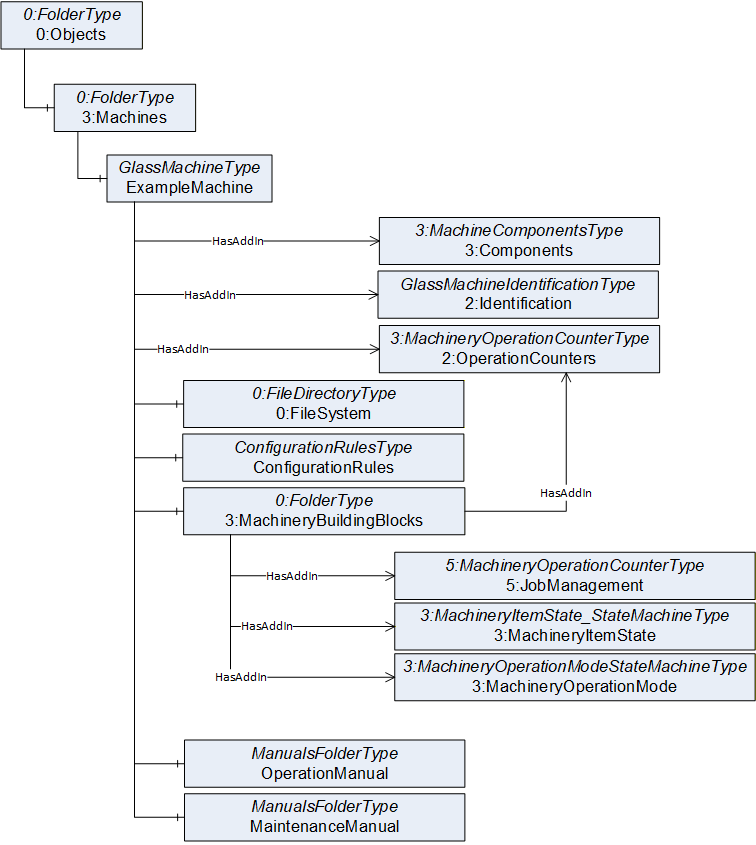
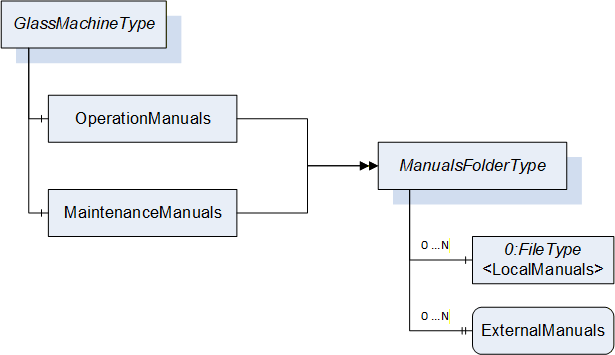
The ObjectType hierarchy of this Companion Specification is shown within Figure 10 to Figure 12. Objects from external specifications are positioned within greyish-green boxes.
Figure 10 shows the inheritance relations of the GlassMachineType and all direct children. In this picture the optional components are shown with a dashed line.
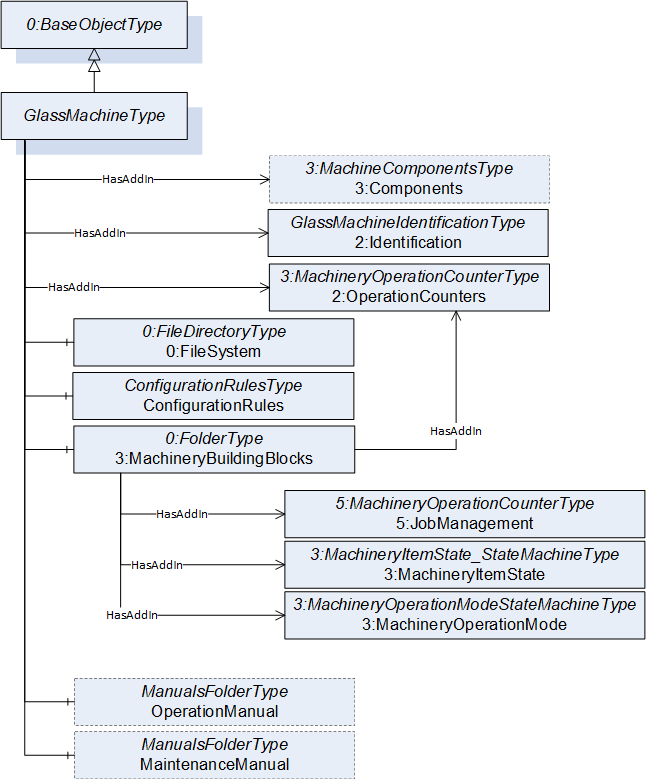
Figure 11 shows the inheritance hierarchy of all ObjectTypes used in the glass technology Identification component.
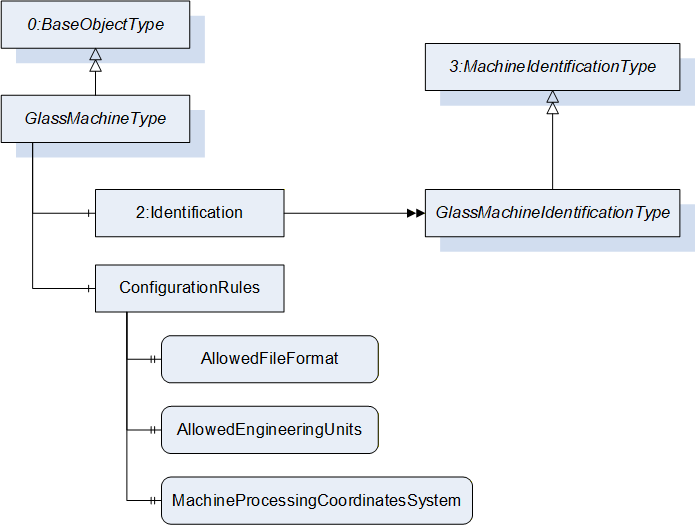
Figure 12 shows the inheritance hierarchy of all ObjectTypes used in the glass technology as manual component.
7 OPC UA ObjectTypes
7.1 GlassMachineType ObjectType definition
7.1.1 Overview
The GlassMachineType provides the information of the machine and is formally defined in Table 15. A Machine or system can contain other subsystems (e.g. other machines or devices). Such a complex system can be modelled with the component structure from OPC UA Machinery (see OPC 40000-1 section 11).
This GlassMachine object can be further divided into subtypes using the modular device structure from OPC UA for Machinery.
7.1.2 ObjectType definition
| Attribute | Value | ||||
| BrowseName | GlassMachineType | ||||
| IsAbstract | False | ||||
| References | Node Class | BrowseName | DataType | TypeDefinition | Other |
|---|---|---|---|---|---|
| Subtype of the 0:BaseObjectType defined in OPC 10000-5 | |||||
| 0:HasAddIn | Object | 3:Components | 3:MachineComponentsType | O | |
| 0:HasComponent | Object | ConfigurationRules | ConfigurationRulesType | M | |
| 0:HasComponent | Object | 0:FileSystem | 0:FileDirectoryType | M | |
| 0:HasAddIn | Object | 2:Identification | GlassMachineIdentificationType | M | |
| 0:HasComponent | Object | 3:MachineryBuildingBlocks | 0:FolderType | M | |
| 0:HasComponent | Object | MaintenanceManuals | ManualFolderType | O | |
| 0:HasComponent | Object | OperationManuals | ManualFolderType | O | |
| 0:HasAddIn | Object | 2:OperationCounters | 3:MachineryOperationCounterType | M | |
| Conformance Units | |||||
|---|---|---|---|---|---|
| FlatGlass_GlassMachineType |
3:Components contains components or submachines of the glass machine.
ConfigurationRules contains the properties that describe the machine configuration.
The FileSystem is the root of all file directories of the OPC UA and the underlying machine.
2:Identification contains the information to identify the glass machine. For more information see GlassMachineIdentificationType and OPC 40001-1(3:MachineIdentificationType).
3:MachineryBuildingBlocks contains all machinery building blocks. See Table 16 for more information.
MaintenanceManuals contains the manuals or the references to the manuals for the maintenance process.
OperationManuals contains the manuals or the references to the manuals for the operation process.
2:OperationCounters provides the information, how long a MachineryItem is turned on and how long it performed an activity
The components of the GlassMachineType have additional references which are defined in Table 16.
| SourceBrowsePath | Reference Type | Is Forward | TargetBrowsePath |
| 3:MachineryBuildingBlocks | 0:HasAddIn | True | 2:OperationCounters |
The components of the GlassMachineType have additional subcomponents which are defined in Table 17.
| BrowsePath | References | NodeClass | BrowseName | DataType | TypeDefinition | Others |
| 3:MachineryBuildingBlocks | 0:HasAddIn | Object | 3:MachineryItemState | 3:MachineryItemState_StateMachineType | M | |
| 3:MachineryBuildingBlocks | 0:HasAddIn | Object | 3:MachineryOperationMode | 3:MachineryOperationModeStateMachineType | M | |
| 3:MachineryBuildingBlocks | 0:HasAddIn | Object | 5:JobManagement | 5:JobManagementType | M |
7.1.3 Additional Information about the Job Management
7.1.3.1 Overview
OPC 10031-4 defines mechanisms to add job order information using the 2:ISA95JobOrderDataType and mechanisms getting the result or current status of the job order using the 2:ISA95JobResponseDataType. Both DataTypes define arrays of properties of a job order: general, personal, equipment, physical assets, and material. The 2:ISA95JobOrderDataType uses the general properties to describe the job order and the other properties to define the requirements, whereas the 2:ISA95JobResponseDataType uses the general properties to describe the output and the other properties to provide the information what has been used.
OPC UA Machinery Job Management (OPC 40001-3) standardizes some of those parameters, which are application-specific from the view of OPC 10031-4.
The guidelines and extensions specified in this section are designed to complement the foundational models, providing a structured framework for implementation. The Optional element (e.g. fields or parameters) of the OPC 10031-4 or OPC 40001-3 may be used as defined.
7.1.3.2 Management of WorkMaster and WorkMaster files
This specification use the 0:FileSystem folder to manage(e.g. upload /download files) the work master files on the server. To connect the WorkMasterID with the file additional predefined key-value pairs for 2:ISA95WorkMasterDataType.Parameter are defined in Table 18.
| ID | DataType of Value | Description | EngineeringUnits | Subparameters |
|---|---|---|---|---|
| LocalPath | String | Contains the file path on the OPC UA server. This must be identical with the relative path of the BrowsePath. | - | - |
| FileNodeId | 0:NodeID | Contains the NodeId of the object of the file. | - | - |
| FileFormat | FileFormatType | Defines the file format of the work master file. This is used to ensure compatibility between the work master and the machine. |
7.1.3.2.1 Untitled
7.1.3.3 ISA95JobOrderDataType Fields
7.1.3.4 Predefined JobOrderParameters and JobResponseData
This specification standardizes some of those parameters, which are application-specific from the view of OPC 10031-4.
In Table 19, predefined key-value pairs for 2:JobOrderParameters and 2:JobResponseData is provided. The table indicates, in which data structure the key-value pair is expected to be used. An "X" in "In" indicates it may be used in 2:JobOrderParameters an "X" in "Out" indicates it may be used in 2:JobResponseData.
| ID | DataType of Value | Description | EngineeringUnits | Subparameters | In | Out |
|---|---|---|---|---|---|---|
| ReasonForSubState | ReasonDescriptionType | Provides an explanation for the current status of the job. This information may be used, for instance, to detail why the server is unable to perform a particular job. | - | - | x | x |
7.1.3.5 ISA95JobResponseDataType Fields
7.2 GlassMachineIdentificationType ObjectType Definition
The GlassMachineIdentificationType provides the information about the identification process and is formally defined in Table 20.
| Attribute | Value | ||||
| BrowseName | GlassMachineIdentificationType | ||||
| IsAbstract | False | ||||
| References | Node Class | BrowseName | DataType | TypeDefinition | Other |
|---|---|---|---|---|---|
| Subtype of the 3:MachineIdentificationType defined in OPC40001-1 | |||||
| 0:HasProperty | Variable | LoggedInProfiles | UserProfileDataType[] | 0:PropertyType | O |
| 0:HasProperty | Variable | ProcessingCategories | ProcessingCategoryDataType[] | 0:PropertyType | M |
| Conformance Units | |||||
|---|---|---|---|---|---|
| FlatGlass_GlassMachineIdentificationType |
LoggedInProfiles contains a list of logged (local and via OPC UA) in user profiles at the machine.
ProcessingCategories contains the list of processing categories, which group together processes that the machine is capable of performing. At least one process from each category can be executed by the machine, allowing higher-level systems to identify the capabilities of the machine. However, these processing categories may not be sufficient for a tooling audit, as they provide a general overview rather than detailed, specific process capabilities.
7.3 ManualFolderType ObjectType Definition
The ManualFolderType provides information about the manuals and is formally defined in Table 21.
| Attribute | Value | ||||
| BrowseName | ManualFolderType | ||||
| IsAbstract | False | ||||
| References | Node Class | BrowseName | DataType | TypeDefinition | Other |
|---|---|---|---|---|---|
| Subtype of the 0:FolderType defined in OPC 10000-5 | |||||
| 0:HasComponent | Object | <LocalManuals> | 0:FileType | OP | |
| 0:HasProperty | Variable | ExternalManuals | 0:UriString[] | 0:PropertyType | O |
| Conformance Units | |||||
|---|---|---|---|---|---|
| FlatGlass_ManualFolderType |
<LocalManuals> contains all manuals, which are stored on the machine control memory and can be accessed via OPC UA.
ExternalManuals contains URIs (by RFC 3986) of manuals, which are stored on external systems. Example: https://example.com/manual/5789; ftp://example.com/manual/234985923
7.4 ConfigurationRulesType ObjectType Definition
The ConfigurationRulesType provides information about the configuration of the machine. This includes all nodes in the OPC UA address space that are related to the machine. It also contains the possible file format and units, which can be handeled by the server. It is formally defined in Table 22.
| Attribute | Value | ||||
| BrowseName | ConfigurationRulesType | ||||
| IsAbstract | False | ||||
| References | Node Class | BrowseName | DataType | TypeDefinition | Other |
|---|---|---|---|---|---|
| Subtype of the BaseObjectType defined in OPC 10000-5 | |||||
| 0:HasProperty | Variable | AllowedFileFormats | FileFormatDataType[] | 0:PropertyType | O |
| 0:HasProperty | Variable | AllowedEngineeringUnits | 0:EUInformation[] | 0:PropertyType | O |
| 0:HasProperty | Variable | MachineProcessingCoordinateSystem | CoordinateSystemEnumeration | 0:PropertyType | M |
| Conformance Units | |||||
|---|---|---|---|---|---|
| FlatGlass_ConfigurationRulesType |
AllowedFileFormats contains all file formats allowed for this machine. A file format describes the syntax and semantic of a document. If there are different versions allowed all must be added.
AllowedEngineeringUnits contains an array of engineering units that can be handled by the OPC UA server for this machine. A machine that supports a method with the input argument EUInformation must also provide this array.
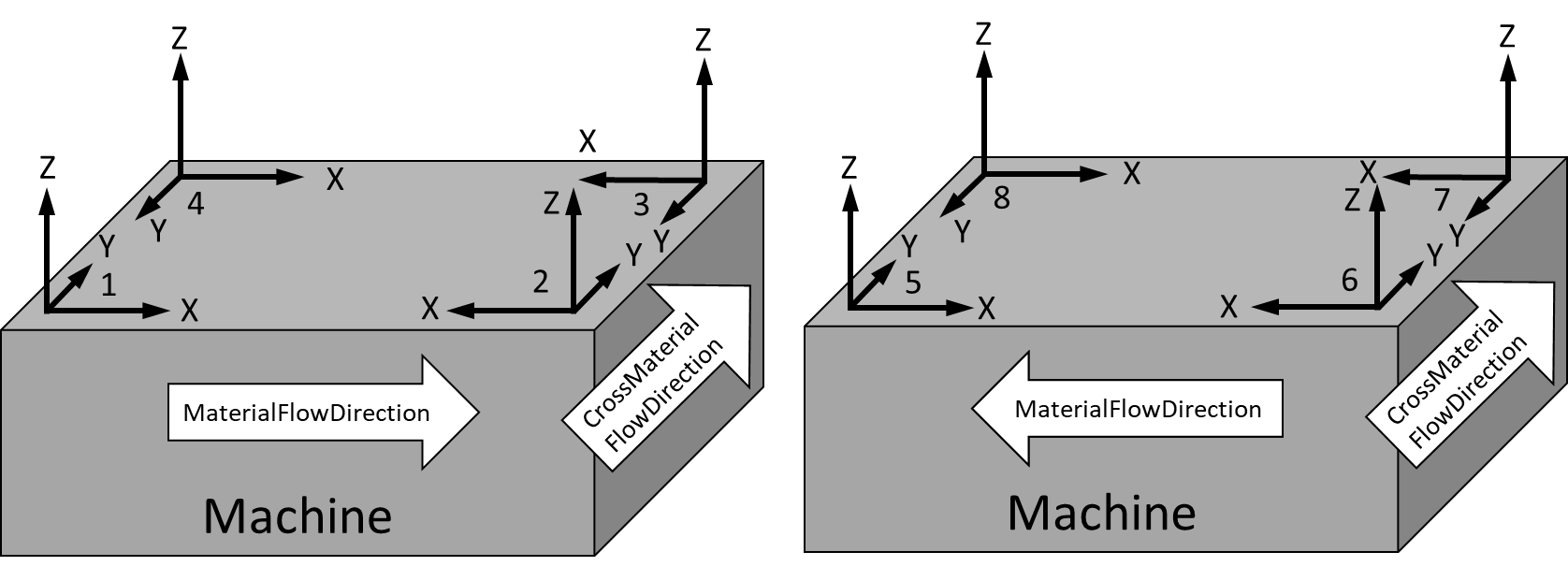
MachineProcessingCoordinateSystem specifies where the machine coordinate origin is located and in which direction the axes are pointing.
8 OPC UA DataTypes
8.1 UserProfileDataType
This structure contains the information about a logged in user with his profile data. The structure is defined in Table 23.
| Name | Type | Description |
| UserProfileDataType | structure | Subtype of Structure defined in OPC UA 10000-5 |
Name | 0:String | Human-readable name of the user profile. |
LoginTime | 0:DateTime | Date and Time in UTC this profile is logged in. |
Language | 0:LocaleId | The Language that is configured for the user |
MeasurementFormat | 0:String | Defines which system of measurement (collection of units of measurement) is used. Use "SI" for the International System of Units. |
AccessLevel | 0:String | Describes the access right the user Profile has. This is a human readable string and should be in English language, e.g. "Administrator" |
OpcUaUser | 0:Boolean | This flag is true if the user is logged in via OPC UA. If it is false the user is logged in another way e.g. as local user. |
Its representation in the AddressSpace is defined in Table 24.
| Attribute | Value | ||||
| BrowseName | UserProfileDataType | ||||
| IsAbstract | False | ||||
| References | Node Class | BrowseName | DataType | TypeDefinition | Other |
|---|---|---|---|---|---|
| Subtype of Structure defined in OPC UA 10000-5 | |||||
| Conformance Units | |||||
|---|---|---|---|---|---|
| FlatGlass_UserProfileDataType |
8.2 FileFormatDataType
A file format describes the syntax and semantic of a document. This structure contains the information about a file format. The structure is defined in Table 25. If there are different version allowed all must be added.
| Name | Type | Description |
| FileFormatDataType | structure | Subtype of Structure defined in OPC UA 10000-5 |
Name | 0:String | The Name of the FileFormat. The following strings are examples for a FileFormat Name: "Edicut", "Lisec.TRF", "Lenhardt" |
FileExtension | 0:String | Is the identifier specified as a suffix to the name of a file. The FileExtention has a leading dot. So, the FileExtension should be look like ".nc",".json",".edi" |
Version | 0:SemanticVersionString | Version of the FileFormat. Syntax is major.minor[.build] (example 2.5 or 5.9.2) |
Its representation in the AddressSpace is defined in Table 26.
| Attribute | Value | ||||
| BrowseName | FileFormatDataType | ||||
| IsAbstract | False | ||||
| References | Node Class | BrowseName | DataType | TypeDefinition | Other |
|---|---|---|---|---|---|
| Subtype of Structure defined in OPC UA 10000-5 | |||||
| Conformance Units | |||||
|---|---|---|---|---|---|
| FlatGlass_FileFormatDataType |
8.3 ReasonDescriptionType
This structure contains the information about a reason for a state or status e.g., the reason why a job is in the State "NotAllowToRun". The structure is defined inTable 27. If there are different version allowed all must be added.
| Name | Type | Description | Optional |
| ReasonDescriptionType | structure | Subtype of Structure defined in OPC UA 10000-5 | |
Description | 0:LocalizedText | The description is a human-readable text that describes the reason oft he state or status | False |
Reference | 0:String | Reference to the source of a reason. This can be an identifiable element in the WorkMaster or an NodeId | True |
Category | 0:String | The category helps classify the reason, and the following categories should be used:NoDetails MaterialRelated ToolRelated WorkMasterParsingInvalid WorkMasterRelated Restrictions SafetyRelated Other | True |
VendorCode | 0:String | A vendor-specific code may be included, which can be utilized for automatic recovery. | True |
Its representation in the AddressSpace is defined in Table 28.
| Attribute | Value | ||||
| BrowseName | ReasonDescriptionType | ||||
| IsAbstract | False | ||||
| References | Node Class | BrowseName | DataType | TypeDefinition | Other |
|---|---|---|---|---|---|
| Subtype of Structure defined in OPC UA 10000-5 | |||||
| Conformance Units | |||||
|---|---|---|---|---|---|
| FlatGlass_ReasonDescriptionType |
8.4 CoordinateSystemEnumeration
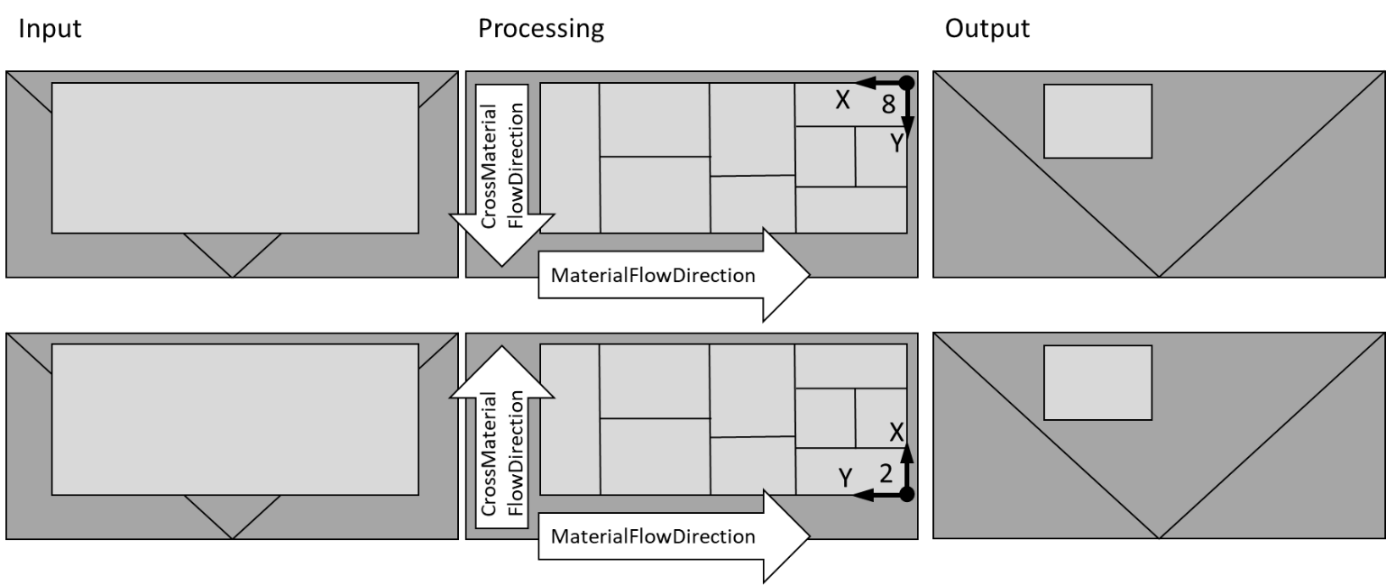
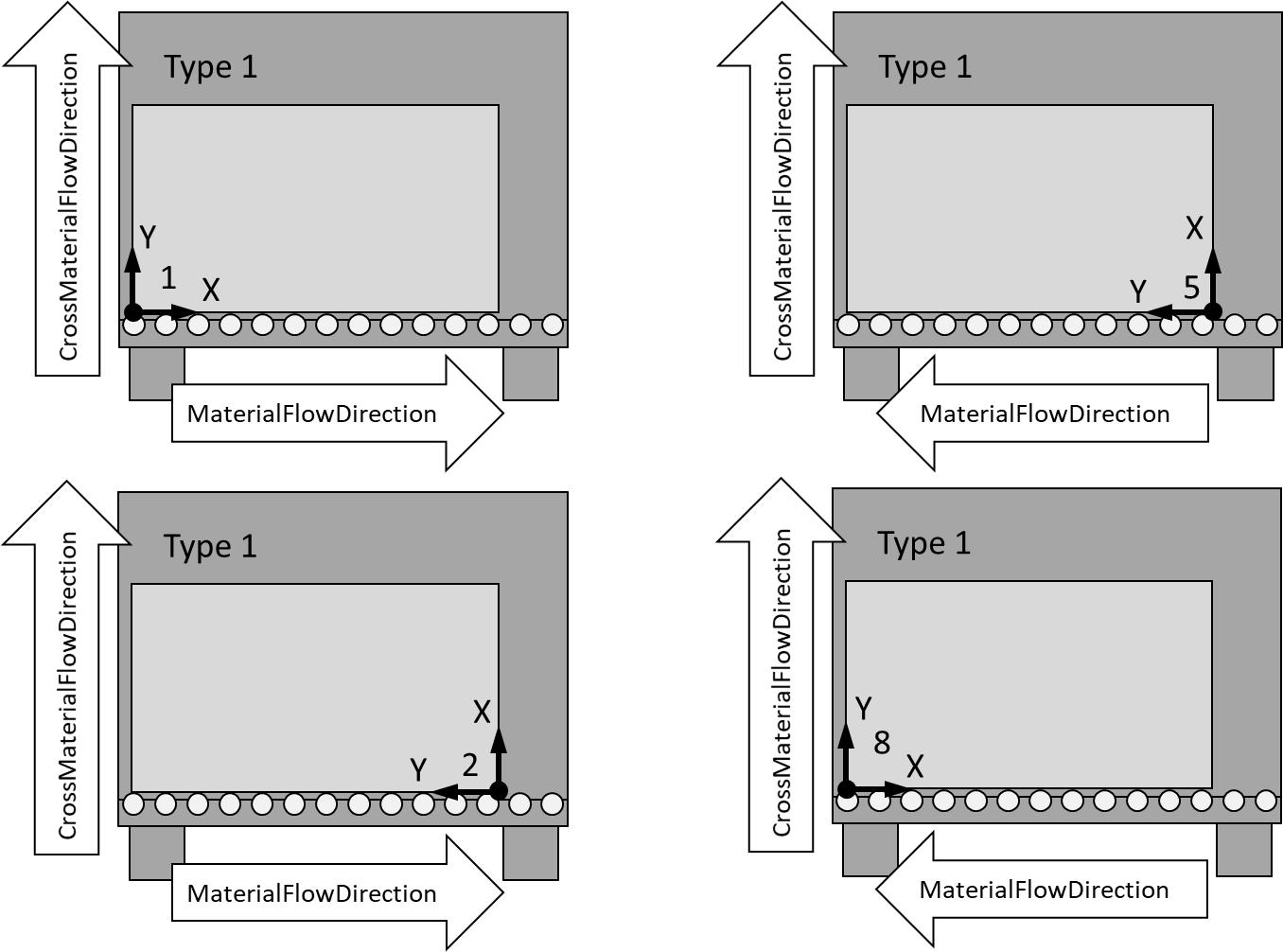
This enumeration specifies the different options in placing the machine processing coordinate systems. The eight different options are shown in Figure 13, as well as some examples in Figure 14 and Figure 15.
This enumeration is defined in Table 29.
Its representation in the AddressSpace is defined in Table 30.
8.5 ProcessingParameterDataType
The structure is defined in Table 31. If there are different version allowed all must be added.
| Name | Type | Description |
| ProcessingParameterDataType | structure | Subtype of Structure defined in OPC UA 10000-5 |
Name | 0:String | The identifier for the ProcessingParameter. |
Description | 0:String | A description of the ProcessingParameter. |
ValueType | ValueDataType | Definition of the types of values (e.g.; string, percentages, etc.). See 8.8 ValueDataType. |
TypicalValue | 0:String | Specification of a typical value for the ProcessingParameter. |
Mandatory | 0:Boolean | Specification of whether the ProcessingParameter is mandatory. |
EClass | EClassTermDataType | Semantic EClass identifier |
Its representation in the AddressSpace is defined in Table 32.
| Attribute | Value | ||||
| BrowseName | ProcessingParameterDataType | ||||
| IsAbstract | False | ||||
| References | Node Class | BrowseName | DataType | TypeDefinition | Other |
|---|---|---|---|---|---|
| Subtype of Structure defined in OPC UA 10000-5 | |||||
| Conformance Units | |||||
|---|---|---|---|---|---|
| FlatGlass_ProcessingParameterDataType |
8.6 ProcessingCategoryDataType
The structure is defined in Table 33. If there are different version allowed all must be added.
| Name | Type | Description | Other |
| ProcessingCategoryDataType | structure | Subtype of Structure defined in OPC UA 10000-5 | |
ID | 0:String | The identifier for the ProcessingCategory from the predefined table above, a mandatory entry in int32 format. | M |
Description | 0:String | A description of the ProcessingCategory. | O |
SupportedParameter | ProcessingParameterDataType[] | One or more SupportedParameter for the ProcessingCategory. | O |
SupportedAssignment | 0:String[] | One or more SupportedAssignment for the ProcessingCategory | O |
SupportedVariable | ProcessingParameterDataType[] | Vendor-specific names | O |
SupportsTransformation | 0:Int32 | An integer value indicating whether transformation support is not provided (0), optional (1), or mandatory (2) | O |
SupportsSubProcessing | 0:Int32 | An integer value showing whether the category optionally (1) or mandatorily (2) supports sub-processings, or does not support them at all (0). | O |
Its representation in the AddressSpace is defined in Table 34.
| Attribute | Value | ||||
| BrowseName | ProcessingCategoryDataType | ||||
| IsAbstract | False | ||||
| References | Node Class | BrowseName | DataType | TypeDefinition | Other |
|---|---|---|---|---|---|
| Subtype of Structure defined in OPC UA 10000-5 | |||||
| Conformance Units | |||||
|---|---|---|---|---|---|
| FlatGlass_ProcessingCategoryDataType |
8.7 EClassTermDataType
The structure is defined in Table 35. If there are different version allowed all must be added.
| Name | Type | Description |
| EClassTermDataType | structure | Subtype of Structure defined in OPC UA 10000-5 |
ID | 0:String | A internal identifier for the EClassTerm which is not part of the EClass dictionary |
Description | 0:String | A description of the EClassTerm |
EClass | 0:String | The unique EClass identifier e.g. 0173-1#02-AAO742#002 |
Its representation in the AddressSpace is defined in Table 36.
| Attribute | Value | ||||
| BrowseName | EClassTermDataType | ||||
| IsAbstract | False | ||||
| References | Node Class | BrowseName | DataType | TypeDefinition | Other |
|---|---|---|---|---|---|
| Subtype of Structure defined in OPC UA 10000-5 | |||||
| Conformance Units | |||||
|---|---|---|---|---|---|
| FlatGlass_EClassTermDataType |
8.8 ValueDataType
The structure is defined in Table 37. If there are different version allowed all must be added.
| Name | Type | Description |
| ValueDataType | structure | Subtype of Structure defined in OPC UA 10000-5 |
Name | 0:String | The identifier for the ValueDataType |
Description | 0:String | A description of the ValueDataType |
BaseUnit | 0:String | An optional string to define the unit of measurement for the ValueDataType. |
PossibleValue | 0:String | An optional string to define a list of possible values for the ValueDataType |
Its representation in the AddressSpace is defined in Table 38.
| Attribute | Value | ||||
| BrowseName | ValueDataType | ||||
| IsAbstract | False | ||||
| References | Node Class | BrowseName | DataType | TypeDefinition | Other |
|---|---|---|---|---|---|
| Subtype of Structure defined in OPC UA 10000-5 | |||||
| Conformance Units | |||||
|---|---|---|---|---|---|
| Subtype of Structure defined in OPC UA 10000-5 |
9 Conformance unit and Profiles
9.1 Overview
Meaning and significance of Profiles and ConformanceUnits are described in OPC 10000-7.
The Profiles and ConformanceUnits for this specification are also found in an online database which is accessible via https://profiles.opcfoundation.org/workinggroup/26
9.2 Conformance Units
This chapter defines the corresponding Conformance Units for the OPC UA Information Model for glass technology.
| Category | Title | Description |
| Server | FlatGlass_GlassMachineType | The Server supports nodes that conform to the (subtypes of) GlassMachineType. The GlassMachineType node itself is available in the AddressSpace. Every instance of the (subtypes of) GlassMachineType has to include all mandatory components of the GlassMachineType and may include the optional components. |
| Server | FlatGlass_GlassMachineIdentificationType | The Server supports nodes that conform to the (subtypes of) GlassMachineIdentificationType. The GlassMachineIdentificationType node itself is available in the AddressSpace. Every instance of the (subtypes of) GlassMachineIdentificationType has to include all mandatory components of the GlassMachineIdentificationType and may include the optional components. |
| Server | FlatGlass_ManualFolderType | The Server supports nodes that conform to the (subtypes of) ManualFolderType. The ManualFolderType node itself is available in the AddressSpace. Every instance of the (subtypes of) ManualFolderType has to include all mandatory components of the ManualFolderType and may include the optional components. |
| Server | FlatGlass_ConfigurationRulesType | The Server supports nodes that conform to the (subtypes of) ConfigurationRulesType. The ConfigurationRulesType node itself is available in the AddressSpace. Every instance of the (subtypes of) ConfigurationRulesType has to include all mandatory components of the ConfigurationRulesType and may include the optional components. |
| Server | FlatGlass_UserProfileDataType | Supports the struct UserProfileDataType. |
| Server | FlatGlass_FileFormatDataType | Supports the struct FileFormatDataType. |
| Server | FlatGlass_LimitedString64 | Supports the DataType LimitedString64. |
| Server | FlatGlass_CoordinateSystemEnumeration | Supports the enumeration type CoordinateSystemEnumeration |
| Server | FlatGlass_ProcessingParameterDataType | Supports the struct ProcessingParameterDataType. |
| Server | FlatGlass_ProcessingCategoryDataType | Supports the struct ProcessingCategoryDataType. |
| Server | FlatGlass_EClassTermDataType | Supports the struct EClassTermDataType. |
| Server | FlatGlass_ValueDataType | Supports the struct ValueDataType. |
9.3 Profiles
9.3.1 Profile list
Table 40 lists all Profiles defined in this document and defines their URIs.
| Profile | URI |
| Glass Server Base V2 Profile | http://opcfoundation.org/UA-Profile/Glass/Flat/Server/ServerBase/V2 |
| Glass Identification Server V2 Facet | http://opcfoundation.org/UA-Profile/Glass/Flat/Server/Identification/V2 |
9.3.2 Server Facets
9.3.2.1 Overview
The following sections specify the Facets available for Servers that implement the glass technology companion specification. Each section defines and describes a Facet or Profile.
An OPC UA Server that implements this Companion Specification needs to implement the Glass Base Server Profile (including the Facets Glass Identification Server Facet and Glass Minimal Production Facet).
9.3.2.2 Glass Server Base V2 Profile and Facets
Table 41 defines a Profile that describes the minimum requirements for the implementation of a Glass Technology OPC UA server.
| Group | Conformance Unit / Profile Title | Mandatory / Optional |
| Profile | 0:Nano Embedded Device 2022 Server Profile http://opcfoundation.org/UA-Profile/Server/NanoEmbeddedDevice2022 | |
| Profile | 2:BaseDevice_Server_Facet | |
| Profile | 0:Data Access Server Facet http://opcfoundation.org/UA-Profile/Server/DataAccess | |
| Flat Glass | FlatGlass_GlassMachineType | M |
| Profile | Glass Identification Server V2 Facet | |
| Profile | 3:State Server Facet | |
| Profile | 3:Machinery Job Management Base Server Facet | |
| Flat Glass | FlatGlass_ProcessingParameterDataType | O |
| Flat Glass | FlatGlass_ProcessingCategoryDataType | O |
| Flat Glass | FlatGlass_ValueDataType | O |
9.3.2.3 Glass Identification Server V2 Facet
Table 42 defines a Facet for the identification of glass technology machines, which requires the InstructionType and MachineIdentificationType as mandatory.
| Group | Conformance Unit / Profile Title | M / O |
| Flat Glass | FlatGlass_GlassMachineIdentificationType | M |
| Machinery | 3:Machinery Machine Identification Server Facet | M |
| Flat Glass | FlatGlass_UserProfileDataType | O |
| Flat Glass | FlatGlass_FileFormatDataType | O |
| Flat Glass | FlatGlass_LimitedString64 | O |
| Flat Glass | FlatGlass_CoordinateSystemEnumeration | O |
| Flat Glass | FlatGlass_EClassTermDataType | O |
| Flat Glass | FlatGlass_ManualFolderType | O |
| Flat Glass | FlatGlass_ConfigurationRulesType | O |
10 Namespaces
10.1 Namespace Metadata
Table 43 defines the namespace metadata for this document. The Object is used to provide version information for the namespace and an indication about static Nodes. Static Nodes are identical for all Attributes in all Servers, including the Value Attribute. See OPC 10000-5 for more details.
The information is provided as Object of type NamespaceMetadataType. This Object is a component of the Namespaces Object that is part of the Server Object. The NamespaceMetadataType ObjectType and its Properties are defined in OPC 10000-5.
The version information is also provided as part of the ModelTableEntry in the UANodeSet XML file. The UANodeSet XML schema is defined in OPC 10000-6.
| Attribute | Value | ||
| BrowseName | http://opcfoundation.org/UA/Glass/Flat/v2/ | ||
| Property | DataType | Value | |
|---|---|---|---|
| NamespaceUri | String | http://opcfoundation.org/UA/Glass/Flat/v2/ | |
| NamespaceVersion | String | 2.0.0 | |
| NamespacePublicationDate | DateTime | 2024-10-01 | |
| IsNamespaceSubset | Boolean | False | |
| StaticNodeIdTypes | IdType[] | 0 | |
| StaticNumericNodeIdRange | NumericRange [] | ||
| StaticStringNodeIdPattern | String | ||
Note: The IsNamespaceSubset Property is set to False as the UANodeSet XML file contains the complete Namespace. Servers only exposing a subset of the Namespace need to change the value to True.
10.2 Handling of OPC UA Namespaces
Namespaces are used by OPC UA to create unique identifiers across different naming authorities. The Attributes NodeId and BrowseName are identifiers. A Node in the UA AddressSpace is unambiguously identified using a NodeId. Unlike NodeIds, the BrowseName cannot be used to unambiguously identify a Node. Different Nodes may have the same BrowseName. They are used to build a browse path between two Nodes or to define a standard Property.
Servers may often choose to use the same namespace for the NodeId and the BrowseName. However, if they want to provide a standard Property, its BrowseName shall have the namespace of the standards body although the namespace of the NodeId reflects something else, for example the EngineeringUnits Property. All NodeIds of Nodes not defined in this document shall not use the standard namespaces.
Table 44 provides a list of namespaces typically used in a glass OPC UA Server.
| NamespaceURI | Description |
| http://opcfoundation.org/UA/ | Namespace for NodeIds and BrowseNames defined in the OPC UA specification. This namespace shall have namespace index 0. |
| Local Server URI | Namespace for nodes defined in the local server. This namespace shall have namespace index 1. |
| http://opcfoundation.org/UA/DI/ | Namespace for NodeIds and BrowseNames defined in OPC 10000-100. The namespace index is Server specific. |
| http://opcfoundation.org/UA/Machinery/ | Namespace for NodeIds and BrowseNames defined in OPC 10000-100. The namespace index is Server specific. |
| http://opcfoundation.org/UA/ISA95-JOBCONTROL_V2/ | Namespace for NodeIds and BrowseNames defined in OPC 10000-100. The namespace index is Server specific. |
| http://opcfoundation.org/UA/Machinery/Jobs/ | Namespace for NodeIds and BrowseNames defined in OPC 10000-100. The namespace index is Server specific. |
| http://opcfoundation.org/UA/Glass/Flat/v2/ | Namespace for NodeIds and BrowseNames defined in this document. The namespace index is Server specific. |
| Vendor specific types | A Server may provide vendor-specific types like types derived from ObjectTypes defined in this document in a vendor-specific namespace. |
| Vendor specific instances | A Server provides vendor-specific instances of the standard types or vendor-specific instances of vendor-specific types in a vendor-specific namespace. It is recommended to separate vendor specific types and vendor specific instances into two or more namespaces. |
Table 45 provides a list of namespaces and their indices used for BrowseNames in this document. The default namespace of this document is not listed since all BrowseNames without prefix use this default namespace.
| NamespaceURI | Namespace Index | Example |
| http://opcfoundation.org/UA/ | 0 | 0:EngineeringUnits |
| http://opcfoundation.org/UA/DI/ | 2 | 2:Identification |
| http://opcfoundation.org/UA/Machinery/ | 3 | 3:MachineComponentsType |
| http://opcfoundation.org/UA/ISA95-JOBCONTROL_V2/ | 4 | 4:ISA95MaterialDataType |
| http://opcfoundation.org/UA/Machinery/Jobs/ | 5 | 5:JobManagementType |
Annex A Flat Glass Processing Namespace and mappings (Normative)
A.1 NodeSet and supplementary files for Flat Glass Processing Information Model
The Glass Information Model is identified by the following URI:
http://opcfoundation.org/UA/Glass/Flat/v2/
Documentation for the NamespaceUri can be found here.
The NodeSet associated with this version of specification can be found here:
The NodeSet associated with the latest version of the specification can be found here:
https://reference.opcfoundation.org/nodesets/?u=http://opcfoundation.org/UA/Glass/Flat/v2/&i=1/
Supplementary files for the Glass Information Model can be found here:
The files associated with the latest version of the specification can be found here:
https://reference.opcfoundation.org/nodesets/?u=http://opcfoundation.org/UA/Glass/Flat/v2/&i=2/
_____________
___________
Agreement of Use
COPYRIGHT RESTRICTIONS
This document is provided "as is" by the OPC Foundation and VDMA.
Right of use for this specification is restricted to this specification and does not grant rights of use for referred documents.
Right of use for this specification will be granted without cost.
This document may be distributed through computer systems, printed or copied as long as the content remains unchanged and the document is not modified.
OPC Foundation and VDMA do not guarantee usability for any purpose and shall not be made liable for any case using the content of this document.
The user of the document agrees to indemnify OPC Foundation and VDMA and their officers, directors and agents harmless from all demands, claims, actions, losses, damages (including damages from personal injuries), costs and expenses (including attorneys' fees) which are in any way related to activities associated with its use of content from this specification.
The document shall not be used in conjunction with company advertising, shall not be sold or licensed to any party.
The intellectual property and copyright is solely owned by the OPC Foundation and VDMA.
PATENTS
The attention of adopters is directed to the possibility that compliance with or adoption of OPC or VDMA specifications may require use of an invention covered by patent rights. OPC Foundation or VDMA shall not be responsible for identifying patents for which a license may be required by any OPC or VDMA specification, or for conducting legal inquiries into the legal validity or scope of those patents that are brought to its attention. OPC or VDMA specifications are prospective and advisory only. Prospective users are responsible for protecting themselves against liability for infringement of patents.
WARRANTY AND LIABILITY DISCLAIMERS
WHILE THIS PUBLICATION IS BELIEVED TO BE ACCURATE, IT IS PROVIDED "AS IS" AND MAY CONTAIN ERRORS OR MISPRINTS. THE OPC FOUDATION NOR VDMA MAKES NO WARRANTY OF ANY KIND, EXPRESSED OR IMPLIED, WITH REGARD TO THIS PUBLICATION, INCLUDING BUT NOT LIMITED TO ANY WARRANTY OF TITLE OR OWNERSHIP, IMPLIED WARRANTY OF MERCHANTABILITY OR WARRANTY OF FITNESS FOR A PARTICULAR PURPOSE OR USE. IN NO EVENT SHALL THE OPC FOUNDATION NOR VDMA BE LIABLE FOR ERRORS CONTAINED HEREIN OR FOR DIRECT, INDIRECT, INCIDENTAL, SPECIAL, CONSEQUENTIAL, RELIANCE OR COVER DAMAGES, INCLUDING LOSS OF PROFITS, REVENUE, DATA OR USE, INCURRED BY ANY USER OR ANY THIRD PARTY IN CONNECTION WITH THE FURNISHING, PERFORMANCE, OR USE OF THIS MATERIAL, EVEN IF ADVISED OF THE POSSIBILITY OF SUCH DAMAGES.
The entire risk as to the quality and performance of software developed using this specification is borne by you.
RESTRICTED RIGHTS LEGEND
This Specification is provided with Restricted Rights. Use, duplication or disclosure by the U.S. government is subject to restrictions as set forth in (a) this Agreement pursuant to DFARs 227.7202-3(a); (b) subparagraph (c)(1)(i) of the Rights in Technical Data and Computer Software clause at DFARs 252.227-7013; or (c) the Commercial Computer Software Restricted Rights clause at FAR 52.227-19 subdivision (c)(1) and (2), as applicable. Contractor / manufacturer are the OPC Foundation, 16101 N. 82nd Street, Suite 3B, Scottsdale, AZ, 85260-1830 .
COMPLIANCE
The combination of VDMA and OPC Foundation shall at all times be the sole entities that may authorize developers, suppliers and sellers of hardware and software to use certification marks, trademarks or other special designations to indicate compliance with these materials as specified within this document. Products developed using this specification may claim compliance or conformance with this specification if and only if the software satisfactorily meets the certification requirements set by VDMA or the OPC Foundation. Products that do not meet these requirements may claim only that the product was based on this specification and must not claim compliance or conformance with this specification.
TRADEMARKS
Most computer and software brand names have trademarks or registered trademarks. The individual trademarks have not been listed here.
GENERAL PROVISIONS
Should any provision of this Agreement be held to be void, invalid, unenforceable or illegal by a court, the validity and enforceability of the other provisions shall not be affected thereby.
This Agreement shall be governed by and construed under the laws of Germany.
This Agreement embodies the entire understanding between the parties with respect to, and supersedes any prior understanding or agreement (oral or written) relating to, this specification.