
6 OPC UA ObjectTypes
6.1 SpatialObjectType ObjectType
6.1.1 Overview
The SpatialObjectType defines an AddIn which can be used to extend objects with a description for relative spatial location.
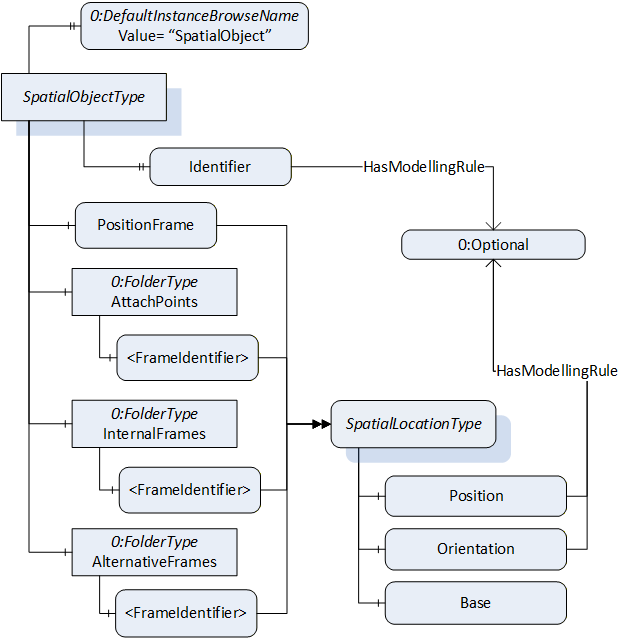
The SpatialObjectType is illustrated in Figure 4 and is formally defined in Table 12.
| Attribute | Value | ||||
| BrowseName | SpatialObjectType | ||||
| IsAbstract | False | ||||
| References | Node Class | BrowseName | DataType | TypeDefinition | Other |
|---|---|---|---|---|---|
| Subtype of the BaseObjectType defined in OPC 10000-5. | |||||
| 0:HasComponent | Variable | PositionFrame | SpatialLocationType | M | |
| 0:HasComponent | Object | AttachPoints | 0:FolderType | O | |
| 0:HasComponent | Object | InternalFrames | 0:FolderType | O | |
| 0:HasComponent | Object | AlternativeFrames | 0:FolderType | O | |
| 0:HasProperty | Variable | Identifier | 0:String | 0:PropertyType | O |
| 0:HasProperty | Variable | 0:DefaultInstanceBrowseName | 0:QualifiedName | 0:PropertyType | |
| ConformanceUnits | |||||
|---|---|---|---|---|---|
| RSL Base | |||||
| RSL SpatialObject Identifier | |||||
| RSL SpatialObject AttachPoints | |||||
| RSL SpatialObject InternalFrames | |||||
| RSL SpatialObject AlternativeFrames |
The Attribute DisplayName of the SpatialObjectType shall be used to add application specific identification.
The mandatory Variable PositionFrame, describes the local displacement of the object related to the location this displacement is based on. The Variable Base of the SpatialLocationType is used to point to the base location via 0:NodeId.
The optional folder AttachPoints is used to define positions on the object, where other objects can be attached.
The optional folder InternalFrames can be used to define positions or frames, which are of interest for the object, but may not be used as attach points. For example, an internal structure of an object can be described in this folder (see example in Annex C.2).
The optional folder AlternativeFrames can be used to provide additional location information with respect to other coordinate systems described within the same SpatialObjectsList. For example, to provide for an application, a location specific to a coordinate system defined by the application (see example Annex C.1.3).
The optional Property Identifier can be used to name the SpatialObject. For multi-server or aggregating scenarios, the Property Identifier is defined as mandatory by a Facet. (Annex C.3 and C.5 describe examples for the use in different scenarios).
The components of the SpatialObjectType have additional subcomponents which are defined in Table 13.
| BrowsePath | References | NodeClass | BrowseName | DataType | TypeDefinition | Others |
| AttachPoints | 0:HasComponent | Variable | <FrameIdentifier> | BaseDataType | SpatialLocationType | MP |
| InternalFrames | 0:HasComponent | Variable | <FrameIdentifier> | BaseDataType | SpatialLocationType | MP |
| AlternativeFrames | 0:HasComponent | Variable | <FrameIdentifier> | BaseDataType | SpatialLocationType | MP |
The component 0:DefaultInstanceBrowseName of the SpatialObjectType have additional Attributes defined in Table 14.
| BrowsePath | Value Attribute | Description Attribute |
| 0:DefaultInstanceBrowseName | SpatialObject | The default BrowseName for instances of the type. |
6.2 SpatialObjectsListType ObjectType
6.2.1 Overview
The SpatialObjectsListType defines an AddIn which may be used to extend objects with a description for a common identifiable reference coordinate system and Organizes all instances of SpatialObjectType AddIns.
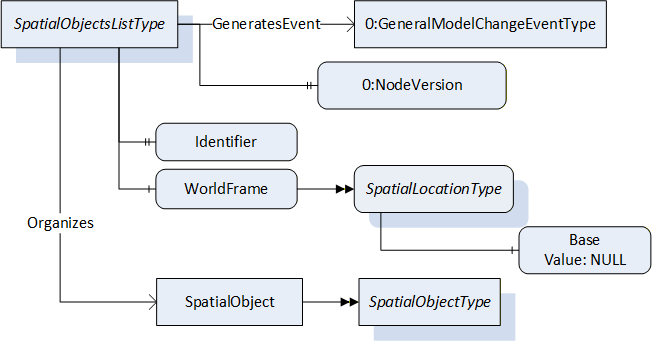
The SpatialObjectsListType is illustrated in Figure 5 and is formally defined in Table 15.
| Attribute | Value | ||||
| BrowseName | SpatialObjectsListType | ||||
| IsAbstract | False | ||||
| References | Node Class | BrowseName | DataType | TypeDefinition | Other |
|---|---|---|---|---|---|
| Subtype of the BaseObjectType defined in OPC 10000-5. | |||||
| 0:HasProperty | Variable | Identifier | 0:String | 0:PropertyType | M |
| 0:HasComponent | Variable | WorldFrame | 0:BaseDataType {Any} | SpatialLocationType | M |
| 0:HasProperty | Variable | 0:NodeVersion | 0:String | 0:PropertyType | M |
| 0:GeneratesEvent | ObjectType | 0:GeneralModelChangeEventType | |||
| 0:Organizes | Object | <SpatialObject> | SpatialObjectType | OP | |
| ConformanceUnits | |||||
|---|---|---|---|---|---|
| RSL Base |
The Attribute DisplayName of the SpatialObjectsListType shall be used to add application specific identification.
The mandatory Property Identifier shall be used to name the SpatialObjectsList. Annex C.3 describes different scenarios for the use of the Identifier.
The mandatory Variable WorldFrame is, direct or indirect via other frames, the geometrical base definition of all objects with SpatialObjectType AddIn, which are OrganizedBy this SpatialObjectsList.
The Variable 0:NodeVersion and the GeneralModelChangeEvent have been added within the SpatialObjectsListType in order to identify changes in the model as described in OPC 10000-3.
A SpatialObjectsList Organizes instances of SpatialObjectType. Typically, a SpatialObjectsList organises at least one instance of SpatialObjectType. Since SpatialObjects are dynamic in nature, it is also possible that no SpatialObject is contained in a SpatialObjectsList.
The components of the SpatialObjectsListType have additional Attributes defined in Table 16.
| BrowsePath | Value Attribute | Description Attribute | ||
| WorldFrame as the origin of the coordinate system has no Base i.e. it must be null. |