
7 OPC UA ObjectTypes
7.1 MachineTool Extension
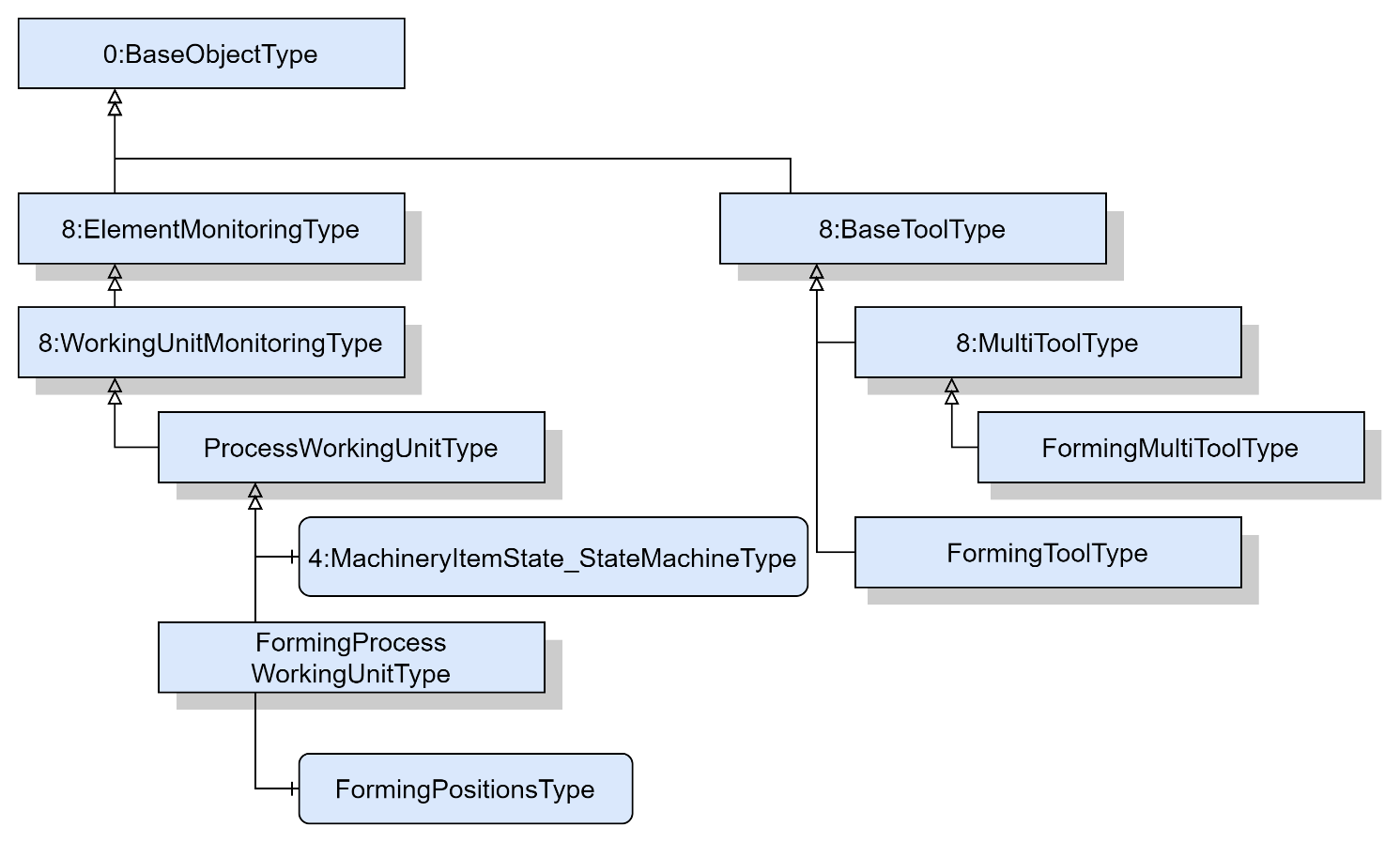
A metal forming machine is described by an instance of the 8:MachineToolType defined in OPC 40501-1 Machine Tools and has various extensions for the metal forming specific values and process data. The 8:MachineToolType Instance can be extended by the following points through metal forming specific objects types (see Figure 10). The object type 8:ElementMonitoringType from the 0:BaseObjectType instance is extended by the Metal Forming ObjectTypes ProcessWorkingUnitType (7.4) and FormingProcessWorkingUnitType (7.5). The ObjectType 8:BaseToolType is supplemented by the ObjectTypes FormingToolType (7.6) and FormingMultiToolType (7.7). The example in Figure 9 also shows an extension of the 8:MachineToolType. To identify machines of different manufacturers, the information in the 2:Identification component of the 8:MachineToolType can be used.
7.2 CyclicProcessValueType ObjectType definition
7.2.1 The CyclicProcessValueType (see Figure 11) is a subtype of the 7:ProcessValueType and is used if the monitoring of dependent on repetitive processes inside a run is done. Therefore, it is important to remind the differences between a job order, run and cycle defined in the Metal Forming terms 3.2. The CyclicProcessValueType describes a machining cycle of a forming process.
| Attribute | Value | ||||
| BrowseName | CyclicProcessValueType | ||||
| IsAbstract | False | ||||
| References | Node Class | BrowseName | DataType | TypeDefinition | Other |
|---|---|---|---|---|---|
| Subtype of the 7:ProcessValueType defined in OPC 40001-2 i.e. inheriting the InstanceDeclarations of that Node. | |||||
| 0:HasComponent | Variable | CyclicProcessValue | CyclicProcessValueData Type | CyclicProcessValue VariableType | M |
| Conformance Units | |||||
|---|---|---|---|---|---|
| MetalForming CyclicProcessValueType |
CyclicProcessValue describes the transactional context between the 6:AnalogSignal, 7:ProcessValueSetpoint and the CycleCount. The DataType CyclicProcessValueDataType is defined in 10.1. The corresponding TypeDefinition CyclicProcessValueVariableType is defined in 9.1.
7.3 FormingPositionsType ObjectType Definition
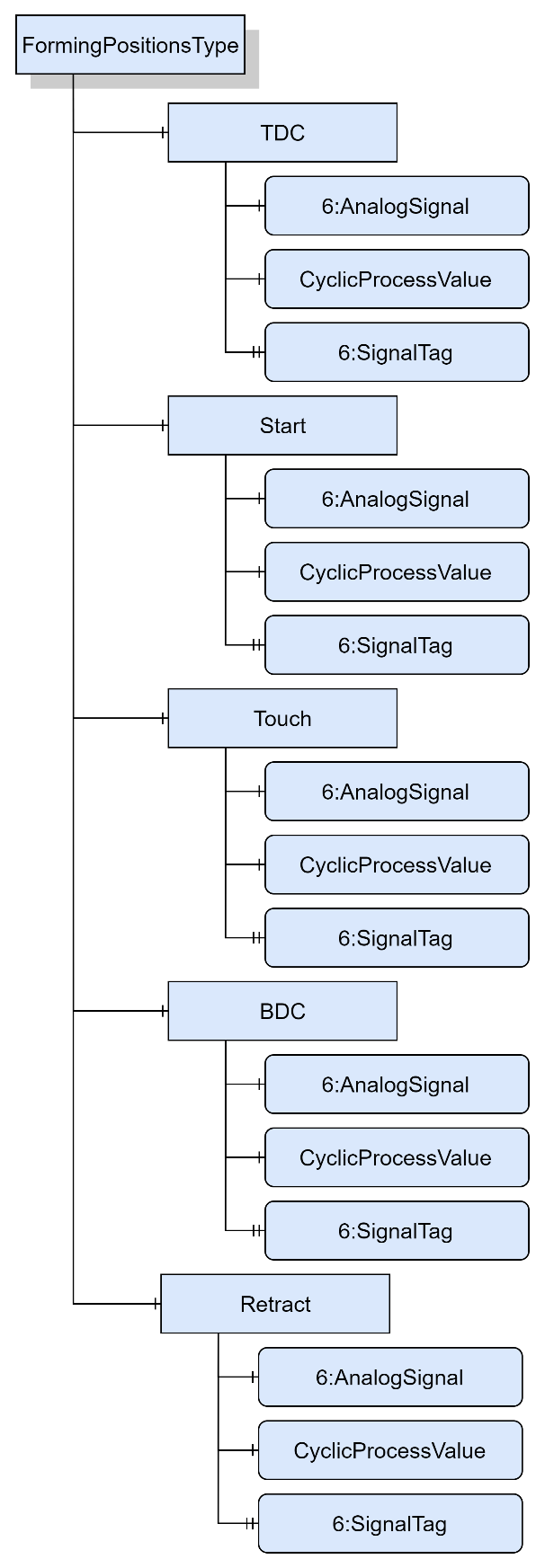
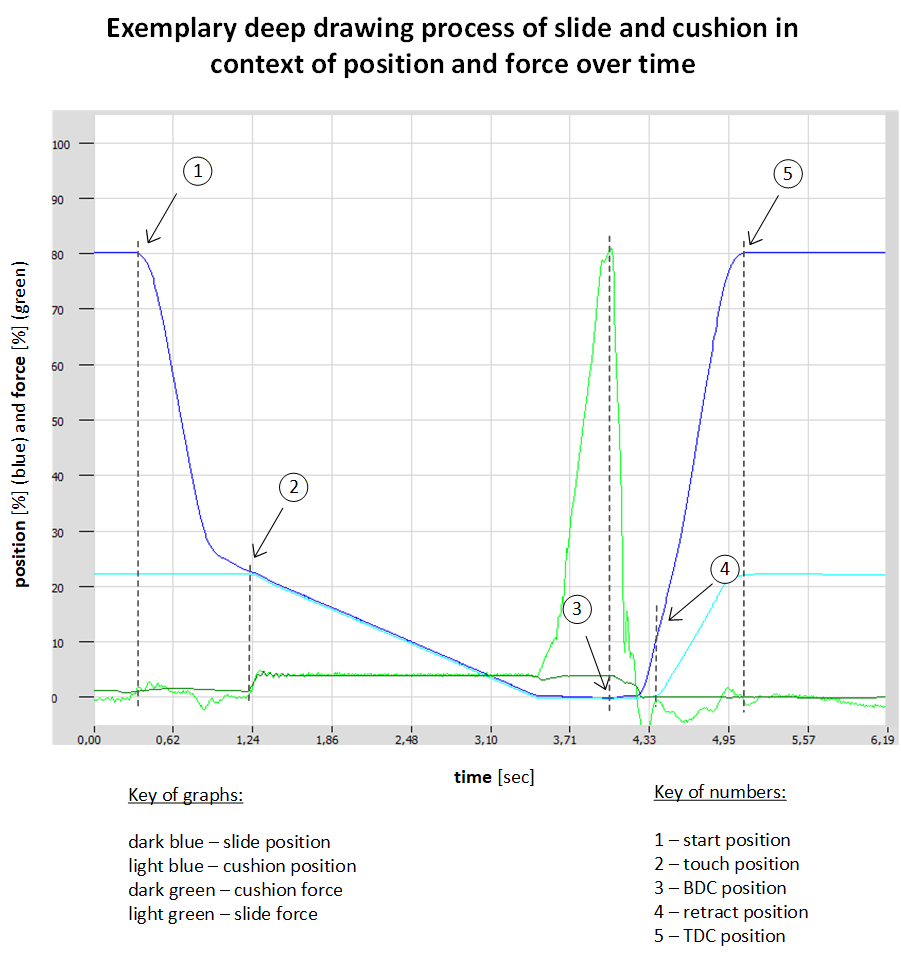
The FormingPositionsType (see Figure 12) defines characteristic positions of a forming process and is formally defined in Table 16. For each cycle, the selected positions will get the ActualValue, Setpoint, EURange, EngineeringUnits and corresponding CycleCount as a CyclicProcessValueType, defined in 7.2. Figure 13 shows a hydraulic press machine with a cushion, indicating the positions of the characteristic points of a forming process.
| Attribute | Value | ||||
| BrowseName | FormingPositionsType | ||||
| IsAbstract | False | ||||
| References | Node Class | BrowseName | DataType | TypeDefinition | Other |
|---|---|---|---|---|---|
| Subtype of the 0:BaseObjectType defined in OPC 10000-5 i.e. inheriting the InstanceDeclarations of that Node. | |||||
| 0:HasComponent | Object | TDC | CyclicProcessValueType | O | |
| 0:HasComponent | Object | Start | CyclicProcessValueType | O | |
| 0:HasComponent | Object | Touch | CyclicProcessValueType | O | |
| 0:HasComponent | Object | BDC | CyclicProcessValueType | O | |
| 0:HasComponent | Object | Retract | CyclicProcessValueType | O | |
| Conformance Units | |||||
|---|---|---|---|---|---|
| MetalForming FormingPositionsType |
TDC is defined in the Metal Forming terms 3.2.1.
Start defines the starting point of a forming process, which can be different to TDC.
Touch defines the position where the workpiece and tool have their first contact.
BDC is defined in the Metal Forming terms 3.2.1.
Retract defines the position where workpiece and tool separate from each other.
7.4 ProcessWorkingUnitType ObjectType Definition
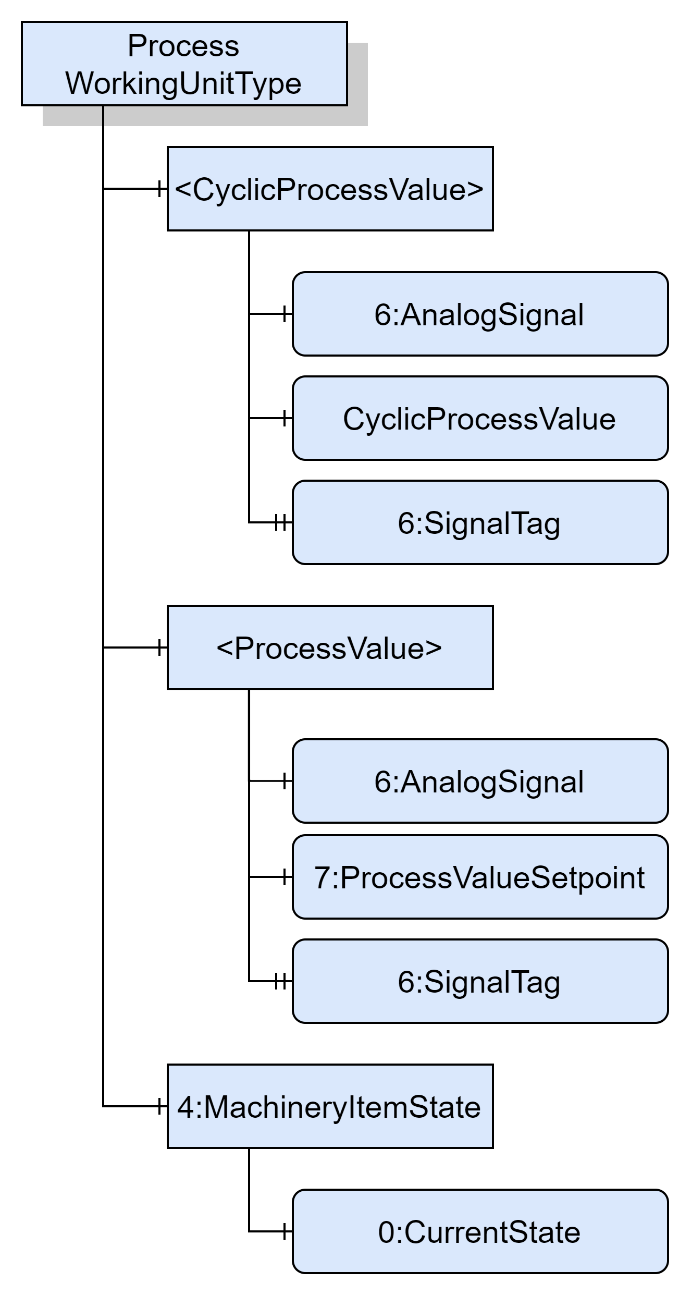
The ProcessWorkingUnitType (see Figure 14) provides an instance of a unit which is part of the forming and / or production process and is formally defined in Table 17.
| Attribute | Value | ||||
| BrowseName | ProcessWorkingUnitType | ||||
| IsAbstract | False | ||||
| References | Node Class | BrowseName | DataType | TypeDefinition | Other |
|---|---|---|---|---|---|
| Subtype of the 8:WorkingUnitMonitoringType defined in OPC 40501-1 Machine Tools | |||||
| 0:HasComponent | Object | <ProcessValue> | 7:ProcessValueType | OP | |
| 0:HasComponent | Object | <CyclicProcessValue> | CyclicProcessValue Type | OP | |
| 0:HasComponent | Object | 4:MachineryItemState | 4:MachineryItemState_ StateMachineType | M | |
| Conformance Units | |||||
|---|---|---|---|---|---|
| MetalForming ProcessWorkingUnitType |
<ProcessValue> describes the monitoring of a signal from the corresponding working unit. Since there are more than one monitoring signals available per working unit, the 7:ProcessValue is defined as an optional placeholder. The 7:ProcessValueType is defined in OPC 40001-2.
<CyclicProcessValue> is of type CyclicProcessValueType, which is a subtype of 7:ProcessValueType and is representing process values and a transactional context between the 6:AnalogSignal, 7:ProcessValueSetpoint and the actual cycle count of the last cycle. The CyclicProcessValueType is formally defined in 7.2.
4:MachineryItemState represents the current state of the working unit.
7.5 FormingProcessWorkingUnitType ObjectType Definition
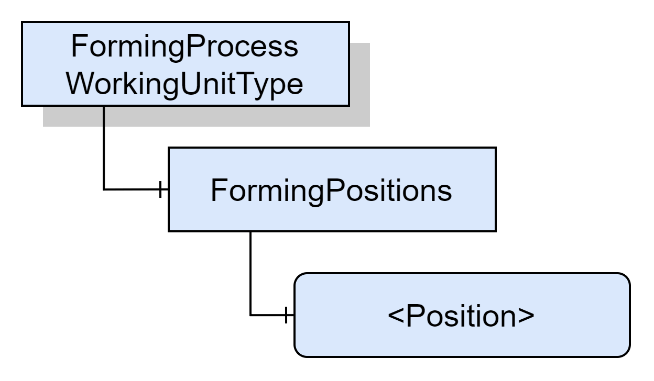
The FormingProcessWorkingUnitType (see Figure 15) represents a forming related working unit process, which needs to describe the actual forming position(s) of the last cycle, next to the processing parameters defined by the ProcessWorkingUnitType in Table 17. Therefore, FormingProcessWorkingUnitType is a subtype of ProcessWorkingUnitType and is formally defined in Table 18.
| Attribute | Value | ||||
| BrowseName | FormingProcessWorkingUnitType | ||||
| IsAbstract | False | ||||
| References | Node Class | BrowseName | DataType | TypeDefinition | Other |
|---|---|---|---|---|---|
| Subtype of the ProcessWorkingUnitType defined in Table 17. | |||||
| 0:HasComponent | Object | FormingPositions | FormingPositionsType | M | |
| Conformance Units | |||||
|---|---|---|---|---|---|
| MetalForming FormingProcessWorkingUnitType |
FormingPositions is representing an ObjectType, including a definition of optional positions which are most used in forming processes. The TypeDefintion for the FormingPositionsType is done in 7.3.
7.6 FormingToolType ObjectType Definition
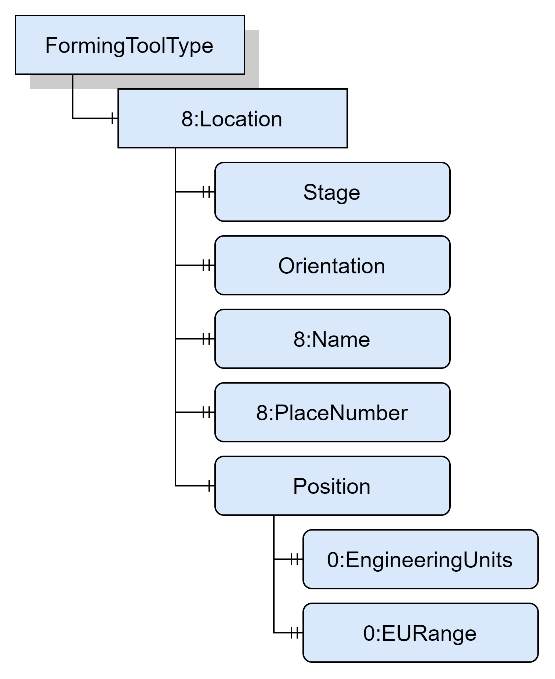
The FormingToolType (see Figure 16) is a subtype of the 8:BaseToolType and provides metal forming specific tool parameter in the Location Object. Therefore, the Location Object is overridden and adjusted with metal forming specific tool parameters. The FormingToolType is defined in Table 19.
| Attribute | Value | ||||
| BrowseName | FormingToolType | ||||
| IsAbstract | False | ||||
| References | Node Class | BrowseName | DataType | TypeDefinition | Other |
|---|---|---|---|---|---|
| Subtype of the 8:BaseToolType defined in OPC 40501-1 Machine Tools. | |||||
| 0:HasComponent | Object | 8:Location | 0:BaseObjectType | O | |
| Conformance Units | |||||
|---|---|---|---|---|---|
| MetalForming FormingToolType |
The components of the FormingToolType have additional subcomponents which are defined in Table 20.
| Source Path | Reference | NodeClass | BrowseName | DataType | TypeDefinition | Others |
| 8:Location | 0:HasProperty | Variable | Orientation | String | 0:PropertyType | O |
| 8:Location | 0:HasComponent | Variable | Position | Double | 0:AnalogUnitRangeType | O |
| 8:Location | 0:HasProperty | Variable | Stage | UInt16 | 0:PropertyType | O |
| 8:Location | 0:HasProperty | Variable | 8:Name | String | 0:PropertyType | M |
| 8:Location | 0:HasProperty | Variable | 8:PlaceNumber | UInt16 | 0:PropertyType | M |
The 8:Location parameter, formally defined in OPC 40501-1 UA for MachineTool, indicates, where the tool is located.
Orientation indicates the mounted direction of the tool if there are several possibilities (e.g. "Front" or "Back" at bending machines) to align the tool at the tool holder.
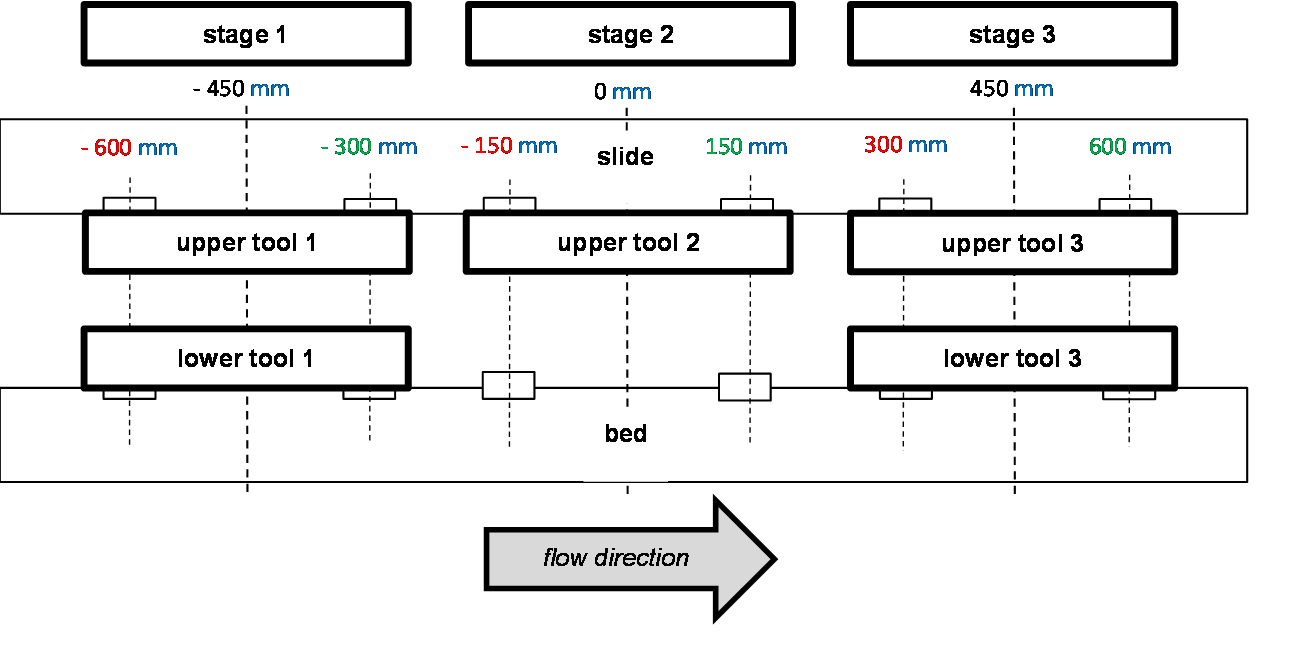
Position is a parameter which describes the absolute position of the central tool axis in dependency to the central middle axis of the complete tool holder. This is necessary if the machine consists of several stages or if the is mounted asymmetric in dependency to the central middle axis of the complete tool holder.
The Position parameter is extended by an 0:EngineeringUnits property as well as an 0:EURange property describing detailed static information.
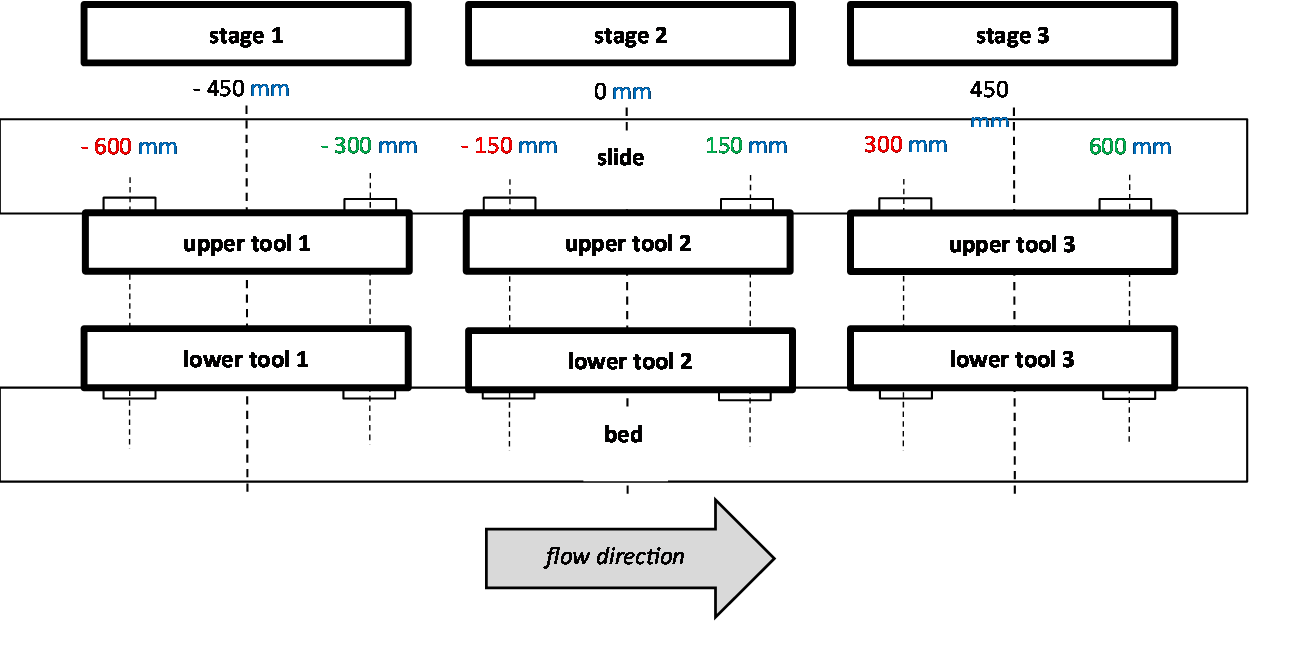
describes a hydraulic press machine with three stages, the absolute Positions as well as the corresponding unit (mm) and the low (red) and high (green) limits of each tool in the current stage.
The Stage parameter indicates on which stage the current defined tool is located.
The 8:PlaceNumber and the 8:Name are used like in the 8:BaseToolType.
7.7 FormingMultiToolType ObjectType Definition
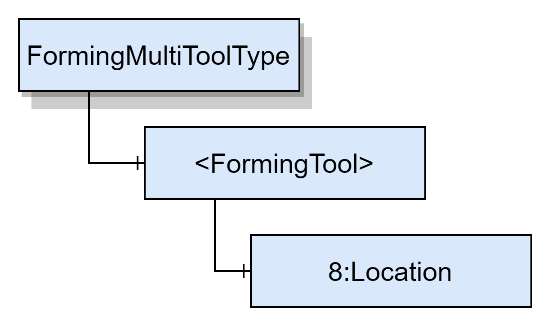
The FormingMultiToolType (see Figure 19) provides an optional placeholder for FormingToolTypes and is formally defined in Table 21.
| Attribute | Value | ||||
| BrowseName | FormingMultiToolType | ||||
| IsAbstract | False | ||||
| References | Node Class | BrowseName | DataType | TypeDefinition | Other |
|---|---|---|---|---|---|
| Subtype of the 8:MultiToolType defined in OPC 40501-1 Machine Tools. | |||||
| 0:HasComponent | Object | <FormingTool> | FormingToolType | OP | |
| Conformance Units | |||||
|---|---|---|---|---|---|
| MetalForming FormingMultiToolType |
The optional placeholder <FormingTool> Object contains information about the individual forming tools within the multitool.
7.8 FormingProcessConditionClassType ObjectType Definition
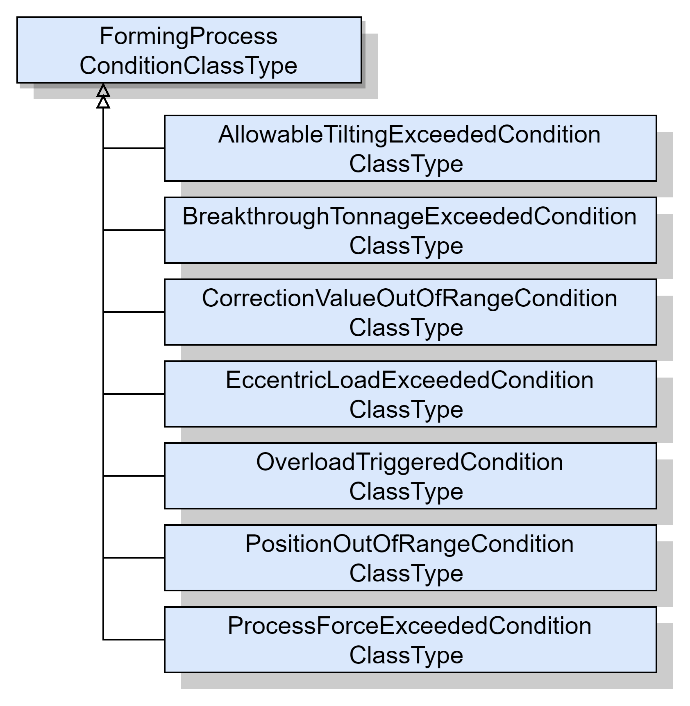
The supertype FormingProcessConditionClassType (see Figure 20) is a subtype of the ProcessConditionClassType and describes condition which can appear during the forming process, formally defined in Table 22.
| Attribute | Value | ||||
| BrowseName | FormingProcessConditionClassType | ||||
| IsAbstract | True | ||||
| References | Node Class | BrowseName | DataType | TypeDefinition | Other |
|---|---|---|---|---|---|
| Subtype of the ProcessConditionClassType defined in OPC 10000-9 Specification. | |||||
| Conformance Units | |||||
|---|---|---|---|---|---|
| MetalForming FormingProcessConditionClassType |
7.9 AllowableTiltingExceededConditionClassType ObjectType
The AllowableTiltingExceededConditionClassType is an abstract ObjectType which should be caused when the allowable tilting of the machine limits is exceeded. The tilt is related to the punch of the hydraulic press machine as shown in Figure 21.
The AllowableTiltingExceededConditionClassType is formally defined in Table 23.
| Attribute | Value | ||||
| BrowseName | AllowableTiltingExceededConditionClassType | ||||
| IsAbstract | True | ||||
| References | Node Class | BrowseName | DataType | TypeDefinition | Other |
|---|---|---|---|---|---|
| Subtype of the FormingProcessConditionClassType defined in 7.8 i.e. inheriting the InstanceDeclarations of that Node. | |||||
| Conformance Units | |||||
|---|---|---|---|---|---|
| MetalForming AllowableTiltingExceededConditionClassType |
7.10 BreakthroughTonnageExceededConditionClassType ObjectType
The BreakthroughTonnageExceededConditionClassType is formally defined in Table 24.
| Attribute | Value | ||||
| BrowseName | BreakthroughTonnageExceededConditionClassType | ||||
| IsAbstract | True | ||||
| References | Node Class | BrowseName | DataType | TypeDefinition | Other |
|---|---|---|---|---|---|
| Subtype of the FormingProcessConditionClassType defined in 7.8 i.e. inheriting the InstanceDeclarations of that Node. | |||||
| Conformance Units | |||||
|---|---|---|---|---|---|
| MetalForming BreakthroughTonnageExceededConditionClassType |
7.11 CorrectionValueOutOfRangeConditionClassType ObjectType
The CorrectionValueOutOfRangeConditionClassType is an abstract ObjectType which should be caused when the correction value of the machine limits is exceeded. In this context, correction values mean dynamically adjusting values during production process, to get a better production quality. EXAMPLE: immersion depth control
The CorrectionValueOutOfRangeConditionClassType is formally defined in Table 25.
| Attribute | Value | ||||
| BrowseName | CorrectionValueOutOfRangeConditionClassType | ||||
| IsAbstract | True | ||||
| References | Node Class | BrowseName | DataType | TypeDefinition | Other |
|---|---|---|---|---|---|
| Subtype of the FormingProcessConditionClassType defined in 7.8 i.e. inheriting the InstanceDeclarations of that Node. | |||||
| Conformance Units | |||||
|---|---|---|---|---|---|
| MetalForming CorrectionValueOutOfRangeConditionClassType |
7.12 EccentricLoadExceededConditionClassType ObjectType
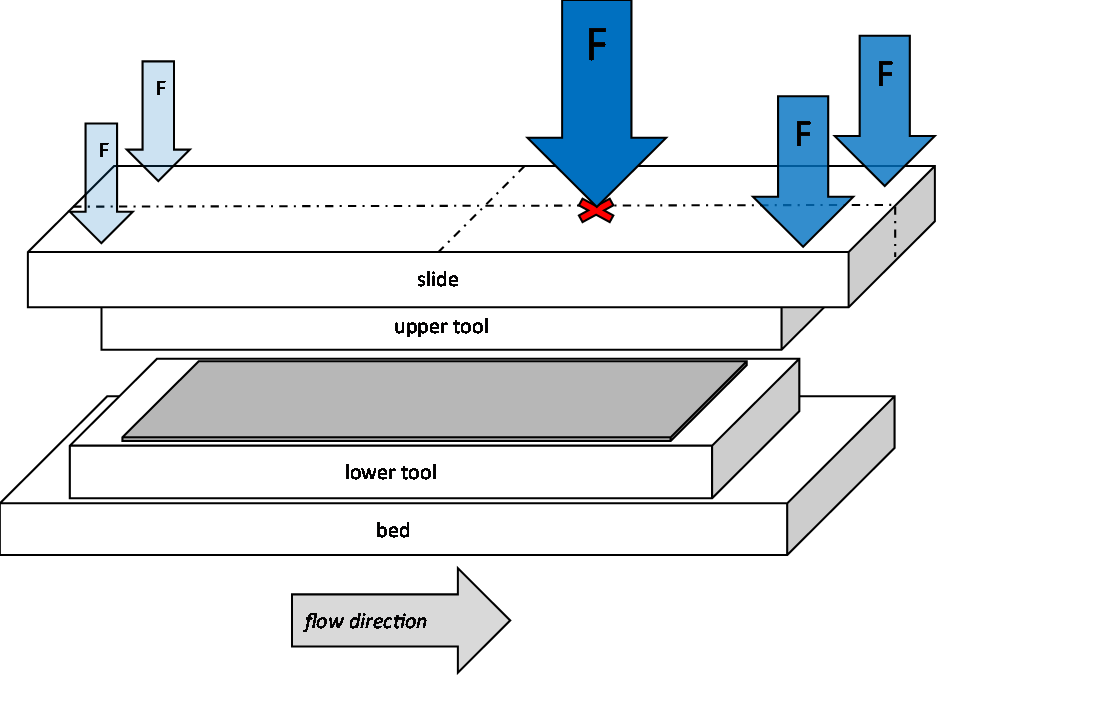
The EccentricLoadExceededConditionClassType is an abstract ObjectType which should be caused when the eccentric load of the machine limits is exceeded. Eccentric load describes the value of the forming force acting off-center as shown in for a hydraulic press machine.
The EccentricLoadExceededConditionClassType is formally defined in Table 26.
| Attribute | Value | ||||
| BrowseName | EccentricLoadExceededConditionClassType | ||||
| IsAbstract | True | ||||
| References | Node Class | BrowseName | DataType | TypeDefinition | Other |
|---|---|---|---|---|---|
| Subtype of the FormingProcessConditionClassType defined in 7.8 i.e. inheriting the InstanceDeclarations of that Node. | |||||
| Conformance Units | |||||
|---|---|---|---|---|---|
| MetalForming EccentricLoadExceededConditionClassType |
7.13 OverloadTriggeredConditionClassType ObjectType
The OverloadTriggeredConditionClassType is an abstract ObjectType which should be caused when the overload of the machine limits is triggered. The overload refers to a situation where the press machine is subjected to a force or load that exceeds its normal operating capacity.
The OverloadTriggeredConditionClassType is formally defined in Table 27.
| Attribute | Value | ||||
| BrowseName | OverloadTriggeredConditionClassType | ||||
| IsAbstract | True | ||||
| References | Node Class | BrowseName | DataType | TypeDefinition | Other |
|---|---|---|---|---|---|
| Subtype of the FormingProcessConditionClassType defined in 7.8 i.e. inheriting the InstanceDeclarations of that Node. | |||||
| Conformance Units | |||||
|---|---|---|---|---|---|
| MetalForming OverloadTriggeredConditionClassType |
7.14 PositionOutOfRangeConditionClassType ObjectType
The PositionOutOfRangeConditionClassType is an abstract ObjectType which should be caused when the operating range of the machine is exceeded. The position out of range generally refers to a situation where the position of a part or tool is exceeded by the normal operating range of the press machine.
The PositionOutOfRangeConditionClassType is formally defined in Table 28.
| Attribute | Value | ||||
| BrowseName | PositionOutOfRangeConditionClassType | ||||
| IsAbstract | True | ||||
| References | Node Class | BrowseName | DataType | TypeDefinition | Other |
|---|---|---|---|---|---|
| Subtype of the FormingProcessConditionClassType defined in 7.8 i.e. inheriting the InstanceDeclarations of that Node. | |||||
| Conformance Units | |||||
|---|---|---|---|---|---|
| MetalForming PositionOutOfRangeConditionClassType |
7.15 ProcessForceExceededConditionClassType ObjectType
The ProcessForceExceededConditionClassType is an abstract ObjectType which should be caused when the process force of the machine is exceeded. The process force is the force that is applied to the material being formed by the press.
The ProcessForceExceededConditionClassType is formally defined in Table 29.
| Attribute | Value | ||||
| BrowseName | ProcessForceExceededConditionClassType | ||||
| IsAbstract | True | ||||
| References | Node Class | BrowseName | DataType | TypeDefinition | Other |
|---|---|---|---|---|---|
| Subtype of the FormingProcessConditionClassType defined in 7.8 i.e. inheriting the InstanceDeclarations of that Node. | |||||
| Conformance Units | |||||
|---|---|---|---|---|---|
| MetalForming ProcessForceExceededConditionClassType |