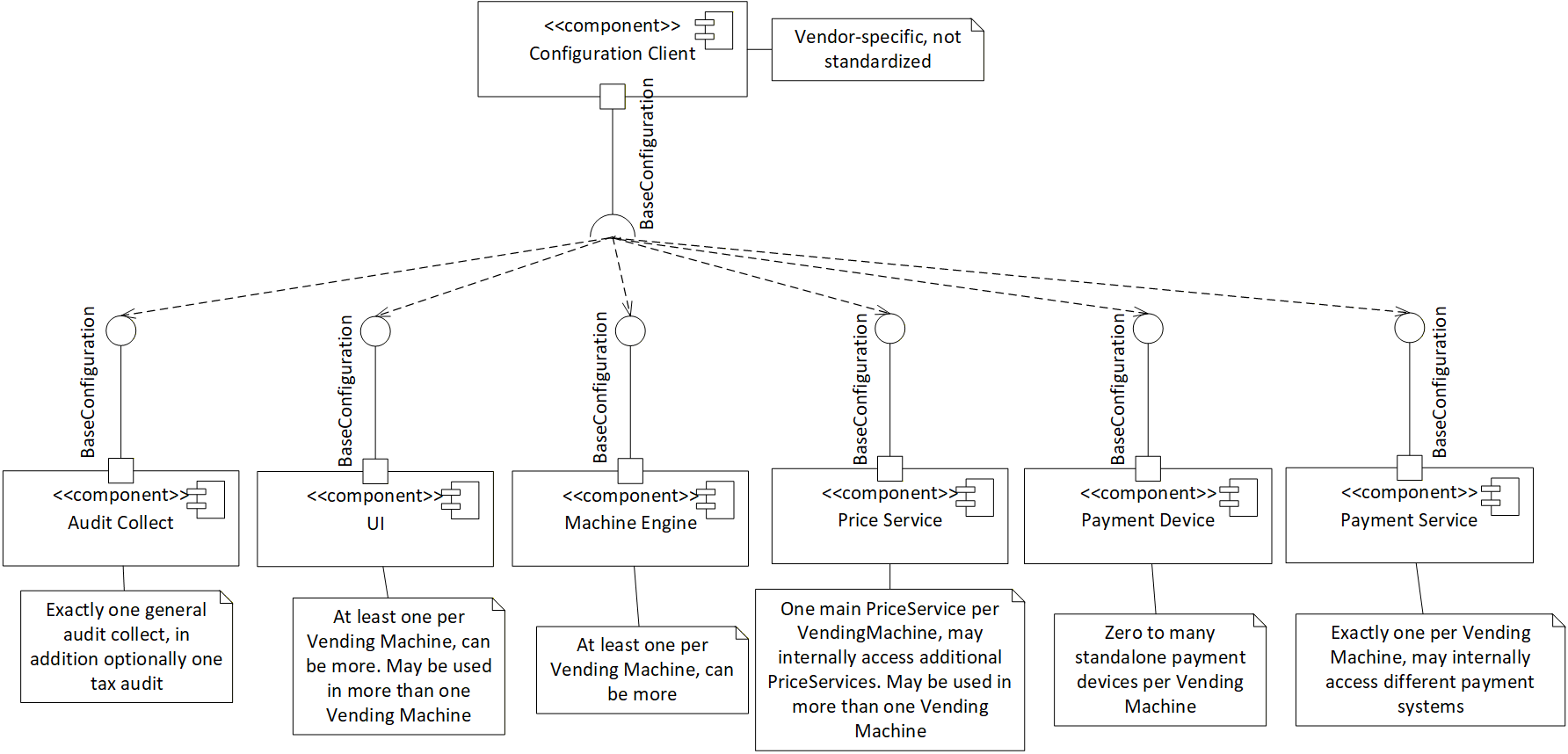
6 Unattended Retail & Coffee Solutions Information Model overview
6.1 Overview
An Unattended Retail & Coffee Solution (for better readability we use the term Vending Machine in the following text) is built out of various components. This specification focuses on components that may be provided by different vendors and therefore require standardized exchange of information between those components. A component may be used by various Vending Machines and does not necessarily need to be physically connected to a Vending Machine, like for example a user interface (UI) that runs on a smart device of a customer like a smart phone or tablet.
In addition to the interactions of the components of a Vending Machine, this specification also defines information exchange to monitor Vending Machines by applications that cannot be considered to be part of the Vending Machine.
Requirements on the power supply of components of a Vending Machine are described in Annex C, and requirements on the network infrastructure of components of a Vending Machine in Annex D.
6.2 Components of a Vending Machine
6.2.1 Machine engine
The machine engine is the device able to create or deliver or collect a given product. It interacts with the UI, the payment service, and the audit collect. It interacts with the customer by physically providing the product to the customer. It provides information to monitor the Vending Machine. A Vending Machine according to this specification needs to support at least one machine engine, but may have several machine engines as components. A machine engine cannot be assigned to more than one Vending Machine, i.e., it can only be used by one payment service.
The machine engine provides its interface by implementing an instance of the MachineEngineType (shown in Figure 10, defined in 7.1). The machine engine does not require OPC UA Client functionality to access other components of the Vending Machine.
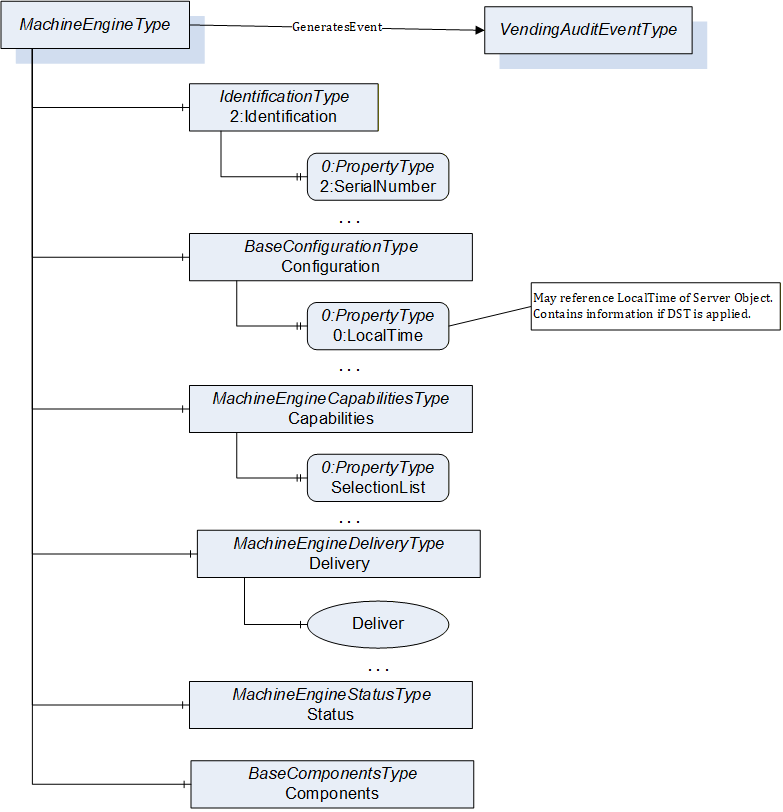
The MachineEngineType provides the identification of the machine engine in the Identification Object, defined in OPC 10000-100. The configuration of the machine engine is provided by the Configuration Object of BaseConfigurationType defined in 7.3. The configuration may be writable via the OPC UA interface to change the configuration of the machine engine. The machine engine provides the configuration for the UI in the Capabilities Object of MachineEngineCapabilitiesType defined in 7.5. The configuration is accessed by the UI and parts may be writable to change the configuration of the UI. The Delivery Object of MachineEngineDeliveryType defined in 7.6 provides functionality to request a delivery (by the payment service) as well as expose the status of the delivery (displayed by the UI). The Status Object of MachineEngineStatusType defined in 7.7 provides the overall status of the machine engine, to be displayed in the UI and consumed by the payment service. The optional Components Object of BaseComponentsType defined in 7.4 can provide information about subcomponents of the machine engine. The machine engine generates Events of VendingBaseAuditEventType to provide audit data.
6.2.2 Payment service
The payment service is responsible to approve product delivery, for example by receiving coins or charging a credit card or any other needed condition for the delivery of a product, like age. It is also responsible of all money movements between the different payment devices, like using cash to revalue a card system, handling change or overpay. It interacts with the UI, the machine engine, the audit collect and the price service. It may interact with the customer, for example by physically collecting coins or bills or scanning a credit card. It provides information to monitor the Vending Machine. A Vending Machine according to this specification supports exactly one payment service.
The payment service provides its interface by implementing an instance of the PaymentServiceType (shown in Figure 11, defined in 7.8). The payment service requires OPC UA Client functionality to access the machine engine(s) and the primary price service of the Vending Machine.
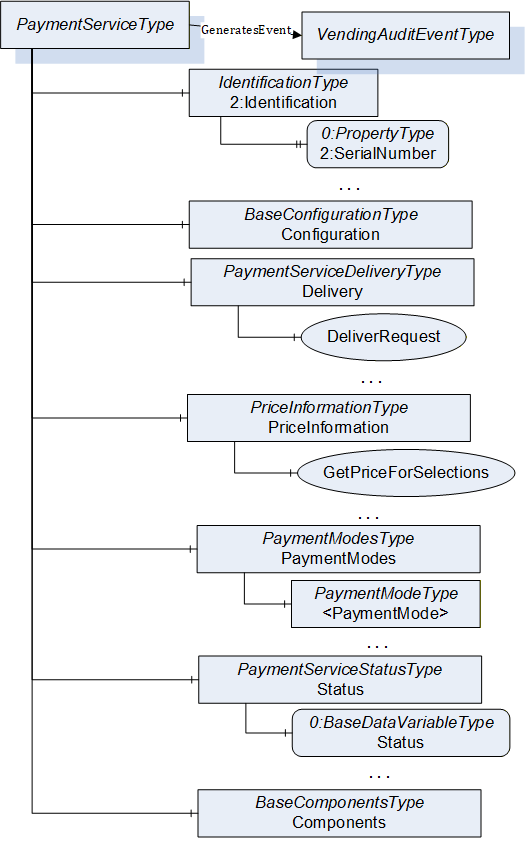
The PaymentServiceType provides the identification of the payment service in the Identification Object, defined in OPC 10000-100. The configuration of the payment service is provided by the Configuration Object of BaseConfigurationType defined in 7.3. The configuration may be writable via the OPC UA interface to change the configuration of the payment service. The Delivery Object of PaymentServiceDeliveryType defined in 7.9 provides functionality to request a delivery (by the UI) as well as expose the status of the payment of the delivery (displayed by the UI). The PriceInformation Object of PriceInformationType defined in 7.11 provides price information for deliverables of products of machine engines manged by the payment service. The PaymentModes Object of PaymentModesType defined in 7.13 provides information about the different payment systems supported by the payment service and their status, having on Object of PaymentModeType defined in 7.14 per payment system. The Status Object provides the overall status of the payment service defined in 7.22. The optional Components Object of BaseComponentsType defined in 7.4 can provide information about subcomponents of the payment service. The payment service generates Events of VendingAuditEventType to provide audit data.
The payment service receives price information from the primary price service of the Vending Machine using the PriceInformation Object of the price service. It is up to the implementation of the payment service whether the requests of the UI about price information is always forwarded to the price service, or cached in the payment service.
The payment service will need to interface to any other device which can affect the delivery, and these devices are payment devices. Payment service will provide the UI with enough information from the payment devices to define the payment, but the detailed implementation of the process is internal to payment service. It is also possible (and for sure will happen in the transition phase before OPC UA compliant payment devices will be available, the payment service will handle internally legacy coin, bills, cashless devices using proprietary protocols. When this happens, payment service has to act relative to audit collect to provide, in a way which is in line with this specification, all the required information.
But, with OPC UA compliant payment devices, the payment service is responsible only for the delivery approval but not for the effective handling of other payment device related data, like audit and configuration. There is a specific configuration Property (IsEmulated) used to expose if the payment service is internally handling the payment device, or if an OPC UA enabled payment device is available, enabling direct access to payment device configuration and audit events.
The IsEmulated Property enable easy switch for the need, today, to handle MDB (and other legacy protocols) before fully switch to OPC UA compliant devices.
The payment service may supervise the audit collect for operation and reject new requests when the audit collect is not operating correctly using the IsCollectingAudit Variable of the AuditCollectType.
6.2.3 Standalone Payment Devices
As stated in 6.2.2, a payment device may be managed in a proprietary manner by the payment service. A standalone payment device is a payment device, that has a standardized OPC UA Server. It is responsible to receive money, either via a physical asset (coin, bill, or token), as a payment cash device, or cashless as a payment cashless device. It provides the information about the received money and mechanisms to payout money. It interacts with the payment service and the audit collect. A Vending Machine according to this specification may have zero to many standalone payment devices.
As there are different types of payment devices, the type hierarchy is shown in Figure 12.
The standalone payment device provides its interface by implementing an instance of a subtype of the StandalonePaymentDeviceType (shown in Figure 12, defined in 7.17), which is an abstract subtype of the PaymentDeviceType used in the payment service. The standalone payment device does not require OPC UA Client functionality.
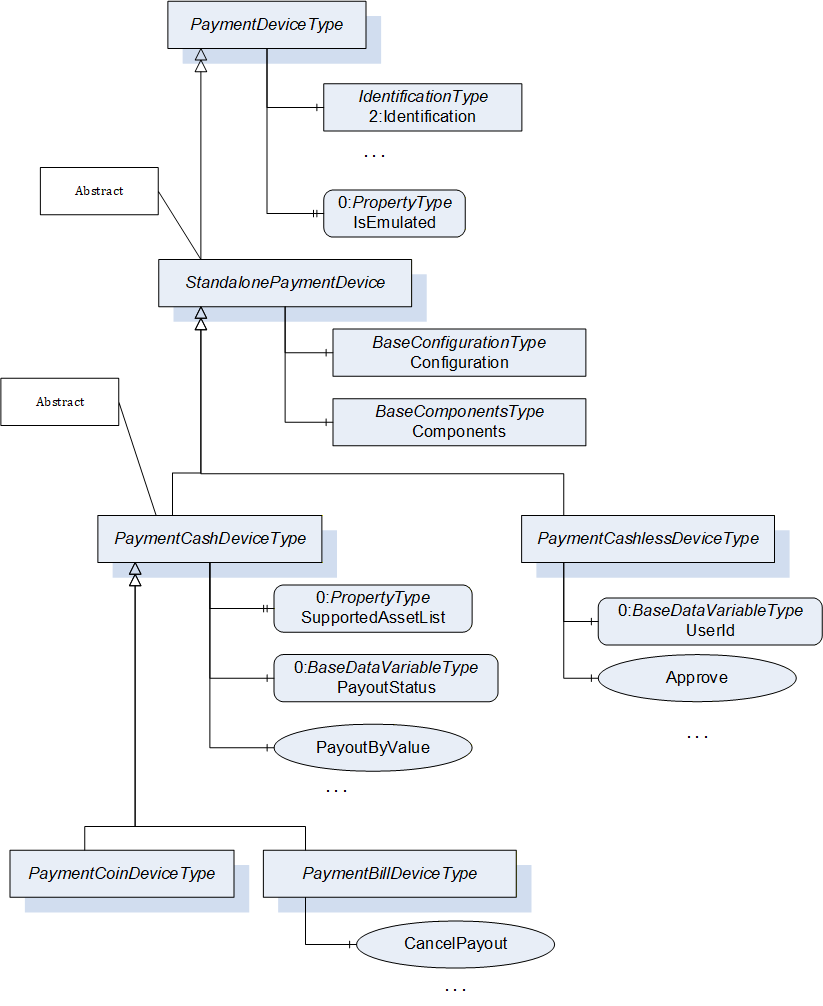
The PaymentDeviceType provides the identification of the payment device in the Identification Object, defined in OPC 10000-100. The configuration of the standalone payment device is provided by the Configuration Object of BaseConfigurationType defined in 7.3. The optional Components Object of BaseComponentsType defined in 7.4 can provide information about subcomponents of the standalone payment device. The payment device generates Events of VendingAuditEventType to provide audit data.
The abstract PaymentCashDeviceType defined in 7.18 defines common functionality for cash-based payment devices like the supported assets and the capability to payout cash. The concrete PaymentCoinDeviceType defined 7.19 represents standalone payment devices handing coins and / or token, with no additional functionality. The concrete PaymentBillDeviceType defined in 7.20 represents standalone payment devices handling bills and / or token, and provides additional functionality like cancelling the payout. The concrete PaymentCashlessDeviceType defined in 7.21 represents standalone payment devices handling cashless money, and provide the corresponding functionality.
6.2.4 UI
The UI (user interface) is the interface between the customer and the system. The UI is only related to the final customer interaction. Technical user interfaces for configuration or maintenance of the machine are not part of this component and not addressed by this specification. A Vending Machine according to this specification needs to have at least one UI, but may have several UIs.
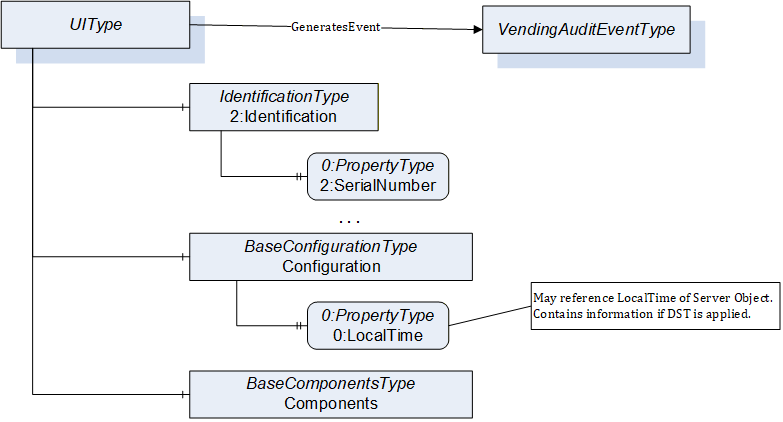
The UI provides its interface by implementing an instance of the UIType (shown in Figure 13, defined in 7.23). The UI requires OPC UA Client functionality to access the payment service and the machine engine(s) of the Vending Machine. The optional Components Object of BaseComponentsType defined in 7.4 can provide information about subcomponents of the UI. The UI generates Events of VendingBaseAuditEventType to provide audit data.
The UI receives the configuration of the Vending Machine by accessing the Machine Engine capabilities specific to a machine engine from the machine engine(s) of the Vending Machine by accessing the Capabilities Object of MachineEngineCapabilitiesType defined in 7.5. This includes the available selections and possible Options per selection. The availability of the selections is provided by the Status Object of MachineEngineStatusType defined in 7.7. The Delivery Object of MachineEngineDeliveryType defined in 7.6 expose the status of a delivery.
The UI receives price information for the selections as well as payment options provided by the payment service of the Vending Machine by accessing the PriceInformation Object of PriceInformationType defined in 7.11. A deliver request is triggered on the Delivery Object of PaymentServiceDeliveryType defined in 7.9.
6.2.5 Price service
The price service calculates the price of a selection of products and considers all discounts. Discounts may be gained on various vendor-specific options, like time of the day, expiry date of the product, availability of product, customer and discount programs, etc. A Vending Machine according to this specification needs to have access to exactly one price service. This price service may internally use other price services (see Annex B).
The price service provides its interface by implementing an instance of the PriceServiceType (shown in Figure 14, defined in 7.24). The price service does not require OPC UA Client functionality to access other components of the Vending Machine.
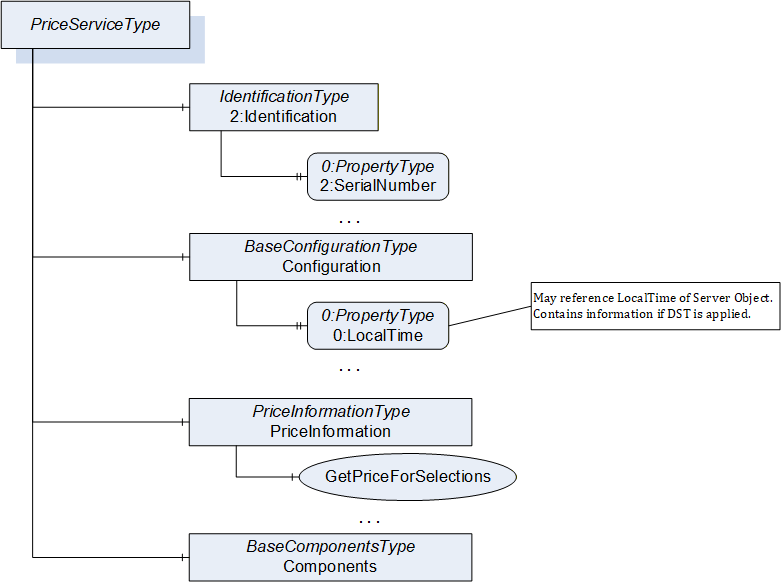
The PriceServiceType provides the identification of the payment service in the Identification Object, defined in OPC 10000-100. The configuration of the payment service is provided by the Configuration Object of BaseConfigurationType defined in 7.3. The configuration may be writable via the OPC UA interface to change the configuration of the payment service. The PriceInformation Object of PriceInformationType defined in 7.11 provides price information for deliverables of products potentially provided by various Vending Machines. The optional Components Object of BaseComponentsType defined in 7.4 can provide information about subcomponents of the payment service.
6.2.6 Audit collect
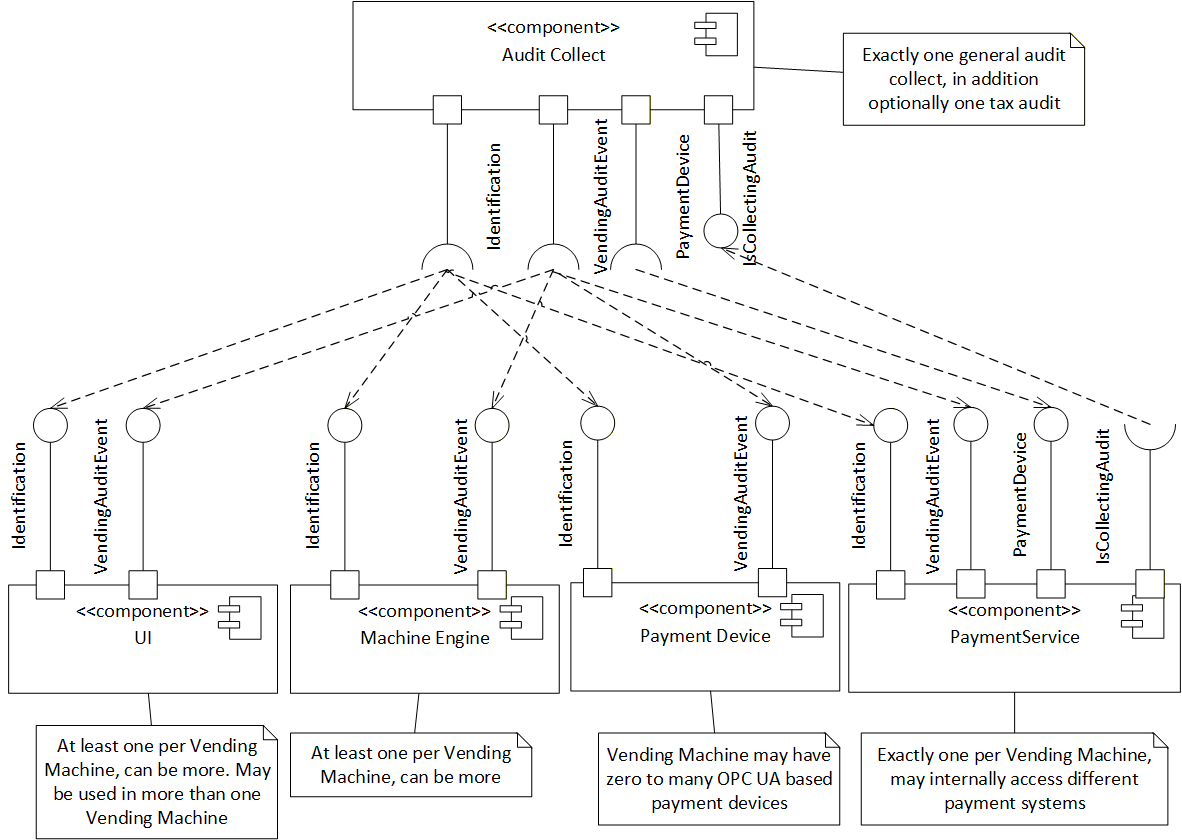
The audit collect collects audit data from all components providing audit Events and makes them available for external access. A Vending Machine according to this specification supports exactly one audit collect, and in addition optionally one tax audit (see 6.2.7).
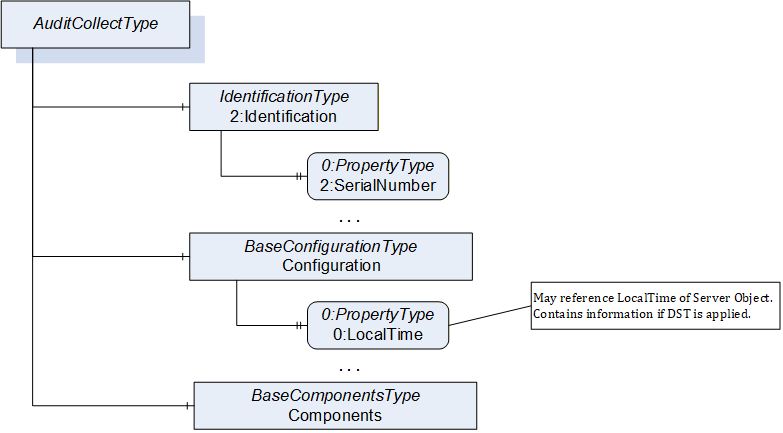
The audit collect provides its interface by implementing an instance of the AuditCollectType (shown in Figure 15, defined in 7.25). The optional Components Object of BaseComponentsType defined in 7.4 can provide information about subcomponents of the audit collect. The audit collect requires OPC UA Client functionality to access audit information of the payment service, the standalone payment devices, the UI(s) and the machine engine(s) of the Vending Machine.
6.2.7 Tax audit
A special case of the audit collect is the TAX audit, which is selecting all tax relevant information of the audit information. This component is implemented according to the tax regulations of the area the Vending Machine is operating, and receives and processes all tax relevant information.
It provides and uses the same interfaces as the audit collect (see 6.2.6), but filters the audit Events to those relevant for the tax regulations. Depending on the tax regulations, different audit Events may be relevant.
In the following sections, the tax audit is included when an audit collect component is referenced.
6.3 Interactions between components
6.3.1 General Considerations on handling method processing
In OPC UA, each service call is executed asynchronously between Client and Server. This is also true for calling an OPC UA Method from a Client. However, a Method call is expected to return a result rather fast (milliseconds or seconds, when provided to a UI it should be milliseconds up to small fractions of a second), not after minutes. Therefore, in cases where the actual execution like creating a product may take longer, the Method is returning a result immediately, before the execution has been done, and the status of the execution is provided by some Variables. This is applied in various places in this specification.
In order to not lose any data, Clients should subscribe to the status Variables to get notified about all changes of the status.
6.3.2 Requesting and Delivering Products
6.3.2.1 Overview
In the following sections, the interactions for providing the main functionality of a Vending Machine, the requesting and delivering of products, is described.
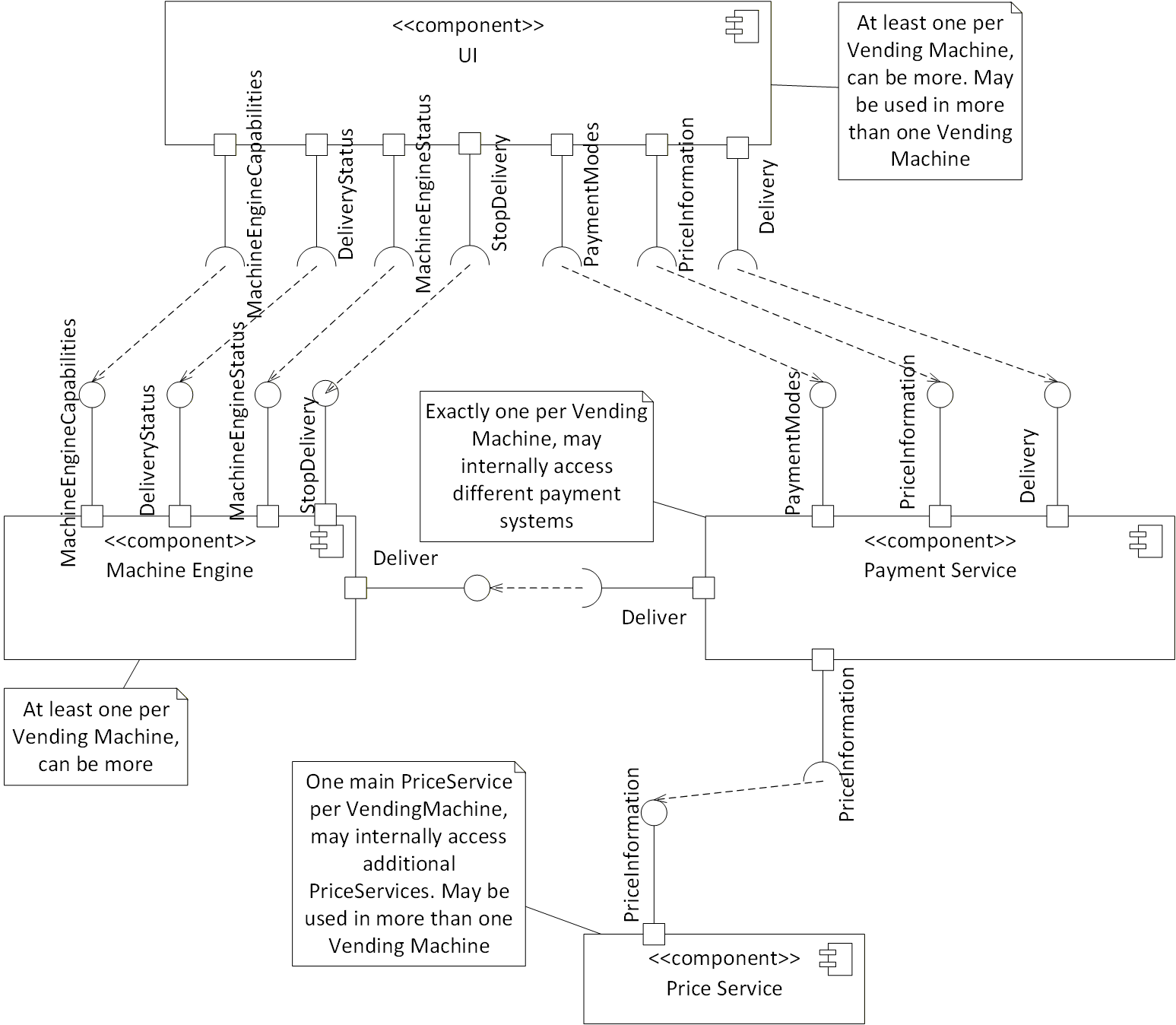
In Figure 16, an overview of the needed components and the interfaces used is given. The interface names reflect the Object names of the corresponding ObjectTypes. To emphasise, that the UI is accessing the status of the Delivery Object of the machine engine, but not calling the Deliver Method, the DeliveryStatus interface was introduced. Same applies for StopDelivery, referencing to the StopDelivery Method of the Delivery Object of the machine engine.
A Vending Machine contains one main price service, which internally may use additional price services (see Annex B).
6.3.2.2 TransactionId
A TransactionId (UInt64) is used to uniquely identify a deliver request. It is generated by the payment service and distributed to other components of the Vending Machine. The uniqueness can only be guaranteed for a certain amount of time in order to identify different deliver requests at the same time, which must be unique at least for the whole time the transaction is active. A reasonable strategy to assign the TransactionId is increasing the number every time by one and roll over to 0 at the maximum of UInt64. However, the strategy of assigning a TransactionId is vendor-specific and other components shall not make assumptions about this.
The TransactionId will not protect against false delivery request; there is protection given using the OPC UA security mechanisms, i.e., only specific Clients can communicate and request deliveries.
6.3.2.3 BasketId
A Vending Machine may support the delivery of many products at once. This can be handled in two ways.
Either by defining selections that consists of various products (e.g., a menu). In that case, it is handled like any other delivery, potentially using different outputs to deliver more than one product.
Or it may support a basket, where the user can select several products into one basket and according to the content the user may get a discount. In that case, a BasketId (UInt64) is used to uniquely identify the basket. It is generated by the payment service and distributed to other components of the Vending Machine. The same assumptions for uniqueness apply as for the TransactionId. In order to support a BasketId, the Delivery Object of the payment service needs to be of type PaymentServiceBasketDeliveryType.
Not all payment services may support basket functionality.
6.3.2.4 Startup of UI
When the UI gets started, it needs to connect to the machine engine(s) it is interested in. Depending on the UI this may be based on user interactions selecting the interesting machine engine(s).
The UI needs to read the information of the Capabilities Object of the machine engine. It may cache the information and just check the SelectionListVersion, if the configuration has changed. The UI needs to subscribe to changes of the status of the machine engine (see 6.3.2.5) to display information like a certain product is not available.
Given the SelectionId and AvailableOptionIds provided by Capabilities are only machine specific and used primarily to provide the needed info for the Deliver method, the UI need to map using separate tables (not part of this specification, typically generated by the back-end software and called plan-o-grams) the SelectionId and AvailableOptionIds to the correct graphic resources in the UI itself.
The UI needs to access the price information of the payment service by accessing the PriceInformation Object of the payment service, and potentially the PaymentModes Object to get information about the available payment modes and their status.
The price for a product is taken by combining the selection parameters (SelectionId, and Options which are machine specific) and the MachineEngineProductInstanceUri to identify the machine engine and the plan-o-gram which defines the final product to be delivered. Typically, this is done in the UI by loading the plan-o-gram into the UI.
If the price service is located on the same hardware of a vending machine, for the vending machine itself the SelectionId and Options have a defined and unique value being connected with the vending machine where they are implemented. Still, given price services can be chained, if chaining is implemented the price search can still be extended.
Any allergens, nutrition values and similar information associated with a product are not provided by mechanisms of this specification, but are typically provided by the plan-o-gram loaded into the UI.
6.3.2.5 Update UI with status of machine engine
While connected to a machine engine, the UI needs to check the status of the machine engine, by subscribing to the corresponding Variables of the Status Object of the machine engine.
In addition, it needs to subscribe to the DeliveryRequests and DeliveryProgress Variables of the Delivery Object of the machine engine. This may be done when connecting to the machine engine and is required once the UI has started a deliver request via the payment service using the DeliverRequest Method of the Delivery Object of the payment service.
6.3.2.6 Update UI with status of payment service
In order to display the price for products the UI needs to get the price information of the products. This is done calling the corresponding Methods of the PriceInformation Object of the payment service. The price may depend on the UserId and PaymentMode, therefore the UI needs to call the Methods each time, this is changing. In addition, the UI should subscribe to Events of the PriceChangeEventType to get the information, when the price information was changed and the Methods need to be called, again.
When the UI has requested a delivery, it needs to subscribe to the TransactionProgress Variable of the Delivery Object to get updates on the progress of the payment.
In case a basket is requested, it needs to subscribe to the overall basket status in the BasketProgress Variable.
In case the user is filling a basket, the UI needs to call the GetPriceForBasket Method of the PriceInformation Object each time the content of the basket is changing (adding or removing items) to get the price for the current basket.
The UI may use the Status Variable of the Status Object to display the overall status of the Vending Machine.
6.3.2.7 Requesting a delivery by the UI
UI calls payment service (DeliverRequest Method)
When a user selects a product to be delivered, the UI calls the DeliverRequest Method of the Delivery Object of the payment service. This includes the last price information recovered by the last PriceInformation Object, the PaymentMode selected, and a generic UserId (the meaning of the variable is custom specific, the effect is to possibly change the price). The payment service generates a TransactionId and returns this to UI.
The payment service may already do some of the following steps before returning the DeliverRequest Method call and potentially return a failure status instead of the TransactionId. This is up to the implementation of the payment service. However, it needs to be considered that the Method call should return rather fast (as fast as possible, not waiting till the end of the delivery, maybe milliseconds), not after minutes (see also 6.3.1).
Payment service checks correct price (internal or via price service)
The payment service checks the correctness of the price provided by the UI. Since the payment service needs to maintain the current price for the UI anyhow, it can check its local data. Alternatively, the payment service may access the primary price service again to validate the price. When the price is not correct, the payment service does not continue the deliver request and provides the corresponding status of the TransactionId in its TransactionProgress Variable.
Payment service collects payment (internal functionality)
The payment service collects the payment from the user. How this is done, is up to the nature of the payment service. It may be collecting coins or bills, charging a credit card, etc. Once successfully collected, the payment service changes the status of the TransactionId in its TransactionProgress Variable. If the payment process gets somehow aborted (implementation specific), the payment service does not continue the deliver request and provides the corresponding status of the TransactionId in its TransactionProgress Variable. The UI may handle this transparent to the user and do another deliver request with a different payment mode.
Payment service triggers delivery in machine engine (Deliver Method)
Once the payment is collected, the payment service triggers the delivery at the machine engine by calling the Deliver Method of the Delivery Object of the machine engine. It provides the TransactionId so that the machine engine can provide the TransactionId in its DeliveryRequests and DeliveryProgress Variables.
Delivery by machine engine (internal functionality)
The machine engine potentially creates the product to be delivered (e.g., coffee) and delivers it to the user. How this is done is vendor-specific. Via the DeliveryProgress Variable it informs the UI and the payment service about the status of the delivery.
Once the delivery was successfully done, the payment service informs the UI about closure of the payment via its TransactionProgress Variable.
When the delivery is aborted, for example due to an error in the machine engine, the machine engine informs both UI and payment service via the DeliveryProgress Variable. In this case, the payment service triggers (if possible) a refund of the payment to the user. How this is done, is specific to the payment service. The payment service informs the UI about this using its TransactionProgress Variable.
In both cases, the successful delivery or the abortion, the payment service and the machine engine will clean up their status Variables and remove the information about the TransactionId. The duration before doing this is vendor-specific.
6.3.2.8 Requesting a delivery stop by the UI
When a delivery has been requested by the UI as described in 6.3.2.7 in step 1, the delivery may be cancelled by the CancelDeliverRequest Method.
When the CancelDeliverRequest Method is called before the payment is collected by the payment service (step 3 in 6.3.2.7), the Method call should be successful. In that case, the payment service does not continue the deliver request and provides the corresponding status of the TransactionId in its TransactionProgress Variable.
When the CancelDeliverRequest Method is called while or after the payment gets collected by the payment service (step 3 in 6.3.2.7), but before requesting the deliver in the machine engine, and the payment service is able to refund the payment, the Method call should be successful. In that case, the payment service triggers a refund, does not continue the deliver request and provides the corresponding status of the TransactionId in its TransactionProgress Variable.
When the CancelDeliverRequest Method is called after the payment service has called the Deliver Method of the machine engine (step 4 in 6.3.2.7), the Method call should fail and no cancellation is possible anymore.
6.3.2.9 Requesting a basket delivery by the UI
In order to support this functionality, the Delivery Object of the payment service needs to be of type PaymentServiceBasketDeliveryType.
UI calls payment service (DeliverBasketRequest Method)
When a user selects the products to be delivered, the UI calls the DeliverBasketRequest Method of the Delivery Object of the payment service. This includes the price information as displayed to the user. The payment service generates a TransactionId per item of the basket and a BasketId and returns this to UI.
The payment service may already do some of the following steps before returning the DeliverBasketRequest Method call and potentially return a failure status instead of the TransactionId. This is up to the implementation of the payment service. However, it needs to be considered that the Method call should return rather fast (milliseconds or seconds), not after minutes.
Payment service checks correct price (internal or via price service)
The payment service checks the correctness of the price provided by the UI. Since the payment service needs to maintain the current price for the UI anyhow, it can check its local data. Alternatively, the payment service may access the primary price service again to validate the price. When the price is not correct, the payment service does not continue the deliver request and provides the corresponding status of the BasketId in its BasketProgress Variable and in addition per item the TransactionIds in its TransactionProgress Variable.
Payment service collects payment (internal functionality)
The payment service collects the payment from the user. How this is done, is up to the nature of the payment service. It may be collecting coins or bills, charging a credit card, etc. Once successfully collected, the payment service changes the status of the TransactionIds in its TransactionProgress Variable and the overall status of the BasketId in its BasketProgress Variable. If the payment of the whole basket is handled at once, that requires that the TransactionProgress of all TransactionIds of the basket shall change at the same time. If the payment process gets somehow aborted (implementation specific), the payment service does not continue the deliver request and provides the corresponding status of the TransactionIds in its TransactionProgress Variable and the overall status of the BasketId in its BasketProgress Variable. The UI may handle this transparent to the user and do another basket deliver request with a different payment mode.
Payment service triggers delivery in machine engine (Deliver Method)
Once the payment is collected, the payment service triggers the delivery per item of the basket at the corresponding machine engines by calling the Deliver Method of the Delivery Object of the machine engine per item. It provides a TransactionId per item of the basket, so that the machine engine can provide the TransactionId for each item in its DeliveryRequests and DeliveryProgress Variables. Whether the payment service calls the Deliver Method for all items in parallel or serializes by some internal logic the requests, is an implementation detail of the payment service.
Delivery by machine engine per item of the basket (internal functionality)
The machine engine potentially creates the product to be delivered (e.g., coffee) and delivers it to the user. How this is done is vendor-specific. Via the DeliveryProgress Variable it informs the UI and the payment service about the status of the delivery.
Once the delivery of all items was successfully done, the payment service informs the UI about closure of the payment via its TransactionProgress Variable.
When the delivery is aborted, for example due to an error in the machine engine, the machine engine informs both UI and payment service via the DeliveryProgress Variable. In this case, the payment service triggers a refund of the payment to the user. How this is done, is specific to the payment service. The payment service informs the UI about this using its TransactionProgress Variable. In addition, it updates the overall status of the basket in the BasketProgress Variable.
In both cases, the successful delivery or the abortion, the payment service and the machine engine will clean up their status Variables and remove the information about the TransactionId. The duration before doing this is vendor-specific.
Clean up of the basket information (internal functionality)
Once the delivery of all items of the basket has been finalized (either successful or not), the payment service updates the BasketProgress Variable. The payment service will clean up this Variable and remove the information about the BasketId. The duration before doing this is vendor-specific.
6.3.2.10 Requesting a basket delivery stop by the UI
When a basket delivery has been requested by the UI as described in 6.3.2.9 in step 1, the delivery may be cancelled by the CancelDeliverBasketRequest Method.
When the CancelDeliverBasketRequest Method is called before the payment is collected by the payment service (step 3 in 6.3.2.9), the Method call should be successful. In that case, the payment service does not continue the deliver request and provides the corresponding status of the TransactionIds in its TransactionProgress Variable and the overall status of the BasketId in its BasketProgress Variable.
When the CancelDeliverBasketRequest Method is called while or after the payment gets collected by the payment service (step 3 in 6.3.2.9), but before requesting any deliver in any machine engine, and the payment service is able to refund the payment, the Method call should be successful. In that case, the payment service triggers a refund, does not continue the deliver request and provides the corresponding status of the TransactionIds in its TransactionProgress Variable and the overall status of the BasketId in its BasketProgress Variable.
When the CancelDeliverBasketRequest Method is called after the payment service has called the Deliver Method of any machine engine (step 4 in 6.3.2.9) for any of the TransactionIds of the basket, the Method call should fail and no cancellation is possible anymore.
6.3.3 Handling Payment Devices
6.3.3.1 Overview
A Vending Machine may have several payment devices responsible to handle money, either received from a customer or provided to the customer. Those devices may be handled in a proprietary way by the payment service, or accessed using a standardized OPC UA information model defined in this specification. The type hierarchy for those devices is introduced in 6.2.3. The following clauses describe the interactions between the payment services and the different types of payment devices.
6.3.3.2 Coin devices
The payment service reads the configuration of the payment device like the SupportedAssetList and the SlotConfigurationList. It may monitor the SupportedAssetListVersion to get notified, when the configuration has changed. It should monitor the Status of the payment device and take appropriate actions if it changes. The AssetConfigurationList defines how to handle specific coins or tokens and can be changed by the payment service using the ChangeAssetConfigurationList Method.
By configuring the AssetConfigurationList to reject all supported assets, the payment service can effectively disable a payment device.
By monitoring the CurrentAvailableValue the payment service knows how much money is currently in the payment device that a customer has already added to the payment device and can be used for a delivery. By calling the ConsumeAvailableValue Method, the payment service can actually consume part of the CurrentAvailableValue.
By monitoring the CurrentSlotContentList the payment service knows the available money currently in the payment device for payout. By monitoring the PayoutStatus the payment service knows about the status of any payout, that can be triggered by the PayoutByValue and PayoutBySupportedAssetList Methods.
A payout does not change the CurrentAvailableValue. If the payment service wants to trigger a logic, that a payout does decrease the CurrentAvailableValue, it needs to call the ConsumeAvailableValue Method in addition to the Method for the payout.
6.3.3.3 Bill devices
The payment devices supporting bills have some additional functionality to that the payment devices for coins support. They allow to cancel a running payout with the CancelPayout Method and provide information about the current bill or token in the escrow. With the HandleBillFromEscrow Method, the payment service can control what the payment device is supposed to do with the current bill in the escrow.
6.3.3.4 Cashless devices
The payment service supervises information from the cashless payment devices, like the UserId, MaxRecharge and CurrentContentOnCard Variables.
The payment service may charge money with the Approve Method. The ApproveStatus Variable provides the result, as the approval may take time. While the approval process is ongoing, the payment service may try to cancel it by calling the CancelApproval Method.
The payment service may add money to the card with the Recharge Method. The RechargeStatus Variable provides the result, as the recharging may take time.
The payment service may refund the last approved charging with the RefundLast Method. The RefundLastStatus Variable provides the result, as the refunding may take time.
The payment service may enable or disable the payment device with the EnableOrDisable Method. The IsEnabled Variable provides the result, as the operation may take time.
6.3.4 Audit
Audit information is provided by OPC UA Events. The VendingBaseAuditEventType defined in 7.26 and its subtypes are used for all audit information. The general audit collect is supposed to subscribe to all Events of VendingBaseAuditEventType from all UIs, all machine engines, the payment service and all payment devices having their own OPC UA Server of the Vending Machine. The optional, specialized tax audit component would only subscribe to Events relevant for the tax regulations.
An audit collect may need identification information of the components its accesses, and as special case for the payment service also the identification of the payment devices. This is provided by the IdentificationType.
For some payment devices, it is required to access configuration information in order to interpret the audit information. Potentially, also the current content of those payment devices needs to be accessed, which in principle could be calculated out of the Events if the initial content is known. This information is provided by Objects of PaymentDeviceType.
As a Vending Machine may be configured not to work when no audit is collected, the audit collect provides a IsCollectingAudit Variable which may be supervised by the payment service, which may reject new requests while the audit is not collected.
In Figure 17, an overview of the needed components and the interfaces used is given.
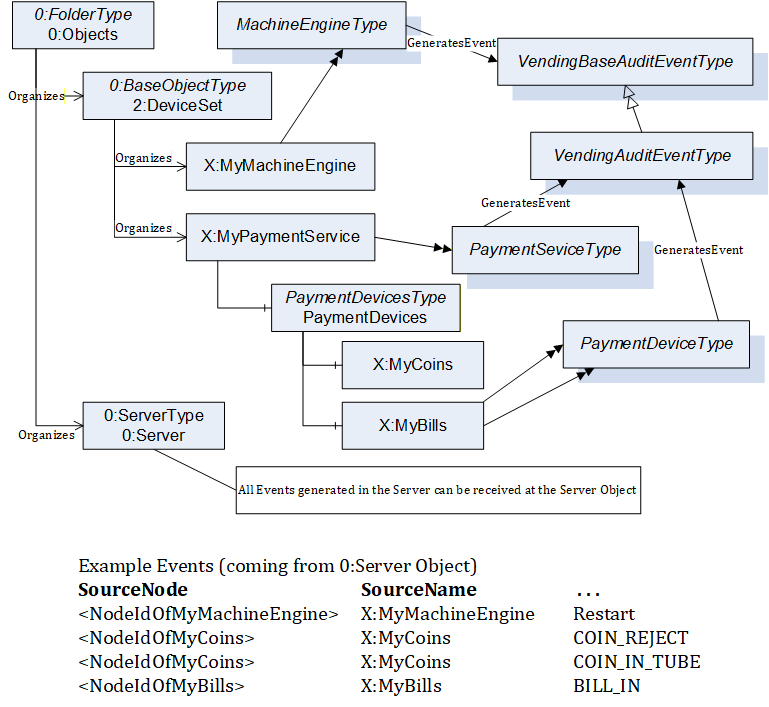
An OPC UA Server may represent several components of a Vending Machine, and as a special case, for the payment service, the payment devices. All those components individually generate Events of VendingBaseAuditEventType, in order to relate the Events to the corresponding component. The audit collect should subscribe to the 0:Server Object and filter for Events of VendingBaseAuditEventType to receive all audit information of the individual components of an OPC UA Server. In Figure 18, an example is given of an OPC UA Server AddressSpace, providing a machine engine and a payment service with two payment devices. X:MyMachineEngine, X:MyPaymentService, X:MyCoins and X:MyBills are all of TypeDefinitions generating Events of VendingBaseAuditEventType. At the bottom of Figure 18 some examples of Events are sketched, showing how the SourceNode and SourceName of the Events are identifying the source of the Events.
6.3.5 Initial Connection, reconnecting, and ConfigurationChangedEvents
Components like audit collect may want to keep track of information of components of a Vending Machine, and potentially subcomponents. Therefore, when initially connecting to an OPC UA Server representing one or several components of a Vending Machine, those components need to browse and read the required information. For example, audit collect does need some information, to interpret the audit information. Therefore, it may need to browse the PaymentDevices and PaymentModes of the payment service. In order to keep track of changes of the configuration of components of a Vending Machine, the audit collect should subscribe to ConfigurationChangedEvents, and in case it receives such an Event re-browse and reread the information of that component. Although the configuration of a Vending Machine is typically quite static, it may be that at restart some devices like a bill validator take a much longer time to restart, and therefore get added to the configuration while the Vending Machine is already running.
When a component like audit collect is reconnecting to an OPC UA Server representing one or several components of a Vending Machine, there are two scenarios:
The connection could be re-established without loss of data. That means, the subscription is still running and the data indicate no loss of data. In that case, the component does not need to do any specific actions.
The connection could not be re-established or some losses of data have been indicated. In that case, the component needs to reread the information from the OPC UA Server.
6.3.6 Configuration
The configuration of components of a Vending Machine is vendor-specific and not defined in this specification. This specification does define an entry point where vendors are supposed to manage their configuration options, an Object called Configuration of the BaseConfigurationType defined in 7.3.
In Figure 19 an overview of the needed components and the interfaces used is given. The Configuration Client component is vendor-specific and not further described in this specification.