
1 Scope
This document OPC 40718 specifies a Companion Specification for shot blasting machinery.
Shot blasting machinery in this context can be any existing or future shot blasting machinery. The implicit and explicit information model specified by the shot blasting machinery Companion Specification will be defined as a companion specification using OPC UA constructs for the purpose of exchanging shot blasting machinery information with OPC UA applications. It shall define the required data structures, parameters, methods, state machines etc. for the communication of shot blasting machinery into higher level manufacturing systems (e.g. Manufacturing Execution System, MES), for information, monitoring and diagnostic purposes and to set parameters regarding the shot blasting process.
Surface treatment processes carried out on shot blasting machinery are e.g. abrasive blasting or shot peening.
The specific parameters ultrasonic shot blasting technology are not covered in the information model specified in this document.
2 Normative references
The following documents are referred to in the text in such a way that some or all of their content constitutes requirements of this document. For dated references, only the edition cited applies. For undated references, the latest edition of the referenced document (including any amendments and errata) applies
OPC 10000-1, OPC Unified Architecture - Part 1: Overview and Concepts
http://www.opcfoundation.org/documents/10000-1/
OPC 10000-2, OPC Unified Architecture - Part 2: Security Model
http://www.opcfoundation.org/documents/10000-2/
OPC 10000-3, OPC Unified Architecture - Part 3: Address Space Model
http://www.opcfoundation.org/documents/10000-3/
OPC 10000-4, OPC Unified Architecture - Part 4: Services
http://www.opcfoundation.org/documents/10000-4/
OPC 10000-5, OPC Unified Architecture - Part 5: Information Model
http://www.opcfoundation.org/documents/10000-5/
OPC 10000-6, OPC Unified Architecture - Part 6: Mappings
http://www.opcfoundation.org/documents/10000-6/
OPC 10000-7, OPC Unified Architecture - Part 7: Profiles
http://www.opcfoundation.org/documents/10000-7/
OPC 10000-100, OPC Unified Architecture - Part 100: Devices
http://www.opcfoundation.org/documents/10000-100/
OPC 40001-1, OPC UA for Machinery - Part 1: Basic Building Blocks
http://www.opcfoundation.org/documents/40001-1/
OPC 10031-4, OPC UA for ISA-95 - Part 4: Job Control
http://www.opcfoundation.org/documents/10031-4/
OPC 40001-3, OPC UA for Machinery - Part 3: Job Management
http://www.opcfoundation.org/documents/40001-3/
3 Terms, definitions and conventions
3.1 Overview
It is assumed that basic concepts of OPC UA information modelling are understood in this specification. This specification will use these concepts to describe the Shot Blasting Information Model. For the purposes of this document, the terms and definitions given in OPC 10000-1, OPC 10000-3, OPC 10000-4, OPC 10000-5, OPC 10000-7, OPC 10000-100, … as well as the following apply.
3.2 OPC UA for Shot Blasting Technology terms
3.2.1 Blaster
Device or assembly which accelerates the shot blasting media.
3.2.2 Wheel Blaster
Device which accelerates the shot blasting media by a rotating wheel with blades.
3.2.3 Air Blaster
Assembly consisting of a nozzle and connected hose(s) or tube(s), which accelerates the shot blasting media by pressurized air.
3.2.4 Storage
Vessel storing shot blasting media.
3.2.5 Conveyor
Workpiece transport system of the shot blasting machine.
3.2.6 Filter Unit
System for exhaust air purification.
3.3 Abbreviated terms
| AC | Alarms and Conditions |
| DCS | Distributed Control Systems |
| ERP | Enterprise Resource Planning |
| HMI | Human Machine Interface |
| HTTP | Hypertext Transfer Protocol |
| IP | Internet Protocol |
| MES | Manufacturing Execution System |
| PLC | Programmable Logical Controller |
| PMS | Production Management System |
| TCP | Transmission Control Protocol |
| UML | Unified Modelling Language |
| URI | Uniform Resource Identifier |
| XML | Extensible Markup Language |
3.4 Conventions used in this document
3.4.1 Conventions for Node descriptions
3.4.1.1 Node definitions
Node definitions are specified using tables (see Table 2).
Attributes are defined by providing the Attribute name and a value, or a description of the value.
References are defined by providing the ReferenceType name, the BrowseName of the TargetNode and its NodeClass.
If the TargetNode is a component of the Node being defined in the table the Attributes of the composed Node are defined in the same row of the table.
The DataType is only specified for Variables; "[<number>]" indicates a single-dimensional array, for multi-dimensional arrays the expression is repeated for each dimension (e.g. [2][3] for a two-dimensional array). For all arrays the ArrayDimensions is set as identified by <number> values. If no <number> is set, the corresponding dimension is set to 0, indicating an unknown size. If no number is provided at all the ArrayDimensions can be omitted. If no brackets are provided, it identifies a scalar DataType and the ValueRank is set to the corresponding value (see OPC 10000-3). In addition, ArrayDimensions is set to null or is omitted. If it can be Any or ScalarOrOneDimension, the value is put into "{<value>}", so either "{Any}" or "{ScalarOrOneDimension}" and the ValueRank is set to the corresponding value (see OPC 10000-3) and the ArrayDimensions is set to null or is omitted. Examples are given in Table 1.
| Notation | DataType | ValueRank | ArrayDimensions | Description |
| 0:Int32 | 0:Int32 | -1 | omitted or null | A scalar Int32. |
| 0:Int32[] | 0:Int32 | 1 | omitted or {0} | Single-dimensional array of Int32 with an unknown size. |
| 0:Int32[][] | 0:Int32 | 2 | omitted or {0,0} | Two-dimensional array of Int32 with unknown sizes for both dimensions. |
| 0:Int32[3][] | 0:Int32 | 2 | {3,0} | Two-dimensional array of Int32 with a size of 3 for the first dimension and an unknown size for the second dimension. |
| 0:Int32[5][3] | 0:Int32 | 2 | {5,3} | Two-dimensional array of Int32 with a size of 5 for the first dimension and a size of 3 for the second dimension. |
| 0:Int32{Any} | 0:Int32 | -2 | omitted or null | An Int32 where it is unknown if it is scalar or array with any number of dimensions. |
| 0:Int32{ScalarOrOneDimension} | 0:Int32 | -3 | omitted or null | An Int32 where it is either a single-dimensional array or a scalar. |
The TypeDefinition is specified for Objects and Variables.
The TypeDefinition column specifies a symbolic name for a NodeId, i.e. the specified Node points with a HasTypeDefinition Reference to the corresponding Node.
The ModellingRule of the referenced component is provided by specifying the symbolic name of the rule in the ModellingRule column. In the AddressSpace, the Node shall use a HasModellingRule Reference to point to the corresponding ModellingRule Object.
If the NodeId of a DataType is provided, the symbolic name of the Node representing the DataType shall be used.
Note that if a symbolic name of a different namespace is used, it is prefixed by the NamespaceIndex (see 3.4.2.2).
Nodes of all other NodeClasses cannot be defined in the same table; therefore only the used ReferenceType, their NodeClass and their BrowseName are specified. A reference to another part of this document points to their definition. Table 2 illustrates the table. If no components are provided, the DataType, TypeDefinition and ModellingRule columns may be omitted and only a Comment column is introduced to point to the Node definition.
Each Type Node or well-known Instance Node defined shall have one or more ConformanceUnits defined in 8.1 that require the Node to be in the AddressSpace.
The relations between Nodes and ConformanceUnits are defined at the end of the tables defining Nodes, one row per ConformanceUnit. The ConformanceUnits are reflected in the Category element for the Node definition in the UANodeSet (see OPC 10000-6).
The list of ConformanceUnits in the UANodeSet allows Servers to optimize resource consumption by using a list of supported ConformanceUnits to select a subset of the Nodes in an Information Model.
When a Node is selected in this way, all dependencies implied by the References are also selected.
Dependencies exist if the Node is the source of HasTypeDefinition, HasInterface, HasAddIn or any HierarchicalReference. Dependencies also exist if the Node is the target of a HasSubtype Reference. For Variables and VariableTypes, the value of the DataType Attribute is a dependency. For DataType Nodes, any DataTypes referenced in the DataTypeDefinition Attribute are also dependencies.
For additional details see OPC 10000-5.
| Attribute | Value | ||||
| Attribute name | Attribute value. If it is an optional Attribute that is not set "--" will be used. | ||||
| References | NodeClass | BrowseName | DataType | TypeDefinition | Other |
|---|---|---|---|---|---|
| ReferenceType name | NodeClass of the target Node. | BrowseName of the target Node. | DataType of the referenced Node, only applicable for Variables. | TypeDefinition of the referenced Node, only applicable for Variables and Objects. | Additional characteristics of the TargetNode such as the ModellingRule or AccessLevel. |
| NOTE Notes referencing footnotes of the table content. | |||||
| Conformance Units | |||||
|---|---|---|---|---|---|
| Name of ConformanceUnit, one row per ConformanceUnit |
Components of Nodes can be complex that is containing components by themselves. The TypeDefinition, NodeClass and DataType can be derived from the type definitions, and the symbolic name can be created as defined in 3.4.3.1. Therefore, those containing components are not explicitly specified; they are implicitly specified by the type definitions.
The Other column defines additional characteristics of the Node. Examples of characteristics that can appear in this column are show in Table 3.
| Name | Short Name | Description |
| 0:Mandatory | M | The Node has the Mandatory ModellingRule. |
| 0:Optional | O | The Node has the Optional ModellingRule. |
| 0:MandatoryPlaceholder | MP | The Node has the MandatoryPlaceholder ModellingRule. |
| 0:OptionalPlaceholder | OP | The Node has the OptionalPlaceholder ModellingRule. |
| ReadOnly | RO | The Node AccessLevel has the CurrentRead bit set but not the CurrentWrite bit. |
| ReadWrite | RW | The Node AccessLevel has the CurrentRead and CurrentWrite bits set. |
| WriteOnly | WO | The Node AccessLevel has the CurrentRead and CurrentWrite bits set. |
If multiple characteristics are defined they are separated by commas. The name or the short name may be used.
3.4.1.2 Additional References
To provide information about additional References, the format as shown in Table 4 is used.
| SourceBrowsePath | Reference Type | Is Forward | TargetBrowsePath |
| SourceBrowsePath is always relative to the TypeDefinition. Multiple elements are defined as separate rows of a nested table. | ReferenceType name | True = forward Reference | TargetBrowsePath points to another Node, which can be a well-known instance or a TypeDefinition. You can use BrowsePaths here as well, which is either relative to the TypeDefinition or absolute. If absolute, the first entry needs to refer to a type or well-known instance, uniquely identified within a namespace by the BrowseName. |
References can be to any other Node.
3.4.1.3 Additional sub-components
To provide information about sub-components, the format as shown in Table 5 is used.
| BrowsePath | Reference | NodeClass | BrowseName | DataType | TypeDefinition | Others |
| BrowsePath is always relative to the TypeDefinition. Multiple elements are defined as separate rows of a nested table | NOTE Same as for Table 2 | |||||
3.4.1.4 Additional Attribute values
The type definition table provides columns to specify the values for required Node Attributes for InstanceDeclarations. To provide information about additional Attributes, the format as shown in Table 6 is used.
| BrowsePath | <Attribute name> Attribute |
| BrowsePath is always relative to the TypeDefinition. Multiple elements are defined as separate rows of a nested table | The values of attributes are converted to text by adapting the reversible JSON encoding rules defined in OPC 10000-6. If the JSON encoding of a value is a JSON string or a JSON number then that value is entered in the value field. Double quotes are not included. If the DataType includes a NamespaceIndex (QualifiedNames, NodeIds or ExpandedNodeIds) then the notation used for BrowseNames is used. If the value is an Enumeration the name of the enumeration value is entered. If the value is a Structure then a sequence of name and value pairs is entered. Each pair is followed by a newline. The name is followed by a colon. The names are the names of the fields in the DataTypeDefinition. If the value is an array of non-structures then a sequence of values is entered where each value is followed by a newline. If the value is an array of Structures or a Structure with fields that are arrays or with nested Structures then the complete JSON array or JSON object is entered. |
There can be multiple columns to define more than one Attribute.
3.4.2 NodeIds and BrowseNames
3.4.2.1 NodeIds
The NodeIds of all Nodes described in this standard are only symbolic names. Annex A defines the actual NodeIds.
The symbolic name of each Node defined in this document is its BrowseName, or, when it is part of another Node, the BrowseName of the other Node, a ".", and the BrowseName of itself. In this case "part of" means that the whole has a HasProperty or HasComponent Reference to its part. Since all Nodes not being part of another Node have a unique name in this document, the symbolic name is unique.
The NamespaceUri for all NodeIds defined in this document is defined in Annex A. The NamespaceIndex for this NamespaceUri is vendor-specific and depends on the position of the NamespaceUri in the server namespace table.
Note that this document not only defines concrete Nodes, but also requires that some Nodes shall be generated, for example one for each Session running on the Server. The NodeIds of those Nodes are Server-specific, including the namespace. But the NamespaceIndex of those Nodes cannot be the NamespaceIndex used for the Nodes defined in this document, because they are not defined by this document but generated by the Server.
3.4.2.2 BrowseNames
The text part of the BrowseNames for all Nodes defined in this document is specified in the tables defining the Nodes. The NamespaceUri for all BrowseNames defined in this document is defined in 9.2.
For InstanceDeclarations of NodeClass Object and Variable that are placeholders (OptionalPlaceholder and MandatoryPlaceholder ModellingRule), the BrowseName and the DisplayName are enclosed in angle brackets (<>) as recommended in OPC 10000-3.
If the BrowseName is not defined by this document, a namespace index prefix is added to the BrowseName (e.g., prefix '0' leading to '0:EngineeringUnits' or prefix '2' leading to '2:DeviceRevision'). This is typically necessary if a Property of another specification is overwritten or used in the OPC UA types defined in this document. Table 49 provides a list of namespaces and their indexes as used in this document.
3.4.3 Common Attributes
3.4.3.1 General
The Attributes of Nodes, their DataTypes and descriptions are defined in OPC 10000-3. Attributes not marked as optional are mandatory and shall be provided by a Server. The following tables define if the Attribute value is defined by this specification or if it is server-specific.
For all Nodes specified in this specification, the Attributes named in Table 7 shall be set as specified in the table.
| Attribute | Value |
| DisplayName | The DisplayName is a LocalizedText. Each server shall provide the DisplayName identical to the BrowseName of the Node for the LocaleId "en". Whether the server provides translated names for other LocaleIds is server-specific. |
| Description | Optionally a server-specific description is provided. |
| NodeClass | Shall reflect the NodeClass of the Node. |
| NodeId | The NodeId is described by BrowseNames as defined in 3.4.2.1. |
| WriteMask | Optionally the WriteMask Attribute can be provided. If the WriteMask Attribute is provided, it shall set all non-server-specific Attributes to not writable. For example, the Description Attribute may be set to writable since a Server may provide a server-specific description for the Node. The NodeId shall not be writable, because it is defined for each Node in this specification. |
| UserWriteMask | Optionally the UserWriteMask Attribute can be provided. The same rules as for the WriteMask Attribute apply. |
| RolePermissions | Optionally server-specific role permissions can be provided. |
| UserRolePermissions | Optionally the role permissions of the current Session can be provided. The value is server-specifc and depend on the RolePermissions Attribute (if provided) and the current Session. |
| AccessRestrictions | Optionally server-specific access restrictions can be provided. |
3.4.3.2 Objects
For all Objects specified in this specification, the Attributes named in Table 8 shall be set as specified in the table. The definitions for the Attributes can be found in OPC 10000-3.
| Attribute | Value |
| EventNotifier | Whether the Node can be used to subscribe to Events or not is server-specific. |
3.4.3.3 Variables
For all Variables specified in this specification, the Attributes named in Table 9 shall be set as specified in the table. The definitions for the Attributes can be found in OPC 10000-3.
| Attribute | Value |
| MinimumSamplingInterval | Optionally, a server-specific minimum sampling interval is provided. |
| AccessLevel | The access level for Variables used for type definitions is server-specific, for all other Variables defined in this specification, the access level shall allow reading; other settings are server-specific. |
| UserAccessLevel | The value for the UserAccessLevel Attribute is server-specific. It is assumed that all Variables can be accessed by at least one user. |
| Value | For Variables used as InstanceDeclarations, the value is server-specific; otherwise it shall represent the value described in the text. |
| ArrayDimensions | If the ValueRank does not identify an array of a specific dimension (i.e. ValueRank <= 0) the ArrayDimensions can either be set to null or the Attribute is missing. This behaviour is server-specific. If the ValueRank specifies an array of a specific dimension (i.e. ValueRank > 0) then the ArrayDimensions Attribute shall be specified in the table defining the Variable. |
| Historizing | The value for the Historizing Attribute is server-specific. |
| AccessLevelEx | If the AccessLevelEx Attribute is provided, it shall have the bits 8, 9, and 10 set to 0, meaning that read and write operations on an individual Variable are atomic, and arrays can be partly written. |
3.4.3.4 VariableTypes
For all VariableTypes specified in this specification, the Attributes named in Table 10 shall be set as specified in the table. The definitions for the Attributes can be found in OPC 10000-3.
| Attributes | Value |
| Value | Optionally a server-specific default value can be provided. |
| ArrayDimensions | If the ValueRank does not identify an array of a specific dimension (i.e. ValueRank <= 0) the ArrayDimensions can either be set to null or the Attribute is missing. This behaviour is server-specific. If the ValueRank specifies an array of a specific dimension (i.e. ValueRank > 0) then the ArrayDimensions Attribute shall be specified in the table defining the VariableType. |
3.4.3.5 Methods
For all Methods specified in this specification, the Attributes named in Table 11 shall be set as specified in the table. The definitions for the Attributes can be found in OPC 10000-3.
| Attributes | Value |
| Executable | All Methods defined in this specification shall be executable (Executable Attribute set to "True"), unless it is defined differently in the Method definition. |
| UserExecutable | The value of the UserExecutable Attribute is server-specific. It is assumed that all Methods can be executed by at least one user. |
3.4.4 Structures
OPC 10000-3 differentiates between different kinds of Structures. The following conventions explain, how these Structures shall be defined.
The first kind are Structures without optional fields where none of the fields allows subtype (except fields with abstract DataTypes). Its definition is in Table 12.
| Name | Type | Description |
| <someStructure> | structure | Subtype of <someParentStructure> defined in … |
SP1 | 0:Byte[] | Setpoint 1 |
SP2 | 0:Byte[] | Setpoint 2 |
The second kind are Structures with optional fields where none of the fields allows subtypes (except fields with abstract DataTypes). Its definition is in Table 13.
Structures with fields that are optional have an "Optional" column. Fields that are optional have True set, otherwise False.
| Name | Type | Description | Optional |
| <someStructure> | structure | Subtype of <someParentStructure> defined in … | |
SP1 | 0:Byte[] | Setpoint 1 | False |
SP2 | 0:Byte[] | Setpoint 2 | True |
The third kind are Structures without optional fields where one or more of the fields allow subtypes. Its definition is in Table 14.
Structures with fields that allow subtypes have an "Allow Subtypes" column. Fields that allow subtypes have True set, otherwise False. Fields with abstract DataTypes can always be subtyped.
| Name | Type | Description | Allow SubTypes |
| <someStructure> | structure | Subtype of <someParentStructure> defined in … | |
SP1 | 0:Byte[] | Setpoint 1 | False |
Allow Subtypes | 0:ByteString | Some Bytestring | True |
4 General information to Shot Blasting Technology and OPC UA
4.1 Introduction to Shot Blasting Technology
Shot blasting is a technology used to clean, strengthen or set the roughness of metal or other material surfaces. Shot blasting is widely used in the producing industries. Shot blasting machinery is divided into wheelblasting and airblasting technology. The information model covers both shot blasting technologies and their specific machine components. By means of sensors, process data like shot blast material usage, power consumption, pressurized air consumption, etc. can be recorded and used for process monitoring.
4.2 Introduction to OPC Unified Architecture
4.2.1 What is OPC UA?
OPC UA is an open and royalty free set of standards designed as a universal communication protocol. While there are numerous communication solutions available, OPC UA has key advantages:
A state of art security model (see OPC 10000-2).
A fault tolerant communication protocol.
An information modelling framework that allows application developers to represent their data in a way that makes sense to them.
OPC UA has a broad scope which delivers for economies of scale for application developers. This means that a larger number of high-quality applications at a reasonable cost are available. When combined with semantic models such as Shot Blasting Technology, OPC UA makes it easier for end users to access data via generic commercial applications.
The OPC UA model is scalable from small devices to ERP systems. OPC UA Servers process information locally and then provide that data in a consistent format to any application requesting data - ERP, MES, PMS, Maintenance Systems, HMI, Smartphone or a standard Browser, for examples. For a more complete overview see
OPC 10000-1.
4.2.2 Basics of OPC UA
As an open standard, OPC UA is based on standard internet technologies, like TCP/IP, HTTP, Web Sockets.
As an extensible standard, OPC UA provides a set of Services (see OPC 10000-4) and a basic information model framework. This framework provides an easy manner for creating and exposing vendor defined information in a standard way. More importantly all OPC UA Clients are expected to be able to discover and use vendor-defined information. This means OPC UA users can benefit from the economies of scale that come with generic visualization and historian applications. This specification is an example of an OPC UA Information Model designed to meet the needs of developers and users.
OPC UA Clients can be any consumer of data from another device on the network to browser based thin clients and ERP systems. The full scope of OPC UA applications is shown in Figure 1.
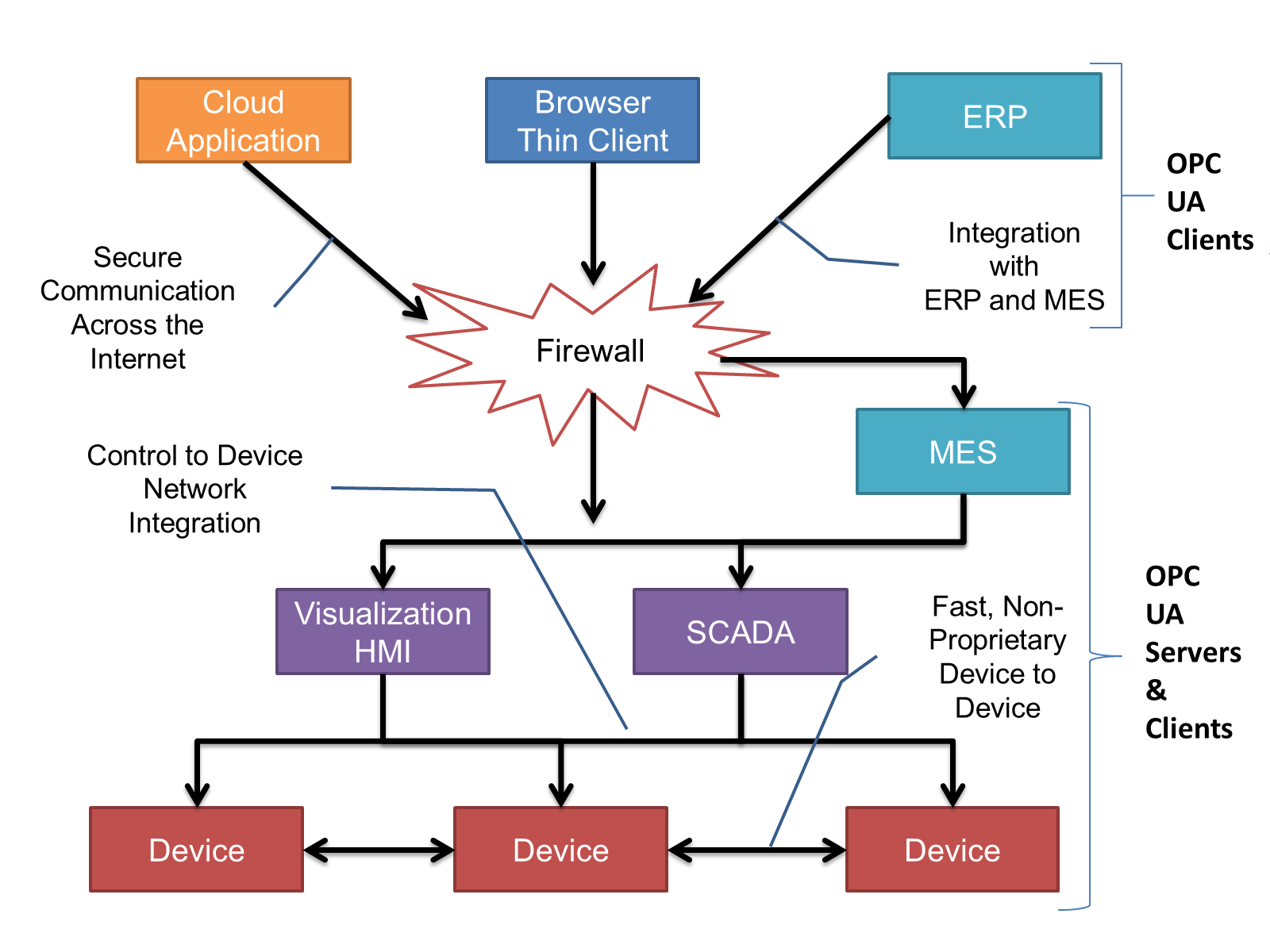
OPC UA provides a robust and reliable communication infrastructure having mechanisms for handling lost messages, failover, heartbeat, etc. With its binary encoded data, it offers a high-performing data exchange solution. Security is built into OPC UA as security requirements become more and more important especially since environments are connected to the office network or the internet and attackers are starting to focus on automation systems.
4.2.3 Information modelling in OPC UA
4.2.3.1 Concepts
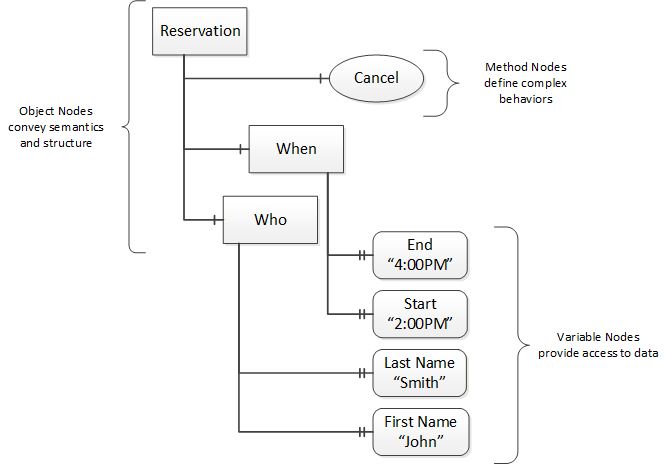
OPC UA provides a framework that can be used to represent complex information as Objects in an AddressSpace which can be accessed with standard services. These Objects consist of Nodes connected by References. Different classes of Nodes convey different semantics. For example, a Variable Node represents a value that can be read or written. The Variable Node has an associated DataType that can define the actual value, such as a string, float, structure etc. It can also describe the Variable value as a variant. A Method Node represents a function that can be called. Every Node has a number of Attributes including a unique identifier called a NodeId and non-localized name called as BrowseName. An Object representing a 'Reservation' is shown in Figure 2.
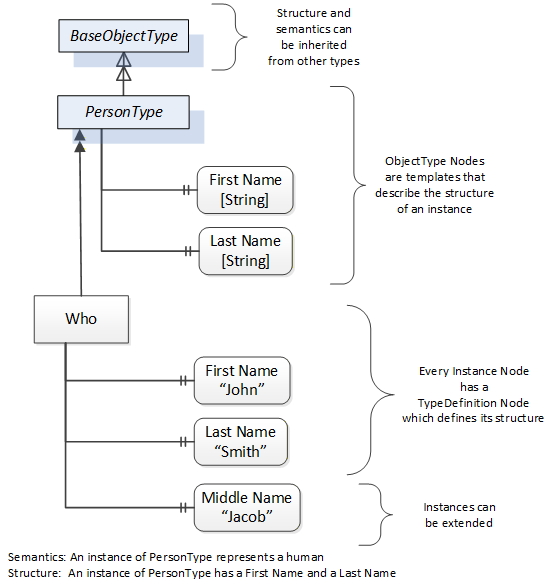
Object and Variable Nodes represent instances and they always reference a TypeDefinition (ObjectType or VariableType) Node which describes their semantics and structure. Figure 3 illustrates the relationship between an instance and its TypeDefinition.
The type Nodes are templates that define all of the children that can be present in an instance of the type. In the example in Figure 3 the PersonType ObjectType defines two children: First Name and Last Name. All instances of PersonType are expected to have the same children with the same BrowseNames. Within a type the BrowseNames uniquely identify the children. This means Client applications can be designed to search for children based on the BrowseNames from the type instead of NodeIds. This eliminates the need for manual reconfiguration of systems if a Client uses types that multiple Servers implement.
OPC UA also supports the concept of sub-typing. This allows a modeller to take an existing type and extend it. There are rules regarding sub-typing defined in OPC 10000-3, but in general they allow the extension of a given type or the restriction of a DataType. For example, the modeller may decide that the existing ObjectType in some cases needs an additional Variable. The modeller can create a subtype of the ObjectType and add the Variable. A Client that is expecting the parent type can treat the new type as if it was of the parent type. Regarding DataTypes, subtypes can only restrict. If a Variable is defined to have a numeric value, a sub type could restrict it to a float.
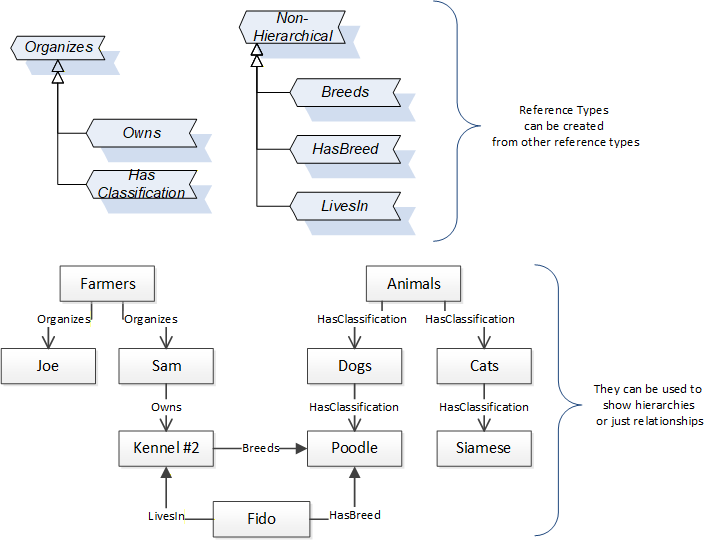
References allow Nodes to be connected in ways that describe their relationships. All References have a ReferenceType that specifies the semantics of the relationship. References can be hierarchical or non-hierarchical. Hierarchical references are used to create the structure of Objects and Variables. Non-hierarchical are used to create arbitrary associations. Applications can define their own ReferenceType by creating subtypes of an existing ReferenceType. Subtypes inherit the semantics of the parent but may add additional restrictions. Figure 4 depicts several References, connecting different Objects.
The figures above use a notation that was developed for the OPC UA specification. The notation is summarized in Figure 5. UML representations can also be used; however, the OPC UA notation is less ambiguous because there is a direct mapping from the elements in the figures to Nodes in the AddressSpace of an OPC UA Server.
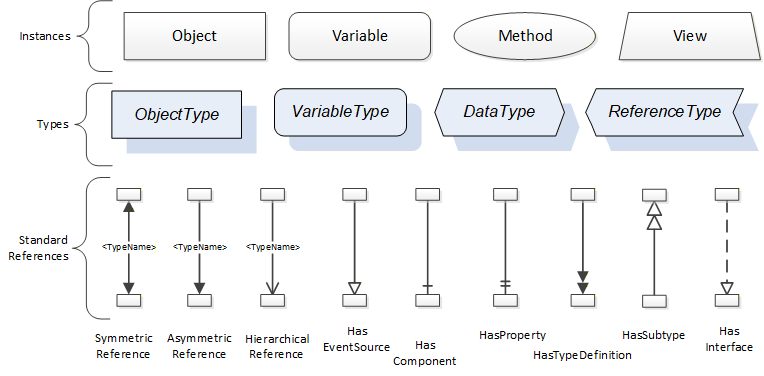
A complete description of the different types of Nodes and References can be found in OPC 10000-3 and the base structure is described in OPC 10000-5.
OPC UA specification defines a very wide range of functionality in its basic information model. It is not required that all Clients or Servers support all functionality in the OPC UA specifications. OPC UA includes the concept of Profiles, which segment the functionality into testable certifiable units. This allows the definition of functional subsets (that are expected to be implemented) within a companion specification. The Profiles do not restrict functionality, but generate requirements for a minimum set of functionality (see OPC 10000-7).
4.2.3.2 Namespaces
OPC UA allows information from many different sources to be combined into a single coherent AddressSpace. Namespaces are used to make this possible by eliminating naming and id conflicts between information from different sources. Each namespace in OPC UA has a globally unique string called a NamespaceUri which identifies a naming authority and a locally unique integer called a NamespaceIndex, which is an index into the Server's table of NamespaceUris. The NamespaceIndex is unique only within the context of a Session between an OPC UA Client and an OPC UA Server- the NamespaceIndex can change between Sessions and still identify the same item even though the NamespaceUri's location in the table has changed. The Services defined for OPC UA use the NamespaceIndex to specify the Namespace for qualified values.
There are two types of structured values in OPC UA that are qualified with NamespaceIndexes: NodeIds and QualifiedNames. NodeIds are locally unique (and sometimes globally unique) identifiers for Nodes. The same globally unique NodeId can be used as the identifier in a node in many Servers - the node's instance data may vary but its semantic meaning is the same regardless of the Server it appears in. This means Clients can have built-in knowledge of of what the data means in these Nodes. OPC UA Information Models generally define globally unique NodeIds for the TypeDefinitions defined by the Information Model.
QualifiedNames are non-localized names qualified with a Namespace. They are used for the BrowseNames of Nodes and allow the same names to be used by different information models without conflict. TypeDefinitions are not allowed to have children with duplicate BrowseNames; however, instances do not have that restriction.
4.2.3.3 Companion Specifications
An OPC UA companion specification for an industry specific vertical market describes an Information Model by defining ObjectTypes, VariableTypes, DataTypes and ReferenceTypes that represent the concepts used in the vertical market, and potentially also well-defined Objects as entry points into the AddressSpace.
5 Use cases
5.1 Overview of the machine and job status
To meet these customer requirements, it should be possible to use the information model to find out the operating status of the blasting system. General machine statuses such as "Executing", "Not Executing", "Out of Service". The status of selected production orders should also be displayed.
5.2 Overview of production parameters
To meet these customer requirements, the blasting system should provide information on the current operating parameters of the production process. It is necessary to be able to query the prevailing operating parameters (e.g. rotational speeds, transport speeds, blasting media type, etc.).
5.3 Providing a production log of production orders
To fulfill these customer requirements, the blasting system should provide information on individual production orders. This includes:
which products (product serial number; batch number of the batch)
when (date, time)
with which parameters (machine settings, program number/recipe, speeds, blast media quantity, transport speed, blast media type, blast duration, ...)
with which result (iO; niO)
with what consumption of operating materials (abrasive, ...)
with what energy consumption (compressed air, electricity, water)
5.4 Implementation of various counters
In order to meet customer requirements, it is necessary to set up a wide variety of counters (e.g. operating time counters, blasting time counters, counters for certain components and processes, etc.).
5.5 Connect and identify the machine to a higher-level network in a standardized manner
The customer would like to be able to access standardized identification data on the machine's type plate (e.g. manufacturer, serial number, year of manufacture, etc.) to connect the blasting machine.
5.6 Providing information for KPI calculations
The customer wants to be able to determine KPI figures as precisely as possible using a wide variety of data. For example, it is necessary to show how many objects were blasted in what time, the conveyor speed of the system and the status of the entire system for which time intervals.
Furthermore, any relevant consumption of operating materials (blasting material) and resources (electricity, water) should be recorded and made available.
5.7 Harmonization with existing standards
If available, the customer wants to be able to fall back on cross-industry preparatory work and comply with existing standards. The OPC UA for Machinery standard should be mentioned here in particular. If possible and sensible, different building blocks from OPC UA for Machinery should be implemented in the information model of the blasting systems.
6 Shot Blasting Technology Information Model overview
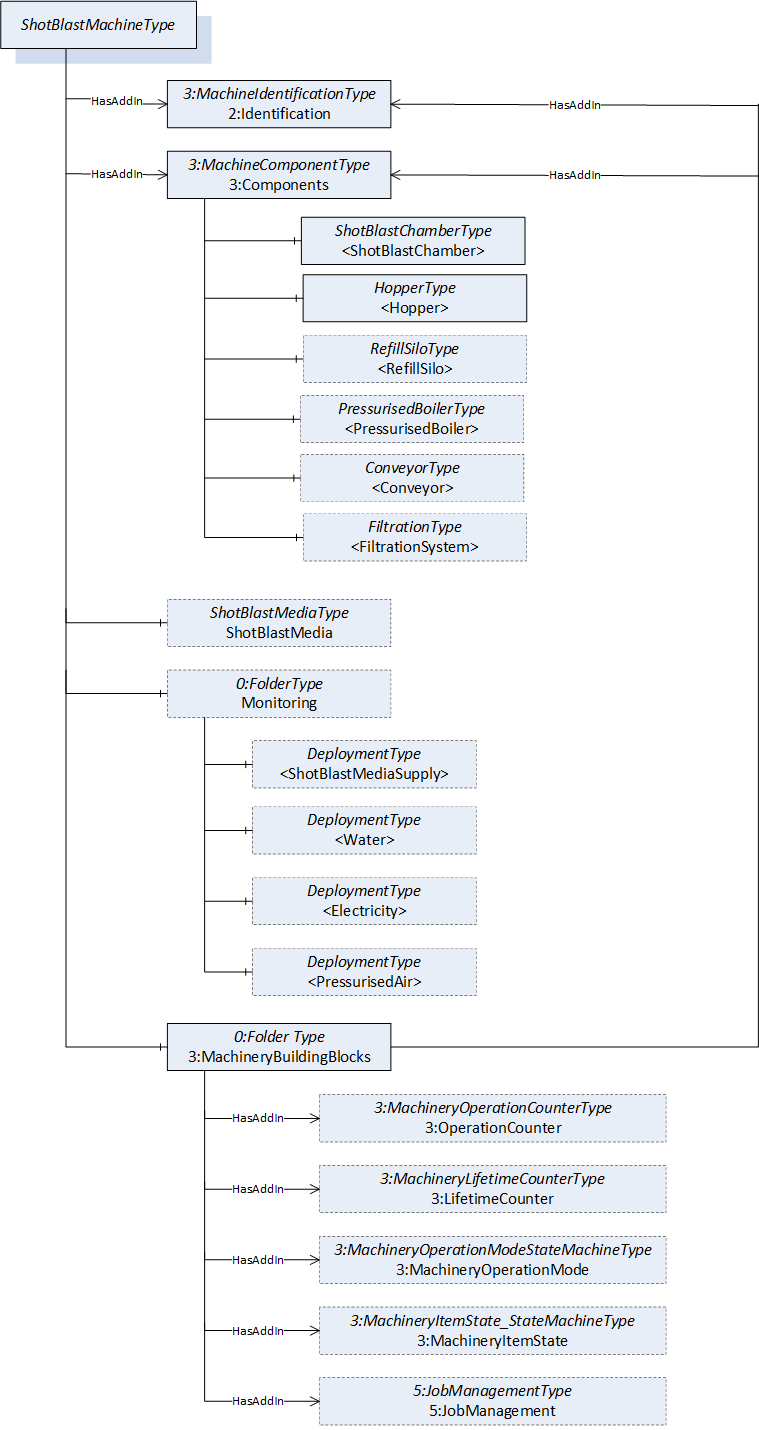
This section provides an overview of the OPC UA information model for shot blasting machines. The information model is structured in such a way that it represents the physical machine and its system components. The instantiation of the ShotBlastMachineType represents the entry point into the information model of each shotblasting machine.
There are two folders on the first level which help to structure the information model. These are the Components folder, in which the physical objects and system components of a shot blasting machine to be mapped are referenced and the Monitoring folder, which contains all system consumption and other variables relating to the overall machine.
Furthermore, several building blocks of the OPC UA for Machinery specification are used in this Companion Specification. This is the Building Block Identification, which maps all available characteristics of the system. The MachineryOperationCounter and the MachineryLifetimeCounter are used to map any counting series. The MachineryOperationMode and MachineryItemState represent the StateMachines provided by the OPC UA for Machinery. Additionally, the Building Block JobManagement can be used to map complex jobs on the machine. All Machinery Building Blocks are also referenced as an Addin in the MachineryBuildingBlocks folder.
7 OPC UA ObjectTypes
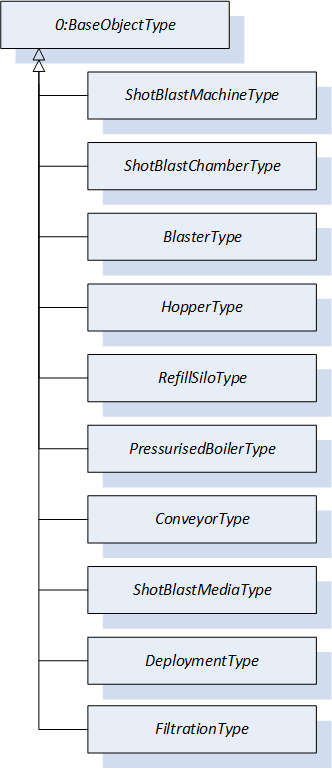
Figure 7 shows all ObjectTypes which are defined by this companion specification.
7.1 ShotBlastMachineType ObjectType Definition
The ShotBlastMachineType defines the representation of a shot blasting machine. This Object is the entry point into the OPC UA information model. The ShotBlastMachineType is defined in Table 15.
| Attribute | Value | ||||
| BrowseName | ShotBlastMachineType | ||||
| IsAbstract | False | ||||
| References | Node Class | BrowseName | DataType | TypeDefinition | Other |
|---|---|---|---|---|---|
| Subtype of the BaseObjectType defined in OPC 10000-5 | |||||
| 0:HasAddIn | Object | 2:Identification | 3:MachineIdentificationType | M | |
| 0:HasAddIn | Object | 3:Components | 3:MachineComponentsType | M | |
| 0:HasComponent | Object | ShotBlastMedia | ShotBlastMediaType | O | |
| 0:HasComponent | Object | Monitoring | 0:FolderType | O | |
| 0:HasComponent | Object | 3:MachineryBuildingBlocks | 0:FolderType | M | |
| Conformance Units | |||||
|---|---|---|---|---|---|
| ShotBlastMachine Basic | |||||
| ShotBlastMachine Media | |||||
| ShotBlastMachine Deployment Monitoring | |||||
| ShotBlastMachine RefillSilo | |||||
| ShotBlastMachine Pressurised | |||||
| ShotBlastMachine Filtration System | |||||
| ShotBlastMachine PAEFS Filtration System | |||||
| ShotBlastMachine StateMachines | |||||
| ShotBlastMachine JobManagement |
Identification is used as defined in OPC 40001-1 and shall also be referenced as AddIn in the MachineryBuildingBlocks Folder.
Components is representing a collection of all physical components of the shot blast machine.
ShotBlastingMedia is representing the material accelerated by the blaster for surface treatment of the workpiece.
Monitoring is representing a collection of the variables that are assigned to this specific component. All media and energy consumption should be mapped according to the DeploymentType and placed within the Monitoring folder. Furthermore, any Variables that are recorded over the entire machine should be placed within the Monitoring folder.
MachineryBuildingBlocks is representing a folder that directly references all those building blocks of the OPC UA for Machinery (OPC 40001-1, OPC 40001-3) which are implemented as an add-in in this specific component.
The components of the ShotBlastMachineType have additional references which are defined in Table 16.
| SourceBrowsePath | Reference Type | Is Forward | TargetBrowsePath |
| 3:MachineryBuildingBlocks | 0:HasAddIn | True | 2:Identification |
| 3:MachineryBuildingBlocks | 0:HasAddIn | True | 3:Components |
The components of the ShotBlastMachineType have additional subcomponents which are defined in Table 17.
| Source Path | Reference | NodeClass | BrowseName | DataType | TypeDefinition | Others |
| 3:Components | 0:HasComponent | Object | <ShotBlastChamber> | ShotBlastChamberType | MP | |
| 3:Components | 0:HasComponent | Object | <Hopper> | HopperType | MP | |
| 3:Components | 0:HasComponent | Object | <RefillSilo> | RefillSiloType | OP | |
| 3:Components | 0:HasComponent | Object | <PressurisedBoiler> | PressurisedBoilerType | OP | |
| 3:Components | 0:HasComponent | Object | <Conveyor> | ConveyorType | OP | |
| 3:Components | 0:HasComponent | Object | <FiltrationSystem> | FiltrationType | OP | |
| Monitoring | 0:HasComponent | Object | <ShotBlastMediaSupply> | DeploymentType | OP | |
| Monitoring | 0:HasComponent | Object | <Water> | DeploymentType | OP | |
| Monitoring | 0:HasComponent | Object | <Electricity> | DeploymentType | OP | |
| Monitoring | 0:HasComponent | Object | <PressurisedAir> | DeploymentType | OP | |
| 3:MachineryBuildingBlocks | 0:HasAddIn | Object | 3:OperationCounter | 3:MachineryOperationCounterType | O | |
| 3:MachineryBuildingBlocks | 0:HasAddIn | Object | 3:LifetimeCounter | 3:MachineryLifetimeCounterType | O | |
| 3:MachineryBuildingBlocks | 0:HasAddIn | Object | 3:MachineryOperationMode | 3:MachineryOperationModeStateMachineType | O | |
| 3:MachineryBuildingBlocks | 0:HasAddIn | Object | 3:MachineryItemState | 3:MachineryItemState_StateMachineType | O | |
| 3:MachineryBuildingBlocks | 0:HasAddIn | Object | 5:JobManagement | 5:JobManagementType | O |
Note: All media and energy consumption should be mapped according to the DeploymentType and placed within the Monitoring folder. Furthermore, any variables that are recorded over the entire machine should be placed within the Monitoring folder.
ShotBlastChamber is representing the enclosed working area in which the blasting media is projected onto the workpiece.
Hopper is representing the main working storage for the shotblast media.
RefillSilo is representing the refill working storage with new shotblast media.
PressurisedBoiler is representing the main working storage for air blast machines.
Conveyor is representing the system that transports the workpiece within the shot blasting area.
FiltrationSystem is representing the system that is responsible for handling the existing process air and its filter unit.
ShotBlastMediaSupply is representing the consumption of blasting material during the blasting process.
Water is representing the consumption of water of the shot blast machine.
Electricity is representing the consumption of electricity of the shot blast machine.
PressurisedAir is representing the consumption of pressurized air of the shot blast machine.
OperationCounter is used as defined in OPC 40001-1. In the information model for shot blasting machines, all counters that are implemented according to the MachineryOperationCounterType of the OPC 40001-1 shall be integrated with the HasComponent reference under this Object. This Object shall also be referenced as AddIn in the MachineryBuildingBlocks Folder.
LifetimeCounter is used as defined in OPC 40001-1. In the information model for shot blasting machines, all counters that are implemented according to the MachineryLifetimeCounterType of the OPC 40001-1 shall be integrated with the HasComponent reference under this Object. This Object shall also be referenced as AddIn in the MachineryBuildingBlocks Folder.
OperationMode is to be used as decribed by OPC 40001-1 and shall also be referenced as AddIn in the MachineryBuildingBlocks Folder.
MachineryItemState is to be used as decribed by OPC 40001-1 and shall also be referenced as AddIn in the MachineryBuildingBlocks Folder.
JobManagement is used as defined in OPC 40001-3 and shall also be referenced as AddIn in the MachineryBuildingBlocks Folder.
7.2 ShotBlastChamberType ObjectType Definition
The ShotBlastChamberType is representing the TypeDefinition of the enclosed shot blasting chamber in which the blasting media is projected onto the workpiece. A shot blasting machine has at least one shot blast chamber, but can also be configured with several shot blasting chambers.
The ShotBlastChamberType is formally defined in Table 18.
| Attribute | Value | ||||
| BrowseName | ShotBlastChamberType | ||||
| IsAbstract | False | ||||
| References | Node Class | BrowseName | DataType | TypeDefinition | Other |
|---|---|---|---|---|---|
| Subtype of the BaseObjectType defined in OPC 10000-5 | |||||
| 0:HasAddIn | Object | 2:Identification | 3:MachineIdentificationType | M | |
| 0:HasAddIn | Object | 3:Components | 3:MachineComponentsType | M | |
| 0:HasProperty | Variable | LoadingState | 0:Boolean | 0:PropertyType | M |
| 0:HasComponent | Object | 3:MachineryBuildingBlocks | 0:FolderType | M | |
| Conformance Units | |||||
|---|---|---|---|---|---|
| ShotBlastChamber Multiple Blasters |
Identification is used as defined in OPC 40001-1 and shall also be referenced as AddIn in the MachineryBuildingBlocks Folder.
Components is representing a collection of all physical components of the shot blasting machine.
Blaster is representing the device which accelerates the shot blasting media either a rotating wheel with blades or by pressurized air.
LoadingState is indicating the status whether the shot blast machine is loaded with a workpiece or not. True means the shotblast chamber is loaded.
MachineryBuildingBlocks is representing a folder that directly references all those building blocks of the OPC UA for Machinery (OPC 40001-1, OPC 40001-3) which are implemented as an add-in in this specific component.
The components of the ShotBlastChamberType have additional references which are defined in Table 19.
| SourceBrowsePath | Reference Type | Is Forward | TargetBrowsePath |
| 3:MachineryBuildingBlocks | 0:HasAddIn | True | 2:Identification |
| 3:MachineryBuildingBlocks | 0:HasAddIn | True | 3:Components |
The components of the ShotBlastChamberType have additional subcomponents which are defined in Table 23.
| Source Path | Reference | NodeClass | BrowseName | DataType | TypeDefinition | Others |
| 3:Components | 0:HasComponent | Object | <Blaster> | BlasterType | MP |
Blaster is representing the device which accelerates the shot blasting media either a rotating wheel with blades or by pressurized air.
7.3 BlasterType ObjectType Definition
The BlasterType is representing the TypeDefinition of the blaster which accelerates the shot blasting media either a rotating wheel with blades or by pressurized air. A blaster is a mandatory component of a shot blasting chamber. A shot blasting chamber can be configured with one or more blasters.
The BlasterType is formally defined in Table 21.
| Attribute | Value | ||||
| BrowseName | BlasterType | ||||
| IsAbstract | False | ||||
| References | Node Class | BrowseName | DataType | TypeDefinition | Other |
|---|---|---|---|---|---|
| Subtype of the BaseObjectType defined in OPC 10000-5 | |||||
| 0:HasAddIn | Object | 2:Identification | 3:MachineryComponentIdentificationType | M | |
| 0:HasComponent | Object | Monitoring | 0:FolderType | M | |
| 0:HasComponent | Object | 3:MachineryBuildingBlocks | 0:FolderType | M | |
| Conformance Units | |||||
|---|---|---|---|---|---|
| Wheel Blaster | |||||
| Pressurised Blaster |
Identification is used as defined in OPC 40001-1 and shall also be referenced as AddIn in the MachineryBuildingBlocks Folder.
Monitoring is representing a collection of the variables that are assigned to this specific component.
MachineryBuildingBlocks is representing a folder that directly references all those building blocks of the OPC UA for Machinery (OPC 40001-1, OPC 40001-3) which are implemented as an add-in in this specific component.
The components of the BlasterType have additional references which are defined in Table 22.
| SourceBrowsePath | Reference Type | Is Forward | TargetBrowsePath |
| 3:MachineryBuildingBlocks | 0:HasAddIn | True | 2:Identification |
The components of the BlasterType have additional subcomponents which are defined in Table 23.
| Source Path | Reference | NodeClass | BrowseName | DataType | TypeDefinition | Others |
| Monitoring | 0:HasComponent | Variable | ShotBlastMediaThroughput | 0:Double | 0:AnalogUnitType | O |
| Monitoring | 0:HasComponent | Variable | ShotBlastMediaThroughputPercent | 0:UInt16 | 0:AnalogUnitType | O |
| Monitoring | 0:HasProperty | Variable | ShotBlastTime | 0:Duration | 0:PropertyType | O |
| Monitoring | 0:HasComponent | Variable | ShotBlastPressure | 0:Double | 0:AnalogUnitType | O |
| Monitoring | 0:HasComponent | Variable | WheelRotationSpeed | 0:Int32 | 0:AnalogUnitType | O |
ShotBlastMediaThroughput is representing the shot blast media throughput per shot blaster.
ShotBlastMediaThroughputPercent is representing the shot blasting media throughput per shot blaster in percent of the maximum throughput capacity.
ShotBlastTime is representing the duration in which the blaster processes shot blasting media.
ShotBlastPressure is representing the air pressure in the pressurized boiler.
WheelRotationSpeed is representing the rotational speed of the shot blast wheel.
7.4 HopperType ObjectType Definition
The HopperType is representing the TypeDefinition of the main working storage for the shotblast media.
The HopperType is formally defined in Table 24.
| Attribute | Value | ||||
| BrowseName | HopperType | ||||
| IsAbstract | False | ||||
| References | Node Class | BrowseName | DataType | TypeDefinition | Other |
|---|---|---|---|---|---|
| Subtype of the BaseObjectType defined in OPC 10000-5 | |||||
| 0:HasComponent | Object | Monitoring | 0:FolderType | O | |
| Conformance Units | |||||
|---|---|---|---|---|---|
| Hopper Fill Level Monitoring |
Monitoring is representing a collection of the variables that are assigned to this specific component.
The components of the HopperType have additional subcomponents which are defined in Table 25.
| Source Path | Reference | NodeClass | BrowseName | DataType | TypeDefinition | Others |
| Monitoring | 0:HasProperty | Variable | HopperLevelMax | 0:Boolean | 0:PropertyType | O |
| Monitoring | 0:HasProperty | Variable | HopperLevelMin | 0:Boolean | 0:PropertyType | O |
HopperLevelMax is indicating that the maximum fill level of the hopper has been reached. True means the maximum fill level has been reached.
HopperLevelMin is indicating that the minimum fill level of the hopper has been reached. True means the minimum fill level has been reached.
7.5 RefillSiloType ObjectType Definition
The RefillSiloType is representing the TypeDefinition of the refill working storage with new shotblast media.
The RefillSiloType is formally defined in Table 26.
| Attribute | Value | ||||
| BrowseName | RefillSiloType | ||||
| IsAbstract | False | ||||
| References | Node Class | BrowseName | DataType | TypeDefinition | Other |
|---|---|---|---|---|---|
| Subtype of the BaseObjectType defined in OPC 10000-5 | |||||
| 0:HasComponent | Object | Monitoring | 0:FolderType | O | |
Monitoring is representing a collection of the variables that are assigned to this specific component.
The components of the RefillSiloType have additional subcomponents which are defined in Table 27.
| Source Path | Reference | NodeClass | BrowseName | DataType | TypeDefinition | Others |
| Monitoring | 0:HasProperty | Variable | RefillSiloLevelMax | 0:Boolean | 0:PropertyType | O |
| Monitoring | 0:HasProperty | Variable | RefillSiloLevelMin | 0:Boolean | 0:PropertyType | O |
RefillSiloLevelMax is indicating that the maximum fill level of the refill silo has been reached. True means the maximum fill level has been reached.
RefillSiloLevelMin is indicating that the minimum fill level of the refill silo has been reached. True means the minimum fill level has been reached.
7.6 PressurisedBoilerType ObjectType Definition
The PressurisedBoilerType is representing the TypeDefinition of the main working storage for air blast machines.
The PressurisedBoilerType is formally defined in Table 28.
| Attribute | Value | ||||
| BrowseName | PressurisedBoilerType | ||||
| IsAbstract | False | ||||
| References | Node Class | BrowseName | DataType | TypeDefinition | Other |
|---|---|---|---|---|---|
| Subtype of the BaseObjectType defined in OPC 10000-5 | |||||
| 0:HasAddIn | Object | 2:Identification | 3:MachineryComponentIdentificationType | M | |
| 0:HasComponent | Object | Monitoring | 0:FolderType | M | |
| 0:HasComponent | Object | 3:MachineryBuildingBlocks | 0:FolderType | M | |
Identification is used as defined in OPC 40001-1 and shall also be referenced as AddIn in the MachineryBuildingBlocks Folder.
Monitoring is representing a collection of the variables that are assigned to this specific component.
MachineryBuildingBlocks is representing a folder that directly references all those building blocks of the OPC UA for Machinery (OPC 40001-1, OPC 40001-3) which are implemented as an add-in in this specific component.
The components of the PressurisedBoilerType have additional references which are defined in Table 29.
| SourceBrowsePath | Reference Type | Is Forward | TargetBrowsePath |
| 3:MachineryBuildingBlocks | 0:HasAddIn | True | 2:Identification |
The components of the PressurisedBoilerType have additional subcomponents which are defined in Table 30.
| Source Path | Reference | NodeClass | BrowseName | DataType | TypeDefinition | Others |
| Monitoring | 0:HasProperty | Variable | PressurisedBoilerLevelMax | 0:Boolean | 0:PropertyType | O |
| Monitoring | 0:HasProperty | Variable | PressurisedBoilerLevelMin | 0:Boolean | 0:PropertyType | O |
| Monitoring | 0:HasComponent | Variable | StoragePressure | 0:Double | 0:AnalogUnitType | O |
PressurisedBoilerLevelMax is indicating that the maximum fill level of the pressurized boier has been reached. True means the maximum fill level has been reached.
PressurisedBoilerLevelMin is indicating that the minimum fill level of the pressurized boiler has been reached. True means the minimum fill level has been reached.
StoragePressure is representing the current pressure inside of the pressurized boiler.
7.7 ConveyorType ObjectType Definition
The ConveyorType is representing the component that is used to transport the part to be processed.
The ConveyorType is formally defined in Table 31.
| Attribute | Value | ||||
| BrowseName | ConveyorType | ||||
| IsAbstract | False | ||||
| References | Node Class | BrowseName | DataType | TypeDefinition | Other |
|---|---|---|---|---|---|
| Subtype of the BaseObjectType defined in OPC 10000-5 | |||||
| 0:HasAddIn | Object | 2:Identification | 3:MachineryComponentIdentificationType | M | |
| 0:HasComponent | Object | Monitoring | 0:FolderType | O | |
| 0:HasComponent | Object | 3:MachineryBuildingBlocks | 0:FolderType | M | |
Identification is used as defined in OPC 40001-1 and shall also be referenced as AddIn in the MachineryBuildingBlocks Folder.
Monitoring is representing a collection of the variables that are assigned to this specific component.
MachineryBuildingBlocks is representing a folder that directly references all those building blocks of the OPC UA for Machinery (OPC 40001-1, OPC 40001-3) which are implemented as an add-in in this specific component.
The components of the ConveyorType have additional references which are defined in Table 32.
| SourceBrowsePath | Reference Type | Is Forward | TargetBrowsePath |
| 3:MachineryBuildingBlocks | 0:HasAddIn | True | 2:Identification |
The components of the ConveyorType have additional subcomponents which are defined in Table 33.
| Source Path | Reference | NodeClass | BrowseName | DataType | TypeDefinition | Others |
| Monitoring | 0:HasComponent | Variable | ConveyorTransportSpeed | 0:Double | 0:AnalogUnitType | O |
| Monitoring | 0:HasComponent | Variable | WorkpieceRotationSpeed | 0:Double | 0:AnalogUnitType | O |
ConveyorTransportSpeed is representing the current speed at which the workpiece is moved by the conveyor.
WorkpieceRotationSpeed is representing the current rotational speed at which the workpiece is rotated by the conveyor.
7.8 ShotBlastMediaType ObjectType Definition
The ShotBlastMediaType provides all necessary information on the blasting material used in the blasting process. It is formally defined in Table 34.
| Attribute | Value | ||||
| BrowseName | ShotBlastMediaType | ||||
| IsAbstract | False | ||||
| References | Node Class | BrowseName | DataType | TypeDefinition | Other |
|---|---|---|---|---|---|
| Subtype of the BaseObjectType defined in OPC 10000-5 | |||||
| 0:HasProperty | Variable | ShotBlastMediaName | 0:String | 0:PropertyType | O |
| 0:HasProperty | Variable | ShotBlastMediaManufacturer | 0:String | 0:PropertyType | O |
| 0:HasComponent | Variable | NominalParticleSizeAverage | 0:Double | 0:BaseDataVariableType | O |
| 0:HasComponent | Variable | NominalParticleSizeRange | 0:Range | 0:BaseDataVariableType | O |
| 0:HasComponent | Variable | ActualParticleSizeRange | 0:Range | 0:BaseDataVariableType | O |
| 0:HasComponent | Variable | ShotBlastMediaHardnessAverage | 0:Double | 0:BaseDataVariableType | O |
| 0:HasComponent | Variable | ShotBlastMediaHardnessRange | 0:Range | 0:BaseDataVariableType | O |
| 0:HasProperty | Variable | ShotBlastMediaBatch | 0:String | 0:PropertyType | O |
ShotBlastMediaName is representing the name of the current used shot blast material.
ShotBlastMediaManufacturer is representing the manufacturers name of the current used shot blast material.
NominalParticleSizeAverage is representing the average particle size of the current used shot blast material.
NominalParticleSizeRange is representing the particle size range of the current used shot blast material.
ActualParticleSizeRange is representing the actual measured particle size range of the current used shot blast material.
ShotBlastMediaHardnessAverage is representing the average hardness of the current used shot blast material.
ShotBlastMediaHardnessRange is representing hardness range of the current used shot blast.
ShotBlastMediaBatch is representing a string that is identifying the charge of the used shot blast material.
The components of the ShotBlastMediaType have additional subcomponents which are defined in Table 35.
| Source Path | Reference | NodeClass | BrowseName | DataType | TypeDefinition | Others |
| ShotBlastMediaHardnessAverage | 0:HasComponent | Variable | ShotBlastMediaHardnessUnit | 0:UInt16 | 0:MultiStateValueDiscreteType | M |
| ShotBlastMediaHardnessRange | 0:HasComponent | Variable | ShotBlastMediaHardnessUnit | 0:UInt16 | 0:MultiStateValueDiscreteType | M |
The component Variables of the ShotBlastMediaType have additional Attributes defined in Table 36.
| BrowsePath | Value Attribute | Description Attribute | |||
| [ {"Value": 0, "DisplayName": "HRC", "Description": ""}, {"Value": 1, "DisplayName": "HV", "Description": ""}, {"Value": 2, "DisplayName": "MOHS", "Description": ""}, {"Value": 3, "DisplayName": "HB", "Description": ""} ] | ||||
| [ {"Value": 0, "DisplayName": "HRC", "Description": ""}, {"Value": 1, "DisplayName": "HV", "Description": ""}, {"Value": 2, "DisplayName": "MOHS", "Description": ""}, {"Value": 3, "DisplayName": "HB", "Description": ""} ] |
7.9 DeploymentType ObjectType Definition
An object with the definition DeploymentType represents a media or energy deployment. Examples of this are water consumption, electricity consumption or the consumption of blasting material. The object is not limited to a list of media or energy sources and can map any deployment. It is formally defined in Table 37.
| Attribute | Value | ||||
| BrowseName | DeploymentType | ||||
| IsAbstract | False | ||||
| References | Node Class | BrowseName | DataType | TypeDefinition | Other |
|---|---|---|---|---|---|
| Subtype of the BaseObjectType defined in OPC 10000-5 | |||||
| 0:HasComponent | Variable | ConsumedMedia | 0:UInt16 | 0:MultiStateValueDiscreteType | M |
| 0:HasComponent | Variable | ActualConsumption | 0:Double | 0:AnalogUnitType | O |
| 0:HasComponent | Variable | TotalConsumption | 0:Double | 0:AnalogUnitType | O |
ConsumedMedia is representing the type of media consumption that is mapped by this object.
ActualConsumption is representing the current consumption of the consumed media.
TotalConsumption is representing the total consumption of the consumed media during a defined time.
The components of the DeploymentType have additional subcomponents which are defined in Table 38.
| Source Path | Reference | NodeClass | BrowseName | DataType | TypeDefinition | Others |
| TotalConsumption | 0:HasProperty | Variable | ConsumingPeriod | UtcTime | 0:PropertyType | O |
ConsumingPeriod is representing the time interval in which the TotalConsumption is recorded.
The component Variables of the DeploymentType have additional Attributes defined in Table 39.
| BrowsePath | Value Attribute | Description Attribute | ||
| [ {"Value": 0, "DisplayName": "Shotblast Media", "Description": ""}, {"Value": 1, "DisplayName": "Electricity", "Description": ""}, {"Value": 2, "DisplayName": "Water", "Description": ""}, {"Value": 3, "DisplayName": "Pressurised Air", "Description": ""} ] |
7.10 FiltrationType ObjectType Definition
The FiltrationType provides all necessary information needed for a simple filtration system of a shot blast machine. It is formally defined in Table 40.
| Attribute | Value | ||||
| BrowseName | FiltrationType | ||||
| IsAbstract | False | ||||
| References | Node Class | BrowseName | DataType | TypeDefinition | Other |
|---|---|---|---|---|---|
| Subtype of the BaseObjectType defined in OPC 10000-5 | |||||
| 0:HasAddIn | Object | 2:Identification | 3:MachineryComponentIdentificationType | M | |
| 0:HasComponent | Object | Monitoring | 0:FolderType | M | |
| 0:HasComponent | Object | 3:MachineryBuildingBlocks | 0:FolderType | M | |
| Conformance Units | |||||
|---|---|---|---|---|---|
| Filtration Status Monitoring |
Identification is used as defined in OPC 40001-1 and shall also be referenced as AddIn in the MachineryBuildingBlocks Folder.
Monitoring is representing a collection of the variables that are assigned to this specific component.
MachineryBuildingBlocks is representing a folder that directly references all those building blocks of the OPC UA for Machinery (OPC 40001-1, OPC 40001-3) which are implemented as an add-in in this specific component.
The components of the FiltrationType have additional references which are defined in Table 41.
| SourceBrowsePath | Reference Type | Is Forward | TargetBrowsePath |
| 3:MachineryBuildingBlocks | 0:HasAddIn | True | 2:Identification |
The components of the FiltrationType have additional subcomponents which are defined in Table 42.
| Source Path | Reference | NodeClass | BrowseName | DataType | TypeDefinition | Others |
| Monitoring | 0:HasProperty | Variable | FilterRunning | 0:Boolean | 0:PropertyType | M |
| Monitoring | 0:HasProperty | Variable | FlowRateOK | 0:Boolean | 0:PropertyType | O |
| Monitoring | 0:HasProperty | Variable | FilterCleaningRunning | 0:Boolean | 0:PropertyType | O |
| Monitoring | 0:HasProperty | Variable | DifferentialPressureMax | 0:Boolean | 0:PropertyType | O |
| Monitoring | 0:HasProperty | Variable | DifferentialPressureMin | 0:Boolean | 0:PropertyType | O |
| Monitoring | 0:HasProperty | Variable | DischargeSystemRunning | 0:Boolean | 0:PropertyType | O |
| Monitoring | 0:HasProperty | Variable | ResidualDustOK | 0:Boolean | 0:PropertyType | O |
| Monitoring | 0:HasComponent | Variable | DifferentialPressure | 0:Double | 0:AnalogUnitType | O |
| Monitoring | 0:HasComponent | Variable | TemperatureFilterUnit | 0:Double | 0:AnalogUnitType | O |
| Monitoring | 0:HasComponent | Variable | FillLevel<n> | 0:UInt16 | 0:AnalogUnitType | OP |
| Monitoring | 0:HasComponent | Variable | FlowRate | 0:Double | 0:AnalogUnitType | O |
| Monitoring | 0:HasComponent | Variable | ResidualDust | 0:Double | 0:AnalogUnitType | O |
| 3:MachineryBuildingBlocks | 0:HasAddIn | Object | 3:MachineryItemState | 3:MachineryItemState_StateMachineType | O |
FilterRunning is representing the state of the fan of the filtration system. True means the fan is running.
FlowRateOK is indicating that the air flow inside of the piping system is okay.
FilterCleaningRunning is representing the state of the cleaning system of the filter unit. True means the cleaning system is currently cleaning the filter unit.
DifferentialPressureMax is indicating if the maximum differential pressure is reached.
DifferentialPressureMin is indicating if the minimum differential pressure is reached.
DischargeSystemRunning is representing the state of the device used to remove collected filter material from the filter unit.
ResidualDustOK is indicating if the exhaust gas is properly cleaned and inside the needed tolerances.
DifferentialPressure is representing the current pressure difference between the two sides of the filter unit.
TemperatureFilterUnit is representing the current temperature of the filter unit.
FillLevel<n> indicates the fill level of a device. As this Variable is an optional placeholder it can be instantiated as often as needed.
FlowRate is representing the air flow inside of the piping system.
ResidualDust is representing the quality of the exhaust gas exiting the filtration system.
8 Profiles and ConformanceUnits
8.1 Conformance Units
This chapter defines the corresponding Conformance Units for the OPC UA Information Model for Shot Blasting Technology. The ConformanceUnits are meant to map one specific instance of a shot blast machine. Usually there is only one instance of the ShotBlastMachineType on an OPC UA server. When there are several instances of a shot blast machine on one OPC UA server, each instance must be mapped by it's specific ConformanceUnits. Therefor it is recommended to separate the instances in different namespaces.
| Category | Title | Description |
| Server | ShotBlastMachine Basic | At least one instance of the ShotBlastMachineMachineType is available on the server. The instance has all mandatory nodes. |
| Server | ShotBlastMachine Media | Every ShotBlastMachineType instance has at least one instance of the optional node from the ShotBlastMediaType. |
| Server | ShotBlastMachine Deployment Monitoring | Every ShotBlastMachineType instance has at least one instance of the optional nodes from the DeploymentType. |
| Server | ShotBlastMachine RefillSilo | Every ShotBlastMachineType instance has at least one instance of the optional node from the RefillSiloType. |
| Server | ShotBlastMachine Pressurised | Every ShotBlastMachineType instance has at least one instance of the optional node from the PressurisedBoilerType. |
| Server | ShotBlastMachine Filtration System | Every ShotBlastMachineType instance has at least one instance of the optional node from the FiltrationType. |
| Server | ShotBlastMachine PAEFS Filtration System OPC40740 | Every ShotBlastMachineType instance has not implemented the optional FiltrationType but the FilterSystemType of the OPC 40740 OPC UA for Process Air Extraction and Filtration Systems (PAEFS) Companion Specification. |
| Server | ShotBlastMachine StateMachines | Every ShotBlastMachineType instance has one instance of the optional node from the 3:MachineryOperationModeStateMachineType and the 3:MachineryItemState_StateMachineType. |
| Server | ShotBlastMachine JobManagement | Every ShotBlastMachineType instance has at least one instance of the optional node from the 5:JobManagementType. |
| Server | ShotBlastChamber Multiple Blasters | Every ShotBlastChamberType instance has more then one instance of the mandatory Placeholder node from the BlasterType. |
| Server | Wheel Blaster | Every BlasterType instance has an instance of the optional node WheelRotationSpeed. |
| Server | Pressurised Blaster | Every BlasterType instance has an instance of the optional node ShotBlastPressure. |
| Server | Hopper Fill Level Monitoring | Every HopperType instance has an instance of the optional nodes HopperLevelMax and HopperLevelMin. |
| Server | Refill Silo Fill Level Monitoring | Every RefillSiloType instance has an instance of the optional nodes RefillSiloLevelMax and RefillSiloLevelMin. |
| Server | Pressurised Boiler Fill Level Monitoring | Every PressurisedBoilerType instance has an instance of the optional nodes PressurisedBoilerLevelMax and PressurisedBoilerLevelMin. |
| Server | Filtration Status Monitoring | Every FiltrationType instance has an instance of the optional node 3:MachineryItemState_StateMachineType. |
8.2 Profiles
8.2.1 Profile list
Table 44 lists all Profiles defined in this document and defines their URIs.
| Profile | URI |
| Pressurised Shot Blasting Machine Server Facet | http://opcfoundation.org/UA-Profile/ShotBlasting/Server/PressurisedShotBlastingMachineServerProfile |
| Wheel Blasting Machine Server Facet | http://opcfoundation.org/UA-Profile/ShotBlasting/Server/WheelBlastingMachineServerProfile |
8.2.2 Server Facets
8.2.2.1 Overview
The following sections specify the Facets available for Servers that implement the Shot Blasting Technology companion specification. Each section defines and describes a Facet or Profile.
8.2.2.2 Pressurised Shot Blasting Machine Server Facet
This profile ensures that the information model implemented represents a pressurized shot blast machine.
| Group | Conformance Unit/ Profile Title | M / O |
| ShotBlasting | ShotBlastMachine Basic | M |
| ShotBlasting | Pressurised Blaster | M |
| ShotBlasting | ShotBlastMachine Media | O |
| ShotBlasting | ShotBlastMachine Deployment Monitoring | O |
| ShotBlasting | ShotBlastMachine RefillSilo | O |
| ShotBlasting | ShotBlastMachine Pressurised | O |
| ShotBlasting | ShotBlastMachine Filtration System | O |
| ShotBlasting | ShotBlastMachine PAEFS Filtration System OPC40740 | O |
| ShotBlasting | ShotBlastMachine StateMachines | O |
| ShotBlasting | ShotBlastMachine JobManagement | O |
| ShotBlasting | ShotBlastChamber Multiple Blasters | O |
| ShotBlasting | Hopper Fill Level Monitoring | O |
| ShotBlasting | Refill Silo Fill Level Monitoring | O |
| ShotBlasting | Pressurised Boiler Fill Level Monitoring | O |
| ShotBlasting | Filtration Status Monitoring | O |
8.2.2.3 Wheel Blasting Machine Server Facet
This profile ensures that the information model implemented represents a shot blast machine that is accelerating the shot blast media via wheels.
| Group | Conformance Unit/ Profile Title | M / O |
| ShotBlasting | ShotBlastMachine Basic | M |
| ShotBlasting | Wheel Blaster | M |
| ShotBlasting | ShotBlastMachine Media | O |
| ShotBlasting | ShotBlastMachine Deployment Monitoring | O |
| ShotBlasting | ShotBlastMachine RefillSilo | O |
| ShotBlasting | ShotBlastMachine Pressurised | O |
| ShotBlasting | ShotBlastMachine Filtration System | O |
| ShotBlasting | ShotBlastMachine PAEFS Filtration System OPC40740 | O |
| ShotBlasting | ShotBlastMachine StateMachines | O |
| ShotBlasting | ShotBlastMachine JobManagement | O |
| ShotBlasting | ShotBlastChamber Multiple Blasters | O |
| ShotBlasting | Hopper Fill Level Monitoring | O |
| ShotBlasting | Refill Silo Fill Level Monitoring | O |
| ShotBlasting | Pressurised Boiler Fill Level Monitoring | O |
| ShotBlasting | Filtration Status Monitoring | O |
8.2.3 Client Facets
This specification does not define any Client Facets.
9 Namespaces
9.1 Namespace Metadata
Table 47 defines the namespace metadata for this document. The Object is used to provide version information for the namespace and an indication about static Nodes. Static Nodes are identical for all Attributes in all Servers, including the Value Attribute. See OPC 10000-5 for more details.
The information is provided as Object of type NamespaceMetadataType. This Object is a component of the Namespaces Object that is part of the Server Object. The NamespaceMetadataType ObjectType and its Properties are defined in OPC 10000-5.
The version information is also provided as part of the ModelTableEntry in the UANodeSet XML file. The UANodeSet XML schema is defined in OPC 10000-6.
| Attribute | Value | ||
| BrowseName | http://opcfoundation.org/UA/SurfaceTechnology/ShotBlasting/ | ||
| Property | DataType | Value | |
|---|---|---|---|
| NamespaceUri | String | http://opcfoundation.org/UA/SurfaceTechnology/ShotBlasting/ | |
| NamespaceVersion | String | 1.0.0 | |
| NamespacePublicationDate | DateTime | 2026-04-01 | |
| IsNamespaceSubset | Boolean | False | |
| StaticNodeIdTypes | IdType [] | 0 | |
| StaticNumericNodeIdRange | NumericRange [] | ||
| StaticStringNodeIdPattern | String | ||
9.2 Handling of OPC UA Namespaces
Namespaces are used by OPC UA to create unique identifiers across different naming authorities. The Attributes NodeId and BrowseName are identifiers. A Node in the UA AddressSpace is unambiguously identified using a NodeId. Unlike NodeIds, the BrowseName cannot be used to unambiguously identify a Node. Different Nodes may have the same BrowseName. They are used to build a browse path between two Nodes or to define a standard Property.
Servers may often choose to use the same namespace for the NodeId and the BrowseName. However, if they want to provide a standard Property, its BrowseName shall have the namespace of the standards body although the namespace of the NodeId reflects something else, for example the EngineeringUnits Property. All NodeIds of Nodes not defined in this document shall not use the standard namespaces.
Table 48 provides a list of mandatory and optional namespaces used in an Shot Blasting Technology OPC UA Server.
| NamespaceURI | Description | Use |
| http://opcfoundation.org/UA/ | Namespace for NodeIds and BrowseNames defined in the OPC UA specification. This namespace shall have namespace index 0. | Mandatory |
| Local Server URI | Namespace for nodes defined in the local server. This namespace shall have namespace index 1. | Mandatory |
| http://opcfoundation.org/UA/DI/ | Namespace for NodeIds and BrowseNames defined in OPC 10000-100. The namespace index is Server specific. | Mandatory |
| http://opcfoundation.org/UA/Machinery/ | Namespace for NodeIds and BrowseNames defined in OPC 40001-1. The namespace index is Server specific. | Mandatory |
| http://opcfoundation.org/UA/ISA95-JOBCONTROL_V2/ | Namespace for NodeIds and BrowseNames defined in OPC 10031-4. The namespace index is Server specific. | Mandatory |
| Namespace for NodeIds and BrowseNames defined in OPC 40001-3. The namespace index is Server specific. | Mandatory | |
| http://opcfoundation.org/UA/SurfaceTechnology/ShotBlasting/ | Namespace for NodeIds and BrowseNames defined in OPC 40740. The namespace index is Server specific. | Mandatory |
| Vendor specific types | A Server may provide vendor-specific types like types derived from ObjectTypes defined in this document in a vendor-specific namespace. | Optional |
| Vendor specific instances | A Server provides vendor-specific instances of the standard types or vendor-specific instances of vendor-specific types in a vendor-specific namespace. It is recommended to separate vendor specific types and vendor specific instances into two or more namespaces. | Mandatory |
Table 49 provides a list of namespaces and their indices used for BrowseNames in this document. The default namespace of this document is not listed since all BrowseNames without prefix use this default namespace.
| NamespaceURI | Namespace Index | Example |
| http://opcfoundation.org/UA/ | 0 | 0:EngineeringUnits |
| http://opcfoundation.org/UA/DI/ | 2 | 2:DeviceRevision |
| http://opcfoundation.org/UA/Machinery/ | 3 | 3:MachineIdentificationType |
| http://opcfoundation.org/UA/ISA95-JOBCONTROL_V2/ | 4 | 4:ISA95MaterialDataType |
| http://opcfoundation.org/UA/Machinery/Jobs/ | 5 | 5:JobManagementType |
Annex A Shot Blasting Technology Namespace and mappings (Normative)
A.1 NodeSet and supplementary files for Shot Blasting Technology Information Model
The Shot Blasting Technology Information Model is identified by the following URI:
http://opcfoundation.org/UA/SurfaceTechnology/ShotBlasting/
Documentation for the NamespaceUri can be found here.
The NodeSet associated with this version of specification can be found here:
The NodeSet associated with the latest version of the specification can be found here:
Supplementary files for the Shot Blasting Technology Information Model can be found here:
The files associated with the latest version of the specification can be found here:
A.2 Capability Identifier
The capability identifier for this document shall be:
SurfaceTechnology/ShotBlasting___________
Agreement of Use
COPYRIGHT RESTRICTIONS
This document is provided "as is" by the OPC Foundation and VDMA.
Right of use for this specification is restricted to this specification and does not grant rights of use for referred documents.
Right of use for this specification will be granted without cost.
This document may be distributed through computer systems, printed or copied as long as the content remains unchanged and the document is not modified.
OPC Foundation and VDMA do not guarantee usability for any purpose and shall not be made liable for any case using the content of this document.
The user of the document agrees to indemnify OPC Foundation and VDMA and their officers, directors and agents harmless from all demands, claims, actions, losses, damages (including damages from personal injuries), costs and expenses (including attorneys' fees) which are in any way related to activities associated with its use of content from this specification.
The document shall not be used in conjunction with company advertising, shall not be sold or licensed to any party.
The intellectual property and copyright is solely owned by the OPC Foundation and VDMA.
PATENTS
The attention of adopters is directed to the possibility that compliance with or adoption of OPC or VDMA specifications may require use of an invention covered by patent rights. OPC Foundation or VDMA shall not be responsible for identifying patents for which a license may be required by any OPC or VDMA specification, or for conducting legal inquiries into the legal validity or scope of those patents that are brought to its attention. OPC or VDMA specifications are prospective and advisory only. Prospective users are responsible for protecting themselves against liability for infringement of patents.
WARRANTY AND LIABILITY DISCLAIMERS
WHILE THIS PUBLICATION IS BELIEVED TO BE ACCURATE, IT IS PROVIDED "AS IS" AND MAY CONTAIN ERRORS OR MISPRINTS. THE OPC FOUDATION NOR VDMA MAKES NO WARRANTY OF ANY KIND, EXPRESSED OR IMPLIED, WITH REGARD TO THIS PUBLICATION, INCLUDING BUT NOT LIMITED TO ANY WARRANTY OF TITLE OR OWNERSHIP, IMPLIED WARRANTY OF MERCHANTABILITY OR WARRANTY OF FITNESS FOR A PARTICULAR PURPOSE OR USE. IN NO EVENT SHALL THE OPC FOUNDATION NOR VDMA BE LIABLE FOR ERRORS CONTAINED HEREIN OR FOR DIRECT, INDIRECT, INCIDENTAL, SPECIAL, CONSEQUENTIAL, RELIANCE OR COVER DAMAGES, INCLUDING LOSS OF PROFITS, REVENUE, DATA OR USE, INCURRED BY ANY USER OR ANY THIRD PARTY IN CONNECTION WITH THE FURNISHING, PERFORMANCE, OR USE OF THIS MATERIAL, EVEN IF ADVISED OF THE POSSIBILITY OF SUCH DAMAGES.
The entire risk as to the quality and performance of software developed using this specification is borne by you.
RESTRICTED RIGHTS LEGEND
This Specification is provided with Restricted Rights. Use, duplication or disclosure by the U.S. government is subject to restrictions as set forth in (a) this Agreement pursuant to DFARs 227.7202-3(a); (b) subparagraph (c)(1)(i) of the Rights in Technical Data and Computer Software clause at DFARs 252.227-7013; or (c) the Commercial Computer Software Restricted Rights clause at FAR 52.227-19 subdivision (c)(1) and (2), as applicable. Contractor / manufacturer are the OPC Foundation, 16101 N. 82nd Street, Suite 3B, Scottsdale, AZ, 85260-1830.
COMPLIANCE
The combination of VDMA and OPC Foundation shall at all times be the sole entities that may authorize developers, suppliers and sellers of hardware and software to use certification marks, trademarks or other special designations to indicate compliance with these materials as specified within this document. Products developed using this specification may claim compliance or conformance with this specification if and only if the software satisfactorily meets the certification requirements set by VDMA or the OPC Foundation. Products that do not meet these requirements may claim only that the product was based on this specification and must not claim compliance or conformance with this specification.
TRADEMARKS
Most computer and software brand names have trademarks or registered trademarks. The individual trademarks have not been listed here.
GENERAL PROVISIONS
Should any provision of this Agreement be held to be void, invalid, unenforceable or illegal by a court, the validity and enforceability of the other provisions shall not be affected thereby.
This Agreement shall be governed by and construed under the laws of Germany.
This Agreement embodies the entire understanding between the parties with respect to, and supersedes any prior understanding or agreement (oral or written) relating to, this specification.