
1 Scope
The OPC UA for Machinery specification contains various building blocks for Machinery that allow to address use cases across different types of machines and components of machines defined in various companion specifications.
For the general scope of the OPC UA for Machinery specification see OPC 40001-1.
This part contains a building block for
Job Management
2 Normative references
The following documents are referred to in the text in such a way that some or all of their content constitutes requirements of this document. For dated references, only the edition cited applies. For undated references, the latest edition of the referenced document (including any amendments and errata) applies
OPC 10000-1, OPC Unified Architecture - Part 1: Overview and Concepts
http://www.opcfoundation.org/documents/10000-1/
OPC 10000-3, OPC Unified Architecture - Part 3: Address Space Model
http://www.opcfoundation.org/documents/10000-3/
OPC 10000-5, OPC Unified Architecture - Part 5: Information Model
http://www.opcfoundation.org/documents/10000-5/
OPC 10000-6, OPC Unified Architecture - Part 6: Mappings
http://www.opcfoundation.org/documents/10000-6/
OPC 10000-7, OPC Unified Architecture - Part 7: Profiles
http://www.opcfoundation.org/documents/10000-7/
OPC 40001-1, OPC UA for Machinery - Part 1: Basic Building Blocks
http://www.opcfoundation.org/documents/40001-1/
OPC 10031-4, OPC UA for ISA-95 - Part 4: Job Control
http://www.opcfoundation.org/documents/10031-4/
3 Terms, definitions and conventions
3.1 Overview
It is assumed that basic concepts of OPC UA information modelling, OPC 40001-1 and OPC 10031-4 are understood in this specification. This specification will use these concepts to describe the Machinery - Job Management Information Model. For the purposes of this document, the terms and definitions given in OPC 10000-1, OPC 10000-3, OPC 10000-5, OPC 10000-7, OPC 40001-1, OPC 10031-4 as well as the following apply.
3.2 OPC UA for Machinery - Job Management terms
3.2.1 job order
Note: A job order is the concrete implementation of a set of information that a machine needs to execute a task. This information can be composed of one or more programs or recipes, or it can consist only of metadata and parameters (production-specific) or of all of these. Several job orders can be running at the same time.
3.2.2 run
A completed execution or completed subset of the execution carried out according to the data provided with the job order.
3.2.3 Item
an object produced as one quantity unit
3.3 Abbreviated terms
| BOM | Bill of materials |
| ERP | Enterprise-Resource-Planning |
| MES | Manufacturing Execution System |
| MOM | Manufacturing Operations Management |
3.4 Conventions used in this document
For conventions used in this document see OPC 40001-1.
4 General information to Machinery and OPC UA
For general information to Machinery and OPC UA see OPC 40001-1.
5 Use cases
The user would like to provide job orders to a MachineryItem to get executed.
The user would like to control job orders by updating the job order, setting the job order to get executed or revoke the execution, pause and resume the execution, and abort or stop the executing.
The user would like to get information about the state of execution, retrieve intermediate results and the end result of the job order execution.
The user would like to delete the job order results from the MachineryItem after execution and receiving the job order.
6 Machinery Job Management Information Model overview
6.1 Overview
This chapter gives an overview over the job management information model. In 6.2, the ObjectTypes for managing job orders are described. 0 describes the integration into a MachineryItem. In 6.4, the mechanism for defining the order for the execution of job orders is defined, and in 6.5 the concept of predefined parameters for the description of job orders is introduced.
6.2 JobManagementType
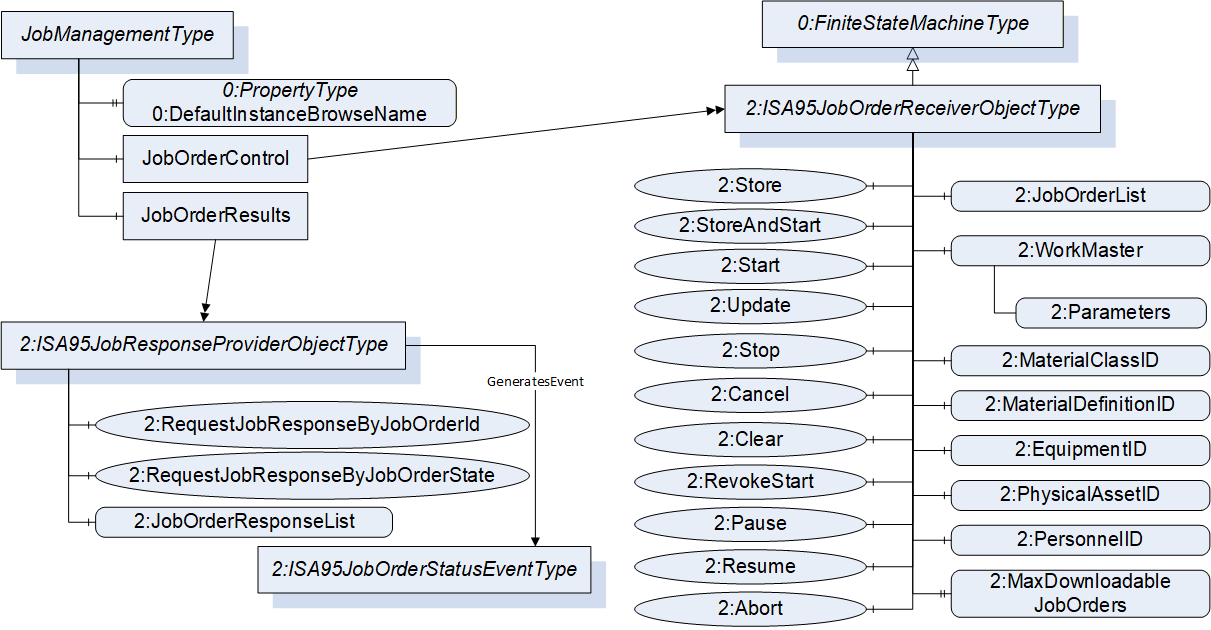
In Figure 1 an overview of the JobManagementType is given. It is formally defined in 8.1. The JobOrderControl Object of 2:ISA95JobOrderReceiverObjectType provides functionality to add and control job orders to a MachineryItem. It also provides information about all job orders currently managed by the MachineryItem (in the 2:JobOrderList). It contains the description of a StateMachine that is applied to the job orders managed in the 2:JobOrderList (not shown in the diagram) that can be specialized and restricted. All job orders managed by the JobOrderControl support the same, potentially specialized StateMachine. Details of the 2:ISA95JobOrderReceiverObjectType are defined in OPC 10031-4.
Once a job order starts to be executed by the MachineryItem, it becomes available in the JobOrderResults Object to provide intermediate results or the final results of the job order execution. During that phase, the job orders can still be controlled by the JobOrderControl Object. The JobOrderResults Object is of 2:ISAJobResponseProviderObjectType and provides different mechanisms (Method, Event, or Variable) to expose the results (see OPC 10031-4 for details). Once the Client has received the end results, it can remove the results from the MachineryItem, and thereby also remove the meta data of the job order managed by the JobOrderControl Object.
6.3 Integration into a MachineryItem
In Figure 2 an example is shown, how the job management can be integrated into a MachineryItem. The building block, using its 0:DefaultInstanceBrowseName JobManagement, is added as AddIn into the 3:MachineryBuildingBlocks Object. In addition, it is referenced by some domain-specific organization.
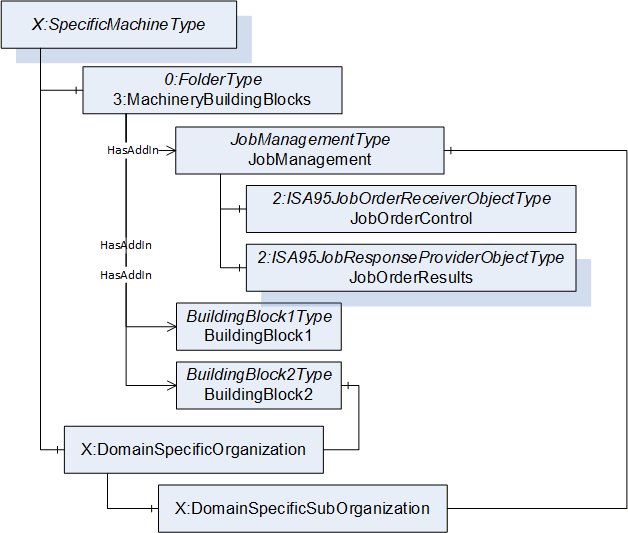
Note that a MachineryItem may also add several job management instances in order to support different specialized StateMachines for the job orders. In this case, the 2:DefaultInstanceBrowseName should only be used once.
6.4 Order of Execution of Job orders
MachineryItems may execute several job orders in parallel or just one job order at a time. Depending on the application, the order of the execution may be defined by different mechanisms. In some cases, the order is determined by a global system and provided with the job order meta data, in other cases, the operator of a machine might choose of a list of job orders.
The general rules on how the execution of job orders is determined:
Job orders can only be executed if they are in the corresponding state (see OPC 10031-4). Applications may choose to only set one job order into that state explicitly to start a job order (e.g. by the operator of the MachineryItem).
If the job order is in the state to be executed, and more than one job order is in that state, the 2:StartTime of 2:ISA95JobOrderDataType indicates the order the job orders shall be executed. The earliest time indicates that the job order shall be started next. Applications may choose to set the same 2:StartTime to several job orders in order to indicate that all those job orders could be executed next.
If there are several job orders having the same 2:StartTime, the 2:Priority of 2:ISA95JobOrderDataType indicates, which job order shall be executed next. The job order with the highest 2:Priority shall be executed next. Applications may choose not to set a priority or let several job orders have the same 2:Priority (and same 2:StartTime).
In case neither the 2:StartTime nor the 2:Priority indicate the order; it is application specific which job order starts next. Companion Specifications may define additional mechanisms.
The order of the job order execution shall be reflected in the 2:JobOrderList. That is, the array shall start with all executed job orders (in the order the execution started), followed by all job orders currently executed or interrupted (in the order the execution started), followed by the job orders that can start to be executed, followed by the job orders that currently cannot start to be executed.
The job orders that can be executed shall be ordered based on 2:StartTime and 2:Priority, also the job orders that currently cannot start to be executed. Note that the order of both is not necessarily absolute, i.e. several entries in the array may be on the same level but put into an arbitrary order and may not be started in the order of the array.
6.5 Predefined parameters for job management
In OPC 10031-4 the bare minimum of meta data is defined describing a job order and an extensibility mechanism is built into the data structures allowing to provide additional meta data. This specification uses the mechanism to define additional meta data in 7. Companion specifications may define additional meta data. Profiles defined in 10 or other companion specifications may require the presence of specific meta data.
7 Predefined Job-Order-Input and Job-Order-Response Information
7.1 Overview
ISA95 job control (OPC 10031-4) defines mechanisms to add job order information using the 2:ISA95JobOrderDataType and mechanisms getting the result or current status of the job order using the 2:ISA95JobResponseDataType. Both DataTypes define arrays of properties of a job order: general, personnel, equipment, physical assets, and material. The 2:ISA95JobOrderDataType uses the general properties to describe the job order and the other properties to define the requirements, whereas the 2:ISA95JobResponseDataType uses the general properties to describe the output and the other properties to provide the information what has been used.
This specification standardizes some of those parameters, which are application-specific from the view of OPC 10031-4.
7.2 Predefined JobOrderParameters and JobResponseData
In Table 1, predefined key-value pairs for 2:JobOrderParameters and 2:JobResponseData is provided. The table indicates, in which data structure the key-value pair is expected to be used. An "X" in "In" indicates it may be used in 2:JobOrderParameters an "X" in "Out" indicates it may be used in 2:JobResponseData.
| ID | DataType of Value | Description | EngineeringUnits | Sub-parameters | In | Out |
| JobName | 0:LocalizedText[] | Human readable name of the job. Array shall always contain the same text, potentially in different languages. | - | - | X | X |
| OrderNumbers | 0:String[] | The OrderNumbers are used to reference company internal ERP orders the job order belongs to. Shall be provided in JobOrderParameters if any planned produced material uses OrderNumber as Identification and shall contain all those OrderNumbers. Shall be provided in JobResponseData if any produced material, any AsBuiltBOM or OutputPerformanceInfo uses OrderNumber as Identification and shall contain all those OrderNumbers. | X | X | ||
| Customers | 0:String[] | This property is used to show the name of the customers of the Job order. | - | - | X | X |
| CustomerOrderNumbers | 0:String[] | The CustomerOrderNumbers is used to reference to the customer orders this job order belongs to. | - | - | X | X |
| JobExecutionMode | JobExecutionMode | Describes the execution mode of the machine for that job order. | - | - | X | X |
| ReasonForStateChange | 0:LocalizedText | Reason why a state change occurred. May be filled by the Comment parameter of the methods used to change the state. | - | - | X | X |
| RunsPlanned | 0:UInt32 | RunsPlanned indicates the number of runs that should be performed by the targeted machinery item when this job order is executed. A run can consist of several steps. If the planned number of job order runs is not known to the machinery item it is set to 0. The number of planned job order runs not being known occurs in continuous production, that is if the machinery item is started with the respective job order and job order runs are repeated endlessly. The production process only ends when the machinery item is stopped by an external measure (operator or system). | - | - | X | - |
| PlannedProductionTime | 0:Duration | The planned pure time period of the production (or value creation) without the consideration of setup and delay time periods. Equals planned order quantity (POQ) times planned run time per item (PRI) in correspondence to ISO22400. | - | - | X | - |
| PlannedSetupTime | 0:Duration | The planned time period before the production process can be started. (e.g. warm-up) | - | - | X | - |
| PlannedTimePerRun | 0:Duration | The planned time period that is needed for the execution of one run of this job order. | - | - | X | - |
| PlannedQuantityPerRun | 0:Double | The planned quantity produced by one run. This shall be higher than 0. Note: If the quantity is measured in pieces, the EngineeringUnits has to be "piece" (H87). | Product-specific | - | X | - |
| PlannedOrderQuantity | 0:Double | The planned order quantity (POQ) shall be the planned quantity of products for a production order (lot size, production order quantity). [Source: ISO 22400] | Product-specific | Overproduction | X | - |
Overproduction | 0:Boolean | Indicates if the machine continues the production even if the nominal output has been reached. | - | - | X | - |
| PlannedDuration | 0:Duration | Planned time period needed for the execution of the job order. Consists of setup time, production time and planned delays. This information is provided by the MES/MOM. | - | - | X | - |
| JobAnnotation | 0:LocalizedText[] | Description text provided to an operator to indicate the equipment or modification of the machine needed for the job order. Note: This is not interpretable by machines. | - | - | X | - |
| RunsCompleted | 0:UInt32 | RunsCompleted is a counter that increases after each completed run of this job order. | - | - | - | X |
| RunsStarted | 0:UInt32 | RunsStarted is a counter that indicates how many of the RunsPlanned have been started already. When the processing of all runs was successful, the number of RunsStarted should equal RunsCompleted and RunsPlanned. It is not corresponding to the quality of produced items. | - | - | - | X |
| ActualQuantityCurrentRun | 0:Double | The actual total quantity that was produced in the current run. It can be incremented either sequentially or in steps. Note: If the quantity is measured in pieces, the EngineeringUnits has to be "piece" (H87). | Product-specific | - | - | X |
| ActualUnitBusyTime | 0:Duration | The elapsed time since the start of production of the job order. This value is intended to be updated in a low frequency. Corresponding ISO22400 definition: AUBT (actual unit busy time) | - | - | - | X |
| ActualUnitSetupTime | 0:Duration | The elapsed time for the setup of the job order. This value is intended to be updated in a low frequency. Corresponding ISO22400 definition: AUST (actual unit setup time) | - | - | - | X |
| ActualUnitDelayTime | 0:Duration | The elapsed time due to delays. This value is intended to be updated in a low frequency. Corresponding ISO22400 definition: ADET (actual unit delay time) | - | - | - | X |
| ActualProductionTime | 0:Duration | The actual production time shall be the actual time during which the work unit produces the job. It includes only the value adding functions. Corresponding ISO22400 definition: APT (actual production time) Note: The actual production time includes time losses depending on speed and quality issues. | - | - | - | X |
| ProducedQuantity | 0:Double | The produced quantity reflects the quantity that a work unit has produced in relation to a production order including the count of good quantity and scrap quantity and rework quantity. [Source: ISO 22400] Corresponding ISO22400 definition: PQ (produced quantity)] | Product-specific | - | - | X |
| EstimatedRemainingTime | 0:Duration | Planned remaining time that is needed to complete this job order. This is an approx. value that can't always be determined. | - | - | - | X |
| JobResult | JobResult | High-level result of the execution of the job order. | - | - | - | X |
| GoodQuantity | 0:Double | The good quantity shall be the produced quantity that meets quality requirements. Note: Measuring work units use good quantity as number of successful executed measurement programs. Source ISO 22400 A quantity is considered as good as long as there is no contradicting evidence. Note that such evidence may arise in subsequent processing steps (on different machines), even if a quantity was considered as good. In this case, the data on the OPC UA Server are not changed retrospectively. Corresponding ISO22400 definition: GQ (good quantity) | Product-specific | - | - | X |
| AsBuiltBOM | BOMInformationDataType[] | The bill of material of the produced output of the job order. | - | - | - | X |
| OutputPerformanceInfo | OutputPerformanceInfoDataType[] | Performance information of the executed job order. | - | - | - | X |
Note: PRI (planned run time per item) as defined in ISO22400 equals PlannedTimePerRun divided by PlannedQuantityPerRun.
7.3 Personnel
This specification does not define any standardized entries for 2:PersonnelRequirements or 2:PersonnelActuals. However, the operators executing the job order may be returned in the 2:PersonnelActuals, where each entry represents one operator (in the ID of 2:ISA95PersonnelDataType). The optional fields may be used as defined in OPC 10031-4.
7.4 Equipment
This specification does not define any standardized entries for 2:EquipmentRequirements and 2:EquipmentActuals. However, the planned equipment may be provided in the 2:EquipmentRequirements, and the actual used in 2:EquipmentActuals.
If an equipment is a component of a MachineryItem modelled in the OPC UA Server, and the 4:AssetId is provided, the 4:AssetId shall be used as ID in the 2:ISA95EquipmentDataType.
If the equipment are components of a MachineryItem modelled in the OPC UA Server, and the 4:ComponentName is provided, it should be provided as additional entry in the 2:Properties array of the 2:ISA95EquipmentDataType, as specified in Table 2.
| ID | DataType of Value | Description | EngineeringUnits | Subparameters | In | Out |
| ComponentName | 0:LocalizedText[] | Name of the MachineryItem provided by the end user. Array shall always contain the same text, potentially in different languages. | - | - | X | X |
7.5 Physical Assets
This specification does not define any standardized entries for 2:PhysicalAssetRequirements and 2:PhysicalAssetActuals. However, the planned physical assets may be provided in the 2:PhysicalAssetRequirements, and the actual used in 2:PhysicalAssetActuals.
7.6 Material
For all Material provided, the optional 2:Quantity and 2:EngineeringUnits as well as the 2:MaterialDefinitionID shall be provided.
If the 2:MaterialDefinitionID and the Identification is provided, the ItemNumber of the Identification shall be identical to the 2:MaterialDefinitionID.
If the 2:MaterialLotID and the Identification is provided, the LotNumber shall be identical to the 2:MaterialLotID.
In Table 3, predefined key-value pairs for 2:MaterialRequirements and 2:MaterialActuals is provided. The table indicates, in which data structure the key-value pair is expected to be used.
| ID | DataType of Value | Description | Engineering Units | Subparameters | In | Out |
| DrawingNumber | String | Number of the drawing related to an item | - | DrawingVersion Number | X | X |
DrawingVersionNumber | String | Drawing version | - | - | X | X |
| Location | String | Location defines source or destination location of the material, depending if it is an input or an output material. | - | - | X | X |
| RelatedContainer | String | Defines the storage location from which the material is taken or in which it is placed. | - | - | X | X |
| Identification | OutputInformationDataType | Identification of the output | - | - | X | X |
| StartTime | 0:DateTime | Output of first item | - | - | - | X |
| EndTime | 0:DateTime | Output of last item | - | - | - | X |
| ProcessIrregularity | ProcessIrregularity | Defines if a process irregularity has been detected. A process irregularity might for example be the breakage of a tool, or exceeding a temperature limit on coolant. | - | - | - | X |
8 OPC UA ObjectTypes
8.1 JobManagementType ObjectType Definition
The JobManagementType provides an AddIn for job management and is formally defined in Table 4.
| Attribute | Value | ||||
| BrowseName | JobManagementType | ||||
| IsAbstract | False | ||||
| References | Node Class | BrowseName | DataType | TypeDefinition | Other |
|---|---|---|---|---|---|
| Subtype of the 0:BaseObjectType | |||||
| 0:HasProperty | Variable | 0:DefaultInstanceBrowseName | 0:QualifiedName | 0:PropertyType | |
| 0:HasComponent | Object | JobOrderControl | 2:ISA95JobOrderReceiverObjectType | M | |
| 0:HasComponent | Object | JobOrderResults | 2:ISA95JobResponseProviderObjectType | M | |
| Conformance Units | |||||
|---|---|---|---|---|---|
| Machinery Job Management Base | |||||
The JobOrderControl Object provides functionality to add job orders and control them (pausing, aborting, etc.). It provides information about the currently managed job orders of the job management. It shall be used as defined in OPC 10031-4.
The JobOrderResults Object provides information about the current status about running job orders. It shall be used as defined in OPC 10031-4.
In case the JobOrderControl provides the 2:JobOrderList and the JobOrderResults provides the 2:JobOrderResponseList, the following rules apply.
For each entry in the 2:JobOrderResponseList shall be a corresponding entry in the 2:JobOrderList (having the same 2:JobOrderId).
For each entry of the 2:JobOrderList having a 2:State different than 2:AllowedToStart or 2:NotAllowedToStart (including substates), there shall be a corresponding entry in the 2:JobOrderResponseList (having the same 2:JobOrderId).
The child Nodes of the JobManagementType have additional Attribute values defined in Table 5.
| BrowsePath | Value Attribute | Description Attribute |
| 0:DefaultInstanceBrowseName | JobManagement | The default BrowseName for instances of the type. |
9 OPC UA DataTypes
9.1 JobExecutionMode
This enumeration JobExecutionMode describes the execution mode of the machine for the job order. The enumeration is defined in Table 6.
| Name | Value | Description |
| SimulationMode | 0 | Machine running in simulation mode with no item involved. |
| TestMode | 1 | Machine running in test mode with an item involved. |
| ProductionMode | 2 | Machine running in production mode. |
Its representation in the AddressSpace is defined in Table 7.
| Attribute | Value | ||||
| BrowseName | JobExecutionMode | ||||
| IsAbstract | False | ||||
| References | Node Class | BrowseName | DataType | TypeDefinition | Other |
|---|---|---|---|---|---|
| Subtype of the Enumeration type defined in OPC 10000-5 | |||||
| 0:HasProperty | Variable | 0:EnumValues | 0:EnumValueType[] | 0:PropertyType | |
| Conformance Units | |||||
|---|---|---|---|---|---|
| Machinery Job Management Planned ExecutionMode | |||||
| Machinery Job Management Result ExecutionMode |
9.2 JobResult
This enumeration JobResult describes the high-level result of an executed job order. The enumeration is defined in Table 8.
| Name | Value | Description |
| Unknown | 0 | Unknown state. Used when result is not known, e.g. because job order is still running. |
| Successful | 1 | Job order was executed successfully. |
| Unsuccessful | 2 | Job order was not executed successfully. |
Its representation in the AddressSpace is defined in Table 9.
| Attribute | Value | ||||
| BrowseName | JobResult | ||||
| IsAbstract | False | ||||
| References | Node Class | BrowseName | DataType | TypeDefinition | Other |
|---|---|---|---|---|---|
| Subtype of the Enumeration type defined in OPC 10000-5 | |||||
| 0:HasProperty | Variable | 0:EnumValues | 0:EnumValueType[] | 0:PropertyType | |
| Conformance Units | |||||
|---|---|---|---|---|---|
| Machinery Job Management Result JobResult | |||||
9.3 OutputInformationDataType
This structure contains identification information. The structure is defined in Table 10.
| Name | Type | Description | Optional |
| OutputInformationDataType | structure | ||
ItemNumber | String | ItemNumber defines an Identifier to identify the type of the item (Material Identifier). | False |
OutputInfo | OutputInfoType | Bitmask indicating which of the optional fields are used for identification. If none is selected, only ItemNumber is used. Each selected optional field shall provide a value. | False |
OrderNumber | String | OrderNumber defines an Identifier to identify the order. Shall be provided if defined in OutputInfo. | True |
LotNumber | String | LotNumber defines an Identifier to identify the production-group of the item (Lot Identifier). Shall be provided if defined in OutputInfo. | True |
SerialNumber | String | SerialNumber defines an Identifier to identify the one entity of the item (Product Identifier). Shall be provided if defined in OutputInfo. | True |
Its representation in the AddressSpace is defined in Table 11.
| Attribute | Value | ||||
| BrowseName | OutputInformationDataType | ||||
| IsAbstract | False | ||||
| References | Node Class | BrowseName | DataType | TypeDefinition | Other |
|---|---|---|---|---|---|
| Subtype of the 0:Structure defined in OPC 10000-5 | |||||
| Conformance Units | |||||
|---|---|---|---|---|---|
| Machinery Job Management Planned Base | |||||
| Machinery Job Management Result Base |
9.4 OutputInfoType
This OutputInfoType is a bitmask that defines the usage of a provided output. It is defined in Table 12.
| Name | Bit No. | Description |
| OrderNumber | 0 | Identifier identifies the order (order identifier). |
| LotNumber | 1 | Identifier identifies the production group of the item (lot identifier). |
| SerialNumber | 2 | Identifier identifies the one entity of the item (product identifier). |
Its representation in the AddressSpace is defined in Table 13.
| Attribute | Value | ||||
| BrowseName | OutputInfoType | ||||
| IsAbstract | False | ||||
| References | Node Class | BrowseName | DataType | TypeDefinition | Other |
|---|---|---|---|---|---|
| Subtype of the Byte type defined in OPC 10000-5 | |||||
| 0:HasProperty | Variable | 0:OptionSetValues | 0:LocalizedText[] | 0:PropertyType | |
| Conformance Units | |||||
|---|---|---|---|---|---|
| Machinery Job Management Planned Base | |||||
| Machinery Job Management Result Base |
9.5 BOMComponentInformationDataType
This structure contains information about a component of the bill of material. The structure is defined in Table 14.
| Name | Type | Description |
| BOMComponentInformationDataType | structure | |
Identification | OutputInformationDataType | Identification of the output. |
Quantity | 0:Double | Quantity defines the amount of material. This quantity can be specified in different ways, e.g. weight or number. |
EngineeringUnits | 0:EUInformation | The engineering unit of the quantity. |
Its representation in the AddressSpace is defined in Table 15.
| Attribute | Value | ||||
| BrowseName | BOMComponentInformationDataType | ||||
| IsAbstract | False | ||||
| References | Node Class | BrowseName | DataType | TypeDefinition | Other |
|---|---|---|---|---|---|
| Subtype of the 0:Structure defined in OPC 10000-5 | |||||
| Conformance Units | |||||
|---|---|---|---|---|---|
| Machinery Job Management Result BOM | |||||
9.6 BOMInformationDataType
This structure contains information about one item of the bill of material. The structure is defined in Table 16.
| Name | Type | Description |
| BOMInformationDataType | structure | |
Identification | OutputInformationDataType | Identification of the output. |
ComponentInformation | BOMComponentInformationDataType[] | Contains information about components. |
Its representation in the AddressSpace is defined in Table 17.
| Attribute | Value | ||||
| BrowseName | BOMInformationDataType | ||||
| IsAbstract | False | ||||
| References | Node Class | BrowseName | DataType | TypeDefinition | Other |
|---|---|---|---|---|---|
| Subtype of the 0:Structure defined in OPC 10000-5 | |||||
| Conformance Units | |||||
|---|---|---|---|---|---|
| Machinery Job Management Result BOM | |||||
9.7 OutputPerformanceInfoDataType
This structure contains an individual performance information. The structure is defined in Table 18.
| Name | Type | Description | Optional |
| OutputPerformanceInfoDataType | structure | ||
Identification | OutputInformationDataType | Identification of the output. | False |
StartTime | 0:DateTime | Output of first item from order. | True |
EndTime | 0:DateTime | Output of last item from order. | True |
Parameters | 2:ISA95ParameterDataType[] | Parameters specific to the performance like pressure or temperature. | False |
Its representation in the AddressSpace is defined in Table 19.
| Attribute | Value | ||||
| BrowseName | OutputPerformanceInfoDataType | ||||
| IsAbstract | False | ||||
| References | Node Class | BrowseName | DataType | TypeDefinition | Other |
|---|---|---|---|---|---|
| Subtype of the 0:Structure defined in OPC 10000-5 | |||||
| Conformance Units | |||||
|---|---|---|---|---|---|
| Machinery Job Management Result PerformanceInfo | |||||
9.8 ProcessIrregularity
This enumeration ProcessIrregularity describes if a process irregularty took place. The enumeration is defined in Table 6.
| Name | Value | Description |
| CapabilityUnavailable | 0 | The machine is not able to give a statement about process irregularities. |
| Detected | 1 | A process irregularity has been detected. |
| NotDetected | 2 | There was no process irregularity detected. |
| NotYetDetermined | 3 | A statement about the process irregularity is to be expected. |
Its representation in the AddressSpace is defined in Table 7.
| Attribute | Value | ||||
| BrowseName | ProcessIrregularity | ||||
| IsAbstract | False | ||||
| References | Node Class | BrowseName | DataType | TypeDefinition | Other |
|---|---|---|---|---|---|
| Subtype of the Enumeration type defined in OPC 10000-5 | |||||
| 0:HasProperty | Variable | 0:EnumValues | 0:EnumValueType[] | 0:PropertyType | |
| Conformance Units | |||||
|---|---|---|---|---|---|
| Machinery Job Management Result ProcessIrregularity | |||||
10 Profiles and ConformanceUnits
10.1 Conformance Units
This chapter defines the corresponding Conformance Units for the OPC UA Information Model for Machinery - Job Management.
| Category | Title | Description |
| Server | Machinery Job Management Base | Supports the JobManagementType and at least one instance used as AddIn under an MachineryBuildingBlocks folder. |
| Server | Machinery Job Management Planned Base | Supports for a job order (input) the following predefined parameters: RunsPlanned for JobOrderParameters; Identification for MaterialRequirements Supports the DataTypes OutputInformationDataType and OutputInfoType If a predefined parameter of this specification is used, it is used as defined. |
| Server | Machinery Job Management Planned JobName | Supports for a job order (input) the following predefined parameters: JobName for JobOrderParameters |
| Server | Machinery Job Management Planned OrderNumbers | Supports for a job order (input) the following predefined parameters: OrderNumbers for JobOrderParameters |
| Server | Machinery Job Management Planned Customers | Supports for a job order (input) the following predefined parameters: Customers for JobOrderParameters |
| Server | Machinery Job Management Planned CustomerOrderNumbers | Supports for a job order (input) the following predefined parameters: CustomerOrderNumbers for JobOrderParameters |
| Server | Machinery Job Management Planned PlannedProductionTime | Supports for a job order (input) the following predefined parameters: PlannedProductionTime for JobOrderParameters |
| Server | Machinery Job Management Planned PlannedSetupTime | Supports for a job order (input) the following predefined parameters: PlannedSetupTime for JobOrderParameters |
| Server | Machinery Job Management Planned PlannedTimePerRun | Supports for a job order (input) the following predefined parameters: PlannedTimePerRun for JobOrderParameters |
| Server | Machinery Job Management Planned PlannedQuantityPerRun | Supports for a job order (input) the following predefined parameters: PlannedQuantityPerRun for JobOrderParameters |
| Server | Machinery Job Management Planned PlannedOrderQuantity | Supports for a job order (input) the following predefined parameters: PlannedOrderQuantity for JobOrderParameters |
| Server | Machinery Job Management Planned PlannedDuration | Supports for a job order (input) the following predefined parameters: PlannedDuration for JobOrderParameters |
| Server | Machinery Job Management Planned JobAnnotation | Supports for a job order (input) the following predefined parameters: JobAnnotation for JobOrderParameters |
| Server | Machinery Job Management Planned ComponentName | Supports for a job order (input) the following predefined parameters: ComponentName for EquipmentRequirements |
| Server | Machinery Job Management Planned DrawingNumber | Supports for a job order (input) the following predefined parameters: DrawingNumber for MaterialRequirements |
| Server | Machinery Job Management Planned DrawingVersionNumber | Supports for a job order (input) the following predefined parameters: DrawingVersionNumber for MaterialRequirements |
| Server | Machinery Job Management Planned Location | Supports for a job order (input) the following predefined parameters: Location for MaterialRequirements |
| Server | Machinery Job Management Planned RelatedContainer | Supports for a job order (input) the following predefined parameters: RelatedContainer for MaterialRequirements |
| Server | Machinery Job Management Planned ExecutionMode | Supports for a job order (input) the following predefined parameters: JobExecutionMode for JobOrderParameters; Supports the DataType JobExecutionMode |
| Server | Machinery Job Management ReasonForStateChange | Supports for a job order (input) and job result (actual) the following predefined paratemters: ReasonForStateChange for JobOrderParameters |
| Server | Machinery Job Management Result Base | Supports for a job result (actual) the following predefined parameters: Identification for MaterialActuals Supports the DataTypes OutputInformationDataType and OutputInfoType If a predefined parameter of this specification is used, it is used as defined. |
| Server | Machinery Job Management Result JobName | Supports for a job result (actual) the following predefined parameters: JobName for JobResponseData |
| Server | Machinery Job Management Result OrderNumbers | Supports for a job result (actual) the following predefined parameters: OrderNumbers for JobResponseData |
| Server | Machinery Job Management Result Customers | Supports for a job result (actual) the following predefined parameters: Customers for JobResponseData |
| Server | Machinery Job Management Result CustomerOrderNumbers | Supports for a job result (actual) the following predefined parameters: CustomerOrderNumbers for JobResponseData |
| Server | Machinery Job Management Result RunsCompleted | Supports for a job result (actual) the following predefined parameters: RunsCompleted for JobResponseData |
| Server | Machinery Job Management Result RunsStarted | Supports for a job result (actual) the following predefined parameters: RunsStarted for JobResponseData |
| Server | Machinery Job Management Result ActualQuantityCurrentRun | Supports for a job result (actual) the following predefined parameters: ActualQuantityCurrentRun for JobResponseData |
| Server | Machinery Job Management Result ActualProductionTime | Supports for a job result (actual) the following predefined parameters: ActualProductionTime for JobResponseData |
| Server | Machinery Job Management Result ActualUnitSetupTime | Supports for a job result (actual) the following predefined parameters: ActualUnitSetupTime for JobResponseData |
| Server | Machinery Job Management Result ActualUnitDelayTime | Supports for a job result (actual) the following predefined parameters: ActualUnitDelayTime for JobResponseData |
| Server | Machinery Job Management Result ProducedQuantity | Supports for a job result (actual) the following predefined parameters: ProducedQuantity for JobResponseData |
| Server | Machinery Job Management Result GoodQuantity | Supports for a job result (actual) the following predefined parameters: GoodQuantity for JobResponseData |
| Server | Machinery Job Management Result EstimatedRemainingTime | Supports for a job result (actual) the following predefined parameters: EstimatedRemainingTime for JobResponseData |
| Server | Machinery Job Management Result ComponentName | Supports for a job result (actual) the following predefined parameters: ComponentName for EquipmentActuals |
| Server | Machinery Job Management Result DrawingNumber | Supports for a job result (actual) the following predefined parameters: DrawingNumber for MaterialActuals |
| Server | Machinery Job Management Result DrawingVersionNumber | Supports for a job result (actual) the following predefined parameters: DrawingVersionNumber for MaterialActuals |
| Server | Machinery Job Management Result Location | Supports for a job result (actual) the following predefined parameters: Location for MaterialActuals |
| Server | Machinery Job Management Result RelatedContainer | Supports for a job result (actual) the following predefined parameters: RelatedContainer for MaterialActuals |
| Server | Machinery Job Management Result StartTime | Supports for a job result (actual) the following predefined parameters: StartTime for MaterialActuals |
| Server | Machinery Job Management Result EndTime | Supports for a job result (actual) the following predefined parameters: EndTime for MaterialActuals |
| Server | Machinery Job Management Result ProcessIrregularity | Supports for a job result (actual) the following predefined parameters: ProcessIrregularity for MaterialActuals Supports the DataType ProcessIrregularity |
| Server | Machinery Job Management Result BOM | Supports for a job result (actual) the following predefined parameters: AsBuiltBOM for JobResponseData Supports the DataTypes BOMInformationDataType, BOMComponentInformationDataType |
| Server | Machinery Job Management Result PerformanceInfo | Supports for a job result (actual) the following predefined parameters: OutputPerformanceInfo for JobResponseData Supports the DataType OutputPerformanceInfoDataType |
| Server | Machinery Job Management Result ExecutionMode | Supports for a job result (actual) the following predefined parameters: JobExecutionMode for JobResponseData; Supports the DataType JobExecutionMode |
| Server | Machinery Job Management Result JobResult | Supports for a job result (actual) the following predefined parameters: JobResult for JobResponseData; Supports the DataType JobResult |
| Server | Machinery Job Management Minimum String Length | Supports for all received JobOrderParameters in all its internal data structures defined in OPC 10031-4 or this specification a string length (in chars) of at least 64. That includes the length of the string part of any LocalizedText. |
| Server | Machinery Job Management Localization | Supports for all received JobOrderParameters in all its internal data structures using arrays of LocalizedText to provide text in different languages at least two entries. |
10.2 Profiles
10.2.1 Profile list
Table 23 lists all Profiles defined in this document and defines their URIs.
| Profile | URI |
| Machinery Job Management Base Server Facet | http://opcfoundation.org/UA-Profile/Machinery/Jobs/Server/Base |
10.2.2 Server Facets
10.2.2.1 Overview
The following sections specify the Facets available for Servers that implement the Machinery - Job Management companion specification. Each section defines and describes a Facet or Profile.
10.2.2.2 Machinery Job Management Base Server Facet
Table 24 defines a Facet with the base functionality of job management. Note, that it does not include the eventing mechanism. This mechanism is already defined by 2:ISA-95 Job Order Status Events Server Facet.
| Group | Conformance Unit / Profile Title | Mandatory / Optional |
| Profile | 2:ISA-95 Job Order Receiver Server V2 Facet | |
| Profile | 2:ISA-95 Job Response Provider Server V2 Facet | |
| Machinery/Jobs | Machinery Job Management Base | M |
| Machinery/Jobs | Machinery Job Management Minimum String Length | M |
| Machinery/Jobs | Machinery Job Management Planned Base | O |
| Machinery/Jobs | Machinery Job Management Planned ExecutionMode | O |
| Machinery/Jobs | Machinery Job Management ReasonForStateChange | O |
| Machinery/Jobs | Machinery Job Management Result Base | O |
| Machinery/Jobs | Machinery Job Management Result BOM | O |
| Machinery/Jobs | Machinery Job Management Result PerformanceInfo | O |
| Machinery/Jobs | Machinery Job Management Result ExecutionMode | O |
| Machinery/Jobs | Machinery Job Management Result JobResult | O |
| Machinery/Jobs | Machinery Job Management Localization | O |
| Machinery/Jobs | Machinery Job Management Planned JobName | O |
| Machinery/Jobs | Machinery Job Management Planned OrderNumbers | O |
| Machinery/Jobs | Machinery Job Management Planned Customers | O |
| Machinery/Jobs | Machinery Job Management Planned CustomerOrderNumbers | O |
| Machinery/Jobs | Machinery Job Management Planned PlannedProductionTime | O |
| Machinery/Jobs | Machinery Job Management Planned PlannedSetupTime | O |
| Machinery/Jobs | Machinery Job Management Planned PlannedTimePerRun | O |
| Machinery/Jobs | Machinery Job Management Planned PlannedQuantityPerRun | O |
| Machinery/Jobs | Machinery Job Management Planned PlannedOrderQuantity | O |
| Machinery/Jobs | Machinery Job Management Planned PlannedDuration | O |
| Machinery/Jobs | Machinery Job Management Planned JobAnnotation | O |
| Machinery/Jobs | Machinery Job Management Planned ComponentName | O |
| Machinery/Jobs | Machinery Job Management Planned DrawingNumber | O |
| Machinery/Jobs | Machinery Job Management Planned DrawingVersionNumber | O |
| Machinery/Jobs | Machinery Job Management Planned Location | O |
| Machinery/Jobs | Machinery Job Management Planned RelatedContainer | O |
| Machinery/Jobs | Machinery Job Management Result JobName | O |
| Machinery/Jobs | Machinery Job Management Result OrderNumbers | O |
| Machinery/Jobs | Machinery Job Management Result Customers | O |
| Machinery/Jobs | Machinery Job Management Result CustomerOrderNumbers | O |
| Machinery/Jobs | Machinery Job Management Result RunsCompleted | O |
| Machinery/Jobs | Machinery Job Management Result RunsStarted | O |
| Machinery/Jobs | Machinery Job Management Result ActualQuantityCurrentRun | O |
| Machinery/Jobs | Machinery Job Management Result ActualProductionTime | O |
| Machinery/Jobs | Machinery Job Management Result ActualUnitSetupTime | O |
| Machinery/Jobs | Machinery Job Management Result ActualUnitDelayTime | O |
| Machinery/Jobs | Machinery Job Management Result ProducedQuantity | O |
| Machinery/Jobs | Machinery Job Management Result GoodQuantity | O |
| Machinery/Jobs | Machinery Job Management Result EstimatedRemainingTime | O |
| Machinery/Jobs | Machinery Job Management Result ComponentName | O |
| Machinery/Jobs | Machinery Job Management Result DrawingNumber | O |
| Machinery/Jobs | Machinery Job Management Result DrawingVersionNumber | O |
| Machinery/Jobs | Machinery Job Management Result Location | O |
| Machinery/Jobs | Machinery Job Management Result RelatedContainer | O |
| Machinery/Jobs | Machinery Job Management Result StartTime | O |
| Machinery/Jobs | Machinery Job Management Result EndTime | O |
| Machinery/Jobs | Machinery Job Management Result ProcessIrregularity | O |
10.2.3 Client Facets
10.2.3.1 Overview
This specification does not define any client facets or profiles. Note that OPC 10031-4 already defines client facets that can be used.
11 Namespaces
11.1 Namespace Metadata
Table 25 defines the namespace metadata for this document. The Object is used to provide version information for the namespace and an indication about static Nodes. Static Nodes are identical for all Attributes in all Servers, including the Value Attribute. See OPC 10000-5 for more details.
The information is provided as Object of type NamespaceMetadataType. This Object is a component of the Namespaces Object that is part of the Server Object. The NamespaceMetadataType ObjectType and its Properties are defined in OPC 10000-5.
The version information is also provided as part of the ModelTableEntry in the UANodeSet XML file. The UANodeSet XML schema is defined in OPC 10000-6.
| Attribute | Value | ||
| BrowseName | http://opcfoundation.org/UA/Machinery/Jobs/ | ||
| Property | DataType | Value | |
|---|---|---|---|
| NamespaceUri | String | http://opcfoundation.org/UA/Machinery/Jobs/ | |
| NamespaceVersion | String | 1.0.1 | |
| NamespacePublicationDate | DateTime | 2024-05-01 | |
| IsNamespaceSubset | Boolean | False | |
| StaticNodeIdTypes | IdType [] | 0 | |
| StaticNumericNodeIdRange | NumericRange [] | ||
| StaticStringNodeIdPattern | String | ||
11.2 Handling of OPC UA Namespaces
Namespaces are used by OPC UA to create unique identifiers across different naming authorities. The Attributes NodeId and BrowseName are identifiers. A Node in the UA AddressSpace is unambiguously identified using a NodeId. Unlike NodeIds, the BrowseName cannot be used to unambiguously identify a Node. Different Nodes may have the same BrowseName. They are used to build a browse path between two Nodes or to define a standard Property.
Servers may often choose to use the same namespace for the NodeId and the BrowseName. However, if they want to provide a standard Property, its BrowseName shall have the namespace of the standards body although the namespace of the NodeId reflects something else, for example the EngineeringUnits Property. All NodeIds of Nodes not defined in this document shall not use the standard namespaces.
Table 26 provides a list of namespaces that may be used in a Machinery - Job Management OPC UA Server.
| NamespaceURI | Description |
| http://opcfoundation.org/UA/ | Namespace for NodeIds and BrowseNames defined in the OPC UA specification. This namespace shall have namespace index 0. |
| Local Server URI | Namespace for nodes defined in the local server. This namespace shall have namespace index 1. |
| http://opcfoundation.org/UA/ISA95-JOBCONTROL_V2/ | Namespace for NodeIds and BrowseNames defined in OPC 10031-4. The namespace index is Server specific. |
| http://opcfoundation.org/UA/Machinery/ | Namespace for NodeIds and BrowseNames defined in OPC UA for Machinery (OPC 40001-1). The namespace index is Server specific. |
| http://opcfoundation.org/UA/Machinery/Jobs/ | Namespace for NodeIds and BrowseNames defined in this document. The namespace index is Server specific. |
| Vendor specific types | A Server may provide vendor-specific types like types derived from ObjectTypes defined in this document in a vendor-specific namespace. |
| Vendor specific instances | A Server provides vendor-specific instances of the standard types or vendor-specific instances of vendor-specific types in a vendor-specific namespace. It is recommended to separate vendor specific types and vendor specific instances into two or more namespaces. |
Table 27 provides a list of namespaces and their indices used for BrowseNames in this document. The default namespace of this document is not listed since all BrowseNames without prefix use this default namespace.
| NamespaceURI | Namespace Index | Example |
| http://opcfoundation.org/UA/ | 0 | 0:EngineeringUnits |
| http://opcfoundation.org/UA/ISA95-JOBCONTROL_V2/ | 2 | 2:ISA95ParameterDataType |
| http://opcfoundation.org/UA/Machinery/ | 3 | 3:MachineryBuildingBlocks |
Annex A Machinery - Job Management Namespace and mappings (Normative)
A.1 NodeSet and supplementary files for Machinery - Job Management Information Model
The Machinery - Job Management Information Model is identified by the following URI:
http://opcfoundation.org/UA/Machinery/Jobs/
Documentation for the NamespaceUri can be found here.
The NodeSet associated with this version of specification can be found here:
The NodeSet associated with the latest version of the specification can be found here:
https://reference.opcfoundation.org/nodesets/?u=http://opcfoundation.org/UA/Machinery/Jobs/&i=1
Supplementary files for the Machinery - Job Management Information Model can be found here:
The files associated with the latest version of the specification can be found here:
https://reference.opcfoundation.org/nodesets/?u=http://opcfoundation.org/UA/Machinery/Jobs/&i=2
___________
Annex B Examples (Informative)
B.1 Overview
This annex gives examples on how the model can be used.
B.2 Example of a job order producing glass
In Table 28, an example JobResponseData is provided.
| Field of JobResponseData | Value |
| JobResponseID | 2 |
| JobOrderID | 77773 |
| StartTime | 17.10.2022 17:17 |
| EndTime | 17.10.2022 17:19 |
| JobState | COMPLETED |
| MaterialActuals[] | |
Entry1 | |
MaterialUse | Material produced |
Quantity | 1 |
EngineeringUnits | pcs |
Properties[] | |
Identification | |
ItemNumber | ISO_4-16-4_LE Solar |
OutputInfo | SerialNumbers |
OrderNumber | Auftr_ISO_123 |
LotNumber | AuftragsPOS_02 |
SerialNumber | ISO_12345 |
StartTime | 17.10.2022 17:17 |
EndTime | 17.10.2022 17:19 |
Param_1234 | 1450 [Width, mm] |
Param_1235 | 1950 [Length, mm] |
Param_1236 | 24,02 [Thickness, mm] |
Location | ISO_Line_3_Exit or Rack_1234 |
| JobResponseData[] | |
AsBuiltBOM[] | |
Entry1 | |
Identification | |
ItemNumber | ISO_4-16-4_LE Solar |
OutputInfo | SerialNumber |
SerialNumber | ISO_12345 |
ComponentInformation[] | |
Entry1 | |
Identification | |
ItemNumber | 1004 (4mm Float) |
OutputInfo | SerialNumber |
SerialNumber | Pane_123456 |
Quantity | 1 |
EngineeringUnits | pcs |
Entry2 | |
Identification | |
ItemNumber | Alu_16mm |
OutputInfo | SerialNumber |
SerialNumber | Frame_3456456 |
Quantity | 1 |
EngineeringUnits | pcs |
Entry3 | |
Identification | |
ItemNumber | 3004 (4mm LowE) |
OutputInfo | SerialNumber |
SerialNumber | Pane_256663 |
Quantity | 1 |
EngineeringUnits | pcs |
Entry4 | |
Identification | |
ItemNumber | Diacol Base Component |
OutputInfo | SerialNumber |
SerialNumber | DiaB1_256663 (Barrel Nbr) |
Quantity | 0,025 |
EngineeringUnits | dm3 |
Entry5 | |
Identification | |
ItemNumber | Diacol Hardener Component |
OutputInfo | SerialNumber |
SerialNumber | DiaH1_2563 (Barrel Nbr) |
Quantity | 0,005 |
EngineeringUnits | dm3 |
Entry6 | |
Identification | |
ItemNumber | Argon |
OutputInfo | - (only ItemNumber) |
Quantity | 5,3 |
EngineeringUnits | dm3 |
OutputPerformanceInfo[] | |
Entry1 | |
Identification | |
ItemNumber | ISO_4-16-4_LE Solar |
OutputInfo | SerialNumber |
SerialNumber | ISO_12345 |
StartTime | 17.10.2022 17:17 |
EndTime | 17.10.2022 17:19 |
Parameters[] | |
Entry1 | |
ID | ISO_Value_1234 |
Description | Gas Filling Level |
Value | 95 |
EngineeringUnits | % |
Entry2 | |
ID | ISO_Value_1100 |
Description | Washing Water Temp |
Value | 62 |
EngineeringUnits | % |
Entry3 | |
ID | ISO_Value_1255 |
Description | Corner Position Pressing |
Value | 20,4; 20,6 ;20,5; 20,3 |
EngineeringUnits | mm |
Entry4 | |
ID | ISO_Value_1001 |
Description | Override average |
Value | 95,2 |
EngineeringUnits | % |
B.3 Example of a job breaking a tree down into a shelf floor, table legs and chips
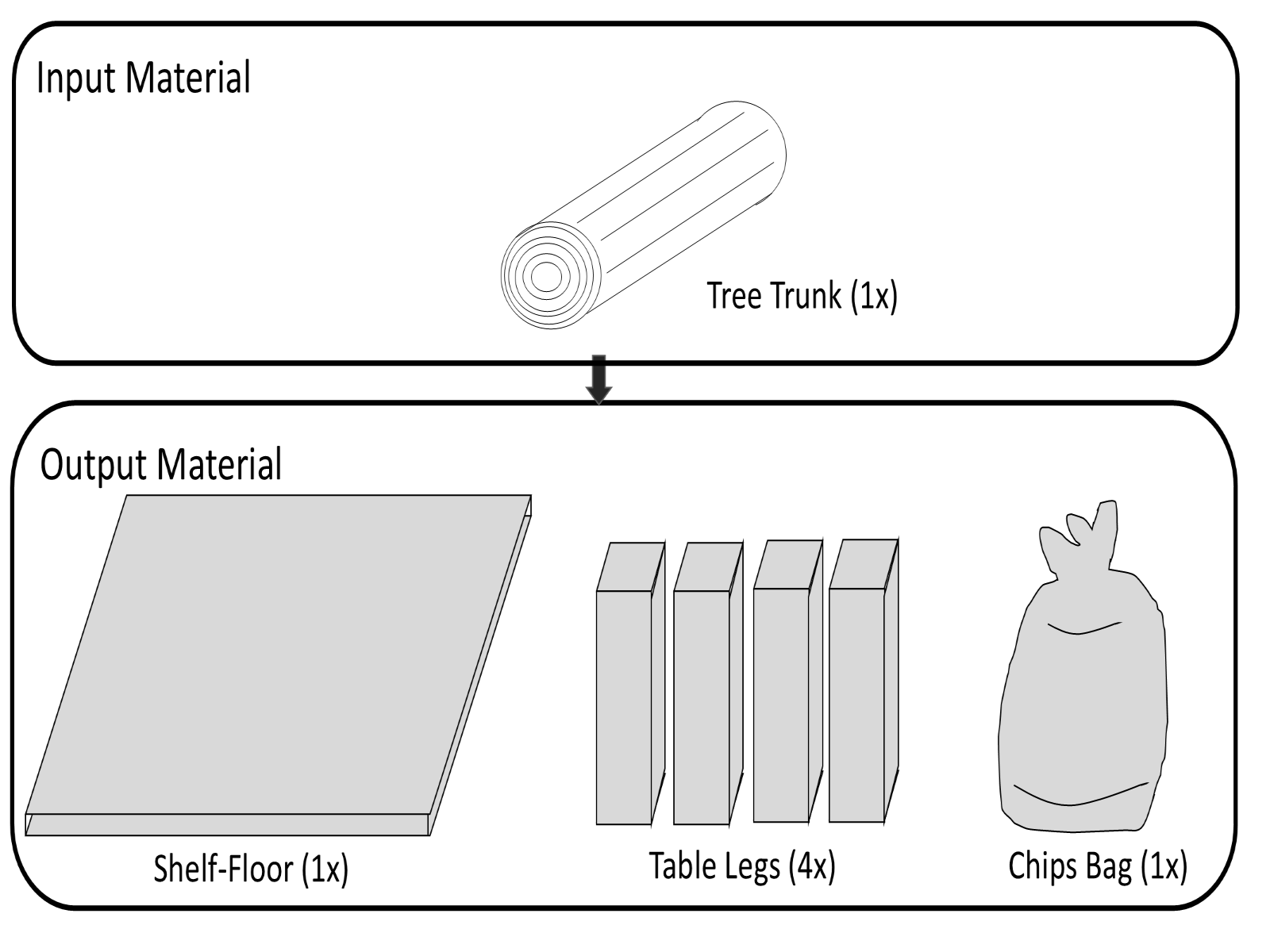
First, the job is sent from the MES system to the woodworking machine. This can be either done by calling the 2:Store or the 2:StoreAndStart Method on the 2:JobOrderReceiverObject defined in OPC 10031-4. In both cases, the job order information is transferred as instance of ISA95JobOrderDataType. An example of such a data structure is given in Table 29. In Figure 3, the planned job order is sketched. From a tree, 1 shelf floor and 4 table legs should be created. In addition a bag of chips is created.
| Field of ISA95JobOrderDataType | Value |
| JobOrderID | 12345 |
| OrderNumbers | Order_Forest_Utilize_01 |
| StartTime (planned) | 27.01.2023 10:17 |
| EndTime (planned) | 27.01.2023 10:19 |
| MaterialRequirements[] | |
Entry1 (Tree as planned Input) | |
MaterialUse | Material consumed |
Quantity | 1 |
EngineeringUnits | pcs |
Properties[] | |
Identification | |
ItemNumber | TreeTrunk |
OutputInfo | - (only ItemNumber) |
Param_771 | 200 [diameter, cm] |
Location | Cutting_line_input_1 |
Entry2 (shelf floor as planned output) | |
MaterialUse | Material produced |
Quantity | 1 |
EngineeringUnits | pcs |
Properties[] | |
Identification | |
ItemNumber | Shelf_Floor_0010 |
OutputInfo | - (only ItemNumber) |
OrderNumber | Order_Forest_Utilize_01 |
LotNumber | Forest_Spruce_ShelfFloor_1245 |
SerialNumber | FSSF_1234568 |
Param_1234 | 2500 [Width, mm] |
Param_1235 | 1500 [Length, mm] |
Param_1236 | 15,8 [Thickness, mm] |
Location | Cutting_line_output_1 |
Entry3 (table leg (4x) as planned output) | |
MaterialUse | Material produced |
Quantity | 4 |
EngineeringUnits | pcs |
Properties[] | |
Identification | |
ItemNumber | Table_Leg_012 |
OutputInfo | - (only ItemNumber) |
OrderNumber | Order_Forest_Utilize_01 |
LotNumber | Forest_Spruce_TableLeg_124 |
StartTime | 27.01.2023 10:17 |
EndTime | 27.01.2023 10:19 |
Param_1234 | 125 [Width, mm] |
Param_1235 | 855 [Length, mm] |
Param_1236 | 125 [Thickness, mm] |
Location | Cutting_line_output_2 |
Entry4 (chips planned output) | |
MaterialUse | Material produced |
Quantity | 1,75 |
EngineeringUnits | m^3 |
Properties[] | |
Identification | |
ItemNumber | SpruceChips_012 |
OutputInfo | - (only ItemNumber) |
Param_333 | Spruce [Woodtype] |
Location | BagFiller_output_1 |
After the job order is received, it needs to be in state "AllowedToStart" before it can be executed. In case of the 2:StoreAndStart Method, it is already in the state, otherwise the 2:Start Method needs to be called. Once it is in the "AllowedToStart" state, the woodworking machine is internally starting the job order once it is ready (and depending on priorities of other job orders which are "AllowedToStart". As soon as the job order has started (state of the job order is "Running"), the machine can provide results of the execution of the job order. The job order may get interrupted, or even aborted. Or it completes by switching into the "Ended" state. In Table 30, the final job order results, provided in an instance of 2:ISA95JobResponseDataType, are shown.
| Field of JobResponseData | Value |
| JobResponseID | 4 |
| JobOrderID | 12345 |
| StartTime | 27.01.2023 10:20 |
| EndTime | 27.01.2023 10:25 |
| JobState | COMPLETED |
| MaterialActuals[] | |
Entry1 (shelf floor as actual output) | |
MaterialUse | Material produced |
Quantity | 1 |
EngineeringUnits | pcs |
Properties[] | |
Identification | |
ItemNumber | Shelf_Floor_0010 |
OutputInfo | - (only ItemNumber) |
OrderNumber | Order_Forest_Utilize_01 |
LotNumber | Forest_Spruce_ShelfFloor_1245 |
SerialNumber | FSSF_1234568 |
StartTime | 27.01.2023 10:20 |
EndTime | 27.01.2023 10:22 |
Param_1234 | 2500 [Width, mm] |
Param_1235 | 1500 [Length, mm] |
Param_1236 | 15,8 [Thickness, mm] |
Location | Cutting_line_output_1 |
Entry2 (table leg (4x) as actual output) | |
MaterialUse | Material produced |
Quantity | 4 |
EngineeringUnits | pcs |
Properties[] | |
Identification | |
ItemNumber | Table_Leg_012 |
OutputInfo | LotNumber |
OrderNumber | Order_Forest_Utilize_01 |
LotNumber | Forest_Spruce_TableLeg_124 |
StartTime | 27.01.2023 10:22 |
EndTime | 27.01.2023 10:25 |
Param_1234 | 125 [Width, mm] |
Param_1235 | 855 [Length, mm] |
Param_1236 | 125 [Thickness, mm] |
Location | Cutting_line_output_2 |
Entry3 (chips as actual output) | |
MaterialUse | Material produced |
Quantity | 1,75 |
EngineeringUnits | m^3 |
Properties[] | |
Identification | |
ItemNumber | SpruceChips_012 |
OutputInfo | - (only ItemNumber) |
SerialNumber | Bag_12345 |
StartTime | 27.01.2023 10:20 |
EndTime | 27.01.2023 10:25 |
Param_333 | Spruce [Woodtype] |
Location | BagFiller_output_1 |
| JobResponseData[] | |
AsBuiltBOM[] | |
Entry1 | |
Identification | |
ItemNumber | Shelf_Floor_0010 |
OutputInfo | LotNumber |
LotNumber | Forest_Spruce_ShelfFloor_1245 |
ComponentInformation[] | |
Entry1 | |
Identification | |
ItemNumber | TreeTrunk |
OutputInfo | SerialNumber |
SerialNumber | TreeTrunk_Sepp123 |
Quantity | 1 |
EngineeringUnits | pcs |
Entry2 | |
Identification | |
ItemNumber | Table_Leg_012 |
OutputInfo | LotNumber |
LotNumber | Forest_Spruce_TableLeg_124 |
ComponentInformation[] | |
Entry1 | |
Identification | |
ItemNumber | TreeTrunk |
OutputInfo | SerialNumber |
SerialNumber | TreeTrunk_Sepp123 |
Quantity | 1 |
EngineeringUnits | pcs |
Agreement of Use
COPYRIGHT RESTRICTIONS
This document is provided "as is" by the OPC Foundation and VDMA.
Right of use for this specification is restricted to this specification and does not grant rights of use for referred documents.
Right of use for this specification will be granted without cost.
This document may be distributed through computer systems, printed or copied as long as the content remains unchanged and the document is not modified.
OPC Foundation and VDMA do not guarantee usability for any purpose and shall not be made liable for any case using the content of this document.
The user of the document agrees to indemnify OPC Foundation and VDMA and their officers, directors and agents harmless from all demands, claims, actions, losses, damages (including damages from personal injuries), costs and expenses (including attorneys' fees) which are in any way related to activities associated with its use of content from this specification.
The document shall not be used in conjunction with company advertising, shall not be sold or licensed to any party.
The intellectual property and copyright is solely owned by the OPC Foundation and VDMA.
PATENTS
The attention of adopters is directed to the possibility that compliance with or adoption of OPC or VDMA specifications may require use of an invention covered by patent rights. OPC Foundation or VDMA shall not be responsible for identifying patents for which a license may be required by any OPC or VDMA specification, or for conducting legal inquiries into the legal validity or scope of those patents that are brought to its attention. OPC or VDMA specifications are prospective and advisory only. Prospective users are responsible for protecting themselves against liability for infringement of patents.
WARRANTY AND LIABILITY DISCLAIMERS
WHILE THIS PUBLICATION IS BELIEVED TO BE ACCURATE, IT IS PROVIDED "AS IS" AND MAY CONTAIN ERRORS OR MISPRINTS. THE OPC FOUDATION NOR VDMA MAKES NO WARRANTY OF ANY KIND, EXPRESSED OR IMPLIED, WITH REGARD TO THIS PUBLICATION, INCLUDING BUT NOT LIMITED TO ANY WARRANTY OF TITLE OR OWNERSHIP, IMPLIED WARRANTY OF MERCHANTABILITY OR WARRANTY OF FITNESS FOR A PARTICULAR PURPOSE OR USE. IN NO EVENT SHALL THE OPC FOUNDATION NOR VDMA BE LIABLE FOR ERRORS CONTAINED HEREIN OR FOR DIRECT, INDIRECT, INCIDENTAL, SPECIAL, CONSEQUENTIAL, RELIANCE OR COVER DAMAGES, INCLUDING LOSS OF PROFITS, REVENUE, DATA OR USE, INCURRED BY ANY USER OR ANY THIRD PARTY IN CONNECTION WITH THE FURNISHING, PERFORMANCE, OR USE OF THIS MATERIAL, EVEN IF ADVISED OF THE POSSIBILITY OF SUCH DAMAGES.
The entire risk as to the quality and performance of software developed using this specification is borne by you.
RESTRICTED RIGHTS LEGEND
This Specification is provided with Restricted Rights. Use, duplication or disclosure by the U.S. government is subject to restrictions as set forth in (a) this Agreement pursuant to DFARs 227.7202-3(a); (b) subparagraph (c)(1)(i) of the Rights in Technical Data and Computer Software clause at DFARs 252.227-7013; or (c) the Commercial Computer Software Restricted Rights clause at FAR 52.227-19 subdivision (c)(1) and (2), as applicable. Contractor / manufacturer are the OPC Foundation, 16101 N. 82nd Street, Suite 3B, Scottsdale, AZ, 85260-1830.
COMPLIANCE
The combination of VDMA and OPC Foundation shall at all times be the sole entities that may authorize developers, suppliers and sellers of hardware and software to use certification marks, trademarks or other special designations to indicate compliance with these materials as specified within this document. Products developed using this specification may claim compliance or conformance with this specification if and only if the software satisfactorily meets the certification requirements set by VDMA or the OPC Foundation. Products that do not meet these requirements may claim only that the product was based on this specification and must not claim compliance or conformance with this specification.
TRADEMARKS
Most computer and software brand names have trademarks or registered trademarks. The individual trademarks have not been listed here.
GENERAL PROVISIONS
Should any provision of this Agreement be held to be void, invalid, unenforceable, or illegal by a court, the validity and enforceability of the other provisions shall not be affected thereby.
This Agreement shall be governed by and construed under the laws of Germany.
This Agreement embodies the entire understanding between the parties with respect to, and supersedes any prior understanding or agreement (oral or written) relating to, this specification.