
1 Scope
The OPC UA for Machinery specification contains various building blocks for Machinery that allow to address use cases across different types of machines and components of machines defined in various companion specifications.
For the general scope of the OPC UA for Machinery specification see OPC 40001-1.
This part contains a building block for
Result Transfer
2 Normative references
The following documents are referred to in the text in such a way that some or all of their content constitutes requirements of this document. For dated references, only the edition cited applies. For undated references, the latest edition of the referenced document (including any amendments and errata) applies.
OPC 10000-1, OPC Unified Architecture - Part 1: Overview and Concepts
OPC 10000-1
OPC 10000-3, OPC Unified Architecture - Part 3: Address Space Model
OPC 10000-3
OPC 10000-4, OPC Unified Architecture - Part 4: Services
OPC 10000-4
OPC 10000-5, OPC Unified Architecture - Part 5: Information Model
OPC 10000-5
OPC 10000-6, OPC Unified Architecture - Part 6: Mappings
OPC 10000-6
OPC 10000-7, OPC Unified Architecture - Part 7: Profiles
OPC 10000-7
OPC 10000-20, OPC Unified Architecture - Part 20: File Transfer
OPC 10000-20
OPC 10000-100, OPC Unified Architecture - Part 100: Devices
OPC 10000-100
OPC 40001-1, OPC UA for Machinery - Part 1: Basic Building Blocks
http://www.opcfoundation.org/UA/Machinery/
3 Terms, definitions and conventions
3.1 Overview
It is assumed that basic concepts of OPC UA information modelling are understood in this specification. This specification will use these concepts to describe the Machinery - Result Transfer Information Model. For the purposes of this document, the terms and definitions given in OPC 10000-1, OPC 10000-3, OPC 10000-4, OPC 10000-5, OPC 10000-7, OPC 40001-1, as well as the following apply.
3.2 OPC UA for Result Transfer terms
3.2.1 Configuration
3.2.1.1 Untitled
Ensures that a recipe produces the same result on different entities of my machine. The configuration can optionally be used to make a program/recipe usable for different articles. The characteristics are often technology or industry specific.
3.2.2 Environment
The set of external entities working with the System in one way or another, e.g. PLC, MES, etc.
3.2.3 Job
The concrete implementation of a set of information that a machine needs to execute an order.
3.2.3.1 Untitled
3.2.4 Part
3.2.4.1 Untitled
Describes a concrete instance or instances of the Product (e.g., a specific DIN A4 sheet).
3.2.5 Program
Contains a number of executable activities for controllable units.
3.2.5.1 Untitled
3.2.6 Product
Describes the output that is to become the core of the value creation (e.g. DIN A4 sheet).
3.2.6.1 Untitled
3.2.7 Recipe
The set of information required to uniquely describe the production requirements for one or more specific products.
3.2.7.1 Untitled
3.2.8 System
Any complex information processing system generating results.
3.2.9 System-wide unique
At any given time no other entity of the same type and meaning shall exist in the OPC UA Server with the same value.
3.2.9.1 Untitled
3.2.10 Step
A domain- or manufacturer-specific definition that represents an intermediate stage of the job process.
3.2.10.1 Untitled
3.3 Abbreviated terms
| MES | Manufacturing Execution System |
| PLC | Programmable Logic Controller |
3.4 Conventions used in this document
For conventions used in this document see OPC 40001-1.
4 General information to Machinery and OPC UA
For general information to Machinery and OPC UA see OPC 40001-1.
5 Use cases
The user would like to receive complex measurement results, that might be created over a certain amount of time and potentially require some processing of raw measurement values.
This leads to the requirements
Clients shall be notified if new results are available (see section 8.1, ResultReadyEventType)
Clients shall be able to access individual results (see section 7.1, ResultManagementType and section 7.1.2, GetResultById)
Clients shall be able to filter for specific results (see section 7.1.3, GetResultIdListFiltered)
Note that the main purpose of the result transfer is to provide meta data together with the individual results. For a simple transfer of measured values like a flow or temperature without such meta data there are simpler mechanisms in OPC UA like providing a OPC UA Variable with a specific measurement value.
6 Result Transfer Information Model overview
6.1 General
The result transfer information model provides mechanisms to transfer results that are produced by a Server or its underlying system. The characteristics of such results is to contain meta data together with the individual results. Servers will provide the results for a certain amount of time so that Clients can receive the results using the result transfer.
The base modelling construct for the result transfer is the ResultManagementType (see Figure 1). Servers may provide several instances of that ObjectType to expose different sources of results. Each instance of ResultManagementType already can provide many results.
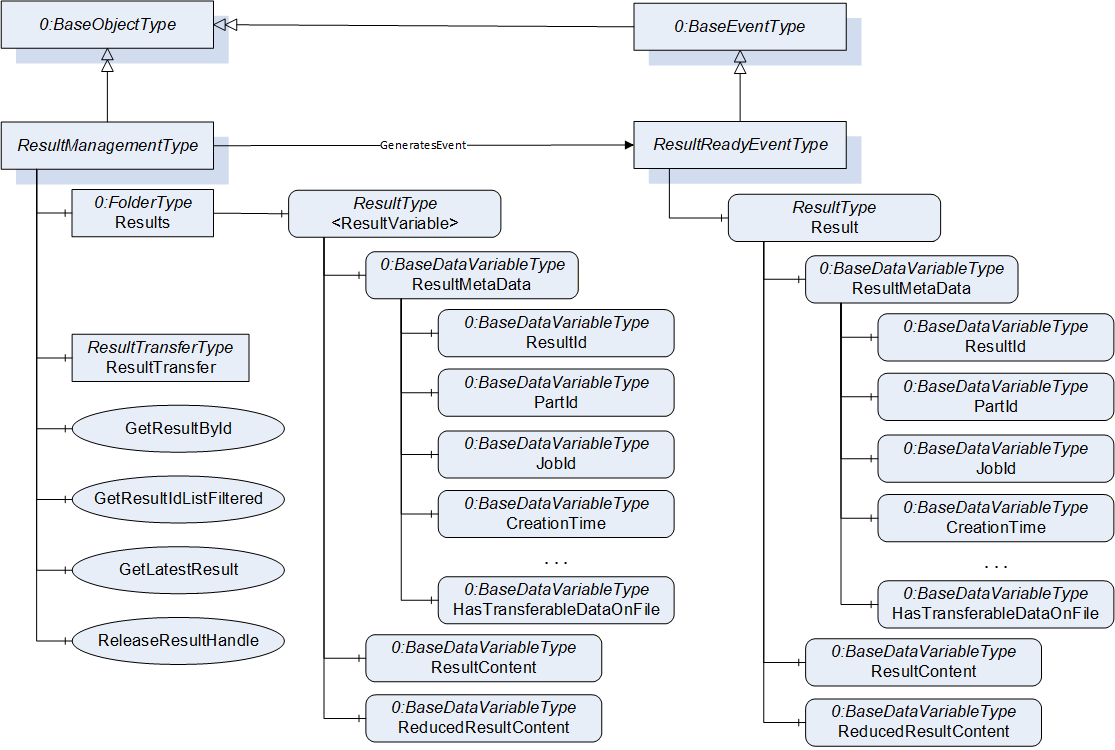
Instances of ResultManagementType provide optionally all available results as Variables of ResultType under the Results folder. They may generate Events of ResultReadyEventType for new created results. And they provide optional Methods to retrieve individual results or filter for specific results.
6.2 Retrieve Information that Results exist
The model provides different mechanism how Clients can retrieve information about the currently available results provided by instances of the ResultManagementType. Not all implementations will provide all those possibilities.
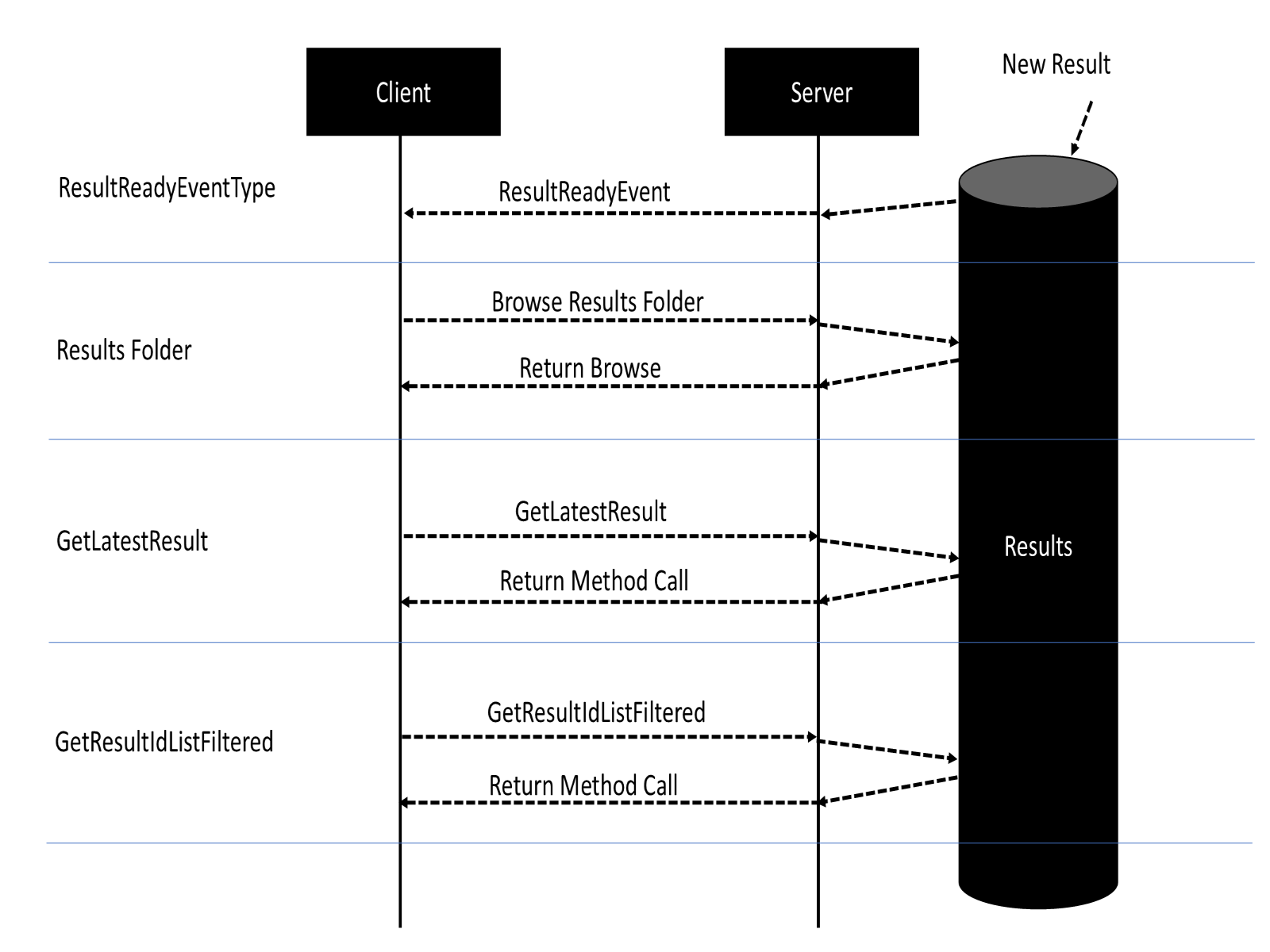
The mechanisms are depicted in Figure 2. In order to get notified that a new result has been created, a Client can subscribe to Events of ResultReadyEventType if the Server supports those Events. In order to retrieve information about the available results, the Client can
Browse the Results folder, each Variable of ResultType represents an individual available result
Call the GetLatestResult Method to retrieve information about the latest created result
Call the GetResultIdListFiltered Method to retrieve information about all available results according to the specified filter criteria
6.3 Transfer Results
The model provides different mechanism how Clients can transfer results provided by instances of the ResultManagementType. Not all implementations will provide all those possibilities.
The result consists of meta data describing the result, a relatively small amount of result data called ResultContent and optionally a larger amount of result data called ResultFile, transferred via the OPC UA file transfer. In some cases, the result only consists of parts of the meta data, the ResultEvaluation, which indicates whether the result is in a tolerance.
If a result has been successfully created, the Server shall at least provide the ResultContent, the ResultFile or the ResultEvaluation.
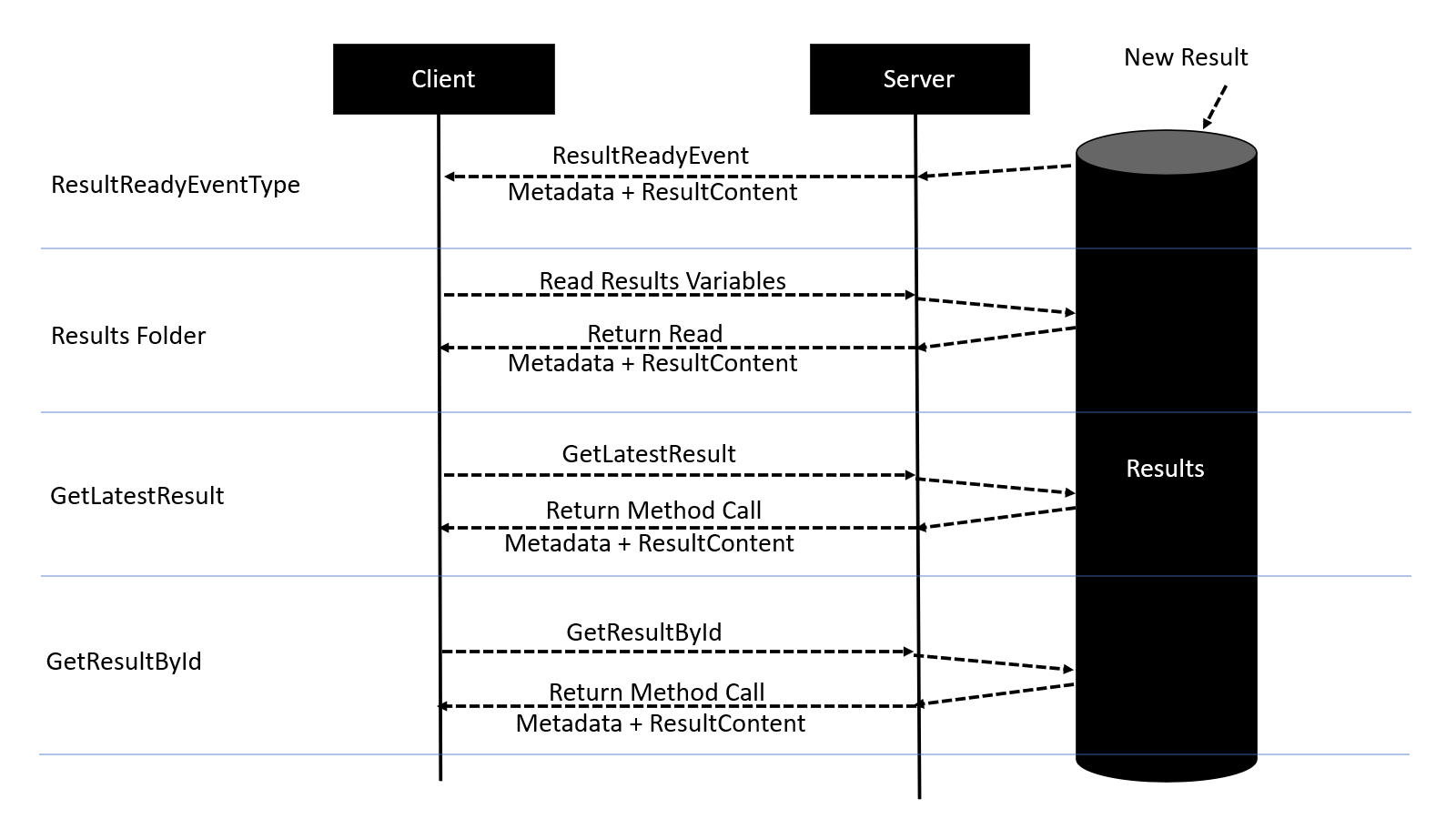
The ResultReadyEvents provide the meta data of the result as well as the ResultContent. Clients can either only subscribe to parts of the meta data and access the ResultContent via a different mechanism or get the ResultContent as well with the Event.
The ResultContent as well as the meta data can be transferred by calling the GetResultById Method. This requires knowledge on the ResultId, that can either be retrieved via the ResultReadyEvents or by calling the GetResultIdListFiltered Method. The latest ResultContent and its meta data can also be transferred by calling the GetLatestResult Method.
The ResultContent as well as the meta data is also provided by Variables under the Results folder and can be transferred by reading or subscribing to those Variables.
In Figure 3, the different options are displayed.
In case the result also contains a ResultFile, the ResultTransfer Object may be used to transfer the ResultFile. In order to use the ResultTransfer Object, the ResultId of the result is needed.
6.4 Lifetime of a Result
The lifetime of a result typically is limited as the management of the results is consuming resources of the Server. When using the Methods GetResultById, GetLatestResult or GetResultIdListFiltered, the Client can provide a timer how long it requests the retrieved results to be available, and receives a handle it can use to call the ReleaseResultHandle Method in order to hint to the Server, that the result is not required by the Client anymore. The mechanism is intended to secure the read process of results and not to lock a specific result for a longer time. There is no guarantee that the Server will keep the result until the RelaseResultHandle is called or the timeout is reached. The strategy of the Server is vendor-specific. A Server may, for example, stop producing new results when the old results should still be kept, or remove old results anyhow. A Server may remove results as soon as one Client has received the result data, or keep the results for a specific time since many Clients may need to access the result data.
Note: Since there is no guaranteed storage time even a Server without the capability to store more than one result locally can use this mechanism.
The handle and timeout are of specific importance when the result contains a ResultFile, or when the GetResultIdListFiltered was called and not all returned ResultIds have been received via the GetResultById Method.
Servers may support the AcknowledgeResults Method that can be used by a specific Client responsible to store the results to inform the Server, that the acknowledged results are processed and can be removed.
6.5 Partial Results and Result Content
Generating results may take time, and during that period Servers may already expose partial results, i.e., results that do contain some information but are not complete. For example, a vision system may inspect a produced part several times from different angles, and each inspection is a partial result. The meta data of the result indicate, when the result is only a partial result. The final result contains the aggregated data of the partial results.
The ResultContent or the ResultEvaluation and potentially in addition the ResultFile together provide the complete result. Servers may also provide a reduced result summarizing the overall result. For example, a vision system inspecting a produced part may provide in the result the raw image data of the product part in addition to the flag indicating if the quality of the produced part is sufficient. The ReducedResultContent may only contain the quality information without the raw image data. The optional ReducedResultContent is provided with the ResultReadyEvents and the Variables of the Results folder.
7 OPC UA ObjectTypes
7.1 ResultManagementType ObjectType Definition
7.1.1 Overview
The ResultManagementType provides mechanism to access results generated by the underlying system. Results can be managed in a local result store of the Server. Methods and Objects with Variables as well as Events and external file stores can be used to provide the results to the Client. The ObjectType is formally defined in Table 1.
| Attribute | Value | ||||
| BrowseName | ResultManagementType | ||||
| IsAbstract | False | ||||
| Description | Provides mechanism to access results generated by the underlying system. | ||||
| References | Node Class | BrowseName | DataType | TypeDefinition | Other |
|---|---|---|---|---|---|
| Subtype of the 0:BaseObjectType defined in OPC 10000-5 | |||||
| 0:HasProperty | Variable | 0:DefaultInstanceBrowseName | 0:QualifiedName | 0:PropertyType | |
| 0:HasComponent | Method | GetResultById | O | ||
| 0:HasComponent | Method | GetResultIdListFiltered | O | ||
| 0:HasComponent | Method | ReleaseResultHandle | O | ||
| 0:HasComponent | Method | GetLatestResult | O | ||
| 0:HasComponent | Object | ResultTransfer | ResultTransferType | O | |
| 0:HasComponent | Object | Results | 0:FolderType | O | |
| 0:HasComponent | Method | AcknowledgeResults | O | ||
| 0:GeneratesEvent | ObjectType | ResultReadyEventType | |||
| Conformance Units | |||||
|---|---|---|---|---|---|
| Machinery-Result Types |
The optional ResultTransfer Object is used to transfer the content of a result by a temporary file transfer. In order to be called by the Client, the Client first need to receive a ResultId.
The optional Results Object is used to organize available results of the system which the Server decides to expose in the AddressSpace. It may contain no result if no result is available, if the Server does not expose results in the AddressSpace at all or if no available result matches the criteria of the Server for exposure in the AddressSpace. It may contain multiple results if multiple results are available.
The components of the ResultManagementType have additional subcomponents which are defined in Table 2.
| Source Path | Reference | NodeClass | BrowseName | DataType | TypeDefinition | Others |
| Results | 0:HasComponent | Variable | <ResultVariable> | ResultDataType | ResultType | OP |
Each <ResultVariable> represents a result. If partial results are supported, the Variable value gets updated with partial results until the final result is provided as value.
The child Nodes of the ResultManagementType have additional Attribute values defined in Table 3.
| BrowsePath | Value Attribute | Description Attribute |
| 0:DefaultInstanceBrowseName | ResultManagement | The default BrowseName for instances of the type. |
7.1.2 GetResultById
The Method GetResultById is used to retrieve a result. Depending on the design of the system, the Client may be informed by Events of ResultReadyEventType that a new result is available. Then, the Client might fetch this result using the information provided by Events of ResultReadyEventType which is defined in Section 8.1.
Since the ResultId is supposed to be system-wide unique, this Method shall return only a single result. If the system supports partial results, only the latest partial result, or the final result, shall be returned.
Since there may be additional result content to be retrieved by temporary file transfer, the Server should keep result data available, resources permitting, until the Client releases the handle by calling ReleaseResultHandle. However, the Client cannot rely on the data to remain available until then.
The signature of this Method is specified below. Table 4 and Table 5 specify the Arguments and AddressSpace representation, respectively.
Signature
	GetResultById (
		[in]	0:TrimmedString	resultId,
		[in]	0:Int32	timeout,
		[out]	0:Handle	resultHandle,
		[out]	ResultDataType	result,
[out] 0:Int32 error)| Argument | Description |
| resultId | System-wide unique identifier for the result. |
| timeout | With this argument the Client can give a hint to the Server how long it will need access to the result data. A value > 0 indicates an estimated maximum time for processing the data in milliseconds. A value = 0 indicates that the Client will not need anything besides the data returned by the method call. A value < 0 indicates that the Client cannot give an estimate. The Client cannot rely on the data being available during the indicated time period. The argument is merely a hint allowing the Server to optimize its resource management. |
| resultHandle | The Server shall return to each Client requesting result data a system-wide unique handle identifying the result set / Client combination. This handle should be used by the Client to indicate to the Server that the result data is no longer needed, allowing the Server to optimize its resource handling. If the instance of ResultManagementType does not support the ReleaseResultHandle Method, the resultHandle should always be set to 0. If the error is set to a value other than 0, the resultHandle may be set to 0. |
| result | The result including metadata. May be set to Null, if error is set to a value other than 0. |
| error | 0 - OK Values > 0 are reserved for errors defined by this and future standards. Values < 0 shall be used for application-specific errors. |
| Attribute | Value | ||||
| BrowseName | GetResultById | ||||
| References | Node Class | BrowseName | DataType | TypeDefinition | ModellingRule |
|---|---|---|---|---|---|
| 0:HasProperty | Variable | 0:InputArguments | 0:Argument[] | 0:PropertyType | 0:Mandatory |
| 0:HasProperty | Variable | 0:OutputArguments | 0:Argument[] | 0:PropertyType | 0:Mandatory |
7.1.3 GetResultIdListFiltered
The Method GetResultIdListFiltered is used to get a list of results matching certain filter criteria. The signature of this Method is specified below. Table 6 and Table 7 specify the Arguments and AddressSpace representation, respectively.
Signature
	GetResultIdListFiltered (
		[in]	0:ContentFilter			filter,
		[in]	0:RelativePath[]			orderedBy,
		[in]	0:UInt32			maxResults,
		[in]	0:Int32			timeout,
		[out]	0:Handle			resultHandle,
		[out]	0:TrimmedString[]		resultIdList,
[out] 0:Int32 error)| Argument | Description |
| filter | Filter used to filter for specific results based on the meta data of the results. Valid BrowsePaths used in the filter can be built from the fields of the ResultReadyEventType, the ResultType VariableType or the ResultDataType or corresponding subtypes. |
| orderedBy | An array of RelativePaths identifying the ordering criteria for the results. If the array is null or empty, no ordering is executed. If several RelativePaths are provided, the first entry in the array is used as first ordering criteria, etc. |
| maxResults | Defines how many resultIds the Client wants to receive at most. If no maximum should be provided, it is set to 0. |
| timeout | With this argument the Client can give a hint to the Server how long it will need access to the result data. A value > 0 indicates an estimated maximum time for processing the data in milliseconds. A value = 0 indicates that the Client will not need anything besides the data returned by the method call. A value < 0 indicates that the Client cannot give an estimate. The Client cannot rely on the data being available during the indicated time period. The argument is merely a hint allowing the Server to optimize its resource management. |
| resultHandle | The Server shall return to each Client requesting result data a system-wide unique handle identifying the result set / Client combination. This handle has to be used by the Client to release the result set. If the instance of ResultManagementType does not support the ReleaseResultHandle Method, the resultHandle should always be set to 0. If the error is set to a value other than 0, the resultHandle may be set to 0. |
| resultIdList | List of resultIds of results matching the Filter. |
| error | 0 - OK Values > 0 are reserved for errors defined by this and future standards. Values < 0 shall be used for application-specific errors. |
| Attribute | Value | ||||
| BrowseName | GetResultIdListFiltered | ||||
| References | Node Class | BrowseName | DataType | TypeDefinition | ModellingRule |
|---|---|---|---|---|---|
| 0:HasProperty | Variable | 0:InputArguments | 0:Argument[] | 0:PropertyType | 0:Mandatory |
| 0:HasProperty | Variable | 0:OutputArguments | 0:Argument[] | 0:PropertyType | 0:Mandatory |
7.1.4 ReleaseResultHandle
The Method ReleaseResultHandle is used to inform the Server that the Client has finished processing a given result set allowing the Server to free resources managing this result set.
The Server should keep the data of the result set available for the Client until the ReleaseResultHandle Method is called or until a timeout given by the Client has expired. However, the Server is free to release the data at any time, depending on its internal resource management, so the Client cannot rely on the data being available. ReleaseResultHandle is merely a hint allowing the Server to optimize its internal resource management. For timeout usage see the description in Section 6.4.
The signature of this Method is specified below. Table 8 and Table 9 specify the Arguments and AddressSpace representation, respectively.
Signature
	ReleaseResultHandle (
		[in]	0:Handle	resultHandle,
[out] 0:Int32 error)| Argument | Description |
| resultHandle | Handle returned by GetResultById or GetResultIdListFiltered, identifying the result set/Client combination. |
| Error | 0 - OK Values > 0 are reserved for errors defined by this and future standards. Values < 0 shall be used for application-specific errors. |
| Attribute | Value | ||||
| BrowseName | ReleaseResultHandle | ||||
| References | Node Class | BrowseName | DataType | TypeDefinition | ModellingRule |
|---|---|---|---|---|---|
| 0:HasProperty | Variable | 0:InputArguments | 0:Argument[] | 0:PropertyType | 0:Mandatory |
| 0:HasProperty | Variable | 0:OutputArguments | 0:Argument[] | 0:PropertyType | 0:Mandatory |
7.1.5 GetLatestResult
The Method GetLatestResult is used to retrieve the latest result created for the instance of ResultManagementType.
Since there may be additional result content to be retrieved by temporary file transfer, the Server should keep result data available, resources permitting, until the Client releases the handle by calling ReleaseResultHandle. However, the Client cannot rely on the data to remain available until then.
The signature of this Method is specified below. Table 10 and Table 11 specify the Arguments and AddressSpace representation, respectively.
Signature
	GetLatestResult (
		[in]	0:Int32	timeout,
		[out]	0:Handle	resultHandle,
		[out]	ResultDataType	result,
[out] 0:Int32 error)| Argument | Description |
| timeout | With this argument the Client can give a hint to the Server how long it will need access to the result data. A value > 0 indicates an estimated maximum time for processing the data in milliseconds. A value = 0 indicates that the Client will not need anything besides the data returned by the method call. A value < 0 indicates that the Client cannot give an estimate. The Client cannot rely on the data being available during the indicated time period. The argument is merely a hint allowing the Server to optimize its resource management. |
| resultHandle | The Server shall return to each Client requesting result data a system-wide unique handle identifying the result set / Client combination. This handle should be used by the Client to indicate to the Server that the result data is no longer needed, allowing the Server to optimize its resource handling. If the instance of ResultManagementType does not support the ReleaseResultHandle Method, the resultHandle should always be set to 0. If the error is set to a value other than 0, the resultHandle may be set to 0. |
| result | The result including metadata. |
| error | 0 - OK Values > 0 are reserved for errors defined by this and future standards. Values < 0 shall be used for application-specific errors. |
| Attribute | Value | ||||
| BrowseName | GetLatestResult | ||||
| References | Node Class | BrowseName | DataType | TypeDefinition | ModellingRule |
|---|---|---|---|---|---|
| 0:HasProperty | Variable | 0:InputArguments | 0:Argument[] | 0:PropertyType | 0:Mandatory |
| 0:HasProperty | Variable | 0:OutputArguments | 0:Argument[] | 0:PropertyType | 0:Mandatory |
7.1.6 AcknowledgeResults
The Method AcknowledgeResults is used to inform the Server that the Client has finished the processing of given results allowing the Server to free resources managing those results.
The Server may be configured to keep the results available for the Client until the AcknowledgeResults Method is called. However, the Server is free to release the results at any time, depending on its internal resource management, so the Client cannot rely on the data being available.
Note: It is recommended that this Method is used only by the Client that is responsible for exclusively storing the results.
The signature of this Method is specified below. Table 12 and Table 13 specify the Arguments and AddressSpace representation, respectively.
Signature
	AcknowledgeResults (
		[in]	0:TrimmedString[]	resultIds,
		[out]	0:Int32[]		errorPerResultId,
		[out]	0:Int32		error
)| Argument | Description |
| resultIds | List of result identifiers to be acknowledged. |
| errorPerResultId | Shall be null or empty if error equals 0. Shall have the same length as resultIds if error is not equal 0. Indicates for each resultId in resultIds, if the acknowledge was successful. Per entry: 0 - OK Values > 0 are reserved for errors defined by this and future standards. Values < 0 shall be used for application-specific errors. |
| error | 0 - OK Values > 0 are reserved for errors defined by this and future standards. Values < 0 shall be used for application-specific errors. Shall be not equal 0 if any resultId of resultIds was not successfully acknowledged. Shall be 0 if all resultIds where acknowledged successful. |
| Attribute | Value | ||||
| BrowseName | AcknowledgeResults | ||||
| References | Node Class | BrowseName | DataType | TypeDefinition | ModellingRule |
|---|---|---|---|---|---|
| 0:HasProperty | Variable | 0:InputArguments | 0:Argument[] | 0:PropertyType | 0:Mandatory |
| 0:HasProperty | Variable | 0:OutputArguments | 0:Argument[] | 0:PropertyType | 0:Mandatory |
7.2 ResultTransferType ObjectType Definition
7.2.1 Overview
This ObjectType is a subtype of the 0:TemporaryFileTransferType defined in OPC 10000-20 and is used to transfer result data as a file.
The ResultTransferType overwrites the Method GenerateFileForRead to specify the concrete type of the generateOptions Argument of the Method. It does not specialize the GenerateFileForWrite Method of the base type as results are supposed to be only generated by the Server, not received.
The ResultTransferType is formally defined in Table 14.
| Attribute | Value | ||||
| BrowseName | ResultTransferType | ||||
| IsAbstract | False | ||||
| Description | Transfers result data as a file. | ||||
| References | Node Class | BrowseName | DataType | TypeDefinition | Other |
|---|---|---|---|---|---|
| Subtype of the 0:TemporaryFileTransferType defined in OPC 10000-20 | |||||
| HasComponent | Method | GenerateFileForRead | M | ||
| Conformance Units | |||||
|---|---|---|---|---|---|
| Machinery-Result Types |
7.2.2 GenerateFileForRead
The Method GenerateFileForRead is used to start the read file transaction. A successful call of this Method creates a temporary FileType Object with the file content and returns the NodeId of this Object and the file handle to access the Object. The signature of this Method is specified below. Table 15 and Table 16 specify the Arguments and AddressSpace representation, respectively.
Signature
	GenerateFileForRead (
		[in]	BaseResultTransferOptionsDataType	generateOptions,
		[out]	0:NodeId					fileNodeId,
		[out]	0:UInt32					fileHandle,
[out] 0:NodeId completionStateMachine)| Argument | Description |
| generateOptions | Options how to generate the file, including the resultId of the result the file belongs to. |
| fileNodeId | NodeId of the temporary file. |
| fileHandle | The FileHandle of the opened TransferFile. The FileHandle can be used to access the TransferFile methods Read and Close. |
| completionStateMachine | If the creation of the file is completed asynchronously, the parameter returns the NodeId of the corresponding FileTransferStateMachineType Object. If the creation of the file is already completed, the parameter is null. If a FileTransferStateMachineType object NodeId is returned, the Read Method of the file fails until the TransferState changed to ReadTransfer. |
| Attribute | Value | ||||
| BrowseName | 0:GenerateFileForRead | ||||
| References | Node Class | BrowseName | DataType | TypeDefinition | ModellingRule |
|---|---|---|---|---|---|
| 0:HasProperty | Variable | 0:InputArguments | 0:Argument[] | 0:PropertyType | 0:Mandatory |
| 0:HasProperty | Variable | 0:OutputArguments | 0:Argument[] | 0:PropertyType | 0:Mandatory |
8 OPC UA EventTypes
8.1 ResultReadyEventType ObjectType Definition
The ResultReadyEventType provides information of a complete or partial result. Events of this type are to be triggered when the Server has a complete or partial result available to the Client. It is formally defined in Table 17.
To enable access to a result, several Properties of the result, which are generated by the system, are supplied. These Properties can be used to query the results in the ResultManagement Object. A sufficiently small result can also be provided in the ResultContent component of the Event.
| Attribute | Value | ||||
| BrowseName | ResultReadyEventType | ||||
| IsAbstract | True | ||||
| Description | Provides information of a complete or partial result. | ||||
| References | Node Class | BrowseName | DataType | TypeDefinition | Other |
|---|---|---|---|---|---|
| Subtype of the 0:BaseEventType defined in OPC 10000-5 | |||||
| 0:HasComponent | Variable | Result | ResultDataType | ResultType | M |
| Conformance Units | |||||
|---|---|---|---|---|---|
| Machinery-Result ResultEvents |
This EventType inherits all Properties of the BaseEventType.
The Result Variable of ResultType VariableType contains the subvariables as defined by the ResultType. Clients can select some of those individually when subscribing to Events. The Result represents a partial or complete result.
9 OPC UA VariableTypes
9.1 ResultType VariableType Definition
The ResultType is a subtype of BaseDataVariableType. It is used to expose the information of the ResultDataType in individual subvariables. They have the same meaning as defined by the DataType in section 10.5.
The VariableType is formally defined in Table 18.
| Attribute | Value | ||||
| BrowseName | ResultType | ||||
| IsAbstract | False | ||||
| ValueRank | -1 (-1 = Scalar) | ||||
| DataType | ResultDataType | ||||
| Description | Exposes the information of the ResultDataType in individual subvariables. | ||||
| References | Node Class | BrowseName | DataType | TypeDefinition | Other |
|---|---|---|---|---|---|
| Subtype of the 0:BaseDataVariableType defined in OPC 10000-5 | |||||
| 0:HasStructuredComponent | Variable | ResultMetaData | ResultMetaDataType | 0:BaseDataVariableType | M |
| 0:HasStructuredComponent | Variable | ResultContent | 0:BaseDataType[] | 0:BaseDataVariableType | O |
| 0:HasComponent | Variable | ReducedResultContent | 0:BaseDataType[] | 0:BaseDataVariableType | O |
| Conformance Units | |||||
|---|---|---|---|---|---|
| Machinery-Result Types |
The optional ReducedResultContent Variable, not defined in the ResultDataType, contains a reduced ResultContent summarizing the overall result (see 6.5).
The components of the ResultType have additional subcomponents which are defined in Table 19.
| BrowsePath | References | NodeClass | BrowseName | DataType | TypeDefinition | Others |
| ResultMetaData | 0:HasStructuredComponent | Variable | ResultId | 0:TrimmedString | 0:BaseDataVariableType | M |
| ResultMetaData | 0:HasStructuredComponent | Variable | HasTransferableDataOnFile | 0:Boolean | 0:BaseDataVariableType | O |
| ResultMetaData | 0:HasStructuredComponent | Variable | IsPartial | 0:Boolean | 0:BaseDataVariableType | O |
| ResultMetaData | 0:HasStructuredComponent | Variable | IsSimulated | 0:Boolean | 0:BaseDataVariableType | O |
| ResultMetaData | 0:HasStructuredComponent | Variable | ResultState | 0:Int32 | 0:BaseDataVariableType | O |
| ResultMetaData | 0:HasStructuredComponent | Variable | StepId | 0:TrimmedString | 0:BaseDataVariableType | O |
| ResultMetaData | 0:HasStructuredComponent | Variable | PartId | 0:TrimmedString | 0:BaseDataVariableType | O |
| ResultMetaData | 0:HasStructuredComponent | Variable | ExternalRecipeId | 0:TrimmedString | 0:BaseDataVariableType | O |
| ResultMetaData | 0:HasStructuredComponent | Variable | InternalRecipeId | 0:TrimmedString | 0:BaseDataVariableType | O |
| ResultMetaData | 0:HasStructuredComponent | Variable | ProductId | 0:TrimmedString | 0:BaseDataVariableType | O |
| ResultMetaData | 0:HasStructuredComponent | Variable | ExternalConfigurationId | 0:TrimmedString | 0:BaseDataVariableType | O |
| ResultMetaData | 0:HasStructuredComponent | Variable | InternalConfigurationId | 0:TrimmedString | 0:BaseDataVariableType | O |
| ResultMetaData | 0:HasStructuredComponent | Variable | JobId | 0:TrimmedString | 0:BaseDataVariableType | O |
| ResultMetaData | 0:HasStructuredComponent | Variable | CreationTime | 0:UtcTime | 0:BaseDataVariableType | O |
| ResultMetaData | 0:HasStructuredComponent | Variable | ProcessingTimes | ProcessingTimesDataType | 0:BaseDataVariableType | O |
| ResultMetaData | 0:HasStructuredComponent | Variable | ResultUri | 0:UriString[] | 0:BaseDataVariableType | O |
| ResultMetaData | 0:HasStructuredComponent | Variable | ResultEvaluation | ResultEvaluationEnum | 0:BaseDataVariableType | O |
| ResultMetaData | 0:HasStructuredComponent | Variable | ResultEvaluationDetails | 0:LocalizedText | 0:BaseDataVariableType | O |
| ResultMetaData | 0:HasStructuredComponent | Variable | ResultEvaluationCode | 0:Int64 | 0:BaseDataVariableType | O |
| ResultMetaData | 0:HasStructuredComponent | Variable | FileFormat | 0:String[] | 0:BaseDataVariableType | O |
10 OPC UA DataTypes
10.1 BaseResultTransferOptionsDataType
This abstract structure contains information on which ResultFile should be provided to be transferred to the Client. The structure contains the ResultId of the requested result. Companion Specifications and vendors shall either subtype this structured DataType to provide more information about the provided ResultFile, like the file format, or use an existing subtype like ResultTransferOptionsDataType. The structure is defined in Table 20.
| Name | Type | Description |
| BaseResultTransferOptionsDataType | structure | |
ResultId | 0:TrimmedString | The Id of the result to be transferred to the Clients |
Its representation in the AddressSpace is defined in Table 21.
| Attribute | Value | ||||
| BrowseName | BaseResultTransferOptionsDataType | ||||
| IsAbstract | True | ||||
| Description | Abstract type containing information which file should be provided. | ||||
| References | Node Class | BrowseName | DataType | TypeDefinition | Other |
|---|---|---|---|---|---|
| Subtype of 0:Structure defined in OPC 10000-5 | |||||
| Conformance Units | |||||
|---|---|---|---|---|---|
| Machinery-Result Types |
10.2 ResultTransferOptionsDataType
This structure contains information on which ResultFile should be provided to be transferred to the Client. The structure is a concrete DataType that can be used directly if no additional information needs to be added. No additional fields have been added to the structure.
Its representation in the AddressSpace is defined in Table 22.
| Attribute | Value | ||||
| BrowseName | ResultTransferOptionsDataType | ||||
| IsAbstract | False | ||||
| Description | Contains information which file should be provided. | ||||
| References | Node Class | BrowseName | DataType | TypeDefinition | Other |
|---|---|---|---|---|---|
| Subtype of BaseResultTransferOptionsDataType | |||||
| Conformance Units | |||||
|---|---|---|---|---|---|
| Machinery-Result Types |
10.3 ResultEvaluationEnum
This enumeration ResultEvaluationEnum indicates whether a result was in tolerance. The enumeration is defined in Table 23.
| Name | Value | Description |
| Undefined | 0 | The evaluation of the result is unknown, for example because it failed |
| OK | 1 | The result is in tolerance |
| NotOK | 2 | The result is out of tolerance |
| NotDecidable | 3 | The decision is not possible due to measurement uncertainty. |
Its representation in the AddressSpace is defined in Table 24.
| Attribute | Value | ||||
| BrowseName | ResultEvaluationEnum | ||||
| IsAbstract | False | ||||
| Description | Indicates whether a result was in tolerance | ||||
| References | Node Class | BrowseName | DataType | TypeDefinition | Other |
|---|---|---|---|---|---|
| Subtype of the 0:Enumeration type defined in OPC 10000-5 | |||||
| 0:HasProperty | Variable | 0:EnumValues | 0:EnumValueType[] | 0:PropertyType | |
| Conformance Units | |||||
|---|---|---|---|---|---|
| Machinery-Result Types |
10.4 ProcessingTimesDataType
This structure contains measured times that were generated during the execution of a recipe. These measured values provide information about the duration required by the various sub-functions The structure is defined in Table 25.
| Name | Type | Description | Optional |
| ProcessingTimesDataType | structure | ||
StartTime | 0:UtcTime | Contains the time when the system started execution of the recipe. | False |
EndTime | 0:UtcTime | Contains the time when the system finished (or stopped/aborted) execution of the recipe. | False |
AcquisitionDuration | 0:Duration | Time spent by the system acquiring data. | True |
ProcessingDuration | 0:Duration | Time spent by the system processing data. | True |
Its representation in the AddressSpace is defined in Table 26.
| Attribute | Value | ||||
| BrowseName | ProcessingTimesDataType | ||||
| IsAbstract | False | ||||
| Description | Contains measured times that were generated during the execution of a recipe. | ||||
| References | Node Class | BrowseName | DataType | TypeDefinition | Other |
|---|---|---|---|---|---|
| Subtype of 0:Structure defined in OPC 10000-5 | |||||
| Conformance Units | |||||
|---|---|---|---|---|---|
| Machinery-Result Types |
10.5 ResultDataType
This structure contains fields that were created during the execution of a recipe. A result may be a total or a partial result, which is defined by the value of the property IsPartial. The structure of the ResultContent which is generated by the system is application-specific and not defined at this time. If no ResultContent is available, the array of ResultContent shall be empty.
The structure is defined in Table 27.
| Name | Type | Description |
Allow
Subtypes |
| ResultDataType | structure | ||
ResultMetaData | ResultMetaDataType | Contains meta data describing the ResultContent | True |
ResultContent | 0:BaseDataType[] | Abstract data type to be subtyped from to hold result data created by the selected recipe. | False |
Its representation in the AddressSpace is defined in Table 28.
| Attribute | Value | ||||
| BrowseName | ResultDataType | ||||
| IsAbstract | False | ||||
| Description | Contains fields that were created during the execution of a recipe. | ||||
| References | Node Class | BrowseName | DataType | TypeDefinition | Other |
|---|---|---|---|---|---|
| Subtype of 0:Structure defined in OPC 10000-5 | |||||
| Conformance Units | |||||
|---|---|---|---|---|---|
| Machinery-Result Types |
10.6 ResultMetaDataType
This structure contains meta data of a result, describing the result. The structure is defined in Table 29.
| Name | Type | Description | Optional |
| ResultMetaDataType | structure | ||
ResultId | 0:TrimmedString | System-wide unique identifier of the result, which is assigned by the system. This ID can be used for fetching exactly this result using the method GetResultById and it is identical to the ResultId of the ResultReadyEventType. If the system does not manage ResultIds, it should always be set to "NA". If the system manages partial results, all partial results of a result shall use the same ResultId. | False |
HasTransferableDataOnFile | 0:Boolean | Indicates that additional data for this result can be retrieved by temporary file transfer. If not provided, it is assumed that no file is available. | True |
IsPartial | 0:Boolean | Indicates whether the result is the partial result of a total result. When not all samples are finished yet the result is 'partial'. If not provided, it is assumed to be a total result. | True |
IsSimulated | 0:Boolean | Indicates whether the result was created in simulation mode. Simulation mode implies that the result is only generated for testing purposes and not based on real production data. If not provided, it is assumed to not be simulated. | True |
ResultState | 0:Int32 | ResultState provides information about the current state of the process or measurement creating a result. Applications may use negative values for application-specific states. All other values shall only be used as defined in the following: 0 - Undefined initial value 1 - Completed: Processing was carried out completely 2 - Processing: Processing has not been finished yet 3 - Aborted: Processing was stopped at some point before completion 4 - Failed: Processing failed in some way. | True |
StepId | 0:TrimmedString | Identifies the step which produced the result. Although the system-wide unique JobId would be sufficient to identify the job which the result belongs to, this makes for easier filtering without keeping track of JobIds. This specification does not define how the StepId is transmitted to the system. Typically, it is provided by the Client when starting an execution. | True |
PartId | 0:TrimmedString | Identifies the part used to produce the result. Although the system-wide unique JobId would be sufficient to identify the job which the result belongs to, this makes for easier filtering without keeping track of JobIds. This specification does not define how the PartId is transmitted to the system. Typically, it is provided by the Client when starting the job. | True |
ExternalRecipeId | 0:TrimmedString | External ID of the recipe in use which produced the result. The External ID is managed by the environment. This specification does not define how the ExternalRecipeId is transmitted to the system. Typically, it is provided by the Client. | True |
InternalRecipeId | 0:TrimmedString | Internal ID of the recipe in use which produced the result. This ID is system-wide unique and it is assigned by the system. | True |
ProductId | 0:TrimmedString | Identifies the product used to produce the result. This specification does not define how the productId is transmitted to the system. Typically, it is provided by the Client. | True |
ExternalConfigurationId | 0:TrimmedString | External ID of the Configuration in use while the result was produced. It is managed by the Environment. This specification does not define how the ExternalConfigurationId is transmitted to the system. Typically, it is provided by the Client. | True |
InternalConfigurationId | 0:TrimmedString | Internal ID of the Configuration in use while the result was produced. This ID is system-wide unique and it is assigned by the system. | True |
JobId | 0:TrimmedString | Identifies the job which produced the result. This ID is system-wide unique and it is assigned by the system. | True |
CreationTime | 0:UtcTime | CreationTime indicates the time when the result was created. Creation time on the measurement system (not the receive time of the Server). It is recommended to always provide the CreationTime. | True |
ProcessingTimes | ProcessingTimesDataType | Collection of different processing times that were needed to create the result. | True |
ResultUri | 0:UriString[] | Path to the actual measured result, managed external to the Server. | True |
ResultEvaluation | ResultEvaluationEnum | The ResultEvaluation indicates whether the result was in tolerance. | True |
ResultEvaluationCode | 0:Int64 | Vendor-specific code describing more details on ResultEvaluation. | True |
ResultEvaluationDetails | 0:LocalizedText | The ResultEvaluationDetails provides high level status information in a user-friendly text. This can be left empty for successful operations. | True |
FileFormat | 0:String[] | The format in which the measurement results are available (e.g. QDAS, CSV, …) using the ResultTransfer Object. If multiple file formats are provided, the GenerateFileForRead of ResultTransfer should contain corresponding generateOptions, to select the file format. This specification does not define those generateOptions. | True |
Its representation in the AddressSpace is defined in Table 30.
| Attribute | Value | ||||
| BrowseName | ResultMetaDataType | ||||
| IsAbstract | False | ||||
| Description | Meta data of a result, describing the result. | ||||
| References | Node Class | BrowseName | DataType | TypeDefinition | Other |
|---|---|---|---|---|---|
| Subtype of 0:Structure defined in OPC 10000-5 | |||||
| Conformance Units | |||||
|---|---|---|---|---|---|
| Machinery-Result Types |
11 Profiles and ConformanceUnits
11.1 Conformance Units
This chapter defines the corresponding Conformance Units for the OPC UA Information Model for Machinery - Result Transfer.
| Category | Title | Description |
| Server | Machinery-Result Types | Exposes the ResultManagementType, ResultTransferType, ResultType, Handle. TrimmedString, BaseResultTransferOptionsDataType, ResultTransferOptionsDataType, ResultEvaluationEnum, ProcessingTimesDataType, ResultDataType, and ResultMetaDataType and all their supertypes in the AddressSpace. |
| Server | Machinery-Result GetResultById | Supports at least one instance of the ResultManagementType supporting the GetResultById and the ReleaseResultHandle Methods. |
| Server | Machinery-Result GetResultsFiltered | Supports at least one instance of the ResultManagementType supporting the GetResultIdListFiltered, GetResultById and the ReleaseResultHandle Method. |
| Server | Machinery-Result GetLatestResult | Supports at least one instance of the ResultManagementType supporting the GetLatestResult Method. |
| Server | Machinery Result AcknowledgeResults | Supports at least one instance of the ResultManagementType supporting the AcknowledgeResults Method. |
| Server | Machinery-Result ResultVariables | Supports at least one instance of ResultManagementType supporting the Results folder having at least one ResultVariable. |
| Server | Machinery-Result ResultEvents | Exposes the ResultReadyEventType and all its supertypes in the AddressSpace. Supports at least one instance of ResultManagementType generating Events of ResultReadyEventType. |
| Server | Machinery-Result ResultFiles | Supports at least one instance of ResultManagementType supporting the ResultTransfer Object and providing access for at least some results using the file transfer. |
| Server | Machinery-Result PredefinedResultMetaData | For all results meta data exposed by the Server, either by events, methods or variables, the optional ExternalRecipeId, InternalRecipeId, JobId, ProductId, StepId and CreationTime shall be provided. |
| Client | Machinery-Result Client Simple Result Transfer | The Client is capable to receive results using the GetLatestResult method and can receive the additional result data of those results via the ResultTransfer Object. |
| Client | Machinery-Result Client Result Transfer | The Client is capable to receive results using any of the following mechanisms: GetResultById method, GetLatestResult, the Result Object with its Variables, the ResultReadyEvents, and if needed the ResultTransfer Object. Optionally it is capable to use the GetResultIdListFiltered method. |
| Client | Machinery Result Client AcknowledgeResults | The Client is capable to call the AcknowledgeResults method after receiving and processing results. |
11.2 Profiles
11.2.1 Profile list
Table 32 lists all Profiles defined in this document and defines their URIs.
| Profile | URI |
| Machinery-Result Simple Result Transfer | http://opcfoundation.org/UA-Profile/Machinery/Result/Server/SimpleResultTransfer |
| Machinery-Result Result Transfer | http://opcfoundation.org/UA-Profile/Machinery/Result/Server/ResultTransfer |
| Machinery-Result Result Transfer Variables | http://opcfoundation.org/UA-Profile/Machinery/Result/Server/ResultTransferVariables |
| Machinery-Result Client Simple Result Transfer | http://opcfoundation.org/UA-Profile/Machinery/Result/Client/SimpleResultTransfer |
| Machinery-Result Client Result Transfer | http://opcfoundation.org/UA-Profile/Machinery/Result/Client/ResultTransfer |
11.2.2 Server Facets
11.2.2.1 Overview
The following sections specify the Facets available for Servers that implement the Machinery - Result Transfer companion specification. Each section defines and describes a Facet or Profile.
11.2.2.2 Machinery-Result Simple Result Transfer Server Facet
Table 33 defines a Facet that describes a Server providing a simple result transfer by offering the GetLatestResult Method. This mechanism is limited to only provide the latest result, not accessing the previous results.
| Group | Conformance Unit / Profile Title | Mandatory / Optional |
| Machinery-Result | Machinery-Result GetLatestResult | M |
| Machinery-Result | Machinery-Result ResultFiles | O |
| Machinery-Result | Machinery-Result PredefinedResultMetaData | O |
| Machinery-Result | Machinery-Result Types | M |
| Address Space Model | 0:Address Space Base | M |
| View Services | 0:View Basic | M |
| View Services | 0:View TranslateBrowsePath | M |
| View Services | 0:View Minimum Continuation Point 01 | M |
| Attribute Services | 0:Attribute Read | M |
| Method Services | 0:Method Call | M |
| Method Services | 0:Method Call Complex | M |
11.2.2.3 Machinery-Result Result Transfer Server Facet
Table 34 defines a Facet that describes a Server providing a result transfer mechanism by providing ResultEvents and the GetResultById Method. This mechanism can be used to allow accessing the latest and previous results.
| Group | Conformance Unit / Profile Title | Mandatory / Optional |
| Machinery-Result | Machinery-Result GetResultById | M |
| Machinery-Result | Machinery-Result GetResultsFiltered | O |
| Machinery Result | Machinery Result AcknowledgeResults | O |
| Machinery-Result | Machinery-Result ResultEvents | M |
| Machinery-Result | Machinery-Result ResultFiles | O |
| Machinery-Result | Machinery-Result PredefinedResultMetaData | O |
| Machinery-Result | Machinery-Result Types | M |
| Address Space Model | 0:Address Space Base | M |
| View Services | 0:View Basic | M |
| View Services | 0:View TranslateBrowsePath | M |
| View Services | 0:View Minimum Continuation Point 01 | M |
| Attribute Services | 0:Attribute Read | M |
| Method Services | 0:Method Call | M |
| Method Services | 0:Method Call Complex | M |
| Profile | 0:Standard Event Subscription Server Facet | M |
11.2.2.4 Machinery-Result Result Transfer Variables Server Facet
Table 35 defines a Facet that describes a Server providing a result transfer mechanism by offering ResultVariables. This mechanism can be used to allow accessing the latest and previous results.
| Group | Conformance Unit / Profile Title | Mandatory / Optional |
| Machinery-Result | Machinery-Result ResultVariables | M |
| Machinery-Result | Machinery-Result ResultEvents | O |
| Machinery-Result | Machinery-Result ResultFiles | O |
| Machinery-Result | Machinery-Result PredefinedResultMetaData | O |
| Machinery-Result | Machinery-Result Types | M |
| Address Space Model | 0:Address Space Base | M |
| View Services | 0:View Basic | M |
| View Services | 0:View TranslateBrowsePath | M |
| View Services | 0:View Minimum Continuation Point 01 | M |
| Attribute Services | 0:Attribute Read | M |
| Method Services | 0:Method Call | O |
| Method Services | 0:Method Call Complex | O |
11.2.3 Client Facets
11.2.3.1 Overview
The following tables specify the Facets available for Clients that implement the Machinery - Result Transfer companion specification.
11.2.3.2 Machinery-Result Client Simple Result Transfer Client Facet
Table 36 defines a Facet that describes the base characteristics for Clients using the GetLatestResult Method to receive results.
| Group | Conformance Unit / Profile Title | Mandatory / Optional |
| Machinery-Result | Machinery-Result Client Simple Result Transfer | M |
| Method Services | 0:Method Client Call Complex | M |
| View Services | 0:View Client Basic Browse | M |
| Address Space Model | 0:Address Space Client Base | M |
11.2.3.3 Machinery-Result Client Result Transfer Client Facet
Table 37 defines a Facet that describes the base characteristics for Clients supporting various ways to receive results.
| Group | Conformance Unit / Profile Title | Mandatory / Optional |
| Machinery-Result | Machinery-Result Client Result Transfer | M |
| Machinery Result | Machinery Result Client AcknowledgeResults | O |
| Method Services | 0:Method Client Call Complex | M |
| View Services | 0:View Client Basic Browse | M |
| Address Space Model | 0:Address Space Client Base | M |
| Profile | 0:Event Subscriber Client Facet | |
| Profile | 0:Attribute Read Client Facet |
12 Namespaces
12.1 Namespace Metadata
Table 38 defines the namespace metadata for this document. The Object is used to provide version information for the namespace and an indication about static Nodes. Static Nodes are identical for all Attributes in all Servers, including the Value Attribute. See OPC 10000-5 for more details.
The information is provided as Object of type NamespaceMetadataType. This Object is a component of the Namespaces Object that is part of the Server Object. The NamespaceMetadataType ObjectType and its Properties are defined in OPC 10000-5.
The version information is also provided as part of the ModelTableEntry in the UANodeSet XML file. The UANodeSet XML schema is defined in OPC 10000-6.
| Attribute | Value | ||
| BrowseName | http://opcfoundation.org/UA/Machinery/Result/ | ||
| Property | DataType | Value | |
|---|---|---|---|
| NamespaceUri | String | http://opcfoundation.org/UA/Machinery/Result/ | |
| NamespaceVersion | String | 1.01.0 | |
| NamespacePublicationDate | DateTime | 2025-07-01 | |
| IsNamespaceSubset | Boolean | False | |
| StaticNodeIdTypes | IdType [] | 0 | |
| StaticNumericNodeIdRange | NumericRange [] | ||
| StaticStringNodeIdPattern | String | ||
12.2 Handling of OPC UA Namespaces
Namespaces are used by OPC UA to create unique identifiers across different naming authorities. The Attributes NodeId and BrowseName are identifiers. A Node in the UA AddressSpace is unambiguously identified using a NodeId. Unlike NodeIds, the BrowseName cannot be used to unambiguously identify a Node. Different Nodes may have the same BrowseName. They are used to build a browse path between two Nodes or to define a standard Property.
Servers may often choose to use the same namespace for the NodeId and the BrowseName. However, if they want to provide a standard Property, its BrowseName shall have the namespace of the standards body although the namespace of the NodeId reflects something else, for example the EngineeringUnits Property. All NodeIds of Nodes not defined in this document shall not use the standard namespaces.
Table 39 provides a list of mandatory and optional namespaces used in a Machinery - Result Transfer OPC UA Server.
| NamespaceURI | Description |
| http://opcfoundation.org/UA/ | Namespace for NodeIds and BrowseNames defined in the OPC UA specification. This namespace shall have namespace index 0. |
| Local Server URI | Namespace for nodes defined in the local Server. This namespace shall have namespace index 1. |
| http://opcfoundation.org/UA/DI/ | Namespace for NodeIds and BrowseNames defined in OPC 10000-100. The namespace index is Server specific. |
| http://opcfoundation.org/UA/Machinery/Result/ | Namespace for NodeIds and BrowseNames defined in this document. The namespace index is Server specific. |
| Vendor specific types | A Server may provide vendor-specific types like types derived from ObjectTypes defined in this document in a vendor-specific namespace. |
| Vendor specific instances | A Server provides vendor-specific instances of the standard types or vendor-specific instances of vendor-specific types in a vendor-specific namespace. It is recommended to separate vendor specific types and vendor specific instances into two or more namespaces. |
Table 40 provides a list of namespaces and their indices used for BrowseNames in this document. The default namespace of this document is not listed since all BrowseNames without prefix use this default namespace.
| NamespaceURI | Namespace Index | Example |
| http://opcfoundation.org/UA/ | 0 | 0:EngineeringUnits |
Annex A Machinery - Result Transfer Namespace and mappings (Normative)
A.1 NodeSet and supplementary files for Machinery - Result Transfer Information Model
The Machinery - Result Transfer Information Model is identified by the following URI:
http://opcfoundation.org/UA/Machinery/Result/
Documentation for the NamespaceUri can be found here.
The NodeSet associated with this version of specification can be found here:
The NodeSet associated with the latest version of the specification can be found here:
https://reference.opcfoundation.org/nodesets/?u=http://opcfoundation.org/UA/Machinery/Result/&i=1
Supplementary files for the Machinery - Result Transfer Information Model can be found here:
The files associated with the latest version of the specification can be found here:
https://reference.opcfoundation.org/nodesets/?u=http://opcfoundation.org/UA/Machinery/Result/&i=2
___________
Annex B Extending the Result Transfer (Informative)
B.1 Overview
This specification defines concepts for result transfer that can be used as is. However, companion specifications or vendors may want to add additional information into the meta data of the result transfer or define explicitly the formats of the transferred results. This annex describes how to best extend the result transfer approach.
B.2 Extending Metadata
The metadata of the result is defined in the ResultMetaDataType, which is used in the ResultDataType and therefore also in the ResultType VariableType, which again is used in the ResultReadyEventType. The ResultDataType is also used in various methods.
If the metadata of the result is to be extended, the ResultMetaDataType has to be extended by creating a subtype. For using the Methods of the ResultManagementType, this is all that needs to be done. Those Methods returning instances of ResultDataType, now using the extended subtype in that structure. It is not allowed to change the signature of the Methods in a subtype of ResultManagementType, therefore, no subtype needs to be created.
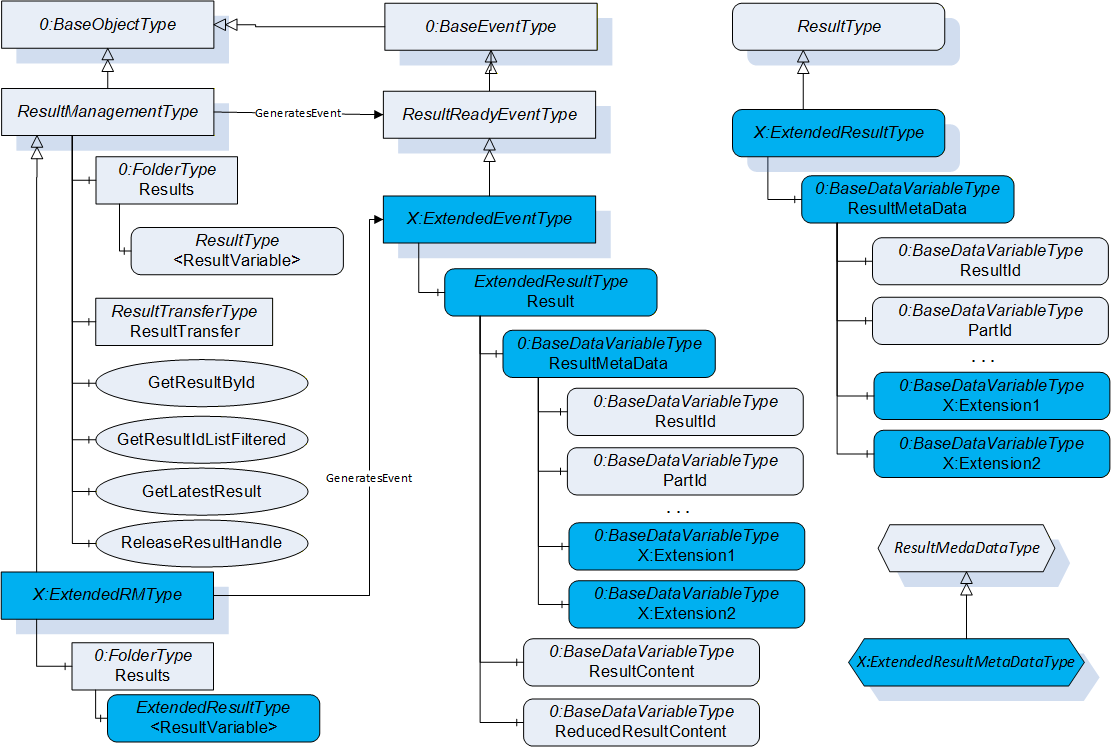
In case, the ResultType Variables or the ResultReadyEvents are supported, additional subtypes should be created. It is not necessary to create a subtype of ResultDataType, as it is not possible to change the DataType of ResultMetaData in the DataType. Only instances of ResultDataType will use the subtype. But the ResultType VariableType is exposing the content of the ResultMetaDataType as subvariables. Therefore, a subtype of the VariableType should be created exposing those additional fields of the subtype of the ResultMetaDataType as subvariables. Since those should also be exposed as Event fields, a subtype of the ResultReadyEventType should be created using the subtype of the VariableType. In both cases, also a subtype of the ResultManagementType should be created, using the subtype of the VariableType and pointing to the subtype of the ResultReadyEventType.
In Table 41, this is summarized.
| Supported Concept | ResultMetaDataType | ResultDataType | ResultType | ResultReadyEventType | ResultManagementType |
| Result Methods | Yes | No | No | No | No |
| Result Variables | Yes | No | Yes | No | Yes |
| Result Events | Yes | No | Yes | Yes | Yes |
In Figure 4, an example extending the metadata for all communication mechanisms is given.
B.3 Explicit Result Format
The result is returned in the ResultContent of the ResultDataType, as well as in the ResultContent and ReducedResultContent of the ResultType VariableType, and potentially also in the file transfer using the ResultTransferType.
B.3.1 Explicit Content Format
In order to expose the format and data structure of the ResultContent, it is not possible to subtype the ResultDataType, as the type of a structure field cannot be changed in a subtype. However, a subtype of the ResultType VariableType should be created, where the ResultContent and ReducedResultContent can be overridden and the DataType is changed to the specific DataType. In order to expose this for the Event subscriptions, a subtype of the ResultReadyEventType should be created as well, using the subtype of the VariableType.
That is, without a subtype of the VariableType there is no standardized mechanism to expose the expected DataType for ResultContent and ReducedResultContent. Clients need to receive an instance of ResultDataType in order to get the information about the used DataType in that instance.
B.3.2 Explicit File Format
If the file transfer is used to expose larger results, Servers may support various file formats, as exposed by the FileFormat field of the ResultMetaDataType. In order to allow access to those different file formats, a Server should subtype the BaseResultTransferOptionsDataType and add a field for selecting the file format (and potentially other fields defining the content of the file). Servers should subtype the ResultTransferType (and therefore also the ResultManagementType) to document which subtype of the ResultTransferOptionsDataType is allowed when calling the Method for the file transfer. The BaseResultTransferOptionsDataType is intentionally defined as an abstract DataType. The subtype ResultTransferOptionsDataType can be used as concrete DataType, if no additional fields are needed. This allows to override the GenerateFileForRead Method and change the DataType of the generateOptions in the signature to a concrete DataType. This would not be allowed, if the BaseResultTransferOptionsDataType would not be abstract.
Agreement of Use
COPYRIGHT RESTRICTIONS
This document is provided "as is" by the OPC Foundation and VDMA.
Right of use for this specification is restricted to this specification and does not grant rights of use for referred documents.
Right of use for this specification will be granted without cost.
This document may be distributed through computer systems, printed or copied as long as the content remains unchanged and the document is not modified.
OPC Foundation and VDMA do not guarantee usability for any purpose and shall not be made liable for any case using the content of this document.
The user of the document agrees to indemnify OPC Foundation and VDMA and their officers, directors and agents harmless from all demands, claims, actions, losses, damages (including damages from personal injuries), costs and expenses (including attorneys' fees) which are in any way related to activities associated with its use of content from this specification.
The document shall not be used in conjunction with company advertising, shall not be sold or licensed to any party.
The intellectual property and copyright is solely owned by the OPC Foundation and VDMA.
PATENTS
The attention of adopters is directed to the possibility that compliance with or adoption of OPC or VDMA specifications may require use of an invention covered by patent rights. OPC Foundation or VDMA shall not be responsible for identifying patents for which a license may be required by any OPC or VDMA specification, or for conducting legal inquiries into the legal validity or scope of those patents that are brought to its attention. OPC or VDMA specifications are prospective and advisory only. Prospective users are responsible for protecting themselves against liability for infringement of patents.
WARRANTY AND LIABILITY DISCLAIMERS
WHILE THIS PUBLICATION IS BELIEVED TO BE ACCURATE, IT IS PROVIDED "AS IS" AND MAY CONTAIN ERRORS OR MISPRINTS. THE OPC FOUDATION NOR VDMA MAKES NO WARRANTY OF ANY KIND, EXPRESSED OR IMPLIED, WITH REGARD TO THIS PUBLICATION, INCLUDING BUT NOT LIMITED TO ANY WARRANTY OF TITLE OR OWNERSHIP, IMPLIED WARRANTY OF MERCHANTABILITY OR WARRANTY OF FITNESS FOR A PARTICULAR PURPOSE OR USE. IN NO EVENT SHALL THE OPC FOUNDATION NOR VDMA BE LIABLE FOR ERRORS CONTAINED HEREIN OR FOR DIRECT, INDIRECT, INCIDENTAL, SPECIAL, CONSEQUENTIAL, RELIANCE OR COVER DAMAGES, INCLUDING LOSS OF PROFITS, REVENUE, DATA OR USE, INCURRED BY ANY USER OR ANY THIRD PARTY IN CONNECTION WITH THE FURNISHING, PERFORMANCE, OR USE OF THIS MATERIAL, EVEN IF ADVISED OF THE POSSIBILITY OF SUCH DAMAGES.
The entire risk as to the quality and performance of software developed using this specification is borne by you.
RESTRICTED RIGHTS LEGEND
This Specification is provided with Restricted Rights. Use, duplication or disclosure by the U.S. government is subject to restrictions as set forth in (a) this Agreement pursuant to DFARs 227.7202-3(a); (b) subparagraph (c)(1)(i) of the Rights in Technical Data and Computer Software clause at DFARs 252.227-7013; or (c) the Commercial Computer Software Restricted Rights clause at FAR 52.227-19 subdivision (c)(1) and (2), as applicable. Contractor / manufacturer are the OPC Foundation, 16101 N. 82nd Street, Suite 3B, Scottsdale, AZ, 85260-1830.
COMPLIANCE
The combination of VDMA and OPC Foundation shall at all times be the sole entities that may authorize developers, suppliers and sellers of hardware and software to use certification marks, trademarks or other special designations to indicate compliance with these materials as specified within this document. Products developed using this specification may claim compliance or conformance with this specification if and only if the software satisfactorily meets the certification requirements set by VDMA or the OPC Foundation. Products that do not meet these requirements may claim only that the product was based on this specification and must not claim compliance or conformance with this specification.
TRADEMARKS
Most computer and software brand names have trademarks or registered trademarks. The individual trademarks have not been listed here.
GENERAL PROVISIONS
Should any provision of this Agreement be held to be void, invalid, unenforceable or illegal by a court, the validity and enforceability of the other provisions shall not be affected thereby.
This Agreement shall be governed by and construed under the laws of Germany.
This Agreement embodies the entire understanding between the parties with respect to, and supersedes any prior understanding or agreement (oral or written) relating to, this specification.