OPC UA for Surface Technology - Cleaning and Pretreatment
7 OPC UA ObjectTypes
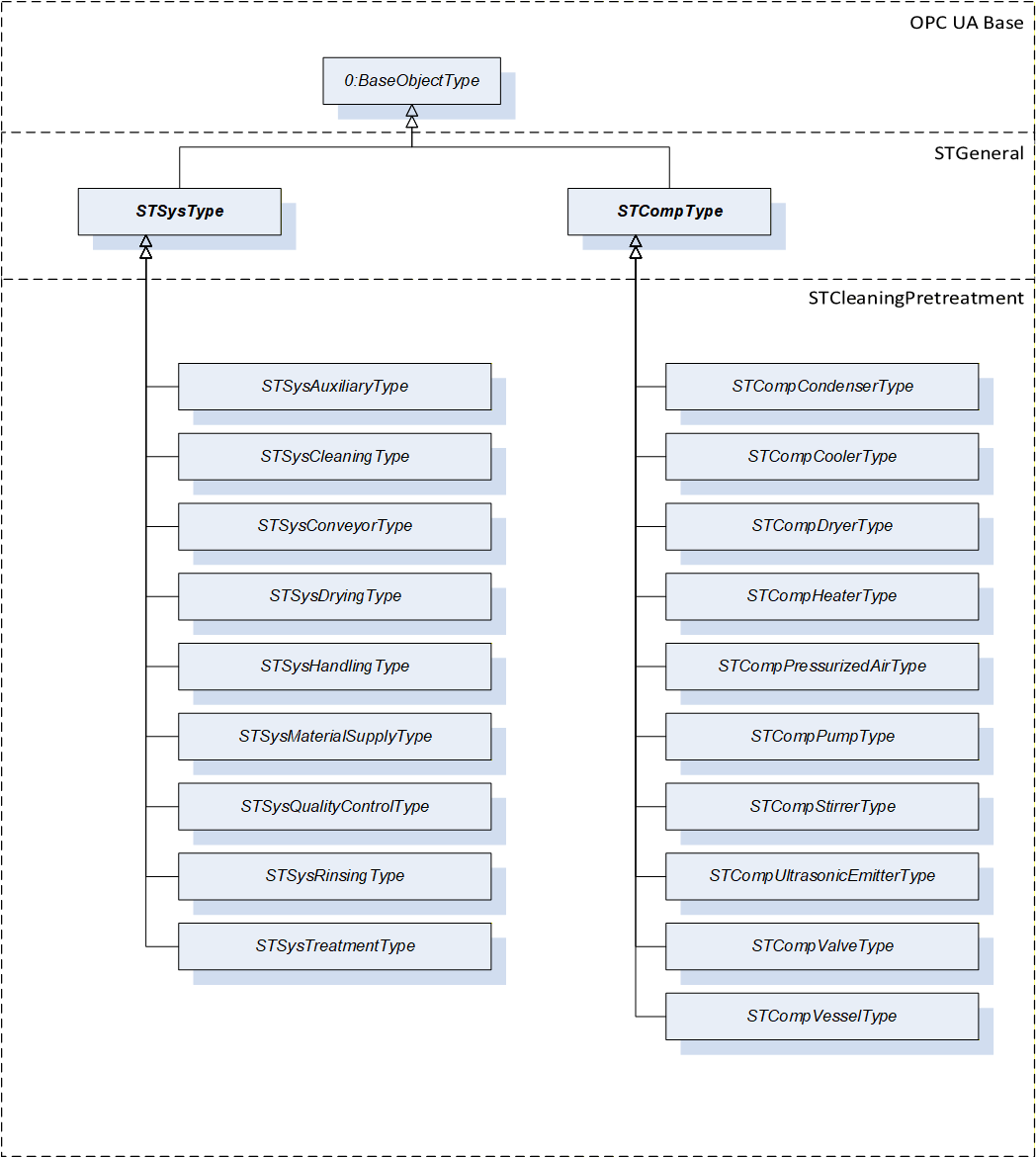
Each instance of a cleaning and pretreatment machine consists of a set of multiple subsystems (Subtypes of 9:STSysType) and their respective components (Subtypes of 9:STCompType) that are controlled by a single machine controller (PLC). 9:STSysType and 9:STCompType are abstract types inherited from STGeneral that serve to standardize the general modelling logic of machinery in the surface technology sector. The Subtypes defined in this Companion Specification serve to extend this modelling logic and to standardize subsystems, components and process parameters specific to cleaning and pretreatment machinery.
Figure 7 shows all ObjectTypes which are defined by this companion specification.
Figure 7 - ObjectTypes of OPC UA for Surface Technology - Cleaning and Pretreatment
7.1 STSysAuxiliaryType ObjectType Definition
The STSysAuxiliaryType provides relevant variables and parameters for controlling and monitoring auxiliary systems or zones of a cleaning and pretreatment machine and is formally defined in Table 15.
ParticleCountClassXLiquid is a placeholder to represent the measured or calculated number of particles of a specified size class (Size Class X) in liquid of the rinsing or cleaning stage in relation to a reference volume as specified by VDA 19/ISO 16232. This parameter can be re-used for each Size Class required for evaluation. Suggested unit: -.
7.2 STSysCleaningType ObjectType Definition
The STSysCleaningType provides relevant variables and parameters for controlling and monitoring a cleaning station or zone of a cleaning and pretreatment machine and is formally defined in Table 17.
The STSysConveyorType provides relevant variables and parameters for controlling and monitoring conveyor-systems or zones of a cleaning and pretreatment machine and is formally defined in Table 19. The Conveyor System serves to feed the workpiece to the cleaning and pretreatment machine and remove it after the cleaning and pretreatment process has concluded.
MovementSpeed describes the speed at which the parts are transported through a cleaning machine. Movement speed is crucial for the quality of a cleaning process. Suggested unit: m/s.
7.4 STSysDryingType ObjectType Definition
The STSysDryingType provides relevant variables and parameters for controlling and monitoring a drying station or zone of a cleaning and pretreatment machine and is formally defined in Table 21.
EmissionControl refers to the concentration of pollutants released into a volume of air from industrial, automotive, or other sources. It plays a crucial role in minimizing environmental impact and ensuring compliance with regulatory standards for air quality. Suggested unit: ppm.
Humidity represents the measured or calculated actual relative humidity in the process chamber as well as the surrounding atmosphere. Suggested unit: %.
7.5 STSysHandlingType ObjectType Definition
The STSysHandlingType provides relevant variables and parameters for controlling and monitoring a handling station or zone of a cleaning and pretreatment machine and is formally defined in Table 23. Handling encompasses operations that serve to move the workpiece between other zones or systems of the cleaning and pretreatment machine.
The STSysMaterialSupplyType provides relevant variables and parameters for controlling and monitoring a material supply system, station or zone of a cleaning and pretreatment machine and is formally defined in Table 25.
The STSysQualityControlType provides relevant variables and parameters for controlling and monitoring a quality control system, station or zone of a cleaning and pretreatment machine and is formally defined in Table 27.
ParticleCountClassXPart is a placeholder to represent the measured or calculated number of particles of a specified size class (Size Class X) extracted from a workpiece or part in relation to a reference area as specified by VDA 19/ISO 16232. This parameter can be re-used for each Size Class required for evaluation. Suggested unit: -.
ParticleCountClassXLiquid is a placeholder to represent the measured or calculated number of particles of a specified size class (Size Class X) in liquid of the rinsing or cleaning stage in relation to a reference volume as specified by VDA 19/ISO 16232. This parameter can be re-used for each Size Class required for evaluation. Suggested unit: -.
FluorescencePart represents the measured fluorescence intensity of the component surface in relation to excitation power as a measure of the part cleanliness level regarding organic contaminants (oils, cooling lubes, release agents). Typically an aggregated characteristic output e.g. an average of multiple points sampled across the surface or functional areas. Suggested unit: - or RFU (relative fluorescence units).
QualityIndexPart represents the calculated Index Score of the quality-determining parameters of the components. Suggested unit: -.
ParticleWeightPart describes the particle fraction of the components determined by wash extraction in accordance with VDA 19/ISO 16232 in relation to a reference surface. Suggested unit: mg/cm2.
NonVolatileResidualsPart describes the proportion of non-volatile components on the part in relation to a reference surface. Suggested unit: mg/m2.
ResidualGasAnalysisWater describes the outgassing rate of water with atomic mass unit 18 remaining in a vacuum system. Suggested unit: mbar*l/s.
ResidualGasAnalysisLightHydrocarbons describes the outgassing rate of high-volatility hydrocarbons with atomic mass unit 45 - 100 remaining in a vacuum system. Suggested unit: mbar*l/s.
ResidualGasAnalysisHeavyHydrocarbons describes the outgassing rate of low-volatility hydrocarbons with atomic mass unit 101 - 200 remaining in a vacuum system. Suggested unit: mbar*l/s.
7.8 STSysRinsingType ObjectType Definition
The STSysRinsingType provides relevant variables and parameters for controlling and monitoring a rinsing station or zone of a cleaning and pretreatment machine and is formally defined in Table 29.
The STSysTreatmentType provides relevant variables and parameters for controlling and monitoring a fluid treatment system, station or zone of a cleaning and pretreatment machine and is formally defined in Table 31.
The STCompCondenserType provides relevant variables and parameters for controlling and monitoring a condenser component of a cleaning and pretreatment machine and is formally defined in Table 33.
Temperature represents the measured or calculated actual temperature. Suggested unit: °C.
7.11 STCompCoolerType ObjectType Definition
The STCompCoolerType provides relevant variables and parameters for controlling and monitoring a cooler component of a cleaning and pretreatment machine and is formally defined in Table 35.
CoolingPower represents the measured or calculated actual electric real power consumption of a component used for a cooling task. Suggested unit: kW.
Temperature represents the measured or calculated actual temperature. Suggested unit: °C.
7.12 STCompDryerType ObjectType Definition
The STCompDryerType provides relevant variables and parameters for controlling and monitoring a dryer component of a cleaning and pretreatment machine and is formally defined in Table 37.
DryerPower represents the measured or calculated actual electric real power consumption of a component used for a drying task. Suggested unit: kW.
Temperature represents the measured or calculated actual temperature. Suggested unit: °C.
Humidity represents the measured or calculated actual relative humidity in the process chamber as well as the surrounding atmosphere. Suggested unit: %.
7.13 STCompHeaterType ObjectType Definition
The STCompHeaterType provides relevant variables and parameters for controlling and monitoring a heater component of a cleaning and pretreatment machine and is formally defined in Table 39.
HeatingPower represents the measured or calculated actual electric real power consumption of a component used for a heating task. Suggested unit: kW.
Temperature represents the measured or calculated actual temperature. Suggested unit: °C.
EmissionControl refers to the concentration of pollutants released into a volume of air from industrial, automotive, or other sources. It plays a crucial role in minimizing environmental impact and ensuring compliance with regulatory standards for air quality. Suggested unit: ppm.
The STCompPressurizedAirType provides relevant variables and parameters for controlling and monitoring a pressurized air component of a cleaning and pretreatment machine and is formally defined in Table 41.
Temperature represents the measured or calculated actual temperature. Suggested unit: °C.
PressurizedAirPressure specifies the pressure of pressurized air used to remove solvent or dirt, typically measured in bar. Exact measurement is essential to ensure proper operation of the drying or cleaning process. Suggested unit: bar.
PressurizedAirVolumeflow refers to volume of pressurized air passing through a system or component within a specific time frame, typically measured in liters per minute or cubic meters per hour. Accurate control of pressurized airflow is essential for ensuring efficient system operation and meeting process requirements. Suggested unit: m3/h.
7.15 STCompPumpType ObjectType Definition
The STCompPumpType provides relevant variables and parameters for controlling and monitoring a pump component of a cleaning and pretreatment machine and is formally defined in Table 43.
Temperature represents the measured or calculated actual temperature. Suggested unit: °C.
EmissionControl refers to the concentration of pollutants released into a volume of air from industrial, automotive, or other sources. It plays a crucial role in minimizing environmental impact and ensuring compliance with regulatory standards for air quality. Suggested unit: ppm.
MediaPressure refers to the pressure exerted by a fluid or gas within a system, such as in pipes or tanks. Proper control of media pressure is crucial for ensuring system efficiency, safety, and optimal performance in industrial and operational processes. Suggested unit: bar.
MediaVolumeFlow refers to the volume of fluid or gas passing through a system or component within a specific time frame, typically measured in liters per minute or cubic meters per hour. Accurate control of media volumeflow is essential for ensuring efficient system operation and meeting process requirements. Suggested unit: l/h.
InverterFrequency represents the measured or calculated actual frequency of an electrical inverter. Suggested unit: Hz.
InverterPower represents the measured or calculated actual power of an electrical inverter. Suggested unit: kW.
PumpVibration represents the relative vibration intensity caused by errors in the pump's runout. Suggested unit: %.
7.16 STCompStirrerType ObjectType Definition
The STCompStirrerType provides relevant variables and parameters for controlling and monitoring a stirrer component of a cleaning and pretreatment machine and is formally defined in Table 45.
The STCompUltrasonicEmitterType provides relevant variables and parameters for controlling and monitoring an ultrasonic emitter component of a cleaning and pretreatment machine and is formally defined in Table 47.
UltrasonicPower is the electrical power with which the ultrasonic transducers in an ultrasonic bath are driven - the input power. It is an important parameter for the quality of a cleaning process to ensure proper operation and quality. Suggested unit: W.
UltrasonicFrequency refers to the acoustic frequency with which ultrasonic transducers are driven in a cleaning bath. The ultrasonic frequency is an important parameter for the quality of a cleaning process to ensure proper operation and quality. Suggested unit: Hz.
7.18 STCompValveType ObjectType Definition
The STCompValveType provides relevant variables and parameters for controlling and monitoring a valve component of a cleaning and pretreatment machine and is formally defined in Table 49.
ValveOpeningAngle describes the opening angle of a valve. Suggested unit: °.
ValveOpeningTime describes the opening time of a valve. Suggested unit: s.
7.19 STCompVesselType ObjectType Definition
The STCompVesselType provides relevant variables and parameters for controlling and monitoring a vessel component of a cleaning and pretreatment machine and is formally defined in Table 51.
HeatingPower represents the measured or calculated actual electric real power consumption of a component used for a heating task. Suggested unit: kW.
CoolingPower represents the measured or calculated actual electric real power consumption of a component used for a cooling task. Suggested unit: kW.
DryerPower represents the measured or calculated actual electric real power consumption of a component used for a drying task. Suggested unit: kW.
Temperature represents the measured or calculated actual temperature. Suggested unit: °C.
phValue represents the measured actual value of pH as a measure of the level of alkalinity or acidity of the process fluids, related to neutralisation staged or pH-controlled pretreatment stages, but a poor indication for cleaner concentration. Suggested unit: pH.
AlkalinityFree represents the measured or calculated actual free alkalinity by titration with strong acid to an endpoint of approx. pH 8 (pH indicator phenolphtalein) to determine strong alkalines, for concentration monitoring of highly alkaline cleaners. Suggested unit: points.
AlkalinityTotal represents the measured or calculated actual total alkalinity by titration with strong acid to an endpoint of approx. pH 4 (pH indicator methyl orange or bromocresol green) to determine all alkalines including pH buffers, for concentration monitoring of alkaline cleaners. Suggested unit: points.
AcidityFree represents the measured or calculated actual free acidity by titration with strong alkali to an endpoint of approx. pH 4 (pH indicator methyl orange or bromocresol green) to determine strong acids, for concentration monitoring of highly acidic cleaners. Suggested unit: points.
AcidityTotal represents the measured or calculated actual total acidity by titration with strong alkali to an endpoint of approx. pH 8 (pH indicator phenolphtalein) to determine all acids including buffers, for concentration monitoring of acidic cleaners. Suggested unit: points.
Conductivity represents the measured or calculated actual electrolytic conductance as temperature-dependent sum parameter for water quality in rinsing water or builder concentration related salt content in cleaning stage. Suggested unit: µS/cm.
ParticleCountClassXLiquid is a placeholder to represent the measured or calculated number of particles of a specified size class (Size Class X) in liquid of the rinsing or cleaning stage in relation to a reference volume as specified by VDA 19/ISO 16232. This parameter can be re-used for each Size Class required for evaluation. Suggested unit: -.
TotalOrganicCarbon (TOC) refers to the amount of carbon found in organic compounds within a water sample. It is a key parameter used to measure water quality, indicating the presence of natural or synthetic organic. substances. TOC analysis is commonly used in environmental monitoring, water treatment, and industrial processes to ensure compliance with quality standards. Suggested unit: ppb.
CleaningAgentConcentration refers to the amount of active cleaning substance present in a solution, typically expressed as a percentage or ratio. It is a critical parameter to ensure optimal cleaning performance while avoiding excessive use of chemicals, maintaining efficiency, and protecting surfaces or equipment. Suggested unit: %.
BuilderConcentration refers to the amount of builder compounds in a cleaning solution, which are added to enhance the cleaning effectiveness by softening water, stabilizing pH, or improving soil removal. Maintaining the correct builder concentration is essential for achieving optimal cleaning results and ensuring chemical efficiency. Suggested unit: %.
SurfactantConcentration refers to the amount of surface-active agents present in a cleaning solution, which reduce surface tension to enhance wetting, spreading, and soil removal. Proper surfactant concentration is essential for effective cleaning performance and minimizing environmental impact. Suggested unit: %.
CorrosionProtectionConcentration refers to the amount of corrosion-inhibiting agents in a solution, designed to protect metals and materials from rust and degradation. Ensuring the correct concentration is vital for maintaining long-term durability and performance of equipment and components. Suggested unit: %.
FillLevel refers to the amount of liquid or material present in a container, measured as a percentage of its total capacity. Accurate monitoring of the fill level is essential for efficient process control and preventing overflows or shortages. Suggested unit: %
FillLevelDiscrete represents the fill level as configurable discrete states (e.g. Empty, Low, Medium, High, Full), used where the level is reported as distinct steps rather than a continuous percentage. MultiStateDiscreteSignalType is defined in OPC 30081.
ChamberPressure refers to the internal pressure within a sealed chamber, often monitored to ensure proper operation of equipment or processes. Maintaining the correct chamber pressure is critical for safety, efficiency, and achieving desired outcomes in applications such as manufacturing or testing. Suggested unit: mbar.
UltrasonicPower is the electrical power with which the ultrasonic transducers in an ultrasonic bath are driven - the input power. It is an important parameter for the quality of a cleaning process to ensure proper operation and quality. Suggested unit: W.
UltrasonicFrequency refers to the acoustic frequency with which ultrasonic transducers are driven in a cleaning bath. The ultrasonic frequency is an important parameter for the quality of a cleaning process to ensure proper operation and quality. Suggested unit: Hz.
CavitationIntensity is defined by the power density of cavitation i.e. the cavitation energy in unit time and unit space. Cavitation intensity depends on ultrasonic power and frequency and is essential for the proper operation of a cleaning process. High cavitation intensity results in transient cavitation i.e. bubble collapses. Suggested unit: Pa.
LevelCavitationNoise (LCNF) is defined as a noise level caused by cavitating bubbles. This noise level can be determined with a hydrophone according to IEC TS 63001. LevelCavitationNoise can be used for qualification of ultrasonic devices giving information on the existence, the strength and the distribution of transient cavitation as a parameter for the cleaning performance of an ultrasonic tank. Suggested unit: dB.
FluorescenceLiquid represents the measured fluorescence intensity of the bath liquid in relation to excitation power as a measure of the bath cleanliness level regarding organic contaminants (oils, cooling lubes, release agents). Typically an aggregated characteristic output e.g. an average of multiple points sampled across the surface or functional areas. Suggested unit: - or RFU (relative fluorescence units).
QualityIndexLiquid represents the calculated Index Score of the quality-determining parameters of the bath liquid. Suggested unit: -.
ParticleWeightLiquid describes the amount of solids in the bath, determined by the weight of particles remaining in a filter in relation to a reference volume. Suggested unit: mg/l.
VolatileResidualsLiquid describes the proportion of volatile components in the bath. Suggested unit: %.
OilContaminantConcentration relative proportion of contaminant oil in the bath in relation to a reference volume. Suggested unit: %.
NonVolatileResidualsLiquid describes the proportion of non-volatile components in the bath. Suggested unit: %.