
1 Scope
This document provides a comprehensive overview of the information model structure of rock crusher machines defined in this OPC UA Companion Specification Mining. As mentioned in OPC 40560, this machine and system-level document contains type definitions for a specific type of machine, equipment, system or service - the rock crusher machine in this case.
2 Normative references
The following documents are referred to in the text in such a way that some or all of their content constitutes requirements of this document. For dated references, only the edition cited applies. For undated references, the latest edition of the referenced document (including any amendments and errata) applies.
OPC 10000-1, OPC Unified Architecture - Part 1: Overview and Concepts
OPC 10000-1
OPC 10000-2, OPC Unified Architecture - Part 2: Security Model
OPC 10000-2
OPC 10000-3, OPC Unified Architecture - Part 3: Address Space Model
OPC 10000-3
OPC 10000-4, OPC Unified Architecture - Part 4: Services
OPC 10000-4
OPC 10000-5, OPC Unified Architecture - Part 5: Information Model
OPC 10000-5
OPC 10000-6, OPC Unified Architecture - Part 6: Mappings
OPC 10000-6
OPC 10000-7, OPC Unified Architecture - Part 7: Profiles
OPC 10000-7
OPC 10000-100, OPC Unified Architecture - Part 100: Devices
OPC 10000-100
OPC 40001-1, OPC UA for Machinery - Part 1: Basic Building Blocks
http://www.opcfoundation.org/UA/Machinery/
OPC 40560, OPC Unified Architecture for Mining - General
http://opcfoundation.org/UA/Mining/General/
OPC 40564-1, OPC Unified Architecture for Mining - Mineral Processing Equipment: General
http://opcfoundation.org/UA/Mining/MineralProcessing/General/
3 Terms, definitions and conventions
3.1 Overview
It is assumed that basic concepts of OPC UA information modelling from OPC 10000-1, OPC 10000-100 and OPC 40001‑1 are understood in this document. This document will use these concepts to describe the OPC 40564-2 Information Model. For the purposes of this document, the terms and definitions given in the documents referenced in the OPC Core documents, OPC 10000-1, OPC 10000-100, OPC 40001-1, OPC 40560 and OPC 40564-1 apply.
3.2 Conventions used in this document
The conventions and definitions described in the OPC Core documents, OPC 10000-1, OPC 10000-100, OPC 40001-1, OPC 40560 and OPC 40564-1 apply.
4 General information to OPC 40564-2: Rock Crusher
4.1 Introduction to the OPC UA Companion Specification Mining
For general information on the OPC UA Companion Specification Mining and OPC UA in general, please refer to OPC 40560.
As explained in OPC 40560, the machine and system category-level documents serve as an abstraction layer for the types of machinery with similar functionalities. Consequently, this machine and system-level document may also rely on models defined in OPC 40564-1.
4.2 Introduction to the Rock Crusher Machine
Rock crushers are used to process material within the mining process chain. Crushers are typically required ahead of conveyors, shafts or other transport or conveying devices. Crushers are used in underground and surface mining operations if necessary. In operations where crushing is applied, uncrushed material is usually transported to the primary crusher by transporting machine, e.g. rear dump trucks, wheeled loaders, trains, or ore-passes. A feeder device can be used in combination with a crusher to control the material flow into the crusher. In processing plants, different types of crushers are used in different crushing stages depending on the input material and the requirements for the final product. The most common types used within the mining context are jaw and cone crushers. [1, P. 1285]
This document contains OPC UA type definitions for the rock crusher machine.
5 Use cases and Scope of Information Exchange
As outlined in OPC 40560, OPC UA type definitions and data items contained in this OPC UA Companion Specification are based on the Use Cases developed for the Application Case Discontinuous Unloading by a Specialist Working Group. The Use Cases of the Rock Crusher machine are explained in detail in OPC 40569-3. Please refer to this document to gain an overview of the Use Cases for this machine as well as to study detailed descriptions of the Use Cases.
As a core feature, OPC UA offers the possibility to extend and complement type definitions. Therefore, the type definitions developed for the Rock Crusher only contain the minimum amount of data elements, such as variables and methods, necessary for the Use Cases described in OPC 40569-3. Manufacturers and mine operators are advised to extend the type definitions defined in this document, e.g. using inheritance, to adapt the type definitions to their individual requirements. This typically includes adding custom variables or alarms to type definitions derived from the ones specified in this document.
Thus, the scope of this document is to define the basic elements of data that are necessary for operation of the Rock Crusher and parameters of the Rock Crusher that are required by other machines interacting with the Rock Crusher as defined in OPC 40569-3. These include, for example:
Exclusion Zone
Unloading Request
A precise overview of the data contained in the OPC 40564-2 Information Model is given in Chapter 7.
The following information sources are excluded and may be added by manufacturers or mine operators using custom type definitions derived from the ones presented in this document:
Real-time sensor data (e.g. temperature, pressure, current)
Tele-remote control signals (e.g. start, stop)
Alarms and events (e.g. current tripping alarm, temperature warning)
Custom state machines
6 Rock Crusher Model overview
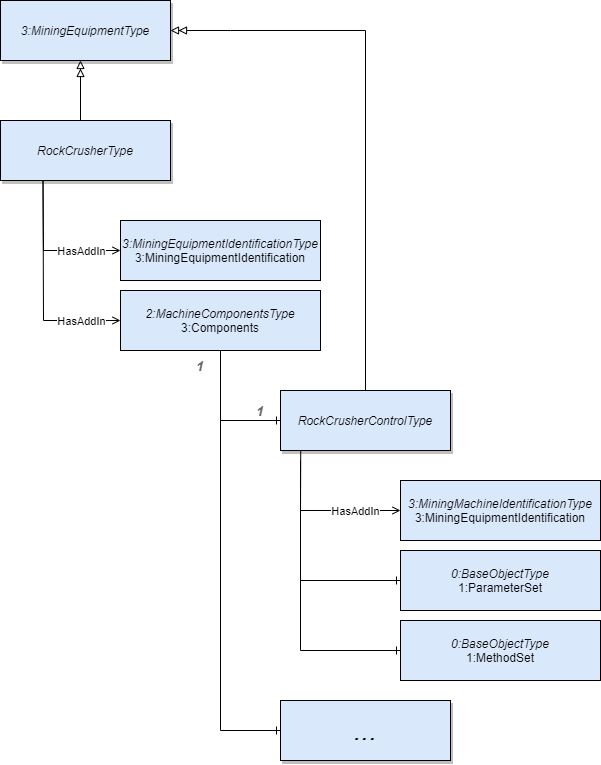
The RockCrusherType and RockCrusherControlType are subtypes of the MiningEquipmentType defined in OPC 40560 and represent components of a rock crusher machine. Importantly, the rock crusher machine is composed of one instance of the RockCrusherType, acting as a container type, and one or more subcomponents, amongst which an instance of the RockCrusherControlType can be present. Figure 1 shows the hierarchical and compositional structure of the AddressSpace of these ObjectTypes.
7 OPC UA ObjectTypes
7.1 RockCrusherType ObjectType
7.1.1 Overview
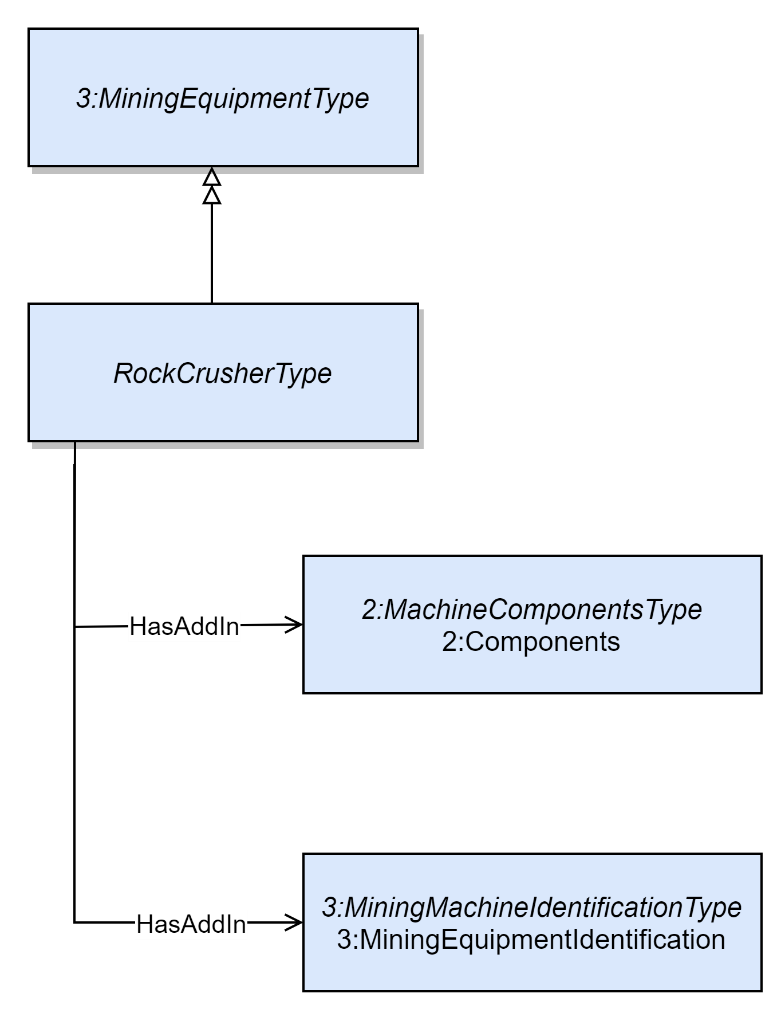
The RockCrusherType provides a representation of a Rock Crusher and is a sub-type of the MiningEquipmentType as shown in Figure 2. It acts as a container class for sub-components and has the ability, through inheritance, to have its own Parameter- and MethodSet.
7.1.2 ObjectType Definition
The RockCrusherType is formally defined in Table 1.
| Attribute | Value | ||||
| BrowseName | RockCrusherType | ||||
| IsAbstract | False | ||||
| References | Node Class | BrowseName |
Data
Type | TypeDefinition | Other |
|---|---|---|---|---|---|
| Subtype of the MiningEquipmentType defined in OPC 40560 | |||||
| 0:HasAddIn | Object | 3:Components | 3:MachineComponentsType | M | |
| 0:HasAddIn | Object | 4:MiningEquipmentIdentification | 4:MiningEquipmentIdentificationType | M | |
| Conformance Units | |||||
|---|---|---|---|---|---|
| Rock Crusher Functional Variables | |||||
| Rock Crusher Methods |
7.1.3 ObjectType description
Please refer to OPC 10000-100, OPC 40001-1, OPC 40560 and OPC 40564-1 for the descriptions of other inherited instance declarations. Specifically, the Components and MiningEquipmentIdentification instance declarations of the RockCrusherType are defined in OPC 40560.
7.2 RockCrusherControlType ObjectType
7.2.1 Overview
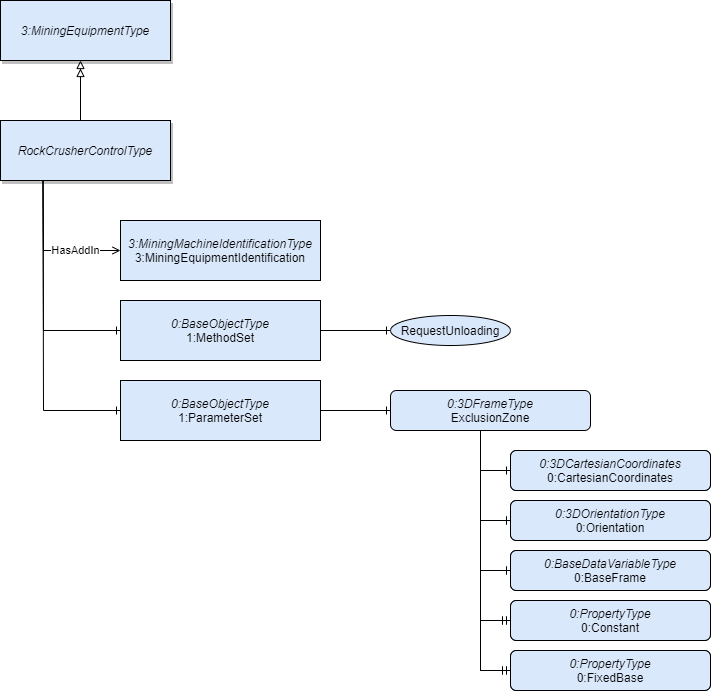
The RockCrusherControlType provides a representation of a rock crusher control and is a sub-type of the MiningEquipmentType as defined in Figure 3. It consists also of a MethodSet and a ParameterSet to cover all relevant aspects of the equipment.
7.2.2 ObjectType Definition
The RockCrusherControlType is formally defined in Table 2.
| Attribute | Value | ||||
| BrowseName | RockCrusherControlType | ||||
| IsAbstract | False | ||||
| References | Node Class | BrowseName |
Data
Type | TypeDefinition | Other |
|---|---|---|---|---|---|
| Subtype of the MiningEquipmentType defined in OPC 40560 | |||||
| 0:HasAddIn | Object | 4:MiningEquipmentIdentification | 4:MiningEquipmentIdentificationType | M | |
| 0:HasComponent | Object | 2:MethodSet | 0:BaseObjectType | M | |
| 0:HasComponent | Object | 2:ParameterSet | 0:BaseObjectType | M | |
| Conformance Units | |||||
|---|---|---|---|---|---|
| Rock Crusher Control Functional Variables | |||||
| Rock Crusher Control Methods |
The components of the RockCrusherControlType have subcomponents which are defined in Table 3.
| BrowsePath | References | NodeClass | BrowseName | DataType | TypeDefinition | Others |
| 2:MethodSet | 0:HasComponent | Method | RequestUnloading | M, | ||
| 2:ParameterSet | 0:HasComponent | Variable | ExclusionZone | 0:3DFrame [] | 0:3DFrameType | M, RO |
7.2.3 RequestUnloading
The signature of this Method is specified below. Table 4 specifies the Arguments and AddressSpace representation, respectively.
Signature
	RequestUnloading(
	  [out] 0:Boolean       RequestUnloadingAcknowledged );
| Argument | Description |
| RequestUnloadingAcknowledged | The RequestUnloadingAcknowledged property describes the acknowledging of the unloading command. True - OK False - RequestError - Unloading could not be confirmed |
| Attribute | Value | ||||
| BrowseName | RequestUnloading | ||||
| References | NodeClass | BrowseName | DataType | TypeDefinition | ModellingRule |
|---|---|---|---|---|---|
| 0:HasProperty | Variable | 0:OutputArguments | 0:Argument[] | 0:PropertyType | 0:Mandatory |
7.2.4 ObjectType Description
7.2.4.1 Untitled
The RequestUnloading method call indicates that some hauling machine requests the unloading operation. After successful confirmation, the unloading procedure starts.
The ExclusionZone property describes the area that haulage machines, which are to be unloaded, are not allowed to enter when approaching the rock crusher.
Please refer to OPC 10000-100, OPC 40001-1, OPC 40560 and OPC 40564-1 for the descriptions of other inherited instance declarations.
8 Profiles and Conformance Units
This chapter defines the corresponding profiles and conformance units for the OPC UA Information Model for OPC 40564-2. Profiles are named groupings of conformance units. Facets are profiles that will be combined with other Profiles to define the complete functionality of an OPC UA Server or Client. The following tables specify the facets available for Servers that implement the OPC 40564-2 Information Model companion specification.
NOTE: The names of the supported profiles are available in the Server Object under ServerCapabilities.ServerProfileArray
8.1 Conformance Units
Table 6 defines the corresponding Conformance Units for the OPC UA Information Model for OPC 40564-2: Rock Crusher.
| Category | Title | Description |
| Server | Rock Crusher Control Functional Variables | Supports all mandatory variables part of the RockCrusherControlType type definition. |
| Server | Rock Crusher Control Methods | Supports all mandatory methods part of the RockCrusherControlType type definition. |
| Client | Rock Crusher Control Client Functional Variables | Supports querying all mandatory variables part of the RockCrusherControlType type definition. |
| Client | Rock Crusher Control Client Methods | Supports calling all mandatory methods part of the RockCrusherControlType type definition. |
8.2 Profiles
8.2.1 Profile list
Table 7 lists all Profiles defined in this document and defines their URIs.
| Profile | URI |
| Rock Crusher Control Core Server Facet | http://opcfoundation.org/UA-Profile/Mining/MineralProcessing/RockCrusher/Server/Core |
| Rock Crusher Control Core Client Facet | http://opcfoundation.org/UA-Profile/Mining/MineralProcessing/RockCrusher/Client/Core |
8.2.2 Server Facets
8.2.2.1 Overview
The following sections specify the Facets available for Servers that implement the Rock Crusher companion specification.
8.2.2.2 Rock Crusher Control Core Server Facet
Table 8 defines a Profile that describes the base characteristics for an OPC UA Server that has implemented the OPC 40564-2 Information Model.
| Group | Conformance Unit / Profile Title | Mandatory / Optional |
| Profile | Mining Base Server Profile | M |
| Rock Crusher Control | Rock Crusher Control Functional Variables | M |
| Rock Crusher Control | Rock Crusher Control Methods | M |
8.2.3 Client Facets
8.2.3.1 Overview
The following tables specify the Facets available for Clients that implement the Rock Crusher companion specification.
8.2.3.2 Rock Crusher Control Core Client Facet
Table 9 defines a Facet that describes the base characteristics for an OPC UA Client querying an OPC UA Server that has implemented the OPC 40564-2 Information Model.
| Group | Conformance Unit / Profile Title | Mandatory / Optional |
| Profile | Mining Base Client Profile | M |
| Rock Crusher Control | Rock Crusher Control Client Functional Variables | M |
| Rock Crusher Control | Rock Crusher Control Client Methods | M |
9 Namespaces
9.1 Namespace Metadata
Table 10 defines the namespace metadata for this document. The Object is used to provide version information for the namespace and an indication about static Nodes. Static Nodes are identical for all Attributes in all Servers, including the Value Attribute. See OPC 10000-5 for more details.
The information is provided as Object of type NamespaceMetadataType. This Object is a component of the Namespaces Object that is part of the Server Object. The NamespaceMetadataType ObjectType and its Properties are defined in OPC 10000-5.
The version information is also provided as part of the ModelTableEntry in the UANodeSet XML file. The UANodeSet XML schema is defined in OPC 10000-6.
| Attribute | Value | ||
| BrowseName | http://opcfoundation.org/UA/Mining/MineralProcessing/RockCrusher/ | ||
| Property | DataType | Value | |
|---|---|---|---|
| NamespaceUri | String | http://opcfoundation.org/UA/Mining/MineralProcessing/RockCrusher/ | |
| NamespaceVersion | String | 1.0.0 | |
| NamespacePublicationDate | DateTime | 2022-09-01 | |
| IsNamespaceSubset | Boolean | False | |
| StaticNodeIdTypes | IdType [] | System.Int32[] | |
| StaticNumericNodeIdRange | NumericRange [] | ||
| StaticStringNodeIdPattern | String | ||
9.2 Handling of OPC UA Namespaces
Namespaces are used by OPC UA to create unique identifiers across different naming authorities. The Attributes NodeId and BrowseName are identifiers. A Node in the UA AddressSpace is unambiguously identified using a NodeId. Unlike NodeIds, the BrowseName cannot be used to unambiguously identify a Node. Different Nodes may have the same BrowseName. They are used to build a browse path between two Nodes or to define a standard Property.
Servers may often choose to use the same namespace for the NodeId and the BrowseName. However, if they want to provide a standard Property, its BrowseName shall have the namespace of the standards body although the namespace of the NodeId reflects something else, for example the EngineeringUnits Property. All NodeIds of Nodes not defined in this document shall not use the standard namespaces.
Table 11 provides a list of mandatory and optional namespaces used in an OPC 40564-2 OPC UA Server OPC UA Server.
| NamespaceURI | Description | Use |
| http://opcfoundation.org/UA/ | Namespace for NodeIds and BrowseNames defined in the OPC UA specification. This namespace shall have namespace index 0. | Mandatory |
| Local Server URI | Namespace for nodes defined in the local server. This namespace shall have namespace index 1. | Mandatory |
| http://opcfoundation.org/UA/DI/ | Namespace for NodeIds and BrowseNames defined in OPC 10000-100. The namespace index is Server specific. | Mandatory |
| http://opcfoundation.org/UAMachinery/ | Namespace for NodeIds and BrowseNames defined in OPC 40001-1. The namespace index is Server specific. | Mandatory |
| http://opcfoundation.org/UA/Mining/General/ | Namespace for NodeIds and BrowseNames defined in OPC 40560. The namespace index is Server specific. | Mandatory |
| http://opcfoundation.org/UA/Mining/MineralProcessing/General/ | Namespace for NodeIds and BrowseNames defined in OPC 40564-1. The namespace index is Server specific. | Mandatory |
| http://opcfoundation.org/UA/Mining/MineralProcessing/RockCrusher/ | Namespace for NodeIds and BrowseNames defined in this document. The namespace index is Server specific. | Mandatory |
| Vendor specific types | A Server may provide vendor-specific types like types derived from ObjectTypes defined in this document in a vendor-specific namespace. | Optional |
| Vendor specific instances | A Server provides vendor-specific instances of the standard types or vendor-specific instances of vendor-specific types in a vendor-specific namespace. It is recommended to separate vendor specific types and vendor specific instances into two or more namespaces. | Mandatory |
Table 12 provides a list of namespaces and their indices used for BrowseNames in this document. The default namespace of this document is not listed since all BrowseNames without prefix use this default namespace.
| NamespaceURI | Namespace Index | Example |
| http://opcfoundation.org/UA/ | 0 | 0:EngineeringUnits |
| http://opcfoundation.org/UA/DI/ | 2 | 2:DeviceRevision |
| http://opcfoundation.org/UA/Machinery/ | 3 | 3:MachineComponentsType |
| http://opcfoundation.org/UA/Mining/General/ | 4 | 4:MiningEquipmentType |
| http://opcfoundation.org/UA/Mining/MineralProcessing/General/ | 5 |
Annex A OPC 40564-2 Namespace and mappings (Normative)
A.1 Namespace and identifiers for OPC 40564-2 Information Model
This appendix defines the numeric identifiers for all of the numeric NodeIds defined in this document. The identifiers are specified in a CSV file with the following syntax:
<SymbolName>, <Identifier>, <NodeClass>Where the SymbolName is either the BrowseName of a Type Node or the BrowsePath for an Instance Node that appears in the specification and the Identifier is the numeric value for the NodeId.
The BrowsePath for an Instance Node is constructed by appending the BrowseName of the instance Node to the BrowseName for the containing instance or type. An underscore character is used to separate each BrowseName in the path. Let's take for example, the MiningEquipmentType ObjectType Node which has the add-in Identification object. The Name for the Identification InstanceDeclaration within the MiningEquipmentType declaration is: MiningEquipmentType_Identification.
The NamespaceUri for all NodeIds defined here:
http://opcfoundation.org/UA/Mining/MineralProcessing/RockCrusher/
The CSV released with this version of the specification can be found here:
http://opcfoundation.org/UA/schemas/Mining/MineralProcessing/RockCrusher/1.0.0/NodeIds.csv
NOTE The latest CSV that is compatible with this version of the specification can be found here:
http://opcfoundation.org/UA/schemas/Mining/MineralProcessing/RockCrusher/NodeIds.csv
A computer processible version of the complete Information Model defined in this document is also provided. It follows the XML Information Model schema syntax defined in OPC 10000-6.
The Information Model Schema for this version of the specification (including any revisions, amendments or errata) can be found here:
NOTE The latest Information Model schema that is compatible with this version of the document can be found here:
Annex B Annex B Bibliography (Informative)
[1] DARLING, P., 2011. SME Mining Engineering Handbook [online]. 3rd ed.
___________
Agreement of Use
COPYRIGHT RESTRICTIONS
This document is provided "as is" by the OPC Foundation and VDMA.
Right of use for this specification is restricted to this specification and does not grant rights of use for referred documents.
Right of use for this specification will be granted without cost.
This document may be distributed through computer systems, printed or copied as long as the content remains unchanged and the document is not modified.
OPC Foundation and VDMA do not guarantee usability for any purpose and shall not be made liable for any case using the content of this document.
The user of the document agrees to indemnify OPC Foundation and VDMA and their officers, directors and agents harmless from all demands, claims, actions, losses, damages (including damages from personal injuries), costs and expenses (including attorneys' fees) which are in any way related to activities associated with its use of content from this specification.
The document shall not be used in conjunction with company advertising, shall not be sold or licensed to any party.
The intellectual property and copyright is solely owned by the OPC Foundation and VDMA.
PATENTS
The attention of adopters is directed to the possibility that compliance with or adoption of OPC or VDMA specifications may require use of an invention covered by patent rights. OPC Foundation or VDMA shall not be responsible for identifying patents for which a license may be required by any OPC or VDMA specification, or for conducting legal inquiries into the legal validity or scope of those patents that are brought to its attention. OPC or VDMA specifications are prospective and advisory only. Prospective users are responsible for protecting themselves against liability for infringement of patents.
WARRANTY AND LIABILITY DISCLAIMERS
WHILE THIS PUBLICATION IS BELIEVED TO BE ACCURATE, IT IS PROVIDED "AS IS" AND MAY CONTAIN ERRORS OR MISPRINTS. THE OPC FOUDATION NOR VDMA MAKES NO WARRANTY OF ANY KIND, EXPRESSED OR IMPLIED, WITH REGARD TO THIS PUBLICATION, INCLUDING BUT NOT LIMITED TO ANY WARRANTY OF TITLE OR OWNERSHIP, IMPLIED WARRANTY OF MERCHANTABILITY OR WARRANTY OF FITNESS FOR A PARTICULAR PURPOSE OR USE. IN NO EVENT SHALL THE OPC FOUNDATION NOR VDMA BE LIABLE FOR ERRORS CONTAINED HEREIN OR FOR DIRECT, INDIRECT, INCIDENTAL, SPECIAL, CONSEQUENTIAL, RELIANCE OR COVER DAMAGES, INCLUDING LOSS OF PROFITS, REVENUE, DATA OR USE, INCURRED BY ANY USER OR ANY THIRD PARTY IN CONNECTION WITH THE FURNISHING, PERFORMANCE, OR USE OF THIS MATERIAL, EVEN IF ADVISED OF THE POSSIBILITY OF SUCH DAMAGES.
The entire risk as to the quality and performance of software developed using this specification is borne by you.
RESTRICTED RIGHTS LEGEND
This Specification is provided with Restricted Rights. Use, duplication or disclosure by the U.S. government is subject to restrictions as set forth in (a) this Agreement pursuant to DFARs 227.7202-3(a); (b) subparagraph (c)(1)(i) of the Rights in Technical Data and Computer Software clause at DFARs 252.227-7013; or (c) the Commercial Computer Software Restricted Rights clause at FAR 52.227-19 subdivision (c)(1) and (2), as applicable. Contractor / manufacturer are the OPC Foundation, 16101 N. 82nd Street, Suite 3B, Scottsdale, AZ, 85260-1830
COMPLIANCE
The combination of VDMA and OPC Foundation shall at all times be the sole entities that may authorize developers, suppliers and sellers of hardware and software to use certification marks, trademarks or other special designations to indicate compliance with these materials as specified within this document. Products developed using this specification may claim compliance or conformance with this specification if and only if the software satisfactorily meets the certification requirements set by VDMA or the OPC Foundation. Products that do not meet these requirements may claim only that the product was based on this specification and must not claim compliance or conformance with this specification.
TRADEMARKS
Most computer and software brand names have trademarks or registered trademarks. The individual trademarks have not been listed here.
GENERAL PROVISIONS
Should any provision of this Agreement be held to be void, invalid, unenforceable or illegal by a court, the validity and enforceability of the other provisions shall not be affected thereby.
This Agreement shall be governed by and construed under the laws of Germany.
This Agreement embodies the entire understanding between the parties with respect to, and supersedes any prior understanding or agreement (oral or written) relating to, this specification.