
1 Scope
The OPC UA for Machinery specification contains various building blocks for Machinery that allow to address use cases across different types of machines and components of machines defined in various companion specifications.
For the general scope of the OPC UA for Machinery specification see OPC 40001-1.
This part contains a building block for
Process Values
2 Normative references
The following documents are referred to in the text in such a way that some or all of their content constitutes requirements of this document. For dated references, only the edition cited applies. For undated references, the latest edition of the referenced document (including any amendments and errata) applies.
OPC 10000-1, OPC Unified Architecture - Part 1: Overview and Concepts
OPC 10000-1
OPC 10000-3, OPC Unified Architecture - Part 3: Address Space Model
OPC 10000-3
OPC 10000-4, OPC Unified Architecture - Part 4: Services
OPC 10000-4
OPC 10000-5, OPC Unified Architecture - Part 5: Information Model
OPC 10000-5
OPC 10000-6, OPC Unified Architecture - Part 6: Mappings
OPC 10000-6
OPC 10000-7, OPC Unified Architecture - Part 7: Profiles
OPC 10000-7
OPC 10000-8, OPC Unified Architecture - Part 8: Data Access
OPC 10000-8
OPC 10000-9, OPC Unified Architecture - Part 9: Alarms and Conditions
OPC 10000-9
OPC 10000-100, OPC Unified Architecture - Part 100: Devices
OPC 10000-100
OPC 40001-1, OPC UA for Machinery - Part 1: Basic Building Blocks
http://www.opcfoundation.org/UA/Machinery/
OPC 30081, OPC UA for Process Automation Devices - PA-DIMTM
http://www.opcfoundation.org/UA/PADIM/
3 Terms, definitions and conventions
3.1 Overview
It is assumed that basic concepts of OPC UA information modelling are understood in this specification. This specification will use these concepts to describe the Machinery - Process Values Information Model. For the purposes of this document, the terms and definitions given in OPC 10000-1, OPC 10000-3, OPC 10000-4, OPC 10000-5, OPC 10000-7, OPC 10000-9, OPC 40001-1, as well as the following apply.
3.2 OPC UA for Process Values terms
No additional terms defined in this specification.
3.3 Abbreviated terms
| MES | Manufacturing Execution System |
| PLC | Programmable Logic Controller |
3.4 Conventions used in this document
For conventions used in this document see OPC 40001-1.
4 General information to Machinery and OPC UA
For general information to Machinery and OPC UA see OPC 40001-1.
5 Use cases
The purpose of this specification is to provide the mechanisms related to the representation of process values for domain-specific Companion Specifications. Accordingly, a number of use cases must be satisfied in this model:
The user would like to access the process values of a machine and its various meta data like ranges, precision and unit.
The user would like to access and set the setpoints of the process values of a machine.
The user would like to access and set deviation limits of the process values, relative to the setpoints.
The user would like to get informed when a process value is passing a deviation limit or range.
The user would like to get the percentage value of a process variable, also when there are dynamic ranges.
The user would like to zero-point adjust the current value of a process value.
The user would like to get vendor-specific error codes on devices providing process values.
The user would like to access and set a substitution value in case of connections lost.
The user would like to get identification information of devices providing process values.
The user would like to get information about the health status of devices providing process values.
6 Process Values Information Model overview
6.1 General
This information model provides information about process values, for example provided by actuators or sensors. In 6.2, the integration of such devices as components of a machine is described. This includes information about the identification of a device as well as health information and specific errors. In 9.1, the VariableType representing process value setpoints is introduced. In 6.4, an ObjectType using the VariableType and providing the process value as well as adding additional mechanisms for alarming and zero-point adjustment is described. Examples of the overall usage of process values are described in 6.5.
6.2 Integration as Device in Machinery Specification
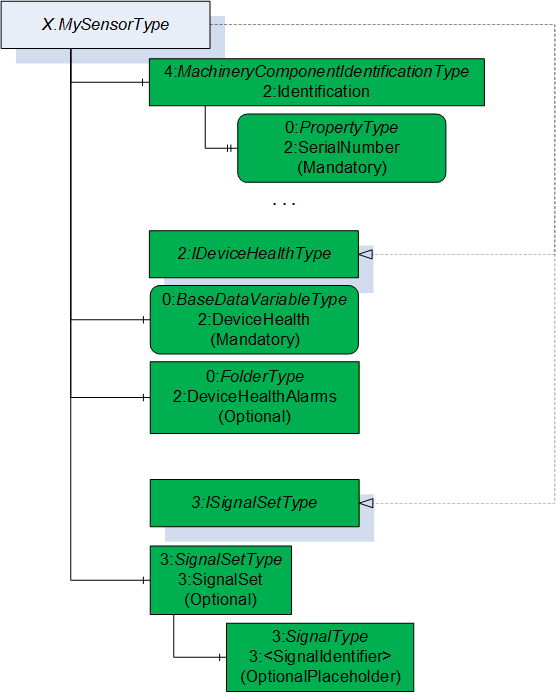
In order to integrate process values in the Machinery Information Model including device information, the device should be represented as component of a machine. An example ObjectType X:MySensorType is shown in Figure 1. It provides identification information using the 4:MachineryComponentIdentificationType. The process values - a device can potentially provide more than one process value - are grouped by the 3:SignalSet defined in the 3:ISignalSetType of OPC 30081. To provide the overall health status of the device as well as specific errors, the 2:IDeviceHealthType is implemented, defined in OPC 10000-100.
Note that it is not required to provide any device information to use the process values defined in this specification. However, this mechanism provides information about the identification and health status of the device.
6.3 ProcessValueSetpointVariableType
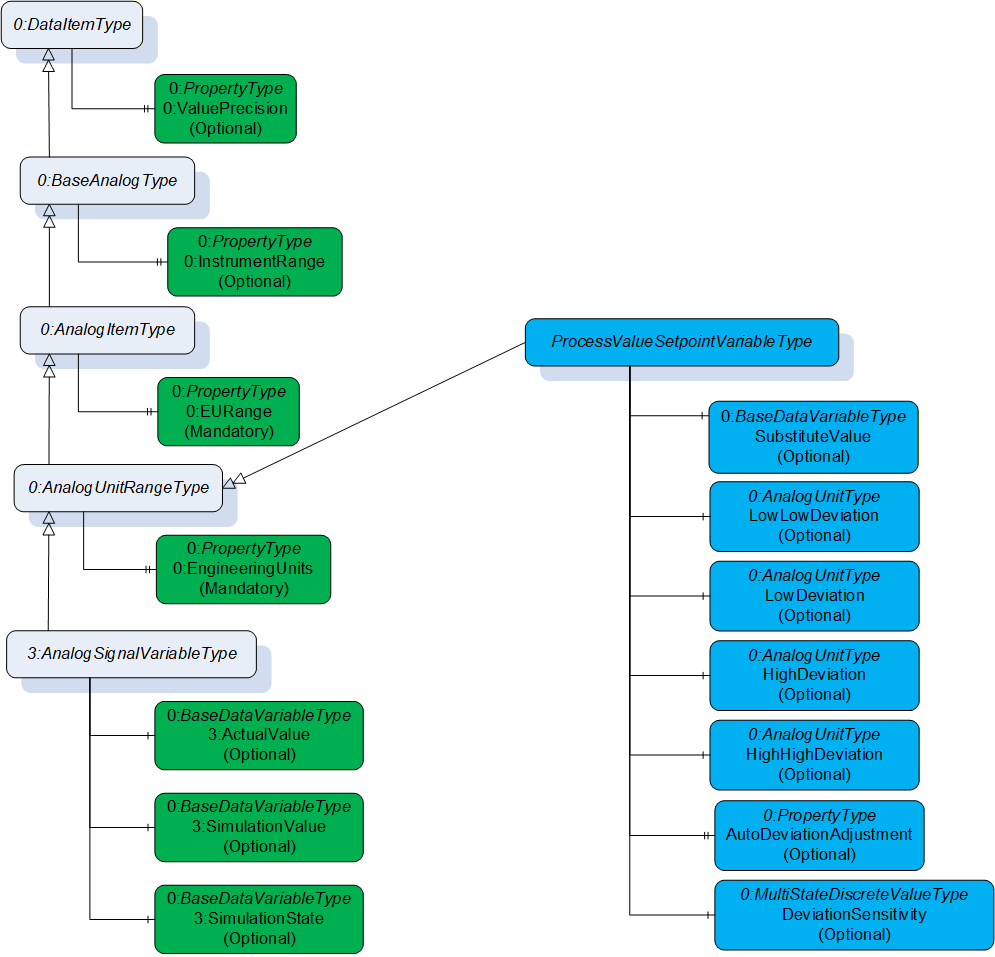
In Figure 2, illustrates the 3:AnalogSignalVariableType and the ProcessValueSetpointVariableType and their supertypes with key InstanceDeclarations. The 3:AnalogSignalVariableType provides the optional Properties 0:ValuePrecision and 0:InstrumentRange and the mandatory Properties 0:EURange and 0:EngineeringUnits and are used as defined in OPC 10000-8. They provide information about the precision, ranges and unit of the process value. The optional Variables 3:ActualValue, 3:SimulationValue, and 3:SimulationState are used as defined in OPC 30081 and provide a simulation value and a flag to define, which value is used.
The ProcessValueSetpointVariableType defined in 9.1 adds additional, optional meta data.
6.4 ProcessValueType
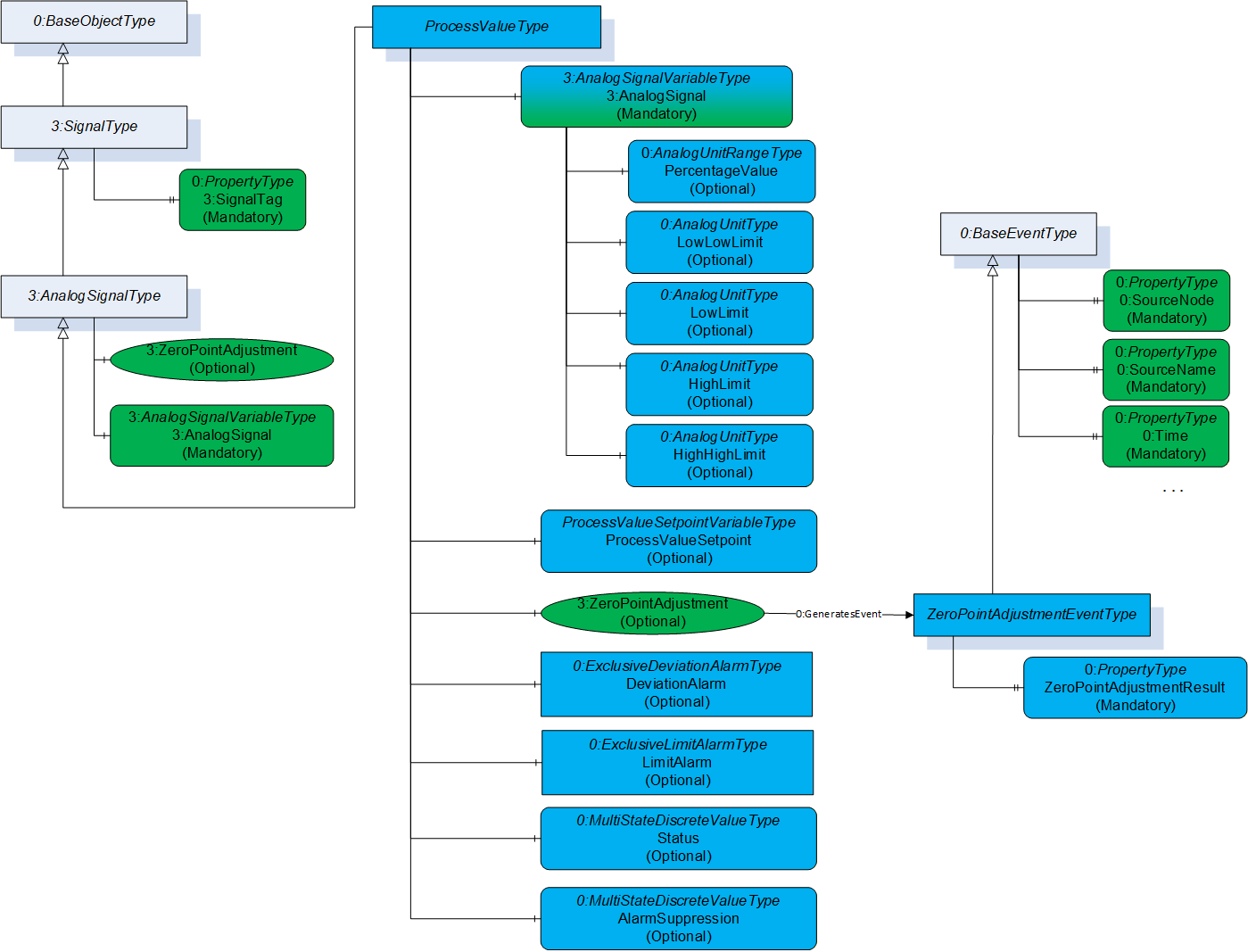
In Figure 3, the ProcessValueType and its supertypes with key InstanceDeclarations is shown. The mandatory 3:SignalTag contains a unique name as defined by OPC 30081. The optional 3:ZeroPointAdjustment Method allows to set a zero point as defined in OPC 30081. The ProcessValueType adds a reference to the ZeroPointAdjustmentEventType. Events of this EventType are generated, when the zero-point adjustment is executed (see 8.1). The 3:AnalogSignal defined in OPC 30081 is extended with additional meta data. The ProcessValueType is defined in 7.1, having additional optional components like process value setpoint and alarm information.
This ObjectType was introduced to bind functionality to the process value that cannot be added to the 3:AnalogSignal directly, like Objects and Methods.
6.5 Examples applying Process Values
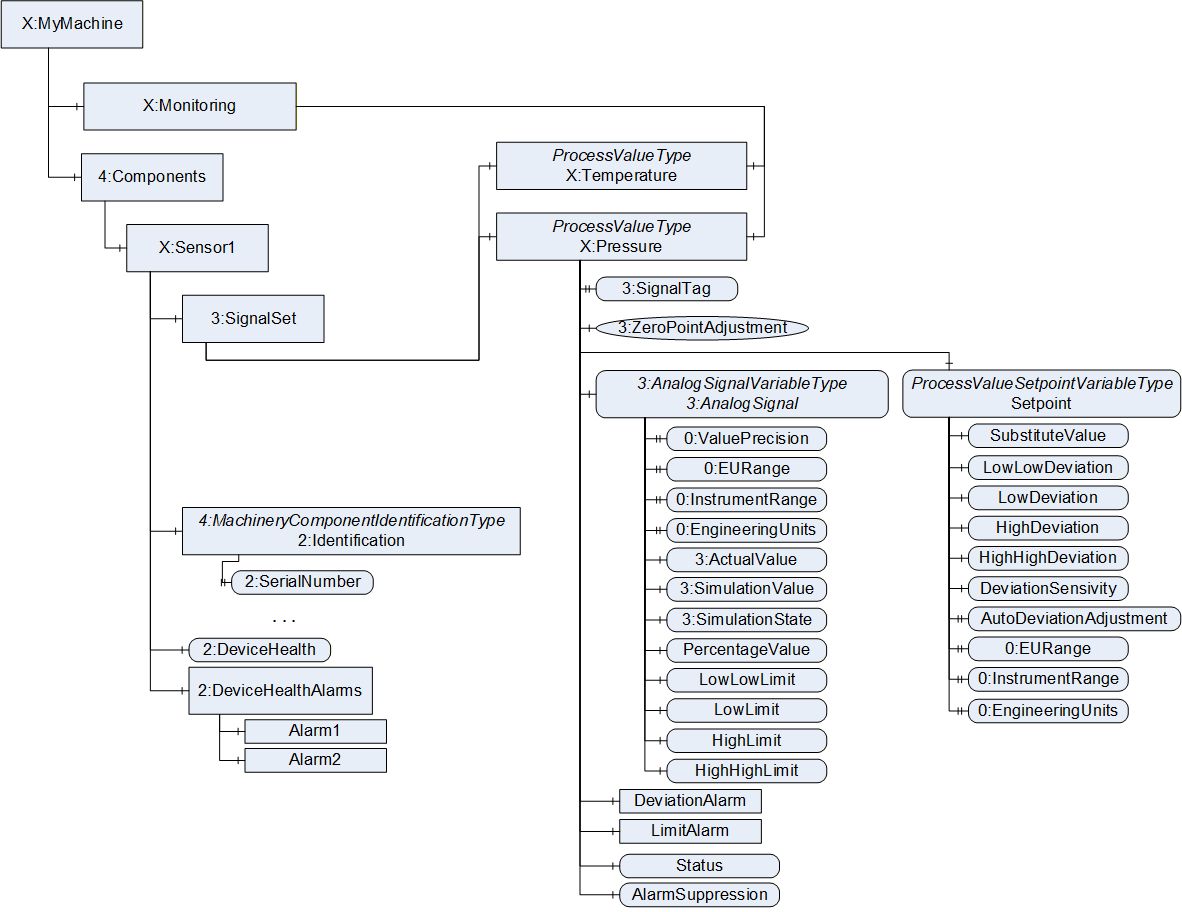
In Figure 4, an example of applying the device values in a machine is given, providing all information defined in this specification. The X:MyMachine Object contains a X:Sensor1 in its 4:Components folder. The X:Sensor1 provides identification information and health status. In addition, it contains two process values, X:Temperature and X:Pressure. Those Objects can be referenced from other paths as well, like the X:Monitoring Object of X:MyMachine. The X:Pressure Object contains various capabilities like the 3:ZeroPointAdjustment Method, DeviationAlarm, and the 3:AnalogSignal containing the process value. This Variable contains various sub-variables with meta data for ranges and unit, deviation etc.
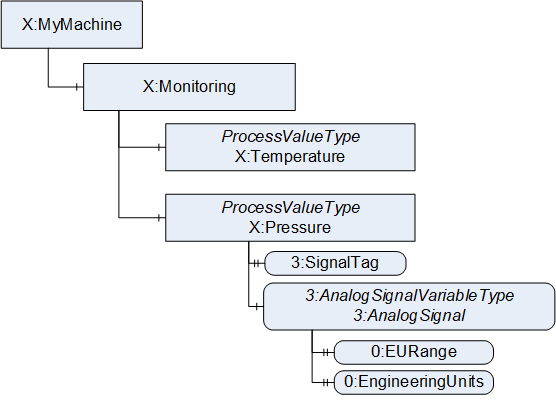
In Figure 5, an example is given using the base infrastructure defined in this specification to provide process values. In this case, no device information or the optional information is given, the X:MyMachine just provided some process values under the X:Monitoring Object.
6.6 Defining Setpoints without an associated Process Value
The ProcessValueType is designed to represent a process value having optionally a process value setpoint. It is not designed to represent a setpoint without a process value. If a setpoint without an associated process values should be represented, using the ProcessValueType is inappropriate. Information models may use the ProcessValueSetpointVariableType as representation of a setpoint. But also this VariableType has optional subvariables that imply a process value (everything associated to deviation) that should not be used without an associated process value.
7 OPC UA ObjectTypes
7.1 ProcessValueType ObjectType Definition
The ProcessValueType represents a process value. It is formally defined in Table 1.
| Attribute | Value | ||||
| BrowseName | ProcessValueType | ||||
| IsAbstract | False | ||||
| Description | Represents a process value | ||||
| References | Node Class | BrowseName | DataType | TypeDefinition | Other |
|---|---|---|---|---|---|
| Subtype of the 3:AnalogSignalType defined in OPC 30081 | |||||
| 0:HasComponent | Variable | 3:AnalogSignal | 0:Number{Any} | 3:AnalogSignalVariableType | M |
| 0:HasComponent | Variable | ProcessValueSetpoint | 0:Number{Any} | ProcessValueSetpointVariableType | O |
| 0:HasComponent | Method | 3:ZeroPointAdjustment | O | ||
| 0:HasComponent | Object | DeviationAlarm | 0:ExclusiveDeviationAlarmType | O | |
| 0:HasComponent | Object | LimitAlarm | 0:ExclusiveLimitAlarmType | O | |
| 0:HasComponent | Variable | Status | 0:UInt16 | 0:MultiStateValueDiscreteType | O |
| 0:HasComponent | Variable | AlarmSuppression | 0:UInt16 | 0:MultiStateValueDiscreteType | O |
| Conformance Units | |||||
|---|---|---|---|---|---|
| Machinery Process Values Base Types |
This ObjectType inherits the InstanceDeclarations defined on its supertypes, including the mandatory 3:SignalTag as defined in OPC 30081.
The mandatory 3:AnalogSignal Variable is overridden and additional InstanceDeclarations are added (see Table 2). It contains the process value and meta data about the process value.
The 3:AnalogSignalVariableType already provides the mandatory 0:EURange, 0:EngineeringUnits and the optional 0:ValuePrecision, 0:InstrumentRange, 3:ActualValue, 3:SimulationValue and 3:SimulationState as defined in OPC 10000-8 and OPC 30081.
The PercentageValue Variable on the 3:AnalogSignal provides the process value in percentage. The 0:EngineeringUnits of the Variable shall always be percentage (UnitId: 20529 with NamespaceUri http://www.opcfoundation.org/UA/units/un/cefact). This Variable is especially useful when the ranges for calculating the percentage values are dynamic, so that the client cannot calculate the percentage based on the 0:EURange of the 3:AnalogSignal Variable. As an example, the wear of a filter should be exposed, by providing the differential pressure. The pressure is presented as the 3:AnalogSignal and the wear is presented as the PercentageValue. Suction output is an internal value. However, the differential pressure depends on the suction output. With 50% suction output the differential pressure of 250 Pa is 0% wear (meaning new filter), for 100% suction output it is 500 Pa and 0% wear. For a used filter, the values are 1600 Pa and 60% wear for 50% suction output and 1700 Pa and 60% wear for 100% suction output. A filter to be replaced would have 2500 Pa and 100% wear for 50% suction output and 2500 Pa and 100% wear for 100% suction output.
There are four optional limit Variables on 3:AnalogSignal: LowLowLimit, LowLimit, HighLimit and HighHighLimit. They define different limits for the Value of the Variable, either absolute or in percentage. It is not required to provide all limit Variables. For example, a process value may only have a LowLimit.
If the limit is defined in percentage, the 0:EngineeringUnits shall be percentage (UnitId: 20529 with NamespaceUri http://www.opcfoundation.org/UA/units/un/cefact). The percentage value is calculated by the range of values between the high and the low limit. 100% therefore corresponds to the equation "EURange.High minus EURange.Low".
If the limit is defined absolute, the 0:EngineeringUnits shall be the same as for the Variable.
If one limit Variable is defined in percentage, all limit Variables shall be defined in percentage.
For all instances of ProcessValueType having an 3:AnalogSignal providing any of the limit Variables, the 3:AnalogSignal shall have scalar Values. Subtypes may be created using arrays and defining the expected behaviour with respect to the limit Variables.
The limit Variables are defined in an order. The LowLowLimit shall be smaller or equal LowLimit, which shall be smaller or equal HighLimit, which shall be smaller or equal HighHighLimit.
In Figure 6, the relation of the limit Variables, and the ranges is shown. The limit Variables are absolute, as well as the ranges.
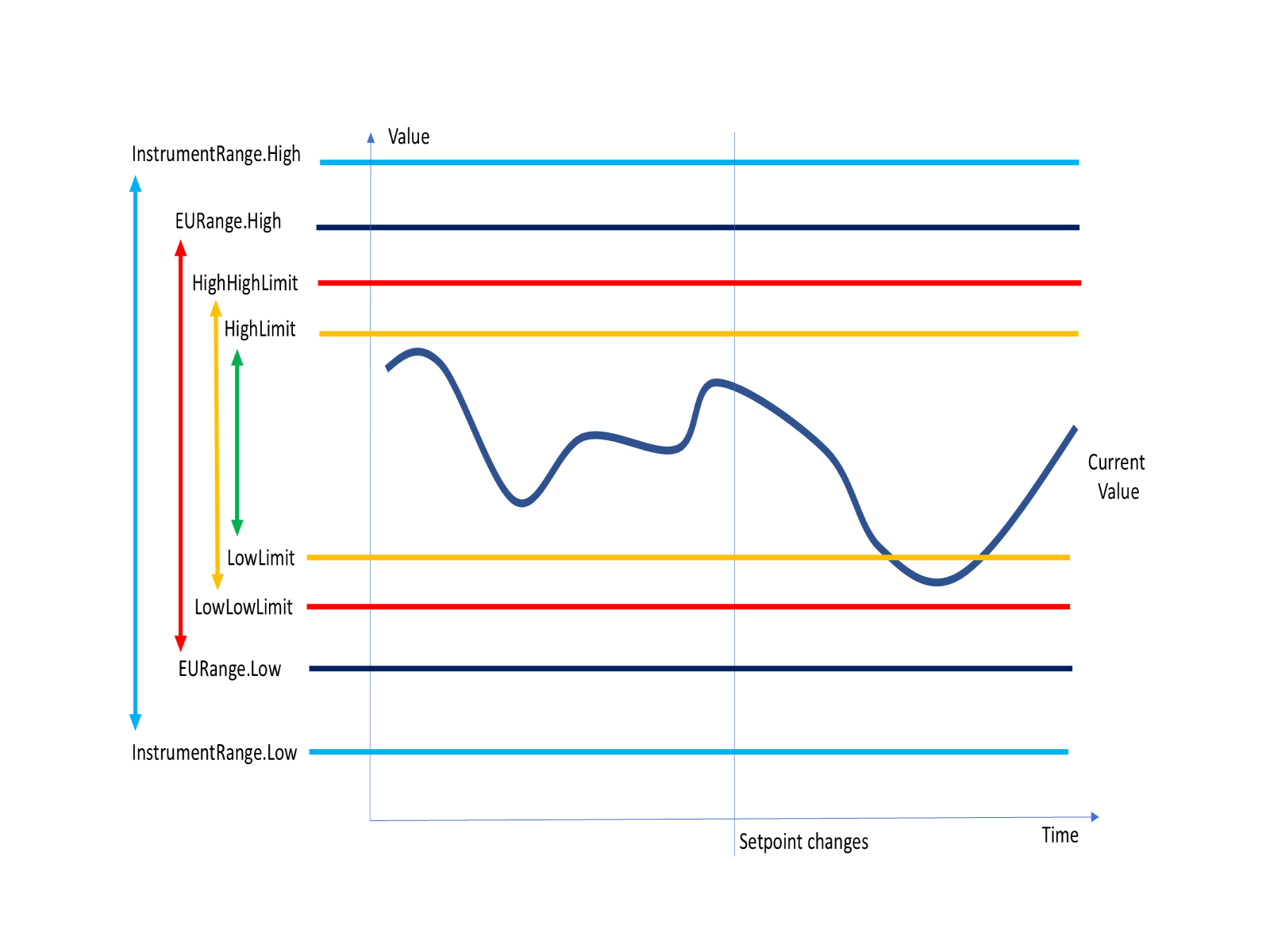
Note that Servers may generate 0:LimitAlarms when the deviation limits are reached. The limit Variables are used to configure this alarm.
The optional ProcessValueSetpoint Variable provides the desired value of the 3:AnalogSignal. The Server may, or may not control the Value to reach the process value setpoint. The DataType, ValueRank and ArrayDimensions shall be the same as for the 3:AnalogSignal. The 0:EngineeringUnits Property shall have the same Value as the 0:EngineeringUnits Property of 3:AnalogSignal. The 0:InstrumentRange Property, if provided, shall have the same Value as the 0:InstrumentRange Property of 3:AnalogSignal. The 0:EURange Property shall have the same Value as the 0:InstrumentRange Property of 3:AnalogSignal, or further restrict the range, i.e. it may have a larger low and a smaller high value.
The optional 3:ZeroPointAdjustment Method is overridden and works as defined in OPC 30081. The ProcessValueType adds a 0:GeneratesEvent Reference to the ZeroPointAdjustmentEventType. When the Method is called and the execution of the Method starts, a corresponding Event is generated. Such an Event shall not be generated, when the Method was called but execution was not started, for example due to access restrictions or invalid input arguments.
The optional DeviationAlarm Object becomes active, when the process value deviates from the ProcessValueSetpoint. The limits of the DeviationAlarm are bound to the deviation Variables of the ProcessValueSetpoint. As the deviation Variables of the ProcessValueSetpoint may be defined in percentage the limits of the DeviationAlarm may need to be calculated accordingly. The 0:LowLowLimit shall be mapped to LowLowDeviation, 0:LowLimit to LowDeviation, 0:HighLimit to HighDeviation and 0:HighHighLimit to HighHighDeviation. If a deviation Variable is not present, the corresponding limit shall not be provided as well. If no deviation Variable is present, the DeviationAlarm shall not be provided.
The optional LimitAlarm Object becomes active, when the process value reaches a limit. The limits of the LimitAlarm are bound to the limit Variables of the 3:AnalogSignal. As the limit Variables of the ProcessValueSetpoint may be defined in percentage the limits of the DeviationAlarm may need to be calculated accordingly. The 0:LowLowLimit shall be mapped to LowLowLimit, 0:LowLowLimit to LowLimit, 0:HighLimit to HighLimit and 0:HighHighLimit to HighHighLimit. If a limit Variable is not present, the corresponding limit shall not be provided as well. If no limit Variable is present, the LimitAlarm shall not be provided.
The optional Status Variable indicates if a deviation limit or an absolute limit has been reached. This specification defines standardized 0:EnumValues (see Table 3) that shall be used as defined in this specification or omitted. Servers may define additional 0:EnumValues starting with 256. The deviation Variables uses the deviation Variables of the ProcessValueSetpoint, and the limit Variables of the 3:AnalogSignal.
For the standardized 0:EnumValues there is a priority, which value shall be reported, when several limits are reached. If the HighHighLimit or the LowLowLimit is reached, it shall be reported. If those are not reached, but the HighLimit or LowLimit is reached, it shall be reported. If those are not reached, but the HighHighDeviation or LowLowDeviation is reached, it shall be reported. If those are not reached, but the HighDeviation or LowDeviation is reached, it shall be reported. If there are additional 0:EnumValues defined, the priority of those is not defined, and they could be reported instead of the standardized ones.
The optional AlarmSuppression Variable indicates if alarms based on the Status shall be suppressed. This might be useful for example when starting a machine Alarms include but are not limited to OPC UA Alarms, they can for example also be acoustic or visual indications on the machine. This specification defines standardized 0:EnumValues (see Table 3) that shall be used as defined in this specification or omitted. Servers may define additional 0:EnumValues starting with 256.
The components of the ProcessValueType have additional subcomponents which are defined in Table 2.
| BrowsePath | References | NodeClass | BrowseName | DataType | TypeDefinition | Others |
| 3:AnalogSignal | 0:HasComponent | Variable | PercentageValue | 0:Double | 0:AnalogUnitRangeType | O |
| 3:AnalogSignal | 0:HasComponent | Variable | LowLowLimit | 0:Number | 0:AnalogUnitType | O |
| 3:AnalogSignal | 0:HasComponent | Variable | LowLimit | 0:Number | 0:AnalogUnitType | O |
| 3:AnalogSignal | 0:HasComponent | Variable | HighLimit | 0:Number | 0:AnalogUnitType | O |
| 3:AnalogSignal | 0:HasComponent | Variable | HighHighLimit | 0:Number | 0:AnalogUnitType | O |
The child Nodes of the ProcessValueType have additional Attribute values defined in Table 3.
| BrowsePath | Value Attribute | Description Attribute | |||
| 3:AnalogSignal | - | The process value. | |||
| - | Provides the process value in percentage. | |||
| NamespaceUri: http://www.opcfoundation.org/UA/units/un/cefact UnitId: 20529 DisplayName: % Description: percent | - | |||
| Low: 0 High: 100 | - | |||
| - | Defines the absolute low low limit | |||
| - | Defines the absolute low limit | |||
| - | Defines the absolute high limit | |||
| - | Defines the absolute high high limit | |||
| ProcessValueSetpoint | - | The desired value, may or may not be controlled by the server. | |||
| DeviationAlarm | - | Becomes active, when the process values derivates from the ProcessValueSetpoint. | |||
| LimitAlarm | - | Becomes active, when absolute limits are reached. | |||
| Status | - | Indicates if a limit has been reached. | |||
| {{0, NONE, Not monitoring}, {1, UNKNOWN, Status not known}, {2, BELOW_LOWLOW_LIMIT, Value is below low LowLowLimit}, {3, BELOW_LOW_LIMIT, Value is below LowLimit}, {4, BELOW_LOWLOW_DEVIATION, Value is below LowLowDeviation}, {5, BELOW_LOW_DEVIATION, Value is below LowDeviation}, {6, WITHIN_TOLERANCE, Value is in tolerance}, {7, ABOVE_HIGH_DEVIATION, Value is above HighDeviation}, {8, ABOVE_HIGHHIGH_DEVIATION, Value is above HighHighDeviation}, {9, ABOVE_HIGH_LIMIT, Value is above HighLimit}, {10, ABOVE_HIGHHIGH_LIMIT, Value is above HighHighLimit}} | - | |||
| AlarmSuppression | - | Indicates if alarms based on the Status shall be suppressed. | |||
| {{0, OFF, no alarm suppression}, {1, HORN, suppresses only horn}, {2, COMPLETE, all alarms are suppressed}} | - |
The components of the ProcessValueType have additional references which are defined in Table 4.
| SourceBrowsePath | Reference Type | Is Forward | TargetBrowsePath |
| 3:ZeroPointAdjustment | 0:GeneratesEvent | True | ZeroPointAdjustmentEventType |
8 OPC UA EventTypes
8.1 ZeroPointAdjustmentEventType ObjectType Definition
The ZeroPointAdjustmentEventType provides information, that a zero-point adjustment took place. It is formally defined in Table 5.
| Attribute | Value | ||||
| BrowseName | ZeroPointAdjustmentEventType | ||||
| IsAbstract | True | ||||
| Description | Provides information, that a zero-point adjustment took place | ||||
| References | Node Class | BrowseName | DataType | TypeDefinition | Other |
|---|---|---|---|---|---|
| Subtype of the 0:BaseEventType defined in OPC 10000-5 | |||||
| 0:HasProperty | Variable | ZeroPointAdjustmentResult | 0:StatusCode | 0:PropertyType | M |
| Conformance Units | |||||
|---|---|---|---|---|---|
| Machinery Process Values Base EventTypes |
This EventType inherits all Properties of the BaseEventType. The 0:SourceNode and 0:SourceName shall be set to the Object the zero-adjustment is bound to (like instances of the ProcessValueType). The 0:Time shall be set to when the zero-point-adjustment took place.
The mandatory ZeroPointAdjustmentResult Variable reflects if the zero-point adjustment was successful. If it was triggered by a Method call, it shall contain the return StatusCode of the Method call.
9 OPC UA VariableTypes
9.1 ProcessValueSetpointVariableType VariableType Definition
The ProcessValueSetpointVariableType is a subtype of 0:AnalogUnitRangeType. It is used to define the desired value of the Variable it belongs to. It is, for example, used by the ProcessValueType, defining the desired value for the 3:AnalogSignal. The DataType, ValueRank and ArrayDimensions shall be identical to the Variable it belongs to. The 0:EngineeringUnits, of that Variable shall have the same Values as defined on the Variable it belongs to. The 0:EURange shall be the same, or further restricted by providing a smaller high or a higher low value. Instances of that VariableType shall not provide the 0:InstrumentRange. A process value setpoint Variable does not require the server to execute any internal logic to bring the process value (Variable to which the process value setpoint belongs) to the process value setpoint.
The VariableType is formally defined in Table 6.
| Attribute | Value | ||||
| BrowseName | ProcessValueSetpointVariableType | ||||
| IsAbstract | False | ||||
| ValueRank | -2 (-2 = Any) | ||||
| DataType | Number | ||||
| Description | Define the desired value of the Variable it belongs to. | ||||
| References | Node Class | BrowseName | DataType | TypeDefinition | Other |
|---|---|---|---|---|---|
| Subtype of the 0:AnalogUnitRangeType | |||||
| 0:HasComponent | Variable | SubstituteValue | 0:Number{Any} | 0:BaseDataVariableType | O |
| 0:HasComponent | Variable | LowLowDeviation | 0:Number | 0:AnalogUnitType | O |
| 0:HasComponent | Variable | LowDeviation | 0:Number | 0:AnalogUnitType | O |
| 0:HasComponent | Variable | HighDeviation | 0:Number | 0:AnalogUnitType | O |
| 0:HasComponent | Variable | HighHighDeviation | 0:Number | 0:AnalogUnitType | O |
| 0:HasProperty | Variable | AutoDeviationAdjustment | 0:Boolean | 0:PropertyType | O |
| 0:HasComponent | Variable | DeviationSensitivity | 0:UInt16 | 0:MultiStateValueDiscreteType | O |
| Conformance Units | |||||
|---|---|---|---|---|---|
| Machinery Process Values Base Types | |||||
| Machinery Process Values Base SetpointType |
The optional SubstituteValue Variable provides a value that should be used when the process value setpoint cannot be controlled anymore. This specification does not define, when this is the case. There might be, for example, a connection lost from the controlling device. The SubstituteValue shall have the same DataType, ValueRank and ArrayDimensions as the process value setpoint Variable. The same meta data as defined for the process value setpoint Variable apply.
There are four optional deviation Variables: LowLowDeviation, LowDeviation, HighDeviation and HighHighDeviation. They define different limits for deviation. The deviation considered is between the value of the process value setpoint and the value of the Variable to which the process value setpoint belongs. The deviation limits are defined relative to the process value setpoint. It is not required to provide all deviation Variables. For example, a process value may only have a LowDeviation. The deviation can either be defined in percentage or absolute.
If the deviation is defined in percentage, the 0:EngineeringUnits shall be percentage (UnitId: 20529 with NamespaceUri http://www.opcfoundation.org/UA/units/un/cefact). The percentage value is calculated by the range of values between the high and the low limit. 100% therefore corresponds to the equation "EURange.High minus EURange.Low".
If the deviation is defined absolute, the 0:EngineeringUnits shall be the same as the process value setpoint.
If one deviation Variable is defined in percentage, all deviation Variables shall be defined in percentage.
All instances of the ProcessValueSetpointVariableType providing any of the deviation Variables shall have scalar Values. Subtypes may be created using arrays and defining the expected behaviour with respect to the deviation Variables.
The deviation Variables are defined in an order. The LowLowDeviation shall be smaller or equal LowDeviation, which shall be smaller or equal zero. HighHighDeviation shall be larger or equal HighDeviation, which shall be larger or equal to zero.
In Figure 7, the relation of the deviation Variables, the ProcessValueSetpoint, and the ranges is shown. The deviation Variables are relative to the ProcessValueSetpoint, whereas the ranges are absolute. In Figure 7, the ProcessValueSetpoint changes at some point in time, and therefore the absolute value for the deviation. Note, that a change of the ProcessValueSetpoint may lead to the absolute value of a deviation may pass the ranges.
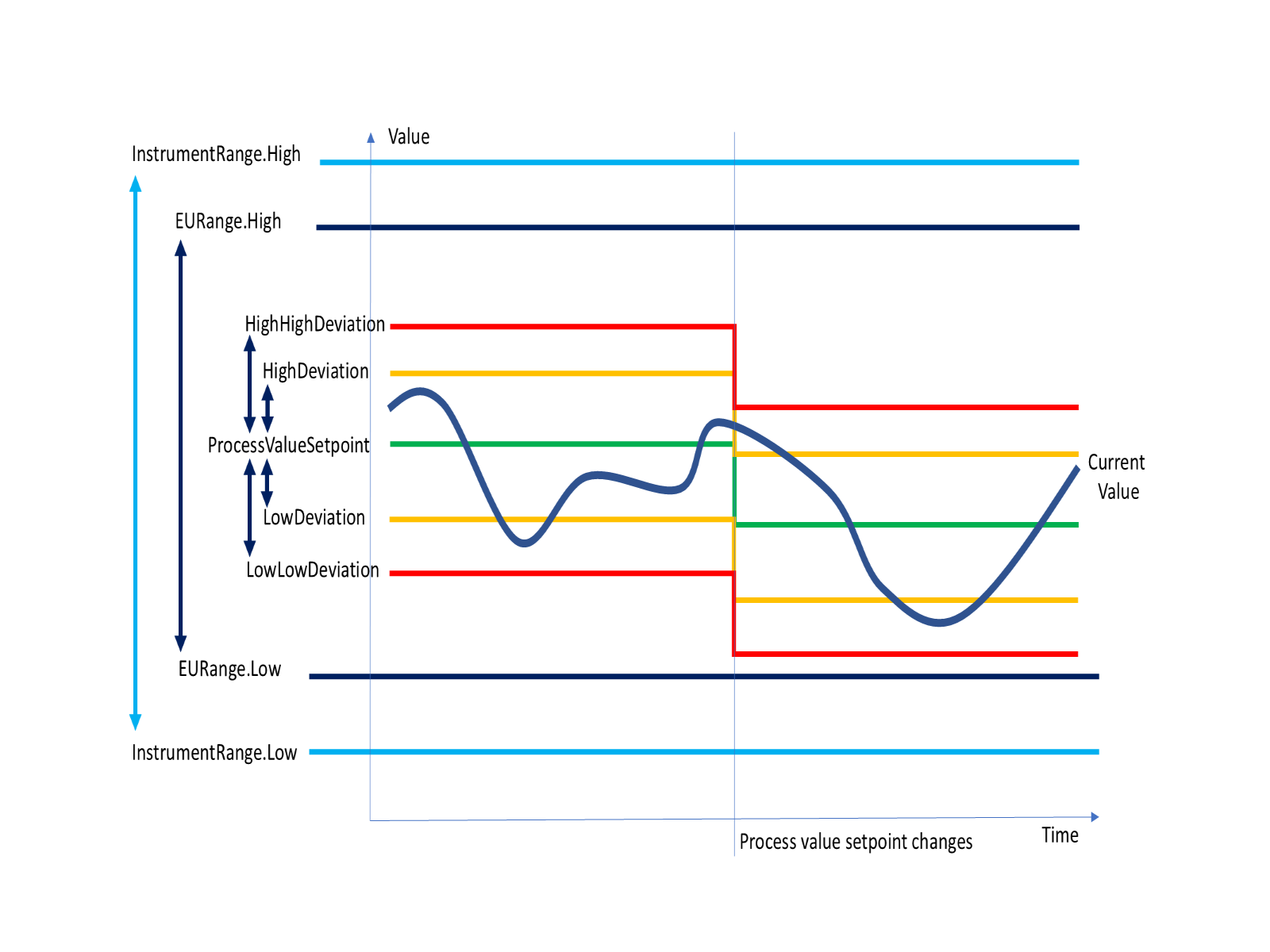
Note that Servers may generate 0:DeviationAlarms (see 7.1) when the deviation limits are reached. The deviation Variables are used to configure this alarm.
The optional AutoDeviationAdjustment Variable defines if the deviation Variables are automatically adjusted based on the settings of DeviationSensitivity (if provided) in case the configuration has changed (0:EURange or DeviationSensitivity). If set to TRUE, the deviation Variables shall be automatically adjusted and writing the deviation Variables shall fail.
The optional DeviationSensitivity Variable indicates the sensitivity of the deviation Variables when automatically set. This specification defines standardized 0:EnumValues (see Table 7) that shall be used as defined in this specification or omitted. Servers may define additional 0:EnumValues starting with 256.
Note that the predefined 0:EnumValues (FINE, MIDDLE, and ROUGH) do not define the absolute widths of the set deviation bands, they are device dependent.
The child Nodes of the ProcessValueSetpointVariableType have additional Attribute values defined in Table 7.
| BrowsePath | Value Attribute | Description Attribute | ||
| LowLowDeviation | - | Defines the low low limit for deviation, relative to the process value setpoint. | ||
| LowDeviation | - | Defines the low limit for deviation, relative to the process value setpoint. | ||
| HighDeviation | - | Defines the high limit for deviation, relative to the process value setpoint. | ||
| HighHighDeviation | - | Defines the high high limit for deviation, relative to the process value setpoint. | ||
| AutoDeviationAdjustment | - | Defines if the deviation variables are automatically adjusted. | ||
| DeviationSensitivity | - | Indicates the sensitivity of the deviation variables when automatically set. | ||
| SubstituteValue | - | Value that should be used when the process value setpoint cannot be controlled anymore. | ||
| {{0, FINE, tight tolerances}, {1, MIDDLE, mean tolerances}, {2, ROUGH, large tolerances}} | - |
10 Profiles and Conformance Units
10.1 Conformance Units
This chapter defines the corresponding Conformance Units for the OPC UA Information Model for Machinery - Process Values.
| Category | Title | Description |
| Server | Machinery Process Values Base SetpointType | Server exposes the ProcessValueSetpointVariableType and all its supertypes in the AddressSpace. |
| Server | Machinery Process Values Base Process Value Setpoint | Server is configurable to support at least one instance of ProcessValueSetpointVariableType. |
| Server | Machinery Process Values Base Types | Server exposes the ProcessValueType and ProcessValueSetpointVariableType and all their supertypes in the AddressSpace. |
| Server | Machinery Process Values Base EventTypes | Server exposes the ZeroPointAdjustmentEventType and all its supertypes in the AddressSpace. |
| Server | Machinery Process Values Analog Object Instances | Server is configurable to support at least one instance of ProcessValueType. |
| Server | Machinery Process Values ZeroPointAdjustment Events | Server is configurable to support at least one instance of ProcessValueType that generates Events of ZeroPointAdjustmentEventType. All instances that support the ZeroPointAdjustment Method generate Events of ZeroPointAdjustmentEventType. |
| Server | Machinery Process Values Percentage Value | Server is configurable to support at least one instance of ProcessValueType providing the PercentageValue Variable on the AnalogSignal. |
| Server | Machinery Process Values Deviation Base | Server is configurable to support at least one instance of ProcessValueSetpointVariableType having at least one deviation Variable |
| Server | Machinery Process Values Monitoring | Server is configurable to support at least one instance of ProcessValueType providing the Status Variable. |
| Server | Machinery Process Values Deviation AutoAdjustment | Server is configurable to support at least one instance of ProcessValueSetpointVariableType providing the AutoDeviationAdjustment Variable. |
| Server | Machinery Process Values Deviation Sensitivity | Server is configurable to support at least one instance of ProcessValueSetpointVariableType providing the DeviationSensitivity Variable. |
| Server | Machinery Process Values Deviation Alarm | Server is configurable to support at least one instance of ProcessValueType providing alarms of the ExclusiveDeviationAlarmType. |
| Server | Machinery Process Values Deviation Alarm Object | Server is configurable to support at least one instance of ProcessValueType providing the DeviationAlarm Object. |
| Server | Machinery Process Values AlarmSuppression | Server is configurable to support at least one instance of ProcessValueType providing the AlarmSuppression Variable. |
| Server | Machinery Process Values Limits Base | Server is configurable to support at least one instance of ProcessValueType having at least one limit Variable on the AnalogSignal. |
| Server | Machinery Process Values Limits Alarm | Server is configurable to support at least one instance of ProcessValueType providing alarms of the ExclusiveLimitAlarmType. |
| Server | Machinery Process Values Limits Alarm Object | Server is configurable to support at least one instance of ProcessValueType providing the LimitAlarm Object. |
| Server | Machinery Process Values Device Object | Server is configurable to support at least one Object providing the MachineryComponentIdentificationType AddIn and implementing the ISignalSet referencing an Object of Type ProcessValueType. |
10.2 Profiles
10.2.1 Profile list
Table 9 lists all Profiles defined in this document and defines their URIs.
10.2.2 Server Facets
10.2.2.1 Overview
The following sections specify the Facets available for Servers that implement the Machinery - Process Values companion specification. Each section defines and describes a Facet or Profile.
10.2.2.2 Machinery-Process Values Base Server Facet
Table 10 defines a Facet that describes the base functionality to provide process values.
| Group | Conformance Unit / Profile Title | Mandatory / Optional |
| Address Space Model | 0:Address Space Base | M |
| Attribute Services | 0:Attribute Read | M |
| Data Access | 0:Data Access AnalogUnitRangeType | M |
| Data Access | 0:Data Access AnalogUnitType | M |
| View Services | 0:View Basic 2 | M |
| View Services | 0:TranslateBrowsePath | M |
| Machinery Process Values | Machinery Process Values Base Types | M |
| Machinery Process Values | Machinery Process Values Analog Object Instances | M |
10.2.2.3 Machinery-Process Values Simple Device Info Server Facet
Table 11 defines a Facet that describes the base functionality to provide process values in the context of the device / component providing the process value. The identification of the device has to be included, optionally health information can be provided.
| Group | Conformance Unit / Profile Title | Mandatory / Optional |
| Profile | Machinery-Process Values Base Server Facet | |
| PA-DIM | 3:PA-DIM ISignal | M |
| Machinery Process Values | Machinery Process Values Device Object | M |
| DI | 2:DI DeviceHealth | O |
| DI | 2:DI HealthDiagnosticsAlarm | O |
| DI | 2:DI DeviceHealthProperty | O |
| Machinery | 4:Machinery Component Identification | M |
10.2.2.4 Machinery-Process Values Zero Point Adjustment Base Server Facet
Table 12 defines a Facet that a server can provide zero point adjustment functionality on a process value.
| Group | Conformance Unit / Profile Title | Mandatory / Optional |
| Profile | Machinery-Process Values Base Server Facet | |
| PA-DIM | 3:PA-DIM ZeroPointAdjustment method | M |
| PA-DIM | 3:PA-DIM Analog Signal | M |
| Method Services | 0:Method Call | M |
10.2.2.5 Machinery-Process Values Zero Point Adjustment Events Server Facet
Table 13 defines a Facet that a server can provide zero point adjustment on a process value including the generation of events when the adjustment is executed.
| Group | Conformance Unit / Profile Title | Mandatory / Optional |
| Profile | Machinery-Process Values Zero Point Adjustment Base Server Facet | |
| Profile | 0:Standard Event Subscription 2022 Server Facet | |
| Machinery Process Values | Machinery Process Values Base EventTypes | M |
| Machinery Process Values | Machinery Process Values ZeroPointAdjustment Events | M |
10.2.2.6 Machinery-Process Values Simulation Server Facet
Table 14 defines a Facet that a server can provide process values including simulation values.
| Group | Conformance Unit / Profile Title | Mandatory / Optional |
| Profile | Machinery-Process Values Base Server Facet | |
| PA-DIM | 3:PA-DIM AnalogSignalVariable Simulation | M |
10.2.2.7 Machinery-Process Values Base Process Value Setpoint Server Facet
Table 15 defines a Facet that a server can provide process values including a process value setpoint.
| Group | Conformance Unit / Profile Title | Mandatory / Optional |
| Profile | Machinery-Process Values Base Server Facet | |
| Machinery Process Values | Machinery Process Values Base Process Value Setpoint | M |
10.2.2.8 Machinery-Process Values Percentage Value Server Facet
Table 16 defines a Facet that a server can provide process values including a percentage value.
| Group | Conformance Unit / Profile Title | Mandatory / Optional |
| Profile | Machinery-Process Values Base Server Facet | |
| Machinery Process Values | Machinery Process Values Percentage Value | M |
10.2.2.9 Machinery-Process Values Deviation Base Server Facet
Table 17 defines a Facet that a server can provide process values including deviation limits.
| Group | Conformance Unit / Profile Title | Mandatory / Optional |
| Profile | Machinery-Process Values Base Server Facet | |
| Machinery Process Values | Machinery Process Values Deviation Base | M |
10.2.2.10 Machinery-Process Values Deviation AutoAdjustment Server Facet
Table 18 defines a Facet that a server can provide process values including at least one deviation limit with automatic adjustment. Optionally, the sensitivity of the adjustment is provided.
| Group | Conformance Unit / Profile Title | Mandatory / Optional |
| Profile | Machinery-Process Values Deviation Base Server Facet | |
| Machinery Process Values | Machinery Process Values Deviation AutoAdjustment | M |
| Machinery Process Values | Machinery Process Values Deviation Sensitivity | O |
10.2.2.11 Machinery-Process Values Deviation Monitoring Server Facet
Table 19 defines a Facet that a server can provide process values including deviation limits and a variable to monitor if the deviation limit is reached.
| Group | Conformance Unit / Profile Title | Mandatory / Optional |
| Profile | Machinery-Process Values Deviation Base Server Facet | |
| Machinery Process Values | Machinery Process Values Monitoring | M |
10.2.2.12 Machinery-Process Values Deviation Alarm Server Facet
Table 20 defines a Facet that a server can provide process values including deviation limits and alarms if the deviation limit is reached. Optionally the alarm is represented as Object in the AddressSpace.
| Group | Conformance Unit / Profile Title | Mandatory / Optional |
| Profile | Machinery-Process Values Deviation Base Server Facet | |
| Profile | 0:A & C Base Condition 2022 Server Facet | |
| Machinery Process Values | Machinery Process Values Deviation Alarm | M |
| Machinery Process Values | Machinery Process Values Deviation Alarm Object | O |
10.2.2.13 Machinery-Process Values Deviation Alarm Suppression Server Facet
Table 21 defines a Facet that a server can provide process values including deviation limits and the possibility to supress alarming when the limit is reached.
| Group | Conformance Unit / Profile Title | Mandatory / Optional |
| Profile | Machinery-Process Values Deviation Base Server Facet | |
| Machinery Process Values | Machinery Process Values AlarmSuppression | M |
10.2.2.14 Machinery-Process Values Limits Base Server Facet
Table 22 defines a Facet that a server can provide process values including deviation limits.
| Group | Conformance Unit / Profile Title | Mandatory / Optional |
| Profile | Machinery-Process Values Base Server Facet | |
| Machinery Process Values | Machinery Process Values Limits Base | M |
10.2.2.15 Machinery-Process Values Limits Monitoring Server Facet
Table 23 defines a Facet that a server can provide process values including absolute limits and a variable to monitor if the absolute limit is reached.
| Group | Conformance Unit / Profile Title | Mandatory / Optional |
| Profile | Machinery-Process Values Limits Base Server Facet | |
| Machinery Process Values | Machinery Process Values Monitoring | M |
10.2.2.16 Machinery-Process Values Limits Alarm Server Facet
Table 24 defines a Facet that a server can provide process values including absolute limits and alarms if the absolute limit is reached. Optionally the alarm is represented as Object in the AddressSpace.
| Group | Conformance Unit / Profile Title | Mandatory / Optional |
| Profile | Machinery-Process Values Limits Base Server Facet | |
| Profile | 0:A & C Base Condition 2022 Server Facet | |
| Machinery Process Values | Machinery Process Values Limits Alarm | M |
| Machinery Process Values | Machinery Process Values Limits Alarm Object | O |
10.2.2.17 Machinery-Process Values Limits Alarm Suppression Server Facet
Table 25 defines a Facet that a server can provide process values including absolute limits and the possibility to supress alarming when the limit is reached.
| Group | Conformance Unit / Profile Title | Mandatory / Optional |
| Profile | Machinery-Process Values Limits Base Server Facet | |
| Machinery Process Values | Machinery Process Values AlarmSuppression | M |
10.2.3 Client Facets
10.2.3.1 Overview
This specification does not define any Facets for Clients.
11 Namespaces
11.1 Namespace Metadata
Table 26 defines the namespace metadata for this document. The Object is used to provide version information for the namespace and an indication about static Nodes. Static Nodes are identical for all Attributes in all Servers, including the Value Attribute. See OPC 10000-5 for more details.
The information is provided as Object of type NamespaceMetadataType. This Object is a component of the Namespaces Object that is part of the Server Object. The NamespaceMetadataType ObjectType and its Properties are defined in OPC 10000-5.
The version information is also provided as part of the ModelTableEntry in the UANodeSet XML file. The UANodeSet XML schema is defined in OPC 10000-6.
| Attribute | Value | ||
| BrowseName | http://opcfoundation.org/UA/Machinery/ProcessValues/ | ||
| Property | DataType | Value | |
|---|---|---|---|
| NamespaceUri | String | http://opcfoundation.org/UA/Machinery/ProcessValues/ | |
| NamespaceVersion | String | 1.00.0 | |
| NamespacePublicationDate | DateTime | 2023-05-01 | |
| IsNamespaceSubset | Boolean | False | |
| StaticNodeIdTypes | IdType [] | 0 | |
| StaticNumericNodeIdRange | NumericRange [] | ||
| StaticStringNodeIdPattern | String | ||
11.2 Handling of OPC UA Namespaces
Namespaces are used by OPC UA to create unique identifiers across different naming authorities. The Attributes NodeId and BrowseName are identifiers. A Node in the UA AddressSpace is unambiguously identified using a NodeId. Unlike NodeIds, the BrowseName cannot be used to unambiguously identify a Node. Different Nodes may have the same BrowseName. They are used to build a browse path between two Nodes or to define a standard Property.
Servers may often choose to use the same namespace for the NodeId and the BrowseName. However, if they want to provide a standard Property, its BrowseName shall have the namespace of the standards body although the namespace of the NodeId reflects something else, for example the EngineeringUnits Property. All NodeIds of Nodes not defined in this document shall not use the standard namespaces.
Table 27 provides a list of namespaces that may be used in a Machinery - Process Values OPC UA Server.
| NamespaceURI | Description |
| http://opcfoundation.org/UA/ | Namespace for NodeIds and BrowseNames defined in the OPC UA specification. This namespace shall have namespace index 0. |
| Local Server URI | Namespace for nodes defined in the local Server. This namespace shall have namespace index 1. |
| http://opcfoundation.org/UA/DI/ | Namespace for NodeIds and BrowseNames defined in OPC 10000-100. The namespace index is Server specific. |
| http://opcfoundation.org/UA/Dictionary/IRDI | Namespace for NodeIds for IRDIs using HasDictionaryEntry (defined for example by OPC 30081). The namespace index is server specific. |
| http://opcfoundation.org/UA/PADIM/ | Namespace for NodeIds and BrowseNames defined in OPC 30081. The namespace index is Server specific. |
| http://opcfoundation.org/UA/Machinery/ | Namespace for NodeIds and BrowseNames defined in OPC 40001-1. The namespace index is Server specific. |
| http://opcfoundation.org/UA/Machinery/ProcessValues/ | Namespace for NodeIds and BrowseNames defined in this document. The namespace index is Server specific. |
| Vendor specific types | A Server may provide vendor-specific types like types derived from ObjectTypes defined in this document in a vendor-specific namespace. |
| Vendor specific instances | A Server provides vendor-specific instances of the standard types or vendor-specific instances of vendor-specific types in a vendor-specific namespace. It is recommended to separate vendor specific types and vendor specific instances into two or more namespaces. |
Table 28 provides a list of namespaces and their indices used for BrowseNames in this document. The default namespace of this document is not listed since all BrowseNames without prefix use this default namespace.
| NamespaceURI | Namespace Index | Example |
| http://opcfoundation.org/UA/ | 0 | 0:EngineeringUnits |
| http://opcfoundation.org/UA/DI/ | 2 | 2:IDeviceHealthType |
| http://opcfoundation.org/UA/PADIM/ | 3 | 3:AnalogSignalType |
| http://opcfoundation.org/UA/Machinery/ | 4 | 4:MachineryComponentIdentificationType |
Annex A Machinery - Process Values Namespace and mappings (Normative)
A.1 NodeSet and Supplementary Files for Machinery - Process Values Information Model
The Machinery - Process Values Information Model is identified by the following URI:
http://opcfoundation.org/UA/Machinery/ProcessValues/
Documentation for the NamespaceUri can be found here.
The NodeSet associated with this version of specification can be found here:
The NodeSet associated with the latest version of the specification can be found here:
The supplementary files associated with this version of specification can be found here:
The supplementary files associated with the latest version of the specification can be found here:
___________
Annex B Examples for Process Values (Informative)
B.1 Overview
The following table provides two process values and an example of their data associated with it. Note that for the DeviationAlarm, most of the optional Nodes are not shown, and for the LimitAlarm, also most of the mandatory nodes are hidden. They are set similar to the DeviationAlarm.
| Node | Pressure | Temperature |
| SignalTag (M) | "Sigxyz123" | "T001" |
| AnalogSignal (M) | 200 | 65 |
ValuePrecision (O) | -2 (Rounded to next 100) | - |
EURange (M) | {-100.0, 250.0} | {-20.0, 180.0} |
InstrumentRange (O) | {-500.0, 350.0} | {-200.0, 300.0} |
EngineeringUnits (M) | Pa (Pascal) | °C |
ActualValue (O) | 200 | 65 |
SimulationValue (O) | 100 | 20 |
SimulationState (O) | FALSE | FALSE |
Damping (O) | - | - |
PercentageValue (O) | 601 | - |
EURange(M) | {0.0,100.0} | - |
EngineeringUnits(M) | pct (Percent) | - |
LowLowLimit (O) | 20 | 5 |
EngineeringUnits(M) | Pa (Pascal) | pct (Percent) |
LowLimit (O) | 50 | 10 |
EngineeringUnits(M) | Pa (Pascal) | pct (Percent) |
HighLimit (O) | 230 | 80 |
EngineeringUnits(M) | Pa (Pascal) | pct (Percent) |
HighHighLimit (O) | 250 | 90 |
EngineeringUnits(M) | Pa (Pascal) | pct (Percent) |
| Status (O) | 6 (WITHIN_TOLERANCE) | 7 (ABOVE_HIGH_DEVIATION) |
EnumValues (M) | As in Table 3 | As in Table 3 |
| AlarmSuppression (O) | 0 (No alarm suppression) | - |
EnumValues (M) | As in Table 3 | - |
| ProcessValueSetpoint (O) | 200 | 20 |
.SubstituteValue (O) | 210 | - |
LowLowDeviation (O) | -40 | - |
EngineeringUnits (M) | Pa (Pascal) | - |
LowDeviation (O) | -20 | -5 |
EngineeringUnits (M) | Pa (Pascal) | pct (Percent) |
HighDeviation (O) | 20 | 5 |
EngineeringUnits (M) | Pa (Pascal) | pct (Percent) |
HighHighDeviation (O) | 40 | - |
EngineeringUnits (M) | Pa (Pascal) | - |
.DeviationSensitivity (O) | 1 - Middle | - |
EnumValues (M) | As in Table 7 | - |
.AutoDeviationAdjustment (O) | FALSE | - |
.EURange (M) | {-100.0, 250.0} | {-10.0, 70.0} |
.InstrumentRange (O) | {-500.0, 350.0} | - |
.EngineeringUnits (M) | Pa (Pascal) | °C |
| DeviationAlarm (O) | ||
SetpointNode (M) | NodeId of Setpoint | NodeId of Setpoint |
LimitState (M) | ||
CurrentState (M) | BAD status | "High" |
CurrentState.Id (M) | BAD status | 2 (StateNumber of High) |
LowLowLimit (O) | -40 | - |
LowLimit (O) | -20 | -10 (- 5 percent to °C based on EURange) 2 |
HighLimit (O) | 20 | +10 (+5 percent to °C based on EURange) 2 |
HighHighLimit (O) | 40 | - |
ActiveState (M) | "Inactive" | "Active" |
ActiveState.Id (M) | FALSE | TRUE |
InputNode (M) | NodeId of SignalObject | NodeId of SignalObject |
AckedState (M) | "Acknowledged" | "Acknowledged" |
AckedState.Id (M) | TRUE (Auto-acknowledged) | TRUE (Auto-acknowledged) |
SuppressedOrShelved (M) | FALSE | FALSE |
ConditionClassId (M) | NodeId of ProcessConditionClassType (static) | NodeId of ProcessConditionClassType (static) |
ConditionClassName (M) | "ProcessConditionClassType" (static) | "ProcessConditionClassType" (static) |
ConditionName (M) | "DeviationAlarm" (static) | "DeviationAlarm" (static) |
BranchId (M) | NULL | NULL |
Retain (M) | FALSE | TRUE |
EnabledState (M) | "Enabled" | "Enabled" |
EnabledState.Id (M) | TRUE | TRUE |
Quality (M) | GOOD | GOOD |
LastSeverity (M) | 600 | 10 |
Comment (M) | "" (no comment set) | "" (no comment set) |
ClientUserId (M) | "" (no comment set) | "" (no comment set) |
EventId (M) | 123435 (Unique in Server) | 123436 (Unique in Server) |
EventType (M) | NodeId of ExclusiveDeviationAlarmType (Static) | NodeId of ExclusiveDeviationAlarmType (Static) |
SourceNode (M) | NodeId of SignalObject | NodeId of SignalObject |
SourceName (M) | Name of SignalObject | Name of SignalObject |
Time (M) | 2022-06-02:10:00:00 | 2022-06-02:10:05:00 |
ReceiveTime (M) | 2022-06-02:10:00:00 | 2022-06-02:10:05:00 |
Message (M) | "No Deviation" | "No Deviation" |
Severity (M) | 10 | 600 |
| LimitAlarm | ||
LimitState (M) | ||
CurrentState (M) | BAD status | BAD status |
CurrentState.Id (M) | BAD status | BAD status |
LowLowLimit (O) | 20 | -10 (5 percent to °C based on EURange) 3 |
LowLimit (O) | 50 | 0 (10 percent to °C based on EURange) 3 |
HighLimit (O) | 230 | 140 (80 percent to °C based on EURange) 3 |
HighHighLimit (O) | 250 | 160 (90 percent to °C based on EURange) 3 |
ActiveState (M) | "Inactive" | "Inactive" |
ActiveState.Id (M) | FALSE | FALSE |
1 The PercentageValue in the example is not calculated based on EURange but by some internal logic, also considering other parameters.
2 The EURange is from -20 to 180°C, -20 is 0% and +180 is 100%. The absolute deviation value based on a percentage value is "absolute_deviation_value = percentage_value * (max_value - min_value)". For example, for +5% it is: absolute_deviation_value = 5/100 * 180°C-(-20°C) = 5/100 * 200°C = 10°C.
3 When calculating the absolute limits, in addition to calculating the absolute_deviation_value, it needs to be set into the context of the range, i.e. absolute_value = min_value + absolute_deviation_value. For example, for +5% it is absolute_value = -20°C +10°C = -10°C.
___________
Agreement of Use
COPYRIGHT RESTRICTIONS
This document is provided "as is" by the OPC Foundation and VDMA.
Right of use for this specification is restricted to this specification and does not grant rights of use for referred documents.
Right of use for this specification will be granted without cost.
This document may be distributed through computer systems, printed or copied as long as the content remains unchanged and the document is not modified.
OPC Foundation and VDMA do not guarantee usability for any purpose and shall not be made liable for any case using the content of this document.
The user of the document agrees to indemnify OPC Foundation and VDMA and their officers, directors and agents harmless from all demands, claims, actions, losses, damages (including damages from personal injuries), costs and expenses (including attorneys' fees) which are in any way related to activities associated with its use of content from this specification.
The document shall not be used in conjunction with company advertising, shall not be sold or licensed to any party.
The intellectual property and copyright is solely owned by the OPC Foundation and VDMA.
PATENTS
The attention of adopters is directed to the possibility that compliance with or adoption of OPC or VDMA specifications may require use of an invention covered by patent rights. OPC Foundation or VDMA shall not be responsible for identifying patents for which a license may be required by any OPC or VDMA specification, or for conducting legal inquiries into the legal validity or scope of those patents that are brought to its attention. OPC or VDMA specifications are prospective and advisory only. Prospective users are responsible for protecting themselves against liability for infringement of patents.
WARRANTY AND LIABILITY DISCLAIMERS
WHILE THIS PUBLICATION IS BELIEVED TO BE ACCURATE, IT IS PROVIDED "AS IS" AND MAY CONTAIN ERRORS OR MISPRINTS. THE OPC FOUDATION NOR VDMA MAKES NO WARRANTY OF ANY KIND, EXPRESSED OR IMPLIED, WITH REGARD TO THIS PUBLICATION, INCLUDING BUT NOT LIMITED TO ANY WARRANTY OF TITLE OR OWNERSHIP, IMPLIED WARRANTY OF MERCHANTABILITY OR WARRANTY OF FITNESS FOR A PARTICULAR PURPOSE OR USE. IN NO EVENT SHALL THE OPC FOUNDATION NOR VDMA BE LIABLE FOR ERRORS CONTAINED HEREIN OR FOR DIRECT, INDIRECT, INCIDENTAL, SPECIAL, CONSEQUENTIAL, RELIANCE OR COVER DAMAGES, INCLUDING LOSS OF PROFITS, REVENUE, DATA OR USE, INCURRED BY ANY USER OR ANY THIRD PARTY IN CONNECTION WITH THE FURNISHING, PERFORMANCE, OR USE OF THIS MATERIAL, EVEN IF ADVISED OF THE POSSIBILITY OF SUCH DAMAGES.
The entire risk as to the quality and performance of software developed using this specification is borne by you.
RESTRICTED RIGHTS LEGEND
This Specification is provided with Restricted Rights. Use, duplication or disclosure by the U.S. government is subject to restrictions as set forth in (a) this Agreement pursuant to DFARs 227.7202-3(a); (b) subparagraph (c)(1)(i) of the Rights in Technical Data and Computer Software clause at DFARs 252.227-7013; or (c) the Commercial Computer Software Restricted Rights clause at FAR 52.227-19 subdivision (c)(1) and (2), as applicable. Contractor / manufacturer are the OPC Foundation, 16101 N. 82nd Street, Suite 3B, Scottsdale, AZ, 85260-1830
COMPLIANCE
The combination of VDMA and OPC Foundation shall at all times be the sole entities that may authorize developers, suppliers and sellers of hardware and software to use certification marks, trademarks or other special designations to indicate compliance with these materials as specified within this document. Products developed using this specification may claim compliance or conformance with this specification if and only if the software satisfactorily meets the certification requirements set by VDMA or the OPC Foundation. Products that do not meet these requirements may claim only that the product was based on this specification and must not claim compliance or conformance with this specification.
TRADEMARKS
Most computer and software brand names have trademarks or registered trademarks. The individual trademarks have not been listed here.
GENERAL PROVISIONS
Should any provision of this Agreement be held to be void, invalid, unenforceable or illegal by a court, the validity and enforceability of the other provisions shall not be affected thereby.
This Agreement shall be governed by and construed under the laws of Germany.
This Agreement embodies the entire understanding between the parties with respect to, and supersedes any prior understanding or agreement (oral or written) relating to, this specification.