
4.1 Introduction to Digital Product Passport
The European Ecodesign for Sustainable Products Regulation (ESPR, Regulation (EU) 2024/1781) establishes the Digital Product Passport (DPP) as a mandatory requirement for products placed on the EU market. The technical standards for DPP implementation are being developed by CEN/CLC/JTC 24 as a series of European standards:
EN 18219:2026 (Unique Identifiers) defines globally unique product identifiers and the three levels of granularity (Model, Batch, Item) at which they apply.
EN 18220:2026 (Data Carriers) specifies the data carriers (e.g. QR codes, RFID) used to link physical products to their digital passports.
EN 18221:2026 (Data Storage) defines requirements for DPP data storage and persistence.
EN 18216:2026 (Data Exchange Protocols) specifies the protocols for exchanging DPP data between systems, i.e. HTTP REST.
EN 18222:2026 (API) defines the application programming interfaces, leveraging the HTTP REST protocol, for accessing DPP data. This API is implemented in the OPC Foundation's UA Cloud Library.
EN 18223:2026 (System Interoperability) defines the semantic data model that this companion specification maps to OPC UA. It specifies the core entities: DigitalProductPassport, DataElement, DataElementCollection, SingleValuedDataElement, MultiValuedDataElement, MultiLanguageDataElement and RelatedResource.
EN 18239:2026 (Security) defines access rights, security, and business confidentiality.
EN 18246:2026 (Data Auth) defines data authentication, reliability and integrity.
This OPC UA companion specification maps the EN 18223:2026 data model to OPC UA ObjectTypes for real-time browsing of DPP data in an AddressSpace, and to OPC UA DataTypes for read/write of complete DPP instances. The DataElementType hierarchy mirrors the EN 18223 entity model, with properties mapped to OPC UA Variables and dictionary references preserved to maintain semantic traceability to the underlying data dictionaries.
For example, the companion specification may be used by a tool to convert DPP templates from the IDTA and Catena-X (provided by these organisations in Asset Admin Shell JSON or XML format only) into OPC UA NodeSet files for storage in the UA Cloud Library. This process is shown in Figure 1
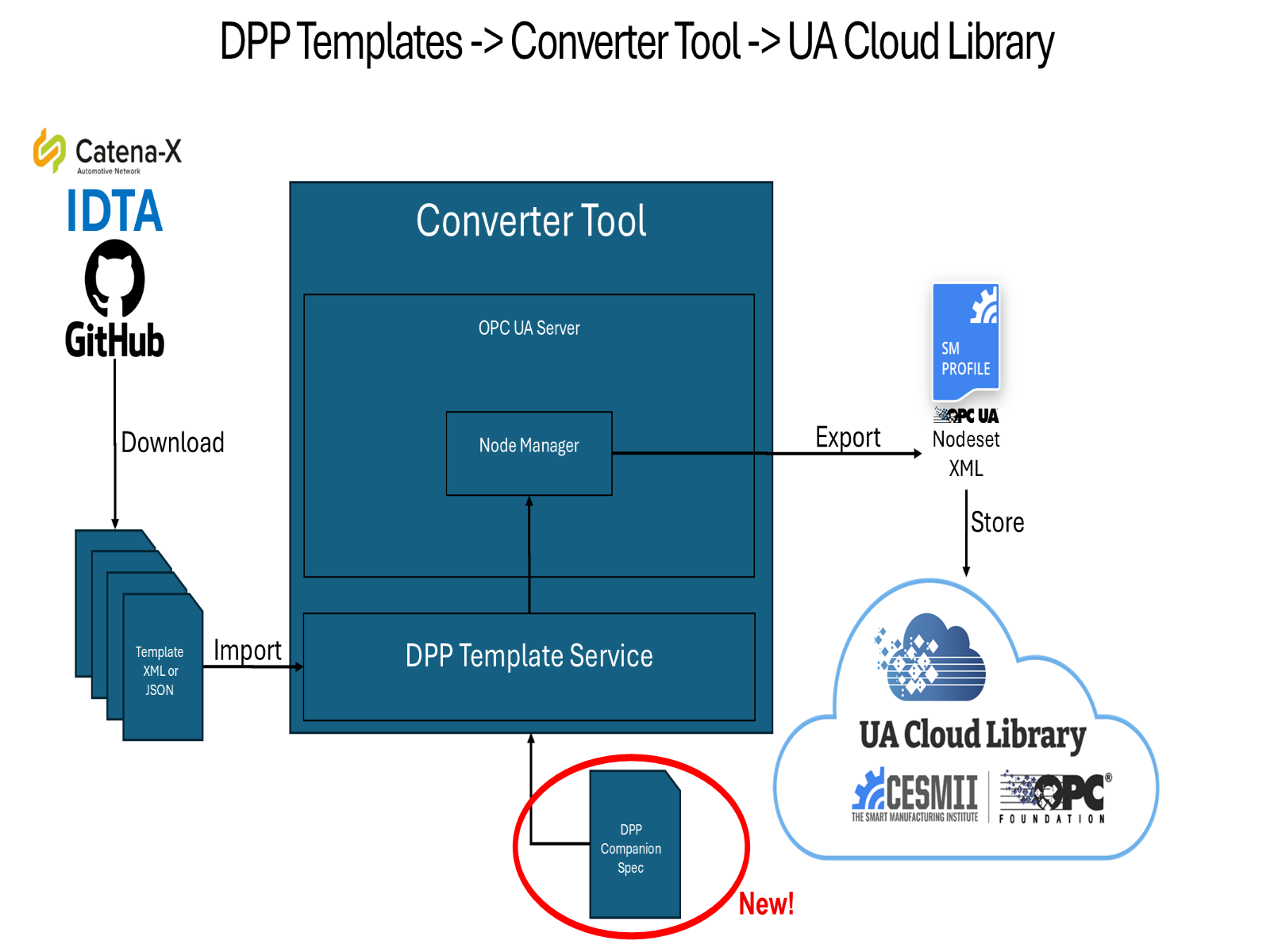
An example of an overall DigitalProductPassport architecture for batteries described by a is depicted in the Figure 2 which makes use of open-source components provided by the OPC Foundation.
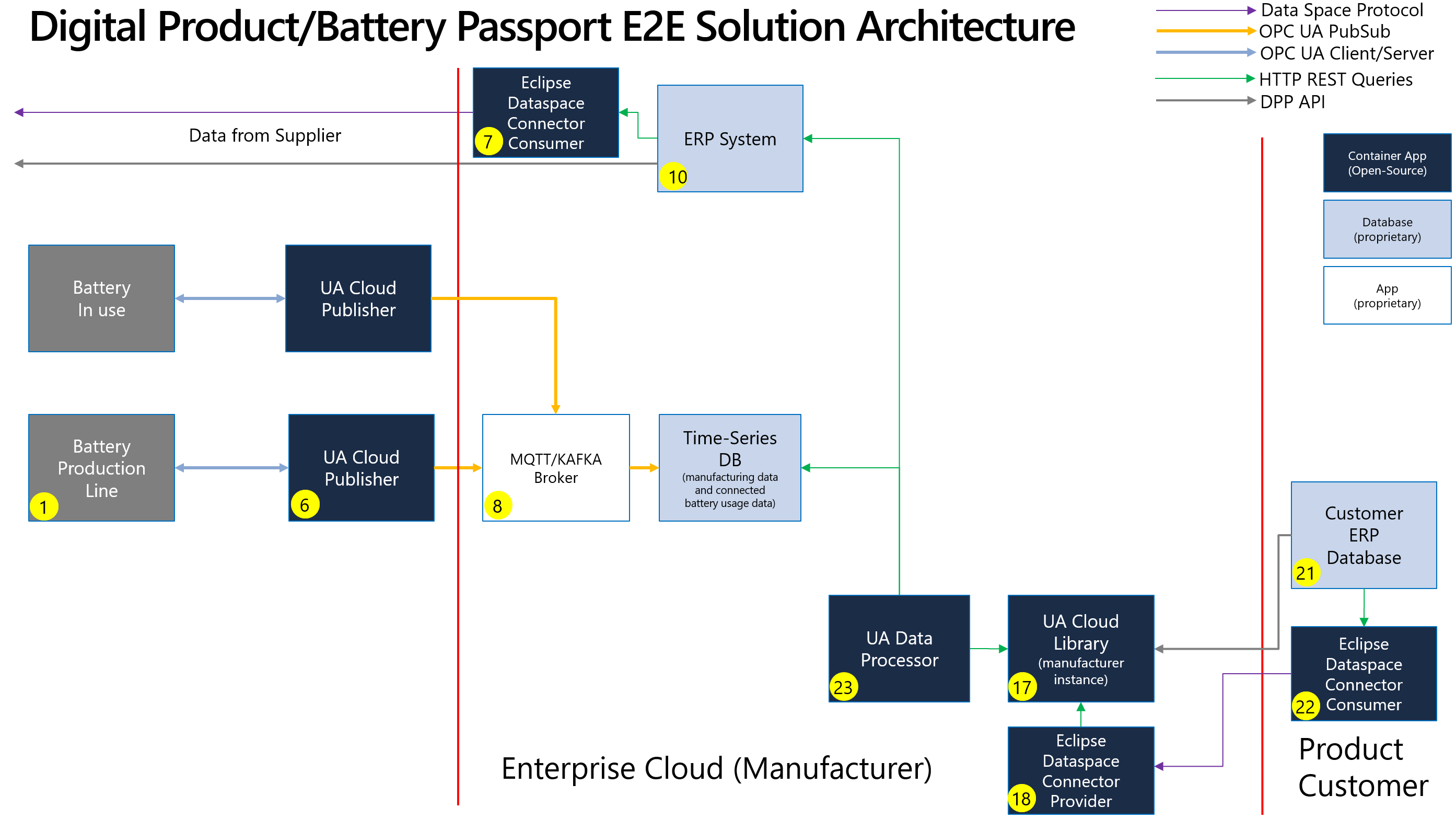
In Figure 2, the Companion Specification will be used within the UA Data Processor, reading battery production data, battery usage data and battery Bill of Materials (BoM) from different data sources and constructing a Digital Battery Passport (DBP) from this information. The DBP is then stored in OPC UA NodeSet file format and uploaded to the UA Cloud Library for retrieval via the DPP API by the battery's customer (called Product Customer in the diagram).