DisplayLanguage: is the language used for the local display of the device. ABN597#004 defines language or languages set on the display.
DateOfLastChange: ABN604#001 defines parameter indicating the date and time at which one of the device parameters was changed the last time.
FactoryReset: ABN609#002 property the value of which indicates the kind of reset function to be executed. Note: Properties can be variables or methods according IEC 61987 CDD.
The components of IAdministrationType have additional references which are defined in Table 17.
The child Nodes of the ICalibrationType have additional Attribute values defined in Table 22.
Table 22 – ICalibrationType Attribute values for child Nodes
BrowsePath
Value Attribute
CalibrationTimestamp
1/1/1601 12:00:00 AM
TypeOfCalibration
0
TypeOfCalibration
0:ValueAsDictionaryEntries
ns=3;s=0112/2///61987#ABP732#001
TypeOfCalibration
0:ValueAsText
adjustment
7.1.4 IConductivityCalibrationType
The IConductivityCalibrationType provides the interface to conductivity measurement specific calibration variables of the sensor resp. signal and is formally defined in Table 23.
The IAmperometricCalibrationType provides the interface to amperometric measurement specific calibration variables of the sensor resp. signal and is formally defined in Table 26.
The IOpticalFluorescenseQuenchingCalibrationType provides the interface to optical fluorescence quenching measurement specific calibration variables of the sensor resp. signal and is formally defined in Table 29.
The IGasChromatographCalibrationType provides the interface to gaschromatograph measurement specific calibration variables of the sensor resp. signal and is formally defined in Table 32.
Subtype of 0:BaseInterfaceType defined in OPC 10000-5, i.e. inheriting the InstanceDeclarations of that Node
0:HasProperty
Variable
CalibrationRange1ResponseFactor
0:Float
0:PropertyType
O
0:HasComponent
Variable
CalibrationRange1LowerRangeValue
0:Float
0:AnalogUnitType
O
0:HasComponent
Variable
CalibrationRange1UpperRangeValue
0:Float
0:AnalogUnitType
O
0:HasProperty
Variable
CalibrationRange2ResponseFactor
0:Float
0:PropertyType
O
0:HasComponent
Variable
CalibrationRange2LowerRangeValue
0:Float
0:AnalogUnitType
O
0:HasComponent
Variable
CalibrationRange2UpperRangeValue
0:Float
0:AnalogUnitType
O
0:HasProperty
Variable
CalibrationRange3ResponseFactor
0:Float
0:PropertyType
O
0:HasComponent
Variable
CalibrationRange3LowerRangeValue
0:Float
0:AnalogUnitType
O
0:HasComponent
Variable
CalibrationRange3UpperRangeValue
0:Float
0:AnalogUnitType
O
Conformance Units
PA-DIM GasChromatograph CalibrationRange1
PA-DIM GasChromatograph CalibrationRange2
PA-DIM GasChromatograph CalibrationRange3
CalibrationRange1ResponseFactor is defined by IRDI as ABQ024#001 which states "ratio between the concentration of a compound being analysed and the response of the detector to that compound for the calibration range 1".
CalibrationRange1LowerRangeValue is defined by IRDI as ABQ025#001 which states "volume concentration value assigned to the lower range end-value of calibration range 1".
CalibrationRange1UpperRangeValue is defined by IRDI as ABQ026#001 which states "volume concentration value assigned to the upper range end-value of calibration range 1".
CalibrationRange2ResponseFactor is defined by IRDI as ABQ027#001 which states "ratio between the concentration of a compound being analysed and the response of the detector to that compound for the calibration range 2".
CalibrationRange2LowerRangeValue is defined by IRDI as ABQ028#001 which states "volume concentration value assigned to the lower range end-value of calibration range 2".
CalibrationRange2UpperRangeValue is defined by IRDI as ABQ029#001 which states "volume concentration value assigned to the upper range end-value of calibration range 2".
CalibrationRange3ResponseFactor is defined by IRDI as ABQ030#001 which states "ratio between the concentration of a compound being analysed and the response of the detector to that compound for the calibration range 3".
CalibrationRange3LowerRangeValue is defined by IRDI as ABQ031#001 which states "volume concentration value assigned to the lower range end-value of calibration range 3".
CalibrationRange3UpperRangeValue is defined by IRDI as ABQ032#001 which states "volume concentration value assigned to the upper range end-value of calibration range 3".
The components of IGasChromatographCalibrationType have additional references which are defined in Table 33.
The IGasChromatographDeviceConditionSetType provides the interface to gas chromatograph device specific condition variables and is formally defined in Table 46
The IFtnirOrFtirDeviceConditionSetType provides the interface to Fourier Transform Near-Infrared Spectroscopy or Fourier Transform Infrared Spectroscopy device specific condition variables and is formally defined in Table 49.
The child Nodes of the IFtnirOrFtirDeviceConditionSetType have additional Attribute values defined in Table 51.
Table 51 – IFtnirOrFtirDeviceConditionSetType Attribute values for child Nodes
BrowsePath
Value Attribute
RemainingDataStorageCapacity
0.0
7.1.14 IDiodeArrayDeviceConditionSetType
The IDiodeArrayDeviceConditionSetType provides the interface to Diode array spectrometer device specific condition variables and is formally defined in Table 52.
The INonDispersiveInfraredSignalConditionSetTypeprovides the interface to NDIR measurement signal specific condition variables and is formally defined in Table 58.
The IParamagneticSignalConditionSetTypeprovides the interface to paramagnetic measurement signal specific condition variables and is formally defined in Table 64.
The IThermalConductivitySignalConditionSetType provides the interface to thermal conductivity measurement signal specific condition variables and is formally defined in Table 67.
The ITunableDiodeLaserSignalConditionSetTypeprovides the interface to TDL measurement signal specific condition variables and is formally defined in Table 70.
The IZirconiumDioxideSignalConditionSetType provides the interface to Zirconium dioxide measurement signal specific condition variables and is formally defined in Table 73.
The IConductivitySignalConditionSetType provides the interface to conductivity measurement signal specific condition variables and is formally defined in Table 79.
The IAmperometricSignalConditionSetType provides the interface to amperometric measurement signal specific condition variables and is formally defined in Table 82.
The IAmperometricGasDetectorSignalConditionSetType provides the interface to Amperometric Electrochemical signal specific condition variables and is formally defined in Table 85
The IOpticalFluorescenseQuenchingSignalConditionSetType provides the interface to optical fluorescence quenching measurement signal specific condition variables and is formally defined in Table 88.
The IGasChromatographSignalConditionSetType provides the interface to gaschromatograph measurement signal specific condition variables and is formally defined in Table 91
The child Nodes of the IGasChromatographSignalConditionSetType have additional Attribute values defined in Table 93.
Table 93 – IGasChromatographSignalConditionSetType Attribute values for child Nodes
BrowsePath
Value Attribute
PeakWidth
0
PeakHeight
0
PeakArea
0
TailingFactor
1.0
ExpectedRetentionTime
0
ActualRetentionTime
0
InjectionTime
1/1/1601 12:00:00 AM
ComponentName
7.1.28 IFtnirOrFtirSignalConditionSetType
The IFtnirOrFtirSignalConditionSetTypeprovides the interface to FT NIR or FT IR signal specific condition variables and is formally defined in Table 94
The child Nodes of the IInfraredSignalConditionSetType have additional Attribute values defined in Table 105.
Table 105 – IInfraredSignalConditionSetType Attribute values for child Nodes
BrowsePath
Value Attribute
SensingElementTemperature
0
SourceResidualLife
1.0
TransmissionRatio
0
SensorNextCalibrationFixed
0
SensorNextCalibrationDynamic
0
PowerOnDurationSensor
0
SensingElementResidualLife
1.0
RelativeGasFlowRate
0
SensingElementResidualSensitivity
1.0
7.1.32 ICatalyticBeadSignalConditionSetType
The ICatalyticBeadSignalConditionSetType provides the interface to Catalytic Bead signal specific condition variables and is formally defined in Table 106
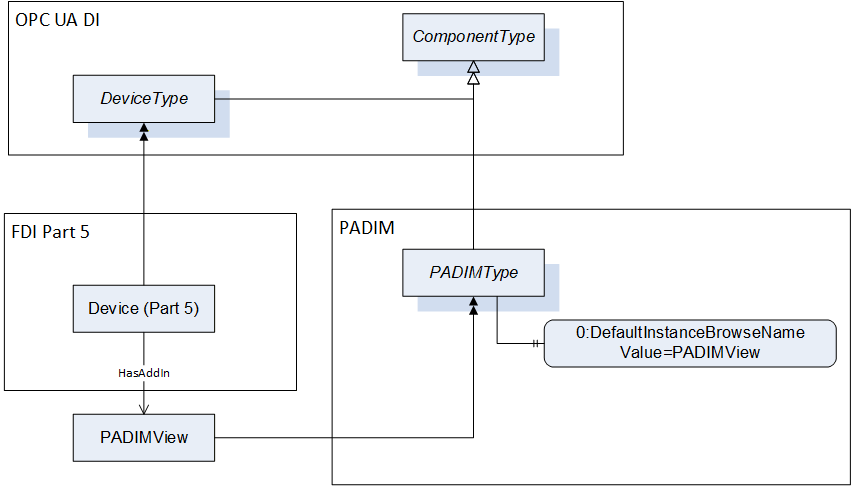
The DefaultInstanceBrowseName Property – defined in OPC 10000-3 – is used to specify the recommended BrowseName for instances of the PADIMType, see Figure 11. Its Value is defined in Table 112.
The following figure illustrates the usage of DefaultInstanceBrowseName.
Figure 11 – Example of Integration of PA-DIM with FDI Part 5 Information Model
The IVendorNamePlateType Interface items that are listed are actually inherited from ComponentType and are listed here because the ModellingRule for these instances is revised to be mandatory (they are optional in ComponentType) or restrictions are introduced here (for 2:DeviceRevision).
DeviceRevision provides the overall revision level of a hardware component or the Device. As an example, this Property can be used in ERP systems together with the ProductCode Property. SemanticVersionString (a sub-type of String defined in OPC 10000-5) shall be used when using the Semantic Versioning format. Each of <major>, <minor>, <patch> shall be able to represent a two-byte integer.
The ITagNamePlateType Interface item that is listed is actually inherited from ComponentType and is listed here because the ModellingRule for the instance is revised to be mandatory, it is only optional in ComponentType.
The DateOfLastChange shall be timestamped in the OPC UA Server.
3:<DictionaryEntryName> is an optional placeholder for an object of IrdiDictionaryEntryType that defines a predefined group of one or more classes below ABV000, e.g. Final control element or Measuring instrument. ABV000 is defined in IEC 61987 Common Data Dictionary (CDD). A Measuring instrument could be e.g. a Coriolis mass flow transmitter with the IrdiIdentifier 3:0112/2///61987#ABA763#003.
The optional SubDevices Object is used to expose sub-devices. The contained SupportedTypes Object (see OPC 10000-100) shall only reference PADIMType or ObjectTypes that are subtypes of the PADIMType, and thus all subdevices shall be instances of PADIMType or subtypes.
DeviceConditionSet is a container object for the condition parameters of the device. It has a reference to IGeneralDeviceConditionSetType to add device specific condition variables.
The components of PADIMType have additional references which are defined in Table 110.
The child Nodes of the PADIMType have additional Attribute values defined in Table 112. An empty field in the column “Value Attribute” means: the text field of the variable’s value attribute has the length 0.
Table 112 – PADIMType Attribute values for child Nodes
BrowsePath
Value Attribute
2:Manufacturer
2:ManufacturerUri
2:Model
2:SerialNumber
2:ProductCode
2:HardwareRevision
2:SoftwareRevision
2:DeviceRevision
1.0.0
2:RevisionCounter
0
2:ProductInstanceUri
2:AssetId
2:DeviceHealth
0
DisplayLanguage
en
DateOfLastChange
1/1/1601 12:00:00 AM
0:DefaultInstanceBrowseName
PADIMView
7.3 ProcessAnalyserType
The ProcessAnalyserType is a subtype of the PADIMType. It is formally defined in Table 113.
Table 113 – ProcessAnalyserType definition
Attribute
Value
BrowseName
ProcessAnalyserType
IsAbstract
False
References
NodeClass
BrowseName
DataType
TypeDefinition
Other
Subtype of PADIMType defined in 7.2, i.e. inheriting the InstanceDeclarations of that Node
3:0112/2///61987#ABP444#002 is a TOC analyser device specific manifestation of the 3:<DictionaryEntryName> placeholder described in PADIMType.
DeviceConditionSet is a container object for the condition parameters of the device. It is inherited from PADIMType and has an additional interface reference to ITocDeviceConditionSetType to add TOC analyser device specific condition variables.
The components of TocAnalyserType have additional references which are defined in Table 116.
3:0112/2///61987#ABP410#002 is an FID device specific manifestation of the 3:<DictionaryEntryName> placeholder described in PADIMType.
DeviceConditionSet is a container object for the condition parameters of the device. It is inherited from PADIMType and has an additional interface reference to IFlameIonisationDeviceConditionSetType to add FID device specific condition variables.
The components of FlameIonisationDetectorType have additional references which are defined in Table 120.
3:0112/2///61987#ABP436#002 is a paramagnetic measurement device specific manifestation of the 3:<DictionaryEntryName> placeholder described in PADIMType.
7.8 ThermalConductivityGasAnalyserType
The ThermalConductivityGasAnalyserType is a subtype of the ProcessAnalyserType. It is formally defined in Table 124.
3:0112/2///61987#ABP453#002 is a thermal conductivity measurement device specific manifestation of the 3:<DictionaryEntryName> placeholder described in PADIMType.
7.9 TunableDiodeLaserSpectrometerType
The TunableDiodeLaserSpectrometerType is a subtype of the ProcessAnalyserType. It is formally defined in Table 125.
3:0112/2///61987#ABP409#002 is a Zirconium dioxide measurement device specific manifestation of the 3:<DictionaryEntryName> placeholder described in PADIMType.
7.11 PhMeterType
The PhMeterType is a subtype of the ProcessAnalyserType. It is formally defined in Table 127.
Table 127 – PhMeterType definition
Attribute
Value
BrowseName
PhMeterType
IsAbstract
False
References
NodeClass
BrowseName
DataType
TypeDefinition
Other
Subtype of ProcessAnalyserType defined in 7.3, i.e. inheriting the InstanceDeclarations of that Node
3:0112/2///61987#ABP423#002 is an optical Fluorescence quenching sensor specific manifestation of the 3:<DictionaryEntryName> placeholder described in PADIMType.
7.15 GasChromatographType
The GasChromatographTypeis a subtype of the ProcessAnalyserType. It is formally defined in Table 131.
Table 131 – GasChromatographType definition
Attribute
Value
BrowseName
GasChromatographType
IsAbstract
False
References
NodeClass
BrowseName
DataType
TypeDefinition
Other
Subtype of ProcessAnalyserType defined in 7.3, i.e. inheriting the InstanceDeclarations of that Node
3:0112/2///61987#ABP432#002 is a fourier transform near infrared or fourier transform infrared specific manifestation of the 3:<DictionaryEntryName> placeholder described in PADIMType.
7.20 DiodeArraySpectrometerType
The DiodeArraySpectrometerTypeis a subtype of the ProcessAnalyserType. It is formally defined in Table 139.
Table 139 – DiodeArraySpectrometerType definition
Attribute
Value
BrowseName
DiodeArraySpectrometerType
IsAbstract
False
References
NodeClass
BrowseName
DataType
TypeDefinition
Other
Subtype of ProcessAnalyserType defined in 7.3, i.e. inheriting the InstanceDeclarations of that Node
0112/2///61987#ABP434#002 is a Raman spectrometer specific manifestation of the 3:<DictionaryEntryName> placeholder described in PADIMType.
7.22 SignalSetType
The SignalSetType provides the signals of the device and is formally defined in Table 141.
Table 141 – SignalSetType definition
Attribute
Value
BrowseName
SignalSetType
IsAbstract
False
References
NodeClass
BrowseName
DataType
TypeDefinition
Other
Subtype of 0:BaseObjectType defined in OPC 10000-5, i.e. inheriting the InstanceDeclarations of that Node
0:HasComponent
Object
<SignalIdentifier>
SignalType
OP
Conformance Units
PA-DIM SignalSet
The child Nodes of the SignalSetType have additional Attribute values defined in Table 142. An empty field in the column “Value Attribute” means: the text field of the variable’s value attribute has the length 0.
Table 142 – SignalSetType Attribute values for child Nodes
BrowsePath
Value Attribute
<SignalIdentifier>
SignalTag
7.23 CalibrationPointSetType
The CalibrationPointSetType provides the calibration points of a sensor resp. signal and is formally defined in Table 143.
Table 143 – CalibrationPointSetType definition
Attribute
Value
BrowseName
CalibrationPointSetType
IsAbstract
False
References
NodeClass
BrowseName
DataType
TypeDefinition
Other
Subtype of 0:BaseObjectType defined in OPC 10000-5, i.e. inheriting the InstanceDeclarations of that Node
0:HasComponent
Object
<CalibrationPointIdentifier>
CalibrationPointType
OP
Conformance Units
PA-DIM ICalibration CalibrationPointSet
7.24 GeneralDeviceConditionSetType
The GeneralDeviceConditionSetType provides the general condition variables of the device ore one of its components and is formally defined in Table 144.
The SignalType provides ObjectType to add analog and discrete signals and is formally defined in Table 147. In order to have a common approach, PA-DIM will always use Objects, even if no Method is needed for some types.
Table 147 – SignalType definition
Attribute
Value
BrowseName
SignalType
IsAbstract
False
References
NodeClass
BrowseName
DataType
TypeDefinition
Other
Subtype of 0:BaseObjectType defined in OPC 10000-5, i.e. inheriting the InstanceDeclarations of that Node
0:HasProperty
Variable
SignalTag
0:String
0:PropertyType
M
Conformance Units
PA-DIM SignalSet
SignalTag is defined by IRDI as ABB271#009 which states “alphanumeric character sequence uniquely identifying a measuring or control point”
The components of SignalType have additional references which are defined in Table 148.
The child Nodes of the SignalType have additional Attribute values defined in Table 149. An empty field in the column “Value Attribute” means: the text field of the variable’s value attribute has the length 0.
Table 149 – SignalType Attribute values for child Nodes
BrowsePath
Value Attribute
SignalTag
7.26 AnalogSignalType
The AnalogSignalType provides ObjectType to add variables and ZeroPointAdjustment Method. It is formally defined in Table 150.
Table 150 – AnalogSignalType definition
Attribute
Value
BrowseName
AnalogSignalType
IsAbstract
False
References
NodeClass
BrowseName
DataType
TypeDefinition
Other
Subtype of SignalType defined in 7.23, i.e. inheriting the InstanceDeclarations of that Node
ZeroPointAdjustment: ABN614#002 defines property that initiates when set the TRUE (ON) state a procedure, which maybe automatic, to define or set the value zero of the output. Remark: properties can be variables or methods according to IEC 61987 CDD.
AnalogSignal provides the measured or readback process value. The unit of this value is provided by the EngineeringUnits property.
<SignalCalibrationIdentifier> is a container object for the calibration parameters of the signal. It has an interface reference to ICalibrationType in order to add general calibration variables. Since it is a placeholder, an instance of AnalogSignalType can have several calibration objects.
SignalConditionSet is a container object for the condition parameters of the signal.
The components of AnalogSignalType have additional references which are defined in Table 151.
SignalConditionSet is a container object for the condition parameters of the signal. It is inherited from AnalogSignalType and has an additional interface reference to INonDispersiveInfraredSignalConditionSetType to add NDIR signal specific condition variables. The components of NonDispersiveInfraredSignalType have additional references which are defined in Table 157.
The TocSignalType provides ObjectType to add TOC measurement specific variables. It is formally defined in Table 160.
Table 160 – TocSignalType definition
Attribute
Value
BrowseName
TocSignalType
IsAbstract
False
References
NodeClass
BrowseName
DataType
TypeDefinition
Other
Subtype of AnalyticalSignalType defined in 7.27, i.e. inheriting the InstanceDeclarations of that Node
0:HasComponent
Object
SignalConditionSet
0:BaseObjectType
O
Conformance Units
PA-DIM TocSignalType
PA-DIM TocSignalType ChopperFrequencyDeviation
PA-DIM TocSignalType RelativeReagentLevel
PA-DIM TocSignalType AbsoluteSampleGasPressure
PA-DIM TocSignalType SampleGasVolumeFlow
SignalConditionSet is a container object for the condition parameters of the signal. It is inherited from AnalogSignalType and has an additional interface reference to ITocSignalConditionSetType to add TOC signal specific condition variables.
The components of TocSignalType have additional references which are defined in Table 161.
The ParamagneticSignalType provides ObjectType to add paramagnetic measurement specific variables. It is formally defined in Table 164.
Table 164 – ParamagneticSignalType definition
Attribute
Value
BrowseName
ParamagneticSignalType
IsAbstract
False
References
NodeClass
BrowseName
DataType
TypeDefinition
Other
Subtype of AnalyticalSignalType defined in 7.27, i.e. inheriting the InstanceDeclarations of that Node
0:HasComponent
Object
SignalConditionSet
0:BaseObjectType
O
Conformance Units
PA-DIM ParamagneticSignalType
SignalConditionSet is a container object for the condition parameters of the signal. It is inherited from AnalogSignalType and has an additional interface reference to IParamagneticSignalConditionSetType to add paramagnetic signal specific condition variables.
The components of ParamagneticSignalType have additional references which are defined in Table 165.
Subtype of AnalyticalSignalType defined in 7.27, i.e. inheriting the InstanceDeclarations of that Node
0:HasComponent
Object
SignalConditionSet
0:BaseObjectType
O
Conformance Units
PA-DIM ThermalConductivitySignalType
SignalConditionSet is a container object for the condition parameters of the signal. It is inherited from AnalogSignalType and has an additional interface reference to IThermalConductivitySignalConditionSetType to add thermal conductivity signal specific condition variables.
The components of ThermalConductivitySignalType have additional references which are defined in Table 169.
SignalConditionSet is a container object for the condition parameters of the signal. It is inherited from AnalogSignalType and has an additional interface reference to ITunableDiodeLaserSignalConditionSetType to add TDL signal specific condition variables.
The components of TunableDiodeLaserSignalType have additional references which are defined in Table 173.
SignalConditionSet is a container object for the condition parameters of the signal. It is inherited from AnalogSignalType and has an additional interface reference to IZirconiumDioxideSignalConditionSetType to add Zirconium dioxide signal specific condition variables.
The components of ZirconiumDioxideSignalType have additional references which are defined in Table 177.
The PhSignalType provides ObjectType to add pH measurement specific variables. It is formally defined in Table 180.
Table 180 – PhSignalType definition
Attribute
Value
BrowseName
PhSignalType
IsAbstract
False
References
NodeClass
BrowseName
DataType
TypeDefinition
Other
Subtype of AnalyticalSignalType defined in 7.27, i.e. inheriting the InstanceDeclarations of that Node
0:HasComponent
Object
<SignalCalibrationIdentifier>
0:BaseObjectType
OP
0:HasComponent
Object
SignalConditionSet
0:BaseObjectType
O
Conformance Units
PA-DIM PhSignalType
PA-DIM PhSignalType SensorNextCalibration
PA-DIM PhSignalType SensingElementImpedance
PA-DIM PhSignalType SensorReferenceImpedance
PA-DIM PhSignalType SensorCleaningsCounter
PA-DIM PhSignalType SensorSterilisationsCounter
PA-DIM IPhCalibration SensorT90
<SignalCalibrationIdentifier> is a container object for the calibration parameters of the signal. It is inherited from AnalogSignalType and has an additional interface reference to IPhCalibrationType to add pH signal specific calibration variables. Since it is a placeholder, an instance of PhSignalType can have several calibration objects.
SignalConditionSet is a container object for the condition parameters of the signal. It is inherited from AnalogSignalType and has an additional interface reference to IPhSignalConditionSetType to add pH signal specific condition variables.
The components of PhSignalType have additional references which are defined in Table 181.
<SignalCalibrationIdentifier> is a container object for the calibration parameters of the signal. It is inherited from AnalogSignalType and has an additional interface reference to IConductivityCalibrationType to add conductivity signal specific calibration variables. Since it is a placeholder, an instance of ConductivitySignalType can have several calibration objects.
SignalConditionSet is a container object for the condition parameters of the signal. It is inherited from AnalogSignalType and has an additional interface reference to IConductivitySignalConditionSetType to add conductivity signal specific condition variables.
The components of ConductivitySignalType have additional references which are defined in Table 185.
<SignalCalibrationIdentifier> is a container object for the calibration parameters of the signal. It is inherited from AnalogSignalType and has an additional interface reference to IAmperometricCalibrationType to add amperometric signal specific calibration variables. Since it is a placeholder, an instance of AnalogSignalType can have several calibration objects.
SignalConditionSet is a container object for the condition parameters of the signal. It is inherited from AnalogSignalType and has an additional interface reference to IAmperometricSignalConditionSetType to add amperometric signal specific condition variables.
The components of AmperometricSignalType have additional references which are defined in Table 189.
Subtype of AnalyticalSignalType defined in 7.27, i.e. inheriting the InstanceDeclarations of that Node
0:HasComponent
Object
<SignalCalibrationIdentifier>
0:BaseObjectType
OP
0:HasComponent
Object
SignalConditionSet
0:BaseObjectType
O
Conformance Units
PA-DIM AmperometricGasDetectorSignalType
<SignalCalibrationIdentifier> is a container object for the calibration parameters of the signal. It is inherited from AnalogSignalType and has an additional interface reference to IAmperometricCalibrationType to add amperometric signal specific calibration variables. Since it is a placeholder, an instance of AnalogSignalType can have several calibration objects.
SignalConditionSet is a container object for the condition parameters of the signal. It is inherited from AnalogSignalType and has an additional interface reference to IAmperometricSignalConditionSetType to add amperometric signal specific condition variables.
The components of AmperometricSignalType have additional references which are defined in Table 193.
The OpticalFluorescenseQuenchingSignalType provides ObjectType to add optical fluorescence quenching measurement specific variables. It is formally defined in Table 196.
<SignalCalibrationIdentifier> is a container object for the calibration parameters of the signal. It is inherited from AnalogSignalType and has an additional interface reference to IOpticalFluorescenseQuenchingCalibrationType to add optical fluorescence quenching signal specific calibration variables. Since it is a placeholder, an instance of AnalogSignalType can have several calibration objects.
SignalConditionSet is a container object for the condition parameters of the signal. It is inherited from AnalogSignalType and has an additional interface reference to IOpticalFluorescenseQuenchingSignalConditionSetType to add optical fluorescence quenching signal specific condition variables.
The components of OpticalFluorescenseQuenchingSignalType have additional references which are defined in Table 197.
The GasChromatographSignalType provides ObjectType to add gaschromatograph measurement specific variables. It is formally defined in Table 200.
Table 200 – GasChromatographSignalType definition
Attribute
Value
BrowseName
GasChromatographSignalType
IsAbstract
False
References
NodeClass
BrowseName
DataType
TypeDefinition
Other
Subtype of AnalyticalSignalType defined in 7.27, i.e. inheriting the InstanceDeclarations of that Node
0:HasComponent
Object
<SignalCalibrationIdentifier>
0:BaseObjectType
OP
0:HasComponent
Object
SignalConditionSet
0:BaseObjectType
O
Conformance Units
PA-DIM GasChromatographSignalType
PA-DIM GasChromatographSignalType Peak
PA-DIM GasChromatographSignalType RetentionTime
PA-DIM GasChromatographSignalType InjectionTime
PA-DIM GasChromatographSignalType ComponentName
<SignalCalibrationIdentifier> is a container object for the calibration parameters of the signal. It is inherited from AnalogSignalType and has an additional interface reference to IGasChromatographCalibrationType to add Gaschromatograph signal specific calibration variables. Since it is a placeholder, an instance of GasChromatographSignalType can have several calibration objects.
SignalConditionSet is a container object for the condition parameters of the signal. It is inherited from AnalogSignalType and has an additional interface reference to IGasChromatographSignalConditionSetType to add Gaschromatograph signal specific condition variables.
The components of GasChromatographSignalType have additional references which are defined inTable 201.
SignalConditionSet is a container object for the condition parameters of the signal. It is inherited from AnalogSignalType and has an additional interface reference to IInfraredSignalConditionSetType to add Infrared signal specific condition variables.
The components of InfraredSignalType have additional references which are defined in Table 206.
<SignalCalibrationIdentifier> is a container object for the calibration parameters of the signal. It is inherited from AnalogSignalType and has an additional interface reference to ICatalyticBeadCalibrationType to add Catalytic Bead signal specific calibration variables. Since it is a placeholder, an instance of CatalyticBeadSignalType can have several calibration objects.
SignalConditionSet is a container object for the condition parameters of the signal. It is inherited from AnalogSignalType and has an additional interface reference to ICatalyticBeadSignalConditionSetType to add Catalytic Bead signal specific condition variables.
The components of CatalyticBeadSignalType have additional references which are defined in Table 210.
The FtnirOrFtirSignalType provides ObjectType to add FT NIR or FT IR specific variables. It is formally defined in Table 213.
Table 213 – FtnirOrFtirSignalType definition
Attribute
Value
BrowseName
FtnirOrFtirSignalType
IsAbstract
False
References
NodeClass
BrowseName
DataType
TypeDefinition
Other
Subtype of AnalyticalSignalType defined in 7.27, i.e. inheriting the InstanceDeclarations of that Node
0:HasComponent
Object
<SignalCalibrationIdentifier>
0:BaseObjectType
OP
0:HasComponent
Object
SignalConditionSet
0:BaseObjectType
O
Conformance Units
PA-DIM FtnirOrFtirSignalType
PA-DIM FtnirOrFtirSignalType TransmissionRatio
PA-DIM FtnirOrFtirSignalType MahalanobisDistance
PA-DIM FtnirOrFtirSignalType SpectralResidual
PA-DIM FtnirOrFtirSignalType ElectronicsReadNoise
PA-DIM FtnirOrFtirSignalType LaserResidualLife
<SignalCalibrationIdentifier> is a container object for the calibration parameters of the signal. It is inherited from AnalogSignalType. Since it is a placeholder, an instance of FtnirOrFtirSignalType can have several calibration objects.
SignalConditionSet is a container object for the condition parameters of the signal. It is inherited from AnalogSignalType and has an additional interface reference to IFtnirOrFtirSignalConditionSetType to add FtnirOrFtirSignalType signal specific condition variables.
The components of FtnirOrFtirSignalType have additional references which are defined in Table 214
The DiodeArraySignalType provides ObjectType to add Diode Array specific variables. It is formally defined in Table 217.
Table 217 – DiodeArraySignalType definition
Attribute
Value
BrowseName
DiodeArraySignalType
IsAbstract
False
References
NodeClass
BrowseName
DataType
TypeDefinition
Other
Subtype of AnalyticalSignalType defined in 7.27, i.e. inheriting the InstanceDeclarations of that Node
0:HasComponent
Object
<SignalCalibrationIdentifier>
0:BaseObjectType
OP
0:HasComponent
Object
SignalConditionSet
0:BaseObjectType
O
Conformance Units
PA-DIM DiodeArraySignalType
PA-DIM DiodeArraySignalType SourceResidualLife
PA-DIM DiodeArraySignalType MahalanobisDistance
PA-DIM DiodeArraySignalType SpectralResidual
PA-DIM DiodeArraySignalType ElectronicsReadNoise
<SignalCalibrationIdentifier> is a container object for the calibration parameters of the signal. It is inherited from AnalogSignalType. Since it is a placeholder, an instance of DiodeArraySignalType can have several calibration objects.
SignalConditionSet is a container object for the condition parameters of the signal. It is inherited from AnalogSignalType and has an additional interface reference to IDiodeArraySignalConditionSetType to add DiodeArraySignalType signal specific condition variables.
7.45 RamanSignalType
The RamanSignalType provides ObjectType to add Diode Array specific variables. It is formally defined in Table 217.
Table 218 – RamanSignalType definition
Attribute
Value
BrowseName
RamanSignalType
IsAbstract
False
References
NodeClass
BrowseName
DataType
TypeDefinition
Other
Subtype of AnalyticalSignalType defined in 7.27, i.e. inheriting the InstanceDeclarations of that Node
0:HasComponent
Object
<SignalCalibrationIdentifier>
0:BaseObjectType
OP
0:HasComponent
Object
SignalConditionSet
0:BaseObjectType
O
Conformance Units
PA-DIM RamanSignalType
PA-DIM RamanSignalType SourceResidualLife
PA-DIM RamanSignalType MahalanobisDistance
PA-DIM RamanSignalType SpectralResidual
PA-DIM RamanSignalType ElectronicsReadNoise
<SignalCalibrationIdentifier> is a container object for the calibration parameters of the signal. It is inherited from AnalogSignalType. Since it is a placeholder, an instance of RamanSignalType can have several calibration objects.
SignalConditionSet is a container object for the condition parameters of the signal. It is inherited from AnalogSignalType and has an additional interface reference to IRamanSignalConditionSetType to add RamanSignalType signal specific condition variables.
7.46 ControlSignalType
The ControlSignalType provides ObjectType to add variables and an AutoAdjustPositioner Method. It is formally defined in Table 219.
Table 219 – ControlSignalType definition
Attribute
Value
BrowseName
ControlSignalType
IsAbstract
False
References
NodeClass
BrowseName
DataType
TypeDefinition
Other
Subtype of SignalType defined in 7.23, i.e. inheriting the InstanceDeclarations of that Node
AutoAdjustPositioner: ABN726#002 defines a property the value of which indicates the kind of adjustment function to be executed.
ControlSignal provides the readback process value. This is the position of the final control element within the travel span (between OPEN and CLOSE position). The unit of this value is provided by the EngineeringUnits property.
The components of ControlSignalType have additional references which are defined in Table 220.
Subtype of SignalType defined in 7.25, i.e. inheriting the InstanceDeclarations of that Node
0:HasComponent
Variable
ControlSignal
0:Boolean{Any}
TwoStateDiscreteControlVariableType
M
Conformance Units
PA-DIM TwoStateDiscreteControl Signal
ControlSignal provides the two-state discrete readback value.
The child Nodes of the TwoStateDiscreteControlSignalType have additional Attribute values defined in Table 228.
Table 228 – TwoStateDiscreteControlSignalType Attribute values for child Nodes
BrowsePath
Value Attribute
ControlSignal
False
ControlSignal
0:FalseState
FALSE
ControlSignal
0:TrueState
TRUE
ControlSignal
Setpoint
False
ControlSignal
Setpoint
0:FalseState
FALSE
ControlSignal
Setpoint
0:TrueState
TRUE
ControlSignal
OperatingDirection
0
ControlSignal
OperatingDirection
0:ValueAsDictionaryEntries
ns=3;s=0112/2///61987#ABL147#001
ControlSignal
OperatingDirection
0:ValueAsText
direct
7.51 MultiStateDiscreteControlSignalType
The MultiStateDiscreteControlSignalType provides ObjectType to add variables related to multi state discrete output. It is formally defined in Table 229.
3:<DictionaryEntryName> is a placeholder for an object of IrdiDictionaryEntryType that represents a property defined in IEC 61987 Common Data Dictionary (CDD). In instances of CalibrationPointType it shall be replaced by an object of IrdiDictionaryEntryType depending on the type of PAT measurement, following these rules:
For CalibrationSetpoint it shall be replaced by one of the following CDD properties: ABP597#001, ABP600#001, ABP603#001, ABP606#001, ABP609#001, ABP612#001, ABP615#001, ABP618#001 (input values for the calibration of PAT concentration measurement), ABP637#001, ABP621#001, ABP624#001, ABP627#001, ABP630#001, or ABP633#001 (input values for the calibration of PAT liquid analysis measurement). If further types of PAT measurements are defined in the CDD in the future, the corresponding properties of these measurement types will also be permitted.
For CalibrationActualValue it shall be replaced by one of the following CDD properties: ABP598#001, ABP601#001, ABP604#001, ABP607#001, ABP610#001, ABP613#001, ABP616#001, ABP619#001 (digital output values measured during the PAT concentration measurement calibration), ABP638#001, ABP622#001, ABP625#001, ABP628#001, ABP631#001, or ABP634#001 (digital output values measured during the PAT liquid analysis measurement calibration). If further types of PAT measurements are defined in the CDD in the future, the corresponding properties of these measurement types will also be permitted.