Each OPC UA application on a device corresponds to a GTA API identifier and at least one personality set. An OPC UA application may use multiple identity personalities corresponding to multiple SecurityPolicies.
Subsection 4.3.2 introduces conventions to be used for GTA API identifiers and personality names being used by OPC UA applications.
The personality’s application property and personality attributes can be used to provide additional distinguishing features depending on the actual personality type. Subsections 4.3.3, 4.3.4, and 4.3.5 provide an in-depth description for three types of personality sets which are commonly used in OPC UA:
- DeviceIdentity Personality set: The personalities representing the DeviceIdentity and corresponding to DeviceIdentity certificates available for the onboarding process. DeviceIdentity Personalities are provided by the device vendor and can be used by OPC UA but are not managed by OPC UA.
- DCA Personality set: The personalities representing the DCA and corresponding to the DCA certificate(s) and the corresponding Trust List.
- Application Instance Personality set(s): Any other personality representing an OPC UA Application Instance corresponding to an Application Instance certificate(s) and the corresponding Trust List.
As described in 4.2.2 the main organization criteria for objects used with GTA API are identifiers and personality names. To allow easy retrieval of the required personality by an OPC UA application the following naming conventions shall be observed.
GTA API identifiers created for exclusive use by OPC UA shall be of type org.opcfoundation.product_instance_uri or org.opcfoundation.application_instance_uri and their respective value shall be set to the ProductInstanceUri or ApplicationUri respectively.
Adhering to this convention allows convenient enumeration of all personalities belonging to a specific ProductInstanceUri or ApplicationUri using gta_personality_enumerate() or direct selection of a personality using its personality name.
GTA API personality names shall be set to an URI query string<InstanceUri>?cg=<CertificateGroup>[&ct=<CertificateType>&ix=<GenerationIndex>]
where
- <InstanceUri > is either the ProductInstanceUri or the ApplicationUri
- <CertificateGroup> is the Name portion of the BrowseName for the OPC UA CertificateGroup (e.g., “DefaultApplicationGroup”), and
- <CertificateType> is the Name portion of the BrowseName for the OPC UA CertificateType (See OPC 10000-12) where any trailing “ApplicationCertificateType” is removed, “EccNistP256ApplicationCertificateType” “EccNistP256”
- <GenerationIndex> is a monotonically increasing number that can be used to distinguish between different versions of the personality. Multiple versions can exist during an update process which takes time to complete.
CertificateType and GenerationIndex are not present for the personality representing the TrustList for the CertificateGroup.
DeviceIdentity personalities are established by the device vendor, device integrator, or device distributor. Depending on the underlying device life-cycle and trust model, a DeviceIdentity may be represented by either an IDevID or LDevID. Especially IDevIDs are not intended for exclusive use by OPC UA. Figure 4 shows the object model for a DeviceIdentity Personality.
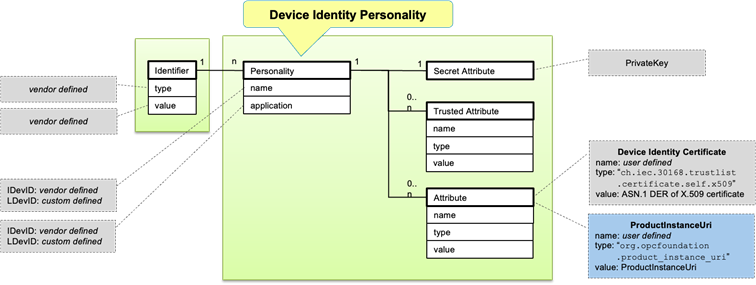
Figure 4 – DeviceIdentity Personality
The decision on the GTA API identifier type and value is left to the device vendor.
The personality name and application are also selected by the vendor.
To support the decision on whether a specific personality is eligible for OPC UA device onboarding, DeviceIdentity personalities should have an attribute of type org.opcfoundation.product_instance_uri. If present, the value of that attribute shall be set to the ProductInstanceUri.
EXAMPLE
"urn:some-company.com:2025-01:model-xyz:snr-16273849"
If this attribute is not present, the personality to be used as DeviceIdentity needs to be communicated to the DCA by other means (out-of-band).
The DeviceIdentity Certificate itself can be made available using a personality attribute of type ch.iec.30168.trustlist.certificate.self.x509. As the security of the DeviceIdentity Certificate does not depend on additional protection offered by a secure element it may also be stored elsewhere.
DCA related Personalities are the first GTA API objects created for OPC UA. There would be one DCA TrustList Personality and one or more DCA Identity Personalities (corresponding to one or more DCA certificates). Figure 5 shows the object model for a DCA Personality Set.
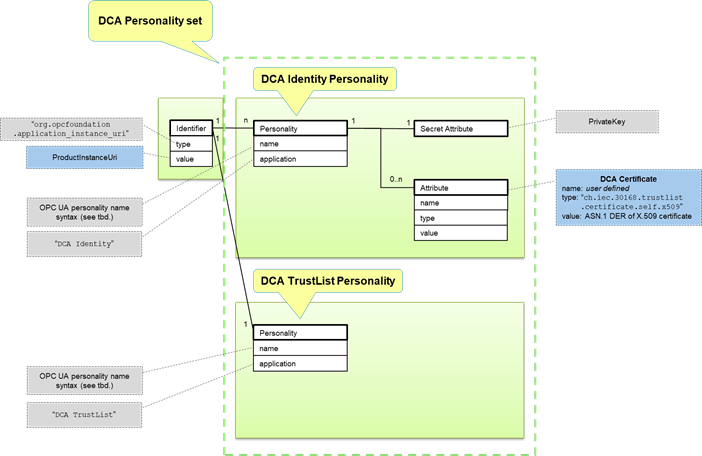
Figure 5 – DCA Personality Set
By convention the identifier used to create DCA related Personalities shall be of type org.opcfoundation.application_instance_uri. The ProductInstanceUri is a natural choice for the identifier value used for the DCA Personality set. However, selection of the identifier value is left to the operator.
The application of a DCA Identity Personality shall be set to “DCA Identity” and the application of a DCA TrustList Personality shall be set to “DCA TrustList”. This allows easy selection of the DCA related Personalities using gta_personality_enumerate_application() (cf. ISO/IEC TS 30168, clause 6.6.10.4.12) during later use.
The name of the DCA Identity Personality is set according to the description in 4.3.2.2.
EXAMPLE
urn:manufacturer.com:2024-10:myproduct:SN51235?cg=DefaultApplicationGroup&ct=Rsa2048&ix=1
urn:manufacturer.com:2024-10:myproduct:SN51235?cg=DefaultApplicationGroup&ct=EccNistP256&ix=10
The DCA Certificate itself can be made available using a personality attribute of type ch.iec.30168.trustlist.certificate.self.x509. As the security of the DCA Certificate does not depend on additional protection offered by a secure element it may also be stored elsewhere.
The name of the TrustList personality is set according to the description in 4.3.2.2.
EXAMPLE
urn:manufacturer.com:2024-10:myproduct:SN51235?cg=DefaultApplicationGroup
Figure 6 shows the object model for an Application Instance Personality Set.
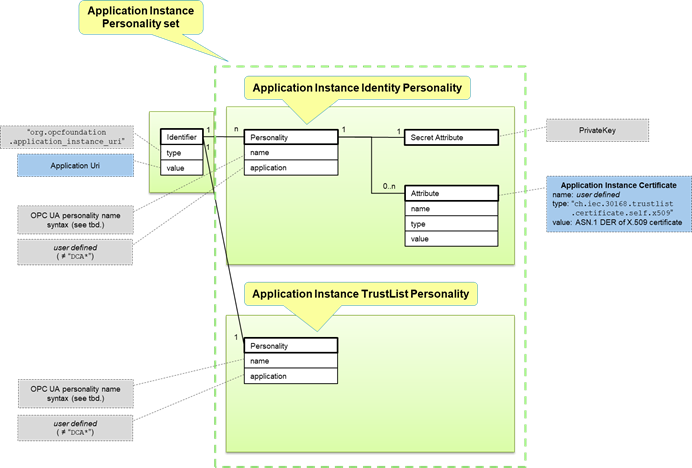
Figure 6 – Application Instance Personality set
GTA API identifiers used as a base to create personalities representing Application Instance Certificates for OPC UA applications should be of type org.opcfoundation.application_instance_uri and the value should be set to the ApplicationUri.
EXAMPLE
urn:manufacturer.com:2024-10:myproduct:myappid?cg=DefaultApplicationGroup
The name of an Application Instance Identity personality is set according to the description in 4.3.2.2. The names used for GTA API personalities representing Application Instance Certificates should be a qualified name with the namespace URI equal to the ApplicationUri. The qualified name used for the personality name can contain additional information to distinguish between multiple personalities sharing a single identifier.
EXAMPLE
urn:manufacturer.com:2024-10:myproduct:myappid?cg=DefaultApplicationGroup&ct=Rsa2048&ix=12
urn:manufacturer.com:2024-10:myproduct:myappid?cg=DefaultApplicationGroup&ct=EccNistP256&ix=14
The ApplicationInstance Certificate itself can be made available using a personality attribute of type ch.iec.30168.trustlist.certificate.self.x509. As the security of the Application Identity Certificate does not depend on additional protection offered by a secure element it may also be stored elsewhere.
The name of the TrustList personality is set according to the description in 4.3.2.2.
EXAMPLE
urn:manufacturer.com:2024-10:myproduct:myappid?cg=DefaultApplicationGroup